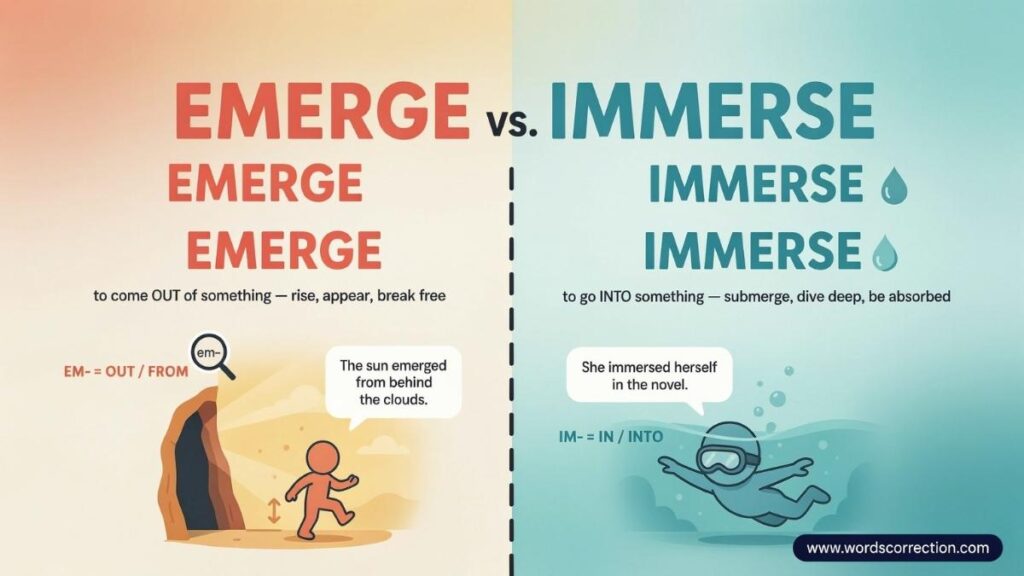
Some English words have a talent for creating confusion, and Emerse or Immerse is a perfect example. The two spellings look remarkably similar, yet that extra “m” changes everything. It’s easy to type one when you actually mean the other, especially when English spelling seems determined to keep things interesting. Fortunately, this particular mystery has a simple solution. In this guide, you’ll learn which spelling is correct, what immerse means, how to use it naturally, and why emerse often causes confusion. You’ll also discover the difference between immerse and emerge, explore common usage mistakes, and learn simple ways to remember the correct spelling without second-guessing every sentence.
Emersе or Immerse Quick Answer
If you’re searching for emerse or immerse correct spelling, the answer is straightforward when you consider the intended meaning.
| Word | Standard modern use | Meaning | Example |
| immerse | Yes | Put into a liquid or become deeply involved | She immersed herself in the course. |
| emerse | Not the standard verb for this meaning | Generally not the word intended in ordinary writing | Incorrect: He emersed himself in the subject. |
| emerge | Yes | Come out, appear, or become visible | The sun emerged from the clouds. |
| emersion | Yes, but uncommon | The act of emerging; also a specialized astronomical term | The emersion was observed after the occultation. |
| emersed | Yes, specialized | Rising or standing above water, especially in botany | The plant has emersed leaves. |
Therefore, if you’re asking which is correct emerse or immerse, choose immerse for the common verb.
Correct Example
She immersed herself in Spanish literature for several months.
In this sentence, immersed means that she became deeply involved in studying Spanish literature.
Another example uses the literal meaning:
Immerse the cloth in warm water for five minutes.
Here, immerse means to put something into a liquid so that it becomes covered.
Incorrect Example
She emersed herself in Spanish literature.
If the intended meaning is “became deeply involved,” the sentence should read:
She immersed herself in Spanish literature.
The problem isn’t a British-versus-American spelling difference. Immerse is the standard spelling in both varieties of English.
What Does Immerse Mean?
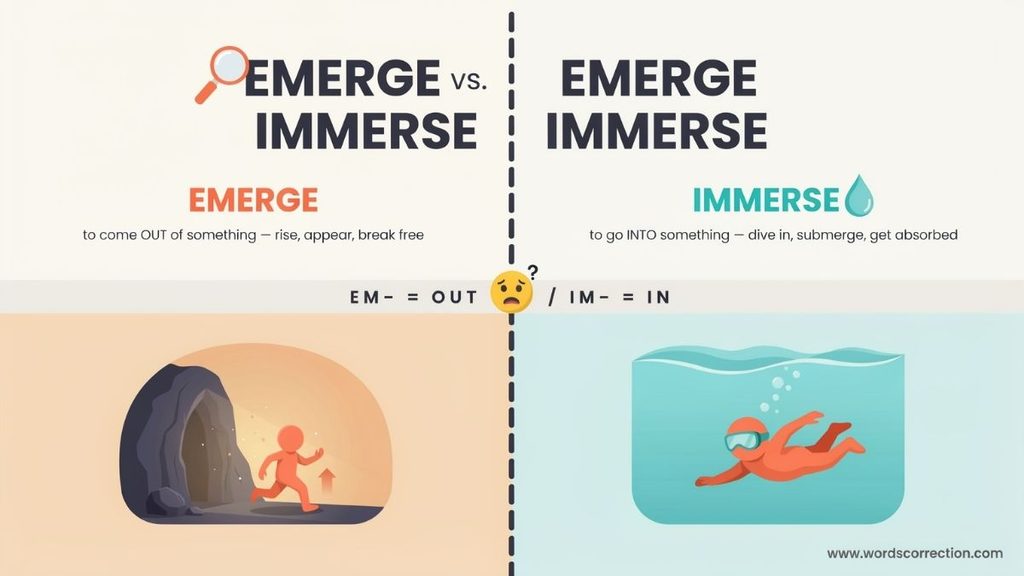
The immerse meaning becomes easier to understand when you picture something going deeply into water.
The verb immerse means to put someone or something into a liquid, usually so that it becomes completely covered. English also uses the word figuratively to describe becoming deeply involved in an activity, subject, environment, or experience.
This gives immerse two major meanings: a literal physical meaning and a figurative meaning.
Immerse Definition The Literal Meaning
To immerse something means to put it into a liquid.
For example:
- Immerse the vegetables in boiling water.
- The scientist immersed the sample in a solution.
- She immersed her hands in warm water.
- Immerse the object completely before removing it.
In each example, something moves into a liquid.
The basic idea is simple:
Immerse = put deeply into something.
Immerse Definition The Figurative Meaning
English frequently uses immerse beyond physical situations.
When you immerse yourself in something, you become deeply involved in it. You give it sustained attention and become heavily engaged with the subject or experience.
For example:
He immersed himself in the study of ancient history.
He isn’t literally climbing into history. Instead, he is spending considerable time and attention studying it.
You can immerse yourself in:
- a book
- a language
- a culture
- music
- your studies
- a project
- research
- a hobby
- a conversation
- a new environment
This figurative use is especially common in education, language learning, travel, professional development, and discussions about entertainment.
How to Use Immerse Correctly
The correct use of immerse becomes much easier once you understand its common sentence patterns.
For the figurative meaning, one of the most common structures is:
immerse + someone + in + something
When the person is doing the action to themselves, the structure often becomes:
immerse yourself in + something
For example:
The teacher encouraged the students to immerse themselves in the language.
The word in is important because it identifies the subject, activity, or environment surrounding the person or object.
Immerse + Object
The direct-object construction is particularly common when immerse describes a physical action.
The technician immersed the device in water.
The structure is:
immerse + object + in + liquid
More examples include:
Immerse the cloth in cold water.
The researcher immersed the sample in a chemical solution.
She immersed the brush in paint.
Immerse Yourself in Something
For figurative meanings, reflexive pronouns appear frequently.
I immersed myself in the research.
She immersed herself in the novel.
He immersed himself in the local culture.
They immersed themselves in the project.
The reflexive pronoun changes according to the subject.
| Subject | Reflexive pronoun | Example |
| I | myself | I immersed myself in the course. |
| You | yourself | You immersed yourself in the subject. |
| He | himself | He immersed himself in research. |
| She | herself | She immersed herself in the language. |
| We | ourselves | We immersed ourselves in the culture. |
| They | themselves | They immersed themselves in the experience. |
Be Immersed in Something
You’ll also frequently see immersed in constructions such as:
The students were immersed in English for several hours each day.
She was completely immersed in the novel.
He became immersed in the project.
In these examples, immersed describes a state of deep involvement.
This construction can refer to either physical surroundings or figurative engagement.
Fix common more word mistakes in English
Lader or Ladder Which One Is Correct?
Emersе or Immerse Meaning
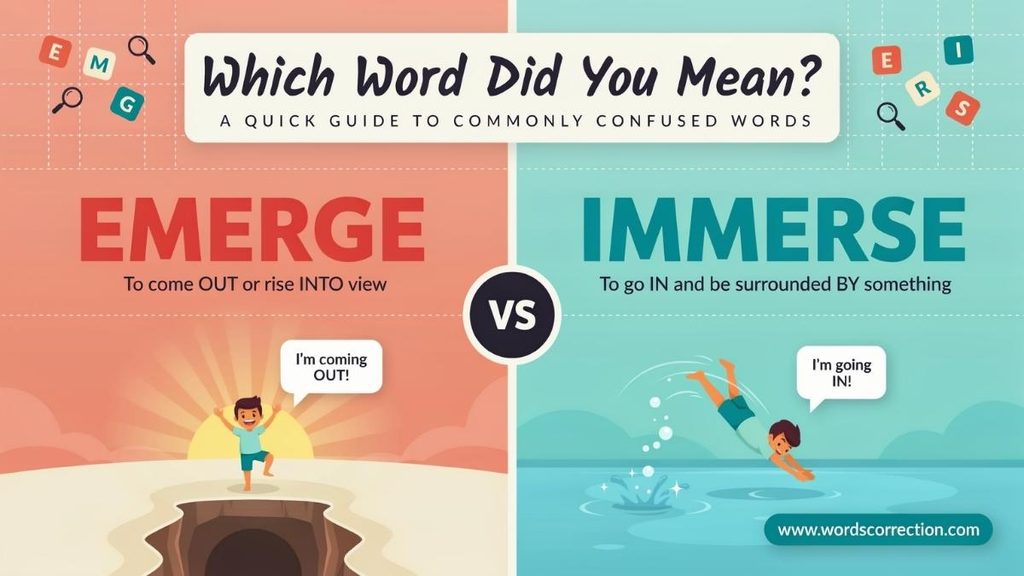
This is where the meaning question becomes more nuanced.
Someone who encounters emerse might assume it represents the opposite of immerse. That seems logical at first. After all, English has many word pairs where prefixes change meaning.
However, modern English doesn’t normally use emerse as the everyday opposite of immerse.
Instead, you’ll encounter legitimate related forms such as emersion and emersed.
Emerse Definition and Related Forms
Consider the following distinctions:
- immerse — put into liquid or become deeply involved
- immersed — placed into liquid or deeply involved
- immersion — the act or state of being immersed
- emerge — come out, appear, or become known
- emersion — an act of emerging; also a specialized astronomical term
- emersed — standing or rising above water, especially in botanical terminology
This distinction matters because seeing emersion or emersed in a legitimate source doesn’t make emerse an appropriate substitute for immerse.
Emersе or Immerse Why the Confusion?
confusion isn’t difficult to understand.
Both forms contain -merse, and their histories are connected to Latin roots involving the idea of plunging or rising. However, their prefixes and historical development lead to different meanings.
The English word immerse ultimately comes from Latin immergere, associated with plunging or dipping into something.
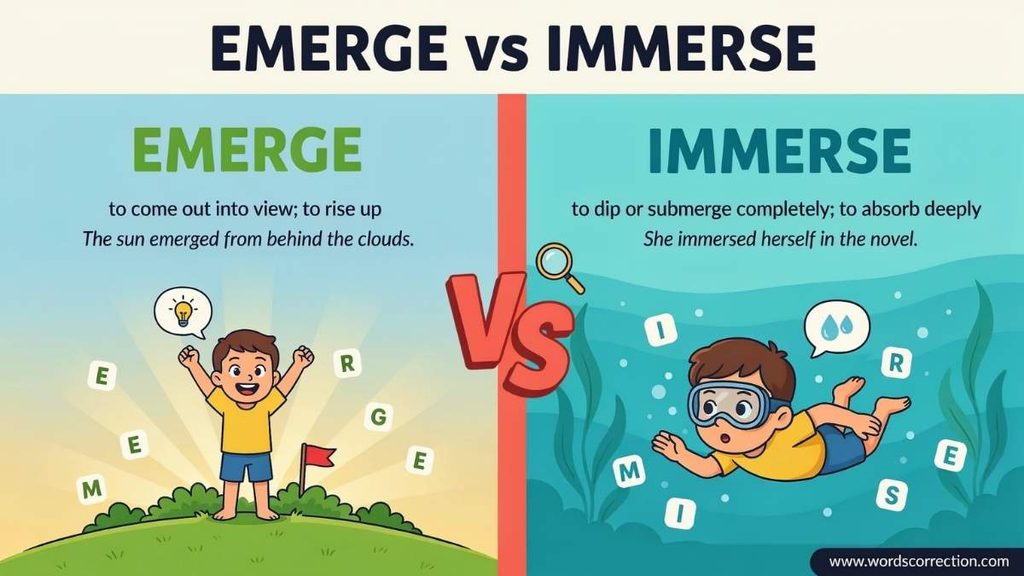
The word emerge, on the other hand, comes from Latin emergere, associated with rising out or coming forth.
That historical contrast creates a useful mental picture:
Immerse → go in
Emerge → come out
Imagine someone entering a swimming pool.
She immersed herself in the water.
Later:
She emerged from the water.
The two verbs describe opposite directions.
Difference Between Emersе or Immerse
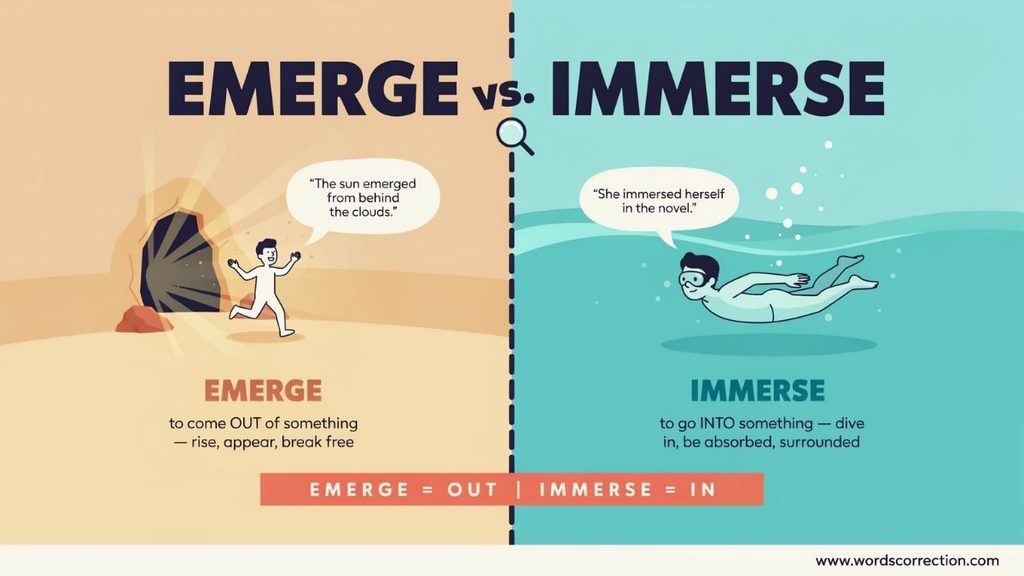
The emerge or immerse question is particularly important because these words look similar but communicate very different ideas.
What Does Emerge Mean?
Emerge means to come out, appear, become visible, become known, or develop.
For example:
The moon emerged from behind the clouds.
Several problems emerged during the investigation.
She emerged from the room a few minutes later.
A new pattern emerged from the research.
None of these examples means “become deeply involved.”
Immerse vs Emerge Comparison
| Feature | Immerse | Emerge |
| Basic idea | Go deeply into | Come out or become visible |
| Direction | Into | Out/from |
| Word type | Verb | Verb |
| Literal example | Immerse the object in water. | The diver emerged from the water. |
| Figurative example | Immerse yourself in learning. | New facts emerged during the investigation. |
| Common noun | Immersion | Emergence |
| Past form | Immersed | Emerged |
A simple rule can make the distinction stick:
Immerse means going in. Emerge means coming out.
Difference Between Emersion and Immersion
The difference between emerse and immerse becomes clearer when you stop treating emerse as a standard spelling variant.
| Term | Meaning | Everyday standard English? |
| immerse | Put into liquid or become deeply involved | Yes |
| emerse | Not the standard modern verb intended in this comparison | No |
| emerge | Come out, appear, or become known | Yes |
| emersion | Emerging; also a specialized astronomical term | Yes, but uncommon |
| emersed | Rising or standing above water | Yes, specialized |
This distinction prevents an easy mistake: seeing a word such as emersion and assuming that emerse must be its ordinary verb form.
English word families don’t always work that neatly.
Is It in American English?
If you’re writing for an American audience, use immerse.
There is no American English spelling rule that changes immerse into emerse.
For example:
She immersed herself in American history.
Not:
She emersed herself in American history.
The same principle applies to:
- academic writing
- business communication
- journalism
- school assignments
- websites
- emails
- everyday conversations
The correct spelling of immerse remains the same.
Is Immerse British or American?
Immerse is used in both British and American English.
This isn’t a spelling difference like color/colour or center/centre.
You don’t write:
British English: emerse
and:
American English: immerse
Instead, both use:
British English: immerse
American English: immerse
British vs American Spelling
| Form | American English | British English |
| Base verb | immerse | immerse |
| Third-person singular | immerses | immerses |
| Past tense | immersed | immersed |
| Present participle | immersing | immersing |
| Noun | immersion | immersion |
| “Emerse” as an alternative | No | No |
Therefore, if you’re asking is emerse British English, the answer is no when you mean the standard verb immerse.
Immerse Word Forms You Should Know
Learning the complete word family can make spelling and grammar much easier.
| Base Word | Related Form | Example |
| immerse | immerse | Immerse the cloth in water. |
| immerse | immerses | She immerses herself in research. |
| immerse | immersed | He was immersed in the book. |
| immerse | immersing | She is immersing herself in French. |
| immerse | immersion | The program offers language immersion. |
Immerse
Immerse is the base verb.
It appears after modal verbs and in infinitive constructions:
You should immerse yourself in the language.
They want to immerse themselves in the local culture.
Immersed
Immersed is the past tense and past participle of immerse.
She immersed herself in the project.
It can also describe a current state:
She was immersed in the project.
Immersing
The present participle is immersing, not immerseing.
The final e drops before the -ing ending:
immerse → immersing
Not:
immerseing
This is a common English spelling pattern found in several verbs.
Immersion
The noun form is immersion.
It can describe physical submersion or deep involvement:
The immersion of the equipment in water was necessary.
The program provides full immersion in Spanish.
Emerse, Emersed, and Emersion Are Not the Same Thing
This distinction deserves attention because it can prevent an otherwise unnecessary spelling correction.
You may encounter emersed and emersion in legitimate technical writing.
That doesn’t mean emerse is the standard verb for immerse.
Emersed
Emersed is a specialized adjective used particularly in botany. It describes plant parts that grow above the surface of water.
For example:
The aquatic plant has emersed leaves that extend above the water.
Here, emersed has a specific technical meaning.
Emersion
Emersion is a noun associated with emerging. It can describe the act of emerging and also has a specialized use in astronomy.
For example:
Astronomers recorded the emersion of the celestial body after the occultation.
This is quite different from saying:
She immersed herself in astronomy.
The first sentence concerns emergence. The second describes deep involvement.
Common Spelling and Usage Mistakes With Immerse
Even after learning the correct spelling, a few related mistakes can appear in everyday writing.
Writing Instead
This is the most direct error.
Incorrect:
She emersed herself in the subject.
Correct:
She immersed herself in the subject.
Confusing Immerse With Emerge
This mistake changes the meaning completely.
Incorrect:
He emerged himself in the culture.
Correct:
He immersed himself in the culture.
If you mean “became deeply involved,” choose immerse.
If you mean “came out” or “became visible,” choose emerge.
Writing Immerseing Instead of Immersing
The correct spelling is:
immersing
not:
immerseing
The final e disappears before -ing.
Using the Wrong Preposition
The figurative construction normally uses in:
She immersed herself in the language.
Not:
She immersed herself the language.
The same pattern works in physical contexts:
Immerse the brush in water.
Confusing Immersed and Immersing
These forms aren’t interchangeable.
She immersed herself in the course.
This describes a completed action.
She is immersing herself in the course.
This describes an action in progress.
Immerse in a Sentence Practical Examples
If you’re searching for immerse in a sentence, examples are often more useful than another dictionary definition.
Education
The professor encouraged students to immerse themselves in primary sources.
This means the students should engage deeply with original materials.
Language Learning
Living with a Spanish-speaking family helped Maya immerse herself in the language.
Here, immerse describes extensive exposure and participation.
Travel
Traveling through rural Japan allowed him to immerse himself in the local culture.
The meaning is figurative rather than physical.
Reading
Once she started the novel, she became completely immersed in the story.
Work
The research team immersed itself in the problem before proposing a solution.
Literal Use
Immerse the fabric in cold water before washing it.
Here, immerse has its physical meaning.
Passive Construction
The children were immersed in a lively discussion.
The children were deeply involved in the discussion.
Emerse in a Sentence What Should You Write Instead?
A search for emerse in a sentence can create confusion because it may encourage you to treat emerse as a normal alternative to immerse.
If you mean deeply involve, use immerse:
Incorrect: The students emersed themselves in science.
Correct: The students immersed themselves in science.
If you mean come out or become visible, use emerge:
Incorrect: The sun emersed from behind the clouds.
Correct: The sun emerged from behind the clouds.
If you’re discussing specialized botanical terminology, emersed may be the correct choice:
The emersed leaves extended above the water.
Context determines the appropriate word.
Immerse Synonyms and When to Use Them
An immerse synonym isn’t necessarily interchangeable with immerse in every sentence.
Synonyms for the Physical Meaning
Useful alternatives include:
- submerge
- dip
- plunge
- dunk
- soak
For example:
Submerge the cloth in water.
This emphasizes placing something below the surface.
By comparison:
Dip the brush in paint.
This usually suggests a shorter or more limited action.
Synonyms for the Figurative Meaning
Depending on context, alternatives include:
- involve
- engage
- absorb
- engross
- devote
- concentrate
- envelop
Compare:
She immersed herself in the research.
with:
She devoted herself to the research.
Both express strong commitment, but immerse emphasizes deep involvement and exposure.
What About an Emerse Synonym?
There isn’t a useful everyday emerse synonym that should replace immerse.
If your intended meaning is “come out” or “become visible,” words related to emerge are more appropriate:
- appear
- arise
- surface
- come out
- rise
- become visible
- come forth
Immerse vs Submerge vs Absorb vs Engage
These words overlap, but each has its own emphasis.
| Word | Main idea | Example |
| Immerse | Become deeply involved or put deeply into something | She immersed herself in French. |
| Submerge | Put completely below a liquid surface | The diver submerged the equipment. |
| Absorb | Take in information or become deeply interested | He absorbed every detail. |
| Engage | Become involved or participate | Students engaged with the lesson. |
| Devote | Give time, effort, or attention | She devoted herself to research. |
Choosing the right word depends on the exact picture you want your sentence to create.
Immerse vs Emerge A Simple Memory Trick
When spelling gets confusing, picture the action instead of focusing only on the letters.
Imagine someone standing beside a swimming pool.
First:
They immerse themselves in the water.
They go into it.
Later:
They emerge from the water.
They come out of it.
So remember:
Immerse = into
Emerge = out
This distinction reflects the historical relationship between the words and provides a practical way to remember their modern meanings.
Case Study Choosing the Right Word
Consider this paragraph:
After moving to Madrid, Lena decided to emerse herself in Spanish. She immersed herself in conversation, books, and local traditions. Eventually, she emerged from her first year with much greater confidence.
The first sentence contains the spelling problem.
The corrected version is:
After moving to Madrid, Lena decided to immerse herself in Spanish. She immersed herself in conversation, books, and local traditions. Eventually, she emerged from her first year with much greater confidence.
Notice how immerse and emerge can both appear naturally in the same paragraph.
Immerse describes deep participation.
Emerge describes coming out of an experience or situation.
This example shows why confusing emerse vs. immerse with emerge vs. immerse can lead to different types of mistakes.
Correct Spelling of Immerse Quick Reference
If you’re wondering how do you spell immerse, remember the spelling:
I-M-M-E-R-S-E
The word begins with im- and contains two m’s.
Correct Forms
- immerse
- immerses
- immersed
- immersing
- immersion
Common Incorrect Forms
- emerse
- imerse
- immerce
- immerseing
- imerseed
Once you remember the base word immerse, its related forms become much easier to recognize.
Is Emerse a Word?
This question requires a little nuance.
If you’re asking, “Can I use emerse instead of immerse in normal English?”, the answer is no.
You shouldn’t use emerse as a spelling variation of immerse when you mean “put into” or “become deeply involved.”
However, English does contain legitimate words such as emersion and emersed, especially in specialized contexts.
That means it would be inaccurate to claim that every word beginning with emers- is automatically incorrect.
The practical rule is simple:
Don’t use “emerse” as a replacement for “immerse.”
When dealing with technical, botanical, astronomical, or historical material, check the exact meaning before deciding whether a related form is appropriate.
Immerse Pronunciation and Spelling
The spelling of immerse remains the same in American and British English, although pronunciation differs slightly between the two varieties.
The first syllable uses a short i sound. The word ends with the sound represented by -erse.
Pronunciation can help reinforce spelling, but listening alone isn’t always enough. English contains many words whose sounds don’t make their spelling immediately obvious.
For that reason, it helps to learn the word as a complete unit:
immerse → immersed → immersing → immersion
This approach reduces the chance of creating a spelling mistake when changing grammatical forms.
British vs. American Spelling The Bottom Line
Unlike spelling pairs such as color/colour, immerse doesn’t change between American and British English.
Both use:
immerse
Both use:
immersed
Both use:
immersing
Both use:
immersion
Therefore, emerge and immerse are not British and American spellings of the same word.
However, this supposed distinction is one of the main misunderstandings behind the emerse or immerse question.
Frequently Asked Questions
Which Is Correct Emersion or Immersion?
Immerse is the correct and standard word for most everyday English contexts. It means to put something completely into a liquid or to become deeply involved in an activity, subject, or experience. Emerse is a rare technical term, primarily used in botany, referring to something that rises or emerges from water.
What does “immerse” mean?
Immerse means to completely submerge something in a liquid or to become deeply involved in an activity, subject, or experience. For example, “She immersed herself in her studies.”
What does “emerse” mean?
Emerse is a rare technical term used mainly in botany. It describes a plant or part of a plant that rises above or emerges from the water. It is not commonly used in everyday English.
Is “emerse” a correct English word?
Yes, emerse is a legitimate English word, but it is uncommon and specialized. It is mainly used in botanical contexts. For ordinary situations involving submerging something or becoming deeply involved in something, immerse is the appropriate word.
What Is the Difference Between Immerse and Emerge?
Immerse means to put something into a liquid or become deeply involved in something. Emerse has a specialized botanical meaning and refers to something rising out of or above water. Although the words look similar, they have different meanings and uses.
What is the difference between “immerse” and “emerge”?
Immerse means to put something into or beneath a liquid, or to become deeply involved in something. Emerge means to come out, become visible, or appear from somewhere. In simple terms, you immerse something by putting it in, while something emerges by coming out.
How do you use “immerse” in a sentence?
You can use immerse when describing complete involvement in an activity or the act of placing something in liquid. For example: “She decided to immerse herself in learning Spanish.”
What does “immerse yourself” mean?
Immerse yourself means to become completely involved or deeply engaged in an activity, subject, environment, or experience. For example, “He immersed himself in the local culture during his trip.”
What are the synonyms of “immerse”?
Depending on the context, synonyms for immerse include submerge, dip, plunge, soak, absorb, engage, involve, and engross. The best synonym depends on whether immerse refers to physical submersion or deep involvement.
What is the difference between “immersion” and “emersion”?
Immersion generally refers to the act of completely submerging something or becoming deeply involved in an experience or activity. Emersion refers to the act or process of emerging from water or another surrounding medium. The two terms have opposite directional meanings in contexts involving submersion and emergence.
What does “immersion in water” mean?
Immersion in water means completely placing or submerging a person or object in water. The term can also refer to being surrounded by water as part of an activity or process.
What is the past tense of “immerse”?
The past tense of immerse is immersed. For instance, “She immersed herself in the project.”
What is the noun form of “immerse”?
The noun form of immerse is immersion. It refers to the act or process of immersing something or becoming deeply involved in something.
What is the adjective form of “immerse”?
Common adjective forms related to immerse include immersed and immersive.In addition, immersed describes someone or something deeply involved or submerged, while immersive describes an experience that deeply engages the senses or attention.
How is “immerse” pronounced?
Immerse is pronounced /ɪˈmɜːrs/ in many varieties of English. The emphasis is on the second syllable: ih-MU
Here’s a trusted source for clear more words Comparison:
Grammar Update
Practice Session: Fill in the Blanks
Instructions: Choose the correct word or word form to complete each sentence.
- She decided to ______ herself in learning Spanish.
- The diver was completely ______ in the water.
- The correct spelling in modern everyday English is usually ______.
- He wanted to ______ himself in the local culture.
- The noun form of immerse is ______.
- The past tense of immerse is ______.
- The opposite action of going into the water is to ______ from it.
- The swimmer slowly began to ______ from beneath the surface.
- The teacher encouraged students to ______ themselves in the subject.
- ______ means becoming deeply involved in an activity or experience.
- The child was fully ______ in the swimming pool.
- The word emerse is mainly found in specialized or ______ contexts.
- Plants that grow above the surface of water may be described as ______.
- She became deeply ______ in her research.
- The two words immerse and emerge have ______ meanings.
- You can ______ an object by placing it completely under water.
- The students were encouraged to ______ themselves in the language.
- His ______ in the new culture helped him learn the language quickly.
- The boat began to ______ as the water level went down.
- Emerse should not normally be confused with the more common verb ______.
- The process of becoming deeply involved in something is called ______.
- Choose the correct sentence: “She ______ herself in her studies” or “She emersed herself in her studies.”
Answer Key
- immerse
- immersed
- immerse
- immerse
- immersion
- immersed
- emerge
- emerge
- immerse
- Immersion
- immersed
- technical
- emersed
- immersed
- different
- immerse
- immerse
- immersion
- emerge
- immerse
- immersion
- immersed
Conclusion
English spelling can create confusion with surprisingly small differences, and emerse or immerse is a good example. The correct spelling for the verb meaning to place something into a liquid or become deeply involved in something is immerse. Although “emerse” may look like a reasonable alternative, it isn’t the standard spelling of this verb.
Most importantly, remember the difference this way: immerse means to go in, while emerge means to come out. For example, whether you’re talking about water, language learning, education, travel, or professional development, immerse is the word you need. Therefore, keeping this distinction in mind can help you avoid a common spelling mistake and use the word confidently and correctly.

Stella AJS is an experienced blogger and dedicated English language writer at Words Correction. She turns confusing grammar, word meanings, spelling, and usage into clear, practical insights that readers can easily understand and apply. With a passion for precise and engaging writing, Stella helps readers avoid common language mistakes, strengthen their vocabulary, and communicate with greater clarity and confidence.