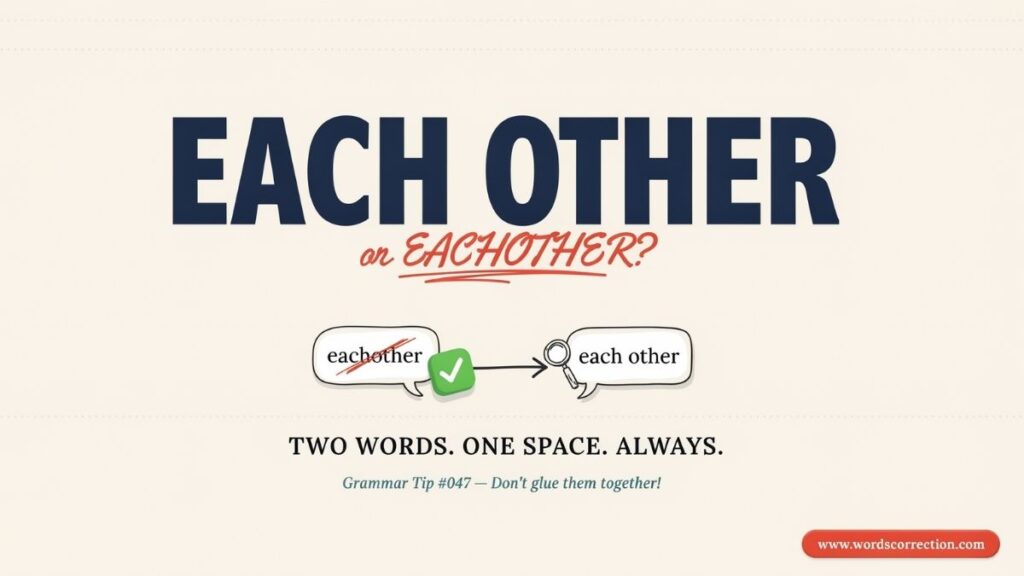
Choosing between each other or eachother can be confusing, especially when both forms look similar. However, only one is correct in standard English. The phrase each other is always written as two separate words and describes a mutual action or relationship. Writing it as one word is a common spelling mistake that can affect the clarity of your writing. The good news is that the rule is simple to learn. In this guide, you’ll understand the correct spelling, learn how to use the phrase in sentences, avoid common grammar mistakes, and improve your writing with clear, practical examples.
Quick Answer Each Other or Eachother?
Each other is the correct spelling. Write it as two words whenever you describe a mutual action or relationship.
Eachother is incorrect in standard English. Although people sometimes type it accidentally, dictionaries and standard writing conventions recognize each other as the proper form.
Consider these examples:
- Correct: The students helped each other prepare for the exam.
- Incorrect: The students helped eachother prepare for the exam.
- Correct: We always listen to each other.
- Incorrect: We always listen to eachother.
The rule is simple: keep the two words separate. If you remember this basic point, you’ll avoid the most common spelling error.
Why Do People Confuse Each Other and Eachother?
The confusion usually comes from pronunciation, typing habits, and the way English combines words.
The Phrase Sounds Like One Word
When people speak quickly, each other often sounds like a single word. The words flow together naturally, especially in everyday conversation.
For example, someone might say, “They respect each other.” Because the phrase sounds connected, a writer may assume it should also appear as one word.
However, pronunciation doesn’t always reveal correct spelling. English contains many expressions that sound like single units but remain separate words in writing.
Learn the difference between confusing more English words
Disgard or Discard Which Spelling Is Correct and Why?
English Uses Both One Word and Two Word Expressions
English includes compound words such as someone, everybody, and another. These examples may encourage writers to combine other expressions that have similar meanings or sounds.
Yet spelling conventions differ from phrase to phrase. Although someone is one word, each other remains two words.
You can’t determine the spelling of every expression by copying the pattern of another.
Fast Typing Leads to Mistakes
People often combine words when typing quickly, particularly in text messages, social media posts, and informal notes.
Autocorrect may not catch every mistake, so the incorrect form can slip into emails, school assignments, blog posts, or professional documents.
The best solution is to remember the standard spelling and proofread your work before sharing it.
What Does Each Other Mean?
Each other describes a reciprocal action, feeling, or relationship. In other words, the people or things involved direct the same action toward one another.
For example:
- The neighbors help each other.
- The two friends trust each other.
- The team members encouraged each other.
- The children shared their toys with each other.
In each sentence, the action involves both sides. The neighbors provide help to one another, the friends share trust, and the team members offer encouragement in return.
The phrase can describe many kinds of relationships, including friendship, cooperation, communication, competition, and affection.
Learn the difference between commonly mixed-up more words
Uninterested vs Disinterested What’s the Difference?
in Everyday English examples
Here are several examples that show how the phrase works in different situations.
| Sentence | Meaning |
| The sisters support each other. | Both sisters provide support. |
| The students questioned each other. | Each student asked questions of the other. |
| The coworkers respect each other. | Both sides show respect. |
| The players congratulated each other. | The players exchanged congratulations. |
| The two businesses compete with each other. | Both businesses compete against one another. |
These examples demonstrate that each other doesn’t describe only positive relationships. It can also express disagreement, competition, or conflict.
For instance, “The rivals challenged each other” describes a mutual action without suggesting friendship.
Learn the difference between tricky grammar more words
Complimented or Complemented Which is Correct Spelling?
How to Use Each Other in a Sentence
You can use each other in several common sentence patterns. Understanding these patterns will help you write more naturally and avoid awkward constructions.
Use Each Other After a Verb
One of the most common patterns places each other after a verb. The phrase acts as the object of the action.
Examples include:
- The children hugged each other.
- The employees helped each other.
- The two candidates challenged each other.
- The friends called each other after work.
In these sentences, the subject performs an action that involves the other person or people.
Notice that you don’t need to add another object after the phrase. For example, “The friends helped each other” expresses a complete idea.
Learn the difference between tricky English words with easy explanations
Loosing or Losing Which Spelling Is Correct?
Use Each Other After a Preposition
The phrase can also follow a preposition such as with, for, to, about, or from.
Examples:
- The students studied with each other.
- The neighbors bought gifts for each other.
- The coworkers spoke to each other.
- The friends learned from each other.
- The two managers disagreed with each other.
The preposition depends on the meaning of the sentence. You should choose the one that fits the intended relationship.
For example, you can say, “They learned from each other,” because one person can gain knowledge from another. However, “They listened to each other” is the natural choice when describing reciprocal listening.
Learn the difference between confusing word pairs
Don’ts or Don’t’s Which Spelling Is Correct?
Use Each Other in Formal and Informal Writing
Each other works in both casual conversation and professional writing. You can use it in emails, reports, essays, articles, and everyday messages.
Informal example:
“We always share ideas with each other.”
Professional example:
“The departments communicate with each other to coordinate their projects.”
Academic example:
“The researchers compared each other’s findings before reaching a conclusion.”
The phrase itself isn’t informal or unprofessional. What matters is whether the full sentence suits your audience and purpose.
Each Other’s or Each Others Which Form Is Correct?
The expressions each other’s and each others often cause confusion. The apostrophe matters because it shows possession.
Use each other’s when you want to indicate that something belongs to, relates to, or is associated with another person in a reciprocal relationship.
Examples:
- The students checked each other’s answers.
- The friends attended each other’s weddings.
- The coworkers respected each other’s opinions.
- The children borrowed each other’s books.
In these sentences, the apostrophe and s create a possessive form.
Learn the difference between often confused words
Appendix or Appendices Which one Is Correct?
Why Each Others Is Usually Incorrect
In standard English, each others is generally incorrect when you intend to show possession. The correct form is each other’s.
Compare these examples:
| Incorrect | Correct |
| They checked each others homework. | They checked each other’s homework. |
| The friends knew each others names. | The friends knew each other’s names. |
| The students read each others essays. | The students read each other’s essays. |
| The neighbors borrowed each others tools. | The neighbors borrowed each other’s tools. |
Remember that the apostrophe belongs before the s in other’s.
Does Each Other’s Work With More Than Two People?
Yes. You can use each other’s when discussing a group of three, ten, or even hundreds of people.
For example:
“The volunteers appreciated each other’s efforts during the event.”
This sentence could describe a small group or a large team. Modern English doesn’t require you to replace each other with one another simply because more than two people are involved.
Learn the difference between confusing more English words step by step
Mangoes or Mangos Which Spelling Is Correct?
Each Other vs One Another
Each other and one another have the same basic meaning. Both expressions describe reciprocal actions or relationships.
Some traditional grammar guides suggest using each other for two people and one another for more than two. However, modern English doesn’t consistently follow that distinction. Both expressions commonly refer to two or more people.
Compare these examples:
- The two sisters support each other.
- The two sisters support one another.
- The team members encouraged each other.
- The team members encouraged one another.
All four sentences are correct.
Learn the difference between basic English word mistakes
Skillset or Skill Set Which Spelling Is Correct?
Which Expression Should You Choose?
In most situations, you can choose whichever expression sounds more natural in your sentence.
Each other is common in everyday conversation and general writing. One another can sound slightly more formal in some contexts, although the difference is subtle.
For example:
“The colleagues shared feedback with each other.”
“The colleagues shared feedback with one another.”
Both sentences communicate the same idea. You don’t need to follow a strict two-person-versus-group rule.
Common Mistakes When Using It
Even when writers know the correct spelling, they can make other errors involving the phrase. Here are some common problems and how to fix them.
Writing Eachother as One Word
This is the most frequent spelling mistake.
Incorrect: The children played with eachother.
Correct: The children played with each other.
How to avoid it Remember that each other always consists of two words in standard English.
Forgetting the Apostrophe in Each Other’s
When the phrase indicates possession, you need an apostrophe.
Incorrect: The students reviewed each others assignments.
Correct: The students reviewed each other’s assignments.
How to avoid it: If you mean that something belongs to or is associated with the other people, use each other’s.
Adding an Unnecessary Apostrophe
Not every use of each other requires an apostrophe.
Incorrect: The two friends helped each other’s.
Correct: The two friends helped each other.
The first sentence incorrectly treats the phrase as possessive even though it doesn’t refer to anything possessed.
How to avoid it: Use each other for a mutual action. Use each other’s when the phrase modifies a noun or indicates possession.
Confusing Each Other With Themselves
Each other and themselves don’t always mean the same thing.
Compare
- The children looked at each other.
- The children looked at themselves in the mirror.
The first sentence describes the children looking at one another. The second describes them looking at their own reflections.
Choosing the correct expression helps you communicate the intended meaning clearly.
Using Each Other When the Relationship Isn’t Mutual
Each other works best when the action or relationship goes both ways.
For example, “The two friends trust each other” suggests mutual trust.
However, if only one person trusts the other, you should state that directly:
“Maria trusts Daniel.”
This sentence doesn’t claim that Daniel also trusts Maria.
Learn the difference between commonly misused words
Wellbeing or Well-Being Which Spelling Is Correct?
Practical Examples in Sentences
The easiest way to understand a grammar rule is to see it in context. The following examples show how to use each other in everyday, academic, and professional situations.
| Context | Example sentence |
| Friendship | The friends always make time for each other. |
| Family | The siblings supported each other through difficult times. |
| School | The students explained the answers to each other. |
| Workplace | The team members rely on each other to finish projects. |
| Sports | The players congratulated each other after the match. |
| Relationships | The couple promised to respect each other. |
| Business | The companies exchanged information with each other. |
| Technology | The devices communicate with each other over a network. |
| Education | The classmates compared each other’s notes. |
| Community | The neighbors looked after each other during the storm. |
These sentences show that the phrase works across a wide range of topics. You can use it whenever the context involves a reciprocal action or relationship.
Learn the difference between everyday English mistakes
Chose or Choose What’s the Difference?
Correcting a Paragraph With Spelling Mistakes
Consider this paragraph:
“The two classmates helped eachother with homework. They checked each others answers and encouraged each-other before the test.”
The paragraph contains three errors. The first combines each other into one word. The second omits the apostrophe in the possessive form. The third adds an unnecessary hyphen.
Here is the corrected version:
“The two classmates helped each other with homework. They checked each other’s answers and encouraged each other before the test.”
The corrected paragraph follows standard spelling and punctuation rules while preserving the original meaning.
This example also highlights an important point: spell-checkers don’t always catch every grammar or punctuation problem. A quick review can prevent small mistakes from weakening your writing.
Quick Tips to Remember the Correct Spelling
If you often confuse each other and eachother, use these simple tips.
- Remember the two-word rule: Always write each other as two separate words.
- Check for possession: Use each other’s when describing something associated with another person in a reciprocal relationship.
- Avoid unnecessary punctuation: Don’t add a hyphen or apostrophe unless the sentence requires the possessive form.
- Read your sentence aloud: Listening to the sentence can help you identify awkward wording, even though it won’t always reveal spelling errors.
- Proofread carefully: Check common expressions when reviewing emails, assignments, and professional documents.
- Practice with examples: Writing a few correct sentences will help the spelling become familiar.
You can also use a simple memory trick: think of each and other as two separate pieces that work together. Keeping them apart on the page is part of using the phrase correctly.
Practice Sessions about Each Other or Eachother
Fill in the blanks
- The two friends always support ______ during difficult times.
- My classmates and I help ______ with our assignments.
- The children smiled at ______ when they met at the park.
- The two companies respect ______’s business practices.
- Good teammates should trust ______.
- The students exchanged gifts with ______ during the celebration.
- The couple understands ______ very well.
- The neighbors often visit ______ on weekends.
- The two sisters borrowed ______’s clothes.
- The team members encouraged ______ before the final match.
- We should listen to ______’s opinions respectfully.
- The two dogs looked at ______ curiously.
- The colleagues congratulated ______ on their achievements.
- The children shared their toys with ______.
- The two countries agreed to cooperate with ______.
- The friends apologized to ______ after the disagreement.
- The students reviewed ______’s essays before submitting them.
- The two players shook hands with ______ after the game.
- The family members care deeply about ______.
- The teachers discussed ______’s teaching methods.
- The dancers followed ______’s movements during the performance.
- The two strangers introduced themselves to ______.
- The employees communicated with ______ throughout the project.
- The neighbors helped ______ during the emergency.
- The members of the group learned to appreciate ______’s differences.
Answers
- each other
- each other
- each other
- each other’s
- each other
- each other
- each other
- each other
- each other’s
- each other
- each other’s
- each other
- each other
- each other
- each other
- each other
- each other’s
- each other
- each other
- each other’s
- each other’s
- each other
- each other
- each other
- each other’s
Here’s a trusted source for clear more words Comparison:
Grammar Update
FAQ’s
What does each other mean in English?
“Each other” refers to two or more people or things performing an action toward one another. It expresses a mutual or reciprocal relationship. For example, “The friends helped each other” means that they helped one another.
Is each other one word or two words?
“Each other” is written as two separate words in standard English. The word “eachother” is an incorrect spelling. For example, “The students respect each other” is correct.
Which spelling is correct each other or eachother?
“Each other” is the correct spelling in standard English. “Eachother” is not accepted as the standard spelling. Always write the expression as two words, such as in “They understand each other.”
How do you use “each other” correctly in a sentence?
Use “each other” when describing a mutual action, feeling, or relationship between people or things. For example, “The colleagues supported each other during the project.” Here, the expression shows that the support was mutual.
What is the difference between each other and one another?
“Each other” and “one another” both express reciprocal actions or relationships. Traditional grammar sometimes associates “each other” with two people and “one another” with more than two, but modern English generally uses them interchangeably. For example, “The teammates encouraged each other” and “The teammates encouraged one another” are both correct.
Is each other considered a compound expression?
“Each other” is a two-word reciprocal expression, traditionally called a reciprocal pronoun. It functions as a unit to show that an action or feeling is shared between people or things. It is not normally written as one word.
Can each other be used at the beginning of a sentence?
Yes, “each other” can appear at the beginning of a sentence when the sentence structure supports it, although this is less common than placing it after a verb or preposition. For example, “Each other’s opinions were respected by the group” is grammatically correct.
What are some common examples of each other in everyday English?
Common examples include “We trust each other,” “They called each other yesterday,” and “The children shared their toys with each other.” In each sentence, the expression indicates a mutual action or relationship.
How can you use each other in formal writing?
Use “each other” in formal writing to describe mutual responsibilities, communication, cooperation, or relationships. For example, “The departments must communicate with each other to improve efficiency.” The expression is appropriate in academic, professional, and business contexts.
How is each other used to express mutual feelings or actions?
“Each other” shows that people share feelings or perform actions toward one another. For example, “The couple loves each other” expresses mutual affection, while “The students questioned each other” describes a reciprocal action.
What is the grammatical function of each other in a sentence?
“Each other” functions as a reciprocal pronoun, indicating that two or more participants act toward or relate to one another. For example, in “The neighbors greeted each other,” it identifies the reciprocal relationship between the neighbors.
Does each other require a hyphen?
No, “each other” does not require a hyphen. The standard spelling consists of two separate words. Write “They understand each other,” not “They understand each-other.”
Is each other’s the correct possessive form?
Yes, “each other’s” is the standard possessive form when expressing shared or reciprocal possession. For example, “The friends attended each other’s weddings” means that the friends attended the weddings of the others.
How do you use each other’s correctly in a sentence?
Use “each other’s” before a noun to show reciprocal possession or association. For example, “The students reviewed each other’s assignments.” The apostrophe and final s indicate the possessive form.
Is each others ever grammatically correct?
“Each others” is generally incorrect in standard English when intended as a possessive expression. The correct form is “each other’s,” as in “They borrowed each other’s books.” The apostrophe is necessary to mark possession.
Can each other be used with plural subjects?
Yes, “each other” commonly appears with plural subjects because it describes reciprocal relationships among multiple participants. For example, “The two teams congratulated each other after the match.” It can also refer to groups containing more than two people.
Can each other refer to more than two people?
Yes, “each other” can refer to two people or larger groups. For example, “The members of the committee listened to each other’s suggestions” describes a reciprocal relationship among several people. Modern English does not restrict the expression to exactly two participants.
Is the phrase love each other grammatically correct?
Yes, “love each other” is grammatically correct and expresses mutual affection between two or more people. For example, “The couple continues to love each other.” The phrase is commonly used to describe reciprocal emotional relationships.
Is help each other a grammatically correct expression?
Yes, “help each other” is a correct expression that describes people providing mutual assistance. For example, “Classmates should help each other understand difficult concepts.” It is appropriate in both conversational and formal English.
What is the difference between each other and together?
“Each other” emphasizes a mutual action or relationship, while “together” generally means doing something jointly or being in the same place. For example, “They support each other” describes mutual support, whereas “They work together” emphasizes collaboration.
How do you use each other in negative sentences?
Use “each other” in a negative sentence to indicate that a mutual action does not occur. For example, “The two neighbors do not speak to each other.” The negative auxiliary “do not” makes the sentence negative.
How can you use each other in interrogative sentences?
Use “each other” in questions to ask about mutual actions, feelings, or relationships. For example, “Do the team members know each other?” and “Why are they avoiding each other?” are both grammatically correct.
What are the most common mistakes when using each other?
Common mistakes include writing “eachother” as one word, omitting the apostrophe in the possessive form “each other’s,” and confusing reciprocal actions with actions performed jointly. To avoid these errors, write “each other” as two words and use “each other’s” to indicate possession.
Why is eachother considered incorrect in standard English?
“Eachother” is considered incorrect because standard English spelling treats “each other” as two separate words. Dictionaries and established writing conventions recognize “each other,” not “eachother,” as the standard form. Using the correct spelling improves clarity and professionalism.
What expressions can be used instead of each other in English writing?
Depending on the context, alternatives to “each other” include “one another,” “mutually,” “reciprocally,” and phrases such as “in return” or “toward one another.” For example, “The colleagues supported one another” conveys the same general meaning as “The colleagues supported each other.” Choose an alternative that preserves the intended meaning and sentence structure.
Learn the difference between more words people mix up
Leafs or Leaves Which one Is Correct?
Conclusion
Understanding the difference between each other or eachother is simple once you know the correct spelling. Each other is always written as two separate words, while each other’s is the possessive form. The spelling eachother is incorrect in standard English, so avoid using it in your writing. Although this mistake may seem small, correct spelling helps keep your message clear and professional. Remember these simple rules, check your apostrophes, and practice using the phrase in different sentences. With a little attention, you can avoid common grammar mistakes and write with greater confidence.

Stella AJS is an experienced blogger and dedicated English language writer at Words Correction. She turns confusing grammar, word meanings, spelling, and usage into clear, practical insights that readers can easily understand and apply. With a passion for precise and engaging writing, Stella helps readers avoid common language mistakes, strengthen their vocabulary, and communicate with greater clarity and confidence.