
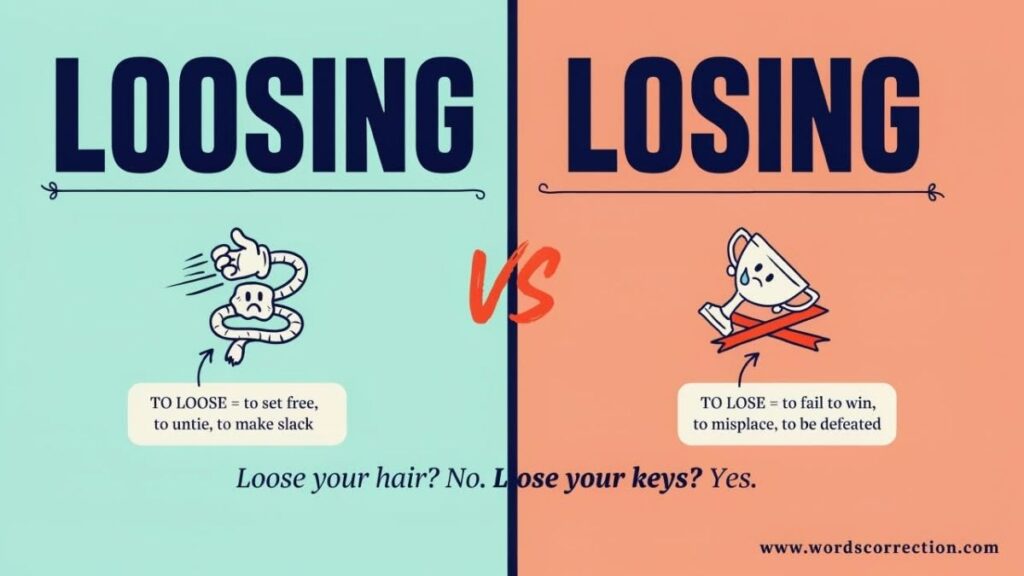
English spelling can turn even simple words into surprisingly confusing traps. Losing or loosing is a perfect example. One extra letter can mean the difference between misplacing your keys and releasing a flock of birds. Although these words look similar, they have distinct meanings and uses. Using the wrong spelling can confuse your readers and weaken your writing. Fortunately, the difference is easy to understand once you learn the rule. This guide explains what each word means, how to use it correctly, and which common mistakes to avoid. You’ll also find practical fill in the blank exercises to test your understanding.
Loosing vs Losing Quick Answer
Losing is the correct spelling when you mean misplacing something, failing to win, or no longer having something. Loosing is also a legitimate English word, but it means releasing or setting something free.
The following table highlights the difference between these commonly confused words.
| Word | Base word | Meaning | Example |
| Losing | Lose | Misplacing something, failing to win, or no longer having something | I keep losing my keys. |
| Loosing | Loose | Releasing something or setting it free | The hunter was loosing the hounds. |
| Lose | Lose | To misplace something or fail to win | Don’t lose your ticket. |
| Loose | Loose | Not tight or securely attached | This shirt feels loose. |
Choosing the correct word becomes easier when you focus on the intended meaning.
- Use losing when something is being misplaced, reduced, or no longer retained.
- Use loosing when something is being released or set free.
- Use lose when describing the act of misplacing something or failing to win.
- Use loose when describing something that isn’t tight or securely attached.
For example, write, “I am losing my patience,” rather than “I am loosing my patience.” The sentence describes a gradual loss of patience, not the release of something.
What Does Losing Mean?
Losing is the present participle of the verb lose. It describes an ongoing action or process involving the failure to keep something, the inability to find something, or the failure to win.
The definition of losing depends on the context. You can lose a physical object, a competition, money, an opportunity, control, or a relationship.
Consider this example:
“Maya is losing confidence in her abilities.”
Maya isn’t releasing her confidence. Instead, her confidence is gradually decreasing.
The same principle applies to everyday situations. When you lose something, you might misplace it, fail to achieve a desired result, or stop having something you once possessed.
Learn the difference between more words people mix up
Volcanoes or Volcanos The Correct Spelling?
Examples of Losing in Sentences
The following examples show how to use losing correctly in different situations.
Losing something you cannot find
- I keep losing my glasses around the house.
- He is losing his wallet more often than usual.
- She worries about losing her notebook before the exam.
In these sentences, losing describes misplacing an item or struggling to keep track of it.
Losing a game or competition
- Our team is losing the basketball game.
- Daniel hates losing a chess match.
- The runner is losing the competition after a slow start.
Here, losing means failing to win or being defeated.
Losing money or an opportunity
- The business is losing money every month.
- She worries about losing an important opportunity.
- We are losing valuable time by arguing.
These examples describe a financial decline, a missed opportunity, or the waste of something valuable.
Losing control or confidence
- He is losing control of the situation.
- I feel as though I am losing my confidence.
- The driver was losing control of the vehicle on the icy road.
In each sentence, something is becoming harder to maintain or manage.
Learn the difference between commonly misused words
Disgard or Discard Which Spelling Is Correct and Why?
Losing Meaning in Different Contexts
The word losing doesn’t always describe a physical object disappearing. It can also express emotional, financial, or personal changes.
| Context | Meaning | Example |
| Everyday life | Misplacing something | I am losing my keys again. |
| Sports | Failing to win | Our team is losing the match. |
| Finance | Experiencing a financial decline | The company is losing money. |
| Relationships | Facing separation or the end of a relationship | She fears losing her closest friend. |
| Health and fitness | Experiencing a reduction | He is losing weight gradually. |
| Emotions | Experiencing a decline in confidence or patience | I am losing my patience. |
| Control | Becoming unable to manage something | The driver was losing control of the vehicle. |
Across these situations, losing retains its central meaning: something is being lost, reduced, or no longer maintained.
Learn the difference between everyday English mistakes
Uninterested vs Disinterested What’s the Difference?
What Does Loosing Mean?
Loosing is the present participle of the verb loose. It means releasing something, setting it free, or allowing it to move without restraint.
Although loosing appears less frequently in modern everyday English, it is a legitimate word. Its spelling isn’t automatically wrong simply because it looks unusual.
Consider this sentence:
“The archer was loosing an arrow toward the target.”
The archer is releasing the arrow from the bow. The sentence describes an action rather than a failure to keep something.
Similarly, loosing can describe releasing an animal, freeing someone from restraint, or allowing something previously held in place to move freely.
Examples of Loosing in Sentences
Here are examples that demonstrate the correct use of loosing.
- The archer was loosing an arrow from his bow.
- The hunter was loosing the hounds at the beginning of the hunt.
- The old text describes loosing a prisoner from his chains.
- The soldier was loosing the rope that held the gate shut.
- The handler was loosing the animal from its restraint.
Some of these examples sound formal or old-fashioned because modern English speakers often prefer words such as releasing, freeing, or unfastening.
For example, “The handler was releasing the animal” sounds more natural in most contemporary contexts than “The handler was loosing the animal.”
Nevertheless, loosing remains a valid choice when the context calls for it.
Learn the difference between commonly confused more words in English
Mangoes or Mangos Which Spelling Is Correct?
Loosing Meaning in English Release, Free, or Unfasten
The meaning of loosing becomes clearer when you connect it to the verb loose.
As an adjective, loose describes something that isn’t tight or securely attached. As a verb, loose can mean to release something or set it free.
Consider these related forms:
- Loose: The rope is loose.
- Loosen: Please loosen the knot.
- Loosed: The prisoner was loosed from his chains.
- Loosing: The archer is loosing an arrow.
These words share a connection, but they don’t all serve the same grammatical purpose.
It’s also important to distinguish loosing from loosening. The verb loosen means to make something less tight, and its present participle is loosening.
Compare the following sentences
- “She is loosening the knot.” This means she is making the knot less tight.
- “She is loosing the animal.” This means she is releasing the animal.
The difference is subtle but meaningful.
Learn the difference between basic English word mistakes
Complimented or Complemented Which is Correct Spelling?
Is Loosing a Word?
Yes, loosing is a real English word. It is the present participle of loose and can also function as a gerund, depending on its role in a sentence.
However, its existence doesn’t mean you should use it whenever you want to write losing.
Consider these examples:
- Correct: “I am losing my phone.”
- Incorrect for the intended meaning: “I am loosing my phone.”
The second sentence would suggest that you are releasing or setting the phone free, which isn’t what most writers intend.
The important lesson is that spelling depends on meaning. A word can be legitimate in English and still be the wrong choice for a particular sentence.
Losing or Loosing a Game?
If you’re talking about a sports event, board game, competition, or online match, losing a game is the correct expression when someone is failing to win.
Consider these examples
- Our team is losing the game by three points.
- I hate losing a match after practicing all week.
- The player is losing the chess game because of a poor decision.
- They were losing the competition until the final round.
In each sentence, the person or team is being defeated or falling behind.
Writing loosing a game would be incorrect if you mean that a team is failing to win. The verb loose refers to releasing or setting something free, not suffering a defeat.
Learn the difference between often confused words
Don’ts or Don’t’s Which Spelling Is Correct?
Losing a Game Meaning Examples in Context
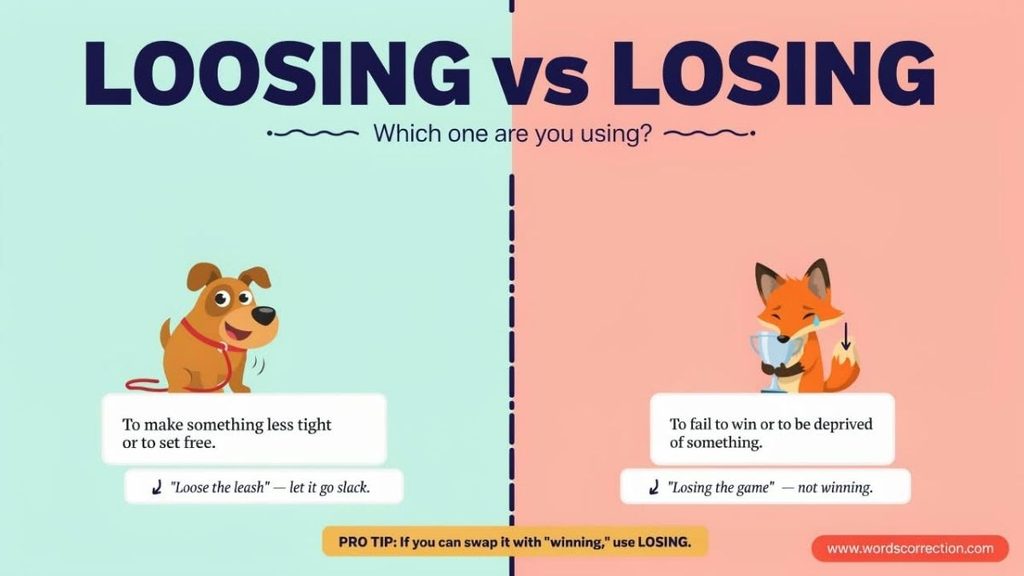
Imagine two teams playing a championship match. Team A has scored four goals, while Team B has scored one.
A commentator might say
“Team B is losing the game, but it still has time to recover.”
The word losing describes the team’s current position in the competition.
Now imagine an archer participating in a historical reenactment. The archer releases an arrow from a bow. In that situation, someone might say:
“The archer is loosing an arrow.”
Both sentences are grammatically possible, but they describe entirely different actions.
Remember: You lose a game when you fail to win it. You loose something when you release it.
Losing or Loosing a Person?
When discussing relationships, separation, or bereavement, losing a person is the correct expression.
For example:
- She is afraid of losing her best friend.
- He is still grieving after losing his father.
- They worry about losing touch with their old classmates.
- I don’t want to risk losing someone I care about.
The phrase losing someone can describe several situations. It might refer to death, the end of a relationship, growing apart, or becoming disconnected from someone important.
Learn the difference between confusing word pairs
Appendix or Appendices Which one Is Correct?
Losing Someone Meaning in Emotional Contexts
The expression often carries emotional weight because it can describe the fear or experience of separation.
For example, “She fears losing her partner” means she worries that the relationship might end or that she might otherwise be separated from that person.
Similarly, “He is struggling with losing his mother” describes grief following her death.
In neither case does loosing fit the intended meaning. The person isn’t being released from a restraint; the sentence describes separation or loss.
There are unusual situations in which loosing a person could mean releasing someone from confinement or restraint. However, that is a different meaning and isn’t the ordinary expression for grief or the end of a relationship.
When you mean separation, bereavement, or the end of a relationship, use losing.
Losing My Mind or Loosing My Mind?
The correct expression is “losing my mind.”
People use this phrase informally to describe feeling overwhelmed, confused, extremely stressed, or unable to think clearly.
Examples include
- I’m losing my mind trying to finish this project.
- She thought she was losing her mind after several sleepless nights.
- You’re making me feel like I’m losing my mind.
The expression is usually figurative. It doesn’t necessarily mean someone is experiencing a serious mental health condition.
Writing loosing my mind would be incorrect when you mean becoming overwhelmed or feeling as though you cannot think straight.
The confusion comes from the similar appearance of lose and loose. However, the phrase uses the verb lose, so its present participle is losing.
The same rule applies to other expressions:
- Losing patience
- Losing confidence
- Losing control
- Losing interest
- Losing sleep
- Losing weight
In each phrase, losing describes something that is diminishing or no longer being maintained.
Learn the difference between tricky grammar more words
Skillset or Skill Set Which Spelling Is Correct?
Losing or Loosing Weight, Control, and a Fight
Certain expressions become easier to spell correctly when you understand their meanings.
Losing or Loosing Weight
Use losing weight when someone experiences a reduction in body weight.
Example “He is losing weight after changing his eating habits.”
The expression describes a reduction, not the release of something. Therefore, loosing weight is incorrect for this meaning.
Losing or Loosing Control
Use losing control when someone can no longer manage a situation, action, or process effectively.
Example “The driver was losing control of the car.”
By contrast, loosing control isn’t the standard expression for becoming unable to manage something.
Losing or Loosing a Fight
Use losing a fight when someone is being defeated in a physical confrontation, argument, or struggle.
Example: “The boxer was losing the fight until he landed a strong punch.”
You might also hear losing an argument, which means failing to defend your position successfully.
In all these cases, the word refers to defeat or the failure to maintain something. That makes losing the appropriate choice.
Learn the difference between commonly mixed-up more words
Wellbeing or Well-Being Which Spelling Is Correct?
Losing vs Loose vs Lose vs Loosing
The difference between lose and loose explains why people often confuse losing and loosing.
Although these words look similar, they have different meanings and grammatical roles.
| Word | Part of speech | Meaning | Example |
| Lose | Verb | To misplace something, fail to win, or no longer have something | Don’t lose your ticket. |
| Loose | Usually an adjective; also a verb | Not tight or firmly attached; as a verb, to release | The screw is loose. |
| Losing | Present participle or gerund of lose | Misplacing, failing to win, or experiencing a loss | She is losing the race. |
| Loosing | Present participle or gerund of loose | Releasing or setting free | He is loosing the arrow. |
| Lost | Past tense and past participle of lose | No longer having something or having failed to win | I lost my keys. |
| Loss | Noun | The act or result of losing | The team suffered a loss. |
| Loosen | Verb | To make something less tight | Loosen the lid. |
| Loosening | Present participle of loosen | Making something less tight | She is loosening the knot. |
What Is the Difference Between Lose and Loose?
Lose is a verb. It describes an action or outcome involving something you no longer have, cannot find, or fail to win.
Examples:
- Don’t lose your passport.
- We don’t want to lose the match.
- She doesn’t want to lose her confidence.
Loose usually functions as an adjective. It describes something that isn’t tight, firmly attached, or securely held.
Examples:
- My shoes feel loose.
- The dog escaped because its collar was loose.
- A loose button fell off my jacket.
Loose can also function as a verb meaning to release something, although this usage is less common in everyday conversation.
The easiest way to remember the difference is to connect each word with its main use lose means to no longer have something; loose means not tight.
Why Is It Losing and Not Loseing?
The correct spelling is losing, not loseing.
English spelling often drops a silent final e when a verb takes the suffix -ing.
For example:
- Make becomes making.
- Write becomes writing.
- Hope becomes hoping.
- Lose becomes losing.
Because lose ends in a silent e, you remove that letter before adding -ing.
The word loose follows a different pattern because it contains two o’s and ends in e. When you form its -ing version, you retain the final e before adding the suffix.
- Loose becomes loosing.
- Use becomes using.
- Close becomes closing.
The word loosing therefore has two consecutive o’s because it comes from loose, not lose.
This is a useful example of how English spelling reflects a word’s base form. The extra letter isn’t random. It signals a different word and a different meaning.
Learn the difference between confusing more English words
Chose or Choose What’s the Difference?
How to Remember the Difference Between Losing and Loosing
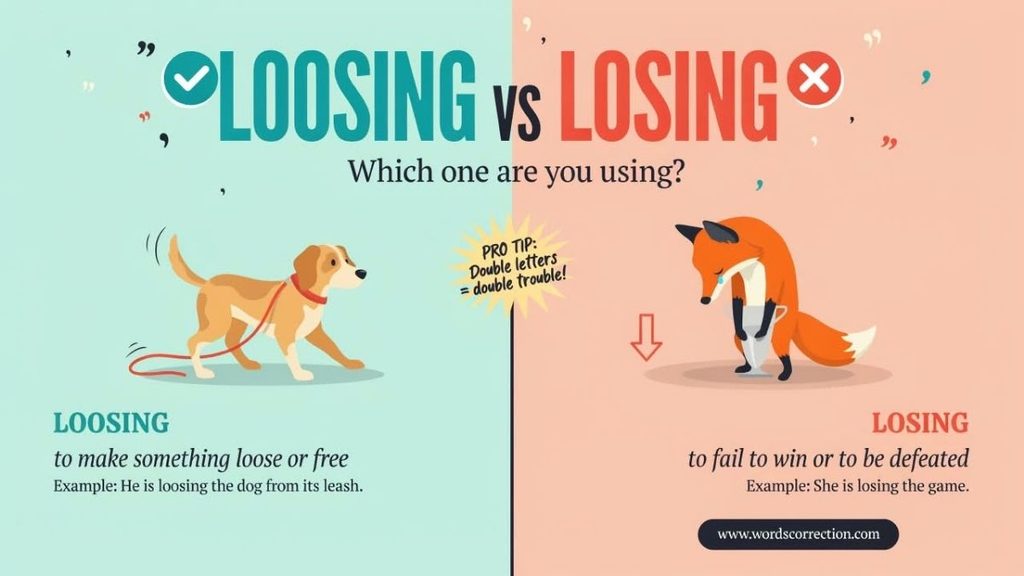
A simple memory trick can help you avoid this spelling mistake.
Losing comes from lose Loosing comes from loose
Start with the base word, then identify the meaning.
- Lose becomes losing You lose a wallet, lose a game, or lose confidence.
- Loose becomes loosing You release something, set it free, or let it go.
Consider this sentence
“I am losing my keys, but I am loosing the dog from its leash.”
The first part describes misplacing something. The second describes releasing an animal.
Here are three practical ways to remember the difference.
Check the Meaning First
Before choosing a spelling, ask yourself what the sentence describes.
If you mean losing something, failing to win, or experiencing a reduction, choose losing.
If you mean releasing something from restraint, loosing may fit.
Check the Base Verb
If the base verb is lose, the -ing form is losing.
If the base verb is loose, the -ing form is loosing.
This method works because the spelling of the base verb determines the spelling of its related form.
Use a Quick Substitution Test
Try replacing the word with a simpler expression.
- “I am losing my patience” means “I am gradually running out of patience.”
- “The archer is loosing an arrow” means “The archer is releasing an arrow.”
If releasing fits the intended meaning, loosing may be correct. If the sentence describes a loss or defeat, use losing.
Common Mistakes With Losing and Loosing
Even confident writers make spelling mistakes when words look alike. The solution is to understand the differences rather than rely on appearance alone.
Using Loosing When You Mean Losing
Incorrect: “Our team is loosing the championship.”
Correct: “Our team is losing the championship.”
The sentence describes a team failing to win. The correct word comes from lose.
Writing Loseing Instead of Losing
Incorrect: “I am loseing interest in the show.”
Correct: “I am losing interest in the show.”
The final e in lose disappears before the suffix -ing.
Confusing Loose With Lose
Incorrect: “My shoes are lose.”
Correct: “My shoes are loose.”
The sentence describes shoes that aren’t tight, so it needs the adjective loose.
Confusing Losing With Lost
Incorrect: “I have losing my keys.”
Correct: “I have lost my keys.”
The present perfect tense uses have or has followed by the past participle lost.
Assuming Loosing Is Always Wrong
Incorrect assumption “Loosing isn’t an English word.”
Correct explanation Loosing is a legitimate word, but it has a different meaning from losing.
A good writer checks both spelling and context. A word may be spelled correctly and still be the wrong choice for a particular sentence.
Learn the difference between tricky words and use them correctly
Leafs or Leaves Which one Is Correct?
Losing vs Lost vs Loss What Is the Difference?
The words losing, lost, and loss are related, but they serve different grammatical purposes.
Losing describes an ongoing action or can function as a noun-like gerund.
Example: “She is losing her keys.”
Lost is the past tense and past participle of lose.
Examples: “She lost her keys yesterday.” “She has lost her keys.”
Loss is a noun that describes the act or result of losing something.
Example: “The company reported a financial loss.”
Compare the forms:
| Word | Example | Explanation |
| Lose | I don’t want to lose. | Base verb |
| Losing | I am losing. | Ongoing action |
| Lost | I lost yesterday. | Past tense |
| Loss | The loss was unexpected. | Noun describing the outcome |
Understanding these forms helps you choose the correct word based on tense and sentence structure.
Losing vs Loses vs Losses
Another common source of confusion involves losing, loses, and losses. Although they share the same root, they don’t have the same grammatical function.
Losing is the -ing form of lose.
Example: “The team is losing again.”
Loses is the simple present form used with a third-person singular subject.
Example: “The team loses every close match.”
Losses is the plural of the noun loss.
Example: “The company recorded several financial losses.”
The spelling difference matters because verbs and nouns follow different grammatical patterns.
| Word | Grammatical role | Example |
| Losing | Present participle or gerund | Losing the match disappointed him. |
| Loses | Present-tense verb | She loses her keys frequently. |
| Loss | Singular noun | The loss hurt the team. |
| Losses | Plural noun | The business suffered heavy losses. |
When you understand the role each word plays in a sentence, choosing the right spelling becomes much easier.
Practice Session about Losing or Loosing
Complete each sentence with the correct word
- Our team is __________ the championship game.
- I keep __________ my keys whenever I’m in a hurry.
- The archer is __________ an arrow toward the target.
- She is __________ patience with the constant interruptions.
- The farmer is __________ the horses into the field.
- He is __________ weight through regular exercise.
- The soldiers are __________ arrows at the enemy.
- You’re __________ my attention with these confusing explanations.
- The handler is __________ the dogs from their cages.
- We are __________ valuable time by arguing.
- The company is __________ money because of poor sales.
- The hunter is __________ the hounds to follow the scent.
- She is __________ confidence before the big presentation.
- The keeper is __________ the birds from their enclosure.
- Our school is __________ the final match by two points.
- He is __________ control of his temper.
- The sailors are __________ the boats from their moorings.
- I am __________ interest in this repetitive conversation.
- The coach is __________ the players to begin the race.
- They are __________ their chance to win the competition.
- The knight is __________ his arrows during the battle.
- Stop __________ time by checking your phone every minute.
- The caretaker is __________ the animals into the open pasture.
- She is __________ sleep because of her busy schedule.
- The instructor is __________ the safety line to release the trapped climber.
Answers
- Losing
- Losing
- Loosing
- Losing
- Loosing
- Losing
- Loosing
- Losing
- Loosing
- Losing
- Losing
- Loosing
- Losing
- Loosing
- Losing
- Losing
- Loosing
- Losing
- Loosing
- Losing
- Loosing
- Losing
- Loosing
- Losing
- Loosing
Here’s a trusted source for clear more words Comparison:
Grammar Update
fAQ’s
Is it loosing or losing?
Losing is correct when you mean misplacing something, failing to win, or no longer having something. Loosing means releasing or setting something free. For example, “I am losing my keys” is correct, while “The archer is loosing an arrow” means releasing it.
What is the difference between losing and loosing?
Losing is the present participle of lose, while loosing is the present participle of loose when used as a verb. Losing refers to misplacing something or experiencing a defeat, whereas loosing means releasing something.
Is loosing a real word?
Yes, loosing is a real word, but it is less common than losing. It means releasing, freeing, or letting something go. For example, “The farmer is loosing the horses into the field” uses the word correctly.
Why do people spell losing as loosing?
People often confuse losing with loosing because the words look and sound similar. However, they come from different base words. Losing comes from lose, while loosing comes from loose. Remembering their meanings helps you choose the correct spelling.
Is it losing or loosing a game?
Losing a game is correct because it means failing to win. For example, “Our team is losing the game by three points.” Loosing a game would suggest releasing something and does not express the intended meaning.
Is it losing or loosing weight?
Losing weight is the correct expression. It means experiencing a reduction in body weight. For example, “She is losing weight gradually.” Loosing weight is incorrect when you mean becoming lighter.
Is it losing or loosing my mind?
Losing my mind is correct. This expression describes feeling overwhelmed, confused, or extremely frustrated. For example, “I’m losing my mind trying to finish this project.” Loosing my mind is incorrect in this context.
Is it losing or loosing control?
Losing control is the correct phrase when someone can no longer manage a situation, emotion, or action. For example, “He was losing control of his temper.” Loosing control does not convey this intended meaning.
Is it losing or loosing a loved one?
Losing a loved one is correct when referring to someone’s death or separation. For example, “Losing a loved one can be an extremely difficult experience.” Loosing a loved one is incorrect because the phrase does not mean releasing someone.
Is it losing or loosing a fight?
Losing a fight is correct when someone is being defeated or is unlikely to win. For example, “The boxer is losing the fight.” Loosing a fight would suggest releasing something rather than experiencing a defeat.
Is it losing or loosing me?
Losing me is correct when you mean that someone is gradually losing your trust, attention, understanding, or connection. For example, “You’re losing me with all these complicated explanations.” Loosing me is incorrect for this meaning.
Why is it losing and not loseing?
The correct spelling is losing, not loseing, because the final e in lose is dropped before adding -ing. This spelling rule also applies to words such as make and making. Therefore, lose becomes losing.
What does losing mean?
Losing is the -ing form of lose. It can mean misplacing something, failing to win, experiencing a reduction, or no longer having something. For example, “I’m losing my patience” means that your patience is gradually running out.
What does loosing mean?
Loosing means releasing, freeing, or letting something go. It is the -ing form of loose when loose functions as a verb. For example, “The archer is loosing an arrow” means the archer is releasing the arrow.
Can losing and loosing be used interchangeably?
No, losing and loosing are not interchangeable because they have different meanings. Use losing for a defeat, a misplaced item, or something you no longer have. Use loosing when describing the act of releasing or setting something free.
Is losing a verb or an adjective?
Losing is primarily the present participle of the verb lose. It can appear in continuous verb forms, as in “She is losing the race,” and in adjective-like uses, as in “the losing team.” Its role depends on the sentence.
Is loosing a verb or an adjective?
Loosing is the present participle of loose when loose is used as a verb. It describes an action involving release or freedom. For example, “The guards are loosing the prisoners” means they are setting the prisoners free.
What is the difference between lose and loose?
Lose is a verb that means to misplace something, fail to win, or no longer have something. Loose is usually an adjective meaning not tight or not firmly attached. For example, “Don’t lose your keys” and “My shoes feel loose” are both correct.
What is the difference between losing and lost?
Losing describes an ongoing action, while lost is the past tense and past participle of lose. For example, “I’m losing my keys” describes an action in progress, while “I lost my keys yesterday” describes something that happened in the past.
What is the past tense of losing?
The past tense of lose is lost, not loosed. For example, “I lost the match last week” is correct. “Loosed” is the past tense of loose when it means released, as in “The guard loosed the dogs.”
What is the opposite of losing?
The opposite of losing depends on the context. In a competition, the opposite is usually winning. When discussing a misplaced object, the opposite may be finding it. When discussing a reduction, the opposite may be gaining or increasing.
How do you use losing in a sentence?
Use losing when describing an ongoing loss, defeat, or reduction. For example, “She is losing confidence before the competition.” Other correct examples include “I’m losing my keys again” and “The team is losing by one point.”
How do you use loosing in a sentence?
Use loosing when describing the act of releasing or setting something free. For example, “The archer is loosing an arrow toward the target.” Another example is “The handler is loosing the dogs into the open field.”
What is the easiest way to remember losing or loosing?
Remember that losing comes from lose, while loosing comes from loose. If you mean failing to win, misplacing something, or no longer having it, choose losing. If you mean releasing something, choose loosing.
Which spelling should I use in everyday writing losing or loosing?
Use losing in most everyday situations involving a defeat, a misplaced item, a reduction, or the loss of something important. Loosing is correct only when you mean releasing or setting something free. If you’re unsure, check whether the sentence relates to loss or release.
Conclusion
Understanding the difference between losing or loosing is simple once you know what each word means. Losing refers to misplacing something, failing to win, or no longer having something, while loosing means releasing or setting something free. Confusing the two can turn an ordinary sentence into an amusing grammatical mistake. After all, losing a game is one thing, but loosing an arrow is an entirely different story
To avoid this common spelling error, focus on the meaning of your sentence before choosing a word. With regular practice and a clear understanding of the rule, you’ll use both words confidently and keep your writing accurate, clear, and professional.

Stella AJS is an experienced blogger and dedicated English language writer at Words Correction. She turns confusing grammar, word meanings, spelling, and usage into clear, practical insights that readers can easily understand and apply. With a passion for precise and engaging writing, Stella helps readers avoid common language mistakes, strengthen their vocabulary, and communicate with greater clarity and confidence.




