
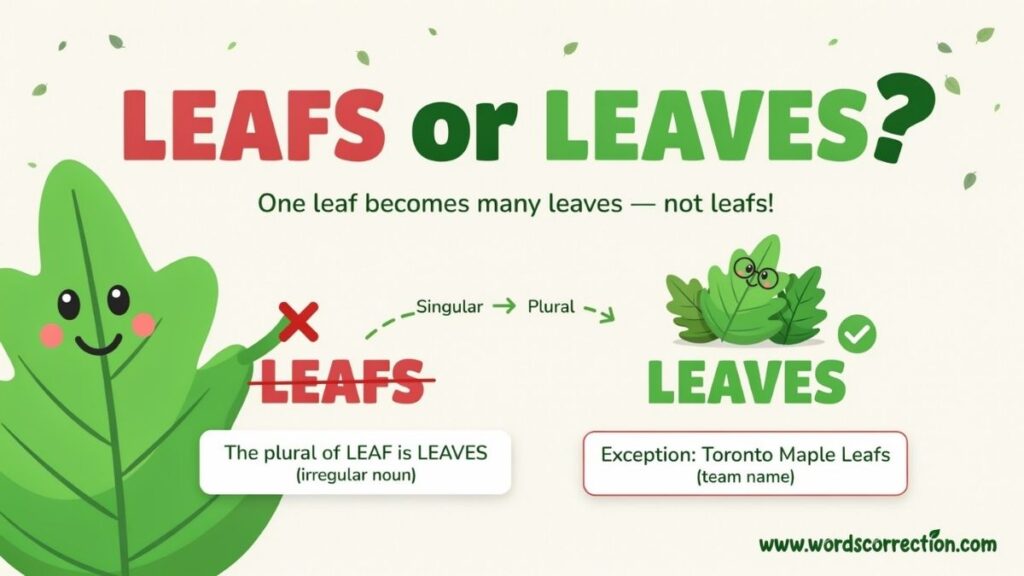
Choosing between “leafs” or “leaves” can be confusing because both words are correct, but they have different uses. A small spelling mistake can turn a simple sentence into a grammar puzzle. The good news is that the rule is easy to understand. Whether you’re describing tree leaves in autumn, adding leaves to a dining table, or writing about someone flipping through a book, knowing the difference helps you choose the right word. In this article, you’ll learn the meaning of each word, the correct grammar rules, useful examples, and common mistakes to avoid. By the end, you’ll use both words with confidence.
Leafs or Leaves Quick Answer
Leaves is the correct plural of leaf in standard English.
The basic pattern is:
One leaf → two leaves
For example:
- The tree has green leaves.
- Autumn leaves covered the sidewalk.
- Several leaves fell from the branches.
- The table has two removable leaves.
Leafs is not normally used as the plural noun for plant foliage. However, it can be correct in other situations.
| Word | Grammatical Role | Correct Use | Example |
| leaf | Singular noun | One plant leaf or similar object | A leaf fell from the tree. |
| leaves | Plural noun | More than one leaf | The leaves are green. |
| leafs | Verb | Third-person singular of leaf | She leafs through the book. |
| leaves | Verb | Third-person singular of leave | He leaves at five. |
| Leafs | Proper noun | Toronto NHL team | The Toronto Maple Leafs played tonight. |
So, if you’re asking is it leafs or leaves when talking about more than one leaf, choose leaves.
Leafs or Leaves Meaning
The easiest way to understand the leafs or leaves meaning is to examine the grammatical role each form performs.
Leaf is the singular noun. It usually refers to the flat, usually green structure attached to a plant stem or branch. However, English also uses leaf for objects that resemble a plant leaf or function as a separate flat section. Examples include a leaf of paper, a leaf of a table, or a leaf of a door.
Leaves is the standard plural noun. It refers to two or more leaves.
Leafs has a more limited role. Most commonly, it appears as a verb meaning to turn pages or look through something by turning its pages. It also appears in the proper name Toronto Maple Leafs.
Consider these examples:
- The tree has thousands of leaves.
- She leafs through her notes before class.
- He leaves the office at six.
- The Toronto Maple Leafs played last night.
The spelling changes because the grammatical function changes.
Learn the difference between confusing more English words
Sole vs Soul which is correct?
Leaf and Leaves: Singular and Plural Forms
What Does Leaf Mean?
A leaf is the singular form of the noun.
In botany, a leaf is a plant structure that usually grows from a stem or branch. Leaves play important roles in photosynthesis, gas exchange, and water regulation.
In everyday English, the word is much simpler to use:
A green leaf hangs from the branch.
The word also has several non-botanical meanings.
A leaf can refer to a physical sheet in a book or manuscript. In furniture, a leaf can mean an additional section that expands a table. In architecture, a leaf can describe a movable section of a door or gate.
Therefore, leaf has a broader meaning than the green part of a plant.
What Does Leaves Mean?
Leaves is the standard plural form of leaf.
For example:
The tree has bright green leaves.
Here, leaves refers to more than one botanical leaf.
The same plural form works for other meanings of leaf:
- The book contains several printed leaves.
- The dining table has two removable leaves.
- The double door has two leaves.
This makes leaves the standard plural form across several meanings of the noun.
The Leaf Plural at a Glance
| Singular | Plural |
| one leaf | two leaves |
| a tree leaf | tree leaves |
| one table leaf | two table leaves |
| one book leaf | several book leaves |
| one door leaf | two door leaves |
The main rule is simple leaf becomes leaves when the noun is plural.
Learn the difference between commonly mixed-up more words
Mistery vs Mystery Which Is Correct?
Why Is the Plural of Leaf Leaves?
This is where English spelling rules become more interesting.
The plural of leaf is leaves, not leafs, in standard everyday English. The spelling changes from f to v before the plural ending.
The pattern is:
leaf → leaves
Several other common English words follow a similar pattern:
| Singular | Plural |
| leaf | leaves |
| knife | knives |
| wife | wives |
| life | lives |
| wolf | wolves |
| shelf | shelves |
| half | halves |
| loaf | loaves |
These forms are often described as irregular plural nouns because you cannot form their plural simply by adding s.
However, it would be misleading to treat the f-to-ves pattern as a universal rule. English has many exceptions.
The F-to-VES Rule Does Every Word Ending in F Change?
No. Not every word ending in f or fe changes to ves.
Some words simply take s:
- roof → roofs
- chief → chiefs
- belief → beliefs
- chef → chefs
- cliff → cliffs
- proof → proofs
- safe → safes
So you should not assume that every word ending in f follows the same pattern.
This is one reason English plural spelling rules can be challenging. Some patterns are predictable, while others require you to learn the standard form of each word.
Common F-to-VES Examples
These words commonly change their spelling:
- leaf → leaves
- knife → knives
- wife → wives
- life → lives
- wolf → wolves
- shelf → shelves
- thief → thieves
- calf → calves
- half → halves
But these remain regular:
- roof → roofs
- chief → chiefs
- belief → beliefs
- chef → chefs
- proof → proofs
- cliff → cliffs
This distinction is important when learning English vocabulary and grammar.
Is Leaf a Countable Noun?
Yes. Leaf is normally a countable noun.
You can refer to:
- one leaf
- two leaves
- several leaves
- hundreds of leaves
- a pile of leaves
For example:
One leaf landed on the windshield.
Hundreds of leaves covered the lawn.
When you refer to more than one individual leaf, you normally use the plural form leaves.
Learn the difference between tricky grammar more words
Organiser or Organizer Which Spelling Should You Use?
Leafs vs Leaves The Key Difference
The biggest mistake is treating leafs and leaves as interchangeable.
They are not.
Leaves is normally the plural noun.
Leafs is usually a verb form or part of a proper name.
| Situation | Correct Form |
| More than one plant leaf | leaves |
| Fallen plant foliage | leaves |
| More than one table leaf | leaves |
| Multiple book leaves | leaves |
| Someone turns pages | leafs |
| Someone looks through a magazine | leafs |
| Toronto NHL team | Leafs |
This is the central difference between leafs and leaves.
Leaves as a Noun
The leaves are falling from the tree.
Here, leaves is a plural noun.
Leafs as a Verb
She leafs through a magazine while waiting.
Here, leafs is a verb.
The spelling difference reflects a grammatical difference. That is why simply memorizing “leaves is correct” does not tell the whole story.
When Is Leafs Correct?
There are two important situations where leafs can be correct.
Leafs as a Present Tense Verb
The verb leaf means to turn pages or look through the pages of something quickly or casually.
Its third-person singular present form is leafs.
| Subject | Verb |
| I | leaf |
| You | leaf |
| We | leaf |
| They | leaf |
| He | leafs |
| She | leafs |
| It | leafs |
Examples:
I leaf through old magazines.
She leafs through the newspaper.
He leafs through his notes before the exam.
In these examples, leafs is a verb. It is not the plural of the noun leaf.
Leafs in a Proper Name
The other well-known use is Toronto Maple Leafs, the name of the National Hockey League team based in Toronto.
In this case, Leafs is part of an official proper name. It should not be changed to Leaves simply because leaves is the ordinary plural of leaf.
For example:
The Toronto Maple Leafs won the game.
Changing the name to “Toronto Maple Leaves” would produce a different name.
Proper names can preserve unusual spelling or grammatical forms for historical or identity reasons.
Is Leafs a Word?
Yes. Leafs is a real English word, but its use depends on context.
If you are asking is leafs a word because you have seen it in a sentence, examine its grammatical function.
It can be:
- the third-person singular present form of the verb leaf
- part of a proper name such as Toronto Maple Leafs
It is not, however, the standard plural form of the noun leaf when you are talking about multiple plant leaves.
Compare:
The tree has green leaves.
She leafs through the magazine.
Both sentences are correct, but the words serve different grammatical functions.
What Does Leafs Mean?
The leafs meaning depends on context.
As a verb, leafs means that someone turns through pages or looks through something by turning its pages.
For example:
He leafs through the old photo album.
In a proper name, Leafs refers to the Toronto hockey team.
However, when you are talking about several plant structures, leafs is not the standard plural.
Leafs in a Sentence
Here are several examples of leafs in a sentence:
- She leafs through the newspaper every morning.
- He leafs through his textbook before the lecture.
- The child leafs through the picture book.
- The Toronto Maple Leafs played an important game.
The first three examples use leafs as a verb. The fourth uses Leafs as part of a proper name.
Learn the difference between confusing word pairs
Volcanoes or Volcanos The Correct Spelling?
What Does Leaves Mean?
The word leaves has several grammatical and semantic uses.
Most commonly, it is the plural noun of leaf:
The leaves are turning brown.
However, leaves is also the third-person singular present form of the verb leave:
She leaves work at five.
That is why context matters.
Leaves as a Noun
The autumn leaves covered the sidewalk.
Here, leaves means plant foliage.
Leaves as a Verb
He leaves the house at seven.
Here, leaves comes from the verb leave.
The spelling is identical, but the meaning and grammatical role are different.
Learn the difference between often confused words
Disgard or Discard Which Spelling Is Correct and Why?
Leaves as Both a Noun and a Verb
One reason leaves can cause confusion is that it belongs to two different words.
Leaves as the Plural of Leaf
The tree has green leaves.
Here, leaves is the plural noun.
Leaves as the Verb Leave
She leaves the office early.
Here, leaves is the third-person singular form of leave.
A useful way to determine the meaning is to examine the surrounding sentence.
If the word refers to plant parts, pages, table sections, or similar objects, it is probably the noun.
If it describes someone departing or allowing something to remain, it is probably the verb leave.
Leave vs Leaf Two Completely Different Words
The words leaf and leave differ by only one letter, but they have different meanings.
| Word | Main Meaning | Example |
| leaf | Plant structure | A leaf fell to the ground. |
| leave | Depart or go away | I need to leave now. |
| leaves | Plural of leaf | The leaves are green. |
| leaves | Verb form of leave | She leaves at noon. |
| leafs | Verb form of leaf | He leafs through the book. |
This distinction is especially useful because leaves can belong to either leaf or leave.
How to Pronounce Leaf, Leaves, and Leafs
Pronunciation provides another useful clue.
- Leaf ends with an f sound.
- Leaves ends with a v sound.
- Leafs keeps the f sound and adds an s sound.
The difference is therefore noticeable in speech as well as writing.
The final sounds can help distinguish leaves from leafs, particularly when the context is unclear.
Learn the difference between basic English word mistakes
Uninterested vs Disinterested What’s the Difference?
Leaves vs Leafs Examples in Real Context
Context makes the distinction easier to understand.
Plants and Trees
Use leaves:
The tree has thousands of leaves.
The green leaves sway in the wind.
Dry leaves covered the garden.
The autumn leaves changed color.
Do not use leafs as the ordinary plural for plant foliage.
Books and Pages
Use leaves when referring to physical book leaves:
The manuscript contains several damaged leaves.
But use leafs when describing the action of turning pages:
She leafs through the manuscript.
The noun and verb perform different jobs.
Tables
Use leaves:
The dining table has two removable leaves.
A table leaf is an extra section that allows a table to become larger.
Doors
In architectural terminology, a movable section of a door can be called a door leaf.
The plural is:
door leaves
For example:
The double door has two leaves.
Again, leafs is not the standard plural noun.
Learn the difference between commonly misused words
Complimented or Complemented Which is Correct Spelling?
Leaf, Leaves, and Table Leaves
The word leaf has several meanings beyond plant foliage.
Furniture provides a useful example.
A table leaf is a removable, hinged, or insertable section that allows a table to become larger.
For example:
We added two leaves to the dining table before the guests arrived.
This is another example of the correct plural of leaf. Even when leaf refers to furniture rather than a plant, the plural noun remains leaves.
Leaf and Leaves for Book Pages
Traditional book terminology also uses leaf and leaves.
A leaf is a physical sheet in a book. Each leaf can have two sides, commonly referred to as pages.
For example, a book may contain:
100 leaves
while those leaves may contain:
200 pages
depending on how the pages are counted.
This specialized meaning reinforces the standard rule:
one leaf → multiple leaves
Not leafs.
Common Grammar Mistakes With Leafs and Leaves
Several mistakes occur frequently.
Using Leafs for Plant Leaves
The tree has hundreds of leafs.
The tree has hundreds of leaves.
Treating Leafs as the General Plural
The autumn leafs covered the road.
The autumn leaves covered the road.
Confusing Leafs and Leaves as Verbs
She leaves through the magazine.
If the intended meaning is “turns pages,” this is incorrect.
She leafs through the magazine.
Changing the Toronto Team’s Name
The Toronto Maple Leaves
The Toronto Maple Leafs
The second form is the team’s official proper name.
Assuming Every F-Ending Word Takes VES
chef → cheves
chef → chefs
The f-to-ves pattern has exceptions.
Learn the difference between everyday English mistakes
Don’ts or Don’t’s Which Spelling Is Correct?
Similar Plural Forms F to VES
The leaf and leaves grammar rule belongs to a broader group of pluralization patterns.
| Singular | Plural | Pattern |
| leaf | leaves | f → ves |
| knife | knives | fe → ves |
| wife | wives | fe → ves |
| wolf | wolves | f → ves |
| shelf | shelves | f → ves |
| life | lives | fe → ves |
| loaf | loaves | f → ves |
| thief | thieves | f → ves |
However, some words remain regular:
| Singular | Plural |
| roof | roofs |
| chef | chefs |
| chief | chiefs |
| belief | beliefs |
| proof | proofs |
| cliff | cliffs |
This is why English spelling rules require both pattern recognition and familiarity with individual words.
Why Do We Say Leaves Instead of Leafs?
The short answer is historical word formation.
English developed leaves as the plural form of leaf through earlier changes in pronunciation and spelling. The f sound changed in certain plural forms, eventually producing the spelling pattern seen today.
That development gave English forms such as:
leaf → leaves
English retained these forms even though modern speakers don’t apply the same pattern to every word ending in f.
For modern writers, the practical rule matters most:
The standard plural of leaf is leaves.
Is Leaves a Word?
Yes. Leaves is a standard English word with more than one grammatical use.
It can be:
- the plural noun of leaf
- the third-person singular present form of leave
Examples:
The leaves are falling.
She leaves at eight.
The spelling is the same, but the meaning depends on context.
Learn the difference between more words people mix up
Appendix or Appendices Which one Is Correct?
Is It Leafs or Leaves? A Simple Decision Rule
When you’re unsure, ask what the word is doing in the sentence.
If you mean more than one leaf:
Use leaves.
If you mean someone turning pages:
Use leafs.
If you mean someone departing:
Use leaves.
If you’re writing the name of the Toronto hockey team:
Use Leafs.
This four-part distinction handles most everyday situations.
Leafs or Leaves Quick Comparison
| Meaning | Correct Spelling | Example |
| One plant structure | leaf | A leaf fell. |
| More than one plant structure | leaves | The leaves fell. |
| Multiple table sections | leaves | Add the table leaves. |
| Multiple book leaves | leaves | Several leaves were damaged. |
| Turn pages | leafs | She leafs through the book. |
| Depart | leaves | He leaves early. |
| Toronto NHL team | Leafs | The Leafs won. |
Leafs or Leaves Examples
These examples show how context determines the correct form:
The tree has green leaves.
Several leaves fell during the storm.
The garden was covered with fallen leaves.
She leafs through the magazine while drinking coffee.
He leaves for work at seven.
The table has two extra leaves.
The Toronto Maple Leafs played at home.
The old book contains several loose leaves.
Each sentence uses the word differently.
Learn the difference between tricky English words with easy explanations
Skillset or Skill Set Which Spelling Is Correct?
A Quick Case Study One Spelling, Three Meanings
Consider these three sentences:
The leaves are turning yellow.
Here, leaves is the plural noun of leaf.
She leaves the office at five.
Here, leaves is the third-person singular form of leave.
She leafs through the report before the meeting.
Here, leafs is the third-person singular form of leaf.
The difference isn’t random. Each form reflects a different word or grammatical function.
Once you recognize that pattern, leafs vs leaves becomes a context question rather than a simple spelling trap.
Practice Leafs or Leaves
Fill in the blanks
- The tree loses its ______ during autumn.
- A single ______ fell onto the garden path.
- The gardener collected the fallen ______.
- She ______ through the book to find a chapter.
- The plant has several green ______.
- He ______ through the magazine while waiting.
- We added two table ______ to make it larger.
- The wind blew the ______ off the branches.
- Each ______ helps the plant capture sunlight.
- My brother ______ through his notes before the exam.
- The oak tree has broad ______.
- A yellow ______ floated across the pond.
- The gardener removed the dry ______.
- She ______ through the pages quickly.
- The tree’s new ______ appeared in spring.
- The double door has two door ______.
- The children jumped into a pile of autumn ______.
- He ______ through the newspaper.
- This plant has one large ______ on its stem.
- We pressed several ______ to preserve them.
- The Toronto Maple ______ are a hockey team.
- The branch was covered with green ______.
- She ______ through the recipe book.
- The carpenter fitted the table with removable ______.
- The dry ______ crunched under our feet.
Answers
- leaves
- leaf
- leaves
- leafs
- leaves
- leafs
- leaves
- leaves
- leaf
- leafs
- leaves
- leaf
- leaves
- leafs
- leaves
- leaves
- leaves
- leafs
- leaf
- leaves
- Leafs
- leaves
- leafs
- leaves
- leaves
Here’s a trusted source for clear more words Comparison:
Grammar Update
FAQ’s
Is it leafs or leaves on a tree?
Leaves is the correct plural of leaf when referring to the parts of a tree or plant. For example, “The tree has green leaves in spring.”
Can I use leafs in a sentence?
Yes. Leafs is correct when used as the third-person singular form of the verb “leaf,” meaning to turn pages or browse through a book. For example, “She leafs through the magazine.”
Why is the plural of leaf leaves instead of leafs?
English commonly changes the -f ending to -ves in certain plural nouns. That is why the plural of leaf is leaves. However, not every word ending in -f follows this pattern.
Is it fall leaves or fall leafs?
Fall leaves is correct when referring to leaves that change color and fall from trees during autumn. For example, “The sidewalk is covered with colorful fall leaves.”
What is the difference between leafs and leaves?
Leaves is the standard plural noun for leaf and can also mean that someone departs. Leafs is usually a verb meaning to browse through pages. It also appears in proper names, such as the Toronto Maple Leafs.
What does leafs mean in English?
Leafs is the present-tense form of the verb “leaf” used with he, she, or it. For example, “He leafs through his notes before the meeting.” It can also appear in established proper names.
Should I say table leafs or table leaves?
Table leaves is the standard expression for removable or hinged sections that extend a table’s surface. For example, “We added two table leaves to make the dining table larger.”
What is a group of leaves called?
A collection of detached leaves may be called a pile, bunch, or bundle of leaves, depending on how they are gathered. The word “foliage” refers collectively to the leaves of plants.
What are the two meanings of leaves?
Leaves has two common grammatical meanings. It is the plural of the noun “leaf,” as in “The leaves are turning yellow,” and the third-person singular form of “leave,” as in “She leaves home at eight.”
What does leaves mean in slang?
The meaning of leaves depends on the context. In informal speech, it may refer to someone leaving or walking away. It can also refer to plant foliage. It does not have one universal slang meaning.
What are two main functions of leaves?
The two main functions of most leaves are photosynthesis and gas exchange. Leaves capture sunlight to help plants produce food and exchange gases needed for plant processes.
What are the two main types of leaves?
The two broad structural types are simple leaves and compound leaves. A simple leaf has one main blade, while a compound leaf has a blade divided into separate leaflets.
What is the main purpose of leaves?
The main purpose of most leaves is photosynthesis, the process through which plants use light energy to make sugars. Leaves also help regulate water loss and exchange gases with the environment.
What are five common types of leaf shapes?
Five common leaf shapes are ovate, lanceolate, linear, cordate, and lobed. Ovate leaves are egg-shaped, lanceolate leaves are long and narrow, linear leaves are slender, cordate leaves are heart-shaped, and lobed leaves have distinct projections or divisions.
What are ten common types of leaves?
Ten common leaf shapes or forms include ovate, elliptical, lanceolate, linear, cordate, orbicular, oblong, needle-like, scale-like, and lobed. These terms describe leaf shape or structure rather than ten universal botanical categories.
What can people make from leaves?
People can use leaves to make compost, mulch, leaf prints, natural dyes, decorative crafts, and woven items. Certain leaves are also used in cooking, food wrapping, and traditional herbal preparations.
What are some common uses of leaves in everyday life?
Leaves serve practical purposes in cooking, gardening, decoration, and crafts. For example, people eat lettuce, wrap foods in banana leaves, use bay leaves to flavor dishes, and compost fallen leaves to improve garden soil.
How should I dispose of fallen leaves?
You can compost fallen leaves, shred them for mulch, or use a local yard-waste collection service. Shredding helps leaves break down faster. Avoid leaving thick layers on grass because they can block sunlight and trap moisture.
Why should you avoid burning dried leaves?
Burning dried leaves produces smoke and fine particles that can irritate the lungs and worsen air quality. Open burning also creates a fire risk. Composting or using a yard-waste collection service is generally a better alternative.
Why should you leave some leaves in your yard?
Leaving some fallen leaves in garden beds can protect the soil, return nutrients as they decompose, and provide shelter for small wildlife. However, thick layers on lawns should be removed or shredded to prevent damage to the grass.
How can you preserve leaves for crafts?
You can preserve leaves by pressing them between absorbent paper or using a suitable glycerin solution to help retain flexibility. The best method depends on the leaf and the finished project. Follow product instructions when using preservation materials.
Is leaves grammatically correct?
Yes. Leaves is grammatically correct as the plural of “leaf” and as the third-person singular form of “leave.” The surrounding sentence determines which meaning applies.
What is the plural of tomato?
The standard plural of tomato is tomatoes. For example, “The recipe calls for four tomatoes.” This spelling follows a common pattern in which many nouns ending in -o add -es, although exceptions exist.
Is door leaves or door leafs correct?
Door leaves is the standard term in architectural and technical English for the moving panels of a door assembly. For example, “The double door has two leaves.” In this context, “leaf” refers to a door panel.
What is the correct plural of leaf?
The correct plural of leaf is leaves when referring to plant parts. For example, “Several leaves fell from the tree.” Remember that “leafs” is used in different grammatical contexts, not as the standard plural noun for plant leaves.
Learn the difference between confusing more English words step by step
Wellbeing or Well-Being Which Spelling Is Correct?
Conclusion
Choosing between leafs or leaves is easier when you know the simple grammar rule. Use leaves as the plural of leaf when talking about trees, plants, or table extensions. Use leafs as a verb when someone browses through a book or magazine. It also appears in proper names, such as the Toronto Maple Leafs. Remember, one small spelling change can make a big difference in meaning. Check how the word functions in your sentence before choosing its form. With these simple rules and examples, you can avoid common spelling mistakes and use leafs and leaves with confidence.

Stella AJS is an experienced blogger and dedicated English language writer at Words Correction. She turns confusing grammar, word meanings, spelling, and usage into clear, practical insights that readers can easily understand and apply. With a passion for precise and engaging writing, Stella helps readers avoid common language mistakes, strengthen their vocabulary, and communicate with greater clarity and confidence.




