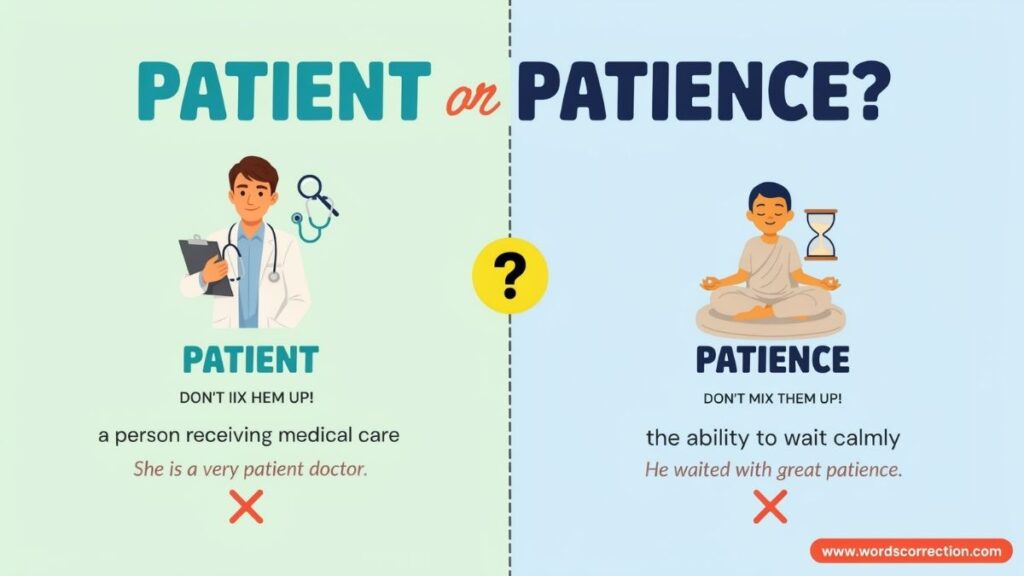
Patient or Patience? These words sound almost identical, yet their meanings are quite different. One refers to a person receiving medical care, while the other describes the ability to remain calm while waiting or facing difficulties. Confusing them can turn a clear sentence into an embarrassing grammar mistake. Whether you’re writing an email, preparing an essay, or having a conversation, using the correct word matters. Fortunately, understanding the difference between patient and patience is simple once you learn their meanings and grammatical roles. This guide explains their definitions, spelling, common mistakes and practical examples to help you use both words correctly and confidently.
Patient or Patience The Quick Answer
The simplest rule is this: use patient to describe someone and patience to name the quality of remaining calm while waiting or facing difficulties.
- Patient (adjective): Describes someone who can wait calmly or tolerate delays.
- Patience (noun): Refers to the ability to wait calmly or deal with difficulties without becoming easily annoyed.
- Patient (noun): Refers to someone receiving medical care.
- Patients (plural noun): Refers to two or more people receiving medical care.
Consider these examples
- Correct: She is very patient with her students.
- Correct: She has a lot of patience with her students.
- Incorrect: She is very patience with her students.
- Correct: The doctor treated several patients today.
The first sentence describes a person’s behavior. The second identifies a quality that person possesses. The final sentence uses patients in its medical sense.
When you’re unsure which word to choose, examine the sentence structure. If you want to describe a person, patient is often the right choice. If you mean the quality itself, patience usually fits.
Patient vs Patience Meaning and Differences
Although patient and patience share a common root and relate to the same general idea, they perform different grammatical functions. Understanding their definitions is the first step toward using them correctly.
What Does Patient Mean?
The adjective patient describes someone who can wait calmly, manage frustration, and tolerate difficult situations without becoming easily upset.
A patient person doesn’t necessarily enjoy waiting. Instead, that person manages frustration and responds calmly when circumstances don’t go as planned.
For example, a patient teacher gives students enough time to understand a difficult lesson. A patient driver controls their frustration when traffic slows down. A patient parent explains a task again when a child doesn’t understand it the first time.
In each example, patient describes a person.
Examples of patient as an adjective
- The teacher remained patient while the students practiced.
- My father is patient when he teaches me to drive.
- Please be patient while we resolve the issue.
- She is a patient listener who allows others to finish speaking.
- You need to be patient when learning a new language.
Patient often appears after linking verbs such as be, remain, and seem. It can also appear before a noun, as in a patient teacher or a patient listener.
However, patient has another important meaning in English. As a noun, it refers to a person receiving medical examination, treatment, or care.
For example
- The patient is waiting for the doctor.
- The hospital admitted a new patient this morning.
- The doctor explained the treatment options to the patient.
This medical definition is common in healthcare settings. The context determines which meaning applies.
Learn the difference between more words people mix up
Disgard or Discard Which Spelling Is Correct and Why?
What Does Patience Mean?
Patience refers to the ability to wait calmly, tolerate frustration, or endure difficulties without reacting with unnecessary anger or irritation.
Unlike patient, which commonly describes a person, patience names the quality itself. It is an abstract noun because it refers to an idea or personal quality rather than a physical object.
You can’t hold patience in your hand like a book. However, you can demonstrate it through your actions.
For instance, a student shows patience by continuing to practice a difficult skill. A customer demonstrates patience by waiting while a support representative investigates a problem. A friend shows patience by listening carefully when someone needs time to explain a concern.
Examples of patience in sentences
- Patience is essential when learning a new skill.
- She showed patience while helping her younger brother.
- Thank you for your patience during the delay.
- I need more patience when dealing with complicated tasks.
- His patience helped him remain calm during a stressful meeting.
The noun patience commonly appears in expressions such as have patience, show patience, exercise patience, lose patience, and test someone’s patience.
For example, when you say, “I have no patience for unnecessary arguments,” you describe a quality you feel you’re lacking in that situation. When you say, “That delay tested my patience,” you explain that the delay challenged your ability to remain calm.
Learn the difference between everyday English mistakes
Uninterested vs Disinterested What’s the Difference?
Patient vs Patience at a Glance
| Feature | Patient | Patience |
| Main part of speech | Adjective | Noun |
| Main meaning | Able to wait calmly or tolerate difficulties | The ability to wait calmly or tolerate difficulties |
| Medical meaning | A person receiving medical care | No corresponding medical meaning |
| Common expressions | Be patient, remain patient, patient teacher | Have patience, show patience, lose patience |
| Example | The manager is patient. | The manager has patience. |
| Common question | What kind of person? | What quality? |
The difference between patient and patience becomes easier to remember when you focus on what the sentence needs. An adjective describes, while a noun names.
Patient or Patience Grammar Adjective vs Abstract Noun
Grammar isn’t simply a collection of rules to memorize. It helps you understand why one word fits a sentence while another doesn’t.
The main rule for patient vs. patience is that the adjective and noun occupy different grammatical roles.
When to Use Patient as an Adjective
Use patient when you want to describe someone’s attitude, behavior, or ability to tolerate a difficult situation.
A few common sentence patterns make this easier.
Subject + linking verb + patient
- The coach is patient.
- My sister seems patient.
- The staff remained patient during the busy afternoon.
Patient + noun
- A patient teacher explains difficult concepts clearly.
- We need a patient driver for this long journey.
- He is a patient listener.
Patient with + person or situation
- Please be patient with me.
- She is patient with young children.
- The team remained patient with the slow process.
These structures work because patient describes the subject or the person associated with a noun.
You can also use comparative and superlative forms. Say more patient when comparing two people and most patient when describing the highest degree within a group.
For example:
- Anna is more patient than her brother.
- Of all the instructors, Mr. Lee is the most patient.
These are standard adjective forms. You don’t need to add a separate ending to patient to express comparison.
Learn the difference between commonly misused words
Complimented or Complemented Which is Correct Spelling?
Why Patience Is an Abstract Noun
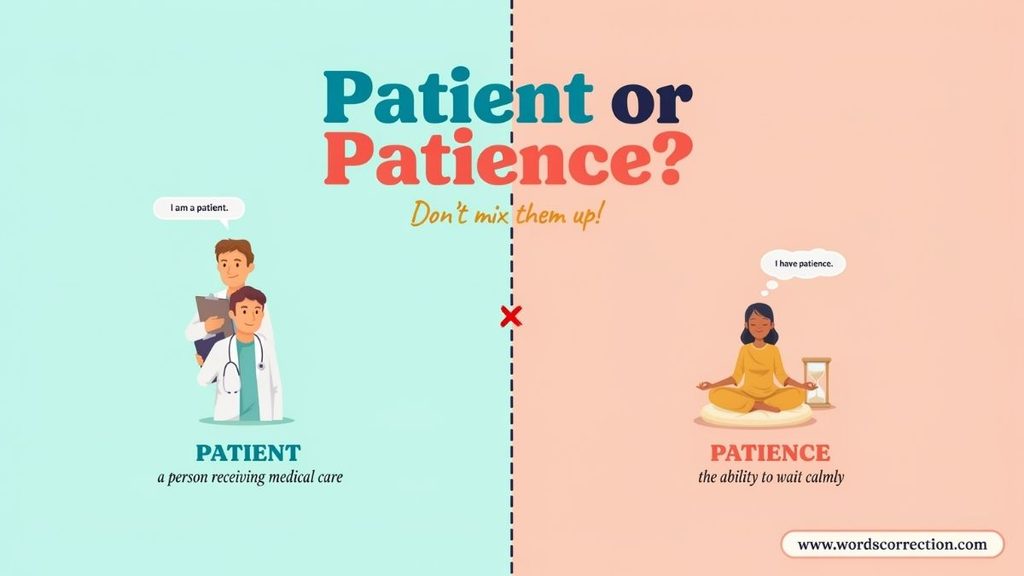
Use patience when you want to discuss the quality of remaining calm or enduring difficulties.
An abstract noun, patience can serve several grammatical roles.
As the subject of a sentence
- Patience helps children develop new skills.
- Patience is important during difficult conversations.
As the object of a verb
- She demonstrated patience during the interview.
- The long delay tested my patience.
- I need to develop more patience.
After a preposition
- Thank you for your patience.
- Success often comes with patience and practice.
- He handled the disagreement with patience.
You can also use patience with quantity words and modifiers:
- A little patience
- More patience
- Enough patience
- A great deal of patience
- Considerable patience
For example, “You need more patience to learn the piano” is correct because patience is the quality required for the task.
By contrast, “You need more patient to learn the piano” is incorrect in this context. If you want an adjective, you could write, “You need to be more patient to learn the piano.”
Learn the difference between basic English word mistakes
Don’ts or Don’t’s Which Spelling Is Correct?
Can You Say “Very Patient” or “Very Patience”?
This is one of the most common patient or patience grammar questions.
Very patient is correct. Very patience is incorrect in standard English.
The reason is simple: very commonly modifies adjectives in expressions such as very kind, very careful, and very patient. The noun patience doesn’t fit that grammatical pattern.
Compare these sentences
- Correct: She is very patient with her students.
- Incorrect: She is very patience with her students.
- Correct: She has a great deal of patience with her students.
- Correct: She is patient because she has learned to manage frustration.
The same rule applies to the phrase “she is very patient or patience.” If you’re describing how she behaves, choose patient. If you’re talking about the quality she possesses, rewrite the sentence using patience.
For example
- She is very patient when explaining math.
- She shows great patience when explaining math.
Both sentences are correct. They express the same general idea through different grammatical structures.
Learn the difference between often confused words
Appendix or Appendices Which one Is Correct?
Patient or Patience Common Expressions Explained
Certain everyday phrases cause more confusion than definitions do. Learning them as complete expressions can help you choose the right word without stopping to analyze every grammatical detail.
“Be Patient” or “Have Patience”?
Both expressions are correct, but they use different sentence structures.
Be patient uses patient as an adjective after the verb be. It describes the behavior you want someone to display.
Examples:
- Please be patient while I find your file.
- Try to be patient with yourself as you learn.
- Be patient; the results may take time.
Have patience uses patience as a noun. It refers to possessing or exercising the quality of calm endurance.
Examples:
- Please have patience while we investigate the problem.
- You need to have patience when teaching beginners.
- Have patience with yourself during the learning process.
The expressions often communicate the same practical message. The difference lies in how they frame it: one describes a person’s behavior, while the other refers to the quality behind that behavior.
Learn the difference between confusing word pairs
Skillset or Skill Set Which Spelling Is Correct?
“Thanks for Being Patient” or “Thanks for Your Patience”?
Both expressions are grammatically correct and natural in American English.
“Thanks for being patient” describes the person’s behavior during a situation.
For example:
“Thanks for being patient while I finished the report.”
“Thank you for your patience” refers to the quality the person demonstrated. It often sounds especially suitable in professional communication.
For example:
“Thank you for your patience while we resolve this issue.”
You can use either phrase in an email, conversation, or customer service message. Choose the version that best fits your tone.
| Situation | Natural expression |
| Asking someone to wait | Please be patient for a moment. |
| A professional email | Thank you for your patience. |
| A friendly conversation | Thanks for being patient with me. |
| A delayed service request | We appreciate your patience. |
| Learning something difficult | Have patience with yourself. |
A useful detail: “Thank you for your patient” is generally incorrect when you mean to thank someone for waiting. Use patience because the sentence needs a noun naming the quality.
You Are Patient or You Have Patience?
Both sentences are correct, but they emphasize different things.
- You are patient. This describes your behavior or personality.
- You have patience. This says you possess the quality of remaining calm.
- You are very patient. This emphasizes a high degree of patience.
- You have a lot of patience. This emphasizes the amount of the quality you demonstrate.
For example, “You are patient with your students” describes how you treat them. “You have a lot of patience with your students” highlights your ability to handle their questions and mistakes calmly.
Neither expression is universally better. The surrounding sentence determines which one sounds most natural.
Patient With Me or Patience With Me?
If you want to ask someone to tolerate your mistakes, delays, or learning process, both of these sentences work:
- Please be patient with me.
- Please have patience with me.
However, the following sentence doesn’t work in standard English:
- Incorrect: Please be patience with me.
The verb be needs an adjective in this construction, so patient is the correct choice. To use patience, change the structure to have patience with me.
Compare the two forms
“Please be patient with me while I learn the software.”
“Please have patience with me while I learn the software.”
Both are clear, polite requests. The first directly describes the behavior you want. The second refers to the quality required to respond calmly.
Learn the difference between tricky grammar more words
Wellbeing or Well-Being Which Spelling Is Correct?
Patients or Patience? Understanding the Difference
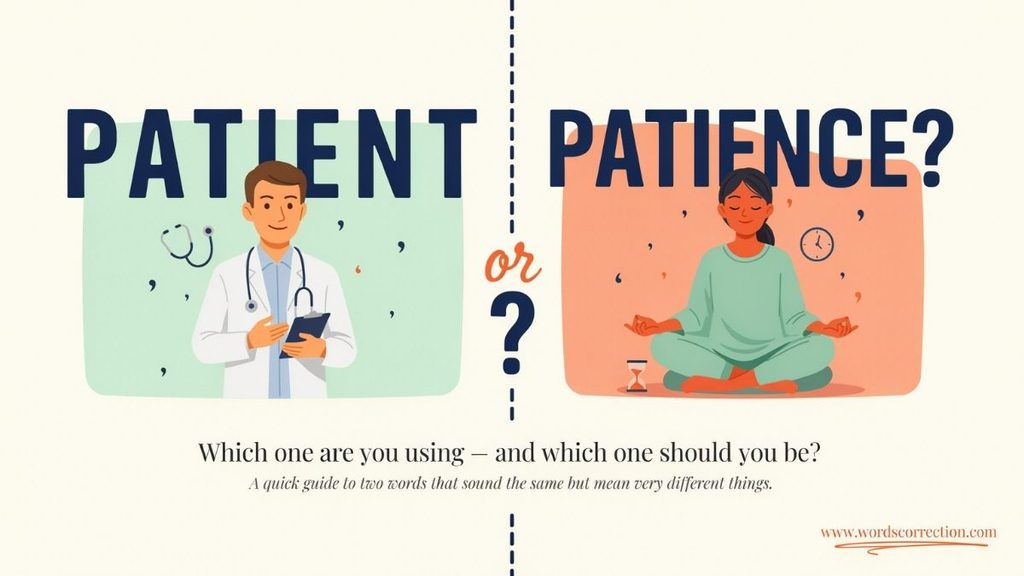
The difference between patients and patience is particularly important because both words appear in everyday English, but their meanings are entirely different.
Patients is the plural form of the medical noun patient. Patience is an abstract noun that describes the ability to wait calmly or endure difficulties.
Consider these examples
- The doctor examined five patients this morning.
- The nurse showed patience while explaining the medication.
- The hospital admitted several new patients.
- Waiting for test results requires patience.
The first and third sentences refer to people receiving medical care. The second and fourth refer to a personal quality.
What Is the Plural of Patient?
The plural of patient, when it refers to someone receiving medical care, is patients.
- One patient arrived at the clinic.
- Two patients arrived at the clinic.
- The doctor spoke with several patients.
The plural form follows the regular English pattern of adding -s to the singular noun.
However, when patient functions as an adjective, it doesn’t take a plural ending simply because the noun it describes is plural.
For example:
- The patient teacher helped the children.
- The patient teachers helped the children.
In the second sentence, teachers is plural, but patient remains unchanged because adjectives generally don’t change form to agree with singular or plural nouns in English.
Learn the difference between commonly mixed-up more words
Chose or Choose What’s the Difference?
Patient vs Patients vs Patience in a Hospital
Healthcare provides a useful way to understand all three words.
| Word | Meaning | Example |
| Patient | An adjective describing someone who waits calmly, or a noun referring to a person receiving care | The patient waited for the doctor. |
| Patients | The plural of the medical noun patient | The hospital treated several patients. |
| Patience | The ability to remain calm while waiting or facing difficulties | The nurse showed patience during a busy shift. |
In a doctor-and-patient relationship, patient refers to the person receiving medical care. A doctor may need patience when explaining a diagnosis or answering questions. The patient may also need patience while waiting for test results or recovering from an illness.
This context shows why spelling alone isn’t enough. You need to consider the word’s meaning and grammatical role.
Patient’s vs Patients’ vs Patience
Apostrophes introduce another set of commonly confused forms. The key is to distinguish ordinary nouns from possessive nouns.
When to Use Patient’s
Use patient’s when something belongs to one patient.
Examples
- The patient’s appointment begins at 10 a.m.
- The patient’s medical records are confidential.
- The doctor reviewed the patient’s test results.
The apostrophe followed by s indicates singular possession.
When to Use Patients’
Use patients’ when something belongs to multiple patients.
Examples
- The patients’ rooms were recently renovated.
- The hospital updated the patients’ records.
- The nurse answered the patients’ questions.
Because patients already ends in s, the apostrophe usually follows that final letter to indicate plural possession.
Learn the difference between confusing more English words
Leafs or Leaves Which one Is Correct?
Why Patience Doesn’t Need an Apostrophe
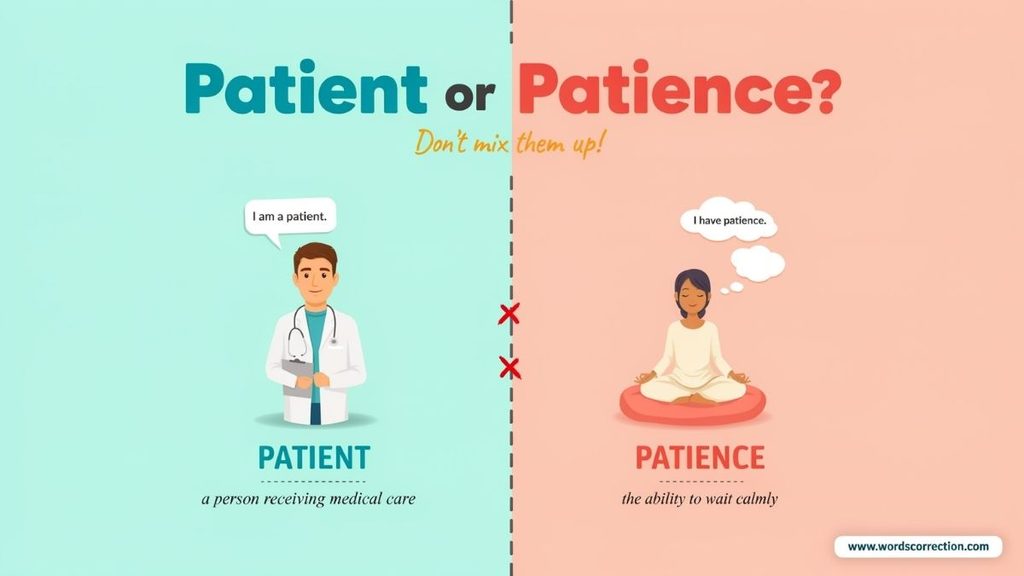
Patience is a complete noun, not a possessive form. You don’t need an apostrophe when you refer to the quality itself.
Correct examples
- Thank you for your patience.
- Her patience impressed the entire team.
- I appreciate your patience during the delay.
Incorrect in the intended meaning
- Thank you for your patience’s.
- The teacher showed a great deal of patient’s.
The correct spelling depends on the grammatical job. Use patience for the quality, patient’s for something belonging to one patient, and patients’ for something belonging to multiple patients.
Patient vs Patience Comparison Table
The following table brings the main distinctions together so you can check your word choice quickly.
| Word or phrase | Grammatical role | Correct use | Example |
| Patient | Adjective | Describes calm behavior | She is patient. |
| Patient | Singular noun | One person receiving medical care | The patient needs rest. |
| Patients | Plural noun | Two or more people receiving medical care | The patients are waiting. |
| Patience | Abstract noun | Names the ability to wait calmly | Patience takes practice. |
| Patient’s | Singular possessive | Shows possession by one patient | The patient’s chart is ready. |
| Patients’ | Plural possessive | Shows possession by multiple patients | The patients’ charts are ready. |
| More patient | Comparative adjective | Compares levels of patience | He is more patient now. |
| Most patient | Superlative adjective | Identifies the highest degree within a group | She is the most patient person here. |
The table also shows why patient can have more than one part of speech. It can function as an adjective describing behavior or a noun referring to someone receiving care. The sentence determines its role.
Patient or Patience in a Sentence Practical Examples
Definitions are useful, but sentence examples show how these words work in real situations.
Patient or Patience Examples in Everyday Life
At home
- My mother is patient when teaching me to cook.
- Parenting requires patience, especially during challenging moments.
- Please be patient while I finish cleaning the kitchen.
- I need more patience when helping my brother with homework.
The school
- The teacher was patient with students who struggled with the lesson.
- Learning mathematics takes time and patience.
- A patient tutor explains difficult ideas in different ways.
- The students showed patience while waiting for their results.
At work
- Our manager remained patient during the software outage.
- Thank you for your patience while we review your application.
- The team needs patience when solving complex problems.
- She is patient when training new employees.
In communication
- Please be patient while I explain my point.
- Good communication requires patience and careful listening.
- He showed patience instead of interrupting his colleague.
- I appreciate your patience during this misunderstanding.
These examples demonstrate that patient describes a person, while patience names a quality that helps people handle everyday situations.
Learn the difference between tricky words and use them correctly
Loosing or Losing Which Spelling Is Correct?
Examples of Patience in Difficult Situations
Patience doesn’t mean you must agree with everyone or accept every delay without question. It means managing your response instead of reacting impulsively.
For example, imagine that a colleague misunderstands your instructions. You could respond angrily and make the disagreement worse. Alternatively, you could explain the task again and ask which part needs clarification.
The second response demonstrates patience because it gives the conversation room to improve.
Here are more examples
- She exercised patience while waiting for an important decision.
- He lost his patience after the computer crashed for the third time.
- The repeated interruptions tested everyone’s patience.
- A little patience helped them resolve the disagreement.
- The coach remained patient even after the team made several mistakes.
Notice the common expressions exercise patience, lose patience, and test someone’s patience. These are useful patterns to learn because they appear frequently in spoken and written English.
Case Study Choosing the Right Word in a Professional Email
Imagine that a customer has waited two days for a response about a delayed order. You want to acknowledge the delay without sounding dismissive.
Consider three possible messages:
A: “Please be patience while we investigate your order.”
B: “Please be patient while we investigate your order.”
C: “Thank you for your patience while we investigate your order.”
For A contains a grammatical error because be requires the adjective patient in this structure.
Option B is correct and politely asks the customer to wait.
Option C is also correct. It thanks the customer for demonstrating patience and may sound more appropriate when acknowledging an existing delay.
The best choice depends on your purpose. If you’re asking the customer to wait, Option B works well. If you’re acknowledging their time and understanding, Option C is often stronger.
The lesson is simple correct grammar and appropriate tone work together. Choosing the right word helps you communicate clearly while maintaining a professional relationship.
How to Remember Patient vs Patience
The easiest way to remember the difference is to connect each word with its job in a sentence.
Patient describes patience names
Think of these two sentences:
- Maria is patient.
- Maria has patience.
The first describes Maria. The second names the quality Maria possesses.
You can also use the following memory trick:
- Patient ends in -ent. Think of an adjective describing a person.
- Patience ends in -ence. Think of a noun naming a quality.
This is a memory aid, not a universal spelling rule for English. Still, it works well for these two words.
Another approach is to memorize common expressions as complete phrases:
- Be patient.
- Remain patient.
- Have patience.
- Show patience.
- Lose patience.
- Thank you for your patience.
Once these patterns become familiar, choosing the correct form feels more natural.
Learn the difference between similar English words the easy way
Mangoes or Mangos Which Spelling Is Correct?
How to Spell Patient and Patience Correctly
The correct spelling of patient or patience depends on which word you need. Both are spelled correctly as shown here, but they have different endings and meanings.
- Patient: P-A-T-I-E-N-T
- Patience: P-A-T-I-E-N-C-E
- Patients: P-A-T-I-E-N-T-S
The main spelling difference appears near the end of each word. Patient ends in -ent, while patience ends in -ence. Patients adds -s to the medical noun patient to form its plural.
How to Spell Patience
Write patience when you mean the ability to wait calmly or endure difficulties.
Examples
- Thank you for your patience.
- Patience helps you learn from mistakes.
- I need to develop more patience.
A useful check is to ask whether you could replace the word with the ability to wait calmly. If that meaning fits, patience may be the word you need.
How to Spell Patient
Write patient when describing someone who remains calm or referring to someone receiving medical care.
Examples
- She is a patient teacher.
- Please be patient with me.
- The patient spoke with the doctor.
A useful check is to ask whether you’re describing someone’s behavior or referring to a person receiving care. If either meaning fits, patient is likely correct.
The spelling rules are the same in American English and British English. Neither variety changes these words to a different standard spelling.
Common Mistakes When Using Patient and Patience
Even experienced writers can confuse similar words when typing quickly. Recognizing the most frequent errors makes proofreading easier.
| Incorrect sentence | Correct sentence | Why? |
| She is very patience. | She is very patient. | Very modifies the adjective patient. |
| Please be patience with me. | Please be patient with me. | The verb be takes an adjective here. |
| Thank you for your patient. | Thank you for your patience. | The sentence needs a noun naming the quality. |
| The doctor treated several patience. | The doctor treated several patients. | The plural medical noun is patients. |
| I need to be more patience. | I need to be more patient. | The sentence describes how the speaker should behave. |
| I need more patient. | I need more patience. | The sentence refers to the quality itself. |
| The patients appointment is tomorrow. | The patient’s appointment is tomorrow. | The apostrophe marks singular possession. |
| The patients’ are waiting. | The patients are waiting. | A simple plural noun doesn’t need an apostrophe. |
The most reliable way to correct these mistakes is to examine the entire sentence. Don’t choose a word simply because it looks familiar or resembles another word.
Instead, ask yourself three questions:
- Am I describing someone?
- Am I naming a quality?
- Am I referring to one or more people receiving medical care?
Your answers will usually point you toward the correct word.
Practice Questions Patient or Patience
Complete each sentence with the correct word patient or patience.
- Please be ______ while you wait for your results.
- Thank you for your ______ during the meeting.
- She is very ______ with young children.
- Learning a new language requires ______.
- The teacher asked the students to be ______.
- I don’t have the ______ to wait any longer.
- You need to be ______ when learning a new skill.
- His ______ helped him overcome many challenges.
- Please be ______ with me while I explain the process.
- The doctor treated every ______ with care.
- Good parents often show ______ when teaching their children.
- You must remain ______ during difficult situations.
- Thank you for being so ______ with us.
- My ______ was tested by the long delay.
- A good teacher should be ______ with students.
- She has the ______ to handle stressful situations.
- The nurse spoke kindly to each ______.
- Developing new skills takes time and ______.
- Please have ______ while the computer restarts.
- He is a ______ person who rarely gets upset.
- The hospital admitted several new ______ today.
- You need ______ to achieve long-term goals.
- I appreciate your ______ while I finish my work.
- Try to be ______ when things don’t go as planned.
- With enough ______, you can learn to manage frustration.
Answer
- patient
- patience
- patient
- patience
- patient
- patience
- patient
- patience
- patient
- patient
- patience
- patient
- patient
- patience
- patient
- patience
- patient
- patience
- patience
- patient
- patients
- patience
- patience
- patient
- patience
Here’s a trusted source for clear more words Comparison:
Grammar Update
FAQs About Patient or Patience
What is the difference between patient and patience?
“Patient” is an adjective that describes someone who can wait calmly or tolerate difficulties. “Patience” is a noun that refers to the ability to remain calm while waiting or facing challenges.
Is it please be patient or please be patience?
“Please be patient” is correct because “patient” is an adjective describing how someone should behave. “Patience” is a noun and cannot replace “patient” in this sentence.
Should I say thank you for your patience or thank you for your patient?
“Thank you for your patience” is correct. The word “patience” refers to someone’s willingness to wait calmly, making it the appropriate choice in this expression.
Is it correct to say be patient with me?
Yes, “be patient with me” is grammatically correct. It politely asks someone to remain calm while you complete a task, explain something, or work through a difficulty.
Can I say have patience with me?
Yes, “have patience with me” is correct. It asks someone to tolerate delays, mistakes, or difficulties without becoming frustrated.
Is I’m patience correct English?
No, “I’m patience” is incorrect. The correct expression is “I’m patient” because “patient” is an adjective. You can also say “I have patience” to describe your ability to remain calm.
What does patient mean as an adjective?
As an adjective, “patient” describes someone who can wait calmly or tolerate difficulties without becoming easily annoyed. For example, “The teacher is patient with her students.”
What does patience mean in simple words?
Patience is the ability to wait calmly, tolerate delays, and deal with difficulties without becoming upset or frustrated.
Can patient be used as a noun?
Yes. As a noun, “patient” refers to someone receiving medical care from a doctor or another healthcare professional. For example, “The patient is waiting for the doctor.”
What is the difference between patient and patients?
“Patient” can be an adjective describing someone who waits calmly or a singular noun referring to someone receiving medical care. “Patients” is the plural form of the medical noun, referring to two or more people receiving treatment.
Is patience a noun or an adjective?
“Patience” is a noun. It refers to the ability to wait calmly, tolerate difficulties, or remain composed in challenging situations.
How do you use patience in a sentence?
Use “patience” when referring to the ability to remain calm or tolerate a difficult situation. For example, “Learning to manage a busy schedule requires patience.”
What is the plural form of patient?
The plural form of the noun “patient,” meaning someone receiving medical care, is “patients.” When “patient” functions as an adjective, it does not change to indicate plural subjects. For example, “The students are patient.”
What are some common expressions with patience?
Common expressions include “have patience,” “show patience,” “lose patience,” “test someone’s patience,” and “thank you for your patience.” These phrases describe how people handle waiting, delays, and difficult situations.
Is please have patient correct?
No, “please have patient” is incorrect in this context. The correct expression is “please have patience” because “patience” is the noun needed after “have.”
How can I remember the difference between patient and patience?
Remember that “patient” describes a person or refers to someone receiving medical care, while “patience” names the quality of remaining calm. For example, “She is patient” describes her behavior, while “She has patience” identifies a quality she possesses.
What is an example of being patient at work?
Waiting calmly for a colleague to complete a task instead of rushing or criticizing them is an example of patience at work. This behavior supports respectful communication and effective teamwork.
What is an example of patience in everyday life?
Waiting calmly in a long queue without becoming angry is a simple example of patience. Instead of allowing the delay to cause frustration, you accept the situation and wait your turn.
What is the opposite of patience?
The most direct opposite of patience is “impatience.” Other related words include irritability and intolerance, depending on the context.
What are some synonyms for patience?
Synonyms for patience include tolerance, forbearance, endurance, and perseverance. “Composure” may also fit when the focus is on remaining calm under pressure, although each word has a slightly different meaning.
Why is patience important in communication?
Patience helps people listen carefully, understand different viewpoints, and respond thoughtfully. It can reduce misunderstandings, prevent unnecessary arguments, and strengthen relationships.
How can someone develop more patience?
You can develop patience by recognizing what triggers frustration, setting realistic expectations, pausing before reacting, and accepting that some tasks take time. Practicing these habits regularly can help you respond more calmly to challenging situations.
Is patience a skill or a personal quality?
Patience is both a personal quality and a skill that can be developed. With practice, people can improve their emotional control, handle delays more effectively, and respond thoughtfully to difficulties.
Why do people confuse patient and patience?
People often confuse “patient” and “patience” because the words look and sound similar and share related meanings. However, they have different grammatical roles: “patient” is an adjective or a singular noun, while “patience” is an abstract noun.
Which sentence is correct She has patience or She is patience?
“She has patience” is correct because “patience” is a noun that follows “has.” You can also say “She is patient” because “patient” is an adjective that describes her behavior. Both sentences are correct, but they use different grammatical structures.
Conclusion
Understanding the difference between patient and patience helps you communicate clearly and avoid common grammar mistakes. Patient can refer to someone receiving medical care or describe a person who remains calm while waiting. Patience, on the other hand, is the ability to tolerate delays or difficulties without becoming frustrated. Confusing these words may not cause a medical emergency, but it can certainly leave your readers puzzled
The key is to remember their meanings and use each word in the right context. You can be patient while waiting for an appointment, but you need patience when the doctor is running late. With a little practice and attention to detail, you can use both words accurately and confidently. After all, mastering grammar takes patience, but it shouldn’t test yours.

Stella AJS is an experienced blogger and dedicated English language writer at Words Correction. She turns confusing grammar, word meanings, spelling, and usage into clear, practical insights that readers can easily understand and apply. With a passion for precise and engaging writing, Stella helps readers avoid common language mistakes, strengthen their vocabulary, and communicate with greater clarity and confidence.