Spelling confusion can make even familiar words surprisingly tricky. If you’re searching for presence or presense, you’re dealing with a common mistake that catches many careful writers off guard. The two forms look remarkably similar, while their pronunciation can make the incorrect spelling seem perfectly reasonable. However, only one is correct in standard English: presence. The spelling presense is simply a common error, not an alternative form or regional variation. In this guide, you’ll learn the meaning, spelling, pronunciation, common mistakes, and practical uses of presence. By the end, you’ll know exactly which spelling to choose and how to avoid this sneaky mistake in your writing.
Presence or Presense: Quick Answer
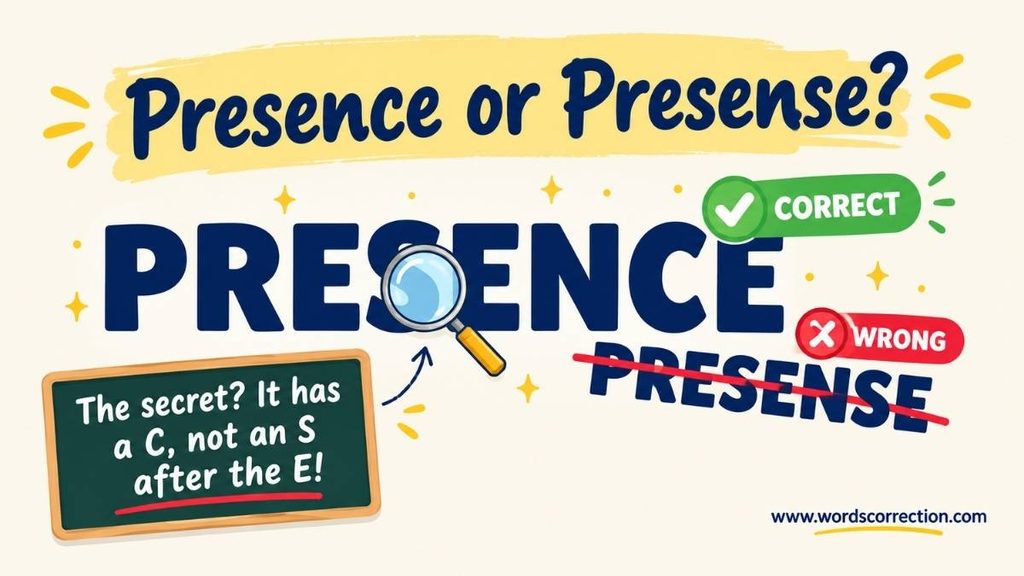
The correct spelling is presence.
Presense is an incorrect spelling and is not a standard English word.
| Word | Correct? | Meaning |
| Presence | Yes | The state or fact of being present or existing in a particular place |
| Presense | No | Common misspelling of presence |
Presence Correct Spelling and Meaning
Presence is the standard spelling.
It is a noun related to the word present. Depending on the context, it can refer to being physically somewhere, existing in a particular place, or having a noticeable influence or quality.
For example:
- Your presence at the meeting was important.
- She has a strong presence in the workplace.
- The presence of security cameras made everyone more cautious.
- His presence in the room immediately changed the atmosphere.
Presense Why It Is Incorrect
Presense is a spelling mistake.
Although it may look logical because of the pronunciation of presence, standard English does not spell the word with -sense at the end.
The correct form is:
presence
Not
presense
This distinction matters in professional writing, academic work, websites, emails, resumes, and other situations where accurate spelling creates a strong impression.
Correct Examples of Presence
Here are several examples of the correct spelling:
- Her presence made the event more enjoyable.
- The manager noticed his presence in the office.
- The company has a growing online presence.
- The presence of water is essential for life.
- He remained calm and showed remarkable presence of mind.
Incorrect Examples of Presense
These sentences contain the common spelling error:
- Incorrect: Her presense made everyone feel welcome.
- Correct: Her presence made everyone feel welcome.
- Incorrect: The presense of the teacher changed the classroom atmosphere.
- Correct: The presence of the teacher changed the classroom atmosphere.
- Incorrect: The company has a strong online presense.
- Correct: The company has a strong online presence.
What Does Presence Mean?
If you’re searching for the presence definition, the simplest explanation is this:
Presence means the state or fact of being present, existing, or noticeable in a particular place or situation.
The exact meaning changes slightly depending on how you use the word.
Presence as Being in a Place
The most basic meaning of presence relates to being present somewhere.
It can describe a person physically being in a location.
For example:
The student’s presence at school was recorded.
Here, presence refers to the student being physically at school.
In this sense, synonyms can include attendance, existence, or being there, depending on the context.
Consider these examples:
- The employee’s presence at work was required.
- Her presence at the ceremony meant a lot to her family.
- The teacher appreciated everyone’s presence at the meeting.
Presence as a Noticeable Quality
Presence can also describe a person’s manner, confidence, appearance, or influence.
Someone with a strong presence may naturally attract attention without saying much.
For example:
The speaker had a commanding presence on stage.
This doesn’t simply mean the speaker was physically there. It suggests that the speaker appeared confident, powerful, or influential.
You might describe someone as having:
- a strong presence
- an impressive presence
- a powerful presence
- a noticeable presence
- a commanding presence
- a professional presence
Presence in Business and Technology
The word presence has also become common in business and digital communication.
A company’s online presence refers to how it appears and operates on the internet.
This may include its:
- website
- social media accounts
- online publications
- digital advertising
- customer reviews
- search visibility
For example
The company has built a strong online presence over the past five years.
Here, presence doesn’t mean that the company is physically located on the internet. It describes the company’s visibility, activity, and representation in the digital environment.
Why Is Presence Spelled With a “C”?
One of the easiest ways to understand the spelling is to connect presence with present.
The word is spelled:
present → presence
The spelling uses c, not s, before the final e.
This is one reason presense is incorrect. People often hear the word and assume the ending should resemble the word sense.
Presence vs. Present
The words present and presence are closely related, but they don’t function in exactly the same way.
Present can be an adjective, noun, or verb depending on the context.
For example:
- She is present at the meeting.
- He gave me a birthday present.
- The manager will present the report tomorrow.
Presence is a noun.
For example:
- Her presence at the meeting was appreciated.
A useful distinction is:
Present = being there or existing now
Presence = the state or fact of being present
The relationship becomes especially clear in sentences such as:
His presence was noticeable.
and
He was present in the room.
Presence or Presense: British English and American English
Some spelling differences between American and British English can cause confusion.
For example, American English often uses color, while British English uses colour. Similarly, American English usually uses center, while British English uses centre.
However, presence is not one of those words.
Both major varieties of English use the same spelling:
presence
Learn the difference between everyday English mistakes
Lader or Ladder Which One Is Correct?
American English vs British English Comparison
| Variety | Correct Spelling | Incorrect Spelling |
| American English | presence | presense |
| British English | presence | presense |
| Canadian English | presence | presense |
| Australian English | presence | presense |
So, if you’re wondering whether presense might be the British version of presence, the answer is no.
Is “Presense” Ever Correct?
No. Presense is not a standard English spelling.
It may appear in informal online writing, social media posts, comments, or user-generated content because people make spelling mistakes. Its appearance in search results or casual writing does not make it an accepted spelling.
Use presence in formal and informal writing.
Presence Pronunciation
Pronunciation can explain why people make the presence spelling mistake.
Presence is commonly pronounced approximately like:
PREZ-uhns
The ending sounds similar to words that contain an -s sound. As a result, someone may incorrectly assume that the spelling should be presense.
This is a classic example of why English spelling cannot always be predicted from pronunciation.
The sound may suggest one spelling, while the standard written form uses another.
Why Pronunciation Can Cause the “Presense” Mistake
Consider how the word sounds when spoken quickly:
presence
Because the final part sounds similar to sense, a writer may unconsciously connect the two words.
That can produce:
presense
The solution is simple: remember the written form rather than relying entirely on sound.
Common Mistakes With Presence
The incorrect spelling presense isn’t random. Several common habits can lead to it.
Spelling the Word by Sound
English contains many words whose pronunciation doesn’t provide a reliable spelling guide.
If you write presence exactly as it sounds, you might naturally arrive at presense.
That’s why learning the visual spelling of the word can be more useful than trying to spell it phonetically.
Confusing Presence With Sense
The word sense is spelled with an s, so it can influence the spelling of presence.
For example:
sense
has an s.
But:
presence
has a c.
Although presence sounds somewhat similar to a combination involving sense, the words have different spellings and meanings.
Confusing Presence With Presents
Another common source of confusion is presence and presents.
These words look and sound similar in some contexts, but their meanings differ.
Presence means being present or having a noticeable quality.
Presents can mean gifts.
For example:
- Her presence made the celebration special.
- She received several birthday presents.
The first sentence describes someone’s being there. The second refers to gifts.
Confusing Presence With Present
The relationship between present vs. presence can also create confusion.
Compare:
- The doctor was present.
- The doctor’s presence was reassuring.
In the first sentence, present describes the doctor’s state.
In the second, presence is the noun describing the doctor’s being there.
Assuming Presense Is a Regional Spelling
English has many regional spelling differences. However, presense isn’t one of them.
Don’t assume that presense is an alternative British, Canadian, or Australian spelling.
The standard spelling remains:
presence
Learn the difference between tricky grammar more words
Emerse or Immerse Correct Spelling and Use
Presence vs. Related Words
Understanding related words makes the spelling easier to remember.
Presence vs Present
Present can describe someone who is in a particular place.
Presence refers to the state or fact of being there.
Example:
The director was present at the meeting.
The director’s presence was important to the team.
Presence vs Presents
These words have different meanings.
Presence = being present or a noticeable quality
Presents = gifts, or the third-person singular form of the verb present
Examples:
- Her presence was comforting.
- He bought several presents for his children.
- The manager presents the findings every Friday.
Presence vs Presense
This is primarily a spelling issue.
Presence is correct.
Presense is incorrect.
There is no difference in meaning because presense is not the accepted spelling of a separate English word.
Presence vs Absence
Absence is commonly used as the opposite of presence.
Presence = being there
Absence = not being there
For example:
- Her presence was noticed immediately.
- Her absence was noticed immediately.
This contrast provides another useful way to remember the word.
How to Use Presence in a Sentence
Learning the presence usage is easier when you see the word in different contexts.
Everyday Examples
- I appreciated your presence at the dinner.
- His presence in the room made me feel safer.
- The child’s presence brought energy to the gathering.
- Your presence means more than you realize.
Professional Examples
- Attendance and presence are important during team meetings.
- The manager has a strong professional presence.
- Her presence at the conference helped strengthen the company’s reputation.
- The organization maintains a significant presence in the region.
Online and Digital Examples
- The brand has developed a strong online presence.
- Social media has changed how businesses establish their presence.
- The company wants to strengthen its digital presence.
- A professional online presence can influence how customers perceive a business.
Common Phrases With Presence
You’ll encounter presence in many established phrases.
Physical Presence
Physical presence means being physically located somewhere.
Example:
The company requires employees to maintain a physical presence in the office on certain days.
In the Presence of
In the presence of means while someone or something is present.
Example:
The agreement was signed in the presence of two witnesses.
Strong Presence
A strong presence describes someone or something that is noticeable, influential, or prominent.
Example:
The organization has a strong presence in the local community.
Impressive Presence
An impressive presence suggests that someone creates a noticeable or positive impression.
Example:
The speaker had an impressive presence on stage.
Commanding Presence
A commanding presence describes someone who naturally attracts attention and conveys confidence or authority.
Example:
The experienced coach has a commanding presence in the locker room.
Online Presence
An online presence refers to a person, business, organization, or brand’s visibility and activity on the internet.
Example:
Small businesses increasingly rely on a strong online presence to reach customers.
Social Presence
Social presence describes how noticeably or actively a person or organization participates in social interactions, particularly in digital environments.
Example:
The brand has developed a friendly social presence across several platforms.
Presence of Mind
Presence of mind means remaining calm, alert, and capable of thinking clearly in a difficult or unexpected situation.
Example:
She had the presence of mind to call for help immediately.
This expression is particularly useful because it shows that presence doesn’t always refer to physical location.
How to Remember the Correct Spelling of Presence
If you frequently make the presense spelling mistake, a few simple memory tricks can help.
Remember “Present + -ence”
Think of the word as being closely connected to present:
present → presence
The spelling contains c:
pre-sen-ce
Not:
pre-sen-se
Don’t Let “Sense” Trick You
The ending of presence can sound like sense, but the spelling isn’t based on the word sense.
When you hear the word, don’t automatically write:
presense
Instead, remember:
presence
Learn the difference between often confused words
Gos or Goes Which One Is Right?
Use the Word in Context
Writing the word repeatedly in meaningful sentences can reinforce the correct spelling.
For example:
- Your presence is appreciated.
- The presence of evidence changed the case.
- She has a strong presence at work.
- The company has an established online presence.
The more familiar the correct form becomes, the less likely you are to type presense.
Presence or Presense Comparison Table
| Feature | Presence | Presense |
| Correct spelling | Yes | No |
| Standard English word | Yes | No |
| Part of speech | Noun | — |
| Refers to being present | Yes | — |
| Used in American English | Yes | No |
| Used in British English | Yes | No |
| Common spelling mistake | No | Yes |
| Example | Her presence was reassuring. | Her presense was reassuring. |
The comparison is straightforward: presence is the correct spelling, while presense is a misspelling.
A Simple Case Study Why “Presense” Looks Correct
Imagine you’re writing this sentence:
The presence of the manager changed the atmosphere.
You know how the word sounds, but you aren’t completely sure how to spell it.
You might think:
pre-sense
Then you type:
presense
The mistake seems reasonable because English contains the word sense, and the pronunciation can make the spelling feel natural.
However, the correct spelling is:
presence
This is an excellent example of why spelling by sound can be unreliable in English.
The best solution isn’t to memorize dozens of complicated spelling rules. Instead, recognize common words visually and connect them with related words.
For presence, the connection with present is especially useful.
Why Correct Spelling Matters
A single spelling error may seem insignificant, but repeated errors can affect how readers perceive your writing.
Imagine reading a professional report that repeatedly uses presense instead of presence.
You might understand the intended meaning immediately. Still, the mistake could make the document appear less carefully edited.
Correct spelling matters particularly in:
- academic writing
- business communication
- resumes
- websites
- blog posts
- professional emails
- marketing materials
- reports
- presentations
- educational content
A correct spelling doesn’t automatically make writing excellent. However, obvious spelling mistakes can distract readers from otherwise strong content.
Presence in Everyday Writing
The word appears naturally in many situations.
At School
The teacher recorded each student’s presence at the event.
At Work
Her presence at the meeting helped the team make a decision.
At an Event
His presence at the ceremony made the occasion more meaningful.
In the Workplace
Professional presence can influence how colleagues perceive you.
In a Room
Everyone noticed the presence of an unfamiliar person in the room.
In Business
The company has expanded its presence in international markets.
Online
The organization is working to improve its online presence.
These examples demonstrate how flexible the word can be.
Presence Definition in English
For a straightforward presence definition in English, think of the word as referring to being present, existing somewhere, or having a noticeable influence or quality.
Its meaning can involve:
- being in a particular place
- attendance
- existence
- proximity
- visibility
- influence
- personal bearing
- online activity
- mental alertness in the phrase presence of mind
The surrounding sentence determines the precise meaning.
Presence Synonyms
Depending on the context, useful presence synonyms include:
- attendance
- existence
- appearance
- proximity
- being
- company
- influence
- visibility
- participation
- nearness
These aren’t perfect substitutes in every sentence.
For example, attendance works well when talking about an event:
Her attendance at the meeting was recorded.
But it doesn’t always replace presence when discussing someone’s personal influence:
She has a commanding presence.
You wouldn’t normally replace that with:
She has a commanding attendance.
“Practice Session Presence or Presense”
Fill in each blank
- We were grateful for your ________ at the ceremony.
- Her ________ made the room feel more welcoming.
- The correct spelling of the word is ________.
- His ________ was immediately noticed by everyone.
- The manager requested my ________ at the meeting.
- The teacher appreciated the students’ ________ in class.
- Your ________ at the event meant a lot to us.
- The word “________” is a common spelling mistake.
- The security guard noticed the ________ of an unfamiliar person.
- Her confident ________ impressed the audience.
- We enjoyed his ________ during the discussion.
- The company values the ________ of its employees at important meetings.
- Please confirm your ________ at tomorrow’s appointment.
- The correct word is “________,” not “presense.”
- His calm ________ helped everyone feel comfortable.
- The doctor requested the patient’s ________ for the appointment.
- The speaker’s ________ attracted everyone’s attention.
- The students were asked to explain the meaning of “________.”
- Thank you for your ________ and support.
- The child became nervous in the ________ of so many people.
- The word “presense” should be corrected to “________.”
- Her strong ________ made her a natural leader.
- The teacher marked “presense” as an incorrect spelling and replaced it with “________.”
- We appreciated your ________ at the celebration.
- The correct noun for the state of being present is “________.”
Answer Session
- presence
- presence
- presence
- presence
- presence
- presence
- presence
- presense
- presence
- presence
- presence
- presence
- presence
- presence
- presence
- presence
- presence
- presence
- presence
- presence
- presence
- presence
- presence
- presence
- presence
Here’s a trusted source for clear more words Comparison:
Grammar Update
FAQ’s
What Is the Correct Spelling: “Presence” or “Presense”?
The correct spelling is presence. Presense is an incorrect spelling and should not be used in standard English.
What does “presense” mean?
Presense does not have a recognized meaning in standard English. It is a common misspelling of presence.
How do you spell “presence” correctly?
Presence is spelled P-R-E-S-E-N-C-E.
How do you spell “presence” when referring to being somewhere?
When referring to the state of being in a particular place, the correct spelling is presence.
How do you spell “present” when referring to a gift?
When referring to a gift, the correct spelling is present. For example, “She gave me a birthday present.”
Presence vs Presense: What Is the Difference?
Presence is the correct English word, while presense is a misspelling. It refers to the state of being present or the noticeable quality of someone or something. The term presence can also describe the way a person appears or makes an impression.
Is “presense” a correct English word?
No. Presense is not the standard spelling. The correct word is presence.
What does “presence” mean?
Presence means the state or fact of being in a particular place. It can also describe the noticeable or influential quality a person has.
What does “a person’s presence” mean?
A person’s presence refers to their being physically or noticeably present in a particular place or situation.
What is the opposite of “presence”?
The most common opposite of presence is absence, which means the state of being away or not present.
What is another word for “presence”?
Depending on the context, synonyms for presence include attendance, existence, appearance, proximity, and company.
What is another word for the presence of a person?
Depending on the context, you can use attendance, company, appearance, or existence to describe a person’s presence.
What is another word for a lack of presence?
The most appropriate word for a lack of presence is absence.
What is a formal word for “not present”?
The standard formal word for “not present” is absent.
What is the noun for not being present?
The noun is absence, which refers to the state of being away or not present.
How do you use “presence” in a sentence?
Example: “Her presence made the meeting more enjoyable.”
Can you give examples of “presence” in a sentence?
Examples include:
- “His presence was immediately noticed.”
- “We appreciated your presence at the ceremony.”
- “The teacher requested the student’s presence in the office.”
Is “presence” a noun?
Yes. Presence is a noun that refers to the state or fact of being present, as well as the impression or influence a person may have.
How is “presence” pronounced?
Presence is commonly pronounced PREZ-uhns.
What is the difference between “present” and “presence”?
Present can refer to something existing now, someone who is in a particular place, or a gift. Presence refers to the state or condition of being present.
What is the difference between “presence” and “presents”?
Presence means the state of being present. Presents can refer to multiple gifts or serve as the third-person singular form of the verb present.
Are “presence” and “present” related words?
Yes. Both words are related to the idea of being present, but they have different meanings and grammatical functions.
Why Is “Presence” Often Misspelled as “Presense”?
The spelling presense is a common error because the pronunciation of presence can make the final -ence ending easy to confuse with -ense.
How can you remember the spelling of “presence”?
A useful way to remember it is to associate presence with its opposite, absence. Both words end in -ence.
Which Is Correct: “Presence” or “Presense”?
“Your presence” is correct. For example: “Thank you for your presence at the event.”
Conclusion
The confusion between presence or presense may seem like a minor spelling issue, but small mistakes can easily sneak into otherwise polished writing. The correct spelling is presence, while presense is simply a misspelling. It isn’t an alternative spelling in American or British English.
A helpful way to remember the correct form is to connect presence with present. When you remember that relationship, the troublesome “s” in presense has nowhere to hide.
Whether you’re writing about someone’s physical presence, a company’s online presence, or someone’s presence of mind, always choose presence. One small letter can make the difference between a polished sentence and a distracting spelling mistake.

Stella AJS is an experienced blogger and dedicated English language writer at Words Correction. She turns confusing grammar, word meanings, spelling, and usage into clear, practical insights that readers can easily understand and apply. With a passion for precise and engaging writing, Stella helps readers avoid common language mistakes, strengthen their vocabulary, and communicate with greater clarity and confidence.