
English grammar has a curious way of making even simple verbs surprisingly confusing. The question of gos or goes is a perfect example. At first glance, adding an -s to go might seem logical, but English has other plans. The correct third-person singular form is goes, while gos isn’t the standard verb form. This small spelling difference can cause unnecessary mistakes in everyday writing, especially for English learners. In this guide, you’ll discover why go becomes goes, when to use each form, the grammar rules behind the change, and common mistakes to avoid, with clear examples to make the difference easy to remember.
Gos or Goes Quick Answer
If you’re deciding between gos or goes as a verb, goes is correct.
| Word | Correct? | Grammatical use |
| go | Yes | Base form of the verb |
| goes | Yes | Third-person singular present form |
| gos | No | Not the standard verb form of go |
Consider these examples:
- I go to work every day.
- You go to work every day.
- We go to work every day.
- They go to work every day.
- He goes to work every day.
- She goes to work every day.
- The bus goes to the city center.
The basic rule is:
Use “goes” with a singular third-person subject in the simple present tense.
That means he goes, she goes, it goes, and John goes are correct.
By contrast, I go, you go, we go, and they go are correct.
Gos or Goes Meaning
The question gos or goes meaning is really a question about how the two forms function in English.
Go is the base form of the verb. It can describe movement, travel, participation, progress, or many other actions.
Goes is the third-person singular present form of that verb.
For example:
- I go to school.
- She goes to school.
Both sentences describe the same general action. The verb changes because the subject changes.
Gos, however, isn’t the standard third-person singular form of go. It shouldn’t be used in ordinary English sentences as a replacement for goes.
Why Is It “Goes” Instead of “Gos”?
The spelling goes follows an English verb-conjugation pattern.
Many verbs form their third-person singular present tense by adding -s:
- work → works
- play → plays
- read → reads
- walk → walks
But verbs ending in -o often take -es.
For example:
- go → goes
- do → does
- echo → echoes
- veto → vetoes
Therefore, the correct spelling isn’t gos. It’s goes.
The important spelling pattern is:
go + es = goes
This is a spelling and grammatical rule, not a difference between American and British English. Goes is the standard form in both varieties.
Why Does Go Become Goes?
English doesn’t always form third-person singular verbs by adding a single -s.
The verb go is one of the forms learners need to memorize because its third-person singular spelling is goes.
Compare:
- I go home.
- She goes home.
The change is part of the normal conjugation of the verb.
This also explains why writing gos is a common spelling error. The writer knows that a third-person singular verb usually needs an -s, but applies the rule too literally.
The correct form must be learned as:
go → goes
What Does “Goes” Mean?
So, what does goes mean?
As a verb, goes means essentially the same thing as go, but it is used with a third-person singular subject in the simple present tense.
The exact meaning changes according to context.
“Goes” as the Third-Person Singular Form of “Go”
In the simple present tense, use goes with:
- he
- she
- it
- one person
- one animal
- one thing
- another singular noun
Examples:
- He goes to school.
- She goes to the office.
- It goes under the table.
- Daniel goes home at six.
- The cat goes outside every morning.
The subject doesn’t have to be a person. Any singular subject can require goes.
For example:
- The train goes through the tunnel.
- The machine goes through several stages.
- The car goes very fast.
- The company goes through regular inspections.
“Goes” for Movement
One common meaning of goes relates to moving from one place to another.
- She goes to work by train.
- The bus goes downtown.
- My brother goes to the market every evening.
“Goes” for Habits and Routines
The simple present often describes repeated actions or routines.
- He goes jogging every morning.
- She goes shopping on Saturdays.
- My father goes to the gym after work.
The action doesn’t need to happen every single day. The simple present can describe a regular or habitual activity.
“Goes” for Progress
The verb can also describe how something develops or progresses.
- Everything goes smoothly.
- The project goes according to plan.
- The meeting goes well.
Here, goes doesn’t necessarily mean physical movement. The surrounding context determines the meaning.
“Goes” for Sounds, Stories, and Sequences
You may also see goes when describing the way something sounds or unfolds.
- The song goes like this.
- The story goes something like this.
- The saying goes that patience is important.
Again, the meaning comes from the context, but the grammatical form remains goes because the subject is singular.
Learn the difference between confusing word pairs
Lader or Ladder Which One Is Correct?
What About “Gos”?
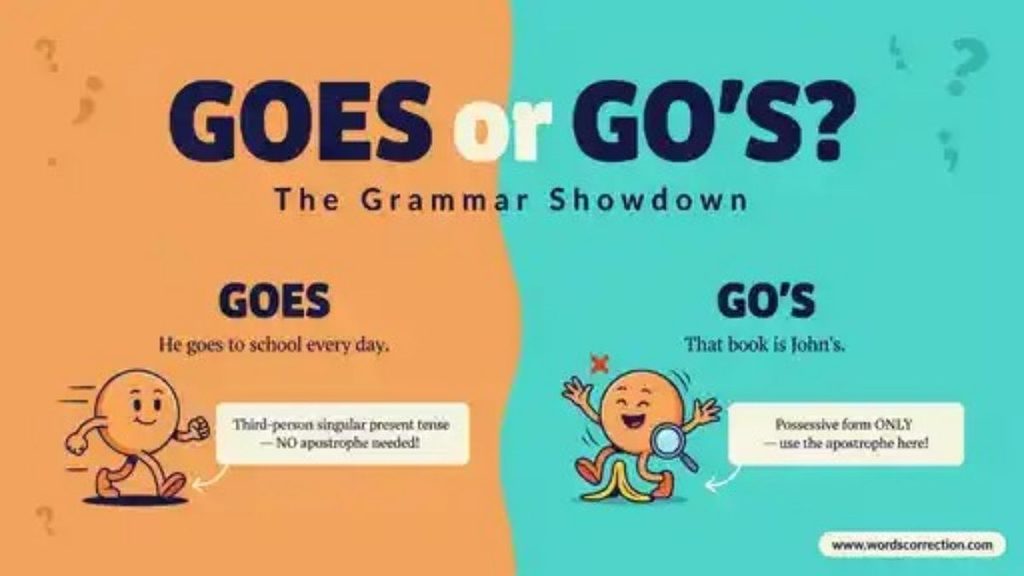
If you’re asking is gos a word, there is an important distinction to make.
Gos isn’t the standard English third-person singular form of the verb go.
Therefore, this sentence is incorrect:
She gos to school every day.
The correct sentence is:
She goes to school every day.
Likewise:
- Incorrect: He gos to work.
- Correct: He goes to work.
- Incorrect: The train gos through the city.
- Correct: The train goes through the city.
It is possible to encounter the sequence gos in specialized contexts, names, abbreviations, or other unrelated uses. That doesn’t make gos a correct conjugation of go.
So if you’re asking is gos correct in an ordinary English sentence, the answer is no.
Gos Correct Spelling
The question of gos correct spelling usually comes from trying to write the third-person singular form of go.
The correct spelling is:
goes
Not:
gos
For example:
- She goes to school.
- He goes home.
- The bus goes downtown.
A useful way to remember the spelling is to associate go with goes, not gos.
Go vs Goes Understanding the Grammar Rule
The difference between go vs goes becomes much easier when you identify the subject first.
In the simple present tense:
| Subject | Correct verb |
| I | go |
| You | go |
| We | go |
| They | go |
| He | goes |
| She | goes |
| It | goes |
| John | goes |
| The students | go |
| My sister | goes |
This is an example of subject-verb agreement.
The verb must agree with the grammatical person and number of the subject.
Use “Go” With I, You, We, and They
Use go with I, you, we, and they in the simple present.
Examples:
- I go to work at eight.
- You go to school every morning.
- We go shopping on Saturdays.
- They go to the park after lunch.
Notice that the verb doesn’t become goes simply because the action happens regularly.
The subject determines the form.
Use “Goes” With He, She, It, and Singular Nouns
Use goes with a singular third-person subject.
Examples:
- He goes to college.
- She goes to work by bus.
- It goes under the desk.
- Michael goes to the library.
- The dog goes outside every morning.
A useful test is to replace the subject with he, she, or it.
For example:
The boy goes to school.
Replace the boy with he:
He goes to school.
The correct form becomes obvious.
Quick Subject-and-Verb Chart
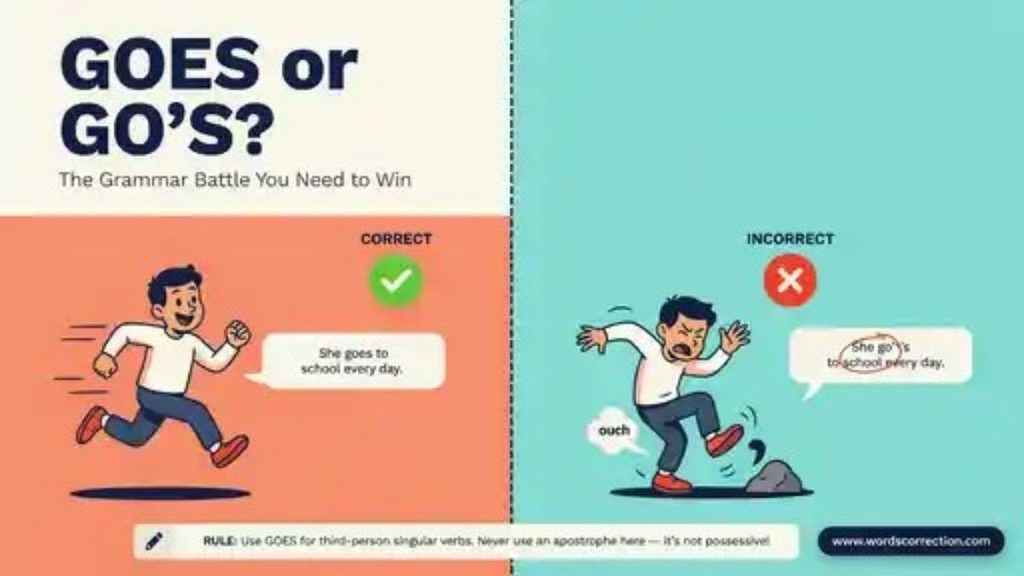
Keep this pattern in mind:
| Person | Singular | Plural |
| First person | I go | We go |
| Second person | You go | You go |
| Third person | He/She/It goes | They go |
The most useful shortcut is:
He, she, it → goes
I, you, we, they → go
When Should You Use “Goes”?
Use goes when you have a third-person singular subject in the simple present tense.
Use “Goes” After He, She, or It
This is the easiest situation to recognize.
- He goes to work.
- She goes to college.
- It goes around the corner.
Use “Goes” With Singular Nouns
A singular noun can also require goes.
- Sarah goes to school.
- The dog goes outside.
- The train goes through the tunnel.
- My father goes to work early.
Ask yourself whether the subject represents one person, animal, thing, or other singular entity.
If it does, goes may be the correct simple present form.
Use “Goes” for Repeated Actions
The simple present is frequently used for routines and repeated activities.
- David goes jogging every morning.
- Maria goes shopping on Fridays.
- The bus goes past my house every hour.
The repeated action makes the simple present appropriate.
Use “Goes” in Common Expressions
Some familiar expressions also use goes.
Examples include:
- As the saying goes…
- The story goes like this…
- Everything goes well.
- The plan goes according to schedule.
In these examples, goes agrees with a singular subject.
When Should You Use “Go” Instead of “Goes”?
Knowing when to use go instead of goes is equally important.
After “I,” “You,” “We,” and “They”
Use the base form go.
- I go there regularly.
- You go first.
- We go together.
- They go every weekend.
Don’t write:
- I goes there regularly.
- They goes every weekend.
After Modal Verbs
After modal verbs such as can, could, will, would, should, may, and might, use go.
Examples:
- She can go now.
- He will go tomorrow.
- They should go home.
- Maria might go with us.
Incorrect:
- She can goes now.
- He will goes tomorrow.
- They should goes home.
The modal verb is followed by the base form of the main verb.
After “Do” and “Does”
This is one of the most important rules to remember.
Use go after do or does.
Correct:
- Does she go to school?
- Does he go to work?
- Do they go together?
Incorrect:
- Does she goes to school?
- Does he goes to work?
The reason is that does already carries the third-person singular marking.
The same principle applies to negative sentences:
- She doesn’t go there.
- He doesn’t go to work on Sundays.
- The bus doesn’t go that way.
Not:
- She doesn’t goes there.
- He doesn’t goes to work.
A simple formula is:
does + go
doesn’t + g
Learn the difference between often confused words
Emerse or Immerse Correct Spelling and Use
Common Mistakes With Gos and Goes

Mistake 1: Writing “Gos”
This is probably the most obvious error.
Incorrect:
She gos to school every morning.
Correct:
She goes to school every morning.
The problem is that go doesn’t form its third-person singular by simply adding -s.
Mistake 2: Using “Goes” With a Plural Subject
The opposite mistake is also common.
Incorrect:
They goes to school together.
Correct:
They go to school together.
Because they is plural, use go.
Mistake 3: Using “Goes” After “Does”
Incorrect:
Does he goes to work?
Correct:
Does he go to work?
Once does appears, use the base form go.
Mistake 4: Using “Goes” After “Doesn’t”
Incorrect:
She doesn’t goes there.
Correct:
She doesn’t go there.
The same rule applies because doesn’t already contains the third-person singular auxiliary does.
Mistake 5 Assuming “Goes” Is Always Plural
The word goes can have two different grammatical roles.
As a verb:
She goes to school.
Here, goes is singular.
As a noun:
He had two goes at the game.
Here, goes is plural.
Context tells you which function the word has.
Gos or Goes Examples
The following gos or goes examples show how the incorrect and correct forms differ.
| Incorrect | Correct |
| She gos to school. | She goes to school. |
| He gos to work. | He goes to work. |
| The bus gos downtown. | The bus goes downtown. |
| My sister gos shopping. | My sister goes shopping. |
| It gos very fast. | It goes very fast. |
| John gos to college. | John goes to college. |
Now compare the correct use of go and goes:
- I go to school every day.
- She goes to school every day.
- We go to the market.
- He goes to the market.
- They go home together.
- The child goes home with his mother.
Gos or Goes in Questions and Negative Sentences
Questions and negative statements are especially useful for understanding goes or gos grammar because they show when the base form returns.
Questions With “Does”
Use:
Does + subject + go…?
Examples:
- Does he go to school?
- Does she go to work?
- Does your brother go there?
- Does the bus go downtown?
Don’t use goes after does.
Negative Sentences With “Doesn’t”
Use:
Subject + doesn’t + go…
Examples:
- He doesn’t go there.
- She doesn’t go to college on Fridays.
- The bus doesn’t go that way.
The verb remains go, even though the subject is third-person singular.
Questions With “Do”
With I, you, we, and they, use do + go.
Examples:
- Do you go there often?
- Do they go to school together?
- Do we go now?
The main verb remains in its base form.
Goes in Different Verb Tenses
The word goes belongs specifically to the simple present form of the verb.
Understanding the other forms of go makes its role easier to recognize.
Simple Present
Use goes with a third-person singular subject.
- She goes to school every day.
- He goes to work at eight.
Present Continuous
The present continuous uses going, not goes.
- She is going to school now.
- He is going home.
Simple Past
The past tense is went.
- She went to school yesterday.
- He went home early.
The past form isn’t goes or goed.
Present Perfect
The present perfect uses has gone with a singular third-person subject.
- She has gone to work.
- He has gone home.
With plural subjects, use have gone:
- They have gone home.
Future
After will, use the base form go.
- She will go tomorrow.
- He will go later.
- They will go next week.
The main forms of the verb are:
| Verb form | Example |
| Base form | go |
| Third-person singular | goes |
| Past tense | went |
| Past participle | gone |
| Present participle | going |
The verb go is irregular because its past form, went, doesn’t follow the regular -ed pattern.
Is “Goes” a Word?
Yes. If you’re asking is goes a word, the answer is yes.
Goes is a standard English word and has several grammatical uses.
Most commonly, it functions as the third-person singular present form of go:
She goes to work every morning.
It can also be the plural noun form of go:
He had two goes at the competition.
So goes is completely correct English.
Is “Gos” a Word?
If you’re asking whether gos is a standard form of the English verb go, it isn’t.
For ordinary English verb usage:
- go is correct.
- goes is correct.
- gos is not the standard form.
Specialized contexts can contain unusual words, names, abbreviations, or acronyms. However, those uses shouldn’t be confused with the normal conjugation of go.
Is “Gos” Correct?
If you mean is gos correct as the third-person singular form of go, no.
Incorrect:
She gos to school.
Correct:
She goes to school.
The correct spelling is goes.
Is “Goes” Correct?
Yes. Goes is correct when it functions as the third-person singular present form of go.
Examples:
- He goes to work.
- She goes to school.
- The train goes through the tunnel.
However, don’t use goes after does, doesn’t, or a modal verb.
Correct:
- Does she go?
- She doesn’t go.
- She can go.
- She will go.
Go Plural or Singular?
The question go plural or singular needs a little clarification because go is primarily a verb in these examples, and verb forms don’t work exactly like noun forms.
As a verb, go is the base form.
It appears with:
- I go
- you go
- we go
- they go
It also appears after auxiliary and modal verbs:
- Does she go?
- She doesn’t go.
- He can go.
- They will go.
Therefore, calling go simply “plural” isn’t accurate.
Its grammatical role depends on the construction and the subject.
What Is the Plural of Go?
If go is being used as a noun meaning an attempt, turn, or opportunity, its plural is goes.
Examples:
- He had a go at the puzzle.
- He had two goes at the puzzle.
- She had several goes before solving it.
This creates an interesting distinction:
As a verb:
She goes to school.
As a plural noun:
She had three goes at the challenge.
The spelling is identical, but the grammatical function is different.
Go Plural Form Understanding the Difference
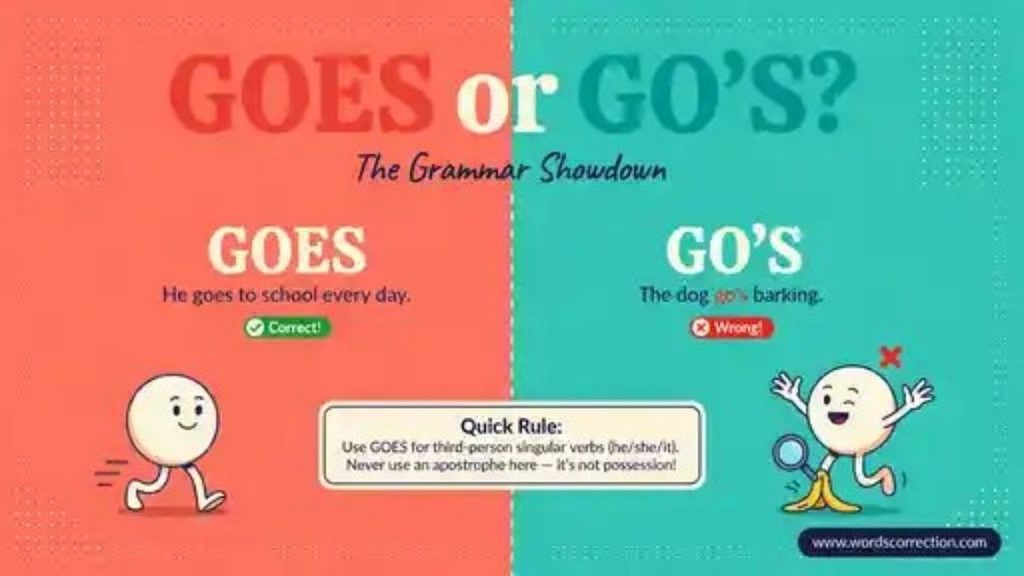
The phrase go plural form can be misleading because go can function as either a verb or a noun.
When it’s a verb, don’t think of goes as simply the “plural form.” In fact, goes is the third-person singular present form.
When it’s a noun, goes can be the plural form of go.
This distinction is essential:
| Word | Function | Example |
| go | Base verb | They go home. |
| goes | Singular verb | She goes home. |
| go | Singular noun | He had a go. |
| goes | Plural noun | He had two goes. |
So the correct plural of go as a noun is goes, but goes isn’t the plural form of the verb go.
A Practical Case Study
Consider Emma’s daily routine.
Emma goes to school every morning.
Why goes?
Because Emma is a singular third-person subject.
Now add another person:
Emma and Daniel go to school every morning.
Why go?
Because Emma and Daniel form a plural subject.
Now turn the first sentence into a question:
Does Emma go to school every morning?
Why go, not goes?
Because does is already functioning as the auxiliary verb that marks the third-person singular.
Finally, make the sentence negative:
Emma doesn’t go to school on Sunday.
Again, doesn’t carries the grammatical marking, so the main verb returns to go.
Frequently Asked Questions About “Go” and “Goes”
What is the difference between “go” and “goes”?
Answer: “Go” is used with I, you, we, and they, while “goes” is used with he, she, and it in the simple present tense.
When should I use “go” in a sentence?
Answer: Use “go” with I, you, we, and they, and after auxiliary or modal verbs such as do, did, can, will, and should.
When should I use “goes” in a sentence?
Answer: Use “goes” with a third-person singular subject, such as he, she, it, or a singular noun, in the simple present tense.
How do you spell “goes” correctly?
Answer: The correct spelling is goes, spelled G-O-E-S. It is the third-person singular form of “go.”
Is “gos” a correct spelling?
Answer: No. “Gos” is not the standard spelling of the verb. The correct form is “goes.”
6. Is “goes” a verb?
Answer: Yes. “Goes” is a verb and is the third-person singular present-tense form of “go.”
Is “goes” singular or plural?
Answer: “Goes” is used with a singular third-person subject, such as he, she, or it. The form used with plural subjects is generally “go.”
Is “goes” the plural of “go”?
Answer: No. “Goes” is not the plural form of “go.” It is the third-person singular present-tense form.
Can I use “goes” with “I”?
Answer: No. Use “go” with “I.”
Example: I go to work every morning.
Can I use “goes” with “they”?
Answer: No. Use “go” with “they.”
Example: They go to the library.
Why does “go” change to “goes”?
Answer: In the simple present tense, “go” changes to “goes” when it follows a third-person singular subject. This follows standard subject-verb agreement.
What is the correct form: “he go” or “he goes”?
Answer: “He goes” is correct in the simple present tense because “he” is a third-person singular subject.
What is the correct form: “they go” or “they goes”?
Answer: “They go” is correct because “they” takes the base form “go.”
Can “go” be used after “does”?
Answer: Yes. Use the base form “go” after “does.”
Example: Does she go to school?
Can “go” be used after “did”?
Answer: Yes. Use “go,” not “went,” after “did.”
Example: Did he go home?
Can “go” be used after “to”?
Answer: Yes. When “go” follows “to” as an infinitive, it remains in its base form.
Example: I want to go outside.
What is the past tense of “go”?
Answer: The past tense of “go” is “went.”
Example: She went to the store yesterday.
What is the past participle of “go”?
Answer: The past participle of “go” is “gone.”
Example: They have gone home.
Is “go” an irregular verb?
Answer: Yes. “Go” is an irregular verb because its past-tense form is “went” rather than a regular “-ed” form.
20. What does “it goes” mean?
Answer: “It goes” can describe how something happens, develops, moves, or functions. Its meaning depends on the context.
What does “anything goes” mean?
Answer: “Anything goes” means that there are few or no restrictions and that almost anything is acceptable.
What does “as the saying goes” mean?
Answer: “As the saying goes” introduces a familiar proverb, quotation, or commonly repeated expression.
What does “goes without saying” mean?
Answer: “Goes without saying” means that something is obvious or generally understood and therefore does not need to be stated.
What are some synonyms for “go”?
Answer: Depending on the context, synonyms for “go” include leave, travel, move, proceed, depart, and continue.
How can I easily remember when to use “go” or “goes”?
Answer: Remember this simple pattern: I/you/we/they → go and he/she/it → goes. This rule covers most simple present-tense uses.
Here’s a trusted source for clear more words Comparison:
Grammar Update
Practice Session: Fill in the Blanks
Instructions: Fill in each blank with the correct form: go or goes.
- She ______ to school every morning.
- They ______ to the gym after work.
- I ______ to the library on Saturdays.
- He ______ to bed early every night.
- We ______ shopping every weekend.
- My brother ______ to college by bus.
- You ______ to the office every day.
- The dog ______ outside when the door is open.
- Sarah and Emma ______ to the same school.
- Tom ______ to the market every Friday.
- I want to ______ home now.
- Does she ______ to work by car?
- They usually ______ for a walk in the evening.
- My father ______ to work at 8 a.m.
- We ______ to the park when the weather is nice.
- He can ______ with us if he wants.
- The train ______ through this town every morning.
- Do you ______ to the gym regularly?
- She will ______ to London next week.
- My friends ______ out together on Fridays.
- It ______ without saying that honesty is important.
- How does this machine ______?
- He always ______ to the same restaurant.
- Did they ______ to the concert last night?
- The story ______ like this: Once upon a time, there was a king.
Answer Key
- goes
- go
- go
- goes
- go
- goes
- go
- goes
- go
- goes
- go
- go
- go
- goes
- go
- go
- goes
- go
- go
- go
- goes
- go
- goes
- go
- goes
Conclusion
The gos or goes confusion may seem like a minor spelling issue, but choosing the wrong form can quickly turn a grammatically correct sentence into an obvious mistake. Fortunately, the rule is straightforward. Use goes with he, she, it, or any singular third-person subject in the simple present: She goes to school. Use go with I, you, we, and they: They go to school. After does, doesn’t, or modal verbs such as can, should, and will, always use go, not goes. Most importantly, gos isn’t the standard verb form. Once you understand the pattern, choosing between go and goes becomes simple and natural.

Stella AJS is an experienced blogger and dedicated English language writer at Words Correction. She turns confusing grammar, word meanings, spelling, and usage into clear, practical insights that readers can easily understand and apply. With a passion for precise and engaging writing, Stella helps readers avoid common language mistakes, strengthen their vocabulary, and communicate with greater clarity and confidence.