
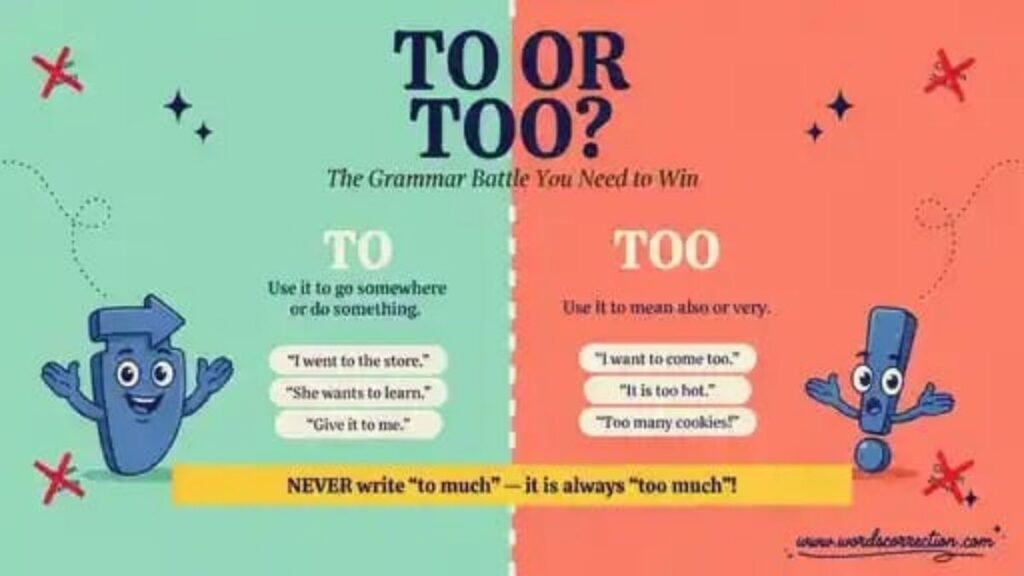
Confused about to or too? You’re not alone. These two small words sound identical, yet they serve entirely different grammatical purposes and can easily create embarrassing writing mistakes. One extra “o” may seem insignificant, but it can completely change the meaning of a sentence. Should you write “I want to go too” or “I want to go to”? The correct choice depends on the meaning and grammatical function of the word. Fortunately, understanding the difference between to and too doesn’t require complicated grammar rules. With clear explanations, practical examples, and simple memory tips, you’ll learn how to use these commonly confused words accurately and confidently.
Quick Answer To vs Too
| Word | Main Meaning | Grammatical Function | Example |
| to | Direction, destination, relationship, purpose, or part of an infinitive | Preposition or infinitive marker | She went to school. |
| too | Also, excessively, or more than necessary | Adverb | She is too tired to study. |
The simplest rule is:
- Use to when you are talking about direction, destination, purpose, or a verb that follows it.
- Use too when you mean also or more than enough.
For example:
- I want to learn English.
- I want to go home too.
- This coffee is too hot.
- She went to the store.
Although to and too sound alike, they are not interchangeable.
What Does “To” Mean?
The word to has several important uses in English. It can function as a preposition or as an infinitive marker before a verb.
Understanding these grammatical functions makes it much easier to know when to use to.
Learn the difference between often confused words
Lader or Ladder Which One Is Correct?
To Shows Direction or Destination

We commonly use to to show movement toward a person, place, or destination.
Examples:
- We went to the office.
- She traveled to New York.
- He walked to the station.
- They are going to the restaurant.
- I sent the package to my sister.
In each sentence, to indicates where someone or something is moving.
A useful question to ask is:
Where is the person or thing going?
If the answer involves a destination or direction, to is often the correct choice.
To Identifies the Receiver of an Action
To can also introduce the person or thing receiving something.
Examples:
- I gave the book to Sarah.
- He sent an email to his manager.
- She explained the problem to me.
- We offered help to our neighbors.
Here, to connects an action with its receiver.
To Comes Before a Verb
One of the most important uses of to is its role as an infinitive marker.
The structure is:
to + base form of a verb
Examples:
- to eat
- to sleep
- to work
- to study
- to learn
- to write
In sentences:
- I want to learn English.
- She needs to study.
- They decided to leave early.
- We hope to see you soon.
- He likes to read.
This is one of the easiest ways to identify to.
If a base-form verb comes immediately after the word, to is often correct.
To Shows Purpose
We frequently use to + verb to explain why someone does something.
Examples:
- I went to the library to study.
- She called me to ask a question.
- He works hard to support his family.
- They stopped to get some food.
- We exercise to stay healthy.
In these sentences, to introduces the purpose of an action.
For example:
I went to the store to buy milk.
The first to shows the destination, while the second to shows the purpose.
To Shows Time or a Range
To can also appear when expressing time ranges and numerical ranges.
Examples:
- The meeting is from 9:00 to 11:00.
- The store is open from Monday to Friday.
- The temperature dropped from 20 degrees to 10 degrees.
- Count from one to ten.
In these cases, to connects the beginning and ending points of a range.
To Shows Relationships
The word to can describe a relationship between two things or people.
Examples:
- This answer is important to me.
- She is married to a doctor.
- The solution is similar to the original.
- This information is useful to students.
The exact grammatical pattern depends on the expression, but to often connects one person or thing with another.
What Does “Too” Mean?
Unlike to, the word too is an adverb.
It has two major meanings:
- Also or as well
- More than necessary or excessively
In some contexts, too can also mean very, although this use is less central to the basic distinction between to and too.
Too Means “Also”
When too means also, it adds information to a statement.
Examples:
- I like coffee too.
- She wants to come too.
- He is a teacher too.
- We enjoyed the movie too.
- I am going too.
In this use, too often appears at the end of a sentence.
For example:
I want to go too.
This means:
I also want to go.
Learn the difference between basic English word mistakes
Emerse or Immerse Correct Spelling and Use
Too Means “More Than Necessary”

The second major meaning of too is excessively or more than is desirable or necessary.
Examples:
- The coffee is too hot.
- The box is too heavy.
- The room is too small.
- He is driving too fast.
- This bag is too expensive.
Consider the sentence:
The coffee is too hot.
It means the coffee has a higher temperature than is comfortable or appropriate.
Too Comes Before Adjectives and Adverbs
When too means excessively, it commonly appears before an adjective or adverb.
Examples:
- too difficult
- too expensive
- too cold
- too slow
- too quickly
- too loudly
In sentences:
- The test is too difficult.
- The water is too cold.
- The car is moving too quickly.
- The music is too loud.
This pattern is a useful clue when deciding between to and too.
Too + Adjective + To + Verb
English frequently uses the structure:
too + adjective/adverb + to + verb
Examples:
- It is too cold to swim.
- She is too tired to work.
- The box is too heavy to carry.
- He is too young to drive.
- The problem is too difficult to solve.
Notice that both words can appear in the same sentence:
The box is too heavy to carry.
The first word, too, means “more than manageable.”
The second word, to, introduces the verb carry.
Too Much, Too Many, Too Little, and Too Few
Too also appears in several common quantity expressions.
Use:
- too much with uncountable nouns
- too many with countable nouns
- too little with uncountable nouns
- too few with countable nouns
Examples:
- There is too much sugar in the tea.
- We have too many assignments.
- There is too little time.
- There are too few chairs.
These expressions describe an amount that exceeds or falls below what is considered appropriate or sufficient.
The Key Difference Between To and Too

The difference between to and too becomes much easier when you focus on their grammatical roles.
| To | Too |
| Can be a preposition | Is an adverb |
| Shows direction | Means also |
| Shows destination | Means excessively |
| Can identify a receiver | Can mean more than necessary |
| Appears before verbs in infinitives | Commonly appears before adjectives/adverbs |
| Example: go to school | Example: too expensive |
| Example: want to learn | Example: I want it too |
The extra o in too can help you remember that it often adds something extra: also or more than necessary.
To or Too: Examples in Sentences
Here are some simple to or too examples that show the difference clearly.
With “To”
- I need to leave now.
- She went to work early.
- He wants to learn Spanish.
- We walked to the park.
- They came to help us.
- I gave the letter to him.
- She went to the store to buy bread.
With “Too”
- The soup is too hot.
- He is too tired to continue.
- I want one too.
- She likes chocolate too.
- The shoes are too expensive.
- You are speaking too quickly.
- There are too many people here.
Learn the difference between commonly misused words
Presence or Presense Which Spelling Is Correct?
Examples Using Both
Sometimes the easiest way to understand to vs too is to see both words in one sentence.
- I want to go too.
- She went to the store too.
- It is too late to call him.
- He is too tired to work.
- We need to leave too.
- The bag is too heavy to carry.
These examples demonstrate why the words cannot simply be exchanged.
Common Mistakes With To and Too
Because to and too sound identical, spelling mistakes are extremely common.
“I Want Too Eat”
Incorrect:
I want too eat.
Correct:
I want to eat.
Why?
Because to comes before the base-form verb eat.
The correct pattern is:
want + to + verb
More examples:
- I want to sleep.
- I want to travel.
- I want to study.
- I want to improve.
“It Is To Hot”
Incorrect:
The water is to hot.
Correct:
The water is too hot.
Why?
Because too means “excessively” or “more than necessary.”
The pattern is:
too + adjective
Examples:
- too hot
- too cold
- too expensive
- too difficult
- too noisy
“It Is To Late”
Incorrect:
It is to late.
Correct:
It is too late.
Here, too means that the time has gone beyond what is appropriate or useful.
Other examples:
- It is too early.
- It is too far.
- It is too difficult.
- It is too expensive.
“To Much”
Incorrect:
There is to much water.
Correct:
There is too much water.
The phrase too much means more than necessary or desirable.
Examples:
- too much noise
- too much work
- too much information
- too much sugar
“I Am Coming Too”
This sentence may actually be correct, depending on what you mean.
I am coming too.
Here, too means also.
It means:
I am also coming.
However:
I am coming to.
usually sounds incomplete unless to is part of a larger construction or the destination is understood from context.
For example:
Are you going to the party?
Yes, I am coming too.
The correct word is too because the speaker means also.
To or Too in Common Expressions
Certain expressions appear so frequently that learning them can help you recognize the correct spelling immediately.
I Want To
Correct:
I want to learn.
Incorrect:
I want too learn.
The word to introduces the verb learn.
I Would Like To
Correct:
I would like to order some food.
Correct:
I would like to speak with you.
The expression would like to is followed by a base-form verb.
Me Too
Correct:
“I love this song.”
“Me too.”
Here, too means also.
Me To
Me to can be grammatically correct when to serves another grammatical purpose.
For example:
She gave the book to me.
However, if you want to say that you share someone’s opinion or experience, use:
Me too.
Too Late
Correct:
It is too late to change the decision.
Here, too means excessively or beyond the appropriate time.
Too Much
Correct:
You are spending too much money.
Too Long
Correct:
The meeting was too long.
Too Far
Correct:
The restaurant is too far from here.
Too Fast
Correct:
You are driving too fast.
Can Too Be Used Before a Verb?
Usually, too does not replace to before a verb.
Incorrect:
I want too eat.
Correct:
I want to eat.
However, too can appear before a verb in certain grammatical structures when it has a different function or when another word separates it from the verb.
For example:
She is too tired to work.
Here, too modifies tired, not work.
This distinction is important. When too means “excessively,” it normally modifies an adjective, adverb, or quantity expression rather than directly introducing an infinitive verb.
Too vs Very
One common source of confusion is the difference between too and very.
Both can appear before adjectives, but they do not usually communicate the same idea.
Compare:
The bag is very heavy.
This simply means the bag has a high degree of weight.
Now compare:
The bag is too heavy.
This suggests that the bag is heavier than is desirable, acceptable, or manageable for the situation.
For example:
- The coffee is very hot.
It has a high temperature. - The coffee is too hot.
It is hotter than I can comfortably drink.
Therefore, too often carries an idea of excess, while very generally intensifies an adjective without necessarily suggesting a problem.
How to Remember To and Too
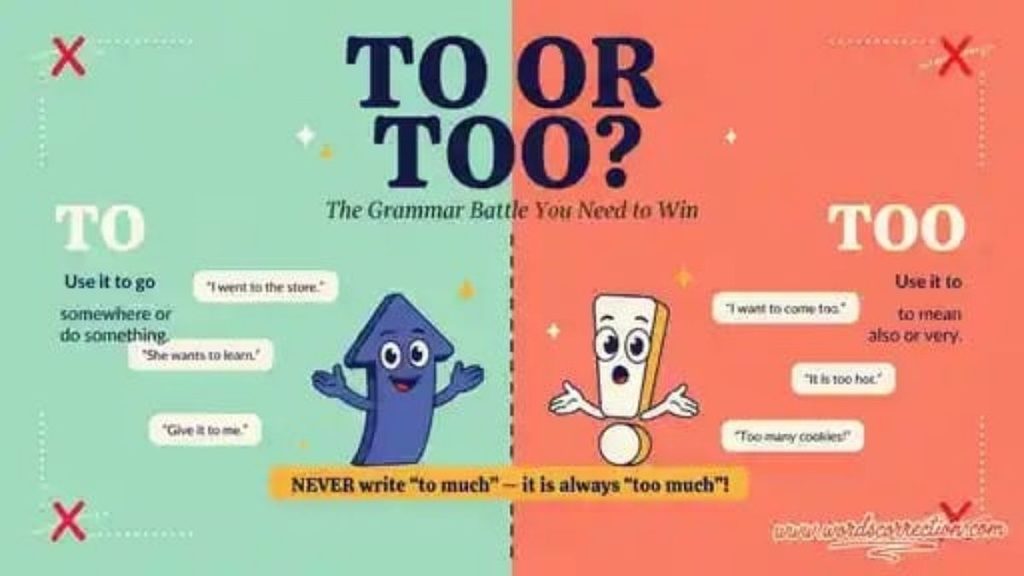
A few simple memory techniques can make this distinction easier.
Use the “Also” Test
If you can replace the word with also, use too.
Example:
I want to come too.
Replace too with also:
I also want to come.
The sentence makes sense, so too is correct.
Use the “Excess” Test
If the word means more than necessary, use too.
Examples:
- too hot
- too cold
- too expensive
- too difficult
- too slowly
Use the Verb Test
If to comes immediately before a base-form verb, it is usually to, not too.
Examples:
- to eat
- to sleep
- to work
- to learn
- to write
So:
I want to learn.
not:
I want too learn.
Remember the Extra O
A simple spelling trick is:
Too has an extra O because it often means something extra.
It can mean:
- also — something extra is included
- excessively — there is more than enough
This is not a complete grammar rule, but it is a useful memory aid.
Learn the difference between confusing more English words
Gos or Goes Which One Is Right?
To, Too, and Two
There is another word that sounds like to and too: two.
These three words are homophones. They sound alike but have different meanings.
| Word | Meaning | Example |
| to | Direction, purpose, or infinitive marker | I want to go. |
| too | Also or excessively | I want to go too. |
| two | The number 2 | I have two books. |
Consider this sentence:
I want to buy two books too.
Each word has a different function:
- to = introduces the verb buy
- two = number 2
- too = also
Learning these distinctions can significantly improve spelling accuracy.
To or Too: A Simple Decision Guide
When you are unsure which word to use, follow these steps.
Step One: Does It Mean “Also”?
If yes, use too.
I want to come too.
Step Two: Does It Mean “Excessively” or “More Than Necessary”?
If yes, use too.
This box is too heavy.
Step Three: Does It Show Direction or Destination?
If yes, use to.
She went to school.
Step Four: Does It Come Before a Base-Form Verb?
If yes, to is usually correct.
I want to study.
Step Five: Is It the Number 2?
If yes, use two.
I have two brothers.
This five-step approach handles most everyday uses of to, too, and two.
To and Too in Everyday English
These words appear constantly in everyday conversations and writing.
Consider these examples:
I need to go.
I need to go too.
It is too late.
She wants to come too.
This is too expensive.
I am going to the store.
He talks too loudly.
The words are short, but they perform very different grammatical jobs.
This is why learning to or too grammar is more useful than simply memorizing individual spelling examples.
To and Too: Correct and Incorrect Examples
| Incorrect | Correct | Reason |
| I want too eat. | I want to eat. | To comes before a verb. |
| It is to hot. | It is too hot. | Too means excessively. |
| She is to tired. | She is too tired. | Too modifies an adjective. |
| There is to much noise. | There is too much noise. | Too much expresses excess. |
| I want to come to. | I want to come too. | Too means also. |
| It is to late. | It is too late. | Too expresses excess. |
| He wants too study. | He wants to study. | To introduces the infinitive. |
| The bag is to heavy. | The bag is too heavy. | Too modifies heavy. |
Common Errors in English Writing
Confusing to and too is particularly common because pronunciation does not help you distinguish them.
In speech, listeners usually rely on context. In writing, however, the spelling must communicate the intended meaning.
A sentence such as:
I want too learn.
contains an obvious spelling error.
The sentence:
I want to learn.
is correct because to introduces the infinitive learn.
Similarly:
The test is to difficult.
should be:
The test is too difficult.
The difference may be only one letter, but that letter changes the grammatical function of the word.
Practice Session
Fill in the Blanks
Instructions: Complete each sentence by choosing the correct word “to” or “too.”
- I want ___ improve my English.
- The soup is ___ hot to eat.
- She went ___ the market.
- I would like ___ learn French.
- He is coming ___.
- This bag is ___ heavy to carry.
- We need ___ leave early tomorrow.
- I enjoyed the movie ___.
- She gave the letter ___ her teacher.
- It is ___ late to call him now.
- I have ___ finish my homework.
- Do you want ___ join us?
- The music is ___ loud.
- I love this song ___.
- He decided ___ study harder.
- There are ___ many people in the room.
- She wants ___ become a doctor.
- I hope you have a great day ___.
- This shirt is ___ expensive for me.
- They went ___ the restaurant after work.
- I would love ___ visit London someday.
- Are you going ___ the party ___?
- He was ___ tired to continue working.
- I need ___ talk ___ you.
- She enjoys reading, and I do ___.
Answer Session
- to
- too
- to
- to
- too
- too
- to
- too
- to
- too
- to
- to
- too
- too
- to
- too
- to
- too
- too
- to
- to
- to, too
- too
- to
- too
Here’s a trusted source for clear more words Comparison:
Grammar Update
FAQ’s
Is it “too late” or “to late”?
The correct phrase is “too late.” The word “too” means excessively or more than necessary. For example: It is too late to change the decision.
Is it “I love you too” or “I love you to”?
The correct phrase is “I love you too.” Here, “too” means “also” and expresses that the feeling is mutual.
Which is correct: “you too” or “you to”?
“You too” is correct when you mean “you also.” For example: Have a great day! — You too!
Is it “want to” or “want too”?
“Want to” is correct when “to” comes before a verb. For example: I want to learn English. “Too” cannot be used in this construction.
When should I use “to” and “too”?
Use “to” to express direction, identify a recipient, or introduce a verb. Use “too” to mean “also” or “excessively.” For example: She went to school and The bag is too heavy.
Is it “I need you to” or “I need you too”?
Both are correct, but they have different meanings. “I need you to” is followed by a verb, as in I need you to help me. “I need you too” means I also need you.
Is it “I like you too” or “I like you to”?
“I like you too” is correct when “too” means “also.” For example: I like you too. The phrase “I like you to” requires another verb, such as I like you to be honest.
Is “I am too” grammatically correct?
Yes, “I am too” can be grammatically correct. When “too” means “also,” it can appear at the end of a sentence. For example: I am coming too.
Is it “I hope you are too” or “I hope you are to”?
The correct phrase is “I hope you are too” when “too” means “also.” For example: I hope you are happy too.
Is “I don’t need to” grammatically correct?
Yes. “I don’t need to” is grammatically correct when the action is understood from the context. For example: You should go if you want to, but I don’t need to.
Is “me too” grammatically correct?
Yes. “Me too” is a standard expression in English and means “I also do” or “I feel the same way.” For example: I enjoy reading. — Me too.
Is “I too love you” grammatically correct?
Yes. “I too love you” is grammatically correct and means “I also love you.” However, “I love you too” is generally more natural in everyday English.
Is it “I wanted to” or “I wanted too”?
The correct expression is “I wanted to” when “to” introduces a verb. For example: I wanted to speak with you.
Do you say “I would love to” or “I would love too”?
The correct expression is “I would love to.” Here, “to” introduces an action. For example: I would love to visit Paris.
Which is correct: “I just had to” or “I just had too”?
“I just had to” is correct when the action is understood or follows “to.” For example: The opportunity was too good, so I just had to accept it.
Is “I too” grammatically correct?
Yes. “I too” is grammatically correct when “too” means “also.” For example: I too agree with this decision.
Is “I too am” grammatically correct?
Yes. “I too am” is grammatically correct. For example: I too am interested in learning more about the subject.
Can “too” be used at the end of a sentence?
Yes. “Too” can be used at the end of a sentence when it means “also.” For example: Iwould like to join you too.
Why do “to” and “too” sound the same?
“To” and “too” are homophones, meaning they have the same pronunciation but different spellings, meanings, and grammatical functions.
What is the easiest way to remember the difference between “to” and “too”?
A simple way to remember the difference is that “to” is commonly used for direction or before a verb, while “too” means “also” or “excessively.” The two o’s in “too” can serve as a reminder that it refers to something extra.
Conclusion
The difference between to and too may seem like a tiny spelling issue, but that extra o can create surprisingly big grammar mistakes. These two words sound the same, yet they have completely different meanings and grammatical functions. That’s why even confident writers can occasionally choose the wrong one.
Remember the basic rule: to is commonly used for direction, destination, purpose, or before a verb in its infinitive form. Too, on the other hand, means also or more than necessary. For example, I want to learn English too uses both words correctly, with each performing a different grammatical job.
The easiest way to remember the difference is to think of the extra o in too as something extra. If you mean also, use too. If you mean excessively, use too. When you’re showing direction or introducing a verb, to is usually the correct choice.
There’s no need to let these two tiny words cause unnecessary confusion. Once you understand their meanings and recognize their common sentence patterns, choosing the right word becomes much easier. With regular practice, to and too will stop being grammar troublemakers and become two words you can use accurately and confidently.

Stella AJS is an experienced blogger and dedicated English language writer at Words Correction. She turns confusing grammar, word meanings, spelling, and usage into clear, practical insights that readers can easily understand and apply. With a passion for precise and engaging writing, Stella helps readers avoid common language mistakes, strengthen their vocabulary, and communicate with greater clarity and confidence.




