

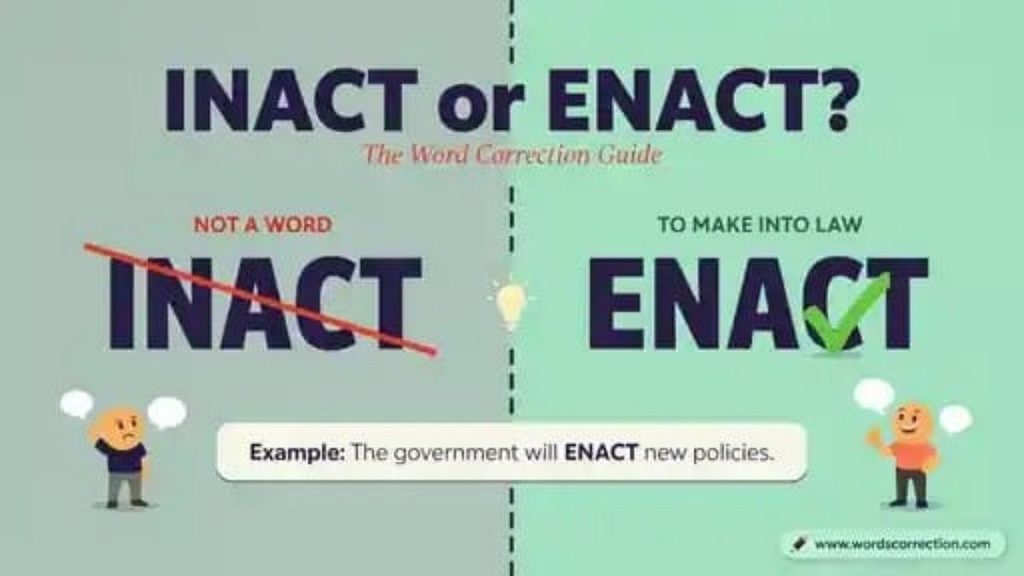
The choice between inact or enact can cause surprising confusion, even in otherwise polished writing. The two spellings look almost identical, but modern English gives them different roles. The confusion is understandable, especially because words such as inactive make inact appear perfectly logical. However, enact is the standard modern word when you mean to formally establish a law, policy, or regulation, or to act out a scene or event. While inact has historical usage, it isn’t the modern alternative to enact. Let’s clarify the difference, examine common mistakes, and make this tricky spelling choice much easier to remember.
Quick Answer Inact or Enact?
Enact is the standard spelling in modern English.
It commonly means to make something official, especially a law, regulation, or policy. It can also mean to perform or act out something.
Inact is not normally used as the modern spelling of enact. Although historical dictionaries record inact as an older form, modern standard English uses enact.
| Word | Modern standard English? | Common meaning |
| Enact | Yes | Make something official or perform something |
| Inact | No, not as a modern alternative to enact | Historical form |
| Inactive | Yes | Not active or operating |
Correct
The government plans to enact new environmental regulations.
Incorrect in modern standard usage
The government plans to inact new environmental regulations.
The second sentence should use enact.
What Does Enact Mean?
Enact is a verb with several related meanings. Its most common use involves formally establishing something, particularly a law or regulation.
In simple terms, enact means to officially put something into effect.
For example:
The legislature enacted a new education law.
Here, enacted means the legislature formally made the law official.
You can also use enact for policies, regulations, reforms, and other formal measures:
The company enacted a new workplace safety policy.
The city enacted stricter building regulations.
The word often suggests an official or formal decision rather than an ordinary personal action.
Learn the difference between often confused words
Lader or Ladder Which One Is Correct?
Enact Meaning in Law
One of the most important uses of enact appears in legal and political contexts.
When a government or legislative body enacts a law, it formally establishes that law.
For example:
Congress enacted legislation to improve road safety.
The verb enacted tells us that the legislation went through the necessary formal process and became legally established.
Common expressions include:
- enact a law
- enact legislation
- enact regulations
- enact a policy
- enact reforms
- enact new measures
- enact legal changes
Enact a Law
Enact a law means to formally make a proposed law official.
For example:
The state enacted a law requiring restaurants to display allergy information.
The bill may have started as a proposal, but once the required legislative process was completed, the government could describe it as an enacted law.
Enact Legislation
Enact legislation means to formally establish legislation.
For example:
The government enacted legislation to protect consumers.
This phrase is especially common in formal writing, journalism, government documents, and legal discussions.
Enact a Policy
The word enact isn’t limited to laws.
Organizations and institutions can also enact policies.
For example:
The university enacted a new policy on academic integrity.
Here, enact emphasizes the formal introduction and establishment of the policy.
Enact Regulations
Governments and regulatory bodies can enact regulations.
For example:
The agency enacted new regulations for workplace safety.
The word gives the sentence a formal, authoritative tone.
Learn the difference between everyday English mistakes
Emerse or Immerse Correct Spelling and Use
What Does Enact Mean Outside Law?
Although enact frequently appears in legal contexts, its meaning is broader.
It can describe the formal introduction or establishment of a plan, measure, policy, or change.
For example:
The organization enacted several changes to improve customer service.
The school enacted a new attendance policy.
The committee enacted measures to reduce unnecessary spending.
In these examples, enact suggests that an idea, decision, or proposal has moved from discussion into formal action.
What Does Enact Mean in Performance?
There’s another important meaning of enact that has nothing to do with legislation.
It can also mean to perform, act out, or portray something.
For example:
The students enacted a scene from the play.
The actors enacted the final scene with great emotion.
The children enacted the story during the school performance.
In this sense, enact is closely connected to acting and performance.
It can describe portraying a character, reproducing an event, or acting out a story.
What Is the Inact Meaning?
This is where things get slightly more interesting.
If you search for inact meaning, you may find historical references to the word. Inact has been recorded as an older form related to enact.
However, that historical use doesn’t make inact an acceptable modern substitute for enact.
In contemporary standard English, use enact when you mean:
- make a law official
- establish a policy
- put a formal measure into effect
- perform or act out something
If you mean something is not active, use inactive instead.
Is Inact a Word?
Historically, yes. In modern standard English, however, inact is not normally used as the alternative spelling of enact.
This distinction matters because calling inact simply a “made-up word” would be inaccurate. The word has historical roots. It has appeared in earlier forms of English.
Modern usage is different.
Today, if you are writing an article, business document, academic paper, government report, or formal email, enact is the appropriate word for the meanings discussed above.
Is Inact a Correct Word?
For modern standard English, inact is not the correct choice when you mean enact.
For example:
The government will enact the new law.
Not:
The government will inact the new law.
If you want to describe something that isn’t active, use inactive:
The account has been inactive for six months.
That small distinction can prevent a surprisingly common spelling mistake.
Learn the difference between commonly mixed-up more words
Presence or Presense Which Spelling Is Correct?
What Is the Difference?
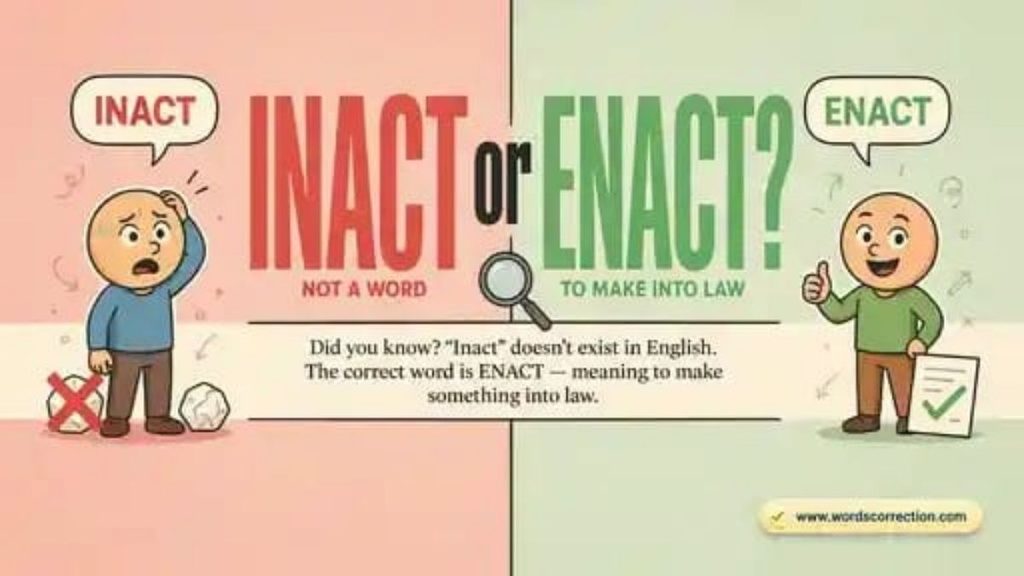
The difference between inact and enact is primarily one of modern usage.
Enact is the standard modern verb. It means to formally establish something or to perform something.
Inact is an older historical form and should not normally replace enact in modern writing.
Consider these examples:
| Intended meaning | Correct word | Example |
| Make a law official | Enact | The legislature enacted the bill. |
| Establish a policy | Enact | The company enacted a new policy. |
| Put formal measures into effect | Enact | The agency enacted new regulations. |
| Perform a scene | Enact | The students enacted the scene. |
| Not active | Inactive | The account is inactive. |
The easiest rule is simple: If you mean formally establish or act out, use enact. If you mean not active, use inactive.
Is Enact a Word?
Yes. Enact is a standard English verb.
It has been used in English for centuries and remains common in modern legal, political, academic, business, and general writing.
Depending on the context, it can mean:
- To make something official, especially a law.
- To formally establish a policy, regulation, or measure.
- To put something into effect.
- To perform or act out something.
For example:
Parliament enacted the proposed legislation.
The company enacted new safety procedures.
The actors enacted the historical scene.
Where Does Enact Come From?
The history of enact helps explain why the spelling can feel slightly confusing.
The word dates back to Middle English. Historical sources also record inact as an earlier form.
Over time, enact became the established form in modern English.
That’s why inact shouldn’t simply be dismissed as a spelling that never existed. It has a historical connection to the word. The important point is that modern English has settled on enact for the meanings we commonly use today.
Enact vs Act: Are They the Same?
Not exactly.
Act is a much broader verb. It can mean to do something, take action, behave in a particular way, or perform in a play.
Enact is more specific.
When you enact something, you generally establish it formally or act it out.
Compare these sentences:
The government acted quickly.
The government enacted a new law.
The first sentence simply says that the government took action. The second tells us what kind of action it took: it formally established a law.
In performance:
The actor acted in the play.
The students enacted the final scene.
The first sentence refers broadly to performing. The second emphasizes acting out a particular scene or event.
How to Use Enact Correctly
Using enact correctly becomes easy once you connect it with the right kinds of objects.
Enact a Law
The legislature enacted a new tax law.
Enact Legislation
Lawmakers enacted legislation to improve public transportation.
Enact a Policy
The company enacted a stricter privacy policy.
Enact Regulations
The government enacted new regulations for commercial buildings.
Enact Change
The organization enacted significant changes to its hiring process.
You’ll notice a common pattern: enact + something formal or something being performed.
Learn the difference between tricky grammar more words
Gos or Goes Which One Is Right?
What’s the Difference?
Enact and implement are closely related, but they aren’t interchangeable in every sentence.
Enact usually emphasizes formally establishing something.
Implement usually emphasizes carrying out a plan, policy, or decision in practice.
Think of the difference this way:
Enact = officially establish it.
Implement = put it into practical operation.
For example:
The government enacted a new education policy.
This tells us the policy was formally established.
Now consider:
Schools implemented the new education policy.
This focuses on schools actually putting that policy into practice.
A policy can therefore be enacted and later implemented.
Simple Comparison
| Word | Main idea |
| Enact | Formally establish or make official |
| Implement | Put a plan or policy into practice |
| Enforce | Make sure people follow a law or rule |
Keeping these three verbs separate will make your writing much more precise.
Enact vs Enforce: Don’t Mix Them Up
Enact and enforce are particularly easy to confuse in legal writing.
When lawmakers enact a law, they formally establish it.
When authorities enforce a law, they make sure people comply with it.
For example:
The government enacted a new traffic law.
This means the law was formally established.
Police enforced the new traffic law.
This means they ensured that people followed it.
So, remember:
Enact creates or establishes the rule.
Enforce ensures that people follow the rule.
Enact, Enacted, Enacting, and Enactment
Once you understand enact, its related forms are straightforward.
Enact
Present-tense verb:
The legislature may enact the proposal next year.
Enacts
Third-person singular present tense:
The legislature enacts laws through a formal process.
Enacted
Past tense and past participle:
The government enacted the regulation last year.
Enacting
Present participle:
The government is enacting new environmental measures.
Enactment
Noun form:
The enactment of the law changed the industry.
The noun enactment refers to the act or process of enacting something. It can also refer to a law or measure that has been formally established.
Enact Synonyms
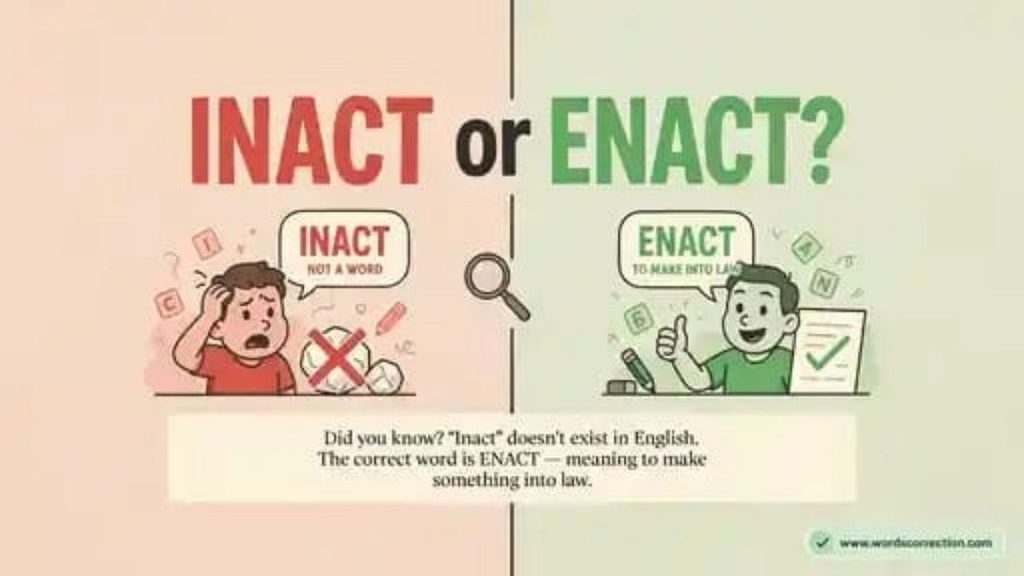
The best synonym for enact depends on the context.
When discussing laws or policies, possible alternatives include:
- establish
- pass
- approve
- authorize
- introduce
- institute
- adopt
- put into effect
However, these words aren’t perfect substitutes in every sentence.
For example, pass a law and enact a law are closely related, but they can emphasize slightly different parts of the legislative process.
When enact means perform, suitable alternatives may include:
- perform
- act out
- portray
- dramatize
- represent
- recreate
Always choose a synonym based on the sentence rather than replacing the word mechanically.
Learn the difference between confusing word pairs
To or Too Clear Difference, Meaning and Usage
Enact Synonym and Antonym
If you’re looking for an enact synonym, the closest choice depends on what enact means in your sentence.
When Enact Means Establish
Possible synonyms include:
- establish
- institute
- adopt
- approve
- authorize
- put into effect
When Enact Means Perform
Possible synonyms include:
- perform
- portray
- act out
- dramatize
- recreate
What Is the Antonym of Enact?
There isn’t one universal opposite.
Depending on the context, possible opposites include:
- repeal
- abolish
- cancel
- revoke
- withdraw
For example, repeal is particularly useful when discussing a law that was previously enacted.
The government enacted the law in 2020.
The government repealed the law in 2025.
The two verbs describe opposite stages in a law’s life.
Enact in a Sentence: Examples
Seeing enact in a sentence is one of the easiest ways to understand its usage.
Legal and Government Examples
The legislature enacted a new consumer protection law.
The government plans to enact stricter environmental regulations.
Lawmakers enacted reforms to improve public transportation.
The state enacted legislation addressing workplace safety.
Business Examples
The company enacted a new policy for remote employees.
The organization enacted measures to reduce operating costs.
Management enacted changes after reviewing the annual report.
General Examples
The school enacted a new attendance policy.
The committee enacted several measures to improve efficiency.
Performance Examples
The students enacted a scene from the novel.
The actors enacted the final moments of the historical event.
The performers enacted the story for the audience.
Common Mistakes With Inact and Enact
Several mistakes appear repeatedly when people use these words.
Mistake 1: Using Inact Instead of Enact
Incorrect:
The government will inact a new law.
Correct:
The government will enact a new law.
Mistake 2: Using Inact When You Mean Inactive
Incorrect:
My account has been inact for months.
Correct:
My account has been inactive for months.
Inactive is the appropriate adjective when something isn’t operating or participating.
Mistake 3: Confusing Enact With Enforce
Incorrect:
The police enacted the traffic law.
Better:
The police enforced the traffic law.
The government may enact the law, while police or other authorities may enforce it.
Mistake 4: Confusing Enact With Implement
Incorrect in some contexts:
The government implemented the law yesterday.
If you mean the government formally established the law, enacted may be more precise.
If you mean an existing policy was put into operation, implemented is usually better.
Why Does “Inact” Look Correct?
English spelling can be surprisingly deceptive.
The prefix in- often means “not,” as in:
- inactive
- incorrect
- incomplete
- invisible
That pattern can make inact look as though it should mean the opposite of act.
But English doesn’t always build words as neatly as a mathematical formula.
Inactive is the standard word meaning “not active.” Enact, meanwhile, developed as a distinct verb meaning to establish formally or perform.
So the visual similarity between inact and inactive can create confusion.
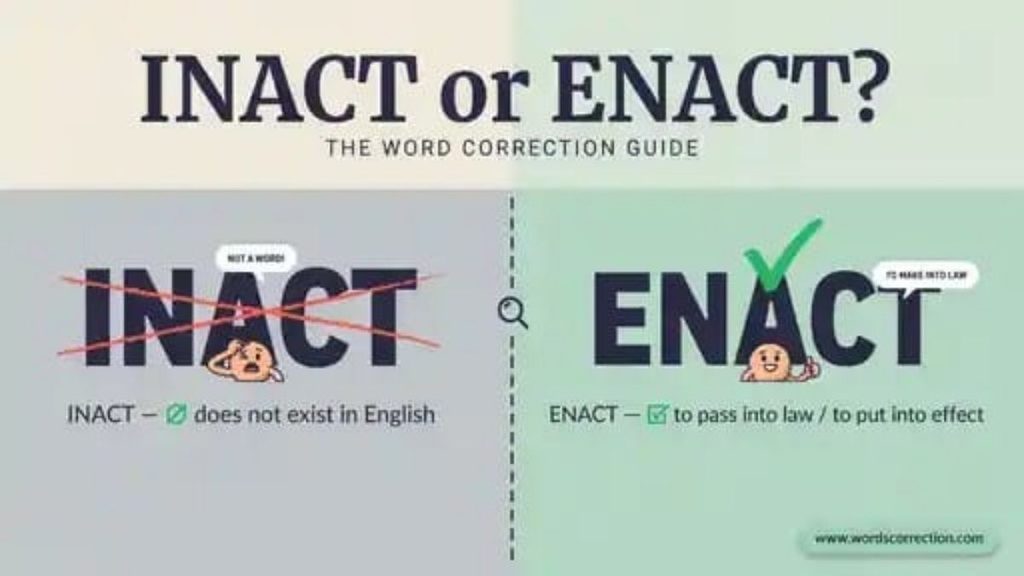
Quick Comparison Inact, Enact, and Inactive
| Word | Status | Meaning | Example |
| Enact | Standard modern English | Formally establish or perform | The legislature enacted the law. |
| Inact | Historical form; not the standard modern alternative | Older form related to enact | Avoid using it as a modern substitute for enact. |
| Inactive | Standard modern English | Not active or operating | The account has been inactive. |
This three-way comparison solves most of the confusion.
Is Enact Used in American and British English?
Yes.
Enact is standard in both American and British English.
There is no American-versus-British spelling difference here. You don’t need to switch to inact when writing for a British audience, and you don’t need a different spelling for American readers.
The correct modern form remains:
enact
That consistency makes this one easier than many other British-American spelling differences.
A Simple Way to Remember Enact
If you’re trying to remember whether the word is inact or enact, focus on the meaning rather than the appearance.
Think:
Enact = establish or act out.
For laws:
Enact a law.
For policies:
Enact a policy.
For regulations:
Enact regulations.
For performances:
Enact a scene.
If you mean “not active,” think:
Inactive.
That distinction is usually all you need.
A Simple Case Study From Bill to Enacted Law
Imagine that lawmakers propose a new environmental bill.
At first, the proposal is only a bill. Lawmakers debate it, revise it, and vote on it.
Once the required legal process is completed and the measure becomes law, you can say:
The legislature enacted the bill.
Later, government agencies may implement the law by creating procedures and programs.
Authorities may then enforce the law by ensuring that people and businesses comply with it.
The progression looks like this:
Proposal → Enact → Implement → Enforce
These verbs describe different stages, which is why choosing the right one matters.
Practice Session
Fill in the Blanks
Instructions: Complete each sentence by choosing the correct word or phrase from the context.
- The government decided to ______ a new environmental law.
- The new policy was officially ______ last month.
- “Inact” is generally considered an incorrect spelling of ______.
- The organization plans to ______ several important changes.
- Parliament voted to ______ the proposed legislation.
- The new regulations will take effect once they are ______.
- The company wants to ______ a stricter workplace policy.
- The actors will ______ a scene from the historical story.
- The government ______ a law to protect endangered species.
- The committee agreed to ______ the proposed reforms.
- The word ______ means to make a law or policy official.
- The manager hopes to ______ meaningful changes within the organization.
- The law was ______ to address environmental concerns.
- The students were asked to ______ a scene from the novel.
- The correct phrase is “in fact,” not ______.
- The word “intact” means complete or ______.
- The government may ______ the regulation if it is no longer necessary.
- To put a plan into action means to ______ it.
- The new law was formally ______ by the legislature.
- The theater group will ______ a famous historical event.
- A suitable synonym for “enact” in a legal context is ______.
- A suitable synonym for “enacted” is ______.
- The company intends to ______ a new policy next year.
- The word “enact” can refer to making something official or ______ a role or scene.
- The proposed changes cannot become effective until they are officially ______.
Answer Session
- enact
- enacted
- enact
- enact
- enact
- enacted
- enact
- enact
- enacted
- enact
- enact
- enact
- enacted
- enact
- infact
- undamaged
- repeal
- implement
- enacted
- enact
- implement
- implemented
- enact
- performing
- enacted
Here’s a trusted source for clear more words Comparison:
Grammar Update
FAQ’s
Is it “inact” or “enact”?
Enact is the correct standard English word when you mean to make something official, such as a law, policy, or regulation. Inact is generally considered an incorrect spelling in this context.
Is “inact” a word?
Inact is not commonly recognized as a standard English word. If you mean to make a law, policy, or proposal official, the correct term is enact.
What does “enact” mean?
Enact means to make something official or legally effective, particularly a law, policy, or regulation. It can also mean to perform or act out a role, scene, or event.
What does “enacted” mean?
Enacted is the past tense and past participle of enact. It means that a law, policy, or regulation has been officially approved and put into effect.
What is another word for “enact”?
Depending on the context, synonyms for enact include implement, establish, approve, pass, introduce, execute, and perform.
What is the opposite of “enact”?
The antonym of enact depends on the context. When referring to laws or policies, suitable opposites include repeal, revoke, abolish, and withdraw. How do you use “enact” in a sentence?
Enact is commonly used when referring to officially establishing a law, policy, or regulation. For example: “The government enacted a new environmental law.”
What is the difference between “enact” and “inact”?
Enact is a standard English verb meaning to make something official or to perform something. Inact is generally not the correct spelling for this meaning and is often used mistakenly in place of enact.
What does “intact” mean?
Intact means complete, whole, or undamaged. For example, “The package arrived intact” means that it arrived without being damaged.
What does “in fact” mean?
In fact is a two-word expression used to emphasize that something is true or to introduce information that confirms or strengthens a previous statement. For example: “She is highly experienced; in fact, she has worked here for ten years.”
Is “infact” correct or should it be “in fact”?
The correct form is “in fact,” written as two separate words. “Infact” is a common spelling error and should be avoided in standard English writing.
What is another word for “enacted”?
Depending on the context, alternatives to enacted include implemented, established, approved, passed, introduced, and put into effect.
What does “enact change” mean?
Enact change means to put a planned change into action or bring about a specific change through deliberate measures. Depending on the context, implement change or introduce change may sound more natural.
What does “enacting change” mean?
Enacting change means actively putting a proposed change into practice. It emphasizes taking concrete action rather than simply discussing or planning a change.
What is another word for “change”?
Depending on the context, alternatives to change include alteration, modification, transformation, transition, evolution, and adjustment.
What is a sophisticated word for “change”?
More sophisticated alternatives for change include transformation, metamorphosis, evolution, transition, and alteration. The most appropriate choice depends on the type and extent of change being described.
What is another word for “ever-changing”?
Common alternatives for ever-changing include dynamic, evolving, fluid, variable, and constantly changing.
What is a sophisticated word for “life-changing”?
Depending on the context, sophisticated alternatives for life-changing include transformative, profound, pivotal, consequential, and far-reaching.
What does “story enact” mean?
Story enactment refers to acting out or performing events from a story. It involves representing characters, actions, or scenes through a performance rather than simply describing them.
What is it called when something turns into something else?
Depending on the context, words such as transform, convert, evolve, metamorphose, and transition can describe something becoming different from its original form.
Conclusion
The confusion between inact and enact is understandable. The two words look remarkably similar, and inact may seem logical because English uses in- in words such as inactive. However, spelling can be deceptive, and modern English makes an important distinction between these terms.
Use enact when you mean to formally establish a law, policy, regulation, or other measure. It can also mean to perform or act out a role, scene, or event. Use inactive when you mean that something is not active, operating, or in use.
Although inact appears in historical English, it is not the standard modern alternative to enact. Therefore, in professional, academic, and everyday writing, enact is the safe and correct choice when you mean “formally establish” or “act out.”
A simple rule makes the difference easy to remember: enact means establish or perform; inactive means not active. Once you understand that distinction, there’s no reason to let one troublesome letter create confusion in your writing.

Stella AJS is an experienced blogger and dedicated English language writer at Words Correction. She turns confusing grammar, word meanings, spelling, and usage into clear, practical insights that readers can easily understand and apply. With a passion for precise and engaging writing, Stella helps readers avoid common language mistakes, strengthen their vocabulary, and communicate with greater clarity and confidence.




