
Choosing between wellbeing or well-being can be confusing, especially when both spellings are correct. These words refer to health, happiness, and overall welfare. However, knowing how to use them correctly can make your writing clearer and more professional. Whether you’re writing a blog post, preparing a report, or discussing mental health, choosing the right spelling matters. Both forms are widely used, but spelling preferences can vary by region and style guide. This article explains their meanings, differences, and correct usage with simple examples. By the end, you’ll know how to use both spellings confidently and avoid common mistakes.
Quick Answer Wellbeing or Well-Being?
Both well-being and wellbeing are correct spellings when you mean a person’s general health, happiness, welfare, or quality of life.
For most American English writing, well-being is a clear and familiar choice. However, wellbeing is also an accepted form and shouldn’t automatically be marked as wrong.
Here’s the practical rule:
| Form | Status | Example |
| well-being | Correct | Exercise can improve your well-being. |
| wellbeing | Correct | Exercise can improve your wellbeing. |
| well being | Generally not preferred as the compound noun | Exercise can improve your well being. |
The most important point is that the two standard forms have the same meaning. The difference is spelling rather than definition.
If you’re writing for a particular publication, university, company, or organization, follow its style guide. When no specific rule exists, choose one accepted form and use it consistently.
Wellbeing vs Well-Being What’s the Difference?
The difference between wellbeing vs. well-being is simple: one spelling closes the compound into a single word, while the other connects the two parts with a hyphen.
The meaning doesn’t change.
Compare these sentences:
Regular exercise supports physical well-being.
Regular exercise supports physical wellbeing.
Both sentences communicate the same idea.
This distinction matters because English contains many compound words that have changed spelling over time. Some remain open, some use hyphens, and others become single words.
For example:
- living room — two words
- well-being — hyphenated
- wellbeing — closed compound
- self-care — hyphenated
- bedroom — one word
- notebook — one word
There isn’t one universal rule that determines how every compound should be spelled. Established usage and dictionary entries provide better guidance.
Well-Being vs Wellbeing Comparison
| Feature | Well-being | Wellbeing |
| Word form | Hyphenated compound | Closed compound |
| Part of speech | Noun | Noun |
| Basic meaning | Health, happiness, welfare, and quality of life | Health, happiness, welfare, and quality of life |
| American English | Widely used | Also accepted |
| British English | Used | Widely used |
| Formal writing | Appropriate | Appropriate when consistent with the chosen style |
| Meaning | Same | Same |
In other words, well-being vs. wellbeing is not a battle between a correct spelling and an incorrect one. Both forms have legitimate use.
Learn the difference between more words people mix up
Fair or Fare which is correct?
What Is the Wellbeing Meaning?
The wellbeing meaning covers a person’s broader state of health, happiness, comfort, security, and quality of life.
It goes beyond simply asking whether someone is physically healthy.
For example, a person may have good physical health but experience financial stress, loneliness, or emotional difficulties. Another person may live with a physical health condition while enjoying strong relationships, a sense of purpose, and a satisfying life.
That’s why well-being is a broad concept.
The wellbeing definition can include:
- Physical health
- Mental health
- Emotional health
- Social connections
- Financial security
- Life satisfaction
- A sense of purpose
- Personal safety
- Overall quality of life
These areas don’t exist in separate boxes. They often affect one another.
Financial difficulties can increase stress. Poor sleep can affect mood. Strong social relationships can provide emotional support. Regular physical activity may benefit both physical and mental health.
So when someone talks about overall well-being, they’re usually talking about the bigger picture.
What Is the Well-Being Meaning?
The well-being meaning is essentially the same as the meaning of wellbeing.
The well-being definition refers to a person’s general condition in terms of health, happiness, welfare, and quality of life.
For example:
The school introduced new programs to support student well-being.
Here, well-being refers to more than academic performance. It may include students’ mental health, emotional health, social relationships, physical health, and ability to cope with pressure.
Likewise:
Exercise can improve your physical well-being.
This sentence focuses on physical health rather than the entire range of factors that contribute to quality of life.
The exact meaning can therefore depend slightly on context, but the core idea remains the same.
Learn the difference between everyday English mistakes
Slushy Vs Slushie Which Spelling is Correct?
Is Wellbeing One Word?
Yes. Wellbeing is one word, and it is an accepted spelling.
This answers the common question, “Is wellbeing one word?” The answer is yes when you’re using the closed compound form.
Examples include:
- Good sleep supports your wellbeing.
- The school takes student wellbeing seriously.
- Exercise can improve physical wellbeing.
- The organization promotes employee wellbeing.
- Strong relationships can benefit emotional wellbeing.
The one-word spelling has become increasingly familiar in modern English. It’s particularly common in British English and appears in health, education, workplace, and public-policy contexts.
However, its existence doesn’t make well-being outdated or incorrect. Both forms remain in use.
Is Wellbeing One Word or Two?
The answer depends on which form you’re choosing.
Wellbeing is one word.
Well-being is one hyphenated word.
Well being is two separate words and is generally not the preferred spelling when the expression functions as the compound noun.
Therefore:
- Is wellbeing one word or two? One word.
- Is well-being one word or two? One hyphenated compound.
- Is well being one word or two? Two words, but generally not the standard spelling of the noun.
That small distinction clears up most of the confusion.
Is Well-Being Hyphenated?
Yes. Well-being is the traditional and widely established hyphenated form.
The hyphen joins well and being to show that they function together as a compound noun.
Examples:
- Mental well-being matters.
- Sleep affects emotional well-being.
- The company prioritizes employee well-being.
- Social connections can strengthen overall well-being.
- Financial security can influence personal well-being.
If your chosen style uses well-being, keep the hyphen every time the word appears as the compound noun.
Why Does the Hyphen Exist?
English uses hyphens in many compound expressions to connect words that work together.
However, compound-word spelling isn’t fixed forever. A combination may begin as two words, become hyphenated, and eventually develop a closed form.
That explains why English contains all three patterns:
| Type | Examples |
| Open compound | high school, living room |
| Hyphenated compound | well-being, self-care |
| Closed compound | bedroom, notebook |
The hyphen in well-being doesn’t add a different meaning. It simply represents one established way of spelling the compound.
Learn the difference between commonly misused words
Sole vs Soul which is correct?
Well Being or Well-Being Which Is Correct?
When you’re using the noun that means health, happiness, welfare, or quality of life, well-being is generally preferred over well being.
For example:
Preferred
The program supports employee well-being.
Also accepted
The program supports employee wellbeing.
Generally not preferred
The program supports employee well being.
The third version may look logical because both words are recognizable on their own. English doesn’t always work that way, though.
Once words form an established compound, the compound can develop its own spelling convention.
Is Well Being Grammatically Correct?
The answer requires a little context.
The sequence well being can appear in a grammatically correct sentence when the words perform separate functions.
For example:
She is doing well, being surrounded by supportive friends.
Here, well and being aren’t forming the noun well-being.
But if you’re referring to someone’s health, happiness, welfare, or quality of life, use:
- well-being
- wellbeing
That distinction is important because spelling depends partly on grammar and meaning.
Well-Being Spelling in American English
For American English, well-being is a safe and familiar choice.
You’ll find the hyphenated form in many contexts, including:
- Academic writing
- Health writing
- Workplace communication
- Education
- Psychology
- Government writing
- General nonfiction
Examples:
Regular physical activity can support mental well-being.
The company created a program focused on employee well-being.
Social relationships can contribute to emotional well-being.
If you’re writing for a US audience and no house style tells you otherwise, well-being is an easy choice.
Learn the difference between basic English word mistakes
Mistery vs Mystery Which Is Correct?
Is Wellbeing Correct in American English?
Yes.
The closed form wellbeing is also used and recognized in English. Therefore, calling it an American English spelling error would be too broad.
The practical difference is one of editorial preference.
If a US publication consistently uses wellbeing, follow its style. If it uses well-being, retain the hyphen.
Consistency is more useful than treating one accepted form as universally wrong.
Wellbeing Spelling in British English
British English also uses both wellbeing and well-being.
The closed form is especially common in British writing, particularly in discussions about:
- Mental health
- Public health
- Education
- Social care
- Workplace health
- Quality of life
- Community welfare
For example:
The school places student wellbeing at the heart of its policies.
You may also see:
The school places student well-being at the heart of its policies.
Both forms can be found in British English.
Learn the difference between often confused words
Organiser or Organizer Which Spelling Should You Use?
Do British People Write Wellbeing or Well-Being?
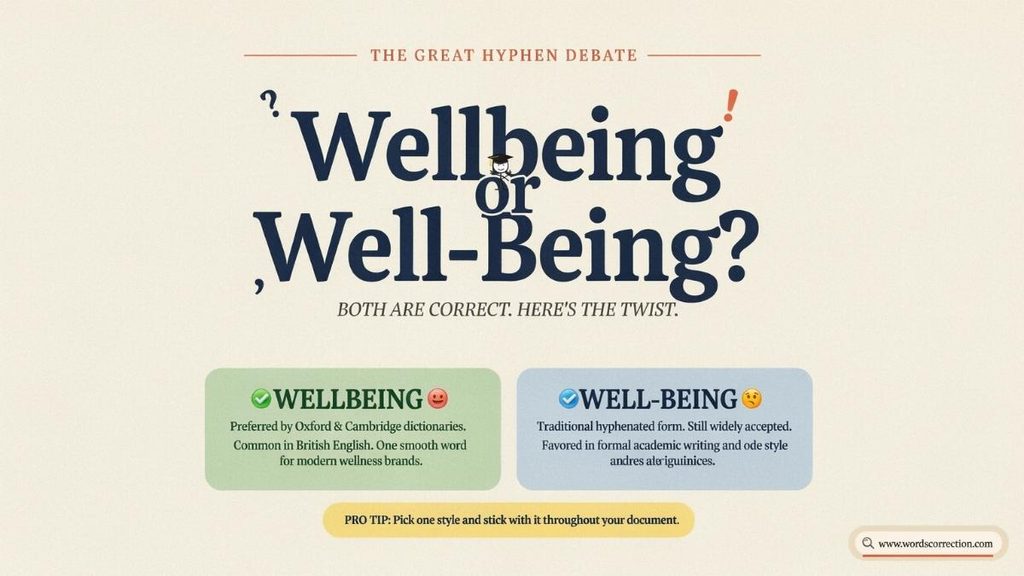
There isn’t a single answer that applies to every British writer.
Different dictionaries, publications, organizations, and editors may choose different forms.
That’s why the question “Is wellbeing one word in British English?” shouldn’t be answered with an absolute yes-or-no rule that excludes the hyphenated form.
A better explanation is this:
Both wellbeing and well-being are used in British English, with wellbeing particularly common in many modern contexts.
When writing for a British publication, follow that publication’s preferred spelling.
Wellbeing or Well-Being in Canadian English
Canadian English combines influences from British and American English, so spelling preferences can vary.
Both wellbeing and well-being may appear depending on the publication or editorial standard.
If you’re writing for a Canadian audience, don’t assume that a British or American preference automatically applies. Instead, check the relevant Canadian dictionary or the publication’s own style guide.
The same principle applies to international English follow the intended audience and maintain consistency.
What Do Dictionaries Say About Well-Being?
Dictionary evidence is useful when a spelling dispute starts turning into a guessing game.
Major dictionaries recognize the word and document its use. However, they don’t always present compound spellings in exactly the same way.
That variation is normal.
| Reference | Spelling treatment |
| Oxford dictionaries | Well-being is established |
| Cambridge Dictionary | Recognizes well-being and wellbeing |
| Collins Dictionary | Recognizes both forms |
| Merriam-Webster Dictionary | Uses the hyphenated form well-being |
This evidence supports an important conclusion both spellings have established usage.
However, dictionary recognition doesn’t mean that every publication must use both forms. A style guide can choose one spelling for consistency.
If a teacher asks for a specific style, use that style. An employer has a house guide, follow it. You’re writing independently, select a recognized form and stay consistent.
Learn the difference between confusing word pairs
Volcanoes or Volcanos The Correct Spelling?
AP Style, APA 7, and Chicago Style
Style guides create another layer of the spelling question.
A dictionary tells you what words and spellings exist. A style guide helps you decide how to use them consistently in a particular type of writing.
AP Style
The AP Stylebook is widely used in journalism and professional news writing.
If you’re writing for a publication that follows AP style, check its current guidance for compound-word spelling and hyphenation.
Don’t rely on an old blog post claiming that AP style always requires one particular spelling. Editorial guidance can change.
APA 7
APA Style is common in academic writing, particularly in psychology, education, and the social sciences.
If you’re asking how to write well-being in APA 7, the safest approach is to follow the current APA guidance and your institution’s requirements.
A university may also have its own style preferences.
Chicago Manual of Style
The Chicago Manual of Style provides detailed guidance on hyphenation and compound words.
If your book, paper, or publication follows Chicago style, use its current rules rather than applying a general assumption about every compound noun.
Learn the difference between tricky grammar more words
Disgard or Discard Which Spelling Is Correct and Why?
The Best Rule for Formal Writing
When formal writing requires a particular style:
- Check the required style guide.
- Check your publication or institution’s house style.
- Choose the accepted spelling that fits those rules.
- Use it consistently.
That approach is more reliable than arguing that one spelling must always be correct.
Well-Being Examples in Everyday Writing
Seeing the word in context makes its use much easier to understand.
Well-Being in a Sentence
Here are practical well-being sentence examples:
- Regular exercise can improve physical well-being.
- Adequate sleep is important for mental well-being.
- Strong friendships can support emotional well-being.
- The school introduced new programs to promote student well-being.
- The company is investing in employee well-being.
- Financial stability can contribute to overall well-being.
- Spending time outdoors may benefit psychological well-being.
Each sentence uses well-being as a noun.
Wellbeing Sentence Examples
The same ideas work with the closed spelling
- Regular exercise can improve physical wellbeing.
- Adequate sleep is important for mental wellbeing.
- Strong friendships can support emotional wellbeing.
- The school introduced programs to promote student wellbeing.
- The company is investing in employee wellbeing.
- Financial stability can contribute to overall wellbeing.
The meaning doesn’t change.
Examples of Well-Being in Daily Life
Well-being isn’t limited to hospitals, schools, or psychology textbooks. It appears in ordinary life.
For example:
- Getting enough sleep supports physical and mental health.
- Spending time with family can strengthen social well-being.
- Managing a realistic budget can support financial well-being.
- Taking breaks during a busy day can help manage stress.
- Regular movement can support physical health.
- Maintaining supportive relationships can improve emotional balance.
- Making time for meaningful activities can contribute to life satisfaction.
These examples show why well-being is broader than simply being healthy.
Workplace Well-Being
The phrase workplace well-being has become common because work can affect many areas of a person’s life.
A healthy workplace isn’t simply one where employees never feel stressed. Work can be demanding even in a supportive environment.
Workplace well-being can involve:
- Reasonable workloads
- Physical safety
- Work-life balance
- Supportive management
- Healthy communication
- Appropriate rest
- Job satisfaction
- Psychological safety
- Fair treatment
For example:
The company introduced flexible scheduling to support employee well-being.
The sentence doesn’t suggest that flexible scheduling solves every workplace problem. It simply identifies one factor that may contribute to better working conditions.
Learn the difference between commonly mixed-up more words
Uninterested vs Disinterested What’s the Difference?
Mental Well-Being and Physical Well-Being
The terms mental well-being and physical well-being often appear together because physical and psychological health can influence one another.
Poor sleep may affect concentration and mood. Long periods of inactivity can affect physical health. Ongoing stress can influence sleep, appetite, and energy.
Likewise, physical activity can support mental health for many people.
Still, these relationships don’t mean that one area automatically determines the other.
Someone can experience excellent physical health while struggling emotionally. Another person may manage a chronic physical condition while maintaining strong social connections and a satisfying life.
That is why overall well-being is broader than any single health measure.
Wellbeing vs Wellness
The words wellbeing and wellness are closely connected, but they aren’t perfect substitutes.
Well-being usually describes a person’s broader state of health, happiness, welfare, and quality of life.
Wellness often emphasizes habits, practices, or an active approach to maintaining or improving health.
Consider this example:
Meditation is part of her wellness routine and supports her overall well-being.
Here, wellness refers to the practice. Well-being refers to the broader outcome or condition.
Learn the difference between confusing more English words
Complimented or Complemented Which is Correct Spelling?
Well-Being vs Wellness Comparison
| Well-being | Wellness |
| Describes a broader state of health and welfare | Often describes an active approach to health |
| Can include happiness and life satisfaction | Often focuses on healthy habits and practices |
| Includes social, financial, mental, and physical factors | Commonly associated with fitness, nutrition, and self-care |
| Example: “The policy supports employee well-being.” | Example: “Exercise is part of his wellness routine.” |
The terms can overlap, so context matters.
Another Word for Well-Being
There isn’t one perfect another word for well-being because the term covers several ideas at once.
Depending on the sentence, possible alternatives include:
- Welfare — useful when discussing safety, protection, or basic needs
- Health — appropriate when focusing on physical or mental condition
- Happiness — useful when discussing positive feelings
- Wellness — appropriate when discussing health practices
- Contentment — useful for a sense of satisfaction
- Quality of life — useful when discussing broader living conditions
- Prosperity — appropriate when discussing financial or material success
For example:
The program aims to improve children’s well-being.
Could become:
The program aims to improve children’s welfare.
That works if the program focuses on children’s safety and living conditions.
However:
The program aims to improve children’s happiness.
has a narrower meaning.
The best synonym depends on what the original sentence is trying to say.
Common Well-Being Spelling Mistakes
A few mistakes appear again and again.
Mistake Writing “Well Being”
The company supports employee well being.
Better:
The company supports employee well-being.
Or:
The company supports employee wellbeing.
Mistake Assuming Wellbeing Is Wrong
Some writers see wellbeing and immediately add a hyphen.
That isn’t necessary if the publication uses the accepted closed form.
Mistake Switching Spellings
Using both forms in the same article can make the writing look inconsistent.
For example:
The program supports mental well-being and employee wellbeing.
Unless there’s a specific reason for the difference, choose one form.
Mistake Treating the Hyphen as a Meaning Difference
The hyphen doesn’t create a new definition.
Wellbeing and well-being generally mean the same thing.
The difference is spelling.
A Simple Case Study Choosing One Spelling
Imagine that a university is preparing a student health guide.
The first draft contains:
Student well-being is an important part of university life. The guide offers advice for improving student wellbeing. Good sleep supports mental well being.
The meaning is clear, but the spelling isn’t consistent.
Suppose the university’s editorial guide prefers the hyphenated form. The editor would revise the passage to:
Student well-being is an important part of university life. The guide offers advice for improving student well-being. Good sleep supports mental well-being.
Nothing about the message changed. The editor simply standardized the spelling.
Now imagine the university’s style guide prefers wellbeing. The same paragraph could use that form throughout.
This illustrates the practical lesson:
Consistency matters more than pretending that one accepted spelling is the only possible choice.
Learn the difference between tricky words and use them correctly
Don’ts or Don’t’s Which Spelling Is Correct?
How to Spell Well-Being Correctly
If you’re wondering how to spell well-being, remember the three forms:
Well-being — correct and widely established.
Wellbeing — correct and widely used.
Well being — generally not the standard compound-noun spelling.
If you’re writing in American English without a specific style requirement, well-being is a safe choice.
If your publication uses wellbeing, follow that preference instead.
How to Choose the Right Form
Use this checklist before publishing:
- Identify your audience.
- Check the required style guide.
- Check your organization’s house style.
- Confirm the spelling in a reputable dictionary.
- Pick one accepted form.
- Use it consistently.
- Check headings, subheadings, tables, captions, and body text.
This simple process can eliminate most spelling inconsistencies.
Practice Sessions About Wellbeing or Well-Being
Fill in the Blanks
- Exercise improves your overall ______.
- Good sleep supports mental ______.
- Both wellbeing and ______ are accepted spellings.
- Healthy food supports physical ______.
- Strong friendships improve emotional ______.
- The school promotes student ______.
- Stress management supports mental ______.
- The company cares about employee ______.
- Good health contributes to overall ______.
- Which spelling uses a hyphen: wellbeing or ______?
- Regular exercise improves physical ______.
- Happiness is an important part of ______.
- The program supports children’s ______.
- Wellbeing and well-being have the same ______.
- A healthy lifestyle can improve your ______.
- Social connections support emotional ______.
- Use your chosen spelling ______ throughout your article.
- Wellness habits can improve your ______.
- The report discusses workplace ______.
- Mental health is part of overall ______.
- Both spellings are accepted in English: wellbeing and ______.
- The correct spelling depends on your audience and style ______.
- Well-being refers to health, happiness, and general ______.
- Daily walks can support your physical ______.
- Consistent spelling makes your writing more ______.
Answers
- well-being
- well-being
- well-being
- well-being
- well-being
- wellbeing
- well-being
- wellbeing
- well-being
- well-being
- well-being
- well-being
- wellbeing
- meaning
- well-being
- well-being
- consistently
- well-being
- well-being
- well-being
- well-being
- guide
- welfare
- well-being
- professional
Here’s a trusted source for clear more words Comparison:
Grammar Update
FAQ’s
Is wellbeing one word or two words?
“Wellbeing” is written as one word, while “well-being” uses a hyphen. Both are accepted spellings of the noun referring to a person’s health, happiness, and overall welfare.
What does wellbeing mean?
Wellbeing refers to a person’s overall state of health, happiness, and life satisfaction. It includes physical health, mental and emotional balance, social relationships, and other factors that influence quality of life.
Is wellbeing one word in AP style?
For AP-style writing, consult the current Associated Press Stylebook or your publication’s editorial guidelines for the preferred spelling. “Well-being” is a widely established form in American English, but the applicable style guidance should determine your final choice.
What is the difference between good health and well-being?
Good health generally describes a person’s physical and mental condition, while well-being encompasses a broader range of life factors. These include emotional stability, social connections, financial security, and overall life satisfaction.
What’s a better word for wellbeing?
The best synonym depends on the context. “Welfare” emphasizes general well-being, “wellness” often refers to practices that support health, and “quality of life” describes a person’s overall living conditions and satisfaction.
What is the best definition of wellbeing?
Wellbeing is a state of health, comfort, and life satisfaction that reflects a person’s physical, mental, emotional, and social condition. Its precise meaning may vary depending on the context in which the term is used.
What are the four types of wellbeing?
A common framework identifies four types of well-being: physical, mental, emotional, and social. These categories describe how physical health, psychological functioning, emotional balance, and relationships contribute to overall welfare. Other frameworks may use different classifications.
What is an example of wellbeing?
Maintaining a healthy sleep routine, exercising regularly, managing stress, and building supportive relationships are examples of practices that promote well-being. For instance, taking a daily walk can support physical health and help relieve stress.
What are the three types of wellbeing?
Three commonly discussed types are physical, mental, and emotional well-being. Physical well-being concerns bodily health, mental well-being relates to psychological functioning, and emotional well-being involves understanding and managing feelings. Some frameworks classify these areas differently.
What are the 5 C’s of wellbeing?
There is no universally accepted set of five C’s of well-being. The term may refer to different models used by schools, health organizations, or other institutions. Always identify the specific framework before listing its five components.
What are the four pillars of wellbeing?
The four pillars depend on the framework being used. One practical approach focuses on physical, mental, emotional, and social well-being. Other models emphasize purpose, relationships, financial security, or lifestyle, so the categories may vary.
What are five ways to improve wellbeing?
Five practical ways to improve well-being are getting adequate sleep, staying physically active, eating a balanced diet, maintaining meaningful relationships, and managing stress. Consistent habits can support health and improve quality of life over time.
What are the four key components of well-being?
Four useful components are physical health, mental health, emotional balance, and social connection. Together, they provide a practical overview of well-being, although professional and academic frameworks may include additional dimensions.
What are the seven domains of well-being?
One framework divides well-being into physical, emotional, intellectual, social, spiritual, occupational, and environmental domains. However, these categories are not universal. The exact domains depend on the model or organization defining them.
Is wellbeing the same as wellness?
No. Well-being generally describes a person’s overall state of health, happiness, and welfare. Wellness often emphasizes the habits and choices that help maintain or improve health. The terms overlap, but their meanings are not always identical.
How can you use wellbeing in a sentence?
You can write, “The school introduced a program to support student wellbeing.” The same sentence can use “well-being” instead. Both spellings communicate the same meaning, so choose the form that matches your preferred style.
Should I use wellbeing or well-being in formal writing?
Choose the spelling recommended by your dictionary, publication, or style guide. “Well-being” is a reliable choice for general American English, while “wellbeing” is also widely used, particularly in British and international contexts. Consistency is essential.
Is well being grammatically correct?
When referring to the noun meaning overall health and welfare, “well-being” and “wellbeing” are the standard spelling choices. The open form “well being” is generally not preferred for this meaning, although the two words can appear together in other grammatical constructions.
Does wellbeing have a different meaning from well-being?
No. “Wellbeing” and “well-being” are spelling variants of the same noun. The difference is orthographic rather than semantic, so both forms express the same general idea.
What is the difference between mental well-being and emotional well-being?
Mental well-being concerns overall psychological functioning, including coping with challenges and managing everyday responsibilities. Emotional well-being focuses more specifically on recognizing, expressing, and managing feelings. Both contribute to a person’s overall health.
Why is well-being important in everyday life?
Well-being influences how people manage stress, maintain relationships, handle daily responsibilities, and experience life satisfaction. Supporting physical health, emotional balance, and meaningful social connections can contribute to a healthier, more fulfilling life.
Learn the difference between similar English words the easy way
Appendix or Appendices Which one Is Correct?
Conclusion
Choosing between wellbeing or well-being is simple once you understand the spelling differences. Both forms are correct and have the same meaning, although preferences vary by region and style guide. To avoid confusion, choose the spelling that suits your audience and use it consistently throughout your writing. Remember, a hyphen may be small, but it can still raise big questions By understanding the rules and following clear examples, you can avoid common spelling mistakes and communicate more confidently. Keep your writing clear, your spelling consistent, and your message easy to understand.

Stella AJS is an experienced blogger and dedicated English language writer at Words Correction. She turns confusing grammar, word meanings, spelling, and usage into clear, practical insights that readers can easily understand and apply. With a passion for precise and engaging writing, Stella helps readers avoid common language mistakes, strengthen their vocabulary, and communicate with greater clarity and confidence.




