
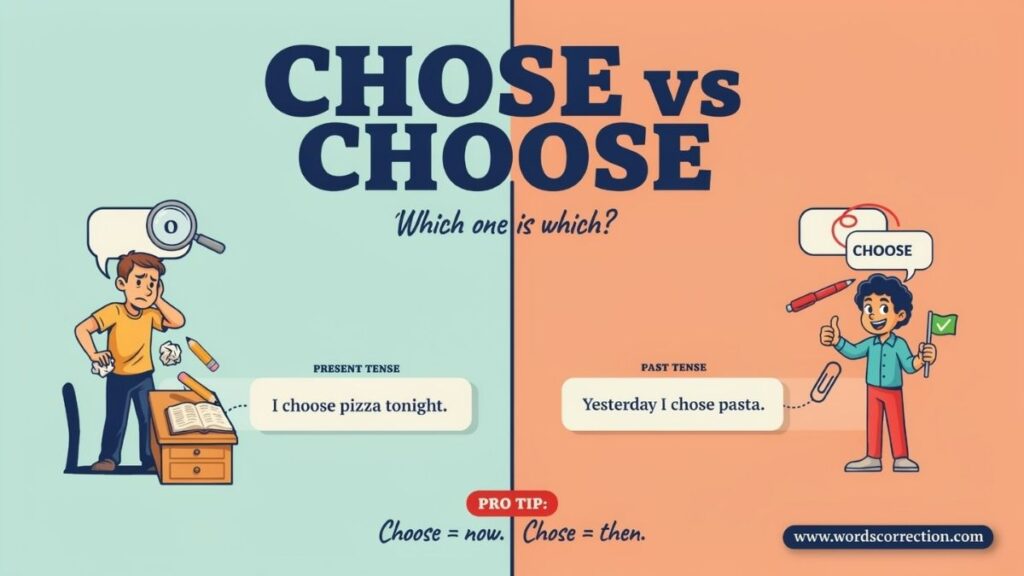
Choosing between chose or choose can be confusing because these words look similar but serve different purposes. Using the wrong form can change the meaning of your sentence and lead to grammar mistakes. Fortunately, the difference is easy to understand once you learn the basic rule. In this guide, you’ll discover what choose and chose mean, when to use each word, and how they work in everyday sentences. You’ll also learn common grammar mistakes, explore practical examples, and practice with 25 grammar exercises and an answer key to test your knowledge and use the correct word with confidence.
Chose or Choose Quick Answer
The answer depends on the tense and sentence structure.
- Choose = base form or present-tense form
- Chose = simple past
- Chosen = past participle
- Chooses = third-person singular present form
- Choosing = -ing form
Compare these sentences
I choose the blue shirt.
I chose the blue shirt yesterday.
She has chosen the blue shirt.
The action is similar in all three examples, but the verb changes because the grammatical structure changes.
| Word | Verb form | Main use | Example |
| choose | Base form | Present, infinitive, commands, future and modal constructions | I choose carefully. |
| chose | Simple past | A completed past choice | I chose carefully yesterday. |
| chosen | Past participle | Perfect tenses and passive structures | I have chosen carefully. |
| chooses | Third-person singular present | He, she, or it | She chooses carefully. |
| choosing | Present participle | Continuous forms and gerunds | She is choosing carefully. |
So, when someone asks, Choose or chose which is correct?, both can be correct. The sentence determines which form belongs there.
Learn the difference between more words people mix up
Sole vs Soul which is correct?
Choose Meaning What Does Choose Mean?
The word choose means to select one person, thing, action, or option from several possibilities.
For example
- You choose a meal from a menu.
- You choose a college from several schools.
- You choose a color for your room.
- You choose whether to stay or leave.
The verb often describes the process of making a choice or decision.
Choose in a Sentence
Here are several natural examples
- I choose tea instead of coffee.
- You can choose any seat.
- We choose healthy meals during the week.
- They choose carefully before making important decisions.
- Please choose one answer.
Notice that choose does not always describe something happening at this exact moment.
It can describe a habit
I choose fresh fruit whenever possible.
It can also appear in a future construction
I will choose tomorrow.
Or it can appear after a modal verb
You can choose any option.
That flexibility makes choose one of the most useful forms of the verb.
Chose Meaning What Does Chose Mean?
Chose is the simple past form of choose. It describes a decision or selection that happened in the past.
For example
- I chose the blue jacket yesterday.
- She chose the earlier flight.
- We chose a small restaurant last night.
- They chose the red team.
- He chose to remain silent.
The key idea is completion. The decision has already happened.
Chose in a Sentence
Consider these examples
- I chose the wrong answer.
- She chose to study medicine.
- He chose the cheapest option.
- We chose a different route.
- They chose to wait.
Words such as these often make the past tense obvious:
- yesterday
- last night
- last week
- last year
- earlier
- previously
- a few days ago
- when I was younger
- several years ago
For example
I chose this career when I was younger.
The phrase “when I was younger” clearly places the decision in the past.
Learn the difference between everyday English mistakes
Mistery vs Mystery Which Is Correct?
Chose vs Choose The Main Difference
The chose vs choose distinction is mainly about tense.
Choose is the base form. It can describe a present action, a habit, an instruction, or a choice connected to the future.
Chose is the simple past form. It describes a completed choice that happened earlier.
Compare
I choose the blue one.
This may describe a present decision or a general preference.
I chose the blue one.
This tells us that the selection happened in the past.
The contrast becomes even clearer when the time changes:
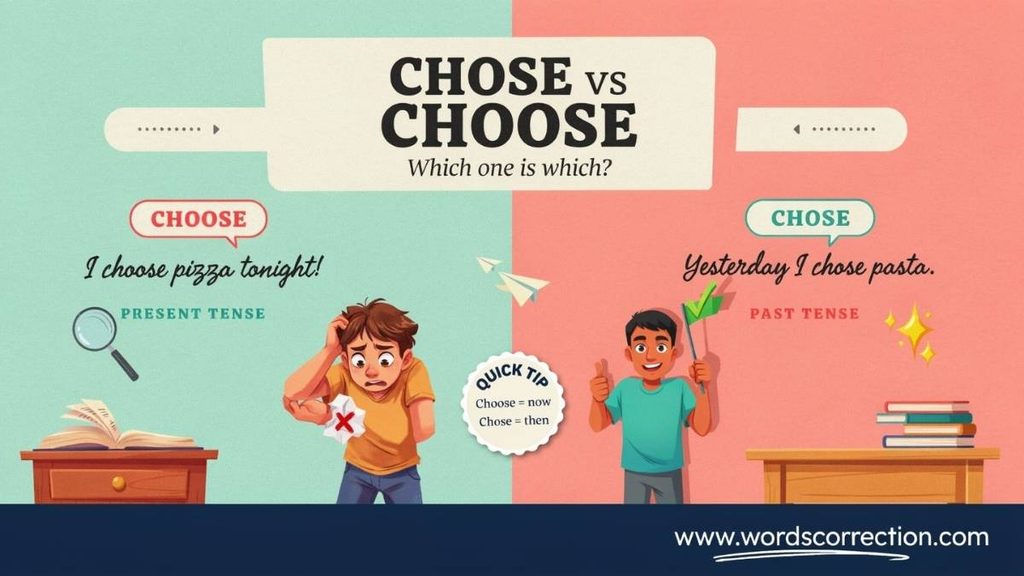
Today, I choose the train. Yesterday, I chose the bus.
The action is similar, but the time is different.
That is the basic choose and chose difference.
Choose vs Chose Pronunciation
The words also have different pronunciations.
In American English
- Choose is pronounced chooz.
- Chose is pronounced chohz.
The beginning and ending sounds are similar, but the vowel sound changes.
Choose has the long oo sound heard in words such as “food.”
Chose has the long o sound heard in words such as “go.”
This difference is useful when speaking because the two words can sound noticeably different in a sentence.
However, pronunciation alone shouldn’t determine which word you use in writing. The tense and sentence structure matter more.
Learn the difference between commonly misused words
Organiser or Organizer Which Spelling Should You Use?
Chose or Choose Past Tense Which One Is Correct?
If you are looking for the past tense of choose, the answer is chose.
The basic sequence is
Choose → Chose → Chosen
For example
- Present: I choose the best option.
- Past: I chose the best option.
- Perfect: I have chosen the best option.
One common mistake is treating choose like a regular verb and adding -ed.
Incorrect
I choosed the red one.
Correct
I chose the red one.
English has many irregular verbs whose past forms do not follow the standard -ed pattern. Choose is one of them.
Choose, Chose, and Chosen The Three Main Verb Forms
Understanding choose, chose, and chosen together makes this grammar point much easier.
Choose
Choose is the base form.
Examples
- I choose.
- You choose.
- We choose.
- They choose.
- I want to choose.
- I will choose.
- You can choose.
Chose
Chose is the simple past form.
Examples
- I chose.
- You chose.
- We chose.
- They chose.
- She chose.
The past form stays the same for every subject.
Chosen
Chosen is the past participle.
It normally appears with helping verbs such as have, has, or had.
Examples:
- I have chosen.
- She has chosen.
- We have chosen.
- They had chosen.
This leads to an important rule:
Do not say “I have chose.” Say “I have chosen.”
Correct
I have chosen a new laptop.
Incorrect
I have chose a new laptop.
Learn the difference between basic English word mistakes
Volcanoes or Volcanos The Correct Spelling?
Choose Verb Conjugation and Verb Forms of Choose
The complete verb forms of choose are easy to organize in a table.
| Form | Word | Example |
| Base form | choose | I choose carefully. |
| Third-person singular | chooses | She chooses carefully. |
| Simple past | chose | She chose carefully. |
| Past participle | chosen | She has chosen carefully. |
| Present participle | choosing | She is choosing carefully. |
This is the basic choose verb conjugation used in everyday English.
The verb is irregular because its past form changes rather than simply adding -ed.
Choose Present Tense When Should You Use It?
Use choose when you are talking about a present action, regular behavior, general preference, or a grammatical structure that requires the base form.
Present Choice
I choose the blue option.
Regular Habit
She chooses a different book every month.
Future Decision
We will choose a restaurant later.
After a Modal Verb
You can choose any seat.
They should choose carefully.
He might choose the cheaper option.
The last examples demonstrate an important rule in English grammar: modal verbs take the base form of the main verb.
Therefore:
- will choose — correct
- can choose — correct
- should choose — correct
- might choose — correct
- will chose — incorrect
- can chose — incorrect
- should chose — incorrect
Learn the difference between often confused words
Disgard or Discard Which Spelling Is Correct and Why?
Chose Past Tense When Should You Use It?
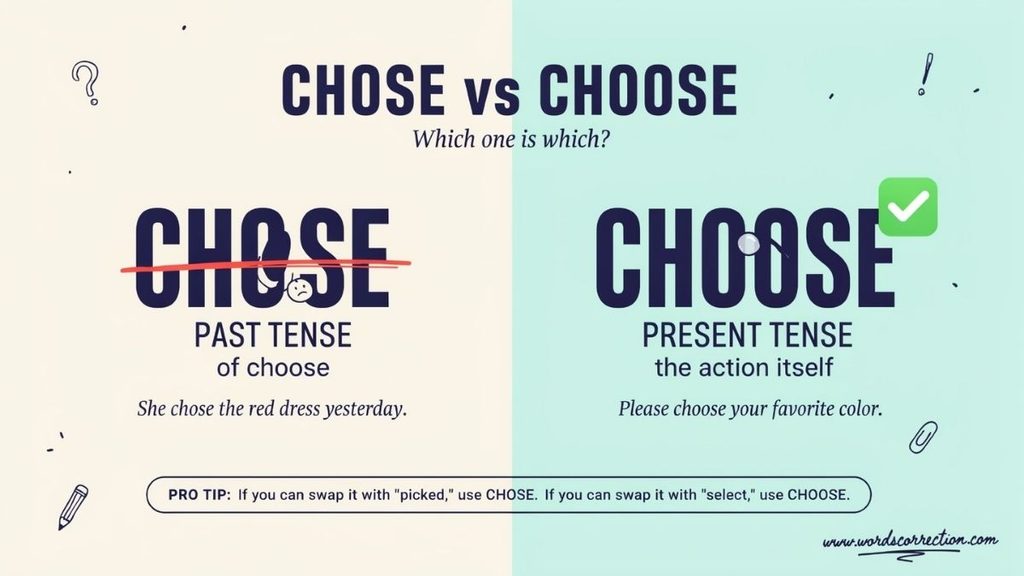
Use chose when the decision happened in the past.
With a Specific Past Time
I chose the blue car last year.
After a Completed Decision
She chose the winning design.
In a Past Story
After comparing both apartments, they chose the smaller one.
With “To” + Verb
He chose to leave early.
The structure chose to + verb is extremely common.
Examples include:
- chose to stay
- chose to leave
- chose to wait
- chose to help
- chose to continue
- chose to accept
- chose to change
When to Use Choose or Chose
If you’re unsure when to use choose or chose, ask yourself:
Did the choice happen in the past and finish?
If yes, chose is usually the correct form for a simple past sentence.
If the action describes the present, a general habit, an instruction, or a structure that requires the base verb, use choose.
| Situation | Correct form | Example |
| Present choice | choose | I choose tea. |
| General preference | choose | I choose tea every morning. |
| Future decision | choose | I will choose tomorrow. |
| After a modal | choose | You can choose one. |
| Completed past choice | chose | I chose yesterday. |
| Past event | chose | She chose the red dress. |
| Perfect tense | chosen | She has chosen the red dress. |
Learn the difference between confusing word pairs
Uninterested vs Disinterested What’s the Difference?
Choose vs Chose Examples in Everyday English
Practical examples make the choose vs chose examples easier to understand.
Food
Present
I choose soup when I want something light.
Past
I chose soup at lunch yesterday.
Shopping
Present
I usually choose practical shoes.
Past
I chose these shoes last weekend.
Education
Future
She will choose her major next semester.
Past
She chose biology last year.
Travel
Present
We usually choose the train.
Past
We chose the train for our last trip.
Personal Decisions
Present
I choose to focus on one task at a time.
Past
I chose to focus on one task during yesterday’s meeting.
These examples show how context controls the verb form.
Learn the difference between tricky grammar more words
Complimented or Complemented Which is Correct Spelling?
Choose vs Chose With Different Pronouns
Unlike some English verbs, chose doesn’t change depending on the subject.
| Subject | Present | Past |
| I | choose | chose |
| You | choose | chose |
| He | chooses | chose |
| She | chooses | chose |
| It | chooses | chose |
| We | choose | chose |
| They | choose | chose |
This means all of these are correct in the simple past:
- I chose.
- You chose.
- He chose.
- She chose.
- We chose.
- They chose.
The present tense is slightly different because he, she, and it require chooses.
He Chose or He Choose?
The correct form depends on the tense.
For the present
He chooses the restaurant.
For the past
He chose the restaurant.
The phrase he choose is not correct as a standard simple present sentence.
The correct present form is he chooses.
This is a common mistake because learners sometimes use the base form after every subject. In the simple present, third person singular subjects usually require the appropriate -s or -es form.
She Chose or She Choose?
The same rule applies to she.
Present
She chooses carefully.
Past
She chose carefully.
If the sentence includes a completed past-time expression such as “yesterday” or “last year,” chose is the natural choice.
Learn the difference between commonly mixed-up more words
Don’ts or Don’t’s Which Spelling Is Correct?
You Chose or You Choose?
Both forms can be correct because you uses the same present and past subject pattern in this context.
Present
You choose the movie every Friday.
Past
You chose the movie last Friday.
The time expression tells the reader which tense you’re using.
I Choose or I Chose?
Both are grammatically correct, but they communicate different meanings.
I choose the blue one.
This refers to a present choice or preference.
I chose the blue one.
This refers to a choice that happened earlier.
If you’re asking, “I choose or I chose?”, don’t choose based on which word sounds better. Look at the meaning and time of the sentence.
Learn the difference between confusing more English words
Appendix or Appendices Which one Is Correct?
Chose or Chosen What’s the Difference?
The chosen or chose confusion often appears when a sentence contains have, has, or had.
Use chose as the simple past form:
She chose the winning design.
Use chosen as the past participle:
She has chosen the winning design.
She had chosen the winning design before the meeting.
Both chose and chosen can refer to past events, but they have different grammatical jobs.
Compare:
- I chose a book.
- I have chosen a book.
- I had chosen a book.
The first sentence uses simple past. The other two use the past participle with helping verbs.
Is “Choosed” a Word?
Choosed is not the standard past tense of choose.
The correct forms are:
choose → chose → chosen
Not:
choose → choosed
This mistake occurs because many verbs form their past tense by adding -ed.
For example
- walk → walked
- clean → cleaned
- open → opened
But English also contains many irregular verbs:
- go → went
- take → took
- write → wrote
- see → saw
- choose → chose
So if you’re wondering whether choosed is correct, the answer is no in standard English.
Learn the difference between tricky words and use them correctly
Skillset or Skill Set Which Spelling Is Correct?
Chooses or Choses Which Is Correct?
Chooses is the correct third-person singular present form.
Examples
She chooses carefully.
He chooses the best option.
The customer chooses a seat.
Choses is not the standard form.
Remember the pattern
- I choose
- You choose
- We choose
- They choose
- He chooses
- She chooses
- It chooses
- Everyone chooses
For the past tense, however, every subject uses chose.
Choosing or Chosing Which Spelling Is Correct?
The correct spelling is choosing.
Examples
She is choosing a dress.
They are choosing between two options.
The spelling chosing is incorrect.
When choose takes the -ing ending, the final silent e is removed:
choose → choosing
This follows a common spelling pattern:
- make → making
- write → writing
- take → taking
- choose → choosing
Knowing this pattern helps avoid unnecessary spelling mistakes.
Will Choose or Will Chose?
The correct expression is will choose.
Correct
I will choose tomorrow.
Incorrect
I will chose tomorrow.
The reason is simple. Will is a modal auxiliary, and modal verbs are followed by the base form of the main verb.
The same rule applies to
- can choose
- could choose
- may choose
- might choose
- should choose
- would choose
- will choose
So one of the easiest chose grammar rules to remember is:
After a modal verb, use choose, not chose.
Learn the difference between similar English words the easy way
Wellbeing or Well-Being Which Spelling Is Correct?
Common Mistakes With Choose and Chose
Even a small verb can create several grammar problems. Here are the mistakes worth watching for.
Using Chose for a Present Habit
Incorrect
I chose coffee every morning.
Correct
I choose coffee every morning.
If the sentence describes a current habit, use the present form.
Using Choose for a Completed Past Action
Incorrect
Yesterday, I choose the red shirt.
Correct
Yesterday, I chose the red shirt.
The word “yesterday” clearly places the action in the past.
Using Chose After Will
Incorrect
I will chose later.
Correct
I will choose later.
Using Chose After Have
Incorrect
I have chose the blue option.
Correct
I have chosen the blue option.
Using Choosed
Incorrect
She choosed the winner.
Correct
She chose the winner.
Using Choses as the Past Tense
Incorrect
He choses the restaurant yesterday.
Correct
He chose the restaurant yesterday.
Choose Grammar Rules to Remember
You don’t need to memorize dozens of rules. These six cover most situations.
Use choose as the base form.
I want to choose.
Use chose for the simple past.
I chose yesterday.
Use chosen as the past participle.
I have chosen.
Use chooses with he, she, or it in the present tense.
She chooses wisely.
Use choosing for the -ing form.
She is choosing now.
Use choose after modal verbs.
You should choose carefully.
These rules provide a practical foundation for correct verb tense usage.
Choose and Chose Sentence Examples
Sentences With Choose
- Choose your words carefully.
- I choose fresh fruit whenever possible.
- You can choose any color.
- We will choose a new supplier next month.
- They choose the same hotel every year.
- She wants to choose her own schedule.
- You should choose the option that suits your needs.
Sentences With Chose
- I chose the blue jacket.
- She chose to stay home.
- He chose the correct answer.
- We chose a quiet restaurant.
- They chose the longer route.
- You chose wisely.
- The committee chose a new leader.
Choosing Between Two Options Choose, Pick, or Decide?
Choose, pick, and decide are closely related, but they aren’t always interchangeable.
Choose usually focuses on selecting one option:
I chose the blue shirt.
Pick is often more informal:
I picked the blue shirt.
Decide focuses more on reaching a decision:
I decided to buy the blue shirt.
Select can sound more formal:
The committee selected three finalists.
These words can overlap, but the best choice depends on the context and tone.
A Simple Case Study One Decision, Three Verb Forms
Imagine a student deciding which college to attend.
At first, several possibilities are available
She needs to choose a college.
The decision happens:
She chose a college last month.
Later, someone asks whether the decision has been finalized:
She has chosen a college.
The underlying action is the same: selecting a college. What changes is the verb form and grammatical structure.
This is the clearest way to understand choose, chose, and chosen difference.
How to Remember the Difference Between Choose and Chose
When the two words start to blur together, use this simple memory trick:
Choose now Chose before Chosen with have, has, or had.
Think of the three forms as a small timeline:
Present/Base → Past → Past Participle
Choose → Chose → Chosen
For example:
choose a book.
I chose a book yesterday.
Have I chosen a book.
This pattern is short, practical, and easy to apply when you’re writing quickly.
Choose or Chose Quiz
Test your understanding before checking the answers
Identify whether each sentence uses choose, chose, or chosen.
Practice Sessions about chose or choose
Complete each sentence with the correct form of the verb in parentheses. Use choose, chooses, chose, chosen, or choosing as needed.
- I usually ______ a cup of tea in the morning.
- She ______ the blue dress for the wedding yesterday.
- You can ______ any book from the shelf.
- We ______ a different restaurant last weekend.
- He always ______ his words carefully.
- They will ______ their team captain tomorrow.
- I have ______ a topic for my English assignment.
- Sarah ______ to study medicine last year.
- You should ______ the option that suits your needs.
- My brother ______ the wrong answer during the test.
- We are ______ a gift for our teacher.
- She has ______ the best candidate for the position.
- I ______ to stay home last night.
- He can ______ between two available options.
- They had ______ a destination before booking their flights.
- Every student must ______ one subject for the project.
- My parents ______ this house in 2018.
- She usually ______ healthy meals for her family.
- I will have ______ a winner by the end of the day.
- We ______ the shorter route because we were late.
- Are you ______ a name for your new business?
- He has already ______ his favorite movie.
- Yesterday, I ______ the cheapest ticket available.
- You may ______ whichever option you prefer.
- After comparing all the options, they had ______ the most suitable plan.
Answer Key
- choose
- chose
- choose
- chose
- chooses
- choose
- chosen
- chose
- choose
- chose
- choosing
- chosen
- chose
- choose
- chosen
- choose
- chose
- chooses
- chosen
- chose
- choosing
- chosen
- chose
- choose
- chosen
Here’s a trusted source for clear more words Comparison:
Grammar Update
FAQ’s
Should I use choose or chose?
Use choose for a present or general choice and chose for a completed past decision. For example, “I choose the blue shirt” describes a present choice, while “I chose the blue shirt yesterday” refers to the past.
What does I chose mean?
“I chose” means that you selected something or made a decision in the past. For example, “I chose the science course” means you selected that course earlier.
Is it correct to say I chose?
Yes, “I chose” is grammatically correct when describing a past decision. For example, “I chose to stay home last night.”
What does choose mean?
Choose means to select a person, thing, or option from two or more possibilities. For example, “You can choose your favorite color.”
What does to choose mean?
“To choose” means to select an option or make a decision. It is the infinitive form of the verb, as in “I want to choose a new book.”
What does chose mean in English?
Chose is the simple past tense of choose. It describes a decision or selection that happened earlier, as in “She chose the winning design.”
How do I use choose correctly?
Use choose when the sentence requires the base form of the verb, including after modal verbs such as can, will, and should. For example, “I will choose tomorrow.”
How do you use choose in a sentence?
Use choose to describe a selection, preference, or decision. For example, “I choose comfortable shoes for everyday use.”
Is I choose you grammatically correct?
Yes, “I choose you” is grammatically correct. It expresses a present choice, preference, or commitment, depending on the context.
Which is correct I chose you or I choose you?
Both are correct, but they refer to different time frames. “I chose you” describes a past decision, while “I choose you” expresses a present choice or commitment.
What is the third form of choose?
The third form of choose is chosen. The three principal forms are choose, chose, chosen.
What is the past perfect tense of choose?
The past perfect form is had chosen. For example, “She had chosen her topic before the class began.”
Is it choosing or chosing?
Choosing is the correct spelling. The final e in “choose” is dropped before adding -ing, so “chosing” is incorrect.
What is the difference between choose and chose?
Choose is the base form of the verb, while chose is its simple past form. For example, “I choose carefully” describes a present or general action, while “I chose carefully yesterday” describes a past action.
How do you pronounce choose and chose?
In American English, choose is pronounced with a long oo sound. Chose is pronounced choose with a long o sound.
Is choosed the correct past tense of choose?
No, choosed is incorrect in standard English. The correct past tense is chose, and the past participle is chosen.
Can I use choose after will?
Yes, use the base form choose after “will.” For example, “I will choose a new laptop tomorrow.” The phrase “I will chose” is grammatically incorrect.
Should I write he chose or he chooses?
Use he chose for a completed past action and he chooses for a present habit or action. For example, “He chose the red car yesterday” and “He chooses the red car every time.”
What is another word for chose?
Common alternatives to chose include selected, picked, opted for, and decided on. For example, “She chose the blue dress” can become “She selected the blue dress.”
What is a formal alternative to choose?
Select is often a more formal alternative to choose. For example, “Please select your preferred option” sounds appropriate in professional instructions.
Can choose describe a future decision?
Yes, choose can refer to a future decision when used in a future construction. For example, “We will choose a destination next week.”
Is I have chose grammatically correct?
No. The correct expression is “I have chosen” because perfect tenses require the past participle. For example, “I have chosen a different approach.”
When should I use chosen instead of chose?
Use chosen with helping verbs such as have, has, and had in perfect-tense constructions. Use chose for the simple past. For example, “She has chosen a book” and “She chose a book yesterday.”
Is choose an irregular verb?
Yes, choose is an irregular verb because its past tense does not follow the regular -ed pattern. Its principal forms are choose, chose, chosen.
What is an easy way to remember choose vs chose?
Remember this simple rule: choose for the base form, chose for the simple past, and chosen for the past participle. For example, “I choose today,” “I chose yesterday,” and “I have chosen already.”
Conclusion
Understanding the difference between chose or choose is easier than it seems. Use choose for the base form and present choices, chose for decisions made in the past, and chosen with helping verbs such as have, has, and had. Mixing up these forms can lead to grammar mistakes, but learning a few simple rules makes a big difference. Review the examples, practice the exercises, and pay attention to the time of each action. With regular practice, you’ll know which word to use and write with greater confidence. After all, good grammar starts with making the right choice

Stella AJS is an experienced blogger and dedicated English language writer at Words Correction. She turns confusing grammar, word meanings, spelling, and usage into clear, practical insights that readers can easily understand and apply. With a passion for precise and engaging writing, Stella helps readers avoid common language mistakes, strengthen their vocabulary, and communicate with greater clarity and confidence.




