
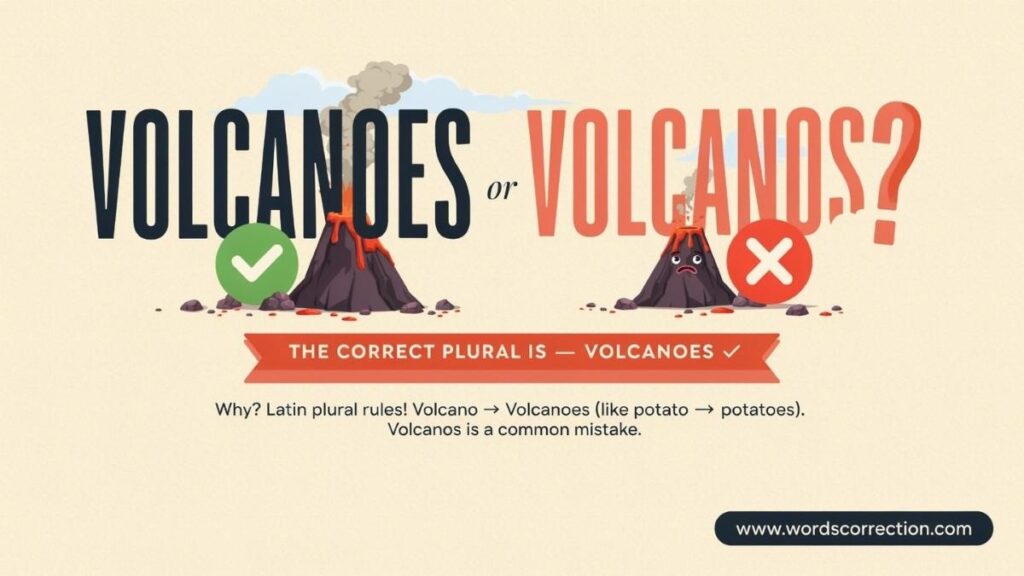
The spelling “volcanoes or volcanos” can be confusing because English sometimes gives us more than one correct way to form a plural. The good news is that both volcanoes and volcanos are correct. However, volcanoes is the more common and preferred spelling in standard English, while volcanos is an accepted alternative. There’s no need to worry if you have used the less common form. In this guide, we’ll explain the difference between volcanoes and volcanos in simple terms, show you how to use both forms correctly, and help you choose the right spelling for clear, professional writing.
Volcanos or Volcanoes Quick Answer
The singular noun is volcano. When you talk about more than one, you can use either volcanoes or volcanos.
| Form | Number | Correct? | Common Usage |
| volcano | Singular | Yes | Very common |
| volcanoes | Plural | Yes | More common |
| volcanos | Plural | Yes | Less common |
For most readers, volcanoes will look more familiar.
For example:
- One volcano erupted overnight.
- Several volcanoes erupted overnight.
- Several volcanos erupted overnight.
The last two sentences mean the same thing.
The Simple Rule
If you’re unsure which spelling to choose, use:
volcano → volcanoes
It’s the more common plural form and works well in academic, professional, educational, and everyday writing.
Volcanoes or Volcanos What’s the Difference?
There isn’t a difference in meaning between volcanoes and volcanos.
Both are plural nouns. Both refer to two or more volcanoes.
The difference is simply the way the plural is spelled.
Volcanoes adds -es, while volcanos adds -s:
- volcano + es = volcanoes
- volcano + s = volcanos
That small spelling difference often causes confusion because English doesn’t follow one universal rule for every noun ending in o.
For example:
- tomato → tomatoes
- potato → potatoes
- hero → heroes
- photo → photos
- piano → pianos
- volcano → volcanoes or volcanos
As these examples show, English pluralization can be less predictable than it first appears.
What Is the Meaning of Volcano?
A volcano is a geological feature through which molten rock, gases, ash, and other volcanic material can reach Earth’s surface.
The word can refer to the volcanic vent itself or to the larger landform that develops around it.
Deep beneath Earth’s surface, molten rock is called magma. When magma rises and reaches the surface, it becomes lava.
During an eruption, a volcano may release:
- Lava
- Volcanic ash
- Rock fragments
- Volcanic gases
- Tephra
- Pyroclastic material
The exact behavior of a volcano depends on several factors, including the composition and temperature of its magma, its gas content, and the geological setting.
Volcano Meaning in Geography
In geography, a volcano is generally understood as a landform or geological system associated with an opening in Earth’s crust.
Volcanic activity can create dramatic landscapes over time. Lava flows may build new land, repeated eruptions can form volcanic mountains, and underwater eruptions can contribute to the development of islands.
Not every volcano looks like the classic steep mountain shown in textbooks. Some have broad, gentle slopes, while others form domes, fissures, calderas, or other structures.
Learn the difference between confusing more English words
Families or Familys which one is correct?
The Origin of the Word Volcano
The word volcano has an interesting history.
It ultimately comes from Vulcano, a volcanic island in the Aeolian Islands of Italy. The island’s name became associated with Vulcan, the Roman god of fire and metalworking.
Over time, the name moved beyond the island itself and became a general term for volcanic mountains and openings.
The scientific understanding of volcanoes has changed considerably since the word entered common use. Ancient societies often explained eruptions through myths and religious beliefs. Modern geology explains volcanic activity through processes involving Earth’s internal heat, magma, gases, tectonic movement, and pressure.
This history also helps explain why the English word doesn’t always behave like a traditional native English noun.
Is Volcanos Correct?
Yes. Volcanos is correct when it is used as the plural of volcano.
If you’ve searched is volcanos correct, is volcanos a word, or is volcanos a correct spelling, the answer is yes.
However, “correct” doesn’t necessarily mean “most common.”
English contains many accepted spelling variations. One form may appear much more frequently than another while both remain valid.
That is exactly what happens with volcanoes and volcanos.
Example
Both sentences are correct:
The region contains several active volcanoes.
The region contains several active volcanos.
The first sentence uses the more common spelling.
Is Volcanoes Correct?
Yes. Volcanoes is correct, and it is the more widely used plural form.
If you’re asking is volcanoes a word, is volcanoes correct, or is volcanoes a correct spelling, the answer is an uncomplicated yes.
Examples include:
- Several volcanoes are located along the Pacific Ring of Fire.
- Scientists monitor active volcanoes for changes in activity.
- Some volcanoes remain dormant for centuries.
- Volcanic ash from nearby volcanoes affected air travel.
For most types of writing, volcanoes is the easiest choice.
Learn the difference between commonly mixed-up more words
Allie or Ally Difference And Usage
What Is the Plural of Volcano?
The plural of volcano is volcanoes or volcanos.
However, volcanoes is the more common plural form.
| Singular | Plural |
| volcano | volcanoes |
| volcano | volcanos |
So, if someone asks, “What is the plural of volcano?”, the most useful answer is:
Volcanoes is the most common plural form, while volcanos is also accepted.
This also answers questions about the volcano plural form, volcano plural spelling, and correct plural of volcano.
Why Are There Two Plural Spellings?
The answer lies partly in the flexible nature of English pluralization.
Some nouns ending in o traditionally take -es:
- potato → potatoes
- tomato → tomatoes
- hero → heroes
Other nouns take -s:
- photo → photos
- radio → radios
- piano → pianos
A few nouns have developed both forms.
Volcano belongs to this group.
Therefore:
volcanoes is an established plural form.
volcanos is also an established plural form.
English doesn’t always provide a single spelling rule that explains every noun. Historical development, borrowed words, pronunciation, and common usage all influence how words form their plurals.
Learn the difference between tricky grammar more words
Happend or Happened Which Spelling Is Correct?
both Which Is More Common?
When comparing volcanoes vs volcanos, the biggest practical difference is frequency.
Volcanoes is much more familiar to most English readers.
That makes it the better default for:
- School assignments
- Academic papers
- Professional writing
- Educational articles
- News writing
- General communication
- Formal documents
Volcanos remains acceptable, but it appears less often.
This distinction matters because readers generally expect familiar spellings. Choosing volcanoes reduces the chance that someone will stop and wonder whether the word contains a spelling error.
Volcanoes or Volcanos in American English
In American English, both spellings are recognized.
However, volcanoes is the standard choice most writers will naturally use.
For example:
Scientists are studying several active volcanoes.
This sentence sounds completely natural in US English.
You could also write:
Scientists are studying several active volcanos.
The meaning remains unchanged.
Therefore, the question volcanos or volcanoes US spelling doesn’t have the same kind of answer as color versus colour. American English does not require volcanos while British English requires volcanoes.
The difference isn’t a strict US-versus-UK spelling rule.
Volcanoes or Volcanos in British English
British English also uses volcanoes and recognizes volcanos as an alternative form.
So, if you’re wondering about volcanos or volcanoes UK spelling, don’t assume that one belongs exclusively to British English.
A useful comparison is:
| Variety | Volcanoes | Volcanos |
| American English | Accepted and more common | Accepted |
| British English | Accepted and more common | Accepted |
| Formal writing | Preferred | Less common |
| General writing | Preferred | Acceptable |
The safest choice across English varieties remains volcanoes.
Learn the difference between confusing word pairs
Steel or Steal which one is correct?
Volcano Spelling and English Grammar
The word volcano provides a useful example of how English spelling and grammar interact.
English pluralization isn’t always mechanical. While many nouns simply take -s, some take -es, change their spelling, or use an irregular form.
For example:
- book → books
- class → classes
- baby → babies
- child → children
- volcano → volcanoes or volcanos
The pluralization of volcano demonstrates why English learners shouldn’t rely on a single rule for every noun.
Words Ending in O
A common question is whether nouns ending in o always take -es.
They don’t.
Compare:
| Singular | Plural |
| potato | potatoes |
| tomato | tomatoes |
| hero | heroes |
| photo | photos |
| piano | pianos |
| radio | radios |
| volcano | volcanoes / volcanos |
English spelling rules provide useful patterns, but vocabulary history often creates exceptions and variations.
Learn the difference between often confused words
Principal or Principle Don’t Mix Them Up
Is Volcanos a Word or a Spelling Mistake?
Volcanos is a word
It isn’t simply a typing error caused by forgetting the letter e.
When used as the plural of volcano, volcanos is an accepted spelling.
Still, writers should distinguish between an accepted variant and a preferred form.
For most general purposes:
Preferred: volcanoes
Accepted alternative: volcanos
That difference explains why a dictionary may recognize both forms even though one appears much more frequently.
How Do You Spell the Plural of Volcano?
If you’re asking how to spell volcanoes or how to spell volcanos, both spellings are possible.
The most common spelling is:
volcanoes
The accepted alternative is:
volcanos
A simple memory aid is:
One volcano, several volcanoes.
When you need a standard form for an assignment or article, choose volcanoes.
Learn the difference between basic English word mistakes
Programme or Program Spelling Guide
Common Mistakes With Volcanoes and Volcanos
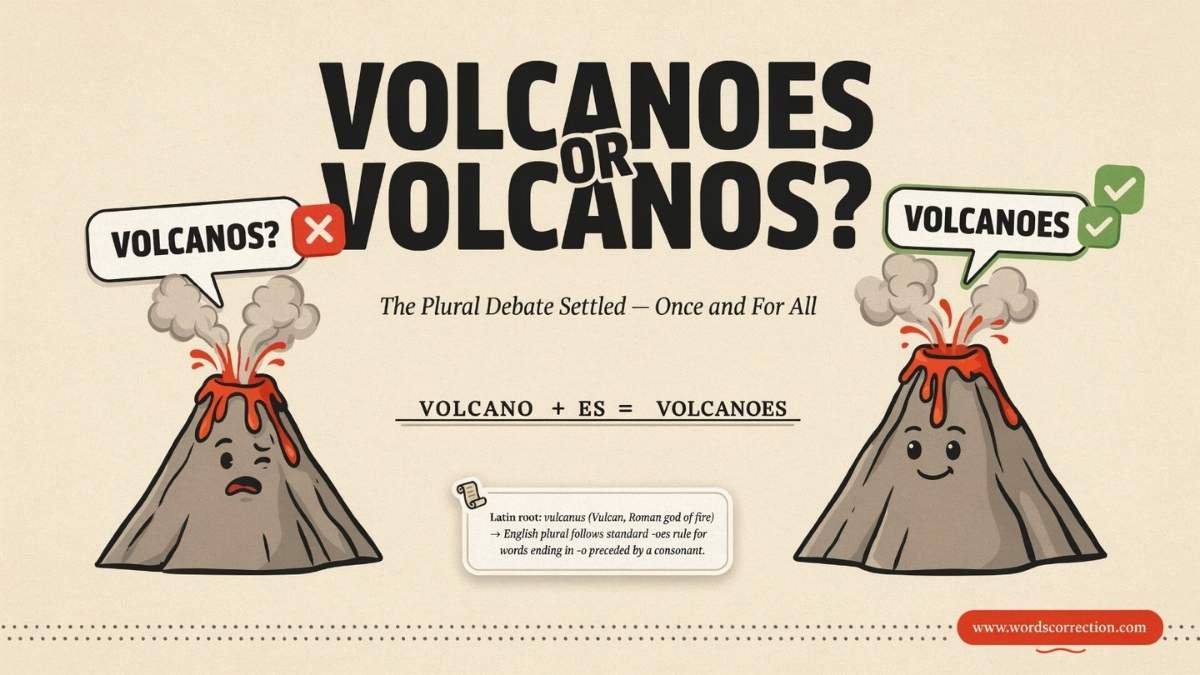
The spelling itself isn’t the only potential problem. Writers sometimes confuse plural forms, possessives, and related words.
Mistake Using Volcano for Multiple Volcanoes
Incorrect:
The country has several active volcano.
Correct:
The country has several active volcanoes.
You can also write:
The country has several active volcanos.
Mistake Treating Volcanos as Always Wrong
Incorrect assumption:
Volcanos is never correct.
Better understanding:
Volcanos is an accepted alternate plural form of volcano.
Mistake Confusing Plural and Possessive Forms
Compare:
- volcanoes = more than one volcano
- volcano’s = something belonging to one volcano
- volcanoes’ = something belonging to several volcanoes
For example:
The volcano’s crater was filled with ash.
Here, volcano’s shows possession.
The volcanoes’ eruptions affected nearby communities.
Here, volcanoes’ is the plural possessive.
Mistake Confusing Volcano and Volcanic
A volcano is a noun.
Volcanic is an adjective.
For example:
The volcano erupted.
But:
The region experienced intense volcanic activity.
These words are related, but they don’t perform the same grammatical job.
Learn the difference between commonly misused words
Fair or Fare which is correct?
Volcanoes and Volcanos in Everyday Sentences
Context makes the spelling difference easy to see.
Using Volcanoes
- The island is home to several volcanoes.
- Scientists monitor active volcanoes closely.
- Some volcanoes can remain dormant for hundreds of years.
- Volcanic ash from erupting volcanoes can affect aviation.
- Several volcanoes formed along the tectonic boundary.
Using Volcanos
- The researchers studied ancient volcanos in the region.
- The documentary examined how volcanos shape landscapes.
- Several extinct volcanos can still be seen across the area.
In every example, the plural meaning stays the same.
Learn the difference between confusing more English words step by step
Organiser or Organizer Which Spelling Should You Use?
What Is a Volcano in Geography?
A volcano in geography is a landform or geological system connected to an opening through which magma and volcanic material reach Earth’s surface.
Volcanoes can form in several geological settings.
Many occur near tectonic plate boundaries, especially where plates move apart or where one plate moves beneath another. Others form above mantle plumes or in areas of volcanic activity away from major plate boundaries.
The result can be dramatically different landscapes.
Volcanic activity has helped create islands, mountains, plateaus, and extensive lava fields. Over geological time, volcanic processes can completely reshape a region.
Types of Volcanoes
Not every volcano has the same shape or eruption style.
Shield Volcanoes
Shield volcanoes have broad, gently sloping sides. They commonly form from relatively fluid lava that spreads over large areas.
Their shape resembles a broad shield rather than a steep mountain.
Composite Volcanoes
Composite volcanoes, also called stratovolcanoes, usually have steeper sides.
They develop from layers of lava, ash, rock fragments, and other volcanic material. Many famous volcanic mountains belong to this category.
Cinder Cone Volcanoes
Cinder cones are generally smaller volcanic landforms.
They form when fragments of volcanic material accumulate around a vent. Their sides can be relatively steep despite their smaller size.
Other Volcanic Landforms
Volcanic systems can also produce:
- Lava domes
- Calderas
- Lava fields
- Fissure vents
- Volcanic plateaus
- Craters
The shape of a volcano depends on its magma, eruption history, geological setting, and the materials produced during eruptions.
Learn the difference between everyday English mistakes
Slushy Vs Slushie Which Spelling is Correct?
Active, Dormant, and Extinct Volcanoes
Volcanoes are also described according to their activity.
Active Volcanoes
An active volcano is generally one that is erupting or has demonstrated recent volcanic activity.
Scientists monitor active volcanoes using tools such as seismometers, gas measurements, satellite observations, and ground-deformation instruments.
Dormant Volcanoes
A dormant volcano isn’t currently erupting but may erupt again.
Dormancy can last for a very long time. A quiet volcano isn’t necessarily an extinct volcano.
Extinct Volcanoes
An extinct volcano is generally considered unlikely to erupt again based on available geological evidence.
These labels aren’t always absolute. Scientists consider geological history and current evidence when assessing volcanic systems.
Learn the difference between tricky English words with easy explanations
Mistery vs Mystery Which Is Correct?
What Happens During a Volcanic Eruption?
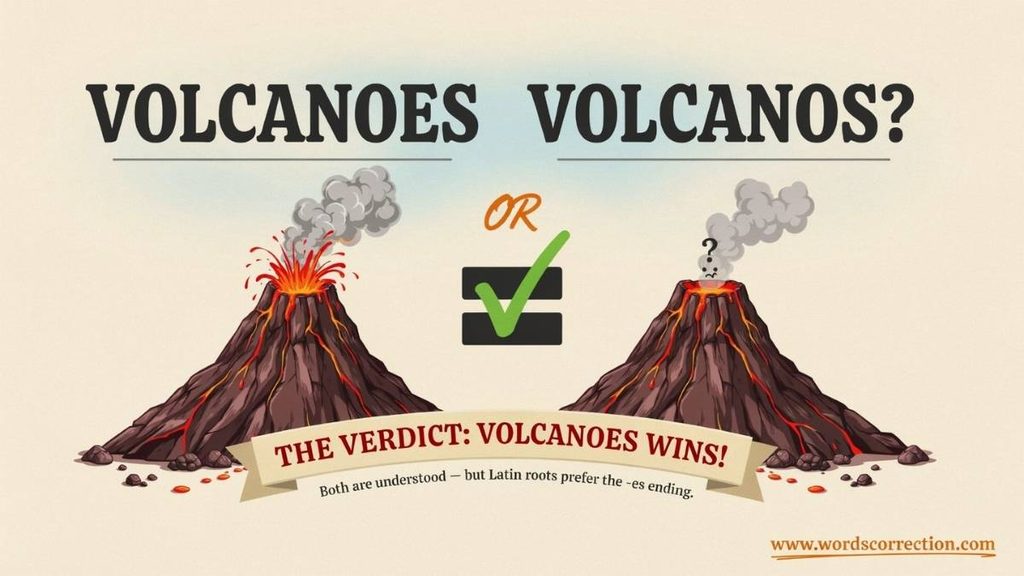
A volcanic eruption begins with processes beneath Earth’s surface.
Magma can rise through cracks and weaknesses in the crust. As pressure decreases, gases dissolved in the magma can expand.
If the pressure becomes sufficient, magma and volcanic gases may reach the surface.
An eruption can release:
- Lava
- Ash
- Rock fragments
- Volcanic gases
- Steam
- Pyroclastic material
Some eruptions produce slow-moving lava flows. Others can be highly explosive.
Magma composition plays an important role. More viscous magma can trap gases more effectively, potentially increasing explosive behavior. More fluid magma can travel farther before cooling.
That difference explains why one volcano may produce a spectacular lava flow while another produces powerful explosive eruptions.
Volcanoes, Magma, and Lava
These three terms often appear together, but they don’t mean the same thing.
Magma is molten rock beneath Earth’s surface.
Lava is magma after it reaches the surface.
Volcano refers to the geological feature or system through which volcanic material can be released.
A simple way to remember the relationship is:
Magma underground → lava at the surface → volcanic activity at or around a volcano
This distinction makes descriptions of volcanic eruptions more accurate.
Volcanic Gases and Ash
An eruption doesn’t only produce lava.
Volcanic systems can release gases such as:
- Water vapor
- Carbon dioxide
- Sulfur dioxide
- Hydrogen sulfide
Volcanic ash also plays an important role in eruptions.
Despite its name, volcanic ash isn’t the same as ash produced by burning wood. Volcanic ash consists of tiny fragments of volcanic glass, minerals, and rock.
That’s why saying “smoke came from the volcano” can be misleading.
A more precise sentence is:
Volcanic ash and gases rose from the volcano.
Famous Volcanoes Around the World
Volcanoes occur on every continent, including Antarctica.
Some well-known examples include:
- Mount Vesuvius in Italy
- Mount Etna in Italy
- Mount Fuji in Japan
- Kīlauea in Hawaii
- Mauna Loa in Hawaii
- Mount St. Helens in Washington State
- Krakatau in Indonesia
- Mount Merapi in Indonesia
These volcanoes differ greatly in size, shape, geological setting, and eruption history.
Studying them helps scientists better understand volcanic processes and assess potential hazards.
Learn the difference between more words people mix up
Sole vs Soul which is correct?
Volcanoes or Volcanos Which Should You Use?
If the goal is clear, standard writing, volcanoes is the strongest choice.
Use volcanoes when:
- You want the most common spelling.
- You’re writing for a broad audience.
- You’re preparing academic content.
- You’re completing schoolwork.
- You’re writing professionally.
- You want the spelling most readers expect.
Use volcanos when:
- You’re following a source that uses the alternate form.
- You’re maintaining consistency with an existing text.
- You specifically want to discuss the spelling variation.
There’s no need to switch between the two forms randomly.
Consistency matters more than trying to make both spellings appear equally often.
Practice Sessions about Volcanoes or Volcanos
Fill in the Blanks
- The plural of volcano is __________.
- Another accepted plural is __________.
- The preferred form is __________.
- “Volcanos” is an __________ spelling.
- “Volcanoes” is a __________ form.
- The singular form is __________.
- “Volcanoes” refers to more than __________ volcano.
- “Volcanos” ends with __________.
- “Volcanoes” ends with __________.
- Both forms have the same __________.
- “Volcanoes” is more __________.
- “Volcanos” is not a __________.
- The plural ending in “-es” is __________.
- The plural ending in “-s” is __________.
- For formal writing, use __________.
- Both forms are __________.
- “Volcano” is __________.
- “Volcanoes” is __________.
- “Volcanos” is __________.
- The two forms differ in __________.
- The plural of “volcano” can be volcanoes or __________.
- The most common spelling is __________.
- “Volcanoes” is preferred in standard __________.
- “Volcanos” is an accepted __________.
- The correct plural forms are __________ and __________.
Answers
- volcanoes
- volcanos
- volcanoes
- alternative
- plural
- volcano
- one
- -s
- -es
- meaning
- common
- misspelling
- volcanoes
- volcanos
- volcanoes
- correct
- singular
- plural
- plural
- spelling
- volcanos
- volcanoes
- English
- spelling
- volcanoes; volcanos
Here’s a trusted source for clear more words Comparison:
Grammar Update
Frequently Asked Questions
Which is correct, volcanoes or volcanos?
Both volcanoes and volcanos are accepted plural forms of volcano. However, volcanoes is more common and is generally preferred in standard English.
What is the plural of volcano?
The plural of volcano can be volcanoes or volcanos. Of the two, volcanoes is the more widely used form.
Is volcanos a correct spelling?
Yes. Volcanos is an accepted plural spelling of volcano, although volcanoes is more commonly used.
Is volcanoes a correct spelling?
Yes. Volcanoes is the standard and most frequently used plural form of volcano.
What is the preferred plural of volcano?
Volcanoes is the preferred plural form in most standard English writing, although volcanos is also grammatically acceptable.
What is the plural of volcano in British English?
Volcanoes is the conventional plural form in British English. Volcanos is also recognized as an alternative.
What is the plural of volcano in American English?
In American English, volcanoes is the more common plural form, while volcanos is also accepted.
Why can volcano be pluralized as volcanoes or volcanos?
English has several pluralization patterns for nouns ending in -o. Volcano is one of the words that permits both -es and -s endings.
Should I write volcanoes or volcanos?
For most situations, volcanoes is the better choice because it is more common and widely recognized. Volcanos is still correct.
Is volcanos considered a misspelling?
No. Volcanos is not considered a misspelling when used as the plural of volcano. It is an accepted alternative to volcanoes.
Is volcanoes the traditional plural form?
Yes. Volcanoes has long been established as the conventional plural form and remains the more frequently used spelling.
Can volcanos be used in formal writing?
Yes. Volcanos is grammatically acceptable in formal writing, although volcanoes is generally preferred because it is more common.
Which form is more common, volcanoes or volcanos?
Volcanoes is substantially more common in standard written English than volcanos.
How do you spell the plural of volcano?
The plural can be spelled volcanoes or volcanos. Volcanoes is the spelling most commonly recommended for general use.
Is volcano a regular plural noun?
Volcano follows one of the variable plural patterns found among English nouns ending in -o. Both volcanoes and volcanos are accepted plurals.
Does volcano take “-s” or “-es” in the plural?
Both endings are possible. Volcanoes uses -es, while volcanos uses -s. Both forms are accepted.
What is the singular form of volcanoes?
The singular form of volcanoes is volcano.
Is volcanoes a singular or plural word?
Volcanoes is a plural noun. It refers to more than one volcano.
Is volcanos singular or plural?
Volcanos is a plural noun. The singular form is volcano.
Do volcanoes and volcanos mean the same thing?
Yes. Volcanoes and volcanos have the same meaning because they are simply two accepted plural forms of the same noun.
Are volcanoes and volcanos pronounced the same way?
Yes. The two spellings are generally pronounced the same way, even though they differ in their written forms.
Can I use both volcanoes and volcanos in the same article?
You can, but consistency is usually preferable. If possible, choose volcanoes as your primary form and mention volcanos as an accepted alternative.
Why is volcanoes more common than “volcanos”?
Volcanoes has become the more established and widely used plural form in standard English. Volcanos remains acceptable but is less frequently used.
Is volcanoes or volcanos a grammar or spelling question?
It is primarily a spelling and word-usage question involving two accepted plural forms. The choice is not about a difference in meaning or grammar.
Which plural form should I use in professional writing?
Volcanoes is generally the safest choice for professional, academic, and formal writing because it is the more common and widely recognized form. Volcanos is also grammatically correct.
Conclusion
The volcanoes vs volcanos confusion is now easy to clear up. Both spellings are correct, so there is no need to worry about making a grammar mistake. However, volcanoes is the more common and preferred form, especially in formal, academic, and professional writing. Volcanos is also acceptable, but it is less common. When you are unsure, choosing volcanoes is the safest option. Now you can use the plural of volcano confidently without stopping to question your spelling. English may give us two choices, but thankfully, this grammar puzzle does not need an eruption.

Stella AJS is an experienced blogger and dedicated English language writer at Words Correction. She turns confusing grammar, word meanings, spelling, and usage into clear, practical insights that readers can easily understand and apply. With a passion for precise and engaging writing, Stella helps readers avoid common language mistakes, strengthen their vocabulary, and communicate with greater clarity and confidence.




