
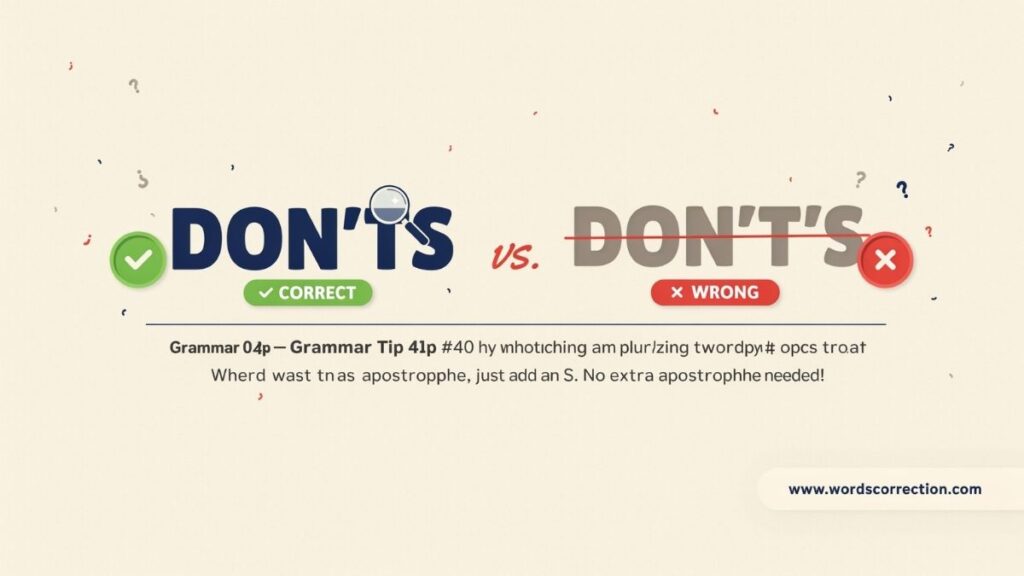
Choosing between don’ts or don’t’s can be confusing, even for confident writers. One small apostrophe can turn a simple spelling question into a grammar puzzle. The good news is that the correct form is easy to learn. In this guide, you’ll discover the correct spelling, understand why the apostrophe matters, and learn how to use “don’t” and “don’ts” in sentences. You’ll also explore common mistakes and simple ways to avoid them. By the end, you’ll know which spelling to use and feel more confident in your writing. After all, good grammar doesn’t have to be complicated!
Dos and Don’ts or Do’s and Don’ts Which Is Correct?
Both “dos and don’ts” and “do’s and don’ts” are accepted forms in English. The difference comes down to editorial style rather than meaning.
The Chicago Manual of Style prefers “dos and don’ts,” while the Associated Press Stylebook uses “do’s and don’ts.” Both versions communicate the same idea: actions people should take and actions they should avoid.
However, “don’t’s” is generally incorrect when used as the plural noun. The word already contains an apostrophe, so adding another one is unnecessary.
Here’s a quick comparison:
| Word or phrase | Correct? | Explanation |
| Dos and don’ts | Yes | Preferred by Chicago style |
| Do’s and don’ts | Yes | Preferred by AP style |
| Dos or don’ts | Yes | Correct when presenting alternatives |
| Do’s or don’ts | Yes | Acceptable under a style that uses do’s |
| Don’ts | Yes | Standard plural of don’t |
| Don’t’s | Generally no | Incorrect for the standard plural noun |
| Dos and don’t’s | No | Uses a nonstandard plural form |
The easiest approach is to choose one accepted spelling and use it consistently. If your school, employer, or publication follows a specific style guide, follow its rules.
Correct Spelling Don’ts or Don’t’s
The phrase “Don’ts or Don’t’s ” describes recommended actions and behaviors people should avoid. The word “dos” refers to things you should do, while “don’ts” refers to things you shouldn’t do.
For example:
- The employee handbook explains the dos and don’ts of workplace communication.
- Review the dos and don’ts before visiting the national park.
- The teacher discussed the dos and don’ts of academic writing.
- Our guide covers the dos and don’ts of online safety.
Notice that “dos” doesn’t contain an apostrophe, while “don’ts” retains one. This difference isn’t a mistake. The apostrophe in “don’ts” belongs to the contraction “don’t,” which comes from “do not.”
Accepted Alternative Do’s and Don’ts
“Do’s and don’ts” is another accepted spelling. Some editors prefer this version because “dos” may look unfamiliar to readers.
The apostrophe in “do’s” doesn’t indicate possession. Instead, it helps distinguish the plural noun from other possible readings of the word.
Consider these examples
- Review the do’s and don’ts before your interview.
- The poster outlines the do’s and don’ts of fire safety.
- We discussed the do’s and don’ts of professional communication.
Both forms have the same meaning. Your choice should depend on the style guide you’re following or the spelling convention you’ve adopted for your content.
Incorrect Spelling Don’t’s
When referring to several actions people should avoid, write “don’ts,” not “don’t’s.”
Incorrect: The instructor explained the don’t’s of laboratory safety.
Correct: The instructor explained the don’ts of laboratory safety.
The original apostrophe remains in its usual position. You simply add an “s” to form the plural noun.
Adding another apostrophe doesn’t improve clarity or follow the standard spelling convention. It only introduces a punctuation error.
What Does “Don’ts” Mean?
“Don’ts” is the plural noun form of “don’t,” a contraction of “do not.” It refers to actions, behaviors, or choices that people should avoid.
For example
- A workplace don’t: Sharing confidential company information without permission.
- A driving don’t: Using your phone while driving.
- A writing don’t: Adding an apostrophe to an ordinary plural noun, such as writing “book’s” when you mean several books.
A single discouraged action is a “don’t.” Several discouraged actions are “don’ts.”
Therefore, the meaning of “dos and don’ts” is simple: it describes what you should and shouldn’t do in a particular situation.
Learn the difference between more words people mix up
Principal or Principle Don’t Mix Them Up
Don’ts or Don’t’s Understanding the Difference
Although the words look similar, they serve different grammatical purposes.
| Word | Grammatical function | Example |
| Do | Verb or command | Do your homework before dinner. |
| Do not | Negative verb phrase | Do not enter the restricted area. |
| Don’t | Contraction of do not | Don’t leave the door open. |
| Dos | Plural noun for recommended actions | The guide lists several dos. |
| Don’ts | Plural noun for discouraged actions | The guide lists several don’ts. |
| Don’t’s | Nonstandard plural in this context | Avoid this spelling in ordinary writing. |
The main difference is how the words function in a sentence. “Don’t” usually forms part of a verb phrase, while “don’ts” acts as a plural noun.
Compare these examples
- Verb: Don’t interrupt when someone is speaking.
- Noun: Interrupting others is one of the don’ts of respectful conversation.
The apostrophe in “don’ts” doesn’t indicate ownership. It remains part of the original contraction.
What Do Dos and Don’ts Mean?
The expression “dos and don’ts” refers to recommended and discouraged actions. People use it to explain rules, offer advice, establish expectations, and help others avoid mistakes.
For example, a cooking guide might recommend washing your hands before preparing food and warn against using the same cutting board for raw meat and ready-to-eat vegetables without proper cleaning. Together, these instructions form a list of dos and don’ts.
The expression appears in many areas of everyday life:
- Education: Dos and don’ts for writing an essay.
- Work: Dos and don’ts for communicating with clients.
- Travel: Dos and don’ts when visiting another country.
- Technology: Dos and don’ts for protecting personal information.
- Health and safety: Dos and don’ts for handling equipment.
The phrase works well because it organizes information into two clear categories. Readers can quickly identify recommended behaviors and actions they should avoid.
Don’ts or Don’t’s Examples
Practical examples make the meaning easier to understand.
| Situation | Do | Don’t |
| Email writing | Use a clear subject line. | Send a message without checking the recipient. |
| Studying | Review your notes regularly. | Wait until the last minute to start studying. |
| Online safety | Use strong, unique passwords. | Share passwords in public messages. |
| Workplace communication | Listen carefully to colleagues. | Interrupt people repeatedly. |
| Academic writing | Cite your sources accurately. | Present someone else’s work as your own. |
These examples illustrate how the phrase works in different situations. The specific recommendations may change depending on the circumstances, but the basic distinction remains the same.
Don’ts or Don’t’s Examples in Sentences
You can use the phrase at the beginning, middle, or end of a sentence. It also works well in headings and instructional materials.
- Beginning: The dos and don’ts of online safety deserve attention before you create a new account.
- Middle: Our manager shared a list of dos and don’ts for communicating with customers.
- End: Before the trip, we reviewed the most important dos and don’ts.
- Heading: Dos and Don’ts for First-Time Visitors.
- Question: Have you reviewed the dos and don’ts of the application process?
The alternative don’ts or don’t’s also works in these examples. Choose the spelling that matches your preferred editorial style.
Learn the difference between everyday English mistakes
Programme or Program Spelling Guide
Why Is the Spelling of Dos and Don’ts Confusing?
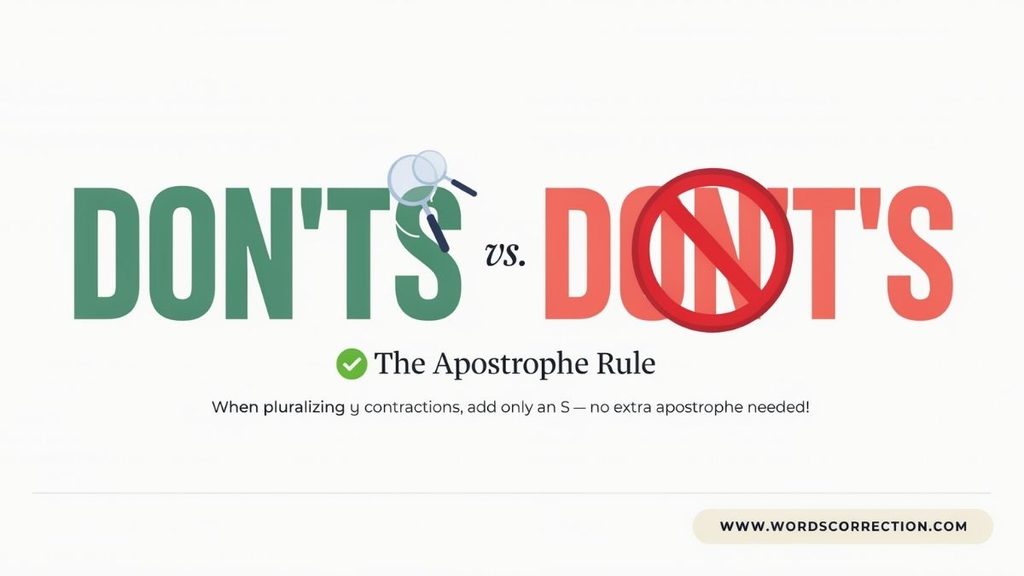
The confusion usually comes from two spelling questions: how to form the plural of “do” and where to place the apostrophe in “don’t.”
English generally forms plural nouns by adding “s” or “es” without an apostrophe. For example, “cat” becomes “cats,” and “box” becomes “boxes.”
You wouldn’t normally write “cat’s” when referring to several cats. That form usually indicates possession or a contraction in another context.
However, “don’t” already contains an apostrophe because it combines “do” and “not.” When you use it as a plural noun, that original apostrophe remains.
The word “do” presents a different issue. Its plural, “dos,” may look unusual to some readers, which explains why certain style guides accept “do’s.”
Why Is Don’t’s Incorrect?
The spelling “don’t’s” adds an unnecessary apostrophe before the plural ending. Standard English usage doesn’t require another apostrophe when forming the plural noun.
The word formation is straightforward:
- Do not becomes don’t.
- Don’t, when used as a noun, becomes don’ts.
- Don’t’s is generally incorrect for this meaning.
Think of the apostrophe as part of the contraction’s established spelling. It doesn’t need to appear again simply because you add a plural ending.
How Do Plurals of Contractions Work?
A contraction combines words by omitting letters. An apostrophe marks the missing letters.
Common examples include:
- Cannot → can’t
- Will not → won’t
- They are → they’re
- We have → we’ve
- Do not → don’t
When a contraction functions as a noun, its plural may take an “s” without an additional apostrophe. “Don’ts” follows this convention.
Not every contraction naturally forms a plural noun in everyday English. Still, the main lesson is clear: don’t add punctuation automatically. Consider the word’s grammatical role and follow an established spelling convention.
Learn the difference between commonly misused words
Fair or Fare which is correct?
Don’ts or Don’t’s What Is the Difference?
The difference between “dos” and “do’s” is primarily a matter of spelling style. Both can represent the plural noun for recommended actions.
“Dos” follows the usual pluralization rule by adding “s.” “Do’s” uses an apostrophe to make the plural more visually familiar to some readers.
For example, the sentence “The guide lists the do’s of public speaking” refers to recommended actions. The apostrophe doesn’t indicate that something belongs to the word “do.”
Should Dos Have an Apostrophe?
Not always. The correct choice depends on the style guide you’re using.
- Chicago style: Dos and don’ts.
- AP style: Do’s and don’ts.
- General writing: Either accepted form can work if used consistently.
- Academic writing: Follow the style guide required by your instructor or institution.
- Professional publishing: Follow the publication’s editorial guidelines.
The difference shows that style conventions can vary without making every alternative grammatically incorrect. Consistency is essential, especially in longer documents.
Learn the difference between confusing more English words step by step
Complimented or Complemented Which is Correct Spelling?
Dos and Don’ts Punctuation
The phrase contains two words with different apostrophe patterns.
In “dos,” the plural ending appears without an apostrophe. “don’ts,” the apostrophe remains because the word comes from a contraction. “do’s,” the apostrophe follows an accepted spelling convention for the plural of “do.”
To remember the difference, ask what the apostrophe represents. In “don’t,” it marks omitted letters from “do not.” In “do’s,” it distinguishes a plural form under certain editorial conventions rather than indicating possession.
Dos and Don’ts Grammar Rules
Understanding the grammatical role of each word makes the spelling easier to remember.
- “Do” can function as a verb or command.
- “Don’t” is a contraction of “do not.”
- “Dos” or “do’s” can function as plural nouns referring to recommended actions.
- “Don’ts” is the standard plural noun referring to discouraged actions.
The apostrophe doesn’t serve the same purpose in every form. Instead of assuming both words need identical punctuation, consider how each word is formed.
Learn the difference between basic English word mistakes
Slushy Vs Slushie Which Spelling is Correct?
American English vs British English
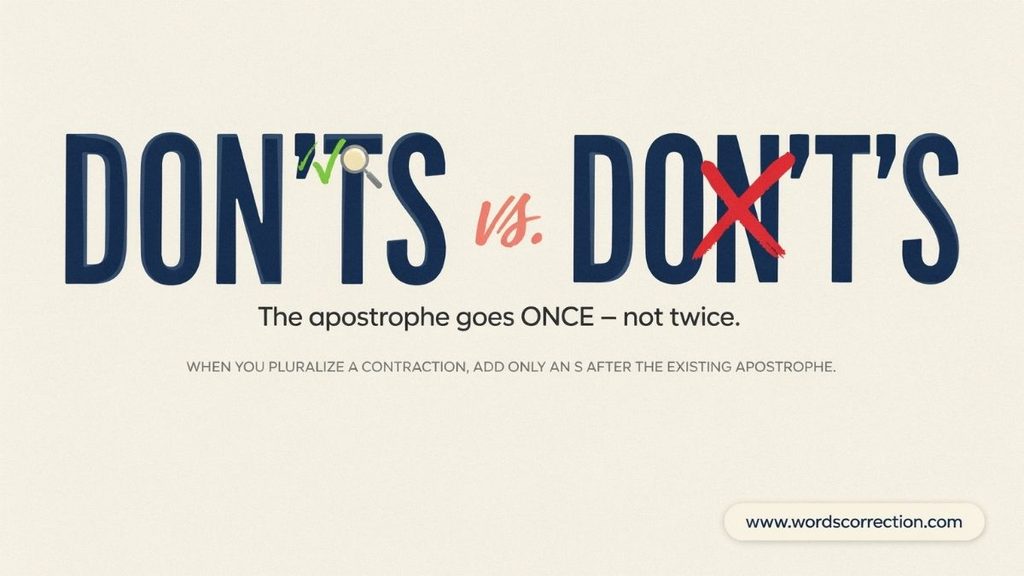
They share the same basic distinction between contractions and plural nouns. Neither variety normally uses “don’t’s” as the standard plural noun.
However, writers may encounter both “dos and don’ts” and “do’s and don’ts.” These variations often reflect editorial preferences rather than a strict difference between American and British English.
Dos and Don’ts in American English
American writers commonly encounter both spellings. The preferred version depends on the publication or organization.
For example, the Chicago style convention favors “dos and don’ts,” while AP style uses “do’s and don’ts.”
If you’re writing a blog post, business email, school assignment, or website article, check whether your organization has a style guide. If not, choose one recognized form and use it consistently.
Dos and Don’ts in British English
British English also uses “dos and don’ts” and “do’s and don’ts.” Individual publishers may prefer one version over the other.
The apostrophe in “don’t” doesn’t disappear simply because the writer uses British English. The contraction remains “don’t,” and the conventional plural noun remains “don’ts.”
The surrounding vocabulary and punctuation may vary according to a publisher’s house style, but the basic spelling distinction remains the same.
What About Global Websites?
For a website serving readers worldwide, consistency matters more than trying to invent a universal rule.
Choose an accepted spelling, record your decision in your editorial guidelines, and apply it across blog posts, headings, downloadable guides, and other content.
For example, if your website follows Chicago style, use “dos and don’ts” throughout. If you follow AP style, use “do’s and don’ts.”
Switching between the two without a clear reason can make your content look poorly edited, even when both forms are accepted.
Learn the difference between often confused words
Sole vs Soul which is correct?
What Do Chicago and AP Style Recommend?
Style guides help writers make consistent choices when English permits more than one accepted form. The difference between “dos and don’ts” and “do’s and don’ts” is a useful example.
The Chicago Manual of Style
The Chicago Manual of Style prefers “dos and don’ts.” This approach avoids adding an apostrophe to “do” when forming its plural.
Examples include:
- Dos and don’ts for new employees.
- The dos and don’ts of academic writing.
- A practical guide to the dos and don’ts of online privacy.
This preference applies to writers following Chicago style. Other publications may adopt a different convention.
The Associated Press Stylebook
The Associated Press Stylebook uses “do’s and don’ts.” This spelling makes the plural of “do” visually distinct and may feel more familiar to some readers.
Examples include:
- Do’s and don’ts for safe travel.
- The basic do’s and don’ts of professional communication.
- A checklist of do’s and don’ts for job interviews.
Both conventions preserve the apostrophe in “don’ts.” Neither requires the additional apostrophe found in “don’t’s.”
When writing for a specific publication, check its current editorial guidance. Following the required style helps maintain consistency across articles and documents.
Learn the difference between confusing word pairs
Mistery vs Mystery Which Is Correct?
Common Mistakes When Writing Don’ts or Don’t’s

Apostrophe mistakes often happen when writers apply one rule too broadly. Recognizing the most common errors can help you avoid them.
Adding an Unnecessary Apostrophe
Incorrect: The teacher explained the don’t’s of essay writing.
Correct: The teacher explained the don’ts of essay writing.
The contraction already contains an apostrophe. Adding another one before the final “s” isn’t necessary.
Removing the Apostrophe From Don’ts
Incorrect: The guide lists the donts of online safety.
Correct: The guide lists the don’ts of online safety.
Without the apostrophe, the word loses an important part of the contraction’s spelling. Retain the apostrophe when writing “don’ts.”
Learn the difference between tricky English words with easy explanations
Uninterested vs Disinterested What’s the Difference?
Confusing Dos With Do’s
Both “dos” and “do’s” can be correct as plural nouns, depending on the style guide. Problems arise when writers switch between the forms without following a consistent convention.
For example, an article that uses “dos and don’ts” in one heading and “do’s and don’ts” in another should be reviewed for consistency unless the difference serves a clear purpose.
Confusing a Plural With a Possessive
Incorrect: The rule’s are easy to remember.
Correct: The rules are easy to remember.
Apostrophes often indicate possession, but they don’t normally create plural nouns. If you mean more than one rule, write “rules.”
The same principle helps explain why “don’ts” is preferable to “don’t’s.” The apostrophe belongs to the contraction; it isn’t an additional marker of possession.
Assuming Dos and Don’ts Must Have Matching Apostrophes
Writers sometimes assume that both words must follow identical punctuation patterns. However, the two words have different structures.
“dos and don’ts,” the first word is a plural noun without an apostrophe, while the second retains one because it comes from a contraction.
In “do’s and don’ts,” both words contain apostrophes, but those marks serve different purposes. “do’s,” the apostrophe reflects a recognized plural spelling convention.
Matching punctuation isn’t the goal. Correct and consistent spelling is.
Learn the difference between tricky grammar more words
Organiser or Organizer Which Spelling Should You Use?
in Professional and Everyday Writing

The expression appears in many types of writing because it offers a simple way to organize advice. These examples show how to use it naturally in different contexts.
In Emails and Business Documents
A workplace email might say:
“Please review the dos and don’ts of client communication before contacting customers.”
The phrase introduces a clear set of recommended and discouraged behaviors. In a more formal document, you could use “recommended practices and prohibited actions” if those terms describe the rules more precisely.
Learn the difference between confusing more English words
Disgard or Discard Which Spelling Is Correct and Why?
In News Articles and Blog Posts
A headline might read:
“Dos and Don’ts of Protecting Your Personal Information Online”
This heading is concise and easy to understand. A publication following AP style might use “Do’s and Don’ts” instead.
When editing an article, keep the selected spelling consistent in the headline, introduction, subheadings, and body text.
In Educational Writing
Teachers often use dos and don’ts to explain classroom expectations or assignment requirements.
For example:
“The dos and don’ts of essay writing include citing sources accurately, organizing ideas clearly, and avoiding plagiarism.”
The phrase makes the topic approachable, while the examples explain what students should actually do.
In Signs, Lists, and Instructions
A short list can communicate rules more clearly than a long paragraph.
Dos
- Read instructions before using equipment.
- Wear the required safety gear.
- Report damaged equipment promptly.
Don’ts
- Don’t operate equipment without training.
- Don’t ignore safety warnings.
- Don’t leave hazards unreported.
In these headings, “dos” and “don’ts” function as plural nouns. Within the bullet points, “don’t” is a contraction used in a verb phrase. The grammatical role determines how each word works.
Learn the difference between commonly mixed-up more words
Volcanoes or Volcanos The Correct Spelling?
How to Remember the Correct Spelling of Don’ts
If apostrophes keep confusing you, remember one simple rule: retain the apostrophe in “don’t” and add the plural “s.”
The word doesn’t need another apostrophe. The original punctuation stays in place.
Use this quick reference:
- Don’t = do not.
- Don’ts = multiple actions to avoid.
- Don’t’s = generally incorrect for the plural noun.
- Dos and don’ts = Chicago-style spelling.
- Do’s and don’ts = AP-style spelling.
Before submitting an article or report, check for “donts,” “don’t’s,” and inconsistent versions of “dos and don’ts.” A quick proofreading pass can catch these small errors before they distract your readers.
Practice Session
Fill in the Blanks
Instructions Choose the correct word or phrase to complete each sentence. Check your answers after completing all 25 questions.
- The correct plural spelling of “don’t” is ______.
- “Don’t” is a contraction of ______.
- Please follow the ______ of professional communication.
- The apostrophe in “don’t” indicates ______.
- I ______ understand the instructions.
- She ______ like spicy food.
- ______ forget to submit your assignment.
- The guide explains the dos and ______ of workplace safety.
- “Don’ts” refers to actions people should ______.
- The preferred spelling of the plural of “do” is ______.
- “Don’t” is a standard English ______.
- They ______ agree with the decision.
- The phrase “dos and don’ts” describes what people should do and what they should ______.
- Choose the correct sentence: “He ______ work here.”
- “Do not” is the ______ form of “don’t.”
- The correct spelling for a list of tasks is ______.
- “Why don’t you try again?” is grammatically ______.
- In “don’ts,” the apostrophe appears before the letter ______.
- Choose the correct sentence: “We ______ need help.”
- “Don’t” and “do not” have essentially the same ______.
- Please read the list of dos and don’ts ______ starting the project.
- Which spelling is incorrect: “don’t,” “don’ts,” or “don’t’s”?
- “Don’t touch the switch” is an example of a negative ______.
- Choose the correct sentence: “They ______ understand.”
- To avoid an unnecessary apostrophe, write ______.
Answer Key
- Don’ts
- Do not
- Dos and don’ts
- A missing letter
- Don’t
- Doesn’t
- Don’t
- Don’ts
- Avoid
- Dos
- Contraction
- Don’t
- Avoid
- Doesn’t
- Full
- To-dos
- Correct
- T
- Don’t
- Meaning
- Before
- Don’t’s
- Command
- Don’t
- Dos and don’ts
Here’s a trusted source for clear more words Comparison:
Grammar Update
FAQ’s
Which is correct don’ts or don’t’s?
Don’ts is the standard spelling of the plural form of don’t. The spelling don’t’s is generally incorrect because it adds an unnecessary apostrophe.
What does don’ts mean?
“Don’ts” refers to actions or behaviors that people should avoid. For example, The handbook explains the dos and don’ts of workplace communication.
Is don’t one word or two?
“Don’t” is one word. It is a contraction of do not, with the apostrophe marking the omitted letter.
Why does don’t have an apostrophe?
The apostrophe in don’t marks the missing letter “o” from “not.” It indicates a contraction, not possession.
Is don’t a real English word?
Yes, “don’t” is a standard English contraction of “do not.” It is widely used in everyday speech and writing.
What is the difference between don’t and don’ts?
“Don’t” means “do not” and is used in negative statements and commands. “Don’ts” is the plural noun referring to actions or behaviors that should be avoided.
Is dos and don’ts grammatically correct?
Yes, “dos and don’ts” is grammatically correct and widely accepted. “Do’s and don’ts” is also used, but “dos and don’ts” avoids an unnecessary apostrophe in “dos.”
What does dos and don’ts mean?
“Dos and don’ts” refers to recommended actions and behaviors to avoid. For example, a style guide may outline the dos and don’ts of professional writing.
How do you use don’t in a sentence?
Use “don’t” to express a negative statement or give a negative command. For example, “I don’t eat meat” or “Don’t forget your appointment.”
What is the full form of don’t?
The full form of don’t is do not. For example, I don’t understand means I do not understand.
Is don’t appropriate in formal writing?
Yes, “don’t” is grammatically correct in formal writing. However, do not may be preferable in highly formal documents or when you want to emphasize a statement.
What are some alternatives to don’t?
Depending on the context, alternatives include do not, avoid, refrain from, and “should not. For example, Don’t touch the equipment could become Please avoid touching the equipment.
How should you write dos and don’ts in AP style?
Use the current edition of the AP Stylebook to confirm its preferred spelling. Style conventions can change, and publications may follow different editorial rules.
Is to do’s spelled correctly?
When referring to tasks, “to-dos” is a common spelling. To-do items is another clear option. For example, I reviewed my to-dos for the week.
Is don’t considered slang?
No, “don’t” is a standard English contraction, not slang. It is appropriate in everyday communication and many professional contexts.
What is a synonym for don’t?
“Do not” is the direct, uncontracted equivalent of don’t. Depending on the sentence, avoid, refrain from, or stop may convey a similar idea.
What does don’t mean in a text message?
In a text message, don’t means do not. For example, Don’t worry means Do not worry. Its meaning does not change in digital communication.
Why do people confuse don’ts with don’t’s?
People often add an apostrophe because they mistakenly use it to form a plural. However, “don’ts” is the standard plural spelling and does not require an additional apostrophe.
How do you spell the plural of don’t?
The correct spelling is “don’ts.” Add an “s” to the contraction without adding another apostrophe.
When should you use don’t instead of doesn’t?
Use don’t with I, you, we, they, and plural subjects. Use doesn’t with singular third-person subjects such as he, she, and it. For example, They don’t agree, but She doesn’t agree.
Is Why don’t you? grammatically correct?
Yes, Why don’t you? is grammatically correct. It commonly introduces a suggestion or asks a question. For example, “Why don’t you try again?”
What is the difference between don’t and do not?
“Don’t” is the contracted form of “do not.” Both have the same basic meaning, but do not can sound more formal or provide stronger emphasis.
Is don’t an abbreviation or an acronym?
“Don’t” is a contraction, not an acronym. It combines do and not, using an apostrophe to mark the omitted letter.
How can you avoid misspelling don’ts?
Remember that don’ts needs only the apostrophe already present in don’t. Add an s to make the plural, and avoid the incorrect spelling don’t’s.
What is the correct way to write dos and don’ts in a heading?
“Dos and Don’ts” is a clear, widely accepted heading format. Capitalization may vary according to your publication’s style guide, but the standard spelling remains dos and don’ts.
Conclusion
Choosing between don’ts or don’t’s is easier when you know the correct spelling. Don’ts is the standard plural form, while don’t is the contraction of “do not.” Adding an extra apostrophe may seem like a small mistake, but it can make your writing look less polished. Remember, apostrophes have a purpose, so don’t give them extra work. By learning the difference between these two forms, you can avoid common grammar mistakes and write with confidence. Keep these simple rules in mind, and you’ll get the spelling right every time. Good grammar starts with small details

Stella AJS is an experienced blogger and dedicated English language writer at Words Correction. She turns confusing grammar, word meanings, spelling, and usage into clear, practical insights that readers can easily understand and apply. With a passion for precise and engaging writing, Stella helps readers avoid common language mistakes, strengthen their vocabulary, and communicate with greater clarity and confidence.




