

Confusing complimented or complemented is a common grammar mistake because these words sound alike and look almost identical. However, their meanings are different. Complimented means praised someone or something, while complemented means matched, improved, or enhanced something. For example, you might compliment a friend on her dress, but the dress’s color may complement her shoes. Using the wrong word can confuse your readers, even when your spelling looks correct. The good news is that learning the difference is easy. Try these 25 fill-in-the-blank exercises to improve your grammar, avoid common mistakes, and use both words correctly.
Complimented or Complemented Quick Answer
The fastest way to understand complimented or complemented meaning is to focus on the action.
| Word | Meaning | Think of It As | Example |
| Complimented | Praised or expressed admiration | Praise | The teacher complimented Mia on her essay. |
| Complemented | Completed, enhanced, or matched well | Enhance | The blue curtains complemented the room. |
Complimented Praise or Admiration
Complimented is the past tense and past participle of compliment.
When you compliment someone, you say something positive about that person’s appearance, personality, work, ability, effort, or achievement.
They manager complimented Jordan on his excellent presentation.
The manager didn’t complete or improve Jordan. The manager praised him.
Complemented Completed or Enhanced
Complemented is the past tense and past participle of complement.
When something complements something else, it adds to it in a way that makes the whole combination better, more complete, or more harmonious.
The dark wood complemented the cream-colored walls.
The wood didn’t praise the walls. It matched and enhanced them.
The One-Second Test
When you’re unsure which word to use, replace it with one of these:
- Praised → use complimented
- Enhanced → use complemented
- Completed → use complemented when the context involves making something whole
- Matched or went well with → use complemented
This simple substitution test makes compliment or complement grammar much easier.
Learn the difference between confusing more English words
Steel or Steal which one is correct?
Complimented vs Complemented Meaning and Difference
The difference between complimented and complemented comes from their base words: compliment and complement.
Although the words look and sound remarkably similar, they have different meanings and uses.
What Does Complimented Mean?
Complimented meaning is straightforward: someone praised, admired, or expressed approval of someone or something.
For example:
- The coach complimented the team on its discipline.
- Sarah complimented her friend on the new haircut.
- The editor complimented the writer’s clear style.
- His supervisor complimented him on his attention to detail.
The action involves praise and admiration.
A useful question is:
Who received the praise?
If the sentence answers that question, complimented is likely the correct word.
What Does Complemented Mean?
Complemented meaning centers on the idea of adding something that improves, completes, or balances another thing.
For example:
- The scarf complemented her outfit.
- The herbs complemented the flavor of the soup.
- Their different skills complemented each other.
- The photographs complemented the article.
Here, nobody necessarily gives praise. Instead, one thing works well with another.
The relationship might involve appearance, function, taste, balance, design, or effectiveness.
Learn the difference between commonly mixed-up more words
Principal or Principle Don’t Mix Them Up
Complimented vs Complemented at a Glance
| Question | Complimented | Complemented |
| Does it mean praised? | Yes | No |
| Does it mean enhanced? | No | Yes |
| Can it describe praise from one person to another? | Yes | No |
| Can it describe colors working well together? | No | Yes |
| Can it describe matching clothing? | No | Yes |
| Can it describe teamwork? | Sometimes, if someone gives praise | Yes, when skills work well together |
| Can it describe food flavors? | No | Yes |
| Base word | Compliment | Complement |
The Difference Between Compliment and Complement
To understand the past-tense forms, start with the base words.
Compliment Definition and Examples
A compliment is a positive remark or expression of praise.
As a noun:
She gave me a compliment about my presentation.
As a verb:
She complimented me on my presentation.
Common things you can compliment include:
- Appearance
- Clothing
- Hair
- Personality
- Skills
- Work
- Achievements
- Creativity
- Effort
- Performance
- Manners
For example:
The director complimented Elena on her thoughtful report.
Here, the director expressed appreciation for Elena’s work.
Complement Definition and Examples
A complement is something that completes, improves, balances, or works well with something else.
As a noun:
The sauce is a perfect complement to the grilled vegetables.
As a verb:
The sauce complemented the grilled vegetables perfectly.
You can complement:
- An outfit
- A color
- A design
- A meal
- A flavor
- A room
- A skill set
- A business strategy
- A system
- A personality combination
- Another person’s strengths
The important idea is relationship. One element contributes something that makes another element work better or look better.
Why Complimented and Complemented Are So Easy to Confuse
English contains many commonly confused English words, but this pair creates an especially frustrating problem because the words are so similar.
The spelling differs by only one vowel:
- complimented
- complemented
Their pronunciation also usually doesn’t provide enough information to distinguish them.
Compliment and Complement Pronunciation
In most standard varieties of English, compliment and complement are pronounced the same way. That makes them homophones.
The same applies to their past-tense forms:
- complimented
- complemented
When you hear someone say the word, you usually can’t determine the spelling from the sound alone.
That’s why this isn’t simply a pronunciation problem. It’s a word-choice problem.
You need to identify the intended meaning before choosing the spelling.
Why Spell-Check May Not Catch the Mistake
Here’s another common trap.
Suppose someone writes:
The red cushions complimented the gray sofa.
A basic spell-checker may not flag complimented because the word itself is spelled correctly.
The problem is meaning. The writer chose the wrong word.
The correct sentence is:
The red cushions complemented the gray sofa.
Both spellings are legitimate. Only one fits the intended meaning.
This highlights an important lesson about English spelling mistakes a correctly spelled word can still be the wrong word.
The Origins of Compliment and Complement
The history of these words helps explain why they look so similar.
Where Compliment Comes From
Compliment entered English through French and ultimately traces back to the Latin word meaning “to fill up” or “complete.” Over time, its meaning developed in connection with polite expressions and eventually with praise or admiration.
Today, the word has a clear social meaning. A compliment gives someone positive recognition.
Think:
compliment → positive words → praise
Where Complement Comes From
Complement also traces back to Latin and retains a stronger connection to the idea of filling up or completing something.
Its modern meaning includes completing, balancing, improving, or enhancing another thing.
Think:
complement → complete → enhance
Their shared history helps explain the similar spelling. Their modern meanings, however, have become distinct enough that you should treat them as separate words.
Learn the difference between tricky grammar more words
Programme or Program Spelling Guide
How to Use Complimented Correctly

Knowing the definition is useful. Knowing the sentence patterns is even better.
Complimented Someone on Something
One of the most common structures is:
complimented + person + on + thing
Examples:
- The professor complimented James on his research.
- My manager complimented me on my presentation.
- She complimented her sister on her new dress.
- The customer complimented the chef on the meal.
This pattern appears frequently in both everyday and professional English.
Complimented Someone’s Work or Ability
You can use complimented when someone expresses admiration for another person’s performance.
The editor complimented the writer on her precise word choice.
The coach complimented the players on their teamwork.
The supervisor complimented Daniel on his problem-solving skills.
The important point is that someone actively gives praise or approval.
Complimented Someone’s Appearance or Personality
Appearance provides some of the most familiar examples.
Maya complimented her friend on her new hairstyle.
Everyone complimented him on his suit.
The host complimented Sarah on her warm personality.
You can also compliment someone without using on:
The teacher complimented her dedication.
The structure depends on what you want to emphasize.
How to Use Complemented Correctly
Complemented describes a useful relationship between two or more elements.
Complemented a Color, Style, or Design
Colors frequently complement one another.
The navy curtains complemented the pale walls.
Her gold earrings complemented her black dress.
The warm lighting complemented the restaurant’s wooden furniture.
This is why you might ask:
Is it complimented or complemented by the colors?
The answer is generally complemented when you mean that the colors enhance or work well with something.
Complemented an Outfit
If you’re talking about clothing, accessories, or appearance as a combination, complemented is usually the right choice.
The silver necklace complemented her outfit.
His brown shoes complemented the jacket.
The scarf complemented the color of her coat.
Notice the difference:
She complimented my outfit.
She praised your outfit.
The scarf complemented my outfit.
The scarf matched or enhanced your outfit.
One letter changes the entire meaning.
Complemented Food or Flavors
Food provides another useful context.
The lemon sauce complemented the grilled fish.
Fresh herbs complemented the rich flavor of the soup.
The crisp salad complemented the main course.
Here, one food element works well with another.
You aren’t saying that the salad praised the main course. That would be a very unusual dinner conversation.
Complemented Skills or Strengths
People can also complement each other when their abilities or qualities work especially well together.
Their complementary skills helped the company solve the problem.
The designer’s creativity complemented the engineer’s technical expertise.
Their personalities complemented each other.
This usage doesn’t mean that the people praised one another. It means their different strengths created a stronger combination.
Learn the difference between confusing word pairs
Fair or Fare which is correct?
Compliment and Complement in a Sentence
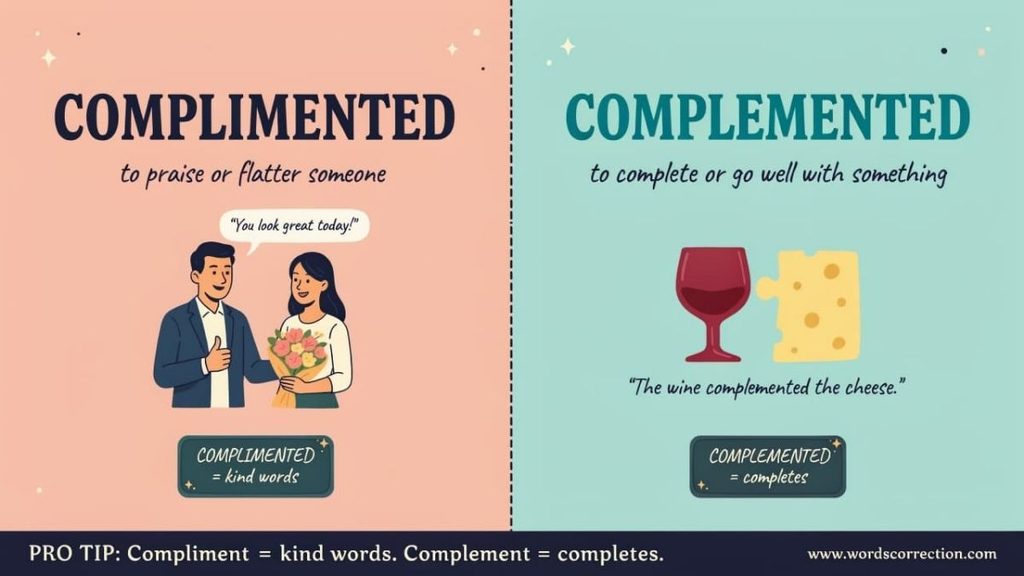
Seeing the words together makes the distinction even clearer.
Consider this sentence:
The manager complimented the designer because the new colors complemented the company’s branding.
The first word means praised.
The second means worked well with or enhanced.
Another example:
She complimented him on his jacket because the color complemented his outfit.
Again:
- complimented = praised
- complemented = matched or enhanced
This is one of the best ways to understand compliment and complement usage.
Learn the difference between often confused words
Slushy Vs Slushie Which Spelling is Correct?
Compliment vs Complement Examples
The following examples show how the words behave in different contexts.
Examples of Compliment
- The teacher complimented Ava on her essay.
- His boss complimented him on his leadership.
- She complimented my cooking.
- The customer complimented the staff’s professionalism.
- They complimented her on her beautiful voice.
Each example involves praise, admiration, or appreciation.
Examples of Complement
- The curtains complemented the furniture.
- The sauce complemented the chicken.
- Her shoes complemented her dress.
- Their skills complemented each other.
- The photographs complemented the article.
Each example involves enhancement, balance, completion, or compatibility.
Complimented or Complemented Side-by-Side Examples
| Sentence | Correct Word | Why |
| The teacher ___ my essay. | Complimented | The teacher praised the essay. |
| The illustrations ___ the article. | Complemented | They enhanced the article. |
| She ___ me on my new hairstyle. | Complimented | She expressed admiration. |
| The necklace ___ her dress. | Complemented | It matched or enhanced the dress. |
| The chef ___ the meal. | Complimented | The chef praised the meal. |
| The herbs ___ the meal. | Complemented | The herbs enhanced the flavor. |
| The manager ___ the employee’s work. | Complimented | The manager praised the work. |
| The two designers’ skills ___ each other. | Complemented | Their skills worked well together. |
Learn the difference between basic English word mistakes
Sole vs Soul which is correct?
Common Mistakes with Complimented and Complemented
These words cause several predictable mistakes.
Mistake Using Complimented for Objects That Enhance Each Other
Incorrect:
The blue pillows complimented the sofa.
Correct:
The blue pillows complemented the sofa.
Why? The pillows didn’t praise the sofa. They matched or enhanced it.
Mistake Using Complemented for Praise
Incorrect:
The manager complemented my presentation.
Correct:
The manager complimented my presentation.
The manager expressed approval. Therefore, complimented is correct.
Mistake Treating the Words as Interchangeable
English contains many words that look or sound similar but have different meanings.
Compliment and complement aren’t interchangeable just because they differ by one letter.
Context determines the correct choice.
Mistake Relying Only on Spell-Check
Both words are legitimate.
A grammar tool may recognize both:
- complimented
- complemented
It may not understand that you intended praised rather than enhanced.
Good writing still requires careful attention to meaning.
Complimented vs Completed Are They the Same?
Complimented vs. completed deserves a quick clarification because the words can seem conceptually related.
Completed means finished.
She completed the assignment.
This means she finished it.
Complemented can involve the idea of making something complete, but in modern English it often means enhanced, balanced, or made more effective as part of a whole.
Compare:
He completed the project.
This means he finished the project.
The final section complemented the project.
This means the final section added something valuable that improved or rounded out the project.
Therefore, don’t automatically treat complemented as another spelling of completed.
Complementary vs Complimentary
Once you understand compliment vs complement, another confusing pair becomes much easier: complimentary and complementary.
Learn the difference between commonly misused words
Mistery vs Mystery Which Is Correct?
What Does Complimentary Mean?
Complimentary usually has two main meanings:
- Expressing praise.
- Provided free of charge.
For example:
She made several complimentary comments about his work.
Here, complimentary means praising.
You might also see:
The hotel offers complimentary breakfast.
Here, it means the breakfast is provided free of charge.
What Does Complementary Mean?
Complementary means completing, enhancing, matching, or working well together.
The two colors are complementary.
The designers have complementary skills.
The distinction follows the same basic pattern:
- complimentary → praise or free
- complementary → completing or enhancing
Is Complimentary the Same as Complementary?
No.
| Word | Main Meaning | Example |
| Complimentary | Praising or free of charge | The hotel provides complimentary breakfast. |
| Complementary | Enhancing or completing | The colors are complementary. |
This distinction is especially useful because both words appear frequently in professional writing, marketing, hospitality, and everyday conversation.
Learn the difference between everyday English mistakes
Organiser or Organizer Which Spelling Should You Use?
Compliment vs Complement Spelling

The compliment vs complement spelling difference is small but meaningful.
A practical memory trick can make it easier.
Compliment Has an “I” for Admiration
Think:
I = admiration
If you’re talking about praise, remember the I in compliment.
I like your work.
they admire your outfit.
I appreciate your effort.
This isn’t a formal spelling rule. It’s simply a memory aid.
Complement Has an “E” for Enhance
Think:
E = enhance
If something improves, balances, or works well with something else, choose complement.
The colors enhance the room.
The sauce enhances the dish.
Their skills enhance the team’s performance.
Again, the E = enhance connection helps you remember the spelling.
When to Use Compliment or Complement
When you’re unsure, run through this quick checklist.
Choose Complimented When
- Someone praises another person.
- Someone expresses admiration.
- Someone gives positive feedback.
- Someone approves of someone’s appearance.
- Someone praises someone’s skills or work.
- Someone makes a positive remark.
Choose Complemented When
- One thing enhances another.
- Two colors work well together.
- An accessory matches an outfit.
- Flavors work well together.
- Two people’s skills balance each other.
- One feature improves another.
- Something completes or rounds out a whole.
The key isn’t memorizing dozens of rules. It’s recognizing the relationship between the words.
Learn the difference between more words people mix up
Volcanoes or Volcanos The Correct Spelling?
How Do You Remember Compliment vs Complement?
Use this two-question method.
Question one Is someone praising something?
If yes, choose compliment.
Question two Is something enhancing, completing, or matching something else?
If yes, choose complement.
Then use these memory shortcuts:
Compliment = I like it.
Complement = It fits with it.
That distinction covers most everyday situations.
Case Study One Sentence, Two Different Meanings
Consider this sentence:
The stylist complimented the red dress.
This means the stylist praised the dress.
Now change one letter:
The stylist complemented the red dress.
This sentence suggests that the stylist made the dress work better with something else, although it sounds incomplete without additional context.
A more natural example is:
The stylist’s gold accessories complemented the red dress.
The accessories and dress form a harmonious combination.
This example shows why context matters more than spelling similarity.
Case Study Workplace Communication
Imagine a manager reviewing a presentation.
The manager complimented the employee on her presentation.
The manager praised her.
Now consider:
The charts complemented the presentation.
The charts enhanced the presentation.
Both sentences can appear in the same paragraph:
The manager complimented Priya on her presentation. The clean charts complemented her explanation and made the data easier to understand.
This example clearly demonstrates the difference between complimented and complemented because both words can appear in the same context while expressing completely different ideas.
Learn the difference between tricky English words with easy explanations
Disgard or Discard Which Spelling Is Correct and Why?
Case Study Clothing and Appearance
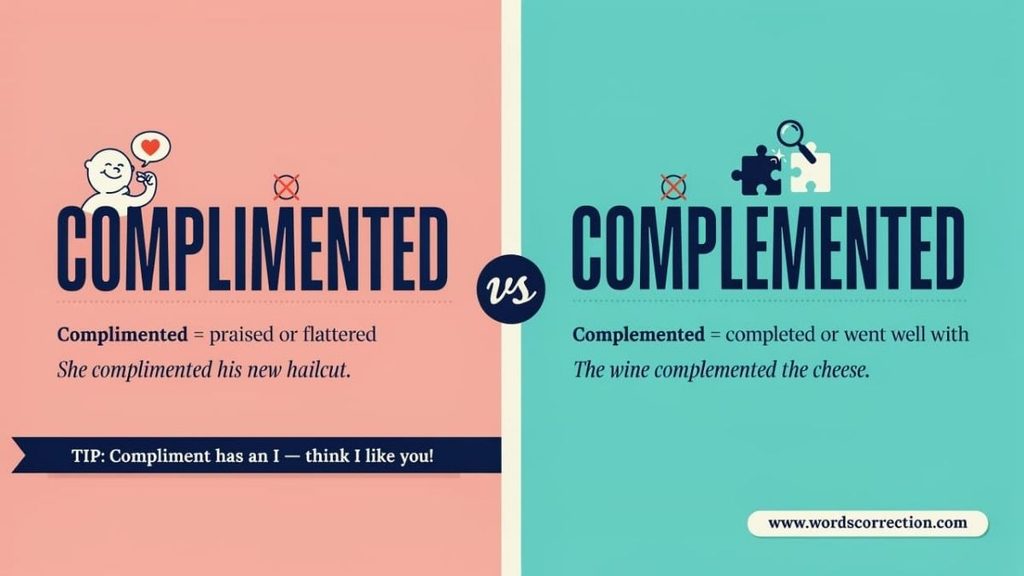
Clothing provides another clear contrast.
Everyone complimented Maria on her dress.
People praised her dress.
The silver shoes complemented her dress.
The shoes matched or enhanced the dress.
You could combine both ideas:
Everyone complimented Maria on her dress because the silver accessories complemented its deep blue color.
Now both words have a clear and separate function.
Complimented Sentence Examples
Here are additional complimented sentence examples for everyday and professional writing:
- The professor complimented the student on her research.
- My friend complimented me on my new haircut.
- The client complimented our team on its quick response.
- The chef complimented the staff after the successful dinner.
- Her parents complimented her on her achievement.
- The director complimented the actor’s performance.
- He complimented his colleague’s creative solution.
- The customer complimented the receptionist’s helpful attitude.
In every case, someone gives praise or appreciation.
Complemented Sentence Examples
Here are useful complemented sentence examples:
- The curtains complemented the new furniture.
- Her necklace complemented her formal outfit.
- The lemon added a fresh note that complemented the fish.
- Their different skills complemented each other.
- The photographs complemented the written content.
- The lighting complemented the restaurant’s design.
- The final chapter complemented the book’s main argument.
- The software update complemented the existing features.
Here, the word describes enhancement, compatibility, balance, or completion.
How to Use Compliment and Complement in One Sentence
Yes, you can use both words in the same sentence.
In fact, doing so makes the distinction especially clear.
The designer complimented the photographer, while the photographs complemented the article.
The designer praised the photographer.
The photographs enhanced the article.
Another example:
She complimented her friend on the outfit, while the scarf complemented the jacket perfectly.
The first word involves praise. The second describes a visual match.
This is one of the clearest compliment vs complement examples for remembering the distinction.
Learn the difference between similar English words the easy way
Uninterested vs Disinterested What’s the Difference?
Compliment and Complement Usage in Everyday English
These words appear across many areas of English.
In Conversations
You might say:
He complimented me on my cooking.
In Business
You might write:
The director complimented the team on its performance.
In Design
You might write:
The new colors complemented the company’s logo.
In Food Writing
You might say:
The spicy sauce complemented the sweetness of the dish.
In Education
You might write:
The instructor complimented the class on its thoughtful discussion.
In Teamwork
You might say:
Their complementary skills helped them finish the project efficiently.
Understanding the meaning allows you to use these words confidently in both casual and formal English.
A Practical Guide to Choosing the Correct Word
When you’re writing and suddenly wonder, “Complimented or complemented?”, don’t stare at the two spellings and hope one looks right.
Instead, identify the action.
If the Action Is Praise
Use:
compliment → complimented → complimenting → compliments
Examples:
- give a compliment
- compliment someone
- complimented her work
- complimenting his appearance
- received several compliments
If the Action Is Enhancement
Use:
complement → complemented → complementing → complements
Examples:
- complement an outfit
- complemented the design
- complementing flavors
- complementary skills
- colors that complement each other
This word-family approach makes correct word usage much easier.
Compliment and Complement Word Families
| Praise Family | Enhancement Family |
| Compliment | Complement |
| Complimented | Complemented |
| Complimenting | Complementing |
| Compliments | Complements |
| Complimentary | Complementary |
| Praise | Enhance |
| Admiration | Compatibility |
Practice Session Complimented or Complemented
Fill in the Blanks
- The teacher __________ Sarah on her excellent writing skills.
- The blue curtains __________ the white walls beautifully.
- My manager __________ me on my performance during the meeting.
- The silver necklace __________ her elegant black dress.
- The chef __________ the kitchen staff on their hard work.
- The fresh herbs __________ the flavor of the soup.
- Everyone __________ James on his confident presentation.
- The wooden furniture __________ the modern design of the room.
- My friend __________ me on my new hairstyle.
- The soft lighting __________ the restaurant’s warm atmosphere.
- The coach __________ the players on their teamwork.
- The spicy sauce __________ the sweetness of the dish.
- The customer __________ the receptionist on her helpful service.
- The colorful illustrations __________ the children’s story.
- My supervisor __________ me on completing the project ahead of schedule.
- The gold accessories __________ her wedding outfit.
- The professor __________ the student on her thoughtful research.
- The background music __________ the emotional scenes in the film.
- My colleague __________ me on my creative solution to the problem.
- The dark wooden table __________ the cream-colored chairs.
- The director __________ the actors on their outstanding performances.
- The lemon dressing __________ the flavor of the grilled fish.
- The interviewer __________ the candidate on his clear answers.
- The new photographs __________ the article and made it more engaging.
- The audience __________ the speaker on her inspiring message.
Answer Key
- complimented
- complemented
- complimented
- complemented
- complimented
- complemented
- complimented
- complemented
- complimented
- complemented
- complimented
- complemented
- complimented
- complemented
- complimented
- complemented
- complimented
- complemented
- complimented
- complemented
- complimented
- complemented
- complimented
- complemented
- complimented
Here’s a trusted source for clear more words Comparison:
Grammar Update
FAQ’s
What is the difference between complimented and complemented?
Complimented means praised or expressed admiration for someone or something. Complemented means enhanced, improved, or matched something well. For example, “She complimented my presentation” means she praised it, while “The visuals complemented my presentation” means they improved it.
Which spelling is correct complimented or complemented?
Both spellings are correct, but they have different meanings. Use complimented for praise and complemented for something that enhances, balances, or completes another thing.
How do you use complimented correctly in a sentence?
Use complimented when someone expresses praise or admiration. For example, “The teacher complimented Daniel on his excellent essay.” The word describes a positive comment about Daniel’s work.
How do you use complemented correctly in a sentence?
Use complemented when one thing improves or works well with another. For example, “The wooden furniture complemented the room’s modern design.” The furniture enhanced the overall appearance of the room.
Are complimented and complemented pronounced the same?
In many English accents, complimented and complemented are pronounced identically. This makes them easy to confuse in conversation, so understanding the context is important when choosing the correct spelling.
What is the difference between compliment and complement as nouns?
A compliment is a positive remark or expression of praise, while a complement is something that completes, balances, or enhances another thing. For example, a kind comment is a compliment, while a matching accessory is a complement to an outfit.
Can compliment and complement both be used as verbs?
Yes. Compliment means to praise someone, while complement means to enhance or match something. For example, “She complimented his presentation” describes praise, while “The images complemented his presentation” describes improvement.
When should you use complimented instead of complemented?
Use complimented when the sentence describes praise, approval, or admiration. For example, “The customer complimented the staff on their helpful service.” The word refers to the positive feedback the customer gave.
When should you use complemented instead of complimented?
Use complemented when something enhances, balances, or matches another thing. For example, “The silver necklace complemented her black dress.” The necklace worked well with the dress rather than expressing praise.
Is it correct to say that one color complimented another?
When describing colors that work well together, complemented is the correct word. For example, “The warm beige complemented the deep brown.” Use complimented only when someone praised the colors.
What is the difference between complimentary and complementary?
Complimentary means expressing praise or provided free of charge, as in “complimentary drinks.” Complementary means enhancing or working well with something else, as in “complementary colors.”
How can you remember the difference between compliment and complement?
Use the memory trick “I for admiration” in compliment and “E for enhance” in complement. If someone praises your work, they compliment you. If something improves your work, it complements it.
What is the difference between complimented and completed?
Complimented means praised, complemented means enhanced or matched well, and completed means finished. For example, “The coach complimented the team,” “The music complemented the film,” and “The team completed the project.”
Can you use complimented and complemented in the same sentence?
Yes. For example, “The editor complimented the writer on the article, and the photographs complemented the story.” The first word describes praise, while the second explains how the photographs enhanced the article.
What are common grammar mistakes involving complimented and complemented?
A common mistake is using complimented to describe objects that match or enhance each other. For example, “The curtains complimented the furniture” should be “The curtains complemented the furniture.” Another mistake is using complemented when describing praise.
Can a person be complemented, or should they be complimented?
A person is generally complimented when someone praises their appearance, skills, behavior, or achievements. Complemented is appropriate when describing how a person’s qualities or skills work well with someone or something else.
How do you use compliment and complement in one sentence?
You can use both words to express different ideas in one sentence. For example, “I complimented the designer on the color scheme because the colors complemented the room’s furniture.”
What does it mean when two skills complement each other?
Two skills complement each other when they work well together and create a stronger combination. For example, a writer’s communication skills may complement a designer’s visual skills, helping a team produce better content.
Why might spell check miss a complimented or complemented mistake?
Spell-check may miss the error because both words are spelled correctly. The problem lies in their meanings, not their spelling. Choosing the right word requires checking whether the sentence describes praise or enhancement.
What is the simplest way to check whether complimented or complemented fits a sentence?
Replace complimented with praised and complemented with enhanced or matched well. If the replacement preserves the intended meaning, you have likely chosen the correct word. This quick test helps prevent common word-choice mistakes.
Conclusion
Choosing between complimented and complemented is easier than it seems. Remember, complimented means praised, while complemented means matched, improved, or enhanced something. Mixing them up can lead to confusing sentences, but a little practice can help you avoid these common grammar mistakes. Use the 25 fill in the blank exercises to test your knowledge and strengthen your writing skills. When you’re unsure which word to choose, ask yourself one simple question: Is someone giving praise, or is something making another thing better? Keep this easy trick in mind, practice regularly, and you’ll soon use both words correctly with confidence.

Stella AJS is an experienced blogger and dedicated English language writer at Words Correction. She turns confusing grammar, word meanings, spelling, and usage into clear, practical insights that readers can easily understand and apply. With a passion for precise and engaging writing, Stella helps readers avoid common language mistakes, strengthen their vocabulary, and communicate with greater clarity and confidence.




