
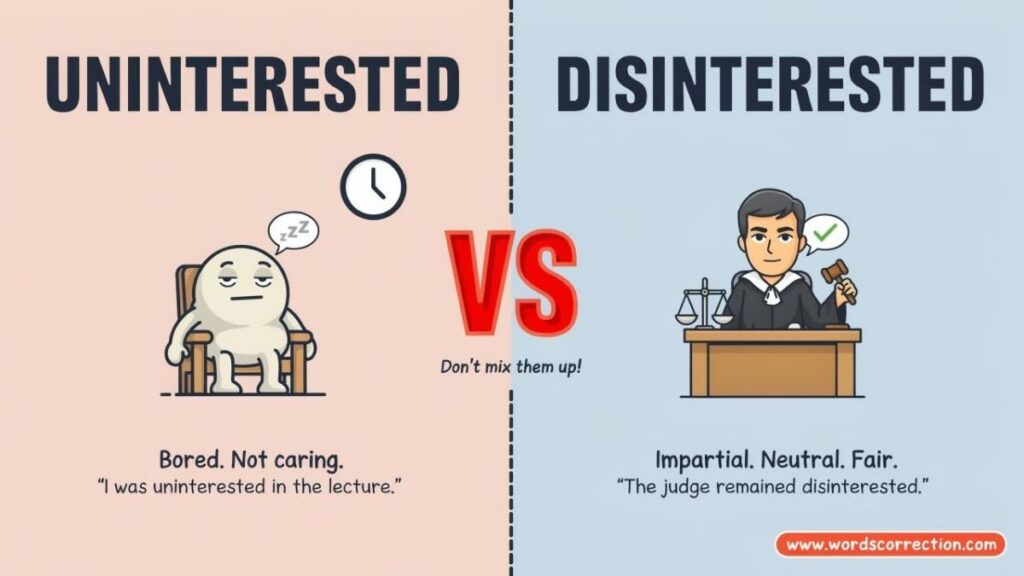
Some English words look so similar that they can easily cause confusion, and uninterested vs disinterested is a perfect example. Although these words share the same root, they have different meanings. Uninterested means having no interest, curiosity, or enthusiasm about something. Disinterested traditionally means being fair and unbiased because you have no personal interest or connection to the matter. Using the wrong word can change the meaning of your sentence and make your writing less clear. The good news is that the difference is easy to understand. Once you know what each word means, you’ll have no trouble choosing the right one in your writing.
Uninterested vs Disinterested The Quick Answer
The simplest way to remember the difference is:
| Word | Main traditional meaning | Simple synonym | Example |
| Uninterested | Not interested or lacking curiosity | Bored, indifferent, apathetic | The uninterested student looked out the window. |
| Disinterested | Impartial because there is no personal stake | Unbiased, neutral, impartial | The disinterested mediator helped both sides reach an agreement. |
A useful memory aid is:
Uninterested = “I am not interested.”
Disinterested = “I have no personal stake.”
This distinction applies to most formal situations, although modern English sometimes uses disinterested to mean “not interested.”
Uninterested Meaning
Uninterested describes someone who lacks interest in something.
An uninterested person may show:
- A lack of curiosity
- A lack of enthusiasm
- Little motivation
- Limited attention
- Boredom
- Indifference
- Apathy toward a subject
For example:
The uninterested student didn’t participate in the discussion.
The sentence tells us that the student wasn’t interested in the discussion. It doesn’t tell us whether the student was biased, impartial, or personally connected to the subject.
Uninterested Definition
The uninterested definition is essentially “not interested.”
The word can describe someone who lacks curiosity, enthusiasm, attention, or motivation toward something.
For example:
The uninterested audience remained quiet throughout the presentation.
Here, the audience isn’t showing much enthusiasm or engagement.
Learn the difference between confusing more English words
Allie or Ally Difference And Usage
Does Uninterested Mean Bored?
Not always.
If you’re asking, “Does uninterested mean bored?” the answer is that the words are related but not exact synonyms.
Bored describes a feeling caused by a lack of stimulation or interest.
Uninterested describes a lack of interest in something.
For example:
I was uninterested in the discussion because the topic didn’t affect me.
This doesn’t necessarily mean the person was bored. The person simply didn’t have much interest in the subject.
By contrast:
The movie was boring.
This describes the movie as dull or unstimulating.
Therefore, uninterested meaning bored can sometimes work in context, but the two words don’t have exactly the same meaning.
Uninterested Examples
Here are several natural uninterested examples:
- The uninterested student checked the clock every few minutes.
- She seemed uninterested in the proposed changes.
- The customer was completely uninterested in the expensive upgrade.
- His uninterested response suggested that he didn’t want to continue the conversation.
- The child became uninterested in the game after ten minutes.
- An uninterested audience can make even an experienced speaker nervous.
In each example, uninterested refers to a lack of interest, enthusiasm, or engagement.
Disinterested Meaning
The traditional disinterested meaning is different.
A disinterested person has no personal stake, financial interest, emotional involvement, or other benefit connected to an outcome. As a result, that person can evaluate the situation more impartially.
For example:
The committee asked a disinterested third party to review the complaint.
The third party should have no personal connection to either side.
Disinterested Definition
The traditional disinterested definition is “free from personal interest or advantage.”
A disinterested person can make an independent judgment without allowing personal gain, relationships, or conflicts of interest to influence the decision.
For example:
The company hired a disinterested professional to investigate the complaint.
The professional should not favor either side.
Learn the difference between commonly mixed-up more words
Happend or Happened Which Spelling Is Correct?
Does Disinterested Mean Unbiased?
In its traditional sense, yes.
The question “Does disinterested mean unbiased?” has a clear answer when the word is used to describe impartiality. A disinterested person has no personal stake that could improperly influence their judgment.
This doesn’t mean the person has no interest in the subject whatsoever. A judge may care deeply about justice while remaining disinterested in the traditional sense.
The key issue is personal interest.
A judge should not personally benefit from one party winning. That allows the judge to make an impartial decision.
Disinterested Examples
Consider these disinterested examples:
- The judge needed to remain disinterested throughout the trial.
- We asked a disinterested third party to review the contract.
- A disinterested mediator helped the two companies settle their dispute.
- The board wanted a disinterested observer to monitor the election.
- The researcher attempted to provide a disinterested assessment of the evidence.
- The referee must remain disinterested and fair throughout the match.
Here, disinterested relates to neutrality, independence, fairness, and the absence of personal bias.
What Is the Difference Between Uninterested and Disinterested?
The difference between uninterested and disinterested becomes clearer when you ask what kind of “interest” the sentence describes.
If you mean a lack of interest, use uninterested.
If you mean freedom from personal interest or bias, use disinterested.
Compare these sentences:
Maria was uninterested in the movie.
She didn’t care about the movie.
Maria was a disinterested observer of the dispute.
She had no personal stake in the dispute.
The first sentence describes interest.
The second describes impartiality.
That difference matters because replacing one word with the other can change the intended meaning.
Learn the difference between tricky grammar more words
Steel or Steal which one is correct?
Uninterested vs Disinterested Difference
| Situation | Best word | Reason |
| A child doesn’t want to read a book | Uninterested | The child lacks interest |
| A referee has no connection to either team | Disinterested | The referee has no personal stake |
| An employee doesn’t care about a new policy | Uninterested | The employee lacks enthusiasm |
| A mediator has no financial connection to either party | Disinterested | The mediator can remain neutral |
| A customer doesn’t want to hear a sales pitch | Uninterested | The customer isn’t interested |
| An independent expert evaluates competing claims | Disinterested | The expert has no personal interest |
Uninterested or Disinterested Meaning Why Are They Confused?
The confusion between these words has a long history.
Both contain the root interest, but their prefixes developed different meanings. Uninterested naturally suggests the absence of interest. Disinterested, however, developed a sense connected with being separate from personal interest.
Over time, everyday English began using disinterested to mean “not interested.” This usage became common enough that modern dictionaries recognize it.
As a result, there are two important layers of usage:
| Usage | Uninterested | Disinterested |
| Traditional meaning | Not interested | Impartial |
| Modern usage | Not interested | Not interested or impartial |
| Best choice for clarity | Lack of interest | Lack of personal stake |
This overlap explains why you may see disinterested used in situations where uninterested would traditionally be preferred.
Uninterested vs Disinterested Examples in Sentences
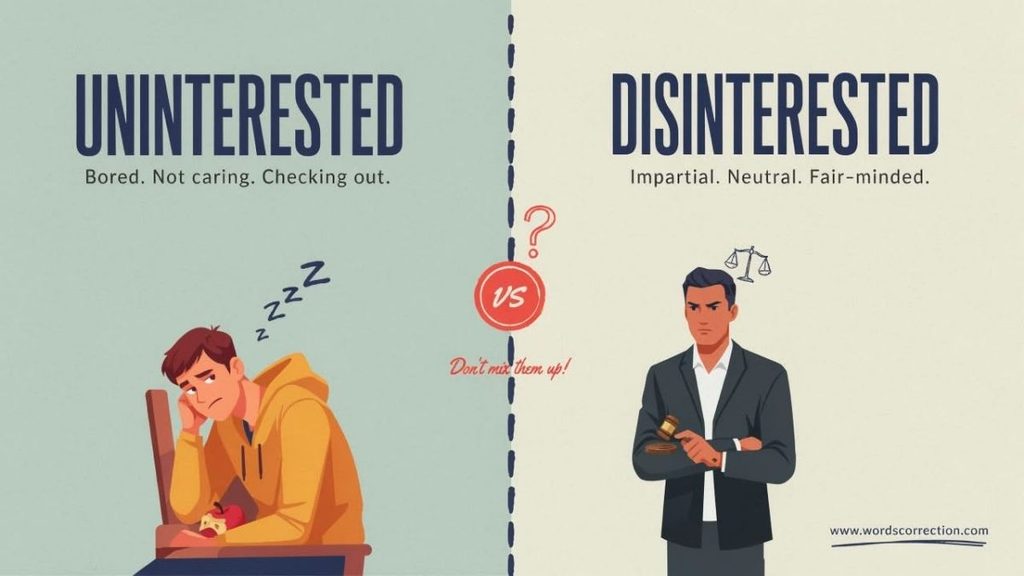
Seeing both words in comparable sentences is one of the easiest ways to understand the distinction.
| Uninterested | Disinterested |
| Jake was uninterested in the lecture. | The mediator was disinterested in the financial outcome. |
| The child looked uninterested in the museum tour. | The lawyer sought a disinterested expert. |
| She seemed uninterested in learning French. | The panel needed a disinterested member. |
| The customer was uninterested in the offer. | The referee remained disinterested during the match. |
| He gave an uninterested response. | The judge provided a disinterested evaluation. |
The contrast becomes clearer when you replace each word with a simple phrase.
Uninterested:
Not interested.
Disinterested:
Without a personal stake.
Those meanings are related, but they aren’t identical.
Learn the difference between confusing word pairs
Principal or Principle Don’t Mix Them Up
Uninterested or Disinterested in a Sentence
If you’re unsure how to use either word naturally, these examples provide a useful guide.
Uninterested in a Sentence
The uninterested student refused to participate in the science experiment.
The student doesn’t want to participate because the activity doesn’t interest them.
Another example:
After hearing the same sales pitch three times, the customer became completely uninterested.
Again, the sentence describes a lack of interest.
Disinterested in a Sentence
The company appointed a disinterested mediator to resolve the disagreement.
The mediator isn’t personally involved and has no stake in the outcome.
Another example:
The committee requested a disinterested observer to ensure that the election remained fair.
The observer’s independence is the important point.
When to Use Uninterested
Knowing when to use uninterested becomes easy when you connect the word with a lack of interest.
Use uninterested when someone:
- Doesn’t care about a topic
- Lacks curiosity
- Shows little enthusiasm
- Doesn’t want to participate
- Finds something unappealing
- Pays little attention
- Lacks motivation
- Isn’t emotionally engaged with a subject
For example:
She was uninterested in the lecture.
The audience appeared uninterested.
He became uninterested in the project.
The employee seemed uninterested in learning the new software.
The word can describe both a person’s internal attitude and their outward behavior.
An uninterested employee might avoid meetings. The uninterested listener might stop paying attention. An uninterested child might leave an activity that no longer holds their attention.
When to Use Disinterested
The answer to when to use disinterested depends on the meaning you want.
For precise, formal writing, use disinterested when you mean:
- Impartial
- Unbiased
- Neutral
- Independent
- Free from personal interest
- Free from financial interest
- Free from a conflict of interest
For example:
The company needs a disinterested arbitrator.
This means the arbitrator should have no personal connection to or financial interest in the dispute.
Another example:
A disinterested observer could provide a more objective assessment.
The observer stands outside the dispute and has no personal stake in the result.
Learn the difference between often confused words
Programme or Program Spelling Guide
Why Disinterested Matters in Professional Writing

In areas such as law, journalism, research, mediation, and corporate governance, personal interest can affect judgment.
Suppose two companies disagree about a contract. One company asks an executive who negotiated the original contract to determine which side is correct.
The executive may have extensive knowledge of the agreement. However, the executive isn’t fully disinterested because they have a professional and potentially personal connection to the matter.
An independent expert would provide a more appropriate perspective.
That’s where the traditional meaning of disinterested becomes especially valuable.
Uninterested vs Disinterested Usage in Modern English
The uninterested vs disinterested usage debate becomes more complicated because language changes over time.
Modern dictionaries recognize that disinterested can mean “not interested” in addition to “impartial.”
For example:
She seemed disinterested in the conversation.
Depending on the context, this could mean:
- She wasn’t interested in the conversation.
- She had no personal stake in the conversation.
Most readers can determine the intended meaning from context. However, ambiguity can still occur.
Instead of writing:
The witness was disinterested.
You could write:
The witness had no personal stake in the case.
Or:
The witness showed no interest in the discussion.
These alternatives make the intended meaning immediately clear.
Traditional vs Modern Usage
| Meaning | Traditional preference | Modern usage |
| Not interested | Uninterested | Uninterested remains clear and standard |
| Impartial | Disinterested | Disinterested remains widely used |
| Not interested | Disinterested | Recognized in modern English |
| Free from personal gain | Disinterested | Still strongly established |
For formal writing, maintaining the traditional distinction is often the clearest approach.
Learn the difference between basic English word mistakes
Fair or Fare which is correct?
Uninterested vs Disinterested Grammar
From a grammatical perspective, both words function primarily as adjectives.
Uninterested Grammar
You commonly use uninterested with the preposition in:
She is uninterested in politics.
He was uninterested in the proposal.
They became uninterested in the project.
Use this common structure:
Subject + be/seem/become + uninterested + in + noun or gerund
For example:
The students seemed uninterested in studying.
Disinterested Grammar
Disinterested also functions as an adjective:
The judge remained disinterested.
They hired a disinterested mediator.
The committee wanted a disinterested observer.
You may also encounter:
She was not personally concerned about the financial outcome.
In this structure, context determines whether disinterested means “not interested” or “not personally concerned.”
When precision matters, especially in formal writing, uninterested in is usually the clearer choice when you mean a simple lack of interest.
Learn the difference between commonly misused words
Slushy Vs Slushie Which Spelling is Correct?
Uninterested vs Disinterested Grammar Common Mistakes

One common mistake is treating the two adjectives as exact synonyms in every situation.
Less precise
The company selected an uninterested mediator.
This could mean the mediator doesn’t care about the dispute.
That isn’t necessarily the intended meaning.
Better
The company selected a disinterested mediator.
Now the sentence clearly indicates that the mediator has no personal stake.
Another common issue occurs when someone writes:
The student was disinterested in mathematics.
If the intended meaning is that the student doesn’t like or care about mathematics, uninterested is clearer:
The student was uninterested in mathematics.
The second sentence eliminates the ambiguity.
Uninterested and Disinterested Are They Synonyms?
They can be synonyms or have different meanings, depending on the context.
Traditionally, the words are not synonyms:
- Uninterested = lacking interest
- Disinterested = impartial or free from personal interest
Modern English, however, sometimes uses disinterested to mean uninterested.
That means the words can overlap in some contexts.
Still, they aren’t interchangeable everywhere.
Consider:
The disinterested judge reviewed the case.
Changing disinterested to uninterested produces:
The uninterested judge reviewed the case.
The second sentence sounds as though the judge doesn’t care about the case. That is probably not the intended meaning.
Uninterested Synonym Words You Can Use Instead
A useful uninterested synonym depends on the exact shade of meaning.
Possible alternatives include:
- Indifferent
- Apathetic
- Unconcerned
- Disengaged
- Inattentive
- Bored
- Incurious
- Unenthusiastic
These words aren’t perfect substitutes in every situation.
Bored suggests that something fails to provide stimulation.
Apathetic suggests a deeper lack of motivation or concern.
Indifferent can mean that someone doesn’t particularly care.
Unenthusiastic focuses on a lack of excitement.
For example:
The uninterested student didn’t ask any questions.
You could write:
The disengaged student didn’t ask any questions.
The basic idea remains similar, but the second version emphasizes the student’s lack of participation.
Learn the difference between everyday English mistakes
Sole vs Soul which is correct?
Disinterested Synonym Words That Convey Impartiality
A useful disinterested synonym also depends on context.
Possible alternatives include:
- Impartial
- Unbiased
- Neutral
- Objective
- Independent
- Fair
- Detached
- Uninvolved
- Dispassionate
For example:
We need a disinterested observer.
Could become:
We need an impartial observer.
Or:
We need an independent observer.
In formal contexts, impartial and unbiased often make the intended meaning especially clear.
Uninterested vs Disinterested in Real-Life Contexts
The distinction becomes easier to remember when you see how the words work in familiar situations.
In a Classroom
The uninterested student kept looking at the clock.
The student lacks interest in the lesson.
A teacher might also say:
The class seemed uninterested in the topic.
The issue is engagement and attention.
In a Courtroom
The court needs a disinterested judge.
Here, the judge should have no personal stake in the case.
The judge’s role requires impartiality, fairness, and independent judgment.
In Business
Imagine that a company wants to resolve a dispute with a supplier.
An executive who negotiated the original contract may have extensive knowledge of the situation. However, that person could also have a professional interest in the outcome.
An independent arbitrator would provide a more disinterested decision.
In Journalism
A journalist covering a political or corporate dispute should avoid undisclosed financial or personal connections that could create a conflict of interest.
A disinterested perspective helps support fair and objective reporting.
However, being disinterested doesn’t mean being emotionally detached from every subject. It means that personal interests shouldn’t improperly influence professional judgment.
In Everyday Conversation
I’m uninterested in reality television.
This is completely natural.
In casual conversation, uninterested is usually the safest choice when you simply mean “not interested.”
A Case Study The Two Meanings in One Situation
Imagine that a school is choosing a new textbook.
Three people are involved:
- Ms. Lee, a teacher who strongly prefers one publisher.
- Mr. Patel, a teacher who doesn’t care which publisher wins.
- Dr. Morgan, an independent education consultant with no connection to any publisher.
Their positions illustrate the distinction clearly.
Ms. Lee is interested because she has a strong preference.
Mr. Patel is uninterested because he doesn’t care which textbook the school chooses.
Dr. Morgan is disinterested because she has no personal or financial stake in the outcome.
| Person | Description | Reason |
| Ms. Lee | Interested | She has a strong preference |
| Mr. Patel | Uninterested | He doesn’t care which book wins |
| Dr. Morgan | Disinterested | She has no personal stake |
This example captures the central uninterested and disinterested difference.
Learn the difference between more words people mix up
Mistery vs Mystery Which Is Correct?
Can Disinterested Mean Not Interested?

Yes. This is one of the most important points in modern English.
If you’re asking “Can disinterested mean not interested?”, the answer is yes in contemporary usage.
However, the meaning can become ambiguous.
Consider:
He was disinterested in the proposal.
A reader may understand this as:
He wasn’t interested in the proposal.
Another reader could interpret it as:
He had no personal interest in the proposal.
If precision matters, choose the clearer word.
Better Choices
If you mean not interested:
He was uninterested in the proposal.
If you mean impartial:
He was disinterested in the outcome.
Or, even more clearly:
He had no personal stake in the outcome.
A small wording change can eliminate significant ambiguity.
Does Uninterested Mean Impartial?
Usually, no.
The question “Does uninterested mean impartial?” highlights one of the biggest reasons these words shouldn’t be treated as interchangeable.
An uninterested person lacks interest.
An impartial person doesn’t favor one side.
Those conditions can exist independently.
Someone can be interested yet impartial.
For example, a judge may be deeply interested in ensuring justice while remaining impartial toward both parties.
Likewise, someone can be uninterested yet biased.
A person might not care much about a political debate but still favor one candidate.
Therefore:
Lack of interest does not necessarily mean absence of bias.
This distinction is central to understanding the words.
Is Disinterested the Same as Uninterested?
The answer to “Is disinterested the same as uninterested?” is not traditionally, although modern English sometimes treats them as overlapping terms.
For careful writing, especially when discussing fairness or decision-making, preserve the traditional distinction:
Uninterested = not interested.
Disinterested = impartial or free from personal stake.
This approach gives readers the clearest possible interpretation.
Learn the difference between tricky English words with easy explanations
Organiser or Organizer Which Spelling Should You Use?
How to Remember Uninterested vs Disinterested
A simple memory trick can make the distinction easier to remember.
Think “UN = no interest”
Uninterested means not interested.
I’m uninterested in the topic.
Think “DIS = separate from personal interest”
Disinterested means separate from personal interest.
The mediator is disinterested.
The mediator stands outside the conflict and has nothing personal to gain.
Another useful mental picture is this:
Uninterested: Someone walks away from a conversation because the topic doesn’t interest them.
Disinterested: Someone evaluates a dispute without having anything to gain from either side.
One person lacks curiosity. The other lacks a personal stake.
Uninterested vs Disinterested in Formal Writing
When writing an essay, report, legal document, business communication, or academic paper, clarity matters more than complicated vocabulary.
If you mean not interested, write:
The participants were uninterested in the optional workshop.
If you mean impartial, write:
The panel required a disinterested reviewer.
If the meaning could be misunderstood, use a more direct phrase:
The reviewer had no financial interest in the outcome.
Or:
The reviewer had no personal connection to either party.
Formal writing benefits from precision. A more sophisticated-sounding word isn’t necessarily a better word.
Uninterested vs Disinterested Common Mistakes to Avoid
Using Disinterested When You Mean Bored
Less precise:
The audience was disinterested during the lecture.
Clearer:
The audience was uninterested during the lecture.
If the audience actually felt bored, you could simply write:
The audience looked bored during the lecture.
Using Uninterested When You Mean Impartial
Less precise for the intended meaning:
The dispute needs an uninterested arbitrator.
This suggests that the arbitrator doesn’t care.
Better:
The dispute needs a disinterested arbitrator.
Now the sentence communicates that the arbitrator has no personal stake.
Assuming the Prefixes Tell the Whole Story
English doesn’t always follow neat rules based on prefixes.
Prefixes can offer clues, but historical development also influences meaning. That’s why disinterested developed its traditional sense of being free from personal interest.
Learn the difference between confusing more English words step by step
Volcanoes or Volcanos The Correct Spelling?
Uninterested vs Disinterested A Practical Decision Guide
When you’re unsure whether to use uninterested or disinterested, ask yourself a few simple questions.
Does the person lack interest?
Use uninterested.
She was uninterested in the subject.
Does the person lack a personal stake?
Use disinterested.
She served as a disinterested mediator.
Could the sentence become ambiguous?
Choose a clearer alternative.
She had no personal stake in the matter.
Are you writing formally about fairness or judgment?
Use disinterested when you mean impartiality.
Are you describing boredom or a lack of enthusiasm?
Use uninterested.
The Fastest Test
Replace the word mentally.
If “not interested” fits, choose uninterested.
If “impartial” or “without a personal stake” fits, choose disinterested.
This simple test will solve most usage questions.
Practice Sessions
Fill in the Blanks
Choose uninterested or disinterested.
- He was __________ in the movie.
- The judge remained __________.
- She seemed __________ in the topic.
- We need a __________ person.
- They were __________ in the lesson.
- The referee must be __________.
- I am __________ in the offer.
- We asked a __________ expert.
- The child looked __________.
- The mediator was __________.
- He became __________ in the game.
- She gave a __________ opinion.
- The students were __________.
- We need a __________ judge.
- He seemed __________ in the meeting.
- The adviser was __________.
- She was __________ in the subject.
- They chose a __________ observer.
- The audience looked __________.
- The committee needs a __________ member.
- He sounded __________ about the plan.
- We need an __________ third party.
- She appeared __________ during class.
- The expert gave a __________ judgment.
- The children were __________ in the activity.
Answers
- Uninterested
- Disinterested
- Uninterested
- Disinterested
- Uninterested
- Disinterested
- Uninterested
- Disinterested
- Uninterested
- Disinterested
- Uninterested
- Disinterested
- Uninterested
- Disinterested
- Uninterested
- Disinterested
- Uninterested
- Disinterested
- Uninterested
- Disinterested
- Uninterested
- Disinterested
- Uninterested
- Disinterested
- Uninterested
Here’s a trusted source for clear more words Comparison:
Grammar Update
FAQs
What is the difference between uninterested and disinterested?
Uninterested means having little or no interest, curiosity, or enthusiasm. Disinterested means being impartial and having no personal interest or bias in a situation.
Can uninterested and disinterested be used interchangeably?
Although the two words are sometimes used interchangeably in everyday English, they have traditionally different meanings. Use uninterested for a lack of interest and disinterested for impartiality or neutrality.
When should you use uninterested?
Use uninterested when someone does not show curiosity, enthusiasm, or concern about a person, subject, activity, or situation.
When should you use disinterested?
Use disinterested when describing someone who can remain neutral because they have no personal, financial, or emotional stake in an outcome.
Can someone be both uninterested and disinterested?
Yes. A person may have no interest in a subject while also having no personal stake in its outcome. The words describe different aspects of a person’s position.
Does disinterested mean impartial?
Yes. In traditional usage, disinterested means impartial, unbiased, or free from personal interests that could influence a judgment.
Can uninterested describe a person’s attitude?
Yes. Uninterested can describe someone who shows little attention, curiosity, enthusiasm, or concern toward something.
Can disinterested describe a decision?
Yes. A disinterested decision is made without personal interests, favoritism, or potential benefits influencing the judgment.
Why are uninterested and disinterested commonly confused?
The words are similar in spelling and pronunciation, and their meanings have partially overlapped in modern English. This makes them easy to confuse, particularly in casual conversation.
Is disinterested suitable for formal writing?
Yes. Disinterested is particularly useful in formal writing when you mean impartial, unbiased, or free from personal interest.
Is uninterested suitable for academic writing?
Yes. Uninterested is appropriate in academic writing when describing someone who lacks interest, enthusiasm, or engagement with a particular subject.
What is the opposite of disinterested?
Depending on the context, possible opposites include biased, partial, self-interested, involved, and personally invested.
What is the opposite of uninterested?
Common opposites include interested, curious, enthusiastic, attentive, engaged, and involved.
Can uninterested describe a lack of attention?
Yes. An uninterested person may give little attention to something because they do not find it engaging, relevant, or appealing.
Can disinterested describe someone with no financial stake?
Yes. Disinterested can describe someone who has no financial or personal benefit connected to a particular decision or outcome.
What does a disinterested third party mean?
A disinterested third party is someone who has no personal stake in a dispute or decision and can therefore provide a neutral and impartial perspective.
What does an uninterested audience mean?
An uninterested audience is a group of people who show little attention, enthusiasm, or curiosity about a presentation, performance, or discussion.
Which word is better when you mean bored?
Uninterested is the better choice when you mean that someone is bored or lacks enthusiasm. Disinterested is traditionally associated with impartiality rather than boredom.
Which word describes a neutral person?
Disinterested is the traditional choice when describing someone who is neutral because they have no personal interest or stake in the outcome.
How can you easily remember the difference?
A simple rule is uninterested means not interested, while disinterested means impartial or unbiased.
Can disinterested also mean uninterested?
Yes. In modern English, disinterested is sometimes used to mean lacking interest. However, maintaining the traditional distinction can make formal writing clearer and prevent ambiguity.
What does it mean when someone seems uninterested?
It means the person appears to lack curiosity, attention, enthusiasm, or concern about a particular subject or situation.
What does it mean to remain disinterested?
It means to remain impartial and avoid allowing personal interests, relationships, or potential benefits to influence a judgment or decision.
Is not interested the same as uninterested?
In most contexts, yes. Not interested directly expresses a lack of interest, while uninterested conveys the same idea in a single adjective.
Which word should you use in professional writing?
Use uninterested when referring to a lack of interest or enthusiasm. Use disinterested when referring to impartiality, neutrality, or freedom from personal interests. This distinction helps make professional writing more precise and easier to understand.
Conclusion
The difference between uninterested vs disinterested may seem minor, but using the wrong word can change the meaning of a sentence. Uninterested means having no interest, curiosity, or enthusiasm about something. Disinterested traditionally means being free from personal interest or bias and able to make a fair judgment.
The easiest way to remember the difference is simple uninterested means not interested, while disinterested means impartial or unbiased. For example, an uninterested student may not care about a lesson, while a disinterested judge should have no personal interest in the case.
English has plenty of confusing word pairs, but this one doesn’t have to cause trouble. Once you understand the difference, you can choose the right word with confidence and make your writing clearer, more accurate, and more professional.

Stella AJS is an experienced blogger and dedicated English language writer at Words Correction. She turns confusing grammar, word meanings, spelling, and usage into clear, practical insights that readers can easily understand and apply. With a passion for precise and engaging writing, Stella helps readers avoid common language mistakes, strengthen their vocabulary, and communicate with greater clarity and confidence.




