
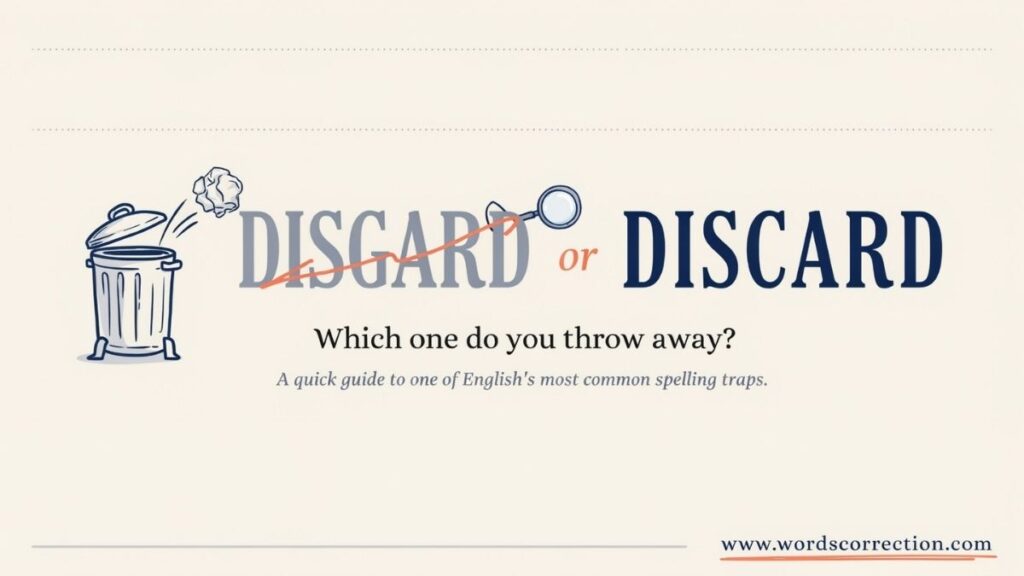
The spelling confusion between “disgard” and “discard” is a common mistake. Both forms may look correct at first, but only one is accepted in standard English. If you’re searching for “disgard or discard,” the answer is simple: “discard” is correct, while “disgard” is incorrect. This mistake can easily appear in emails, school assignments, business writing, and everyday messages. The good news is that the correct spelling is easy to remember once you understand its meaning and word forms. This guide explains the difference between “disgard” and “discard,” shows how to use “discard” correctly, and provides a simple trick to help you remember its spelling.
Quick Answer Disgard or Discard?
| Spelling | Correct? | Meaning | Usage |
| discard | Yes | To throw away, reject, or get rid of something | Standard English |
| disgard | No | Incorrect spelling of discard | Not standard English |
Use discard in both American and British English. Disgard is a misspelling, not a regional spelling variant.
Disgard or Discard Which Is Correct?
The answer is clear: discard is correct.
The correct spelling is:
D-I-S-C-A-R-D
The incorrect form, disgard, replaces the c with g. Although the incorrect version may seem reasonable when you’re spelling the word from memory, standard English recognizes only discard for this meaning.
This isn’t a situation where both spellings are accepted. English has genuine spelling differences such as color/colour and organize/organise, but discard/disgard isn’t one of them.
Whether you’re writing for an American or British audience, the spelling stays the same.
Is Disgard a Word?
If you’re asking, “Is disgard a word?”, the answer is no in standard English when you mean “throw away,” “reject,” or “get rid of.”
You may find disgard in online posts, comments, unedited documents, or other places where spelling errors occur. However, seeing a word used incorrectly doesn’t make it an accepted English spelling.
For professional writing, academic work, business communication, websites, emails, and other edited content, use discard.
Is Discard a Word?
Yes. Discard is a standard English word.
It primarily works as a verb, although it can also function as a noun.
As a verb, discard means to get rid of something that is unwanted, unnecessary, or no longer useful. It can also mean to reject an idea, plan, possibility, or option.
For example:
- Please discard the empty container.
- The editor discarded the unnecessary paragraph.
- The team discarded the original proposal.
- The researchers discarded the unreliable results.
The word also has a familiar meaning in card games. When a player gets rid of a card they don’t want, they discard it.
Learn the difference between more words people mix up
Allie or Ally Difference And Usage
Discard Meaning and Definition
The basic discard meaning is “to get rid of something or reject it.”
The word can describe a physical object, but its use goes much further. You can discard an idea, proposal, plan, possibility, piece of information, or playing card.
A useful discard definition is:
Discard means to throw away, reject, or get rid of something because it is unwanted, unnecessary, or no longer useful.
The exact sense depends on the context.
For example, when you discard a broken chair, you physically get rid of it. When you discard an idea, you reject it rather than physically throwing anything away.
Discard as a Verb
Discard is primarily a verb.
You can discard an object, idea, plan, option, piece of information, or card.
Consider these examples:
- Discard the damaged package.
- Discard the outdated document.
- Discard the original plan.
- Discard the unreliable data.
- Discard the card you don’t need.
The verb often suggests a deliberate decision. You’re not simply losing something by accident. You’re choosing to remove or reject it.
Discard as a Noun
Learn the difference between everyday English mistakes
Happend or Happened Which Spelling Is Correct?
Discard can also function as a noun.
In general use, a discard can refer to something that has been rejected or thrown away. In card games, it can refer specifically to a card that a player has discarded.
For example:
- The discard was placed beside the deck.
- The player added another card to the discard pile.
- Several discards were lying beside the playing area.
The noun is less common in everyday conversation than the verb, but it has a clear and established place in English vocabulary.
Is Discard an Adjective?
Discard isn’t normally used as a standalone adjective.
Instead, discarded commonly describes something that has been rejected or thrown away.
For example:
- discarded materials
- discarded documents
- discarded clothing
- discarded equipment
Therefore, if you’re searching for the discard adjective form, discarded is usually the form that fits the sentence.
Why Is Disgard Incorrect?
The simplest explanation is that disgard isn’t the established spelling of the word.
The correct form is discard, and its spelling connects naturally with the word card.
Think of it as:
dis + card = discard
That connection provides an easy spelling clue.
Why Does “Disgard” Look Possible?
English spelling doesn’t always make pronunciation easy to predict. When people hear a word rather than see it written, they may remember the sound correctly but choose the wrong letters.
That’s one reason disgard can seem believable.
Another source of confusion is the word disregard.
The two words share the beginning dis- and can both involve the idea of rejecting something. Their meanings, however, are different.
Compare:
Please discard the damaged document.
This means to get rid of the document.
Please disregard the previous message.
This means to ignore the message.
Understanding that distinction can prevent both spelling and word-choice mistakes.
Learn the difference between commonly misused words
Steel or Steal which one is correct?
The Origin and Etymology of Discard
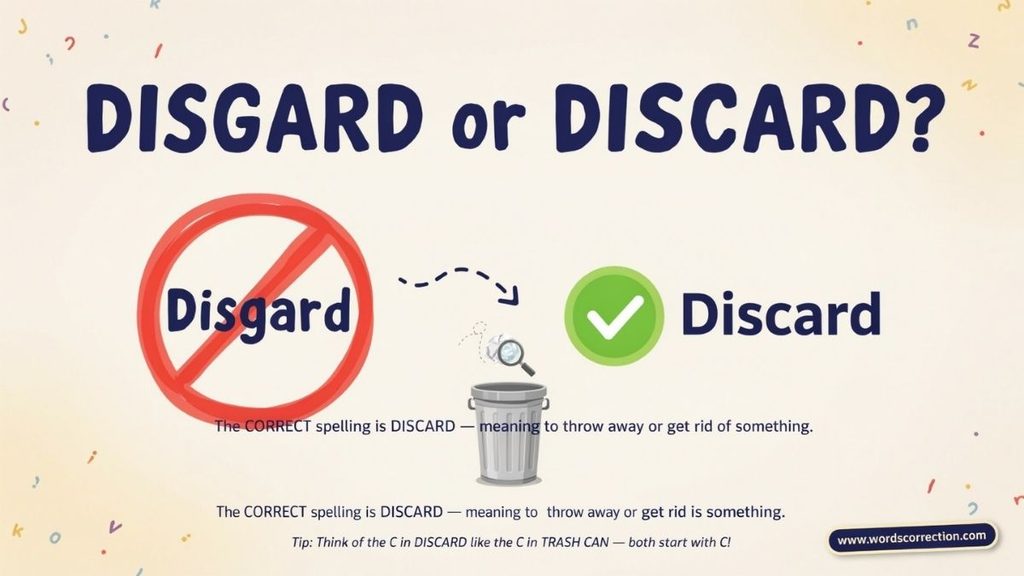
The etymology of discard goes back to the late 16th century. The word developed from dis-, expressing removal, and card. Its early use was connected with rejecting a playing card.
The word origin of discard helps explain why the word contains c rather than g.
That structure gives us a useful spelling pattern:
dis- + card = discard
The original connection with playing cards also explains why the word still has an important role in card games.
Over time, the meaning expanded. English speakers began using discard for more than unwanted cards. The verb eventually became useful for objects, ideas, plans, information, possibilities, and other things that someone deliberately rejects or gets rid of.
A Useful Connection With Card
The word card gives you a practical memory aid.
If you know how to spell card, you already know the most important part of discard.
card → discard
This is more useful than trying to memorize the spelling letter by letter.
Learn the difference between basic English word mistakes
Principal or Principle Don’t Mix Them Up
Discard vs Disgard what’s the Difference?
The discard vs disgard question doesn’t involve two different words with different meanings.
Instead, it compares a correct spelling with an incorrect one.
| Feature | Discard | Disgard |
| Correct spelling | Yes | No |
| Standard English word | Yes | No |
| Means “throw away” | Yes | No |
| Can mean “reject” | Yes | No |
| Used in card games | Yes | No |
| Used in American English | Yes | No |
| Used in British English | Yes | No |
So the difference between disgard and discard is simply correctness.
If you’re wondering should I use disgard or discard, always choose discard.
Discard in American and British English
There is no British-versus-American spelling difference here.
Discard is the standard spelling in both varieties of English.
That point matters because many English words genuinely have regional spelling differences. For example, American English generally uses color while British English commonly uses colour.
Discard doesn’t follow that pattern.
American English Example
Please discard the empty containers before leaving the room.
British English Example
Please discard any unwanted packaging in the recycling bin.
The spelling remains discard in both examples.
The pronunciation of discard can vary somewhat between American and British speakers, but that doesn’t create a different spelling.
Is Disgard a British Spelling?
No.
Disgard isn’t a British English spelling of discard.
If you’re writing for readers in the United Kingdom, use discard. The same applies when writing for readers in the United States.
How to Use Discard in a Sentence
The best way to understand correct English usage is to see how the word works in different contexts.
Discard an Unwanted Item
When something is no longer needed or useful, you can discard it.
- Discard the damaged packaging.
- Please discard the empty bottle.
- We should discard these broken tools.
- The workers discarded the unusable material.
Here, discard means throw away or get rid of.
Discard an Idea or Plan
Discard can also describe a decision to reject an idea or plan.
- The committee discarded the original proposal.
- She discarded the idea after reviewing the evidence.
- The team discarded several possible solutions.
- The manager discarded the first version of the plan.
In these examples, discard doesn’t mean physically throwing something away. It means reject, abandon, or remove from consideration.
Learn the difference between often confused words
Programme or Program Spelling Guide
Discard Information
You can also discard information when it’s inaccurate, irrelevant, duplicated, or no longer useful.
- The analyst discarded the duplicate records.
- The researchers discarded unreliable measurements.
- The editor discarded information that wasn’t relevant.
- The team discarded outdated data.
This use appears frequently in academic, scientific, business, and technical writing.
Discard a Card
In a card game, a player can discard a card they don’t want.
- Discard one card before drawing another.
- She discarded the lowest card.
- The player decided to discard an unwanted card.
This is one of the clearest examples because it connects directly to the historical development of the word.
Discard Word Forms
Learning the main word forms together can help you avoid several common spelling mistakes.
| Word | Function | Example |
| discard | Base verb | Discard the old file. |
| discards | Third-person singular verb | She discards unnecessary notes. |
| discarded | Past tense and past participle | They discarded the old plan. |
| discarding | Present participle and gerund | He is discarding unused materials. |
| discard | Noun | The discard went into the pile. |
| discards | Plural noun | Several discards remained on the table. |
The important point is that the spelling stays consistent:
discard → discards → discarded → discarding
The c never changes to g.
Discarded or Disgarded?
The correct spelling is discarded.
Incorrect: disgarded
Correct: discarded
For example:
The company discarded the outdated documents.
The form comes directly from the correct base word:
discard + ed = discarded
Discarding or Disgarding?
The correct form is discarding.
Incorrect: disgarding
Correct: discarding
For example:
The editor is discarding unnecessary sections.
Again, the base word remains discard.
Learn the difference between confusing word pairs
Fair or Fare which is correct?
Discard vs Disregard
Discard and disregard are easy to confuse because they look similar. Their meanings, however, aren’t interchangeable.
| Word | Meaning | Example |
| discard | Throw away, get rid of, or reject | Discard the broken equipment. |
| disregard | Ignore or pay no attention to | Disregard the previous instructions. |
A useful distinction is this:
Discard removes or rejects something.
Disregard means to ignore something.
Compare the Meaning
Company discarded the damaged products.
The company rejected or removed the products.
They company disregarded the warning.
The company ignored the warning.
This difference becomes especially important in professional writing, where a single word can change the intended meaning.
Learn the difference between tricky grammar more words
Slushy Vs Slushie Which Spelling is Correct?
Discard vs Delete vs Dispose
The words discard, delete, and dispose of are related, but each has its own best uses.
| Word | Typical use | Example |
| discard | Reject or get rid of something | Discard the unnecessary documents. |
| delete | Remove digital information | Delete the old email. |
| dispose of | Get rid of something, often with proper handling | Dispose of the chemicals safely. |
When to Use Discard
Use discard when you want to emphasize rejection or removal.
- Discard the damaged products.
- Discard the outdated plan.
- Discard the unnecessary information.
- Discard the unwanted card.
When to Use Delete
Delete is generally more precise when you’re talking about digital information.
- Delete the duplicate file.
- Delete the old message.
- Delete the unnecessary record.
You may also see discard in digital interfaces, especially when someone chooses not to save changes. In that context, discard emphasizes abandoning the changes rather than simply removing an existing file.
When to Use Dispose Of
Dispose of is especially useful when the method or proper handling of the material matters.
For example:
Dispose of hazardous materials according to the appropriate safety procedures.
The phrase commonly appears in instructions involving waste, chemicals, equipment, and other materials that require careful handling.
Learn the difference between commonly mixed-up more words
Sole vs Soul which is correct?
Common Mistakes With Discard
Several spelling and usage mistakes appear repeatedly.
Writing “Disgard”
This is the most common error.
Incorrect: Disgard the old files.
Correct: Discard the old files.
Writing “Disgarded”
The incorrect base spelling often leads to an incorrect past tense.
Incorrect: The files were disgarded.
Correct: The files were discarded.
Writing “Disgarding”
The same problem occurs with the present participle.
Incorrect: She is disgarding old files.
Correct: She is discarding old files.
Assuming “Disgard” Is British English
This is a common misconception.
British English uses discard, not disgard.
Confusing Discard With Disregard
These words have different meanings.
Use discard for getting rid of or rejecting something.
Use disregard for ignoring something.
Using Discard When Delete Is More Precise
In technology-related writing, choosing the right verb can improve clarity.
For example, delete a file is usually more precise when you specifically mean removing a digital file.
By contrast, discard changes means abandoning changes that haven’t been saved.
Learn the difference between confusing more English words
Mistery vs Mystery Which Is Correct?
How to Remember the Correct Spelling of Discard
A good spelling trick can save you from repeatedly making the same mistake.
Think “Dis + Card”
Break the word into two familiar parts:
dis + card = discard
The second part is the word card.
That gives you a simple memory sentence:
If you don’t want the card anymore, you can discard it.
This works because the word’s historical use was connected with rejecting playing cards.
Use Card as the Memory Anchor
If you remember card, you can remember the c in discard.
Think:
card → discard
Don’t let the pronunciation push you toward a g.
Remember the Main Forms Together
Keep these forms together:
discard → discarded → discarding
This helps prevent mistakes such as disgarded and disgarding.
Learn the difference between similar English words the easy way
Volcanoes or Volcanos The Correct Spelling?
Discard Synonyms and Similar Words
If you’re looking for a discard synonym, choose one based on the context.
Useful synonyms include:
- throw away
- throw out
- get rid of
- dispose of
- reject
- abandon
- eliminate
- remove
- cast aside
- scrap
- ditch
- jettison
- dismiss
- relinquish
- shed
These words aren’t perfect substitutes in every situation.
For example, throw away sounds natural in everyday conversation:
Throw away the empty box.
Discard sounds slightly more neutral and can work well in both everyday and formal writing:
Discard the empty box.
Jettison has a much stronger or more dramatic tone:
The company jettisoned the outdated strategy.
The best synonym depends on the meaning, audience, and tone of the sentence.
Learn the difference between commonly confused more words in English
Organiser or Organizer Which Spelling Should You Use?
Discard in Everyday Writing
The word appears in many everyday situations.
At Home
Discard any food that has spoiled.
At Work
Discard outdated forms before preparing the new documents.
In Business
The board discarded the proposal after reviewing the financial risks.
In Research
The researchers discarded measurements that contained obvious errors.
In Technology
Select the option to discard your unsaved changes.
In Card Games
Each player must discard one card at the end of the round.
These examples show how broad the word can be. You can discard unwanted items, waste, information, ideas, plans, options, and playing cards.
Discard in Formal and Academic Writing
Discard fits naturally into formal writing because it expresses deliberate rejection or removal clearly.
Consider:
The researchers discarded the results that failed to meet the reliability criteria.
The word tells the reader that the results were intentionally excluded from further consideration.
Another example:
The committee discarded the proposal after identifying several unresolved problems.
Here, discarded communicates a deliberate decision.
The word works well in:
- Academic papers
- Research reports
- Business documents
- Technical writing
- Professional emails
- Editorial content
- Policy documents
- Formal instructions
The key is to use it when the intended meaning involves rejecting, removing, or getting rid of something.
Discard in Card Games
The card-game sense of discard provides one of the clearest examples of the word’s meaning.
In many card games, players hold cards and eventually get rid of cards they don’t want. This action is called discarding.
The cards that players have discarded often form a discard pile.
For example:
She discarded a card and drew another from the deck.
You can also use discard as a noun:
The discard was placed face up beside the deck.
The connection between card and discard is useful for both understanding the word and remembering its spelling.
Card → discard
Discard Examples Correct and Incorrect
Comparing incorrect and correct examples makes the spelling difference easy to recognize.
| Incorrect | Correct |
| Please disgard the receipt. | Please discard the receipt. |
| The company disgarded the proposal. | The company discarded the proposal. |
| She is disgarding old files. | She is discarding old files. |
| Disgard the damaged card. | Discard the damaged card. |
More Correct Examples
- Please discard the unwanted packaging.
- The manager discarded the first proposal.
- We should discard the damaged items.
- The player decided to discard two cards.
- The researchers discarded unreliable data.
- She is discarding old documents.
- The editor discarded several unnecessary sentences.
- You can discard the changes if you don’t want to save them.
- The company discarded the outdated procedure.
Discard Crossword Clue and Word-Game Searches
If you’re searching for a discard crossword clue, the exact answer depends on the clue, letter count, and crossing letters.
Common crossword synonyms for discard include:
- dump
- ditch
- scrap
- reject
- shed
- remove
- abandon
- cast off
A crossword clue that means “discard” doesn’t necessarily require the answer discard itself. Crossword puzzles frequently use synonyms.
For example, a clue meaning “discard” might have an answer such as dump, ditch, or shed, depending on the number of spaces.
That’s why searches such as discard 4 letter word, discard 5 letter word, or discard 6 letter word aren’t enough to determine one exact answer without the rest of the puzzle.
Is Disgard or Discard Correct?
The answer is discard.
If you’re asking, “What is the correct spelling disgard or discard?”, remember this simple rule:
Discard is correct. Disgard is incorrect.
There is no standard British spelling called disgard. There is no American spelling called disgard either.
Both American and British English use:
discard
Is Disgard a Real Word?
In standard English, disgard isn’t the accepted spelling of the word meaning “throw away” or “reject.”
If you see disgard in an online article, social media post, comment, or informal message, it is most likely a spelling mistake.
For accurate English spelling and correct English usage, use discard.
This applies to:
- Academic writing
- Business communication
- Professional emails
- Website content
- Reports
- Essays
- Formal documents
- Everyday writing
What Is the Correct Spelling of Discard?
The correct spelling of discard is:
D-I-S-C-A-R-D
The easiest way to remember it is:
DIS + CARD = DISCARD
Keep the c.
The main word forms are:
- discard
- discards
- discarded
- discarding
Avoid these incorrect forms:
- disgard
- disgards
- disgarded
- disgarding
Once you learn the base spelling, the related forms become much easier to handle.
Practice Sessions about Disgard or Discard
Fill in each blank
- Please ________ the empty box after opening the package.
- She decided to ________ the damaged document.
- The player had to ________ one card during the game.
- We should ________ any outdated information.
- He ________ the old plan after the meeting.
- The company is ________ several outdated files.
- Please ________ any materials you no longer need.
- The editor chose to ________ the unnecessary paragraph.
- She ________ the broken equipment last week.
- The team decided to ________ the original proposal.
- You should ________ the spoiled food immediately.
- He is ________ the cards that are no longer useful.
- The researcher ________ the results that were unreliable.
- The correct spelling is ________, not “disgard.”
- The manager asked the staff to ________ damaged products.
- She ________ the first draft and started again.
- The player placed the card in the ________ pile.
- We are ________ old records that are no longer required.
- The company ________ several outdated procedures.
- Please ________ this form if you no longer need it.
- He decided to ________ the idea because it was too expensive.
- The correct past tense of “discard” is ________.
- The correct present participle of “discard” is ________.
- Never write “disgarded”; the correct spelling is ________.
- Remember the spelling by thinking “dis + ________.”
Answers
- discard
- discard
- discard
- discard
- discarded
- discarding
- discard
- discard
- discarded
- discard
- discard
- discarding
- discarded
- discard
- discard
- discarded
- discard
- discarding
- discarded
- discard
- discard
- discarded
- discarding
- discarded
- card
Here’s a trusted source for clear more words Comparison:
Grammar Update
FAQs
Is discard or disgard correct?
“Discard” is the correct spelling. “Disgard” is a misspelling and is not recognized as the standard English form.
What does discard mean?
“Discard” means to get rid of something because it is unwanted, unnecessary, damaged, or no longer useful. It can also mean rejecting an idea, option, or possibility.
Is disgard a word?
No. “Disgard” is not a standard English word. It is a common misspelling of “discard.”
Why is disgard incorrect?
“Disgard” is incorrect because the standard spelling is “discard,” which contains “card” at the end. The spelling “disgard” results from replacing the “c” with “g.”
How do you spell discard correctly?
The correct spelling is D-I-S-C-A-R-D: “discard.”
Can discard be used as a noun?
Yes. “Discard” can function as a noun when referring to something that has been rejected or thrown away.
Can discard be used as a verb?
Yes. As a verb, “discard” means to throw something away, reject it, or decide that it is no longer wanted.
What are the main forms of the verb discard?
The main forms are “discard,” “discards,” “discarded,” and “discarding.” For example, “She discarded the old documents.”
Is disgarded the correct past tense of discard?
No. The correct past tense and past participle is “discarded.” “Disgarded” is an incorrect spelling.
Is disgarding a correct word?
No. The correct form is “discarding.” For example, “He is discarding the damaged materials.”
What is a formal synonym for discard?
Depending on the context, formal alternatives include “dispose of,” “reject,” “eliminate,” “relinquish,” and “cast aside.”
What are five common synonyms for discard?
Five common synonyms are “throw away,” “get rid of,” “dispose of,” “reject,” and “eliminate.” The appropriate synonym depends on the context.
Can discard mean reject?
Yes. “Discard” can mean to reject an idea, proposal, possibility, or option because it is no longer considered suitable.
Can discard mean throw away?
Yes. “Discard” commonly means to throw away something that is unwanted or no longer useful.
Can discard refer to an idea or plan?
Yes. You can discard an idea or plan when you decide not to pursue it. For example, “The team discarded the original plan.”
What is the difference between discard and disregard?
“Discard” generally means to get rid of or reject something. “Disregard” means to ignore something or choose not to pay attention to it.
What is the difference between discard and delete?
“Discard” has a broad meaning and can apply to objects, ideas, cards, and information. “Delete” specifically refers to removing digital or written data.
Is discard spelled differently in British English?
No. “Discard” has the same spelling in British and American English. “Disgard” is not a British spelling.
How can you remember the correct spelling of discard?
Remember the word as “dis + card.” Since “card” is spelled with a “c,” this simple connection can help you avoid writing “disgard.”
What is an example of discard in a sentence?
“Please discard the damaged item and replace it with a new one.” Here, “discard” means to get rid of something that is no longer suitable.
Conclusion
The confusion between “disgard” and “discard” is a common spelling mistake, but the correct choice is simple: “discard” is the standard English spelling. “Disgard” is incorrect and should be avoided in formal and everyday writing.
Remember the easy spelling trick dis + card = discard. The word “discard” can mean to throw something away, reject an idea, or remove something you no longer need. It works well in casual, academic, and professional writing.
So, when you’re unsure about “disgard or discard,” keep the “c” in mind. Choose “discard,” and you’ll never have to deal with this spelling mix up again.

Stella AJS is an experienced blogger and dedicated English language writer at Words Correction. She turns confusing grammar, word meanings, spelling, and usage into clear, practical insights that readers can easily understand and apply. With a passion for precise and engaging writing, Stella helps readers avoid common language mistakes, strengthen their vocabulary, and communicate with greater clarity and confidence.




