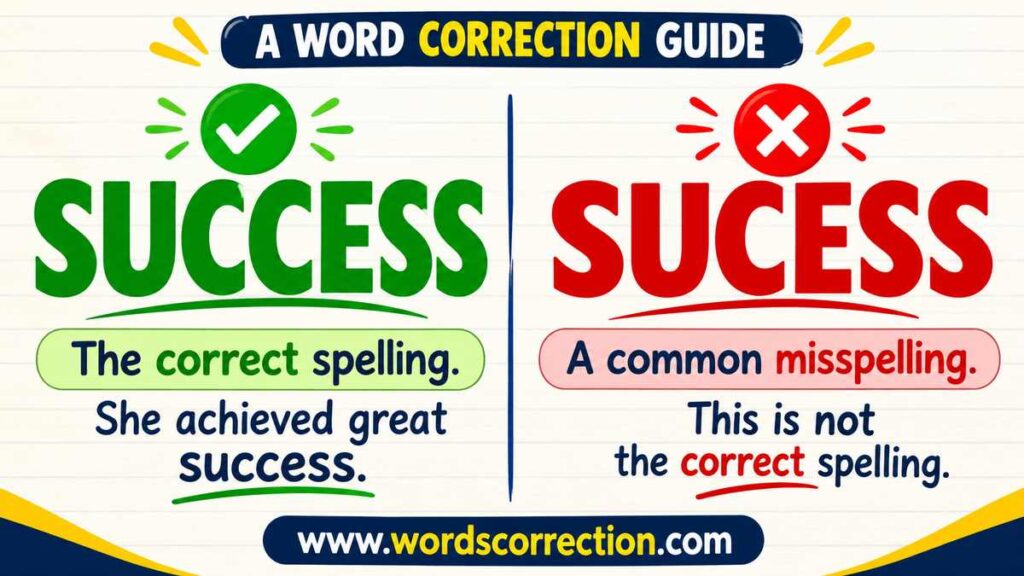
Success vs sucess? A small spelling mistake can make even a simple sentence look less professional. If you’ve ever been unsure which spelling is correct, you’re not alone. Many people confuse these two forms because they look almost identical. However, only one is correct success. The spelling sucess is a common mistake and isn’t accepted in standard English. In this guide, you’ll learn the correct spelling of success, understand its meaning and see how to use it in everyday sentences. You’ll also discover easy tips to remember its spelling and avoid making the same mistake again.
Success vs Sucess Which Spelling Is Correct?
Success is the correct spelling in standard English. It contains seven letters, including two consecutive Cs and two consecutive Ss.
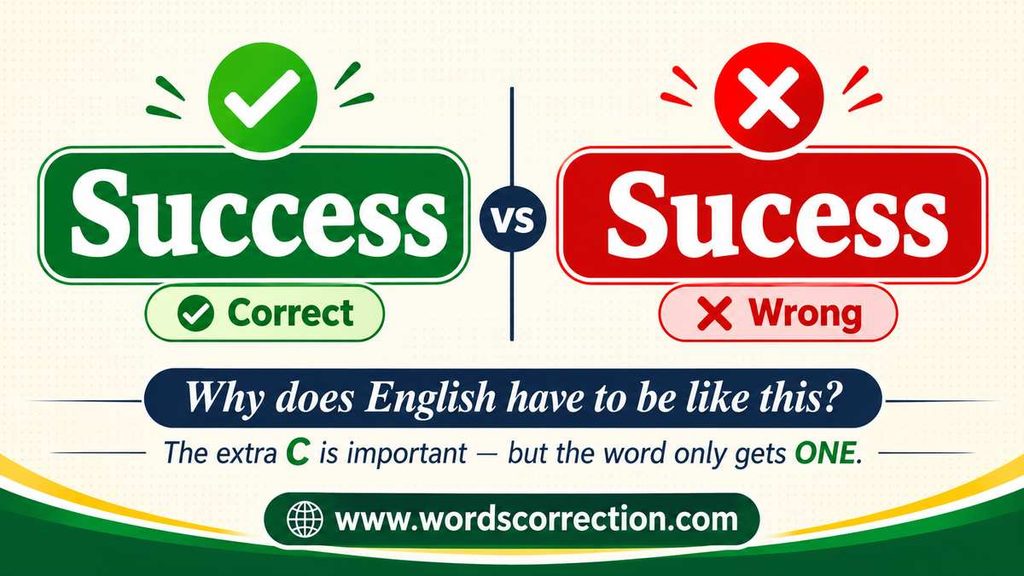
On the other hand, sucess contains only one C. This missing letter makes it incorrect.
Here’s a quick comparison:
| Word | Spelling status | Explanation |
|---|---|---|
| Success | Correct | Standard English spelling |
| Sucess | Incorrect | Missing the second C |
| Succes | Incorrect | Missing the final S |
| Sucessful | Incorrect | Incorrect spelling of successful |
| Successful | Correct | Standard adjective form |
For example:
- Correct: Her hard work led to great success.
- Incorrect: Her hard work led to great sucess.
The first sentence uses the standard spelling. The second contains a spelling error.
The most important thing to remember is that success has two Cs and two Ss. Both letter combinations are essential. Leaving out either repeated letter changes the spelling.
What Is the Difference Between Success vs Sucess?
The difference between success vs sucess comes down to one missing letter. Although the two forms look almost identical, only one belongs in standard English.
Success Is the Correct Spelling
The word success follows the standard spelling used in dictionaries, books, newspapers, academic papers, and professional documents.
Its correct spelling is:
S – U – C – C – E – S – S
Notice the two repeated consonant combinations:
- CC: Two consecutive Cs appear in the middle.
- SS: Two consecutive Ss appear at the end.
Both combinations are essential. You shouldn’t remove either letter when writing the word.
Examples:
- The company celebrated its success after years of hard work.
- Academic success requires patience and consistent effort.
- Her latest business project became a huge success.
- The team’s success surprised its competitors.
In each sentence, success describes an achievement or favorable result.
Sucess Is a Common Spelling Mistake
The spelling sucess is incorrect because it leaves out the second C.
People often make this mistake when typing quickly or relying on pronunciation instead of remembering the written form. Since the missing letter doesn’t create an obvious difference in everyday speech, the error can easily slip into an email, assignment, or social media post.
Consider these examples:
- Incorrect: The event was a great sucess.
- Correct: The event was a great success.
- Incorrect: She worked hard to achieve sucess.
- Correct: She worked hard to achieve success.
If you’re wondering whether sucess has a separate meaning, the answer is no in standard English. It isn’t an alternative spelling, a regional variation, or a different grammatical form.
Learn the difference between confusing more English words
Realist vs Realest What’s the Difference?
What Does Success Mean? Definition and Meaning in English
Understanding the success meaning helps you use the word correctly. Success is a noun that describes achieving something you wanted or receiving a favorable result from an action, effort, or situation.
In simple English, success means achieving a desired goal or obtaining a positive result.
For example, a student who passes an important examination achieves academic success. A business that attracts customers and earns a profit may experience commercial success. Similarly, an athlete who wins a championship achieves success in sports.
However, success doesn’t always involve money, awards, or public recognition. Completing a difficult personal goal, learning a new skill, or overcoming a major challenge can also represent success.
Different Meanings of Success
The word can describe several types of achievements depending on the situation.
Achievement of a goal
Success can mean reaching a specific target after making an effort.
Example: Completing her first marathon was a personal success.
A favorable result
It can describe something that produces the outcome people wanted.
Example: The marketing campaign was a success because it attracted thousands of new customers.
Wealth or professional recognition
People sometimes use success to describe financial stability, career growth, or public recognition.
Example: Years of dedication helped him achieve professional success.
A successful person or thing
Success can also refer to someone or something that has become successful.
Example: The new restaurant was an immediate success.
Success in Everyday English
People use success in conversations, business discussions, academic writing, and professional communication.
Its meaning depends on the context:
| Context | Example | Meaning |
|---|---|---|
| Education | She achieved academic success. | Reaching educational goals |
| Business | The product became a success. | A favorable commercial result |
| Career | He found success in marketing. | Professional achievement |
| Personal life | Learning to drive was a personal success. | Accomplishing an individual goal |
| Sports | Their success came after months of training. | Winning or achieving a sports goal |
The central idea remains the same: success involves a positive result or achievement.
Learn the difference between commonly mixed-up more words
Gluing vs Glueing Which Spelling Is Correct?
How to Spell Success Correctly
If you want to know how to spell success, start by remembering its seven letters.
The correct spelling is:
S – U – C – C – E – S – S
| Spelling detail | Correct form |
|---|---|
| Total letters | 7 |
| First letter | S |
| Middle consonants | CC |
| Final letters | SS |
| Vowels | U and E |
A useful way to check your spelling is to look at the middle and end of the word. If you see only one C, you’ve probably written it incorrectly.
Why Is Success Spelled With Two Cs?
The spelling of success has a historical explanation. The English word came through Old French succès, which came from Latin successus. The Latin form is related to succedere, meaning to follow after, come after, or advance.
The Latin spelling already contained the double C. English retained this spelling pattern as the word developed.
This history also helps explain the connection between success and succeed. Both words come from the same Latin word family.
However, don’t treat the double C as a universal English spelling rule. English spelling contains many historical patterns and exceptions. Learning the spelling of individual words remains important.
How Many Letters Are in Success?
Success contains seven letters:
- One S at the beginning.
- One U.
- Two Cs.
- One E.
- Two Ss at the end.
It contains five consonant letters and two vowels. The repeated letters count individually.
How to Remember the Correct Spelling of Success
A simple memory trick can help you avoid repeating the same mistake.
Remember this:
Success needs two Cs to reach its goals and two Ss to finish strong.
It’s a simple reminder, but it works because it highlights the two letter combinations people often forget.
You can also try these methods:
- Visual memory: Look at the word SUCCESS and memorize its overall shape.
- Letter grouping: Remember it as SUC-CESS.
- Word association: Learn success alongside succeed and successful.
- Writing practice: Write the word correctly several times.
- Proofreading: Check the repeated letters before submitting important writing.
The goal isn’t to memorize a complicated spelling rule. It’s to make the correct form familiar enough that you recognize an error immediately.
Learn the difference between tricky grammar more words
Tieing vs Tying Which Spelling Is Correct?
Success vs Successful vs Successfully What’s the Difference?
Although success, successful, and successfully share the same word root, they don’t have the same grammatical function. Each word plays a different role in a sentence.
Confusing them can lead to awkward sentences, even when you spell every letter correctly.
Success: The Noun
Success is a noun. It refers to an achievement, a favorable result, or the accomplishment of a goal.
You use it when talking about something someone has achieved rather than describing how they performed an action.
Examples:
- Her success inspired other young entrepreneurs.
- The project was a complete success.
- Education played an important role in his success.
- Their success came after several unsuccessful attempts.
In these examples, success names an achievement or positive outcome.
Successful The Adjective
Successful is an adjective. It describes a person, plan, business, event, or activity that achieves a desired result.
Examples:
- She is a successful businesswoman.
- They launched a successful advertising campaign.
- He became a successful writer after years of practice.
- The school organized a successful fundraising event.
Notice how successful describes a noun. It tells you what kind of person, event, or activity you’re talking about.
Successfully The Adverb
Successfully is an adverb. It explains how someone completes an action or achieves a result.
Examples:
- She successfully completed her training.
- The company successfully entered a new market.
- He successfully passed the driving test.
- The team successfully finished the project before the deadline.
Here, successfully describes the actions rather than the people or things performing them.
Success-Related Words and Their Correct Spellings
Learning related forms together makes English vocabulary easier to remember.
| Word | Part of speech | Meaning | Example |
|---|---|---|---|
| Success | Noun | Achievement or favorable result | Her success impressed everyone. |
| Succeed | Verb | To achieve a desired result | You can succeed with consistent effort. |
| Successful | Adjective | Achieving a favorable result | It was a successful event. |
| Successfully | Adverb | In a successful way | They completed the task successfully. |
| Unsuccessful | Adjective | Not achieving the desired result | The first attempt was unsuccessful. |
| Unsuccessfully | Adverb | Without achieving the desired result | He unsuccessfully tried to fix the problem. |
One spelling detail deserves attention: successful has two Cs and only one L before the Y ending is added to form successfully.
The correct forms are:
- Success
- Succeed
- Successful
- Successfully
- Unsuccessful
- Unsuccessfully
Don’t write sucessful, successfull, or sucessfully. These are spelling errors, not accepted alternatives.
Learn the difference between confusing word pairs
Enable vs Inable What’s the difference?
How to Use Success in a Sentence
Knowing the definition is useful, but understanding natural word combinations makes your writing stronger. English speakers often use success with particular verbs, adjectives, and expressions.
These combinations are called collocations. Learning them helps you write sentences that sound natural rather than forced.
Success With A
You can use the article a before success when referring to a particular successful event, attempt, or outcome.
Examples:
- The school concert was a success.
- Her first business venture was a huge success.
- The new product launch turned out to be a success.
However, success is usually an uncountable noun when you refer to success in a general sense.
Compare:
- She achieved success through hard work.
- Her latest project was a success.
The first sentence discusses success generally. The second treats a particular project as one successful event or outcome.
Success With Great
The phrase great success describes an impressive achievement or favorable outcome.
Examples:
- The conference was a great success.
- She achieved great success in her career.
- Their new advertising strategy brought great success.
You can also use other adjectives:
- Huge success
- Major success
- Remarkable success
- Considerable success
- Commercial success
- Academic success
Choose an adjective that fits the situation. For example, commercial success works well for a profitable product, while academic success suits educational achievements.
Success With Achieve
Achieve success is a common expression used when someone reaches a goal through effort, planning, or determination.
Examples:
- Students can achieve success through consistent study habits.
- The company worked hard to achieve success in international markets.
- She achieved success after years of professional training.
The verb achieve emphasizes the effort or process behind the result.
Success With “Find”
The phrase find success describes discovering opportunities or reaching favorable results in a particular field.
Examples:
- He found success as a freelance writer.
- The company found success by offering affordable products.
- She hopes to find success in the fashion industry.
This expression often appears in career, business, and personal achievement discussions.
Success With Lead To
You can use lead to success when explaining how an action, decision, or strategy produces a positive outcome.
Examples:
- Careful planning can lead to success.
- Regular practice often leads to better performance and success.
- Strong customer service can lead to long-term business success.
This phrase is especially useful when discussing the relationship between actions and results.
Success With Measure
The expression measure success refers to evaluating whether someone or something has achieved its goals.
However, success doesn’t have the same measurement in every situation.
In business, people may measure success through:
- Revenue growth.
- Customer retention.
- Profit margins.
- Market share.
For a student, success may involve:
- Exam results.
- Skill development.
- Course completion.
- Improvement in academic performance.
Personal goals, success might mean building a healthy habit, learning a language, or completing a challenging project.
Examples:
- The company measures success through customer satisfaction.
- Schools often measure academic success through student performance.
- Everyone measures personal success differently.
Learn the difference between often confused words
Flys vs Flies Which Spelling Is Correct?
Success vs Sucess Correct and Incorrect Examples
Sometimes the easiest way to understand a spelling difference is to see the incorrect form beside the correct one.
Because sucess looks almost identical to success, a quick comparison can help you recognize the missing letter.
| Incorrect spelling | Correct spelling | Explanation |
|---|---|---|
| Sucess | Success | Missing one C |
| Succes | Success | Missing the final S |
| Sucessful | Successful | Missing one C |
| Succesful | Successful | Missing one C |
| Successfull | Successful | Contains an unnecessary extra L |
| Sucessfully | Successfully | Missing one C |
| Succesfully | Successfully | Missing one C |
| Sucesses | Successes | Missing one C |
Correct Examples of Success in a Sentence
Here are practical examples from different situations.
Everyday conversation
- Your success makes me happy.
- I hope you achieve success in your new project.
- Their success didn’t happen overnight.
Academic writing
- Academic success depends on several factors, including preparation and consistent effort.
- The study examined the relationship between student performance and academic success.
Professional emails
- Congratulations on the success of your recent presentation.
- We appreciate your contribution to the project’s success.
Business communication
- The company’s success depends on customer satisfaction.
- Our new marketing campaign achieved considerable success.
Social media
- Every small success deserves recognition.
- Celebrating another milestone on the road to success!
Sports
- The team’s success resulted from regular practice and strong teamwork.
- Winning the tournament marked a major success for the club.
Formal reports
- The project achieved its primary objectives and was considered a success.
- Customer feedback played an important role in the product’s success.
Case Study How One Missing Letter Changes a Professional Message
Imagine a marketing manager preparing an email to announce a company’s latest product launch.
The first draft reads:
We are pleased to announce the sucess of our latest product launch. Thank you to everyone who contributed to this achievement.
The message communicates the right idea, but the spelling error makes the announcement look less polished.
After proofreading, the manager changes it to:
We are pleased to announce the success of our latest product launch. Thank you to everyone who contributed to this achievement.
The meaning hasn’t changed. The correction simply improves spelling accuracy and makes the message more professional.
The lesson: Even a small spelling mistake can distract readers from important information. Always proofread business announcements, reports, and other high-visibility documents.
Learn the difference between basic English word mistakes
Nonresponsive vs Unresponsive which is Correct?
Why Do People Misspell Success?
If the correct spelling is so simple, why do people write sucess?
The answer involves several common spelling challenges. English contains many words with repeated consonants, and pronunciation doesn’t always reveal how those words look in writing.
The Double C Is Easy to Forget
The most obvious reason for the misspelling is that people remember only one C.
When someone types quickly, the second C can disappear without the writer noticing.
For example:
- Incorrect: She worked hard to achieve sucess.
- Correct: She worked hard to achieve success.
Remembering the CC combination is the easiest way to avoid this particular mistake.
Pronunciation Doesn’t Reveal Every Letter
The pronunciation of success doesn’t clearly tell you that the word contains two Cs.
In standard American English, success is pronounced approximately /səkˈsɛs/.
The repeated C letters represent the /k/ sound in the middle. However, hearing that sound doesn’t tell you whether the written word contains one C, two Cs, or another spelling pattern.
That’s why pronunciation alone isn’t always a reliable spelling guide.
Repeated Letters Cause Confusion
English contains many words with doubled consonants. Some are easy to remember, while others require practice.
Examples include:
- Necessary
- Successful
- Occasion
- Committee
- Accommodation
- Embarrassment
When people write quickly, they may forget one of the repeated letters.
Success belongs to this group of commonly misspelled words because its double C and double S combinations require attention.
Fast Typing Leads to Small Errors
Typing quickly increases the chance of missing letters, especially when you’re writing on a phone or switching between tasks.
For example, someone might type:
- Sucess instead of success.
- Succesful instead of successful.
- Sucessfully instead of successfully.
These errors can appear in text messages, emails, blog posts, school assignments, and workplace reports.
Slowing down for a quick review can prevent many of them.
Spell-Check Doesn’t Catch Every Mistake
Spell-check tools are helpful, but they aren’t perfect.
Most modern writing tools can identify sucess as a misspelling. However, spelling software may overlook errors when a word resembles another recognized word or when autocorrect makes an unintended change.
For better spelling accuracy:
- Use a reliable dictionary when you’re unsure.
- Enable spell-check in your writing software.
- Read important documents before sending them.
- Check repeated letters in commonly misspelled words.
- Don’t assume autocorrect has fixed every error.
Technology can help you catch mistakes, but it shouldn’t replace careful proofreading.
Learn the difference between commonly misused words
Breathe vs Breath Difference and Correct Usage
Common Spelling Mistakes Related to Success
The spelling problem doesn’t stop with success. Its related forms can also cause confusion, particularly when writers add endings or prefixes.
Let’s examine the most common errors.
Sucess vs Success
This is the main spelling confusion.
- Incorrect: Sucess
- Correct: Success
The incorrect version contains one C instead of two.
Succes vs Success
Some writers remember both Cs but forget the final S.
- Incorrect: Succes
- Correct: Success
Remember that the word ends with two consecutive Ss.
Sucessful vs Successful
When you turn success into an adjective, the spelling changes slightly because you add the suffix -ful.
- Incorrect: Sucessful
- Correct: Successful
Notice that the adjective still contains two Cs.
Also, don’t add two Ls. The correct form has only one L.
Succesful vs Successful
This mistake combines the missing-C problem with the adjective ending.
- Incorrect: Succesful
- Correct: Successful
The correct spelling retains the double C and adds -ful.
Sucessfully vs Successfully
The adverb form causes another common spelling error.
- Incorrect: Sucessfully
- Correct: Successfully
The correct word contains the full spelling of successful followed by -ly.
Quick reminder: Success, successful, and successfully all retain the double C. Learning this pattern makes the related forms easier to recognize.
Learn the difference between everyday English mistakes
Developed vs Developped Which Spelling Is Correct?
American vs British English Is Success Spelled Differently?
Some English words have different spellings in American and British English. For example, American writers usually use color, while British writers use colour. Similarly, organize is common in American English, while organise is widely used in British English.
However, success has the same spelling in both varieties.
| English variety | Correct spelling | Incorrect spelling |
|---|---|---|
| American English | Success | Sucess |
| British English | Success | Sucess |
| Canadian English | Success | Sucess |
| Australian English | Success | Sucess |
There is no spelling difference between success spelling UK and success spelling US.
Success Spelling in American English
American English uses success in everyday conversations, academic writing, business communication, and formal documents.
Examples:
- The company achieved remarkable success.
- Her success inspired other students.
- We hope the new project will be a success.
Success vs Sucess: Spelling in British English
British English uses success with the same seven letters as American English. The correct spelling is success, not sucess. The incorrect version leaves out one C.
Examples:
- The team’s success attracted national attention.
- She enjoyed considerable success in her career.
- The event was a great success.
The pronunciation may vary slightly between speakers and regional accents, but the written spelling remains unchanged.
If you’re learning English, there’s no need to memorize separate American and British spellings for this word. Remember to use success, with two Cs and two Ss, in both varieties of English.
Learn the difference between more words people mix up
Channel vs Chanel Which Spelling Is Correct?
Is Success a Noun, Verb, or Adjective?
Understanding the grammar of success helps you avoid another type of writing mistake: using the correct spelling in the wrong grammatical position.
The word success is a noun, not a verb or an adjective.
However, English has several related forms that perform different grammatical functions.
Success as a Noun
A noun names a person, place, thing, idea, or concept.
Success names the achievement of a goal or a favorable result.
Examples:
- Success requires patience.
- Her success brought new opportunities.
- The project achieved unexpected success.
Spelling tip: Whether you’re writing about success in a sentence or comparing success vs sucess, always use the correct seven-letter spelling: success.
Succeed as a Verb
Succeed is the verb form associated with success.
It means to achieve something you want or to reach a favorable outcome.
Examples:
- She hopes to succeed in business.
- You can succeed if you remain consistent.
- The company succeeded in attracting new customers.
One important grammar point: succeed is often followed by in when referring to an activity or field.
For example:
- He succeeded in completing the project.
- She succeeded in her career.
You can also use succeed with an infinitive:
- She succeeded in finding a solution.
- He succeeded in winning the competition.
Successful as an Adjective
Successful describes someone or something that achieves a desired result.
Examples:
- He is a successful entrepreneur.
- The business launched a successful product.
- They organized a successful event.
Successfully as an Adverb
Successfully describes how an action was completed.
Examples:
- She successfully completed the assignment.
- The team successfully reached its target.
- The company successfully introduced its new service.
Quick Grammar Comparison
| Word | Grammar category | Example |
|---|---|---|
| Success | Noun | Her success was impressive. |
| Succeed | Verb | She wants to succeed. |
| Successful | Adjective | She is successful. |
| Successfully | Adverb | She completed the task successfully. |
These words are closely related, but you cannot freely exchange them. Each one has a specific grammatical role.
Success in Different Writing Situations
Correct spelling matters in every type of writing. However, some situations require extra attention because spelling mistakes can affect how readers perceive your work. Understanding Success vs Sucess can help you avoid common errors and communicate more professionally.
Here’s how to use the correct spelling of success naturally in different writing situations.
Success in Academic Writing
Students frequently use the word success when discussing educational achievements, research outcomes, and learning goals.
Examples:
- Academic success requires effective study habits.
- The research explored factors that contribute to student success.
- Consistent preparation played an important role in the students’ success.
In academic writing, success can also refer to measurable research outcomes. Explain what success means in the context of your discussion so readers can understand the results clearly.
Remembering Success vs Sucess is especially useful when preparing assignments, essays, research papers, and other academic documents.
Success in Professional Emails
Professional emails should communicate information clearly and accurately. Correct spelling helps your messages look polished and credible.
Examples:
- Congratulations on the success of your recent project.
- We appreciate your contribution to the team’s success.
- Best wishes for continued success in your new position.
A spelling mistake in a professional message can distract readers, especially when you’re congratulating someone or discussing an important achievement. Always proofread your emails before sending them.
Success in Business Writing
Business communication often uses the word success when discussing performance, growth, customer satisfaction, and profitability.
Examples:
- Customer satisfaction contributes to long-term business success.
- The company’s success depends on effective planning.
- The new product achieved commercial success.
When writing business reports, support claims about success with relevant figures whenever possible.
For example, instead of simply saying a campaign was successful, explain that it generated 2,000 new leads or increased sales by 15%. This makes your statement more specific, informative, and measurable.
Whether you’re writing a business proposal, report, or marketing document, using the correct spelling in Success vs Sucess helps maintain a professional standard.
Success in Everyday Conversations
In casual conversations, success can describe anything from completing a small task to achieving a major life goal.
Examples:
- I hope your interview is a success.
- Her success makes everyone proud.
- Good luck with your new business!
You don’t need complicated vocabulary to use the word correctly. Simple sentences often communicate the message best.
Success in Social Media Posts
Social media captions frequently use success to celebrate achievements, milestones, and personal progress.
Examples:
- Another step toward success!
- Small victories lead to bigger achievements.
- Celebrating a new milestone and another success story.
Whether you’re posting about a graduation, business launch, or personal accomplishment, remember the double C.
Learn the difference between tricky English words with easy explanations
Tapping vs Taping What’s the Difference?
Common Phrases and Expressions With Success
English speakers use success in several familiar expressions. Learning these phrases can improve your vocabulary and make your writing sound more natural.
| Phrase | Meaning | Example |
|---|---|---|
| Achieve success | Reach a desired goal | She worked hard to achieve success. |
| Great success | An impressive achievement | The event was a great success. |
| Business success | Positive business performance | Customer trust contributes to business success. |
| Academic success | Achievement in education | Good preparation supports academic success. |
| Career success | Achievement in a profession | Experience helped him achieve career success. |
| Success story | An account of an achievement | Her journey became a success story. |
| Key to success | An important factor in achievement | Practice is the key to success. |
| Path to success | The process of reaching a goal | Education can open a path to success. |
| Measure of success | A way to evaluate achievement | Customer satisfaction is one measure of success. |
| Success rate | The proportion of successful outcomes | The treatment had a high success rate. |
These expressions work in different contexts. For instance, success rate is useful when discussing statistics, while success story often describes someone’s journey or achievement.
Success Synonyms What Other Words Can You Use?
A synonym is a word that has the same or a similar meaning as another word. Several words can replace success in certain situations, but their meanings aren’t always exactly the same.
Common synonyms for success include:
- Achievement: Something accomplished through effort.
- Accomplishment: A completed task or significant achievement.
- Triumph: A major victory or impressive success.
- Victory: Winning a competition or overcoming an opponent.
- Prosperity: Financial or general well-being.
- Attainment: Reaching a goal or desired level.
- Fulfillment: A feeling of satisfaction from achieving something meaningful.
- Positive result: A favorable outcome.
Examples:
- Original: Her success surprised everyone.
- Alternative: Her achievement surprised everyone.
The replacement works because both words describe something accomplished.
However, not every synonym fits every situation. For example, victory usually refers to winning a competition or overcoming opposition, while success has a broader meaning. Choosing the right synonym depends on the context and the message you want to convey.
Success Antonyms: What Is the Opposite of Success?
The most common antonym of success is failure.
Other related opposites include:
- Defeat
- Loss
- Setback
- Disappointment
- Downfall
- Unsuccessful outcome
For example:
- Success: The business achieved its sales target.
- Failure: The business failed to reach its sales target.
Success and failure often appear together because they describe opposite outcomes. However, a temporary setback doesn’t necessarily mean someone has failed permanently.
Success vs Sucess Complete Comparison Table
If you need a quick spelling reference, this table summarizes the main differences.
| Feature | Success | Sucess |
|---|---|---|
| Spelling status | Correct | Incorrect |
| Letter count | 7 | 6 |
| Double C | Yes | No |
| Double S | Yes | Yes |
| Standard English | Accepted | Not accepted |
| Part of speech | Noun | Not a standard English word |
| Meaning | Achievement or favorable result | No established standard meaning |
| American English | Correct | Incorrect |
| British English | Correct | Incorrect |
| Dictionary recognition | Standard entry | Misspelling |
The answer is straightforward: use success whenever you want to describe an achievement or positive result.
Easy Tricks to Remember the Spelling of Success
Even experienced writers sometimes forget a letter when spelling familiar words. Fortunately, a few simple techniques can help you remember the correct spelling of Success vs Sucess and avoid making the same mistake again.
Remember the Double C and Double S
The easiest way to remember the correct spelling is to memorize its two repeated letter combinations.
SU + CC + E + SS = SUCCESS
Think of the word as two important spelling pairs:
- Double C in the middle.
- Double S at the end.
Whenever you write success, check that both combinations are in the correct places. This simple trick makes it easier to distinguish success from the incorrect spelling sucess.
Learn Related Words Together
Learning words from the same word family helps you recognize their spelling patterns and improve your vocabulary.
For example:
- Success
- Succeed
- Successful
- Successfully
- Unsuccessful
- Unsuccessfully
Notice that these words share the double-C spelling pattern. Studying them together can strengthen your understanding of Success vs Sucess and help reduce common spelling mistakes.
Use the Word in Your Own Sentences
Memorizing a spelling rule is helpful, but using the word in everyday writing makes it easier to remember.
Try practicing with these sentences:
- Hard work can lead to success.
- She wants to become a successful writer.
- He successfully completed the assignment.
- Their success inspired the entire team.
- You can succeed with regular practice.
Pay attention to how the word changes according to its grammatical function. Regular practice will help you use each form correctly.
Check the Word Before Publishing
If you regularly write articles, emails, reports, or social media content, proofreading should become an essential part of your writing routine. Checking your spelling before publishing helps maintain accuracy and professionalism.
Useful resources include:
- Merriam-Webster: Check definitions, meanings, and standard spellings.
- Cambridge Dictionary: Explore word meanings, pronunciation, and grammatical information.
- Grammarly: Identify spelling mistakes and grammar issues in your writing.
These resources can help you catch errors, but always review your final text before publishing. Remembering the correct spelling of success is a small habit that can make a noticeable difference in your writing.elf.
Practice Session Success vs Sucess
Test your understanding of the correct spelling, meaning, and usage of success, succeed, successful, and successfully. Fill in each blank with the appropriate word.
1. Hard work and dedication are important for achieving ________.
2. She worked hard to ________ in her professional career.
3. The company celebrated its ________ after launching a new product.
4. He is a highly ________ businessman.
5. The students completed their assignments ________.
6. The correct spelling is ________, not sucess.
7. Her greatest ________ was graduating from university.
8. Everyone hopes to ________ in life.
9. The project was completed ________ within the deadline.
10. A ________ person learns from mistakes and keeps improving.
11. The plural form of success is ________.
12. She has achieved many ________ throughout her career.
13. The team worked together to make the event a ________.
14. He ________ in passing his final examination.
15. Practice and patience can help you become ________.
16. The company wants to achieve greater ________ in the future.
17. She managed to complete the difficult task ________.
18. Never give up if you want to ________.
19. His business became ________ because of careful planning.
20. Failure can sometimes be a stepping stone to ________.
21. The correct past tense of succeed is ________.
22. She is proud of her academic ________.
23. The event was considered a great ________ by the organizers.
24. He completed the training program ________.
25. Remember to write ________ with two Cs and two Ss.
Answers
- Success
- Succeed
- Success
- Successful
- Successfully
- Success
- Success
- Succeed
- Successfully
- Successful
- Successes
- Successes
- Success
- Succeeded
- Successful
- Success
- Successfully
- Succeed
- Successful
- Success
- Succeeded
- Success
- Success
- Successfully
- Success
Here’s a trusted source for clear word meanings:
Cambridge Dictionary
FAQs
Which spelling is correct success vs sucess?
Success is the correct spelling in standard English. Sucess is a misspelling and should not be used in formal or everyday writing.
Why is success often misspelled as sucess?
People often misspell success by leaving out one of the two Cs. This mistake usually happens because they rely on how the word sounds rather than remembering its correct spelling.
Is sucess recognized as a word in English dictionaries?
No. Sucess is not an accepted English spelling. It is considered a misspelling of success in standard English.
How many letters are in the word success?
The word success contains seven letters: S, U, C, C, E, S, and S. It has two Cs and two Ss.
Does success have a double C or a double S?
Success contains both a double C and a double S. The two Cs appear in the middle of the word, while the final two letters are Ss.
What part of speech is the word success?
Success is a noun that refers to achieving a goal, accomplishing something important, or obtaining a favorable result.
What is the plural form of success?
The plural form of success is successes. It refers to multiple achievements, accomplishments, or favorable outcomes.
Is success a countable or uncountable noun?
Success can function as both a countable and an uncountable noun. It is uncountable when referring to achievement in general and countable when describing individual accomplishments.
What is the verb form of success?
The verb form of success is succeed. It describes the act of achieving a goal, accomplishing something, or obtaining a desired result.
What is the adjective form of success?
The adjective form is successful. It describes a person, activity, or thing that achieves a desired outcome or performs well.
What is the adverb form of success?
The adverb form is successfully. It explains how an action is completed or how someone achieves a particular goal.
What is the difference between success and succeed?
Success is a noun that describes an achievement or favorable outcome, whereas succeed is a verb that means to accomplish a goal or achieve a desired result.
What is the difference between success and successful?
Success refers to an achievement or positive outcome, while successful describes someone or something that achieves a desired result. For example, a person can achieve success and become successful.
When should you use successful or successfully?
Use successful when describing a person, activity, or thing. Use successfully when explaining how an action is performed. For example, “She is a successful writer” and “She completed the project successfully.”
Is succeed or success correct in a sentence?
Both words are correct, but their grammatical functions differ. Use success as a noun when referring to an achievement and succeed as a verb when describing the act of achieving a goal.
What does succeeded mean?
Succeeded is the past tense and past participle of succeed. It means that someone achieved a goal, completed an objective, or obtained a favorable result.
Is succeded a correct spelling?
No. Succeded is an incorrect spelling. The correct form is succeeded, which contains two Cs and two Es.
What is the difference between succeed and succeeded?
Succeed is the base form of the verb, while succeeded is its past tense and past participle. For example, “I hope to succeed” describes a future goal, whereas “I succeeded yesterday” describes a completed achievement.
What is the origin of the word success?
The word success comes from the Latin successus, meaning an outcome or result. It is related to the Latin verb succedere, which means to follow after or come after.
What is the prefix in the word success?
The word success developed from the Latin successus, which is related to succedere. Its historical formation includes the Latin prefix sub-, meaning under or after. The spelling suc- reflects a change in that prefix.
What are some common synonyms for success?
Common synonyms for success include achievement, accomplishment, triumph, victory, prosperity, attainment, and fulfillment. The most suitable synonym depends on the context and intended meaning.
What is the opposite of success?
The opposite of success is failure. Other related words include defeat, disappointment, setback, loss and unsuccessful outcome.
How do you pronounce success correctly?
Success is pronounced /səkˈses/. It has two syllables, with the emphasis on the second syllable. The final syllable sounds like “sess.”
Is success spelled differently in British and American English?
No. Success has the same spelling in both British and American English. Unlike words such as color and colour, it has no regional spelling variations.
What is an easy way to remember the spelling of success?
Remember that success has two Cs in the middle and two Ss at the end. Practicing the word in simple sentences and paying attention to its letter pattern can help you avoid common spelling mistakes.
Learn how to use confusing more words correctly
Descision vs Decision Which Spelling Is Correct?
conclusion
Understanding Success vs Sucess is easy once you learn the correct spelling. Success is the only accepted form in standard English, while sucess is simply a common spelling mistake. Although the two look similar, leaving out one letter can make your writing less accurate and professional. The key to remembering Success vs Sucess is that the correct word contains two Cs and two Ss. Whether you’re writing an email, completing an assignment, or creating professional content, using the correct spelling helps you communicate clearly and confidently. Knowing the difference between Success vs Sucess also helps you avoid common spelling errors and strengthen your English writing skills. After all, success is worth achieving, and spelling it correctly is a small but important step toward better communication.

Stella AJS is an experienced blogger and dedicated English language writer at Words Correction. She turns confusing grammar, word meanings, spelling, and usage into clear, practical insights that readers can easily understand and apply. With a passion for precise and engaging writing, Stella helps readers avoid common language mistakes, strengthen their vocabulary, and communicate with greater clarity and confidence.