
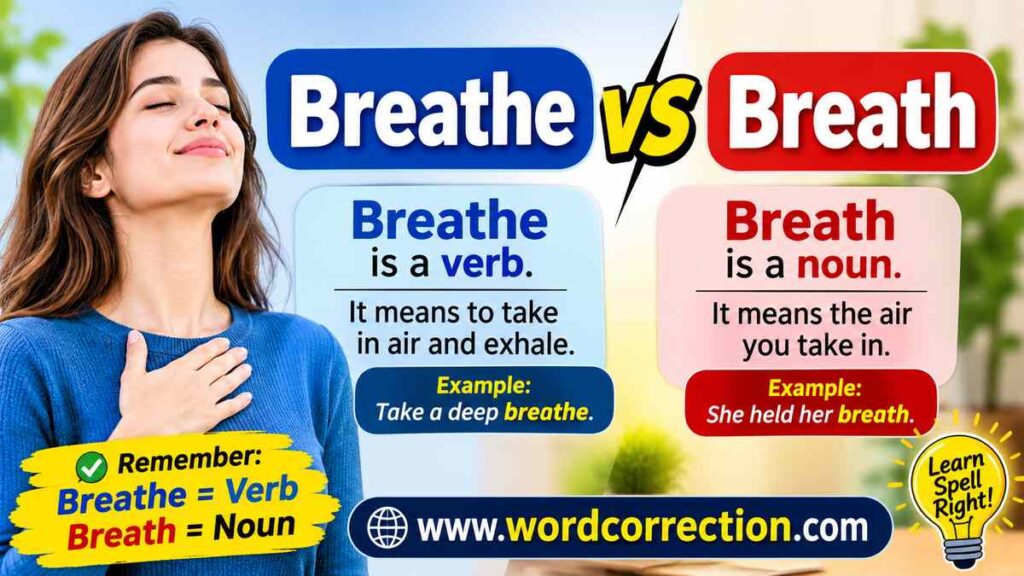
The confusion between breath vs breathe is surprisingly common, even among experienced English writers. Although these words look almost identical and share a connection to respiration, using the wrong one can turn a perfectly clear sentence into an embarrassing grammar mistake. The difference, however, is easier to understand than it might seem. You don’t need to hold your breath while figuring it out. This guide explains the meanings, pronunciation, grammatical roles and correct usage of both words through clear examples, practical tips and helpful exercises. By understanding a few simple rules, you can avoid common spelling mistakes and use breath and breathe confidently in everyday writing.
Breathe vs Breath Quick Comparison
| Feature | Breath | Breathe |
| Part of speech | Noun | Verb |
| Meaning | Air inhaled or exhaled | To inhale and exhale |
| Pronunciation | /brɛθ/ | /briːð/ |
| Vowel sound | Short E | Long E |
| Final sound | Unvoiced TH | Voiced TH |
| Word forms | Breaths | Breathes, breathed, breathing |
| Example | Take a breath. | Breathe deeply. |
The easiest way to remember the difference is simple: you take a breath, but you breathe.
What Is the Difference Between Breath and Breathe?
The main difference between breath vs breathe involves their parts of speech. Although both words relate to respiration, they perform different grammatical functions in a sentence.
Breath is a noun that identifies the air moving through your respiratory system. It can also refer to one complete instance of inhaling or exhaling.
Breathe is a verb that describes the physical action of inhaling and exhaling. It tells the reader what someone or something does.
For example, a runner might take a short breath before continuing. The same runner might stop to breathe after climbing a hill. Understanding breath vs breathe makes it easier to recognize that the noun identifies what the runner takes, while the verb describes the action.
What Does Breath Mean? (Breath Definition)
Breath is a noun that refers to the air taken into or released from the lungs during respiration. In the context of breath vs breathe, breath describes a single inhalation or exhalation, the air someone exhales, or the ability to breathe.
In everyday English, people use the word in several ways. You might take a deep breath before giving a speech, hold your breath while waiting for an announcement, or notice your breath becoming faster after exercise. Understanding breath vs breathe helps you choose the correct word and avoid common grammatical mistakes.
How to Use Breath as a Noun
The word breath can function as a countable or uncountable noun, depending on its meaning.
As a countable noun, it describes one or more individual breaths. For example, someone might take a deep breath before speaking or let out two heavy breaths after running.
As an uncountable noun, it can refer to the air someone exhales or the general ability to breathe. Consider these examples:
- His breath smelled of peppermint.
- The cold air made her breath visible.
- The patient had difficulty catching his breath.
The surrounding sentence helps you understand which meaning applies.
Common Expressions With Breath
English contains several familiar expressions that use breath as a noun. Learning these phrases can help you avoid common spelling mistakes.
| Expression | Meaning | Example |
| Take a deep breath | Inhale deeply | Take a deep breath before you begin. |
| Hold your breath | Stop breathing temporarily | She held her breath underwater. |
| Catch your breath | Recover normal breathing | We stopped to catch our breath. |
| Out of breath | Breathing heavily after activity | He was out of breath after running. |
| Shortness of breath | Difficulty or discomfort when breathing | She experienced shortness of breath. |
| Under your breath | In a very quiet voice | He muttered something under his breath. |
| With bated breath | With great anticipation | They waited with bated breath. |
| Waste your breath | Speak without achieving anything | Don’t waste your breath arguing with him. |
| Breath of fresh air | Something refreshing or different | Her new ideas were a breath of fresh air. |
In expressions such as shortness of breath and out of breath, the noun is always the correct choice in standard English.
Other Meanings of Breath
Although breathing is its primary meaning, breath also appears in figurative and descriptive language.
For example, a breath of fresh air describes something new or refreshing. The last breath refers to the final moment of life, while in the same breath means mentioning two things together. Similarly, a breath of wind describes a very light movement of air.
These expressions show how the word extends beyond its literal physical meaning.
Learn the difference between tricky words and use them correctly
Dought vs Doubt Which Spelling Is Correct?
What Does Breathe Mean? (Breathe Definition)
Breathe is a verb that means to inhale and exhale air. It describes the process of moving air into and out of the lungs.
During inhalation, the respiratory system draws air into the lungs. Oxygen from that air passes into the bloodstream. During exhalation, the body releases carbon dioxide and other gases.
This process happens continuously, often without conscious effort. People can also control their breathing for short periods or deliberately change their breathing pattern during activities such as singing, swimming, speaking, and certain relaxation exercises.
How to Use Breathe as a Verb
Use breathe when describing the action of inhaling or exhaling.
Here are a few examples:
- I breathe slowly when I feel nervous.
- She stepped outside to breathe some fresh air.
- The baby was breathing peacefully.
- He found it difficult to breathe after running.
In these examples, breathe describes an action rather than naming the air itself.
Different Forms of Breathe
Like other regular English verbs, breathe changes its form depending on the subject and tense.
| Verb form | Usage | Example |
| Breathe | Base form | I breathe fresh air. |
| Breathes | Present tense, third-person singular | She breathes slowly. |
| Breathed | Simple past | He breathed deeply. |
| Breathed | Past participle | She has breathed normally since then. |
| Breathing | Present participle or gerund | They are breathing quietly. |
Pay particular attention to breathes and breathing. Both contain the letter sequence breath, but they come from the verb breathe.
Everyday Uses of Breathe
The verb appears in several everyday situations. People use it when talking about physical breathing, exercise, relaxation, and even creative ideas.
For example, athletes pay attention to how they breathe during physical activity. Musicians control their breathing while playing wind instruments, and some people breathe slowly during relaxation exercises.
The word also appears in figurative expressions. Phrases such as give the project room to breathe vs breathe life into an old idea suggest giving something space, energy, or renewed activity.
Learn the difference between confusing word pairs
Nonresponsive vs Unresponsive which is Correct?
How to Pronounce Breath and Breathe
One reason people confuse these words is that their spelling differs by only one letter. However, their pronunciation is noticeably different.
The word breath has a short E sound, while breathe has a long E sound. Their final TH sounds also differ.
Breath Pronunciation /brɛθ/
The word breath is pronounced with three main sound elements: the initial B sound, an R sound followed by a short E vowel, and the unvoiced TH sound.
The final sound is similar to the TH in think. To pronounce it correctly, place your tongue lightly between your teeth and let air pass without vibrating your vocal cords.
Breathe Pronunciation /briːð/
The word breathe has a different vowel and final consonant. It uses a long E sound and a voiced TH sound.
The final sound resembles the TH in this or that. To make this sound, place your tongue lightly between your teeth and allow your vocal cords to vibrate.
The Two TH Sounds
English has two common TH sounds:
| Sound | Phonetic symbol | Example |
| Unvoiced TH | /θ/ | Think, bath, breath |
| Voiced TH | /ð/ | This, mother, breathe |
The difference comes from whether your vocal cords vibrate. You can check this by gently placing your fingers against your throat while pronouncing the two sounds. The voiced sound creates a vibration, while the unvoiced sound does not.
Why the Final E Matters
The final E in breathe is silent, but it changes the pronunciation of the word.
Compare:
| Word | Pronunciation | Vowel sound |
| Breath | /brɛθ/ | Short E |
| Breathe | /briːð/ | Long E |
This spelling pattern appears in other English words too. For example, bath and bathe have related meanings but different pronunciations.
The final E isn’t simply decorative. It carries important information about how to pronounce the word.
Learn the difference between similar English words the easy way
Really vs Realy Which Spelling Is Correct?
Breath vs Breathe Grammar Understanding the Noun and Verb Difference
Understanding parts of speech makes the correct choice much easier.
A noun names a person, place, thing, or idea. A verb describes an action, occurrence, or state.
In this case, breath is a noun because it names the air or an instance of breathing. Breathe is a verb because it describes the action of inhaling and exhaling.
Consider these examples:
| Sentence | Word | Grammatical role |
| Take a breath. | Breath | Noun |
| Breathe slowly. | Breathe | Verb |
| Her breath was cold. | Breath | Noun |
| He breathes quietly. | Breathes | Verb |
| She took three breaths. | Breaths | Plural noun |
| They were breathing normally. | Breathing | Verb form |
Is Breath a Noun or a Verb?
In standard modern English, breath is primarily a noun. It names the air you inhale or exhale and can also describe a single inhalation or exhalation.
Correct examples include:
- My breath smells fresh.
- Take another breath.
- He struggled to catch his breath.
Is Breathe a Noun or a Verb?
Breathe is a verb. It describes the physical action of inhaling and exhaling.
For example, you might say, Remember to breathe, She breathes through her nose,or We breathed fresh air.
You may encounter breathing used as a noun, particularly in sentences such as Deep breathing can help you relax. However, this doesn’t make breathe a noun. Breathing is a related form of the verb.
Learn the difference between commonly confused more words in English
Shute vs Chute Which Spelling Is Correct?
When to Use Breath or Breathe
The easiest way to choose between these words is to examine the sentence structure.
Ask yourself whether you’re naming something or describing an action.
Use Breath When You Need a Noun
Look for sentence structures that require a noun. Common clues include articles such as a and the, possessive words such as my and his, numbers, and adjectives that describe the noun.
Examples:
- Take a breath.
- Hold your breath.
- She took three breaths.
- His deep breath surprised everyone.
Use Breathe When You Need a Verb
Use breathe when the sentence describes an action. It often follows modal verbs such as can, could, should, and must. It also appears after to in infinitive constructions and with auxiliary verbs in continuous tenses.
Examples:
- I can breathe normally.
- You should breathe slowly.
- She needs to breathe.
- They are breathing deeply.
A particularly useful rule is that modal verbs take the base form of a verb. Therefore, write I can’t breathe, not I can’t breath.
Learn the difference between confusing more English words step by step
Grately vs Greatly Which Spelling Is Correct?
Breath vs Breathe Examples in Sentences
Examples make the difference easier to remember because they show how each word works in real situations.
10 Examples Using Breath
- She took a deep breath before entering the examination room.
- His breath became faster after the long walk.
- Please hold your breath while I count to five.
- I could see my breath in the freezing morning air.
- He was completely out of breath after climbing the stairs.
- She paused to catch her breath before continuing.
- The mint helped improve his breath.
- I heard a quiet sigh escape her breath.
- He whispered the answer under his breath.
- The new teacher was a breath of fresh air for the students.
10 Examples Using Breathe
- Remember to breathe slowly when you feel overwhelmed.
- I love to breathe the fresh air after the rain.
- She tried to breathe normally before speaking.
- The doctor asked him to breathe deeply.
- Babies breathe automatically without thinking about it.
- He stopped running to breathe for a moment.
- Some musicians must control how they breathe while performing.
- It was difficult to breathe in the smoky room.
- She was breathing quietly while sleeping.
- After hearing the good news, he finally felt free to breathe easily.
Breath or Breathe in a Sentence Side by Side Examples
| Breath (Noun) | Breathe (Verb) |
| Take a deep breath. | Breathe deeply. |
| I need a breath. | I need to breathe. |
| Hold your breath. | Try not to breathe for a moment. |
| His breath was warm. | He breathed slowly. |
| She caught her breath. | She started breathing normally. |
The words can appear in the same sentence without causing confusion.
For example: Take a deep breath and breathe slowly.
The sentence uses breath to identify what you take and breathe to describe what you do.
Learn the difference between tricky English words with easy explanations
An Hour or A Hour Which one Is Correct?
Common Mistakes With Breath and Breathe
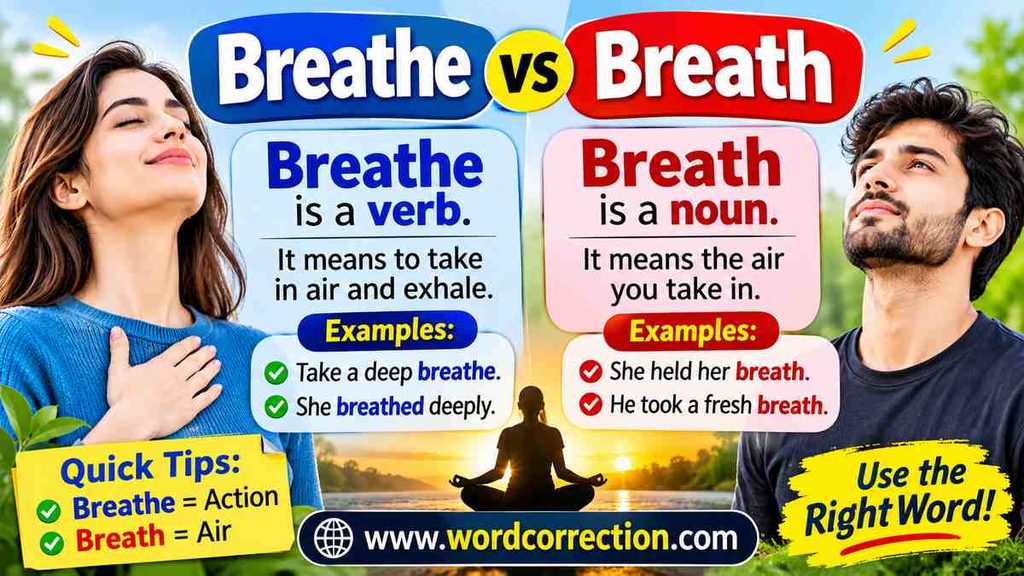
Even experienced English speakers sometimes confuse these words, especially when writing quickly. Most mistakes happen because the words look similar and share the same general meaning.
Is It Take a Deep Breath or Take a Deep Breathe?
The correct expression is take a deep breath.
The article a introduces a singular countable noun. Since breath is the noun, it belongs in this sentence.
Correct: Take a deep breath.
Incorrect: Take a deep breathe.
You can use the same rule in sentences such as “She took a long breath,” “He needed another breath,” and “Take three slow breaths.”
Is It I Can’t Breathe or I Can’t Breath?
The correct sentence is I can’t breathe.
The word can’t is a modal verb. Modal verbs such as can, could, should, and must are followed by the base form of a verb. Because breathe is the verb, it is the correct choice.
Correct: I can’t breathe.
Incorrect: I can’t breath.
Other examples include “She can breathe normally,” “You should breathe slowly,” and “They must breathe carefully.”
Is It Shortness of Breath or Shortness of Breathe?
Is It Shortness of Breath or Shortness of Breathe?
The correct expression is shortness of breath, not shortness of breathe.
Here, breath is a noun that refers to breathing or the ability to breathe. In the context of breath vs breathe, breath is the correct choice because the expression requires a noun. For example, someone might report shortness of breath or experience difficulty breathing. Understanding this distinction helps you avoid common spelling and grammatical mistakes.The correct expression is shortness of breath.
Here, breath is a noun that refers to breathing or the ability to breathe. For example, someone might report shortness of breath or experience difficulty breathing.
Is It Out of Breath or Out of Breathe?
The correct expression is out of breath.
The preposition of is followed by the noun breath in this established expression. You might say, “I was out of breath after running” or “She arrived at school completely out of breath.”
Is It Hard to Breathe or Hard to Breath?
The correct expression is hard to breathe.
The word to introduces an infinitive verb in this construction. For example, “It was hard to breathe in the dusty room.”
Why Do People Confuse Breath and Breathe?
Several factors contribute to this common spelling mistake. The words have nearly identical spellings and closely related meanings. Their pronunciation also differs in ways that English learners may not immediately recognize.
People sometimes choose a spelling based on how a word looks rather than its grammatical role, especially when writing quickly. The best solution is to check the sentence structure before choosing the spelling.
Learn the difference between more words people mix up
Realist vs Realest What’s the Difference?
Related Words Breathing Breathes Breathed and More
The breath and breathe word family includes several related forms. Understanding them will improve your vocabulary and help you use the correct spelling in different grammatical situations.
| Word | Part of speech or form | Meaning |
| Breath | Noun | Air inhaled or exhaled |
| Breaths | Plural noun | More than one breath |
| Breathe | Verb | To inhale and exhale |
| Breathes | Verb | Third-person singular of breathe |
| Breathed | Verb | Past tense and past participle |
| Breathing | Verb form or gerund | The act or process of breathing |
| Breathless | Adjective | Without breath or extremely excited |
| Breathable | Adjective | Allowing air to pass through |
| Breather | Noun | A short rest or pause |
Breathing
Breathing is the present participle of breathe. It can also function as a gerund, which means a verb form acting as a noun.
Examples include She is breathing slowly, Deep breathing can help some people relax, and The sound of his breathing was barely noticeable.
Breathes
Breathes is the present-tense form used with third-person singular subjects such as he, she, and it.
For example, She breathes quietly, He breathes fresh air every morning, and The animal breathes through its respiratory system.
Breathed
Breathed is the simple past tense and past participle of breathe.
Examples include She breathed a sigh of relief,He breathed deeply before answering, and They have breathed cleaner air since moving away from the busy road.
Breathless
Breathless is an adjective that describes someone who has difficulty catching their breath or feels extremely excited.
For example, someone might arrive breathless after running. A breathtaking performance might also leave an audience breathless.
Breathable
It describes a material that allows air or water vapor to pass through it. Breathable fabrics are commonly used in sports clothing, jackets, and other garments designed for comfort.
Breather
A breather commonly means a short break or pause. For example, after several hours of studying, someone might need a short breather before continuing.
Learn the difference between everyday English mistakes
Gluing vs Glueing Which Spelling Is Correct?
Is There a Difference Between American and British English?
No. American and British English follow the same spelling conventions for breath and breathe. Both varieties distinguish between breath, which functions as a noun, and breathe, which functions as a verb. Their meanings and basic grammatical rules remain consistent across both forms of English.
However, their pronunciation may vary slightly depending on regional accents. Speakers may pronounce certain vowel and consonant sounds differently, but these variations do not affect the standard spelling.
For example, both American and British English use the sentence: “Take a breath and breathe slowly.”
Therefore, when learning breath vs breathe, you do not need to memorize separate American and British spellings. The same grammatical rules apply to both varieties of English.
Learn the difference between commonly misused words
Tieing vs Tying Which Spelling Is Correct?
Easy Tricks to Remember the Difference Between Breath and Breathe
If you regularly confuse these words, a few simple memory techniques can help.
Remember the Noun and Verb Rule
This is the most reliable method. Breath is a noun, while breathe is a verb.
Think about the difference between a thing and an action. You take something called a breath, but you perform an action called breathing.
Remember the Final E
The additional E in breathe signals a different pronunciation.
Breath has a short E sound, while breathe has a long E sound. You can use this spelling difference as a reminder whenever you’re unsure.
Use the Sentence Substitution Test
Try replacing the word with another noun or verb.
For example, consider “Take a deep breath.” The sentence needs a noun that identifies what someone takes.
Now consider “Remember to breathe.” You can replace breathe with relax because both words function as verbs.
This simple test helps identify the correct part of speech.
Learn Through Common Expressions
Memorize a few everyday phrases to make the difference easier to remember.
For nouns, learn expressions such as take a breath, hold your breath, catch your breath, and out of breath.
For verbs, remember breathe deeply, breathe slowly, breathe in, and breathe out.
Once these expressions become familiar, choosing the correct spelling will feel much more natural.
Learn the difference between basic English word mistakes
Enable vs Inable What’s the difference?
Practice Session Breath vs Breathe
Complete each sentence using the correct form of the word: breath, breathe, breaths, breathes, breathed, or breathing.
- Take a deep ______ before speaking in front of the audience.
- Remember to ______ slowly when you feel nervous.
- He was completely out of ______ after climbing the stairs.
- She needs to ______ some fresh air after working indoors.
- The baby was ______ peacefully in the crib.
- I took three deep ______ before starting the presentation.
- His ______ smelled like peppermint.
- The doctor asked the patient to ______ deeply.
- She finally caught her ______ after running several miles.
- Everyone should learn how to ______ calmly during stressful situations.
- He ______ a sigh of relief after hearing the good news.
- The athlete controls how he ______ during a competition.
- It was difficult to ______ in the smoky room.
- She held her ______ while waiting for the announcement.
- Deep ______ can help some people feel more relaxed.
- The cold weather made my ______ visible in the air.
- You should never forget to ______ while exercising.
- He was ______ heavily after the long walk.
- Take another ______ before continuing your speech.
- The patient struggled to ______ normally.
- She ______ slowly through her nose during meditation.
- The singer paused to catch her ______ before performing again.
- The hikers stopped for a moment to ______ in the fresh mountain air.
- His final ______ was a deeply emotional moment for his family.
- After the difficult examination, the students finally felt free to ______ easily.
Answers
- Breath
- Breathe
- Breath
- Breathe
- Breathing
- Breaths
- Breath
- Breathe
- Breath
- Breathe
- Breathed
- Breathes
- Breathe
- Breath
- Breathing
- Breath
- Breathe
- Breathing
- Breath
- Breathe
- Breathes
- Breath
- Breathe
- Breath
- Breathe
Here’s a trusted source for clear word meanings:
Cambridge Dictionary
FAQs
What is the plural form of breath?
The plural form of breath is breaths. It refers to multiple inhalations or exhalations. For example: “She took three deep breaths before beginning her presentation.”
Can breath be used as a countable noun?
Yes, breath can function as a countable noun when referring to individual inhalations or exhalations. For example: “He took a deep breath before delivering his speech.”
What is the difference between breathing and breath?
Breath is a noun that refers to the air inhaled or exhaled, whereas breathing describes the process of inhaling and exhaling. For example: “Her breath was warm” and “Her breathing was steady.”
Is breath an abstract noun or a concrete noun?
Breath is generally classified as a concrete noun because it refers to the physical air inhaled or exhaled. However, it can also appear in figurative expressions with broader meanings.
What is the adjective form of breath?
Common adjectives derived from breath include breathless and breathable. Breathless describes someone who is short of breath or extremely excited, while breathable refers to materials that allow air to pass through them.
What does the word breathless mean?
Breathless describes someone who is temporarily short of breath, often after physical activity, or someone who feels extremely excited. For example: “She arrived breathless after running up the stairs.”
What does breathable mean in English?
Breathable describes a material that allows air to pass through it. For example, breathable fabrics promote airflow and provide greater comfort, particularly in warm weather.
What does the expression a breath of fresh air mean?
The expression “a breath of fresh air” describes someone or something refreshing, positive, or pleasantly different. For example: “The new manager’s creative ideas were a breath of fresh air.”
What does under your breath mean?
“Under your breath” is an English expression meaning to speak very quietly or almost inaudibly, often to yourself. For example: “He muttered a complaint under his breath during the meeting.”
What does with bated breath mean?
“With bated breath” means waiting anxiously or excitedly for something to happen. For example: “The students waited with bated breath for their examination results.”
What does catch your breath mean?
“Catch your breath” means to recover normal breathing after physical activity or exertion. It can also refer to taking a short pause before continuing an activity.
What does waste your breath mean?
“Waste your breath” means speaking without achieving the desired result, particularly when someone is unlikely to listen or change their opinion. For example: “Don’t waste your breath arguing with him.”
What does in the same breath mean?
“In the same breath” is an expression used when someone mentions two related or contrasting things within the same conversation. For example: “She praised the project and criticized its budget in the same breath.”
What does take someone’s breath away mean?
“Take someone’s breath away” means to make someone feel amazed, impressed, or overwhelmed by something exceptionally beautiful or extraordinary. For example: “The breathtaking mountain scenery took our breath away.”
What does breathe life into mean?
“Breathe life into” means giving new energy, creativity, or activity to something. For example: “The renovation breathed new life into the old building.”
What does breathe easy mean?
“Breathe easy” is an informal expression meaning to feel relieved or free from worry after a stressful situation. For example: “After receiving the good news, the family could finally breathe easy.”
What does breathe down someone’s neck mean?
“Breathe down someone’s neck” means watching someone too closely or putting excessive pressure on them. For example: “The supervisor was constantly breathing down his employees’ necks.”
What is the difference between inhaling and exhaling?
Inhaling means drawing air into the lungs, while exhaling means releasing air from the lungs. Both actions are essential parts of the breathing process.
Can breathe be used with the word deeply?
Yes, deeply can modify breathe to describe taking air in and releasing it slowly or fully. For example: “Take a moment to breathe deeply before answering the question.”
What is the difference between breath and breathing in medical terminology?
In medical terminology, breath generally refers to the air inhaled or exhaled, whereas breathing describes the process of moving air into and out of the lungs. Both terms are commonly used in medical discussions and everyday communication.
Is breathing a gerund or a present participle?
Breathing can function as both a gerund and a present participle, depending on its role in a sentence. It acts as a gerund when functioning as a noun, as in “Deep breathing promotes relaxation.” It functions as a present participle in “She is breathing slowly.”
What is the difference between breathless and breathtaking?
Breathless is an adjective describing someone who is short of breath or overwhelmed with excitement. Breathtaking describes something exceptionally beautiful, impressive, or astonishing. For example: “The breathtaking scenery left everyone breathless.”
Is breath used in figurative language?
Yes, breath appears in several figurative expressions that communicate ideas beyond its literal meaning. Examples include “a breath of fresh air,” “with bated breath,” and “take someone’s breath away.”
What is the difference between breath and breathless?
Breath is a noun referring to the air inhaled or exhaled, while breathless is an adjective describing someone who is short of breath or extremely excited. For example: “He took a breath after becoming breathless.”
Why is the final E important in the spelling of breathe?
The final E distinguishes breathe from breath in both spelling and pronunciation. It gives breathe a long E vowel sound, while breath has a short E sound. This spelling difference also helps distinguish breathe, which is a verb, from breath, which is a noun.
Learn the difference between often confused words
Flys vs Flies Which Spelling Is Correct?
Final Thoughts
English grammar can sometimes take your breath away, but understanding Breathe vs Breath doesn’t have to leave you searching for answers. Remember the essential rule: breath is a noun, while breathe is a verb. When learning Breathe vs Breath, keep in mind that you take a deep breath, hold your breath, and remember to breathe slowly. The additional E in breathe also creates a longer vowel sound, providing another useful clue to distinguish the two words.
To avoid common mistakes such as writing “take a deep breathe” or “I can’t breath,” always consider the grammatical role each word plays in a sentence. Understanding Breathe vs Breath through regular practice, clear examples, and attention to spelling will help you use both words confidently. So, take a deep breath, relax, and let your grammar breathe freely.

Stella AJS is an experienced blogger and dedicated English language writer at Words Correction. She turns confusing grammar, word meanings, spelling, and usage into clear, practical insights that readers can easily understand and apply. With a passion for precise and engaging writing, Stella helps readers avoid common language mistakes, strengthen their vocabulary, and communicate with greater clarity and confidence.




