English spelling can sometimes be confusing, especially when two words look almost identical. The difference between descision vs decision is a common example. Although both spellings may appear similar, only decision is correct in standard English. The extra “s” in descision turns a familiar word into a spelling mistake. Understanding this distinction will help you avoid common writing errors and communicate more clearly. Whether you’re preparing an academic assignment, writing a professional email, or improving your English skills, knowing the correct spelling matters. Let’s explore the meaning, pronunciation, spelling rules and proper usage of decision.
Descision vs Decision The Quick Answer
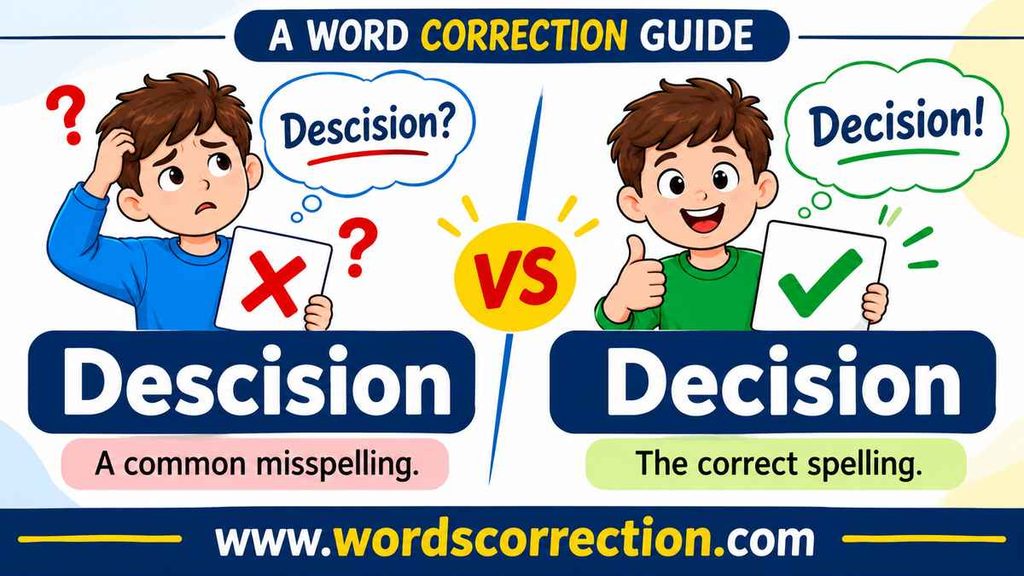
Decision is the correct spelling. Descision is incorrect and isn’t an accepted alternative in standard English.
The word decision contains eight letters:
D – E – C – I – S – I – O – N
Notice the spelling carefully. It contains one C followed by one S. Adding another S creates an incorrect spelling.
Consider these examples:
- Correct: We need to make a decision before Friday.
- Incorrect: We need to make a descision before Friday.
- Correct: Her decision surprised everyone.
- Incorrect: Her descision surprised everyone.
The difference may seem small, but spelling accuracy matters. A simple error can distract readers and make otherwise well-written content look less professional.
| Spelling | Status | Explanation |
|---|---|---|
| Decision | Correct | Standard English spelling |
| Descision | Incorrect | Contains an extra S |
| Decission | Incorrect | Uses two S letters |
| Decison | Incorrect | Omits the second I |
| Desicion | Incorrect | Uses the wrong letter sequence |
If you’re wondering whether to write descision vs decision, the answer is straightforward: always choose decision.
Learn the difference between tricky words and use them correctly
Grately vs Greatly Which Spelling Is Correct?
What Does Decision Mean?
Understanding Descision vs Decision starts with knowing the meaning of the correct word. A decision is a choice or conclusion someone reaches after considering different possibilities. It can involve selecting an option, solving a problem, forming an opinion, or deciding what action to take.
In simple terms, a decision means choosing between two or more possibilities. Knowing the meaning of Descision vs Decision helps you understand why decision is the correct spelling and how to use it properly.
For example, imagine you’re planning a vacation. You have three destinations in mind, but your budget allows you to visit only one. After comparing travel costs, weather, and available activities, you select one destination. That selection becomes your decision.
The meaning of decision can also vary slightly depending on the context. Everyday conversations, it usually refers to a personal choice. Business, it may describe an official action. In law, it can refer to a judgment made by a court. Remember, when comparing Descision vs Decision, decision is always the correct spelling.
Decision Definition in English
The decision definition in English centers on the act or result of deciding.
A decision generally refers to a choice or judgment made after considering available options.
Here are several important meanings:
- Choice: Selecting one option from several possibilities.
- Judgment: Reaching a conclusion after thinking about a situation.
- Determination: Settling on a particular course of action.
- Resolution: Reaching a firm conclusion about what to do.
- Verdict: A formal decision, especially in a legal setting.
For example:
- The manager made a decision about the new project.
- Her decision to study abroad changed her life.
- The judge announced the court’s decision.
- We reached a decision after a long discussion.
Although these examples involve different situations, they share one central idea: someone reaches a conclusion or selects a course of action.
Decision as a Noun
One important point in decision grammar is that decision is a noun, not a verb.
A noun names a person, place, thing, idea, or concept. Since a decision represents a choice or conclusion, it functions as a noun in English.
Consider these sentences:
- His decision was final.
- The committee announced its decision.
- I respect your decision.
- Their decision created new opportunities.
In each sentence, decision identifies the choice or conclusion being discussed.
The related verb is decide. For example:
- Verb: We must decide today.
- Noun: We must make a decision today.
Understanding this distinction will help you use the word correctly in different sentence structures.
Decision vs Choice What’s the Difference?
The words decision and choice have similar meanings. However, they don’t always communicate exactly the same idea.
A choice refers to an available option or the act of selecting one. A decision often emphasizes the conclusion or commitment reached after considering those options.
For example, imagine a restaurant menu with five different meals. Each meal represents a choice. After reviewing the menu, you select pasta. That selection becomes your decision.
| Decision | Choice |
|---|---|
| Often emphasizes the conclusion reached | Often emphasizes the available option or selection |
| Can involve careful thought and judgment | Can involve a simple selection |
| Example: I made a decision to move abroad. | Example: I chose the blue suitcase. |
| Can refer to an official judgment | Usually refers to selecting between possibilities |
The two words sometimes overlap. You can say, “I made a choice” or “I made a decision.” Both are grammatically correct, although the best option depends on the context.
Learn the difference between similar English words the easy way
An Hour or A Hour Which one Is Correct?
Why Is Decision the Correct Spelling?
The correct spelling of decision comes down to its established English spelling pattern and its relationship with the verb decide.
The word has a specific sequence of letters:
D + E + C + I + S + I + O + N
The letter C appears before I, followed by a single S. Adding another S changes the spelling into descision, which isn’t a standard English word.
The Correct Letter Pattern: D-E-C-I-S-I-O-N
Breaking a word into individual letters can make a confusing spelling easier to remember.
Here’s the structure of decision:
| Letter | Position |
|---|---|
| D | 1 |
| E | 2 |
| C | 3 |
| I | 4 |
| S | 5 |
| I | 6 |
| O | 7 |
| N | 8 |
The most important part is the middle of the word: C-I-S.
Many spelling mistakes happen because writers remember the general sound but forget the exact letter sequence. Learning the pattern reduces that risk.
Understanding the -Sion Ending
The ending -sion appears in many English nouns. You’ll find it in words such as:
- Decision
- Division
- Revision
- Confusion
- Conclusion
- Permission
However, don’t assume every word ending in a similar sound follows exactly the same spelling pattern. English has several spelling conventions, and each word has its own history.
In decision, the ending connects with the verb decide. The noun refers to the choice or conclusion that results from deciding.
This relationship provides a useful clue when learning decision spelling rules.
Why Descision Is Incorrect
The spelling descision contains an unnecessary S. It doesn’t represent a separate word, a regional variation, or an accepted British or American spelling. Understanding Descision vs Decision helps you recognize that decision is the only correct form in standard English.
People sometimes write it because they confuse the sound of the word with its written form. Others simply type too quickly and fail to notice the extra letter.
For correct English usage, remember:
- Write decision, not descision.
- Use one C and one S.
- Keep both I letters in their correct positions.
- Don’t add an extra S when typing or proofreading.
The correct spelling remains decision in formal documents, casual messages, academic writing, and professional communication.
Learn the difference between commonly confused more words in English
Realist vs Realest What’s the Difference?
How to Spell Decision Correctly
Learning how to spell decision correctly doesn’t require complicated grammar rules. A few simple techniques can make the spelling easier to remember.
Break the Word Into Parts
Instead of trying to memorize all eight letters at once, focus on the word’s structure.
DEC + ISION
This is a practical memory aid rather than a formal linguistic division. It helps you focus on the letter sequence that people often miss.
Pay particular attention to the middle:
- D-E-C
- I-S-I-O-N
When you put the parts together, you get DECISION.
Write the word a few times while looking carefully at the C and S. With practice, the correct spelling should become easier to recall.
Learn Decision and Decide Together
One of the easiest ways to remember decision is to learn it alongside decide.
Both words belong to the same word family.
| Word | Part of Speech | Meaning |
|---|---|---|
| Decide | Verb | To choose or reach a conclusion |
| Decision | Noun | A choice or conclusion |
| Decisive | Adjective | Able to make decisions confidently or settle an issue |
| Indecisive | Adjective | Unable to make decisions easily |
| Indecision | Noun | Difficulty making a decision |
For example:
- I need to decide which course to take.
- I made my decision yesterday.
- She is a decisive team leader.
- His indecision delayed the project.
Learning the decision word family helps you understand spelling, meaning, and grammar at the same time.
Easy Memory Trick for Decision
Here’s a simple way to remember the correct spelling:
Decision has one C and one S. Don’t give it an extra S!
You can also connect the noun with its related verb:
- Decide
- Decision
Both contain the letter C. Remembering this connection can help prevent the common descision spelling mistake.
Another useful technique is to write one original sentence whenever you practice the word.
For example:
“I made a decision to improve my English writing.”
This approach connects spelling with actual usage instead of relying on memorization alone.
Learn the difference between confusing more English words step by step
Gluing vs Glueing Which Spelling Is Correct?
How to Pronounce Decision
Correct spelling becomes easier when you understand how a word sounds. However, pronunciation alone won’t always tell you which letters to write. The word decision is a good example of this difference.
When learning Descision vs Decision, understanding the correct pronunciation can also help you become more familiar with the word.
In American English, decision has three syllables, and the stress falls on the second syllable.
Decision Pronunciation in American English
The standard American English IPA pronunciation is:
/dɪˈsɪʒ.ən/
You can understand its pronunciation through three simple points:
- First syllable: Begins with a short /dɪ/ sound.
- Second syllable: Receives the main stress and contains the /sɪʒ/ sound.
- Final syllable: Ends with a relaxed /ən/ sound.
The middle sound is particularly important. The letter S in decision produces a sound similar to the middle consonant in vision and measure. It doesn’t sound like the regular S in sun.
This difference helps explain why people sometimes struggle to connect the spoken word with its spelling.
Why Pronunciation Causes Spelling Confusion
English pronunciation doesn’t always reveal the exact spelling of a word. Several letters can represent similar sounds, while the same letter can produce different sounds in different words.
For example:
- Vision: The S produces a /ʒ/ sound.
- Decision: The S also produces a /ʒ/ sound.
- Simple: The S produces a /s/ sound.
- Pressure: The letter combination produces a different sound pattern.
When people hear decision, they may remember its sound but forget the exact spelling. Some then add an extra S because they associate the sound with another spelling pattern.
The solution is simple: learn the written form alongside its pronunciation. Don’t depend on sound alone.
How to Use Decision in a Sentence
Understanding a word’s meaning is only half the job. You also need to know how it fits into a sentence.
Since decision is a noun, it can appear in several grammatical positions. You can use it as a subject, an object, or part of a phrase that describes a particular choice.
Decision as a Subject
A subject tells readers what or whom a sentence discusses. You can use decision as the subject when the sentence focuses on a particular choice or conclusion.
Examples:
- The decision surprised everyone at the meeting.
- Her decision changed the direction of the business.
- The final decision belongs to the director.
- Every decision has a possible outcome.
In these examples, the noun identifies the subject being discussed.
Decision as an Object
An object receives the action of a verb or completes its meaning. Decision often appears as an object after verbs such as make, announce, change, review, and reconsider.
Examples:
- We need to make a decision today.
- The company announced its decision yesterday.
- I respect your decision to leave.
- They reconsidered their decision after reviewing the results.
Notice how the noun works naturally with different verbs. Learning these combinations will help you write more fluent English.
Common Expressions With Decision
English speakers use decision in several common expressions. Learning these combinations is more useful than memorizing the definition alone.
| Expression | Meaning | Example |
|---|---|---|
| Make a decision | Choose between options | We must make a decision today. |
| Reach a decision | Arrive at a conclusion | The committee reached a decision. |
| Final decision | The last or settled choice | The manager announced the final decision. |
| Difficult decision | A choice that requires careful thought | Leaving the company was a difficult decision. |
| Important decision | A choice with significant effects | Choosing a university is an important decision. |
| Decision-making | The process of choosing | Good decision-making requires information. |
| Decision process | Steps used to reach a conclusion | The decision process took several weeks. |
| Decision about something | A choice concerning a subject | We made a decision about the budget. |
You can also use these expressions:
- Come to a decision
- Arrive at a decision
- Make the right decision
- Make a final decision
- Announce a decision
- Reconsider a decision
- Accept someone’s decision
- Question a decision
For example, “The board finally came to a decision after reviewing all the proposals” sounds natural and communicates a clear outcome.
Learn the difference between tricky English words with easy explanations
Tieing vs Tying Which Spelling Is Correct?
Decision vs Decide What’s the Difference?
The words decision and decide belong to the same word family, but they perform different grammatical jobs.
The main difference is that decision is a noun, while decide is a verb. One names the choice; the other describes the action of choosing.
Decision Is a Noun
A noun identifies a thing, concept, or idea. In this case, decision names the conclusion someone reaches after considering different options.
Examples:
- My decision is final.
- Her decision impressed the team.
- We discussed the decision yesterday.
- Their decision affected the entire department.
Decide Is a Verb
A verb describes an action, state, or process. The word decide describes the act of choosing or reaching a conclusion.
Examples:
- I need to decide today.
- They decided to cancel the event.
- She will decide after the interview.
- We haven’t decided where to travel.
Decision vs Decide Comparison Table
| Feature | Decision | Decide |
|---|---|---|
| Part of speech | Noun | Verb |
| Meaning | A choice or conclusion | To choose or reach a conclusion |
| Common usage | Make a decision | Decide what to do |
| Example | My decision was correct. | I decided to stay. |
| Related form | Decisions | Decided, deciding |
Consider these two sentences:
- “I need to decide which job to accept.”
- “I need to make a decision about my career.”
Both sentences communicate a similar idea, but their grammatical structures differ.
Decisive vs Decision
Another related comparison involves decisive and decision.
Although they share the same word family, their meanings and grammatical roles are different.
- Decision: A choice or conclusion. It is a noun.
- Decisive: Describes someone who makes decisions confidently or something that settles an issue. It is an adjective.
Examples:
- Her decision surprised the entire team.
- She is a decisive manager.
- The final match was a decisive victory.
- His decision settled the disagreement.
Remembering these differences will help you avoid mixing up related words.
Learn the difference between more words people mix up
Enable vs Inable What’s the difference?
Decision vs Decisions Singular and Plural Forms
A common grammar question involves the difference between decision and decisions. Both spellings are correct, but they don’t mean exactly the same thing.
Decision is singular. Decisions is plural.
Use the singular form when discussing one choice or conclusion. Use the plural form when referring to two or more choices.
| Word | Number | Example |
|---|---|---|
| Decision | Singular | Her decision was unexpected. |
| Decisions | Plural | Her decisions were unexpected. |
What Is the Plural of Decision?
The plural form of decision is decisions.
To make the plural, simply add an S to the end of the singular noun.
- One decision
- Two decisions
- Several decisions
- Many important decisions
For example:
- The manager made one important decision.
- The manager made several important decisions.
Notice that the plural S appears at the end of the word. It doesn’t change the spelling of the original noun.
Should You Use Decision or Decisions in a Sentence?
Your choice depends on how many decisions you’re discussing.
Use decision for one:
“Her decision to accept the offer was wise.”
Use decisions for more than one:
“Her decisions helped the company grow.”
This distinction is important because singular and plural nouns affect subject-verb agreement.
Compare:
- The decision is final.
- The decisions are final.
Using the wrong form can make an otherwise correct sentence grammatically inaccurate.
Learn the difference between everyday English mistakes
Flys vs Flies Which Spelling Is Correct?
Correct Examples of Decision in Everyday English
Examples make grammar easier to understand because they show how people use words in real situations. The following decision examples cover common settings where the word appears naturally.
Decision in Professional Communication
In workplaces, people frequently discuss decisions about budgets, hiring, projects, deadlines, and business plans.
Examples:
- The director made a decision about the annual budget.
- Our team reached a final decision after reviewing the proposal.
- The company announced its decision to expand operations.
- We need an informed decision before investing more money.
- The manager has the authority to make the final decision.
A business decision can affect employees, customers, finances, and long-term goals. That’s why professional writing often uses expressions such as informed decision, official decision, and final decision.
Decision in Academic Writing
Students and researchers also use the word when discussing choices, research methods, and conclusions.
Examples:
- The student’s decision to study medicine surprised her family.
- Researchers made a decision to examine a larger sample.
- The committee reached a decision about the scholarship.
- Choosing the correct research method was an important decision.
In academic writing, decision can describe an individual choice or a formal conclusion reached by a group.
Decision in Everyday Conversations
You don’t need formal language to use decision correctly. It fits naturally into ordinary conversations.
Examples:
- I’ve made my decision.
- Have you made a decision about dinner?
- That was a difficult decision.
- I respect your decision.
- We should make a decision before booking the tickets.
These sentences are short and natural. They’re also useful examples of how the word appears in everyday English.
Decision in Emails and Text Messages
Correct spelling matters in digital communication, too. Even a short message can look unprofessional when it contains avoidable spelling mistakes.
Professional email example:
Dear Sarah,
We’ve reviewed the available options and reached a decision about the project timeline. Please let us know if you’d like to discuss the next steps.
Best regards
Casual text message:
“I’ve finally made a decision about which laptop to buy!”
Both examples use the same correct spelling. The tone changes, but the spelling doesn’t.
Learn the difference between commonly misused words
Nonresponsive vs Unresponsive which is Correct?
Descision vs Decision Incorrect and Correct Examples
Sometimes the easiest way to understand a spelling mistake is to compare it with the correct version.
The following table shows common sentences containing descision and their corrected forms.
| Incorrect sentence | Correct sentence |
|---|---|
| I made a descision yesterday. | I made a decision yesterday. |
| It was a difficult descision. | It was a difficult decision. |
| We need your descision by Monday. | We need your decision by Monday. |
| Her descision changed everything. | Her decision changed everything. |
| The final descision is yours. | The final decision is yours. |
| They announced their descision. | They announced their decision. |
| I respect your descision. | I respect your decision. |
| This is an important descision. | This is an important decision. |
The incorrect examples contain the same mistake: an extra S appears in place of the correct letter sequence.
A Practical Case Study The Extra S in a Business Email
Imagine a marketing employee preparing an email for a client.
The original sentence reads:
“We have made a descision to extend the project deadline.”
The employee sends the message without checking the spelling. Although the meaning remains understandable, the error can distract the client and reduce the professional quality of the email.
The corrected version reads:
“We have made a decision to extend the project deadline.”
What does this example teach?
- A small spelling error can affect the appearance of professional communication.
- Spellcheck can catch many common mistakes, but proofreading still matters.
- Learning the correct letter pattern helps prevent repeated errors.
The lesson isn’t that one spelling mistake ruins a business relationship. Rather, careful writing shows attention to detail.
A Practical Case Study A Student’s Assignment
Consider a student writing an essay about career planning.
The student types:
“Choosing the right career is an important descision.”
The sentence communicates the intended idea, but the spelling is incorrect.
The corrected sentence is:
“Choosing the right career is an important decision.”
A useful way to avoid this mistake is to review commonly confused words before submitting an assignment. Reading the sentence aloud can help identify awkward wording, while a spelling check can catch the extra S.
Learn the difference between basic English word mistakes
Breathe vs Breath Difference and Correct Usage
Why Do People Spell Decision as Descision?
If decision is the correct spelling, why does descision appear so often?
The mistake usually comes from confusion between pronunciation, spelling patterns, and memory. The two forms look similar, so a person typing quickly may not notice the additional letter.
Confusion About the Single S
The biggest problem is the extra S.
Some writers remember the general appearance of the word but don’t recall its exact structure. As a result, they insert another S.
The solution is to memorize the correct sequence:
D-E-C-I-S-I-O-N
Pay attention to the middle letters. That’s where the common error occurs.
Pronunciation and Spelling Differences
English contains many words whose spelling isn’t immediately obvious from their pronunciation.
For instance, the S in decision produces a /ʒ/ sound rather than the usual /s/ sound. Someone who relies entirely on pronunciation may struggle to remember the written form.
Learning both the sound and spelling together provides a better solution.
Influence of Similar English Words
Other English words can create spelling confusion because they use double letters or similar endings.
For example:
- Discussion
- Permission
- Possession
- Confession
- Decision
These words don’t all follow the same spelling pattern. However, seeing different combinations can sometimes cause writers to transfer one word’s pattern to another.
The best approach is to learn each word’s established spelling instead of assuming that similar sounds require identical letter combinations.
Typing Too Quickly
Fast typing is another common reason for spelling mistakes.
When someone writes an email, text message, or assignment in a hurry, the brain may focus on the message rather than every individual letter.
To catch these errors:
- Slow down when typing unfamiliar words.
- Review the middle of commonly misspelled words.
- Use a reliable spellchecker.
- Read important documents before submitting them.
Technology can help, but it shouldn’t replace basic spelling knowledge.
Learn the difference between often confused words
Developed vs Developped Which Spelling Is Correct?
Common Spelling Mistakes Related to Decision
Besides descision, several other incorrect spellings appear when people write this word. Some mistakes involve extra letters, while others happen because writers leave out or rearrange letters.
Here are common misspellings you should recognize:
| Incorrect spelling | Correct spelling |
|---|---|
| Descision | Decision |
| Decission | Decision |
| Decition | Decision |
| Dicision | Decision |
| Decison | Decision |
| Decidion | Decision |
| Desicion | Decision |
| Decisoin | Decision |
All these variations are incorrect in standard English.
One useful proofreading technique is to search your document for descision. You can also search for other common misspellings if you suspect you’ve made the same mistake more than once.
Remember that spellcheck programs don’t always catch every error, particularly when a misspelled form resembles another valid word or passes a software dictionary’s checks.
American vs British English Is Decision Spelled Differently?
American and British English have several spelling differences. For example, Americans generally write color, while British writers often use colour. However, the word decision doesn’t follow that pattern.
Both varieties use exactly the same spelling.
American English Spelling
In American English, the correct spelling is decision.
Examples:
- We made a decision about the new project.
- The final decision will come tomorrow.
- She respected her parents’ decision.
British English Spelling
British English also uses decision.
Examples:
- The committee reached a decision.
- His decision surprised everyone.
- The manager announced the official decision.
Does the Meaning or Pronunciation Change?
The spelling and basic meaning remain the same in American and British English.
Pronunciation can vary slightly between individual speakers and accents, but neither variety accepts descision as a standard alternative.
Therefore, whether you’re writing for an American, British, or international audience, use decision.
Make a Decision vs Take a Decision Which Is Correct?
You may have heard people say both make a decision and take a decision. This can create confusion, especially for English learners. Understanding Descision vs Decision also means learning how the word decision works in common English expressions.
The good news is that both expressions are used in English. However, their naturalness and frequency vary by region.
Make a Decision
Make a decision is the standard and natural expression in American English.
It means choosing an option or reaching a conclusion after considering different possibilities.
Examples:
- I need to make a decision about my education.
- We made a decision to hire another employee.
- She finally made the right decision.
- The director must make a final decision today.
The expression works in casual conversations, business communication, and academic writing.
Take a Decision
Take a decision is also grammatically used in English, particularly in some British-influenced varieties and South Asian English.
For example:
- The board took a decision about the new policy.
- We need to take an important decision.
- The government took a decision to review the proposal.
However, American English speakers generally prefer make a decision.
If you’re writing for an American audience, choose make a decision. It sounds more natural and follows common American usage. Knowing this distinction makes it easier to understand Descision vs Decision and use the correct expression in everyday writing.
Make a Decision or Take a Decision Comparison Table
| Expression | Usage | Recommendation |
|---|---|---|
| Make a decision | Common in American and British English | Recommended |
| Take a decision | Used in some varieties of English | Acceptable in relevant regional contexts |
| Make the final decision | Natural and widely used | Recommended |
| Take the final decision | Less common in American English | Prefer make |
What does take a decision mean?
It means reaching a conclusion or choosing a particular course of action. The meaning is generally similar to make a decision.
What does make a decision mean?
It means considering available options and selecting one. It can describe a simple personal choice or an important professional judgment.
Decision Synonyms Other Words You Can Use
Using the same word repeatedly can make your writing sound repetitive. Fortunately, English offers several alternatives to decision.
However, not every synonym works in every situation. Some describe a simple choice, while others suggest a formal judgment or a firm conclusion.
| Synonym | Meaning | Example |
|---|---|---|
| Choice | Selecting an option | That was a difficult choice. |
| Conclusion | An opinion reached after thinking | We reached a conclusion. |
| Judgment | An assessment or considered opinion | Her judgment was reasonable. |
| Determination | A firm decision or intention | He showed determination to continue. |
| Resolution | A firm decision to do something | She made a resolution to exercise regularly. |
| Verdict | A formal judgment, especially in court | The jury delivered its verdict. |
| Selection | The act of choosing | The final selection surprised us. |
| Agreement | A shared understanding or arrangement | Both parties reached an agreement. |
Which Decision Synonym Should You Choose?
Think about the situation before replacing decision with another word.
For example:
- Use choice when discussing available options.
- Use judgment when discussing someone’s evaluation.
- Use verdict when referring to a formal legal conclusion.
- Use resolution when describing a firm intention or commitment.
- Use conclusion when someone reaches an opinion after considering information.
A synonym should make your sentence clearer, not simply replace a word for variety.
How to Remember tThe Correct Spelling of Decision
A spelling mistake becomes easier to avoid when you have a reliable way to remember the correct form. Understanding Descision vs Decision can help you recognize the correct spelling and avoid common writing errors.
Here are practical methods that work well for everyday writing.
Remember the One-S Rule
The simplest trick is to remember that decision contains one S.
Write the correct spelling several times:
DECISION – DECISION – DECISION
Focus on the middle letters instead of memorizing the entire word as one unfamiliar combination. This simple technique can help you avoid the incorrect spelling in Descision vs Decision.
Connect Decision With Decide
Both words belong to the same word family.
- Decide
- Decision
- Decisive
- Indecision
Learning these related forms helps you recognize the shared spelling pattern and understand why decision is correct.
Write and Practice the Word
Practice works best when you use the word in meaningful sentences.
Try these examples:
- I made an important decision.
- Her decision was unexpected.
- We need to decide before Friday.
- The manager announced the final decision.
Writing complete sentences helps connect spelling with meaning and grammar. It also makes remembering the correct form of Descision vs Decision easier.
Proofread Before Submitting
Before sending an email or submitting an assignment, check commonly confused words.
Pay special attention to:
- Extra letters
- Missing letters
- Incorrect word endings
- Singular and plural forms
- Words that sound similar
A quick review can prevent mistakes that would otherwise go unnoticed. Remember, when comparing Descision vs Decision, always use decision because it is the correct English spelling.
Quick Checklist Are You Using Decision Correctly?
Before publishing an article, sending an email, or submitting an assignment, use this checklist:
- Have you written decision instead of descision?
- Does the word contain one C and one S?
- Have you used the correct singular or plural form?
- Are you using decision as a noun?
- Have you chosen the appropriate expression, such as make a decision?
- Does the word fit naturally into the sentence?
- Have you checked the spelling before submitting your writing?
These small checks can improve your writing accuracy without requiring a lengthy proofreading process.
Practice Session Descision vs Decision
Choose the correct word to complete each sentence. Test your understanding of the correct spelling, meaning, and usage of decision.
1. Making the right ______ requires careful thinking.
2. Decision is the correct spelling, while ______ is incorrect.
3. She made an important ______ about her career.
4. We need to ______ before the deadline.
5. Every important ______ has its own consequences.
6. He couldn’t make a final ______ about the offer.
7. Good ______-making skills are useful in everyday life.
8. They reached a ______ after discussing all the options.
9. A wise ______ can lead to better results.
10. I have to make a difficult ______ today.
11. The manager announced the final ______ yesterday.
12. People should consider the consequences before making a ______.
13. She finally ______ to accept the job.
14. Making a ______ is sometimes more difficult than expected.
15. The committee made several important ______.
16. You should never make an important ______ in a hurry.
17. His ______ changed the direction of his career.
18. The correct spelling of the word is ______.
19. A good ______ should be based on reliable information.
20. We must carefully consider every option before making a ______.
21. The judge delivered a final ______ in the case.
22. Personal values can influence your ______.
23. She used the 10-10-10 rule to evaluate her ______.
24. Learning from past ______ can improve your future choices.
25. He showed confidence after making his final ______.
Answers
- Decision
- Descision
- Decision
- Decide
- Decision
- Decision
- Decision
- Decision
- Decision
- Decision
- Decision
- Decision
- Decided
- Decision
- Decisions
- Decision
- Decision
- Decision
- Decision
- Decision
- Decision
- Decisions
- Decision
- Decisions
- Decision
Here’s a trusted source for clear word meanings:
Cambridge Dictionary
FAQs
Is it descision vs decision?
Decision is the correct spelling in English. Descision is a common misspelling and is not recognized as a standard English word.
Why do people misspell decision as descision?
People often misspell decision because they confuse its spelling with other words that contain similar letter patterns. However, the correct spelling is always decision.
How can I remember the correct spelling of decision?
You can remember the correct spelling by dividing the word into three parts: de-ci-sion. Pay attention to the letter C after “de” to avoid writing descision.
What does decision mean in simple English?
A decision is a choice or conclusion made after considering different options. It involves selecting what you believe is the best course of action in a particular situation.
Is decision a noun or a verb?
Decision is a noun, while decide is its related verb. For example, “I made a decision” uses the noun, whereas “I decided to leave” uses the verb.
What is the difference between decision and decisions?
Decision is the singular form, meaning one choice or conclusion. Decisions is the plural form, referring to two or more choices or conclusions.
What is the difference between decision and choice?
A choice involves selecting between available options, while a decision refers to the conclusion or judgment reached after considering those options. Although closely related, the words can have slightly different meanings depending on the context.
Is it correct to say make a decision or take a decision?
Yes, both expressions are grammatically correct. “Make a decision” is more common in American English, while “take a decision” is widely used in British and Commonwealth English.
What are the different types of decisions?
Common types of decisions include strategic, tactical, operational, routine, and personal decisions. Each type serves a different purpose depending on the situation, responsibilities, and desired outcome.
What is the difference between a good decision and a bad decision?
A good decision considers relevant information, available options, personal goals, and possible consequences. A bad decision may result from overlooking important facts, acting impulsively, or failing to consider potential outcomes.
What are the three main steps in decision-making?
The three basic steps are identifying the problem, evaluating available options, and selecting the most suitable solution. Reviewing the results afterward can also help improve future decisions.
What are the three C’s of decision-making?
The three C’s of decision-making are commonly described as clarity, confidence, and commitment. These principles encourage people to understand their options, choose carefully, and take responsibility for their decisions.
What is the 10-10-10 rule for decision-making?
The 10-10-10 rule is a decision-making technique that encourages you to consider how a choice might affect you in 10 minutes, 10 months, and 10 years. It helps you evaluate immediate consequences alongside long-term outcomes.
Who created the 10-10-10 decision-making rule?
Suzy Welch popularized the 10-10-10 decision-making approach. She introduced this method to help people evaluate choices by considering their short-term, medium-term, and long-term consequences.
What are the four main decision-making styles?
The four commonly recognized decision-making styles are directive, analytical, conceptual, and behavioral. Each style reflects a different approach to gathering information, evaluating options, and making choices.
What makes a decision difficult?
A decision can become difficult when several options have similar benefits, important consequences remain uncertain, or personal values conflict. Limited information, emotional pressure, and fear of making mistakes can also make the process challenging.
How do personal values influence decision-making?
Personal values influence decisions by shaping what people consider important, meaningful, and acceptable. They help guide choices related to relationships, careers, personal responsibilities, and everyday situations.
What is the difference between a decision and a judgment?
A decision involves selecting an option or choosing a course of action, while judgment involves evaluating information and forming an opinion. Good judgment often provides the foundation for making informed decisions.
What are some examples of decisions in everyday life?
Everyday decisions include choosing what to eat, deciding what to study, selecting a career, managing money, and planning daily activities. Each example involves considering different options and selecting one.
How can I improve my decision-making skills?
You can improve your decision-making skills by gathering reliable information, comparing available options, considering possible consequences, and learning from past experiences. Taking time to evaluate your choices can help you make more thoughtful and confident decisions.
Learn the difference between confusing more English words
Channel vs Chanel Which Spelling Is Correct?
Final Thoughts
Spelling mistakes can make even familiar words confusing, but understanding Descision vs Decision makes it easy to recognize the correct form. Decision is the only accepted spelling in standard English, while descision is a common misspelling. The correct word contains one C and one S. Remembering this simple distinction can help you avoid spelling errors and communicate more clearly and confidently.
Whether you’re writing a professional email, completing an academic assignment, or communicating in everyday situations, correct spelling makes your writing clearer and more polished. Practice using decision in different sentences to become more familiar with its spelling and meaning. When comparing Descision vs Decision, always remember that decision is correct. After all, strong writing often comes down to getting the small details right.

Stella AJS is an experienced blogger and dedicated English language writer at Words Correction. She turns confusing grammar, word meanings, spelling, and usage into clear, practical insights that readers can easily understand and apply. With a passion for precise and engaging writing, Stella helps readers avoid common language mistakes, strengthen their vocabulary, and communicate with greater clarity and confidence.