
English spelling can turn even a tiny word into a big grammar headache. A single fly may seem harmless, but when there are two, should you write flys or flies? The confusion doesn’t stop there. Expressions like time flys and sentences such as she flys a plane can make this spelling mistake even more common. So, which form follows standard English grammar? In the battle of Flys vs flies, only one spelling is correct for everyday writing. Whether you’re talking about insects, airplanes, or how quickly time passes, this guide will help you understand the difference and avoid common spelling mistakes.
Flys vs Flies The Quick Answer
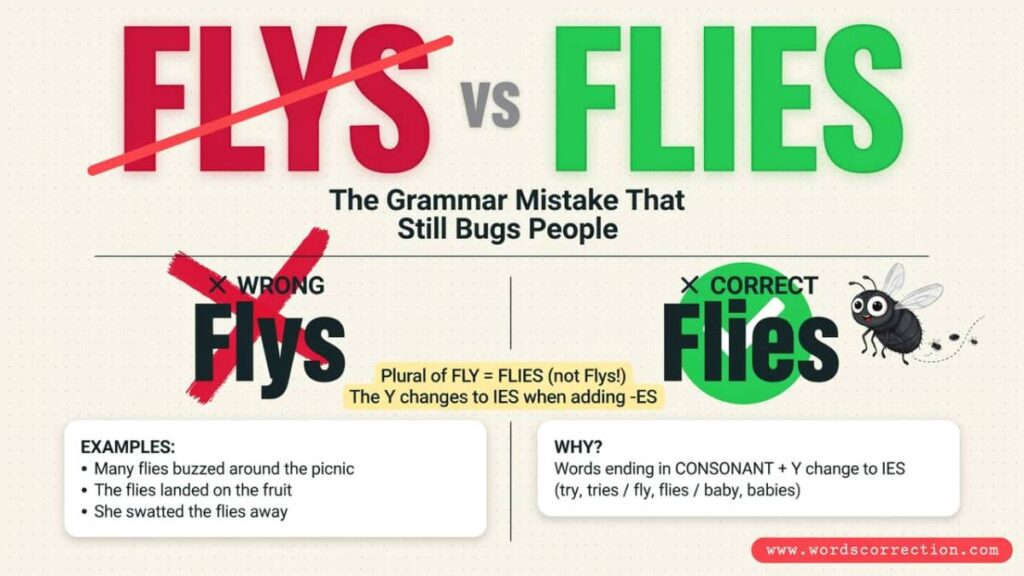
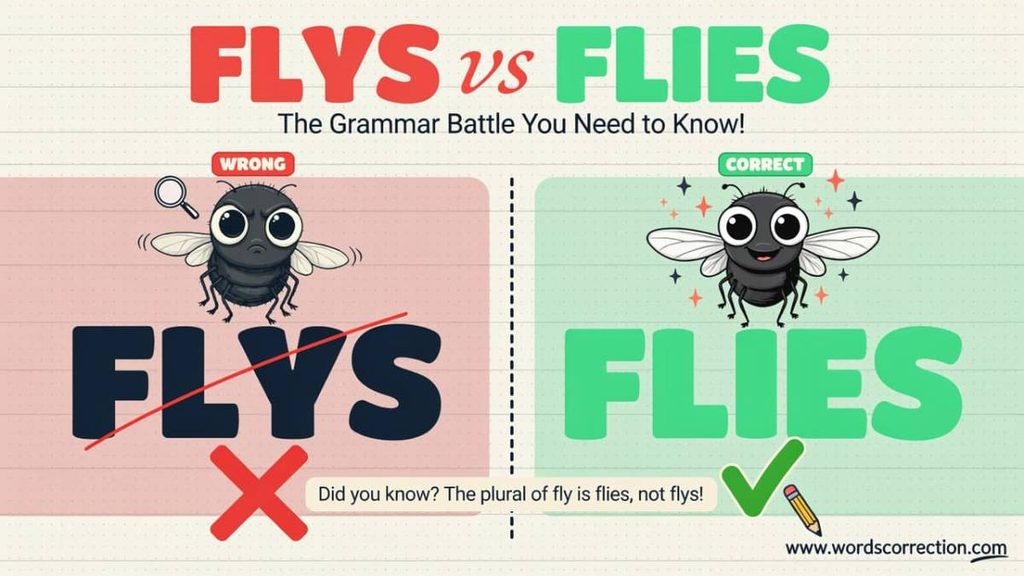
Flies is the correct spelling in standard English. It serves as both the plural form of the noun “fly” and the third-person singular present-tense form of the verb “fly.”
The spelling “flys” is generally incorrect when used as an ordinary plural noun or verb.
Consider these examples:
- Correct: Several flies are buzzing around the kitchen.
- Incorrect: Several flys are buzzing around the kitchen.
- Correct: She flies a plane for an international airline.
- Incorrect: She flys a plane for an international airline.
- Correct: Time flies when you’re having fun.
- Incorrect: Time flys when you’re having fun.
The explanation comes down to a common English spelling rule when a word ends in a consonant followed by Y, you generally change the Y to I before adding ES to form its plural or third-person singular verb form.
| Word | Correct form | Explanation |
|---|---|---|
| Fly | Flies | Consonant + Y changes to IES |
| Baby | Babies | Consonant + Y changes to IES |
| City | Cities | Consonant + Y changes to IES |
| Toy | Toys | Vowel + Y takes S |
| Boy | Boys | Vowel + Y takes S |
The key is to look at the letter immediately before Y. That small detail determines the correct spelling.
Learn the difference between confusing more English words
Wise vs Wize Which Spelling Is Correct?
What Is the Difference Between Flys vs Flies?
The main difference between flys vs flies involves standard spelling and grammatical function. Although both forms might look possible, only flies follows accepted English spelling conventions in ordinary writing.
Let’s examine their meanings separately.
Flies Meaning
The word “flies” has two main grammatical uses.
As a plural noun: It refers to more than one insect belonging to the order Diptera. These insects have one pair of functional wings and include familiar species such as houseflies, fruit flies, and blowflies.
Examples:
- Two flies landed on the kitchen counter.
- The gardener noticed several flies near the compost.
- We closed the windows to keep the flies outside.
As a verb: It describes what one person, animal, or thing does when moving through the air or traveling by aircraft.
Examples:
- The eagle flies above the mountains.
- My brother flies to Chicago every month.
- A small aircraft flies over the village.
In another familiar expression, flies describes the quick passage of time:
- Time flies when you’re having fun.
Therefore, the meaning depends on the sentence rather than the spelling itself.
Flys Meaning
People sometimes search for “Flys meaning” because they encounter this spelling in online conversations, product names, or informal writing.
In ordinary English grammar, however, flys isn’t the accepted plural of fly or the standard third-person singular form of the verb.
You may encounter Flys as:
- A proper name or surname.
- A business or brand name.
- A deliberately stylized spelling.
- A nonstandard spelling in informal communication.
These special cases don’t change the standard spelling rule.
For example, a business might use Flys as part of its registered name. That doesn’t make the spelling appropriate in a sentence such as “Three flys entered the room.”
Remember: A name can have an unusual spelling without changing the rules of standard English.
Flys vs Flies Difference at a Glance
| Feature | Flys | Flies |
|---|---|---|
| Standard plural of fly | Incorrect | Correct |
| Third-person singular verb | Incorrect | Correct |
| Refers to multiple insects | Incorrect | Correct |
| Used with he, she, or it | Incorrect | Correct |
| Proper name or brand | Possible | Possible |
| Standard English spelling | No | Yes |
The easiest way to remember the distinction is to use flies whenever you’re writing about multiple insects or describing someone or something flying.
Learn the difference between commonly mixed-up more words
Faring vs Fairing what’s the Difference?
Why Is Flies the Correct Spelling?
The spelling of flies follows established English spelling rules. The most important rule involves nouns and verbs that end in a consonant followed by the letter Y.
When you add certain suffixes, including the plural ending or the third-person singular verb ending, the Y usually changes to I before you add ES.
This process produces the spelling flies.
The Consonant Plus Y Rule for Nouns
In English, many singular nouns end in a consonant followed by Y. To make these nouns plural, you generally replace Y with I and add ES.
The pattern looks like this:
Consonant + Y → IES
For example:
| Singular noun | Plural noun |
|---|---|
| Fly | Flies |
| Baby | Babies |
| City | Cities |
| Lady | Ladies |
| Party | Parties |
| Puppy | Puppies |
| Story | Stories |
| Country | Countries |
Why does this happen?
English spelling conventions use this pattern to form plurals for many nouns ending in consonant + Y. Instead of writing flys, standard English changes the final Y to I and adds ES.
Examples in sentences:
- The baby has two favorite toys.
- Several cities attract tourists every year.
- The puppies are playing in the garden.
- Flies gather around uncovered food.
Notice that the spelling change affects only the final letters. The rest of the word remains unchanged.
The Y-to-IES Rule for Verbs
The same spelling pattern applies when you use a verb in the third-person singular present simple tense.
When the subject is he, she, it, or a singular noun, verbs ending in consonant + Y generally change Y to I and take ES.
For example:
| Base verb | Third-person singular |
|---|---|
| Fly | Flies |
| Try | Tries |
| Cry | Cries |
| Study | Studies |
| Carry | Carries |
| Hurry | Hurries |
| Reply | Replies |
| Apply | Applies |
Consider these sentences:
- He flies a commercial aircraft.
- She studies English every evening.
- The baby cries when she’s hungry.
- My father carries his laptop to work.
- The student replies to the teacher’s question.
In each example, the subject is singular and the verb follows the third-person singular spelling rule.
This explains why he flies and she flies are correct while he flys and she flys are not.
When Do You Add S Instead of Changing Y to IES?
Not every English word ending in Y changes to IES. When a word ends in a vowel followed by Y, you generally add S without changing the Y.
The pattern is:
Vowel + Y → YS
For example:
| Singular | Plural |
|---|---|
| Toy | Toys |
| Boy | Boys |
| Key | Keys |
| Day | Days |
| Monkey | Monkeys |
| Donkey | Donkeys |
| Journey | Journeys |
The same distinction applies to verbs.
| Base verb | Third-person singular |
|---|---|
| Play | Plays |
| Enjoy | Enjoys |
| Stay | Stays |
| Employ | Employs |
| Buy | Buys |
Compare these examples:
- The bird flies across the sky.
- The boy plays in the garden.
- She tries to solve the problem.
- He enjoys reading books.
The letter immediately before Y determines which spelling pattern applies.
In fly, the Y follows L, a consonant. In toy, the Y follows O, a vowel. That’s why one becomes flies while the other becomes toys.
A Quick Spelling Fact
The consonant + Y and vowel + Y distinction appears in both English pluralization and third-person singular verb conjugation. Understanding this pattern helps you spell many other words correctly.
Learn the difference between tricky grammar more words
Dought vs Doubt Which Spelling Is Correct?
How to Use Flies Correctly
Knowing the spelling rule is only half the job. You also need to understand how flies functions in a sentence.
The word can act as a noun or a verb. Its grammatical role depends on the context.
Flies as a Plural Noun
As a noun, flies is the plural form of fly. It commonly refers to two or more flying insects.
A fly is a small insect with one pair of functional wings. Many species appear around food, garbage, plants, and other environments where they can find suitable food or breeding sites.
The plural form flies follows the regular consonant + Y spelling rule.
Examples:
- Several flies entered the house through an open window.
- The flies gathered around the fruit bowl.
- We used screens to keep flies away from the kitchen.
- A few flies were resting on the garden fence.
- The farmer noticed flies near the animal feed.
Plural of fly insect: The correct answer is flies, not flys.
However, the word flies doesn’t refer only to insects. It has other noun meanings too.
Flies as Fishing Equipment
In fly fishing, anglers use artificial flies as bait. These small fishing lures imitate insects or other organisms that fish naturally eat.
Examples:
- The fisherman carried several artificial flies in his tackle box.
- Dry flies float on the water’s surface.
- Wet flies imitate insects beneath the water.
Here, flies is still the plural of fly. The meaning changes according to the context.
Flies as a Clothing Term
In clothing terminology, a fly refers to the opening at the front of trousers or pants, usually covered by a zipper or buttons.
Examples:
- The tailor repaired the fly on my trousers.
- The jeans have a metal zipper fly.
The plural form is flies when referring to multiple such openings.
This is another example of why context matters when interpreting English vocabulary.
Flies as a Verb
The word flies also works as the third-person singular present-tense form of the verb fly.
The verb describes movement through the air, usually with wings or through the operation of an aircraft. It can also describe traveling by plane or passing quickly.
The basic verb pattern looks like this:
| Subject | Correct verb |
|---|---|
| I | Fly |
| You | Fly |
| We | Fly |
| They | Fly |
| He | Flies |
| She | Flies |
| It | Flies |
The distinction comes from subject-verb agreement in the present simple tense.
Examples:
- I fly to New York for work.
- They fly internationally every summer.
- He flies a plane for a living.
- She flies to London twice a year.
- The bird flies south during winter.
- The airplane flies above the clouds.
Important: The spelling flies doesn’t depend on whether the subject is a person, animal, or aircraft. It depends on whether the subject is third-person singular.
He Flies a Plane or He Flys a Plane?
The correct sentence is He flies a plane.
The subject he is third-person singular. Therefore, the verb fly changes to flies.
Compare:
- Correct: He flies a passenger aircraft.
- Incorrect: He flys a passenger aircraft.
- Correct: My uncle flies a helicopter.
- Incorrect: My uncle flys a helicopter.
The same rule applies to she and it.
Examples:
- She flies an airplane.
- The bird flies over the lake.
- The drone flies above the trees.
Flies in Common Expressions and Idioms
English uses flies in several familiar expressions. Understanding these phrases can improve your vocabulary and help you recognize the word in different contexts.
Time flies
This expression means time passes quickly, especially when you’re enjoying yourself or staying busy.
Example: Time flies when you’re having fun.
When pigs fly
This humorous expression describes something extremely unlikely or seemingly impossible.
Example: He’ll clean his room without being asked when pigs fly.
The days fly by
This phrase describes how quickly days seem to pass.
Example: The days fly by during summer vacation.
A bird flies south
This describes the seasonal movement of certain birds toward warmer regions.
Example: The bird flies south before winter arrives.
In these examples, flies follows the correct third-person singular spelling pattern.
Learn the difference between confusing word pairs
Really vs Realy Which Spelling Is Correct?
Flys vs Flies Correct and Incorrect Examples
Sometimes the best way to understand a spelling rule is to see it in action. The following examples show how the correct spelling works in everyday English.
Common Spelling Mistakes and Their Corrections
Writers often make the same mistake because they remember the general rule of adding S to form plurals. However, fly follows the consonant + Y pattern.
Here are some common errors and their corrections:
| Incorrect sentence | Correct sentence |
|---|---|
| There are three flys in the kitchen. | There are three flies in the kitchen. |
| He flys to work every week. | He flies to work every week. |
| She flys a private jet. | She flies a private jet. |
| Time flys when you’re busy. | Time flies when you’re busy. |
| The bird flys over the forest. | The bird flies over the forest. |
| Several flys landed on the food. | Several flies landed on the food. |
| My father flys internationally. | My father flies internationally. |
The mistake usually happens when someone applies the wrong spelling pattern. Once you understand the difference between consonant + Y and vowel + Y, these errors become much easier to avoid.
Example Sentences Using Flies
Here are additional examples showing how to use flies naturally in different situations.
Everyday conversation:
- There are too many flies around the garbage.
- A fly keeps landing on my sandwich.
- Time flies when you’re talking to old friends.
Education and academic writing:
- The housefly belongs to the insect order Diptera.
- Some birds fly thousands of miles during seasonal migration.
- The researcher observed how flies responded to different environmental conditions.
Professional communication:
- She flies to different cities to attend business meetings.
- The company uses drones that fly over agricultural fields.
- The pilot flies commercial aircraft across international routes.
Creative writing:
- A golden eagle flies gracefully above the mountains.
- The butterfly flies from one flower to another.
- As the sun sets, time seems to fly.
The same spelling appears in sentences with different meanings. The grammatical role determines how you interpret the word.
Learn the difference between often confused words
Shute vs Chute Which Spelling Is Correct?
Is Flys Ever a Correct Word?
This is one of the most common questions people ask when researching the meaning of flys vs flies.
The answer requires some clarification.
In standard modern English, flys isn’t the accepted spelling for the plural noun or third-person singular verb. However, you might encounter this spelling in certain specialized situations.
Proper Names and Surnames
Names don’t always follow ordinary spelling conventions.
For example, a person might have Flys as a surname, or a family business might use it as part of its official name.
In these cases, the spelling is a proper noun rather than an attempt to form the plural of fly.
Brand Names and Trademarks
Businesses sometimes choose unusual spellings to create memorable brand identities.
A company could deliberately use Flys in its name. That spelling may be appropriate when reproducing the company’s official branding.
However, this doesn’t mean you should write:
- Three flys are sitting on the wall.
- The airplane flys over the city.
The standard forms remain flies.
Specialized and Informal Uses
You may also find flys in usernames, online posts, stylized product names, or nonstandard writing.
Specialized terminology can create additional confusion because the noun fly has meanings beyond insects and aircraft. For example, theatrical terminology uses fly to describe certain overhead rigging systems.
However, these uncommon cases shouldn’t be confused with the ordinary plural or verb forms discussed in this article.
The practical rule: If you’re writing standard English and mean multiple insects or describe someone flying, use flies.
Learn the difference between basic English word mistakes
Grately vs Greatly Which Spelling Is Correct?
Why Do People Confuse Flys vs Flies?
If the spelling rule is straightforward, why does the mistake keep happening?
The answer lies in how English spelling works. Some rules appear simple until another word introduces an exception. The confusion becomes even greater when pronunciation doesn’t reveal the difference.
Let’s examine the most common reasons.
The Basic Plural Rule Can Be Misleading
Most English nouns form their plurals by adding S or ES.
For example:
- Book → Books
- Chair → Chairs
- Car → Cars
- Box → Boxes
Because fly is a short word, writers sometimes apply the same simple pattern and produce flys.
However, the consonant + Y rule changes the final Y to I before adding ES.
That’s why the correct plural is flies.
Words Like Toys and Boys Create Confusion
Words such as toys, boys, and days follow a different spelling pattern.
They retain their Y because a vowel comes immediately before the final Y.
Compare:
| Consonant + Y | Vowel + Y |
|---|---|
| Fly → Flies | Toy → Toys |
| Baby → Babies | Boy → Boys |
| City → Cities | Day → Days |
| Party → Parties | Key → Keys |
The difference is only one letter, but it changes the spelling pattern.
Pronunciation Does Not Solve the Spelling Problem
Another reason people make this spelling mistake is that flies and flys would generally represent the same pronunciation in ordinary English.
The correct spelling isn’t something you can reliably identify by listening.
Someone might pronounce a sentence correctly but write it incorrectly because the spoken sound doesn’t reveal whether the word ends in YS or IES.
That’s why learning English spelling rules matters even when you already know how to pronounce a word.
Autocorrect and Spell-Check Can Reinforce Mistakes
Modern writing tools make spelling easier, but they don’t always understand context.
Some systems may recognize unusual names, usernames, or specialized terms. Others may fail to catch a mistake if a word appears in a context they don’t fully understand.
For example, a spell-checker might identify flys as an error. However, it may not explain whether you need flies as a noun or a verb.
The best solution is to understand the grammar rather than depend entirely on automatic corrections.
Translation Can Interfere With English Spelling
People learning English sometimes translate sentences directly from another language.
The problem is that different languages use different word-formation rules.
A learner might understand that a noun needs a plural ending but apply a familiar spelling pattern from their first language.
English spelling conventions don’t always follow the same logic. Learning common patterns such as consonant + Y helps prevent these mistakes.
Learn the difference between commonly misused words
An Hour or A Hour Which one Is Correct?
Flys vs Flies in Real English Natural and Unusual Usage
Not every word that appears online represents correct standard English. Some spellings are common mistakes, while others belong to names, technical terminology, or specialized contexts.
Understanding this distinction helps you choose the right form without assuming that every unusual spelling has the same grammatical status.
| Usage | Status | Example |
|---|---|---|
| Flies as a plural noun | Standard English | The flies are near the window. |
| Flies as a verb | Standard English | She flies a plane. |
| Flys as an ordinary plural | Incorrect | Three flys are outside. |
| Flys as an ordinary verb | Incorrect | He flys every week. |
| Flys as a proper name | Possible | Flys is part of a business name. |
| Flys as a stylized spelling | Possible | A brand uses Flys as its chosen spelling. |
For everyday communication, the distinction is simple: use flies unless you’re reproducing a specific name or an established specialized spelling.
Learn the difference between everyday English mistakes
Realist vs Realest What’s the Difference?
American vs British English Is the Spelling Different?
American English and British English sometimes use different spellings for the same words.
For example:
| American English | British English |
|---|---|
| Color | Colour |
| Favorite | Favourite |
| Center | Centre |
| Organize | Organise (common British variant) |
| Traveling | Travelling |
However, flies doesn’t have this kind of regional spelling difference.
Both American and British English use flies as the standard plural of fly and the third-person singular present-tense form of the verb.
Examples:
- American English: The bird flies south for winter.
- British English: The bird flies south for winter.
The spelling remains identical.
You don’t need to memorize separate American and British rules for this word. The consonant + Y pattern works in both varieties.
Learn the difference between more words people mix up
Gluing vs Glueing Which Spelling Is Correct?
Fly vs Flies vs Flew vs Flown vs Flying
Another source of confusion involves the different forms of the verb fly.
English verbs change their forms depending on tense and grammatical function. Unlike regular verbs that form their past tense by adding ED, fly is an irregular verb.
Its main forms are:
| Verb form | Grammatical function | Example |
|---|---|---|
| Fly | Base form | Birds fly across the lake. |
| Flies | Third-person singular present | The eagle flies high. |
| Flew | Simple past tense | The plane flew over the city. |
| Flown | Past participle | She has flown to Paris. |
| Flying | Present participle / gerund | The birds are flying south. |
Let’s understand each form.
Fly The Base Verb
Fly is the base form of the verb. You use it with I, you, we, and they in the present simple tense.
Examples:
- I fly to work twice a month.
- Birds fly using their wings.
- They fly to different countries.
It also appears after modal verbs such as can, will, should, and might.
Examples:
- She can fly a helicopter.
- They will fly tomorrow.
- Birds should fly freely in the open sky.
Flies The Third-Person Singular Present
Flies is the form you use with he, she, it, or another singular subject in the present simple tense.
Examples:
- He flies a private aircraft.
- The bird flies over the river.
- My sister flies to Boston regularly.
Remember the subject-verb agreement rule. A singular third-person subject takes flies, not flys.
Flew The Simple Past Tense
Flew describes an action that happened in the past.
Examples:
- The airplane flew above the mountains yesterday.
- We flew to California last summer.
- The bird flew away when the door opened.
Don’t confuse flew with flies. One describes an action in the past, while the other describes a present-tense action.
Flown The Past Participle
Flown is the past participle of fly. It usually appears with helping verbs such as has, have, and had.
Examples:
- She has flown across the Atlantic.
- They have flown to several countries.
- The pilot had flown that route before.
Flying The Present Participle
Flying describes an ongoing action or works as a gerund, depending on the sentence.
Examples:
- The airplane is flying above the clouds.
- Flying makes some people nervous.
- The birds are flying toward the trees.
Understanding these five forms will help you avoid confusion when writing about aircraft, insects, birds, and movement through the air.
Learn the difference between tricky English words with easy explanations
Tieing vs Tying Which Spelling Is Correct?
What Is the Difference Between Fly and Flies?
The difference between fly and flies depends on the grammatical role of the word and the subject of the sentence.
Fly can function as a singular noun or a base verb. Flies can function as a plural noun or a third-person singular verb.
Here is a simple comparison:
| Word | Grammatical role | Example |
|---|---|---|
| Fly | Singular noun | A fly landed on my desk. |
| Fly | Base verb | Birds fly south in winter. |
| Flies | Plural noun | Several flies entered the room. |
| Flies | Third-person singular verb | The bird flies south. |
| Flys | Nonstandard spelling | Avoid it in ordinary writing. |
One important detail deserves attention: a singular noun doesn’t always require a singular verb form.
For example:
- The bird flies south.
- The birds fly south.
In the first sentence, bird is singular, so the verb becomes flies. In the second sentence, birds is plural, so the verb remains fly.
This is a basic subject-verb agreement rule.
What Is the Plural of Fly When Referring to an Airplane?
This question can be confusing because fly is also a verb associated with aircraft.
If you’re talking about multiple aircraft, the plural of plane is planes, not flies.
Examples:
- Three planes are flying over the airport.
- Several aircraft are waiting for departure.
- Two pilots fly commercial planes.
However, if you’re talking about multiple air journeys, use flights.
Examples:
- We booked three flights this month.
- The airline operates several international flights.
The distinction is important:
- Planes: Multiple aircraft.
- Flights: Multiple air journeys.
- Flies: Multiple insects or the third-person singular form of the verb fly.
There is no standard grammatical rule that turns the noun plane into flies.
How to Remember the Difference Between Flys vs Flies
Spelling rules become easier when you connect them to familiar examples. Instead of memorizing flies as an isolated word, remember the pattern behind it.
Here are five practical ways to avoid the mistake.
Remember the Consonant + Y Rule
When a word ends in a consonant followed by Y, change Y to I and add ES when forming its plural or third-person singular verb form.
Examples:
- Fly → Flies
- Baby → Babies
- City → Cities
- Try → Tries
Compare Fly With Toy
This is one of the easiest comparisons to remember.
- Fly → Flies
- Toy → Toys
Why? The Y in fly follows a consonant, while the Y in toy follows a vowel.
Check the Subject Before Choosing the Verb
When you’re using fly as a verb, look at the subject.
- I fly.
- You fly.
- They fly.
- He flies.
- She flies.
- It flies.
If the subject is he, she, it, or a singular noun, use flies in the present simple tense.
Remember That Flies Has Two Grammatical Uses
You can use flies as a plural noun or a verb.
- Noun: The flies are near the window.
- Verb: The bird flies over the window.
Understanding these two functions makes it easier to identify the correct spelling in different sentences.
Use a Simple Memory Trick
Think of this sentence:
A fly becomes flies, just as a baby becomes babies.
Both words follow the same consonant + Y spelling pattern.
Whenever you’re unsure about the spelling, compare the word with another familiar example.
Practice Session Flys vs Flies
Complete each sentence with the correct word: fly, flies, or flys.
1. Time ______ when you are having fun.
2. The bird ______ over the tall trees every morning.
3. Several ______ are sitting near the window.
4. My brother wants to learn how to ______ an airplane.
5. She ______ to London every summer.
6. The butterfly ______ around the colorful flowers.
7. These ______ are attracted to uncovered food.
8. He ______ a commercial aircraft for an international airline.
9. Birds usually ______ south during the winter.
10. Time ______ faster when you are busy.
11. A small bird ______ into the garden every morning.
12. The children watched as the airplane began to ______.
13. Many ______ gathered around the fruit basket.
14. My father knows how to ______ a helicopter.
15. The airplane ______ above the clouds.
16. The pilot will ______ to another country tomorrow.
17. A dragonfly ______ close to the surface of the water.
18. The saying “time ______” reminds us that life passes quickly.
19. House ______ are commonly found around food.
20. She dreams of learning to ______ a plane someday.
21. The eagle ______ high above the mountains.
22. Some birds ______ thousands of miles during migration.
23. The airplane ______ across the sky at a great speed.
24. A few ______ entered the room through the open door.
25. He wants to ______ around the world one day.
Answers
- flies
- flies
- flies
- fly
- flies
- flies
- flies
- flies
- fly
- flies
- flies
- fly
- flies
- fly
- flies
- fly
- flies
- flies
- flies
- fly
- flies
- fly
- flies
- flies
- fly
Here’s a trusted source for clear word meanings:
Cambridge Dictionary
FAQs
Is it time flies or time flys?
“Time flies” is the correct expression. The word “flies” is the third-person singular form of the verb “fly” and describes how quickly time passes.
Is it the bird flies or the bird flys?
“The bird flies” is grammatically correct. Because “the bird” is a singular subject, the verb “fly” changes to “flies” in the present tense.
Is flys ever a correct word?
“Flys” is generally considered an incorrect spelling in modern standard English. However, it may occasionally appear in proper names, specialized terminology, or historical references.
Why is flies spelled with ies instead of ys?
The spelling changes because of the consonant-plus-y rule in English grammar. When a verb ends in a consonant followed by “y,” the “y” changes to “ies” when forming the third-person singular present tense. Therefore, “fly” becomes “flies.”
What is the difference between fly, flies, and flys?
“Fly” is the base form of the verb and can also refer to a single insect. “Flies” is the plural form of the noun and the third-person singular form of the verb. “Flys” is generally considered a misspelling in standard modern English.
Is it she flies or she flys?
“She flies” is the correct spelling. Since “she” is a third-person singular subject, the verb “fly” changes to “flies” in the simple present tense.
Is it he flies a plane or he flys a plane?
“He flies a plane” is grammatically correct. The verb “fly” takes the “-ies” ending when used with a singular third-person subject such as “he.”
What is the plural of fly when referring to insects?
The correct plural form of “fly” is “flies.” For example, “Several flies are resting near the window.” The spelling follows the consonant-plus-y pluralization rule.
Is flies a noun or a verb?
“Flies” can function as both a noun and a verb. As a noun, it refers to more than one flying insect. As a verb, it describes the action of moving through the air or passing quickly.
Can flys be used as the plural of fly?
No. In standard modern English, “flies” is the accepted plural form of “fly.” The spelling “flys” does not follow the conventional English pluralization rule.
What is the past tense of fly?
The past tense of “fly” is “flew.” For example, “The bird flew over the trees yesterday.” Unlike “flies,” the word “flew” is an irregular past-tense form.
What is the past participle of fly?
The past participle of “fly” is “flown.” It is commonly used with auxiliary verbs such as “has,” “have,” and “had.” For example, “She has flown to London several times.”
Is flies spelled the same way in American and British English?
Yes. “Flies” is the correct spelling in both American and British English. There is no spelling variation between these English varieties for this word.
How do you use flies as a verb in a sentence?
Use “flies” as a verb when describing an action performed by a singular third-person subject. For example, “The airplane flies over the city every morning.”
How do you use flies as a plural noun in a sentence?
Use “flies” as a plural noun when referring to two or more insects. For example, “Several flies gathered around the uncovered food.”
Does the word fly change to flies in the present tense?
Yes. In the simple present tense, “fly” changes to “flies” when the subject is he, she, or it. With other subjects, the base form “fly” is generally used.
Why do we write the bird flies instead of the bird fly?
“The bird flies” follows the subject-verb agreement rule. Because “the bird” is singular, the verb must take its third-person singular form, “flies.”
Is it correct to say time flys by?
No. The correct expression is “time flies by.” The word “flies” follows the standard spelling rule that changes a consonant followed by “y” into “-ies.”
What are some common expressions that use the word flies?
Several common English expressions use “flies,” including “time flies,” “flies in the face of,” and “money flies out of your pocket.” These expressions use the correct spelling according to their grammatical meaning.
Can you use flies in a sentence without referring to insects?
Yes. “Flies” can describe the action of traveling through the air or passing quickly. For example, “Time flies when you are having fun.” In this sentence, “flies” refers to the passage of time rather than insects.
What is the difference between flies and flying?
“Flies” is the third-person singular present form of the verb “fly” or the plural form of the noun. “Flying” is the present participle or gerund form, used to describe the ongoing action of flight.
Is flies a regular or irregular verb form?
“Flies” is a regular present-tense form because it follows the standard consonant-plus-y spelling rule. However, the past-tense form “flew” is irregular, and its past participle is “flown.”
Does the word flys follow English plural spelling rules?
No. The standard English pluralization rule requires changing the consonant-plus-y ending to “-ies.” Therefore, “flies” is the grammatically correct plural form of “fly.”
What is the difference between flies and flees?
“Flies” refers to moving through the air or can describe multiple insects. “Flees” means to escape or run away from danger. For example, “The bird flies over the field” and “The frightened animal flees from danger.”
How can I remember whether to write flys vs flies?
Remember the consonant-plus-y spelling rule. When forming the plural of the noun “fly” or the third-person singular present form of the verb, replace “y” with “ies.” Therefore, “flies” is the correct spelling in standard modern English.s.
Learn the difference between confusing more English words step by step
Enable vs Inable What’s the difference?
Conclusion
Understanding the difference between Flys vs Flies may seem simple, but choosing the correct spelling is essential for clear, accurate, and professional writing. Flies is the correct standard spelling when referring to multiple insects or describing someone or something that moves through the air. In contrast, flys is generally considered a spelling error in everyday English. Knowing the difference between Flys vs Flies can help you avoid common grammatical mistakes.
The spelling rule is straightforward: when a word ends in a consonant followed by Y, change the Y to IES to form its plural or third-person singular present-tense form. This is why the correct spelling is “flies,” not “flys.” Understanding this simple rule makes the distinction between Flys vs Flies much easier to remember.
By applying this rule, you can improve your spelling accuracy and communicate more confidently. Learning the correct usage of Flys vs Flies also helps you recognize similar spelling patterns in English grammar.
Ultimately, mastering Flys vs Flies does not require complicated grammar rules. Simply remember that “flies” is the accepted spelling in standard modern English, whether you are referring to insects or describing something moving through the air. With a little practice, you can use the correct form naturally and make your writing clearer and more polished.

Stella AJS is an experienced blogger and dedicated English language writer at Words Correction. She turns confusing grammar, word meanings, spelling, and usage into clear, practical insights that readers can easily understand and apply. With a passion for precise and engaging writing, Stella helps readers avoid common language mistakes, strengthen their vocabulary, and communicate with greater clarity and confidence.




