
English can make even simple words confusing. Consider nonresponsive vs unresponsive. Both words describe someone or something that does not respond, so you might think they mean exactly the same thing. However, the right choice often depends on the situation. For example, you might describe a customer who ignores your emails as nonresponsive, while an unresponsive patient may not react to voice or touch. Although the words have similar meanings, using them correctly can make your writing clearer and more professional. Let’s look at their meanings, differences, examples, and common mistakes so you can choose the right word with confidence.
Nonresponsive vs Unresponsive What’s the Difference?
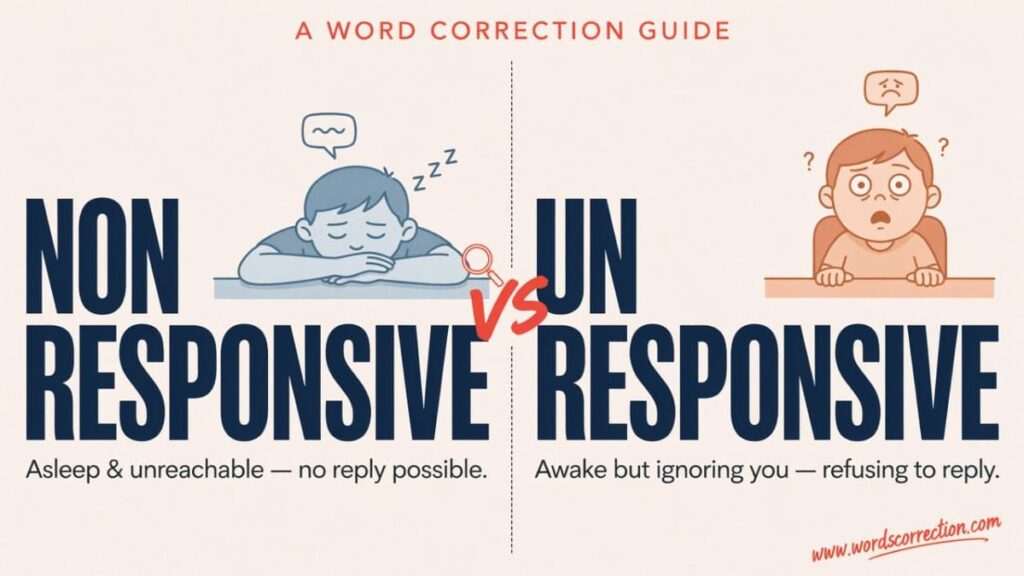
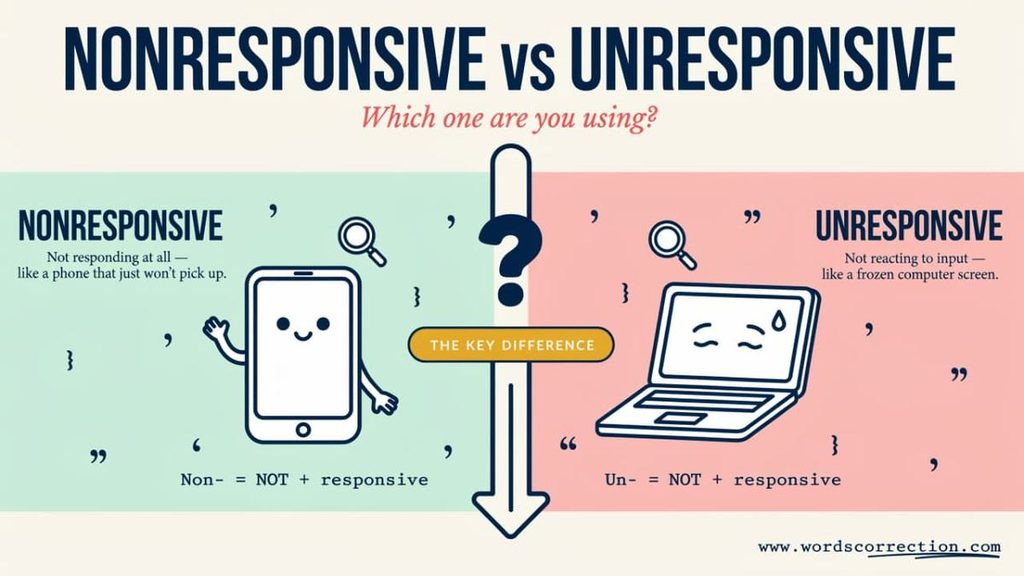
The main difference between nonresponsive vs unresponsive lies in how writers use them to describe a lack of response or reaction.
Nonresponsive commonly describes someone or something that fails to provide an expected answer, address a request, or meet a particular requirement. It frequently appears in formal, business, administrative, and technical writing.
Unresponsive commonly describes someone or something that fails to react to a person, action, command, or external stimulus. It appears frequently in everyday conversations, medical terminology, and descriptions of technology.
Consider these examples:
- Nonresponsive: The company remained nonresponsive to repeated customer complaints.
- Unresponsive: The patient was unresponsive to verbal instructions.
Both sentences describe a lack of response. However, the first focuses on a company’s failure to address complaints, while the second describes a patient’s failure to react to verbal communication.
Here’s another example:
- The website was nonresponsive to user requests.
- The website became unresponsive after the software update.
Both sentences are grammatically correct. The first emphasizes the website’s failure to provide the expected response. The second describes a technical problem in which the website stopped reacting to user commands.
Nonresponsive vs Unresponsive Comparison Table
| Feature | Nonresponsive | Unresponsive |
|---|---|---|
| Basic meaning | Not responding | Not responding or reacting |
| Common emphasis | Failure to answer or address something | Failure to react or respond |
| Tone | Often formal or technical | Common in everyday and technical English |
| People | Yes | Yes |
| Medical situations | Yes, in suitable contexts | Very common |
| Business communication | Very common | Also acceptable |
| Technology | Common | Very common |
| Grammar | Correct adjective | Correct adjective |
The important point: These distinctions describe common usage patterns, not strict grammatical rules. Neither word belongs exclusively to one context.
Learn the difference between tricky words and use them correctly
Faring vs Fairing what’s the Difference?
What Does Nonresponsive Mean?
Nonresponsive Meaning and Definition
Nonresponsive is an adjective that describes someone or something that fails to respond, answer, react, or address an expected request.
In simple words, nonresponsive means not giving the response that someone expects or needs.
The word combines the prefix non- with the adjective responsive. The prefix non- generally expresses absence or negation. Therefore, nonresponsive describes a lack of responsiveness.
For example, imagine sending three emails to a company about an incorrect bill. You receive no reply. In that situation, you could describe the company’s customer service department as nonresponsive.
Here are a few more examples:
- The applicant submitted a nonresponsive proposal.
- The manager was nonresponsive to the team’s concerns.
- The website received several complaints about its nonresponsive support system.
- The student’s answer was nonresponsive to the actual question.
Notice how each example involves an expected response that someone or something fails to provide.
Nonresponsive in Everyday English
Although nonresponsive often appears in formal writing, you can also use it in ordinary conversations.
It works particularly well when you want to describe a person, organization, service, or system that doesn’t provide an expected response.
For example:
In customer service:
“The company has been nonresponsive to my refund requests.”
This sentence suggests that the customer contacted the company but received no satisfactory response.
In education:
“The student’s answer was nonresponsive to the question.”
Here, the student provided an answer, but it didn’t address what the question actually asked.
In workplace communication:
“Management remained nonresponsive to employee concerns.”
This describes a failure to acknowledge or address workplace issues.
In technology:
“The application uses a nonresponsive design.”
This example has a different meaning. In web development, nonresponsive design refers to a layout that doesn’t adapt properly to different screen sizes. It doesn’t necessarily mean the application has stopped working.
That distinction matters because responsive also has a specialized meaning in web design.
Nonresponsive in Psychology and Communication
In psychology and interpersonal communication, nonresponsive can describe behavior in which someone shows little or no response during an interaction.
For example, a person might remain nonresponsive during a conversation, avoid answering questions, or fail to engage with another person’s attempts to communicate.
However, the word describes observable behavior. It doesn’t automatically explain why someone behaves that way.
A person who doesn’t respond might be:
- Distracted by something else.
- Uncomfortable discussing a particular subject.
- Emotionally overwhelmed.
- Uninterested in the conversation.
- Unable to communicate at that moment.
- Experiencing difficulty processing information.
For example:
“During the meeting, Daniel became nonresponsive when the team asked about the project delay.”
This sentence describes Daniel’s behavior. It doesn’t prove that he deliberately ignored the team.
Important distinction: Nonresponsive behavior doesn’t necessarily indicate indifference, hostility, or unwillingness. Context matters when interpreting human behavior.
Learn the difference between similar English words the easy way
Dought vs Doubt Which Spelling Is Correct?
What Does Unresponsive Mean?
Unresponsive Meaning and Definition
Unresponsive is an adjective that describes someone or something that fails to react, answer, or respond to an action, request, stimulus, or situation.
In simple words, unresponsive means not reacting or responding when a response is expected.
The word combines the prefix un- with responsive. The prefix un- commonly expresses the opposite of a quality or condition. In this case, it changes responsive into its negative form.
For example:
- The patient was unresponsive when the nurse called his name.
- My laptop became unresponsive after I opened several applications.
- The customer remained unresponsive despite repeated phone calls.
- The touchscreen is unresponsive to finger movements.
Each sentence describes a failure to react or respond.
Unlike nonresponsive, which often appears when discussing unanswered requests or unmet expectations, unresponsive frequently emphasizes a lack of reaction. Still, the distinction isn’t absolute. Both adjectives can describe similar situations.
Unresponsive in Everyday English
Unresponsive is a familiar word in everyday American English. You can use it to describe people, electronic devices, organizations, and situations where something fails to react.
Consider these examples:
Describing a person:
“Mark was unresponsive when his colleagues tried to speak with him.”
This means Mark didn’t answer or react during the interaction.
Describing a relationship:
“She felt hurt because her partner had become unresponsive to her messages.”
The sentence describes a lack of communication. It doesn’t necessarily establish the reason behind it.
Describing technology:
“My computer became unresponsive while I was editing the document.”
This means the computer stopped reacting to commands.
Describing customer service:
“The support team was unresponsive when I requested assistance.”
Here, unresponsive describes a failure to answer or help.
Unresponsive as a Medical Term
Medical professionals commonly use unresponsive to describe a person who doesn’t respond to voice, touch, or other stimuli.
For example:
“The emergency team found the patient unresponsive.”
This statement describes an important clinical observation. It doesn’t identify the underlying medical condition or explain why the patient isn’t reacting.
An unresponsive patient may have a serious medical problem involving consciousness, neurological function, oxygen supply, blood circulation, or another condition. However, the word itself isn’t a diagnosis.
Healthcare professionals assess responsiveness through observations and appropriate examinations.
These assessments may include checking whether the person:
- Opens their eyes in response to a voice.
- Responds to simple verbal instructions.
- Reacts to physical stimulation.
- Shows purposeful movement.
- Demonstrates signs of awareness.
A person who doesn’t respond normally requires urgent assessment. If someone is unresponsive and isn’t breathing normally, call emergency services immediately and follow the dispatcher’s instructions. Begin CPR and use an automated external defibrillator (AED) if indicated and available.
Another important distinction involves the phrase unresponsive to treatment. This doesn’t mean a patient is unconscious. Instead, it means a medical condition hasn’t improved or responded as expected to a particular treatment.
For example:
“The infection remained unresponsive to the initial treatment.”
The patient may be fully conscious even though the treatment hasn’t produced the desired result.
Learn the difference between commonly confused more words in English
Really vs Realy Which Spelling Is Correct?
Nonresponsive vs Unresponsive Key Differences in Context
Now that both definitions are clear, let’s examine how context influences the choice.
The difference between nonresponsive and unresponsive isn’t a simple grammatical formula. Instead, certain patterns make one word more natural than the other.
Response vs Reaction
One useful way to understand their common distinction is to consider the difference between responding and reacting.
A response often involves answering a question, addressing a request, or providing information.
A reaction often involves showing a physical, emotional, or behavioral change after something happens.
For example:
- A company that doesn’t answer customer complaints may be nonresponsive.
- A person who doesn’t react when someone calls their name may be unresponsive.
However, these categories overlap. A company can also be unresponsive to complaints, and a person can be nonresponsive during a conversation.
Formality and Tone
Nonresponsive often sounds more formal or administrative. You’ll commonly encounter it in official reports, business documents, procurement procedures, and professional evaluations.
Unresponsive sounds natural in everyday conversation. It also appears in technical and medical language.
Compare:
- Formal: The department was nonresponsive to the written complaint.
- Conversational: The department was unresponsive when I called.
Both sentences work. The difference comes from emphasis and writing style rather than grammatical correctness.
The Subject Being Described
The noun following an adjective can help you choose the more natural word.
| Subject | Natural example | Alternative |
|---|---|---|
| Company | Nonresponsive company | Unresponsive company |
| Patient | Unresponsive patient | Nonresponsive patient |
| Customer service | Nonresponsive customer service | Unresponsive customer service |
| Answer | Nonresponsive answer | Unresponsive answer |
| Computer | Unresponsive computer | Nonresponsive computer |
| Treatment | Unresponsive to treatment | Nonresponsive to treatment |
| Website design | Nonresponsive design | Not usually interchangeable with unresponsive design |
The last example deserves attention. In web development, responsive design describes a layout that adjusts to different screen sizes. Therefore, nonresponsive design has a specific technical meaning that differs from a website that simply stops working.
Learn the difference between confusing more English words step by step
Shute vs Chute Which Spelling Is Correct?
When Should You Use Nonresponsive vs. Unresponsive?
Choosing between these words becomes easier when you consider the situation and the kind of response involved.
Use Nonresponsive for Formal Answers and Requirements
When someone provides an answer that doesn’t address a question, nonresponsive is often the better choice.
For example:
“The candidate’s response was nonresponsive to the interview question.”
The candidate may have spoken at length. However, the answer didn’t address what the interviewer asked.
This usage also appears in:
- Academic examinations.
- Job applications.
- Official correspondence.
- Written complaints.
- Administrative decisions.
- Requests for information.
Consider another example:
“The application was rejected because the submitted documents were nonresponsive to the stated requirements.”
Here, the documents failed to address the specific requirements.
Use Nonresponsive in Business and Professional Communication
In business writing, nonresponsive often describes an organization or individual who fails to address a request, concern, or obligation.
For example:
“The supplier remained nonresponsive to repeated requests for updated delivery information.”
The word fits because the supplier failed to provide the expected information.
Other examples include:
- The department was nonresponsive to employee feedback.
- The company received criticism for its nonresponsive customer service.
- The contractor submitted a nonresponsive proposal.
- The management team remained nonresponsive to the reported concerns.
Nonresponsive in Legal Terminology
The word also has an established place in legal and administrative language.
In legal proceedings, a nonresponsive answer is an answer that doesn’t address the question asked. A witness might provide information that avoids the actual question or moves away from the subject.
The term also appears in discovery disputes and document requests.
For example:
“The court instructed the party to provide a complete response because the original submission was nonresponsive to the discovery request.”
In government contracting and procurement, a nonresponsive bid generally refers to a bid that fails to meet a material requirement in the solicitation.
For instance, a contractor might submit a proposal without a required document or fail to satisfy an essential technical specification.
Important: In procurement, responsiveness can have a specific legal meaning. A nonresponsive bid may be rejected under the applicable rules. The exact requirements depend on the governing contract documents and procurement regulations.
Use Unresponsive for People Who Don’t React
When describing someone who doesn’t react during an interaction, unresponsive often sounds natural.
For example:
“James became unresponsive when his teacher asked him a question.”
This sentence suggests that James didn’t answer or react.
You can also use the word in situations involving communication, relationships, and social interactions.
- My colleague was unresponsive during the discussion.
- The child appeared unresponsive when the teacher called his name.
- He became unresponsive after receiving the disappointing news.
- The customer remained unresponsive despite several follow-up messages.
Remember that a lack of response doesn’t always mean deliberate avoidance. Someone may be distracted, confused, distressed, or unable to communicate.
Use Unresponsive for Medical Situations
Medical writing commonly uses unresponsive when describing a patient’s reaction to external stimuli.
For example:
“The patient was unresponsive to verbal commands.”
This sentence describes an observable lack of reaction.
However, medical professionals also use nonresponsive in certain clinical contexts.
For example:
“The patient was nonresponsive to the initial treatment.”
Here, the sentence describes a lack of treatment response rather than a lack of consciousness.
Both words are possible in medical writing, but the intended meaning matters.
Use Either Word for Devices and Technology
Technology provides some of the clearest examples of overlapping usage.
Imagine that your computer freezes while you’re working. You click the mouse, press keys, and wait for the screen to react. Nothing happens.
You could say:
- My computer is unresponsive.
- My computer is nonresponsive to keyboard commands.
Both sentences are correct.
However, the first sounds more natural in everyday conversation. The second emphasizes the computer’s failure to respond to particular commands.
The same principle applies to:
- Mobile phones.
- Touchscreens.
- Websites.
- Software applications.
- Electronic equipment.
- Automated systems.
One special case is responsive web design. This established technical term refers to a website layout that adapts to different screen sizes and devices. A nonresponsive website may display poorly on mobile screens even when its software works perfectly.
Learn the difference between tricky English words with easy explanations
Grately vs Greatly Which Spelling Is Correct?
Nonresponsive vs Unresponsive Examples in Sentences
Definitions explain the meaning, but examples show how these adjectives work in real communication.
Examples of Nonresponsive in Sentences
Here are 10 examples of nonresponsive in different situations.
| Example | Context |
|---|---|
| The company was nonresponsive to customer complaints. | Business |
| His answer was nonresponsive to the question. | Education |
| The department remained nonresponsive to employee concerns. | Workplace |
| The contractor submitted a nonresponsive bid. | Procurement |
| The website had a nonresponsive layout. | Web development |
| The manager was nonresponsive to repeated requests. | Professional communication |
| The agency received criticism for its nonresponsive service. | Public administration |
| The committee rejected the nonresponsive proposal. | Formal evaluation |
| Her nonresponsive behavior made the conversation difficult. | Interpersonal communication |
| The patient was nonresponsive to the initial intervention. | Healthcare |
Examples of Unresponsive in Sentences
The following examples show how unresponsive works in everyday, medical, and technical contexts.
| Example | Context |
|---|---|
| The patient was unresponsive when the nurse called his name. | Healthcare |
| My phone became unresponsive after the update. | Technology |
| She felt upset because her friend was unresponsive to her messages. | Personal communication |
| The computer remained unresponsive for several minutes. | Technology |
| The child appeared unresponsive to verbal instructions. | Education or healthcare |
| The customer service representative was unresponsive to my request. | Business |
| The device became unresponsive after overheating. | Electronics |
| He seemed unresponsive during the conversation. | Everyday English |
| The treatment was unresponsive to the initial approach. | Healthcare |
| The touchscreen was unresponsive to finger movements. | Technology |
One small improvement is worth making in the ninth example. For clearer medical writing, say:
“The patient’s condition was unresponsive to the initial treatment.”
This version makes it clear that the condition didn’t improve rather than suggesting that the treatment itself failed to respond.
Examples Where Both Words Are Correct
Sometimes, both adjectives fit the same sentence without changing its basic meaning.
| With Nonresponsive | With Unresponsive |
|---|---|
| The company was nonresponsive to complaints. | The company was unresponsive to complaints. |
| The employee was nonresponsive during the meeting. | The employee was unresponsive during the meeting. |
| The computer was nonresponsive to commands. | The computer was unresponsive to commands. |
| The support team remained nonresponsive. | The support team remained unresponsive. |
| The patient was nonresponsive to verbal instructions. | The patient was unresponsive to verbal instructions. |
These examples demonstrate why treating one word as universally correct and the other as incorrect creates confusion.
The best choice depends on what you’re describing and which expression sounds most natural in that context.
Learn the difference between more words people mix up
An Hour or A Hour Which one Is Correct?
Nonresponsive vs Unresponsive Synonyms
Both adjectives have several synonyms. However, not every alternative carries exactly the same meaning. Some describe a lack of communication, while others suggest silence, inactivity, or an inability to react.
Choosing the right synonym helps you avoid repetition without changing your intended message.
Nonresponsive Synonyms
Common synonyms for nonresponsive include:
| Synonym | Meaning | Example |
|---|---|---|
| Uncommunicative | Not willing or able to communicate | The employee was uncommunicative during the discussion. |
| Inattentive | Not paying attention | The student was inattentive during class. |
| Uncooperative | Unwilling to cooperate | The department was uncooperative with the investigation. |
| Irrelevant | Not related to the subject | His answer was irrelevant to the question. |
| Nonreactive | Not showing a reaction | The material remained nonreactive under the test conditions. |
| Silent | Not speaking or making a sound | The committee remained silent. |
These words aren’t perfect replacements in every situation.
For example, uncooperative suggests unwillingness to help, while nonresponsive simply describes a failure to respond. A person might be nonresponsive without deliberately refusing to cooperate.
Unresponsive Synonyms
Common synonyms for unresponsive include:
| Synonym | Meaning | Example |
|---|---|---|
| Unreactive | Not showing a reaction | The substance was unreactive under normal conditions. |
| Uncommunicative | Not communicating effectively | He became uncommunicative after the argument. |
| Silent | Not speaking | She remained silent throughout the meeting. |
| Inert | Not active or capable of movement or reaction in a particular context | The machine remained inert without power. |
| Unconscious | Not awake or aware of surroundings | The injured person was unconscious. |
| Unresponsive | Failing to react or answer | The patient remained unresponsive to verbal commands. |
Be careful with unconscious. Although an unconscious person is generally unresponsive, the words don’t mean exactly the same thing. Someone can be conscious but fail to answer a question.
Nonresponsive and Unresponsive Antonyms
Antonyms are useful when you want to express the opposite meaning.
Nonresponsive antonyms:
- Responsive
- Attentive
- Communicative
- Cooperative
- Engaged
- Relevant (when describing an answer)
Unresponsive antonyms:
- Responsive
- Reactive
- Attentive
- Communicative
- Active
- Alert (in appropriate contexts)
The most direct antonym for both words is responsive.
For example:
- Nonresponsive: The company was nonresponsive to customer feedback.
- Responsive: The company was responsive to customer feedback.
Similarly:
- Unresponsive: The touchscreen was unresponsive.
- Responsive: The touchscreen was responsive.
Learn the difference between everyday English mistakes
Realist vs Realest What’s the Difference?
Why Do People Confuse Nonresponsive and Unresponsive?
If both words describe a lack of response, why do writers struggle to choose between them?
The confusion comes from their similar meanings, shared word structure, and overlapping applications. Several factors contribute to the problem.
Similar Meanings
The biggest reason is simple: both adjectives describe the absence of an expected response.
When someone doesn’t answer a question, you might call that person nonresponsive vs unresponsive. When a company ignores customer complaints, either word may describe the situation.
This overlap makes it difficult to establish a strict boundary between them.
The Difference Between Non- and Un-
Both words use negative prefixes, but the prefixes don’t create a rigid difference in meaning.
- Non- generally indicates absence or negation.
- Un- often indicates the opposite of a quality or condition.
However, English doesn’t apply these prefixes through one universal rule. Their meanings depend on the words they modify and how speakers use them.
For example, nonresponsive and unresponsive have developed overlapping meanings. You can’t determine the correct choice simply by looking at their prefixes.
Overlapping Contexts
Both adjectives can describe:
- People who don’t answer questions.
- Organizations that fail to address complaints.
- Devices that don’t react to commands.
- Patients who don’t respond to stimuli.
- Services that fail to meet expectations.
Because they appear in similar situations, writers sometimes treat them as exact synonyms.
Although they can be interchangeable in many sentences, their common usage patterns still matter.
Formal and Informal Word Usage
Another reason for the confusion involves tone.
Nonresponsive often appears in formal documents, reports, and professional communication. Meanwhile, unresponsive frequently appears in everyday conversations.
For example:
- Formal: The organization remained nonresponsive to the written request.
- Informal: The organization was unresponsive when I called.
This is a tendency rather than a grammatical requirement. You can use unresponsive in formal writing and nonresponsive in ordinary conversation.
Learn how to use confusing more words correctly
Flys vs Flies Which Spelling Is Correct?
Nonresponsive vs Unresponsive in Different Professional Contexts
The meaning of a word can become more specific when it enters a specialized field. Medical, legal, psychological, and technical writing provide useful examples.
Nonresponsive vs Unresponsive in Medical Terms
In healthcare, both adjectives can describe a lack of response. However, the specific situation determines which expression makes sense.
Unresponsive commonly describes a patient who doesn’t react to voice, touch, or other stimuli.
Example:
“The emergency team found the patient unresponsive.”
Nonresponsive can describe a condition that doesn’t improve after treatment.
Example:
“The infection was nonresponsive to the prescribed medication.”
You may also encounter the phrase unresponsive to treatment. It describes the same general lack of treatment effectiveness.
For example:
“The patient’s condition remained unresponsive to the initial treatment.”
The important distinction is between a patient’s responsiveness and a medical condition’s response to treatment.
A patient can be alert and communicative while their illness remains unresponsive to medication.
Nonresponsive vs Unresponsive in Psychology
In psychology and behavioral discussions, both words can describe observable behavior.
Nonresponsive behavior may involve:
- Failing to answer questions.
- Avoiding participation in conversations.
- Showing little engagement during an interaction.
- Not acknowledging another person’s communication.
Unresponsive behavior can describe a similar lack of reaction, particularly when someone doesn’t react to emotional or social cues.
For example:
“During the counseling session, the client appeared unresponsive to the therapist’s questions.”
This sentence describes an observation. It doesn’t establish a psychological diagnosis.
Likewise, a person who doesn’t respond to emotional support isn’t necessarily indifferent. Stress, anxiety, discomfort, communication difficulties, and many other factors can influence behavior.
A useful writing principle: Describe what someone does rather than assuming why they do it.
Nonresponsive in Legal Terminology
Legal writing frequently uses nonresponsive to describe answers, documents, and submissions that fail to address a particular request.
For example:
“The witness gave a nonresponsive answer.”
This means the witness didn’t directly answer the question.
Another example:
“The submitted documents were deemed nonresponsive to the discovery request.”
Here, the documents failed to satisfy the request’s requirements.
In procurement, a nonresponsive bid may fail to meet a material condition in a solicitation. This can have important consequences because contracting authorities generally evaluate submissions against established requirements.
Nonresponsive in Business Communication
Business communication depends on clear and timely responses.
When a company fails to answer customer questions, address complaints, or provide requested information, nonresponsive is a natural choice.
For example:
“The supplier was nonresponsive to repeated requests for an updated delivery schedule.”
You can also use unresponsive:
“The supplier remained unresponsive throughout the negotiation.”
Both are correct. The first sounds slightly more administrative, while the second works naturally in general business communication.
Nonresponsive in Technology
Technology introduces another interesting distinction.
A nonresponsive design doesn’t adapt properly to different screen sizes. An unresponsive application, on the other hand, may stop reacting to user commands.
For example:
- “The website has a nonresponsive layout.”
- “The website became unresponsive after the update.”
These sentences describe two different technical problems.
In the first, the website may work normally but display incorrectly on a mobile device.
In the second, the website has stopped responding to user interactions.
Understanding this distinction prevents a common technical writing mistake.
Learn the difference between commonly misused words
Gluing vs Glueing Which Spelling Is Correct?
Common Mistakes When Using Nonresponsive and Unresponsive
Even experienced writers sometimes confuse these adjectives. Fortunately, most mistakes become easier to avoid once you understand their meanings.
Here are some common problems and their corrections.
| Common mistake | Better usage | Explanation |
|---|---|---|
| Assuming nonresponsive is incorrect English | Both words are correct. | Nonresponsive is a standard adjective. |
| Assuming unresponsive only describes unconscious people | The computer became unresponsive. | The word also describes devices and systems. |
| Using nonresponsive to imply intentional ignoring | The employee was nonresponsive to the request. | Lack of response doesn’t prove intent. |
| Treating unresponsive and unconscious as exact synonyms | The patient was unresponsive. | Unresponsiveness doesn’t automatically establish unconsciousness. |
| Using nonresponsive design to describe frozen software | The software became unresponsive. | The two expressions describe different technical issues. |
| Assuming one word is always more formal | Both work in formal writing. | Context determines the natural choice. |
| Treating every synonym as interchangeable | Choose a synonym based on its precise meaning. | Words such as uncooperative add meaning that nonresponsive doesn’t necessarily carry. |
Is Nonresponsive One Word or Two?
Yes, nonresponsive is conventionally written as one word.
Correct: The company was nonresponsive to the complaint.
Incorrect in standard usage: The company was non responsive to the complaint.
The standard spelling doesn’t require a space or hyphen.
Is Unresponsive One Word or Two?
Unresponsive is also written as one word.
Correct: The phone became unresponsive.
Incorrect: The phone became un responsive.
Unlike some English expressions that change spelling depending on their grammatical function, unresponsive has a standard closed spelling.
Is Nonresponsive Hyphenated?
No. The standard spelling is nonresponsive, without a hyphen.
For example:
- Nonresponsive customer service.
- Nonresponsive behavior.
- Nonresponsive proposal.
- Nonresponsive system.
The same principle applies to unresponsive. Write it as one word.
Learn the difference between basic English word mistakes
Tieing vs Tying Which Spelling Is Correct?
Real-Life Situations Which Word Should You Choose?
Sometimes a quick comparison makes more sense than a long grammatical explanation. Let’s look at a few everyday situations.
Job Interview
Imagine an interviewer asks a candidate about previous work experience. Instead of answering the question, the candidate discusses an unrelated topic.
You could say:
“The candidate gave a nonresponsive answer.”
However, if the candidate doesn’t react when the interviewer asks a question, this sentence sounds natural:
“The candidate appeared unresponsive during the interview.”
Workplace Meeting
Suppose employees raise concerns about a new company policy, but management doesn’t address them.
“The management team was nonresponsive to employee feedback.”
Now imagine one employee doesn’t react when a colleague speaks to them.
“The employee seemed unresponsive during the discussion.”
Both descriptions work because they focus on different situations.
Email and Text Messages
You send a colleague an email asking for an important document. Several days pass without a reply.
You could write:
“My colleague has been nonresponsive to my emails.”
Alternatively:
“My colleague has been unresponsive to my messages.”
Both sentences are correct. The first may sound slightly more formal, while the second is natural in everyday communication.
Exams and Assignments
A student writes an answer that doesn’t address the question.
“The student’s answer was nonresponsive to the prompt.”
This is more precise than saying the answer was simply wrong. The student might have included accurate information, but it wasn’t relevant to the question.
Healthcare
A nurse calls a patient’s name, but the patient doesn’t react.
“The patient was unresponsive to verbal commands.”
This is an appropriate description of the observed behavior. Medical professionals would need further assessment to determine the patient’s condition.
Technology
Your laptop freezes while you’re working on an important report.
“My laptop became unresponsive.”
However, if you’re discussing a website that doesn’t adjust to smaller screens, you might say:
“The website has a nonresponsive design.”
The difference isn’t just stylistic. The sentences describe separate technical problems.
How to Choose the Right Word Practical Writing Tips
When you’re unsure whether to use nonresponsive vs unresponsive, ask yourself a few simple questions.
Identify What Isn’t Responding
Start by identifying the subject.
Are you describing:
- A person?
- A company?
- A medical patient?
- A written answer?
- A computer?
- A service?
- A treatment?
Both words can describe many of these subjects, but identifying the subject helps establish the context.
Consider the Type of Response
Next, consider what kind of response you expect.
Someone supposed to answer a question? A company expected to address a complaint? A device supposed to react to a command? Is a patient expected to respond to a stimulus?
For example:
“The answer was nonresponsive to the question.”
This focuses on the quality and relevance of the answer.
“The patient was unresponsive to verbal stimuli.”
This focuses on the patient’s reaction.
Consider Your Audience
Formal documents may benefit from nonresponsive when describing unanswered requests, irrelevant answers, or unmet requirements.
In casual conversation, unresponsive often sounds more natural.
However, don’t force a distinction where none exists. Clear communication matters more than choosing a word simply because it sounds formal.
Follow Established Technical Terminology
Specialized fields often develop preferred expressions.
For example:
- Web development uses responsive design and nonresponsive design.
- Healthcare commonly uses unresponsive patient.
- Procurement uses nonresponsive bid.
- Business writing uses both nonresponsive and unresponsive to describe poor communication.
When writing for a specialized audience, follow the terminology used in that field.
Avoid Assuming Someone’s Intentions
A person who doesn’t respond might be busy, distracted, uncomfortable, or unable to communicate.
Calling someone unresponsive describes their behavior. Calling them uncooperative suggests something more.
Choose words carefully when describing people, especially in professional, psychological, and medical contexts.
Quick Memory Trick Nonresponsive vs Unresponsive
Here’s an easy way to remember the difference:
- Nonresponsive: Think of an expected answer, request, or requirement that receives no appropriate response.
- Unresponsive: Think of a person, device, or system that fails to react.
For example:
“Management was nonresponsive to the complaint.”
“The computer became unresponsive.”
This memory trick can help you make a quick choice. Just remember that it’s a general usage guide, not a strict grammatical rule.
Practice Session Nonresponsive vs Unresponsive
Fill in each blank with Nonresponsive vs Unresponsive.
- The customer service department remained __________ despite several emails.
- The patient became __________ after the medical emergency.
- The company was __________ to repeated customer complaints.
- My computer became __________ after the software update.
- The patient was __________ to verbal instructions.
- The treatment proved __________ because the condition did not improve.
- The manager was __________ to employees’ concerns.
- The website became __________ during heavy traffic.
- The patient remained __________ to external stimuli.
- The organization was __________ to customer feedback.
- The medication was __________ to the patient’s condition.
- He appeared __________ when his colleagues asked questions.
- The technical support team was __________ to my requests.
- The application became __________ and stopped working.
- The patient was __________ to physical stimuli.
- The company remained __________ despite several complaints.
- The proposed solution was __________ to the project requirements.
- The doctor found the patient __________ to verbal attempts.
- The organization was __________ to suggestions.
- The software became __________ after a system error.
- The employee was __________ to important instructions.
- The patient’s condition was __________ to conventional treatment.
- The company remained __________ to formal complaints.
- The device became __________ when the technician pressed its buttons.
- The patient remained __________ despite repeated attempts to communicate.
Answers
- Nonresponsive
- Unresponsive
- Nonresponsive
- Unresponsive
- Unresponsive
- Nonresponsive
- Nonresponsive
- Unresponsive
- Unresponsive
- Nonresponsive
- Nonresponsive
- Unresponsive
- Nonresponsive
- Unresponsive
- Unresponsive
- Nonresponsive
- Nonresponsive
- Unresponsive
- Nonresponsive
- Unresponsive
- Nonresponsive
- Nonresponsive
- Nonresponsive
- Unresponsive
- Unresponsive
Here’s a trusted source for clear word meanings:
Cambridge Dictionary
FAQs
General Meaning and Differences
Which is correct nonresponsive vs unresponsive?
Both nonresponsive and unresponsive are correct English words. They describe someone or something that fails to respond or react. However, unresponsive is more common in everyday communication, while nonresponsive is frequently used in formal, medical, legal, and technical contexts.
What is the main difference between nonresponsive and unresponsive?
The main difference between nonresponsive and unresponsive is their usage rather than their meaning. Both describe a lack of response, but unresponsive is more commonly used in everyday English, whereas nonresponsive often appears in specialized or professional contexts.
Can nonresponsive and unresponsive be used interchangeably?
Yes, nonresponsive and unresponsive can often be used interchangeably because they share similar meanings. However, the most appropriate choice depends on the context, particularly in medical, legal, and professional writing.
Is nonresponsive a real word?
Yes, nonresponsive is a recognized English word. It describes someone or something that does not respond, react, or provide an expected answer. It is commonly used in professional, technical, and formal communication.
Is nonresponsive written as one word or with a hyphen?
Nonresponsive is conventionally written as one word without a space or hyphen. The alternative spelling non-responsive is also used, but nonresponsive is a standard spelling in modern English.
Medical and Psychological Contexts
What does nonresponsive mean in medical terminology?
In medical terminology, nonresponsive describes a patient who does not react to external stimuli, verbal instructions, or attempts at communication. It can also refer to a medical condition that does not improve with a particular treatment.
What does it mean when a patient is medically unresponsive?
A medically unresponsive patient does not demonstrate an expected reaction to stimuli, such as sounds, touch, or verbal commands. This condition may indicate a serious medical emergency and requires immediate medical assessment.
Which term is more appropriate in medical reports nonresponsive vs unresponsive?
Both terms are appropriate in medical documentation. However, unresponsive is widely used to describe a patient’s lack of reaction to stimuli, while nonresponsive can describe patients, medical conditions, or treatments that fail to produce an expected response.
What is the difference between nonresponsive and unresponsive in psychology?
In psychology, unresponsive generally describes someone who shows little or no emotional, verbal, or behavioral reaction to a situation. Nonresponsive can describe a similar lack of reaction, particularly when discussing communication, behavior, or responses to psychological interventions.
Can someone be unresponsive without being unconscious?
Yes, someone can be unresponsive without being unconscious. A person may be awake but unable or unwilling to communicate, answer questions, or react appropriately. Sudden or unexplained unresponsiveness should always be treated as a potential medical emergency.
Synonyms and Alternative Expressions
What are the best synonyms for nonresponsive?
Common synonyms for nonresponsive include unresponsive, unreceptive, inactive, indifferent, inattentive, and noncommunicative. The most suitable synonym depends on whether the word describes a person’s behavior, communication, or reaction to a particular situation.
What is another word for someone who does not respond to messages?
Someone who does not respond to messages can be described as unresponsive, noncommunicative, inattentive, or unavailable. In informal conversations, the term ghoster may also describe someone who suddenly stops communicating without explanation.
What is a professional way to describe a lack of response?
Professional alternatives for a lack of response include failure to respond, delayed communication, absence of feedback, no acknowledgment, and lack of communication. These expressions are appropriate for workplace emails, business reports, and formal correspondence.
What is the opposite of nonresponsive and unresponsive?
The opposites of nonresponsive and unresponsive include responsive, attentive, receptive, communicative, and reactive. These words describe someone or something that responds appropriately to communication, instructions, or external stimuli.
What is the difference between unresponsive, indifferent, and unreceptive?
Unresponsive describes someone who does not react or reply. Indifferent refers to a person who shows little interest or concern, while unreceptive describes someone who is unwilling to accept or consider ideas, suggestions, or information.
Everyday Communication and Practical Usage
How do you use nonresponsive and unresponsive in sentences?
Both words can be used in different situations to describe a lack of response. Here are some examples:
- The customer service department remained nonresponsive to repeated complaints.
- He was unresponsive to my messages throughout the day.
- The patient became unresponsive after the incident.
- The condition was nonresponsive to the prescribed treatment.
- The computer became unresponsive after the software update.
Can nonresponsive describe a company or customer service department?
Yes, nonresponsive can describe a company, organization, or customer service department that fails to answer inquiries, address complaints, or provide requested information. For example, “The company was nonresponsive to several customer complaints.”
What does nonresponsive mean in legal and business writing?
In legal and business writing, nonresponsive describes an answer, document, proposal, or bid that fails to address specific requirements or meet established conditions. It can also refer to an individual or organization that does not respond to an official request.
What does an unresponsive computer or website mean?
An unresponsive computer or website is a system that fails to react to user commands, mouse clicks, or keyboard inputs. This problem may result from software errors, insufficient memory, connectivity issues, or system crashes.
How can you politely describe someone who is not responding?
You can politely describe someone as unavailable, yet to respond, or unable to provide a reply. Expressions such as “I have not received a response yet” and “I am still waiting for an update” communicate the situation professionally without sounding confrontational.
Grammar, Usage, and Examples
Is nonresponsive considered a formal or informal word?
Nonresponsive is generally considered a neutral to formal word, particularly in medical, legal, business, and technical writing. However, it is also acceptable in everyday English when describing someone or something that fails to respond.
Is nonresponsive hyphenated in British and American English?
Nonresponsive is commonly written as one word in both American and British English. The hyphenated spelling, non-responsive, is also used, although spelling preferences may vary depending on the publication or style guide.
Which expression is correct nonresponsive to treatment or unresponsive to treatment?
Both expressions are grammatically correct. However, unresponsive to treatment is a widely used phrase in medical contexts to describe a condition that does not improve despite receiving a particular treatment.
What are the most common mistakes when using nonresponsive vs unresponsive?
Common mistakes include using unnecessary spaces or hyphens, confusing the words with unrelated meanings, and assuming that every lack of response indicates deliberate ignorance. Although both words describe a failure to respond, the context determines which expression is most appropriate.
How can you remember when to use nonresponsive vs unresponsive?
A simple way to remember the difference is to use unresponsive for everyday situations involving people, communication, and reactions. Choose nonresponsive when writing about formal, medical, legal, or technical situations. Both words are correct, but selecting the appropriate term makes your writing clearer and more precise.
Learn the difference between often confused words
Enable vs Inable What’s the difference?
Conclusion
Understanding the difference between nonresponsive vs unresponsive is easier than it may seem. Both words describe a lack of response, and their meanings often overlap. However, the context determines which word sounds more natural and appropriate. Nonresponsive commonly appears in business, formal communication, and administrative settings, while unresponsive is widely used in everyday language and medical contexts.
The key is to focus on what you want to describe. Are you talking about someone who fails to reply to a message or someone who does not react to their surroundings? Choosing the right word makes your meaning clearer and your writing more effective. Once you understand their usage, you won’t have to guess between these two similar words. After all, good grammar isn’t about making things complicated; it’s about making your message easy to understand.

Stella AJS is an experienced blogger and dedicated English language writer at Words Correction. She turns confusing grammar, word meanings, spelling, and usage into clear, practical insights that readers can easily understand and apply. With a passion for precise and engaging writing, Stella helps readers avoid common language mistakes, strengthen their vocabulary, and communicate with greater clarity and confidence.




