
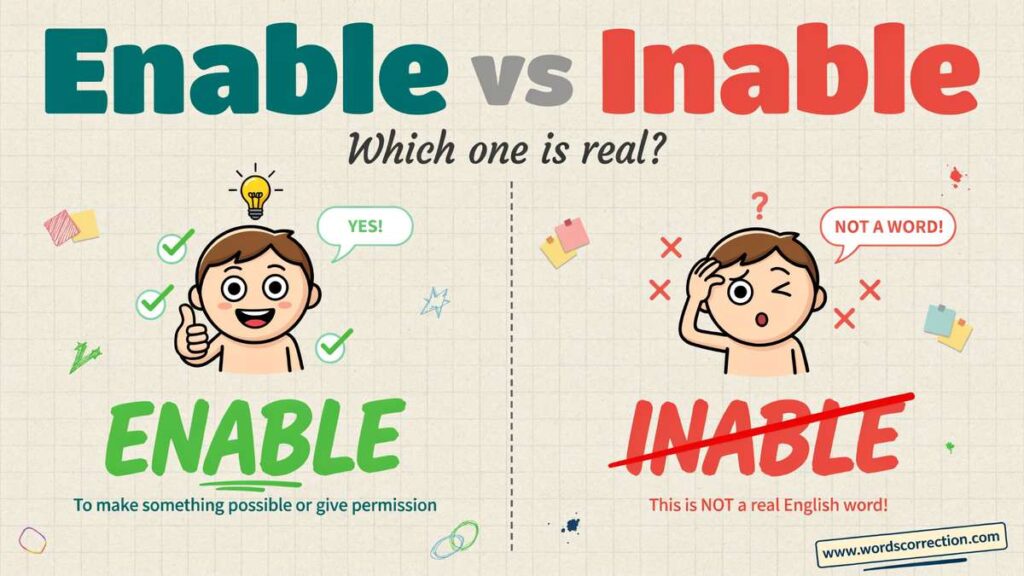
English spelling can be confusing, especially when similar-looking words have different meanings. The difference between Enable vs Inable is a good example. You may wonder whether “inable” is a correct word, an old spelling, or simply a common spelling mistake. The confusion is understandable because English has words like “unable” and “incapable,” which can make the spelling even trickier. So, which word should you use? In this guide, you’ll learn the meanings of enable, unable, and inable, understand their differences, and explore simple examples to help you avoid common grammar and spelling mistakes.
Enable vs Inable The Quick Answer
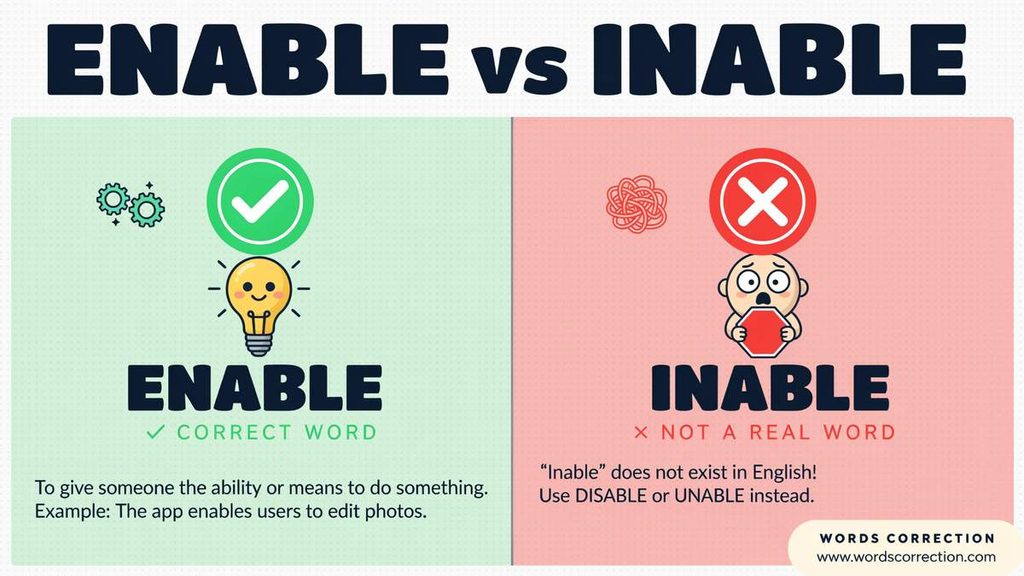
Enable is the correct modern spelling when you mean to make something possible. Unable is the correct word when you mean that someone cannot do something. Inable is an obsolete or nonstandard form that you should avoid in contemporary English.
Consider these examples
- Correct: The new software will enable employees to finish their work faster.
- Correct: I am unable to attend the meeting tomorrow.
- Not recommended: The new software will inable employees to finish their work faster.
- Not recommended: I am inable to attend the meeting tomorrow.
Notice that enable and unable don’t perform the same grammatical job. The first describes an action that makes something possible. The second describes a lack of ability.
Here’s a quick comparison:
| Word | Meaning | Part of speech | Modern usage |
|---|---|---|---|
| Enable | Make something possible | Verb | Correct |
| Unable | Not capable of doing something | Adjective | Correct |
| Inable | Historical form of enable or unable | Obsolete/nonstandard verb or adjective | Avoid |
The easiest way to remember the distinction is:
- Enable = Make it possible.
- Unable = Cannot do it.
- Inable = Avoid in modern standard English.
What Does Enable Mean?
The word enable means to make someone capable of doing something or make an action possible by providing the necessary ability, resources, permission, or support. Understanding Enable vs Inable helps you recognize why “enable” is the correct modern spelling.
Enable is a verb, specifically a transitive verb. This means it normally takes a direct object. You enable someone, enable something, or enable a particular action. In Enable vs Inable, remember that “enable” is the accepted standard English word.
For example:
- The scholarship enabled Maria to attend college.
- New technology enables doctors to diagnose certain conditions more quickly.
- This application enables users to manage their accounts online.
- Regular practice enables students to improve their writing skills.
In each example, something provides the means or opportunity to achieve a particular goal. This is the central meaning of “enable” and an important point to remember when learning Enable vs Inable.a particular result.
Enable as a Verb Meaning and Usage
As a verb, enable describes the action of making something possible. It can involve providing equipment, knowledge, financial support, permission, or another necessary resource.
For instance, imagine someone wants to start a small business but doesn’t have enough money. A financial grant could enable that person to purchase equipment and open a shop.
The grant doesn’t operate the business itself. Instead, it provides the means to make the goal achievable.
Common sentence structure:
Enable + someone/something + to + base verb
Examples:
- Good teachers enable students to think independently.
- The new system enables customers to track their orders.
- Her savings enabled her to purchase a house.
- The training program enables workers to develop valuable skills.
One important grammar rule: Don’t omit to before the second verb in this construction.
- Correct: The course enables students to learn new skills.
- Incorrect: The course enables students learn new skills.
Enable in Everyday Communication
People use enable in conversations about opportunities, education, personal growth, and practical solutions.
For example, a parent might say:
“My savings will enable my daughter to continue her education.”
A manager might explain:
“Better communication tools enable our team to work more efficiently.”
A student might write:
“Access to online resources enables me to study from home.”
In each case, enable connects a resource or opportunity with the result it makes possible.
Enable in Technology and Computing
In technology, enable often means to activate a feature, switch on a setting, or allow a device or application to perform a particular function.
You’ve probably seen this word while using a smartphone, computer, website, or online account.
Common examples include:
- Enable notifications to receive alerts.
- Enable location access to use navigation features.
- Enable Bluetooth to connect wireless devices.
- Enable two-factor authentication to add account security.
- Enable dark mode to change an application’s appearance.
In these situations, enable doesn’t necessarily mean giving a person a new physical ability. Instead, it means allowing a feature or function to operate.
Enable Word Forms and Related Words
Understanding the different forms of enable helps you use the word correctly in different tenses and sentence structures.
| Word form | Grammatical role | Example |
|---|---|---|
| Enable | Base verb | This tool can enable remote access. |
| Enables | Present tense | The feature enables faster communication. |
| Enabled | Past tense/past participle | The update enabled the new feature. |
| Enabling | Present participle/gerund | Enabling notifications is simple. |
| Enablement | Noun | Employee enablement improves workplace performance. |
Remember: The past tense of enable is enabled, not inabled.
Learn the difference between tricky words and use them correctly
Waring vs Wearing Which Word Is Correct?
What Does Unable Mean?
The word unable means not having the ability, capacity, or practical means to perform an action.
Unlike enable, unable is an adjective. It describes a person, organization, or situation rather than expressing an action that makes something possible.
For example:
- I am unable to attend the training session.
- She was unable to complete the assignment on time.
- The company is unable to provide additional funding.
- We were unable to contact the customer.
Each sentence describes a lack of ability or an obstacle that prevents someone from completing an action.
Unable as an Adjective
Unable usually appears after a form of the verb be, such as am, is, are, was, and were.
Its most common grammatical structure is:
Subject + be + unable + to + base verb
Examples:
- He is unable to drive.
- They are unable to solve the problem.
- I was unable to open the document.
- She will be unable to join us tomorrow.
Notice that the word to comes before the main verb. This is an important part of correct grammatical usage.
When to Use Unable in a Sentence
Use unable when someone cannot perform an action because of a limitation, difficulty, or lack of necessary resources.
Here are some common situations:
Physical limitations
- The injured player was unable to continue the match.
- He is unable to walk without assistance.
Lack of resources
- The company was unable to purchase new equipment.
- We are unable to afford the additional expenses.
Technical problems
- I was unable to access my email account.
- The computer was unable to connect to the network.
Unexpected circumstances
- She was unable to attend because of an emergency.
- We were unable to reach the destination before sunset.
Unable vs Not Able
Both expressions communicate a similar meaning. However, their grammatical structures and tone can differ slightly.
| Unable | Not able |
|---|---|
| More concise | Slightly more conversational |
| Common in formal writing | Common in everyday speech |
| She is unable to attend. | She is not able to attend. |
| We were unable to respond. | We were not able to respond. |
Neither expression is automatically better in every situation. Choose the one that sounds natural in your sentence.
Unable Word Forms and Related Words
Unable belongs to a word family associated with ability.
| Word | Part of speech | Meaning |
|---|---|---|
| Able | Adjective | Having the ability |
| Unable | Adjective | Lacking the ability |
| Ability | Noun | The power or skill to do something |
| Inability | Noun | The lack of ability |
| Ably | Adverb | In a capable or skilled manner |
For example:
- She is able to complete the project.
- She is Is Inable a Word?
- This is where the spelling confusion becomes interesting. When discussing Enable vs Inable, the answer is not simply yes or no.
- “Inable” has historical recognition in English, but it is not a standard word for modern everyday writing. Historical references record it as an obsolete form of “enable.” Some historical and specialist references also recognize it as an obsolete or nonstandard adjective meaning “unable.”
- So, if you’re asking whether “inable” has ever appeared in English, the answer is yes. However, when choosing between Enable vs Inable for a modern email, school assignment, business document, or blog post, use “enable” or “unable” instead. Understanding Enable vs Inable will help you avoid outdated or incorrect word choices.unable to complete the project.
- Her ability to communicate is excellent.
- Her inability to communicate clearly caused confusion.
One spelling detail matters here: Inability is correct, but inable is not the standard modern adjective. The existence of a legitimate word such as inability doesn’t mean every similar-looking form is also correct.
Learn the difference between similar English words the easy way
Wise vs Wize Which Spelling Is Correct?
Is Inable a Word?
This is where the spelling confusion becomes interesting. When discussing Enable vs Inable, the answer is not simply yes or no.
“Inable” has historical recognition in English, but it is not a standard word for modern everyday writing. Historical references record it as an obsolete form of “enable.” Some historical and specialist references also recognize it as an obsolete or nonstandard adjective meaning “unable.”
So, if you’re asking whether “inable” has ever appeared in English, the answer is yes. However, when choosing between Enable vs Inable for a modern email, school assignment, business document, or blog post, use “enable” or “unable” instead. Understanding Enable vs Inable will help you avoid outdated or incorrect word choices.
The Historical Meaning of Inable
The word inable has appeared in older English vocabulary with more than one meaning.
Its historical uses include:
- As a verb: An obsolete alternative spelling of enable, meaning to make someone or something capable of doing something.
- As an adjective: An obsolete or nonstandard form meaning unable or not capable of doing something.
This explains why older dictionaries and historical word references may include it.
However, historical recognition doesn’t automatically make a spelling appropriate today. English changes over time. Words that once appeared in ordinary writing can become outdated, uncommon, or replaced by more widely accepted forms.
For modern readers, enable and unable communicate the intended meanings clearly.
Why Inable Is Not Recommended in Modern Writing
There are several practical reasons to avoid this spelling.
First, readers expect standard modern forms. When someone sees inable in an email or article, they may assume the writer intended to type unable or enable.
Second, it creates unnecessary confusion. Both modern words already have established meanings and grammatical functions. Introducing an obsolete spelling makes the sentence harder to understand.
Third, common spellcheck tools may flag it. Although a spelling checker isn’t a complete authority on historical vocabulary, its suggestions can reveal which forms are widely accepted in contemporary writing.
Consider these examples:
| Sentence with inable | Better modern version |
|---|---|
| The new system will inable users to save files. | The new system will enable users to save files. |
| I am inable to complete the work. | I am unable to complete the work. |
| This opportunity will inable her to study abroad. | This opportunity will enable her to study abroad. |
The correct replacement depends on the intended meaning. Don’t replace every occurrence of inable with enable automatically.
Learn the difference between commonly confused more words in English
Faring vs Fairing what’s the Difference?
Enable vs Unable vs Inable Key Differences
Although these three spellings look similar, their meanings and grammatical functions differ.
The most important distinction is between making something possible and lacking the ability to do something.
| Feature | Enable | Unable | Inable |
|---|---|---|---|
| Standard modern spelling | Yes | Yes | No |
| Part of speech | Verb | Adjective | Obsolete/nonstandard verb or adjective |
| Main meaning | Make something possible | Not capable | Historical meanings |
| Common structure | Enable someone to do something | Be unable to do something | Avoid |
| Opposite or related form | Disable | Able | No standard modern role |
| Modern writing | Recommended | Recommended | Not recommended |
Enable vs Unable The Main Difference
The difference between enable and unable becomes easier to understand when you compare their functions.
Enable describes an action that creates an opportunity or provides the ability to do something. Unable describes a condition in which someone cannot perform an action.
Compare
- The scholarship enables students to attend university.
- Some students are unable to attend university because of financial difficulties.
The first sentence explains how financial support makes education possible. The second describes a limitation that prevents students from attending.
Here’s another example
- The new application enables users to edit videos.
- I am unable to edit videos because my computer isn’t working.
The application provides a useful function. The computer problem creates an obstacle.
Enable vs Able What’s the Difference?
These words share the same basic idea of ability, but they aren’t interchangeable.
- Able describes having the capacity or skill to do something.
- Enable describes making someone or something capable of doing something.
Examples:
| Able | Enable |
|---|---|
| She is able to speak three languages. | Language classes enable students to learn new languages. |
| I am able to complete the task. | The new software enables me to complete the task. |
| He is able to work independently. | His training enabled him to work independently. |
Think of able as describing an existing capability and enable as providing what someone needs to develop or use that capability.
Enable vs Disable Opposite Meanings
If you’re looking for the opposite of enable, disable is generally the correct choice.
Enable means to activate, permit, or make something possible. Disable means to deactivate, prevent, or make something unable to function.
These words frequently appear together in technology.
Common examples include
- Enable notifications to receive alerts.
- Disable notifications to stop receiving alerts.
- Enable automatic updates to install new versions.
- Disable automatic updates to manage installations manually.
A useful comparison:
| Enable | Disable |
|---|---|
| Activate a feature | Deactivate a feature |
| Allow an action | Prevent or restrict an action |
| Make something possible | Make something unavailable or inactive |
| Enable Bluetooth | Disable Bluetooth |
Important: Unable and disable aren’t interchangeable. Unable describes a lack of ability, while disable describes an action that removes or restricts a function.
Unable vs Incapable
Both unable and incapable describe a lack of ability, but they have slightly different patterns.
Unable commonly refers to a particular situation or action.
- I am unable to finish the report today.
- She was unable to answer the question.
Incapable often describes a person’s general capacity or a specific limitation.
- He is incapable of operating the machine without training.
- The damaged device is incapable of processing large files.
Grammar also differs:
- Unable to do something.
- Incapable of doing something.
For example:
- Correct: She is unable to swim.
- Correct: She is incapable of swimming.
Both sentences communicate a similar idea, but their grammatical structures aren’t identical.
Learn the difference between confusing more English words step by step
Dought vs Doubt Which Spelling Is Correct?
How to Use Enable, Unable, and Inable Correctly
Knowing definitions is useful. Applying them correctly in real sentences is even better.
The easiest approach is to identify what you want to communicate before choosing a spelling.
Use Enable When Something Makes an Action Possible
Choose enable when a person, resource, tool, opportunity, or system provides the means to achieve something.
Examples:
- Online courses enable people to learn from home.
- Financial assistance enables families to afford education.
- Modern equipment enables doctors to perform complex procedures.
- A reliable internet connection enables remote employees to work efficiently.
- Good communication enables teams to solve problems faster.
In each sentence, the subject helps make an action possible.
Use Unable When Someone Cannot Do Something
Choose unable when you want to express a lack of ability or the inability to complete an action.
Examples:
- I am unable to attend the conference.
- The students were unable to finish the examination.
- She is unable to access her account.
- We were unable to find the correct address.
- The company is unable to meet the delivery deadline.
Remember the common construction:
Be + unable + to + base verb
Don’t write unable for do, unable doing, or unable to completed.
Use Enable Someone to Do Something
This is one of the most common grammatical patterns involving enable.
The structure looks like this:
Enable + person/object + to + base form of verb
Examples:
- The new policy enables employees to work remotely.
- The training enabled him to improve his performance.
- This feature enables customers to make online payments.
- The funding will enable the organization to expand its services.
The word to is essential in this construction.
Use Be Unable to Do Something
Unable follows a different pattern.
Subject + be + unable + to + base form of verb
Examples:
- I am unable to understand the instructions.
- She was unable to finish the presentation.
- They are unable to attend the event.
- We will be unable to provide the service tomorrow.
Compare the structures:
| Enable | Unable |
|---|---|
| The course enables me to learn. | I am unable to learn without support. |
| The tool enables users to communicate. | Users are unable to communicate without the tool. |
| The funding enabled us to expand. | We were unable to expand without funding. |
These patterns help you understand the correct use of enable without relying on guesswork.
Learn the difference between tricky English words with easy explanations
Really vs Realy Which Spelling Is Correct?
Enable vs Inable Examples in Everyday English
Examples make the distinction easier to remember. The following sentences demonstrate how these words work in different situations.
Enable Example Sentences
Here are ten examples of enable in a sentence:
- The new software enables employees to complete tasks more efficiently.
- Financial support enabled her to continue her education.
- This device enables users to monitor their health data.
- Good leadership enables teams to achieve shared goals.
- The internet enables people to communicate across long distances.
- Regular exercise enables the body to maintain strength.
- The new policy will enable businesses to operate more efficiently.
- This setting enables automatic backups.
- Her experience enabled her to solve the problem quickly.
- The scholarship enabled several students to attend college.
Unable Example Sentences
Here are ten examples showing the correct use of unable:
- I am unable to attend the meeting today.
- She was unable to find her missing documents.
- The company is unable to accept new orders.
- We were unable to complete the project before the deadline.
- He is unable to use the application without assistance.
- They were unable to reach an agreement.
- The machine was unable to process the information.
- I will be unable to respond until Monday.
- The team was unable to solve the technical problem.
- She is unable to travel because of unexpected circumstances.
Inable in a Sentence Historical and Modern Usage
If you encounter inable in an old document, its meaning may depend on the context.
For example:
- Historical verb usage: An older text might use inable where modern English would use enable.
- Historical adjective usage: An older or nonstandard text might use inable where modern English would use unable.
These examples explain the historical forms rather than recommend them.
In contemporary writing, use:
- The new program enables students to learn.
- The students are unable to access the program.
Incorrect vs Correct Sentence Examples
The following table highlights mistakes that commonly occur when writers confuse these words.
| Incorrect sentence | Correct sentence |
|---|---|
| This feature will inable users to save files. | This feature will enable users to save files. |
| I am inable to attend the event. | I am unable to attend the event. |
| The training inabled her to improve. | The training enabled her to improve. |
| He is unable for complete the task. | He is unable to complete the task. |
| The application enable users to communicate. | The application enables users to communicate. |
| She was enable to finish the project. | She was able to finish the project. |
| The company will inable the feature. | The company will enable the feature. |
Pay attention to the last two examples. Sometimes the correct replacement isn’t simply enable or unable. You may need able or a different verb depending on the intended meaning.
Learn the difference between more words people mix up
Shute vs Chute Which Spelling Is Correct?
Why Do People Confuse Enable, Unable, and Inable?
English spelling isn’t always predictable. Some words follow familiar patterns, while others developed through different historical roots. That’s why a spelling that looks logical can still be incorrect in modern usage.
The confusion surrounding enable vs inable usually comes from several related factors.
The Similarity Between Enable and Unable
At first glance, enable and unable look almost identical. Both contain the letters able, and both relate to the idea of having an ability.
However, their meanings and grammatical roles differ.
- Enable is a verb that means to make someone capable of doing something.
- Unable is an adjective that means not capable of doing something.
For example:
- The new equipment enables workers to lift heavy materials.
- The injured worker is unable to lift heavy materials.
Because these words look similar, learners sometimes assume that inable must be the negative form of enable. That’s where the confusion begins.
Confusion About Negative Prefixes in English
English uses several prefixes to change the meanings of words. Three common examples are un-, in-, and en-.
| Prefix | General function | Examples |
|---|---|---|
| Un- | Often expresses the opposite or absence of something | Unable, unfair, unhappy |
| In- | Often expresses negation | Inactive, inaccurate, incomplete |
| En- | Often means to cause, make, or put into a particular state | Enable, enrich, encourage |
These patterns explain why someone might assume that adding in- to able creates a correct opposite.
However, English word formation doesn’t work like a mathematical formula. You can’t attach any negative prefix to a word and automatically create an accepted spelling.
For example:
- Happy → Unhappy
- Accurate → Inaccurate
- Active → Inactive
- Able → Unable
The established negative form of able is unable, not inable.
The Connection Between Unable and Inability
Another reason people confuse these spellings is the relationship between unable and inability.
Both are standard English words, and both express the absence of ability.
Consider their grammatical differences:
| Word | Part of speech | Example |
|---|---|---|
| Able | Adjective | She is able to swim. |
| Unable | Adjective | She is unable to swim. |
| Ability | Noun | Swimming is an important ability. |
| Inability | Noun | His inability to swim surprised everyone. |
The word inability uses the negative prefix in- with the noun ability. That is why some learners mistakenly create inable by applying the same pattern to the adjective.
However, the correct adjective remains unable.
Spelling Overlap and Autocorrect Mistakes
Typing quickly can create spelling errors, especially when two words share similar letters.
For example, someone might type inable while intending to write unable. Another writer might confuse it with enable because both words appear frequently in educational and professional contexts.
Autocorrect can help identify some errors, but it doesn’t understand every sentence’s intended meaning.
Consider:
- The system will enable the feature.
- I am unable to use the feature.
Both sentences are grammatically correct, but replacing one word with the other changes the meaning.
A spelling checker can identify suspicious words, but understanding the sentence helps you choose the right replacement.
Overgeneralization of English Word Formation
Learners sometimes develop a spelling rule after noticing a few similar examples.
For instance, they may learn that:
- Unhappy means not happy.
- Unfair means not fair.
- Inactive means not active.
- Incomplete means not complete.
Then they assume that inable must mean not able.
Although the reasoning seems sensible, established English usage follows particular word histories and conventions. Not every word accepts every prefix.
The best approach is to learn common word families rather than create new forms by guessing.
Translation Interference
Another source of common English spelling mistakes is translating directly from another language.
A learner may understand the idea of making someone unable to do something and attempt to construct an English word using a familiar negative prefix.
Unfortunately, direct translation doesn’t always preserve English spelling patterns.
For example, a phrase that translates literally into something resembling not able should normally become unable in English.
Reading well-written English examples and learning complete sentence patterns can help prevent these mistakes.
Learn the difference between everyday English mistakes
Grately vs Greatly Which Spelling Is Correct?
Common Grammar Mistakes to Avoid
Even after learning the correct spelling, writers sometimes use enable and unable incorrectly.
Here are the most important mistakes to watch for:
- Using inable instead of enable: Write “The application enables users to edit photos.”
- Using inable instead of unable: Write “I am unable to attend.”
- Confusing enable with able: Write “The training enabled her to improve” when discussing something that provided the opportunity.
- Omitting to after enable: Write “The program enables students to learn.”
- Using the wrong verb form: Write “The feature enables users” rather than “The feature enable users.”
- Using the wrong structure after unable: Write “She is unable to complete the task.”
- Confusing inability with unable: Use inability as a noun and unable as an adjective.
- Treating disable and unable as interchangeable: Disable is a verb, while unable is an adjective.
A Quick Grammar Checklist
Before publishing an article, sending an email, or submitting an assignment, check these points:
- Did you use enable when you mean to make something possible?
- Did you use unable when you mean someone cannot do something?
- Did you avoid inable in modern standard English?
- Did you use the correct verb tense?
- Did you include to after enable and unable in their common sentence patterns?
- Did you distinguish inability from unable?
- Did you use disable when you mean to deactivate a function?
These small checks can prevent several avoidable writing errors.
Learn the difference between commonly misused words
An Hour or A Hour Which one Is Correct?
Enable vs Unable in Formal and Informal Writing
Both enable and unable work in formal and informal English. Their suitability doesn’t depend on whether you’re writing a casual message or a professional document.
What matters is using the right word for the intended meaning.
Enable in Formal Writing
Enable frequently appears in business reports, academic writing, technical documentation, and professional communication.
Examples:
- The proposed changes will enable the organization to improve operational efficiency.
- The research findings enable further investigation into the subject.
- The new system enables employees to access important information remotely.
In professional writing, enable can communicate how a resource, process, or development makes an action possible.
Unable in Formal Writing
Unable is equally appropriate in formal communication.
Examples:
- We regret that we are unable to process your request at this time.
- The research team was unable to verify the results.
- The organization is currently unable to provide additional assistance.
These sentences sound natural and professional without unnecessary complexity.
Enable and Unable in Informal Writing
You can also use both words in everyday conversations.
For example:
- “This app enables me to organize everything in one place.”
- “I’m unable to come over tonight.”
- “The new phone enables faster downloads.”
- “I’m unable to open the file.”
There’s no need to replace these words with complicated alternatives simply to sound more conversational.
Should You Use Inable in Formal or Informal Writing?
Generally, no.
Even though historical references recognize the spelling, it isn’t suitable for ordinary modern communication.
Avoid it in:
- Academic assignments.
- Professional emails.
- Business reports.
- Website content.
- Social media posts.
- Technical instructions.
- Everyday messages.
Use enable or unable according to the meaning you intend.
Learn the difference between basic English word mistakes
Realist vs Realest What’s the Difference?
Enable vs Unable Practical Case Studies
Understanding a word becomes easier when you see how it works in realistic situations. The following illustrative examples show how enable and unable communicate different ideas.
Case Study A Student Applying for a Scholarship
Imagine a student who wants to attend university but cannot afford the tuition fees.
A scholarship provides financial assistance and makes higher education possible.
Correct use of enable:
“The scholarship enabled the student to attend university.”
Now consider the same situation from another perspective.
Correct use of unable:
“Without financial assistance, the student was unable to attend university.”
The first sentence describes an opportunity created by financial support. The second describes the limitation that existed without it.
Case Study
A Business Introducing New Software
A company introduces software that allows employees to manage orders, track deliveries, and communicate with customers.
Correct use of enable:
“The new software enables employees to manage customer orders more efficiently.”
However, imagine an employee who cannot access the system because of an internet outage.
Correct use of unable:
“The employee was unable to access the software because of the network problem.”
The software enables an action, while the network problem creates an inability.
Case Study A Smartphone Feature
Suppose you want your smartphone to send notifications whenever someone messages you.
You open the settings and activate notifications.
Correct use of enable:
“Enable notifications to receive message alerts.”
Later, you decide to stop receiving those alerts.
Correct use of disable:
“Disable notifications to stop receiving message alerts.”
If your phone cannot activate the feature because of a software error, you might say:
“The device is unable to enable notifications.”
These examples demonstrate why context matters more than spelling similarity.
Learn the difference between often confused words
Gluing vs Glueing Which Spelling Is Correct?
Enable Synonyms and Antonyms
Learning synonyms and antonyms helps expand your vocabulary and gives you more ways to express the same idea.
However, not every alternative works in every sentence. Choose a replacement that preserves the original meaning.
Enable Synonyms
Here are several common synonyms of enable:
| Synonym | Meaning | Example |
|---|---|---|
| Allow | Give permission or opportunity | The policy allows employees to work remotely. |
| Permit | Officially allow something | The rules permit students to use calculators. |
| Empower | Give someone authority or confidence | Training empowers employees to make decisions. |
| Facilitate | Make an action easier | Technology facilitates communication. |
| Equip | Provide necessary tools or skills | The course equips students with practical knowledge. |
| Authorize | Give official permission | The manager authorized the payment. |
| Make possible | Create the conditions for something | The grant made the project possible. |
These words overlap with enable, but their meanings aren’t identical.
For example, authorize focuses on permission, while equip emphasizes providing the necessary tools or resources.
Enable Antonyms
The most direct opposite of enable is usually disable, especially in technical contexts.
Other possible antonyms depend on the sentence.
| Antonym | Meaning |
|---|---|
| Disable | Prevent something from functioning |
| Prevent | Stop something from happening |
| Block | Obstruct access or progress |
| Restrict | Limit what someone can do |
| Hinder | Make an action more difficult |
| Prohibit | Officially forbid something |
For example:
- Enable access ↔ Restrict access.
- Enable a feature ↔ Disable a feature.
- Enable progress ↔ Hinder progress.
Choose the antonym according to the context rather than treating all these words as interchangeable.
Learn the difference between confusing word pairs
Tieing vs Tying Which Spelling Is Correct?
Enable Pronunciation How Do You Say Enable?
Pronunciation can also contribute to spelling confusion, especially when learners hear a word before seeing it written.
The standard American English pronunciation of enable is:
- IPA: /ɪˈneɪbəl/
- Syllables: Three
- Stress: Second syllable
The word begins with a short vowel sound, followed by the stressed sound in able.
For comparison:
| Word | American English IPA |
|---|---|
| Enable | /ɪˈneɪbəl/ |
| Unable | /ʌnˈeɪbəl/ |
Notice the difference at the beginning. Enable starts with the /ɪ/ sound, while unable starts with /ʌ/.
Although their pronunciations sound somewhat similar, their meanings and grammatical roles are different.
How to Remember the Difference Between Enable and Unable
Remembering these words doesn’t require memorizing complicated grammar rules. A simple association can help you choose the correct spelling.
Enable = Make something possible.
Unable = Not capable of doing something.
Inable = An obsolete or nonstandard form to avoid in modern writing.
Here are three easy memory tricks:
Think about the action. If something gives a person the ability or opportunity to perform an action, use enable.
Think about the limitation. If someone cannot perform an action, use unable.
Remember the established word family. Able and unable are opposites, while ability and inability are related nouns.
Try this quick exercise:
- The new application will _____ users to manage their accounts.
- I am _____ to attend the interview tomorrow.
- The company _____ its employees to work remotely.
Answers:
- Enable
- Unable
- Enables
Once you connect each word with its purpose, the spelling becomes much easier to remember.
Practice Session Enable vs. Inable
Choose the correct word to complete each sentence. Use enable or unable where appropriate.
- Modern technology can ______ people to work from anywhere.
- Please ______ notifications on your mobile phone.
- The new software will ______ users to edit documents easily.
- I am ______ to attend the meeting today.
- Parents should ______ their children to make good decisions.
- You must ______ Bluetooth to connect your headphones.
- She was ______ to complete the assignment on time.
- Good education can ______ students to achieve their goals.
- The administrator decided to ______ the security feature.
- He was ______ to open the locked door.
- This application will ______ you to manage your finances.
- I am ______ to access my email account.
- Please ______ location services on your device.
- The training program will ______ employees to improve their skills.
- They were ______ to find a suitable solution.
- This tool can ______ users to save time.
- She is ______ to attend the online class.
- You can ______ dark mode in your phone settings.
- The new system will ______ customers to track their orders.
- He was ______ to answer the difficult question.
- Teachers should ______ students to develop critical thinking skills.
- I was ______ to complete the task without assistance.
- Please ______ automatic updates on your computer.
- These resources will ______ learners to improve their English.
- The broken internet connection made us ______ to join the meeting.
Answers
- Enable
- Enable
- Enable
- Unable
- Enable
- Enable
- Unable
- Enable
- Enable
- Unable
- Enable
- Unable
- Enable
- Enable
- Unable
- Enable
- Unable
- Enable
- Enable
- Unable
- Enable
- Unable
- Enable
- Enable
- Unable
Here’s a trusted source for clear word meanings:
Cambridge Dictionary
FAQs
Is Inable a Real Word in English?
“Inable” is an obsolete or nonstandard English form and is not commonly accepted in modern English. In most situations use “enable” to mean making something possible or “unable” to describe a lack of ability.
What Is the Difference Between Enable vs Inable?
“Enable” is a standard English verb meaning to make something possible or give someone the ability to do something. “Inable” is a nonstandard form that should generally be avoided in modern writing.
Which Spelling Is Correct Enable vs Inable?
“Enable” is the correct standard spelling in modern English. It is used when someone makes an action possible or provides an opportunity or activates a feature. “Inable” is not the accepted spelling for this meaning.
What Does the Word Enable Mean?
“Enable” means to give someone the ability resources or permission to do something. It can also mean activating a feature or function. For example enabling notifications allows a device to display alerts.
What Does Inable Mean in Modern English?
“Inable” is generally considered an obsolete or nonstandard form in modern English. It is not recommended in everyday communication or formal writing. Depending on the intended meaning “enable” or “unable” may be the appropriate word.
Is Inable an Obsolete English Word?
Yes. “Inable” has appeared historically as a variant form but it is obsolete or nonstandard in contemporary usage. Modern writers should use established alternatives such as “enable” or “unable” depending on the context.
Why Do People Confuse Enable vs Inable?
People may confuse “enable” and “inable” because their spellings look similar. The unusual beginning of “inable” can also make it seem like a negative form of “able.” However “unable” is the standard word for expressing a lack of ability.
Is Unable the Correct Alternative to Inable?
“Unable” is the correct alternative when describing someone who cannot do something. For example write “I am unable to attend the meeting” rather than “I am inable to attend the meeting.” The two words do not have the same meaning as “enable.”
What Is the Difference Between Enable and Unable?
“Enable” is a verb meaning to make something possible while “unable” is an adjective describing someone who lacks the ability to do something. For example “The software enables users to edit files” and “I am unable to edit this file.”
Does Enable Mean to Allow Someone to Do Something?
Yes. “Enable” can mean giving someone the opportunity permission or ability to do something. For example “The new policy enables employees to work remotely” means the policy makes remote work possible.
Does Enable Mean to Make Something Possible?
Yes. “Enable” commonly means making an action process or situation possible. For example “Modern technology enables people to communicate across long distances” explains how technology makes communication easier.
What Is the Opposite of Enable?
The most common opposite of “enable” is “disable” particularly when discussing devices software or features. Other opposites may include prevent hinder obstruct and restrict depending on the context.
Is Disable the Opposite of Enable?
Yes. “Disable” is the direct opposite of “enable” in many contexts. Enable means to activate or make something functional while disable means to deactivate or prevent it from functioning. For example you can enable or disable notifications on your phone.
How Do You Pronounce the Word Enable?
The word “enable” is pronounced ih-NAY-buhl. It has three syllables with the primary stress on the second syllable. Practicing the correct pronunciation can help improve spoken English and vocabulary confidence.
What Part of Speech Is Enable?
“Enable” is a verb. It describes an action that makes something possible or gives someone the ability to perform a task. For example “This application enables users to manage their accounts.”
What Is the Past Tense and Past Participle of Enable?
Both the past tense and past participle of “enable” are “enabled.” The word follows the regular English verb pattern by adding “-d” to its final silent e. For example “The administrator enabled the security feature.”
What Is the Noun Form of Enable?
The noun form of “enable” is “enablement.” It refers to the process of providing someone with the ability resources or authority to accomplish something. For example “Employee enablement improves workplace productivity.”
What Are the Most Common Synonyms of Enable?
Common synonyms of “enable” include allow permit empower authorize facilitate equip and make possible. The best synonym depends on the sentence because these words can express slightly different meanings.
What Are the Antonyms of Enable?
Common antonyms of “enable” include disable prevent hinder obstruct restrict and prohibit. “Disable” is particularly suitable when discussing technology while “prevent” and “hinder” are useful in general situations.
How Do You Use Enable in Everyday English?
“Enable” is commonly used when discussing opportunities abilities permissions and technology. For example “Online courses enable students to learn from home.” It can also describe activating settings such as enabling location services on a smartphone.
Can Enable Be Used When Talking About Technology?
Yes. “Enable” is frequently used in technology-related contexts. It describes activating a feature function or setting on a device or application. For example “Enable Bluetooth to connect your phone to wireless headphones.”
What Does It Mean to Enable Someone to Do Something?
To enable someone to do something means to provide the ability resources support or opportunity they need to complete an action. For example “Good education enables students to build successful careers.”
Is I Am Inable to Attend Grammatically Correct?
No. “I am inable to attend” is not standard modern English. The correct sentence is “I am unable to attend.” Use “unable” when explaining that you cannot participate in an activity or event.
Should I Use Unable or Not Able in a Sentence?
Both “unable” and “not able” are grammatically correct. However “unable” is generally more concise and formal. For example “She is unable to complete the assignment” and “She is not able to complete the assignment” communicate the same basic meaning.
How Can You Remember the Correct Spelling of Enable?
You can remember “enable” by connecting it with the word “able.” Adding the prefix and spelling pattern creates “enable” meaning to make someone able to do something. Remember that “unable” expresses the opposite idea while “inable” is not the standard modern spelling.
Conclusion
English spelling can be confusing, especially when a small prefix changes a word’s meaning. However, Enable vs Inable is an easy spelling difference to understand once you learn the correct usage. In Enable vs Inable, “enable” is the correct modern English word, meaning to make something possible or give someone the ability to do something. “Unable” means lacking the ability to do something, while “inable” is an outdated spelling that is not used in modern standard English. Understanding Enable vs Inable helps you avoid confusing these words in everyday writing. Remember this simple rule: you enable a feature, but you may be unable to use it. By learning Enable vs Inable, you can improve your spelling and use the correct word with confidence. Keep this distinction in mind, and Enable vs Inable will no longer be a confusing spelling pair.

Stella AJS is an experienced blogger and dedicated English language writer at Words Correction. She turns confusing grammar, word meanings, spelling, and usage into clear, practical insights that readers can easily understand and apply. With a passion for precise and engaging writing, Stella helps readers avoid common language mistakes, strengthen their vocabulary, and communicate with greater clarity and confidence.




