
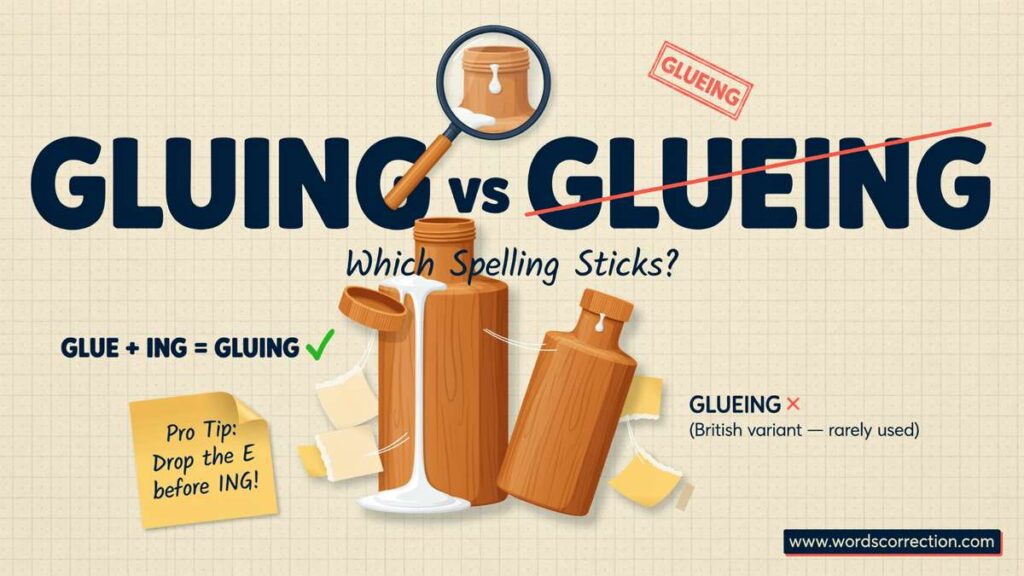
English spelling rules can make even simple words confusing, and gluing versus glueing is a perfect example. Both spellings may look correct, but choosing the right one can leave writers unsure about the rules for adding -ing to a verb. The good news is that the difference is easier to understand than it seems. In this article, we’ll explore gluing vs glueing, explain what each spelling means, and show why the silent e is usually dropped. You’ll also learn which form works best in everyday writing, with clear examples to help you avoid common spelling mistakes.
Quick Answer Is It Gluing vs Glueing?
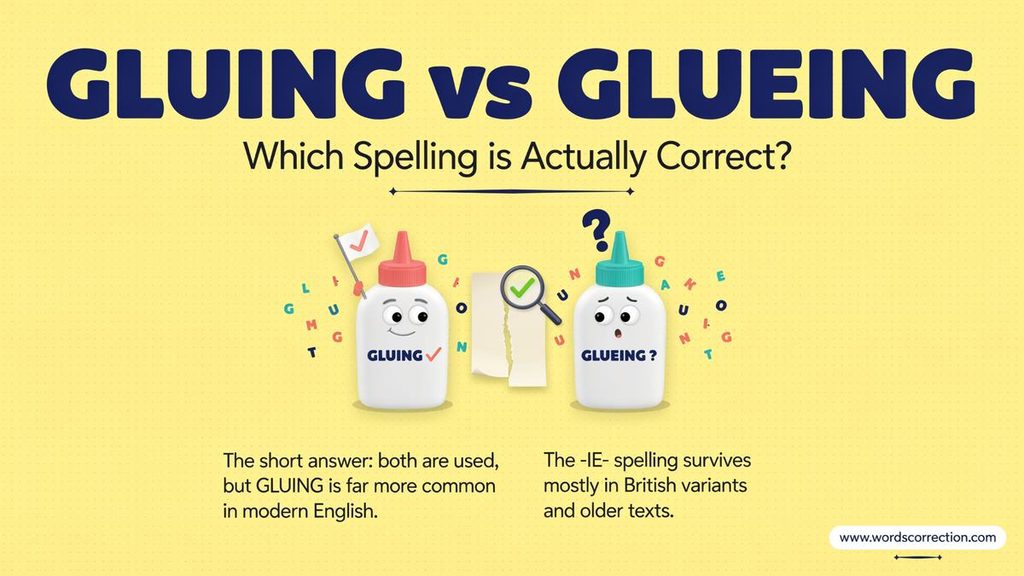
Both gluing vs glueing are recognized spellings of the present participle of the verb glue. They have the same meaning and pronunciation, so neither spelling describes a different action.
However, gluing is the more straightforward choice for general modern writing. It follows the familiar English spelling pattern of removing a final silent e before adding the suffix -ing. The Oxford Advanced American Dictionary also lists gluing as its preferred form.
Here’s a quick comparison
| Feature | Gluing | Glueing |
|---|---|---|
| Spelling status | Correct | Correct |
| Dictionary recognition | Yes | Yes |
| Meaning | Joining with glue | Joining with glue |
| Pronunciation | /ˈɡluːɪŋ/ | /ˈɡluːɪŋ/ |
| Grammatical function | Present participle and gerund | Present participle and gerund |
| American English | Standard form | Recognized alternative in general English references |
| British English | Accepted | Accepted |
| General writing recommendation | Practical default | Acceptable alternative |
The easiest rule to remember: Choose gluing for everyday, academic, and professional writing unless your preferred dictionary or style guide recommends otherwise. You can still recognize glueing as a valid alternative.
For example
- Gluing: Sarah is gluing the broken pieces of her favorite vase together.
- Glueing: Sarah is glueing the broken pieces of her favorite vase together.
Both sentences communicate exactly the same information.
Learn the difference between tricky words and use them correctly
Moment vs Momment Which Spelling Is Correct?
What Does Gluing Mean?
Gluing means joining, attaching, or bonding two or more surfaces using glue or another adhesive substance. It describes the process of applying an adhesive so that separate materials stick together.
The word comes from the base verb glue, which functions as both a noun and a verb.
As a noun, glue refers to a sticky substance used to attach objects. As a verb, it describes the action of using that substance to connect materials.
For example
- The children are gluing colorful shapes onto their posters.
- Mark is gluing two pieces of wood together.
- She enjoys gluing photographs into her scrapbook.
- The technician is gluing a loose component back into place.
In each sentence, gluing describes the action of applying an adhesive to join materials.
Gluing Definition and Grammatical Function
The gluing definition depends on how the word functions within a sentence. English grammar commonly uses it in two ways: as a present participle and as a gerund.
| Grammatical form | Function | Example |
|---|---|---|
| Present participle | Forms a continuous verb tense | He is gluing the box. |
| Gerund | Functions as a noun | Gluing takes patience. |
Although both forms end in -ing, they perform different grammatical jobs. Recognizing this distinction helps you understand how to use gluing correctly.
Gluing as a Present Participle
A present participle is a verb form that ends in -ing. It commonly combines with an auxiliary verb to describe an ongoing action.
For example
- I am gluing the pieces together.
- She is gluing a photograph onto the page.
- They are gluing cardboard shapes for their school project.
- We were gluing the decorations when the lights went out.
In these sentences, gluing works with auxiliary verbs such as am, is, are, and were.
The complete verb phrases are am gluing, is gluing, are gluing, and were gluing. Each describes an action taking place at a particular time.
The present participle also appears in different continuous tenses
- Present continuous: He is gluing the broken handle.
- Past continuous: He was gluing the broken handle.
- Future continuous: He will be gluing the broken handle.
Notice that gluing remains unchanged while the auxiliary verb establishes the tense.
Gluing as a Gerund
A gerund is a verb form ending in -ing that functions as a noun. Although it comes from a verb, it can act as a subject, direct object, or complement within a sentence.
For example
- Subject: Gluing requires a steady hand.
- Direct object: She enjoys gluing paper decorations.
- Object of a preposition: He is interested in gluing wooden models.
- Subject complement: Her favorite part of the project is gluing the pieces together.
The difference becomes clearer when you compare two sentences
- She is gluing the photographs. Here, gluing forms part of a continuous verb phrase.
- Gluing photographs is her favorite hobby. Here, gluing functions as a noun.
The spelling stays the same, but the grammatical function changes.
Learn the difference between similar English words the easy way
Distress vs Duress what’s the Difference?
What Does Glueing Mean?
Glueing has the same meaning as gluing. It describes the process of attaching or joining objects with glue or another suitable adhesive.
The difference comes from the way writers form the word from its base verb. Gluing removes the final e before adding -ing, while glueing retains it.
Consider these examples
- She is glueing two pieces of cardboard together.
- The students are glueing pictures onto their classroom posters.
- He spent the afternoon glueing the wooden model.
- Glueing the broken decoration back together took several minutes.
Each sentence communicates the same meaning as its gluing alternative.
Glueing Meaning in Different Contexts
The glueing meaning doesn’t change according to the material or situation. However, the activity can involve different surfaces and purposes.
For example
- Crafting: Glueing paper shapes onto a greeting card.
- Woodworking: Glueing two wooden boards together.
- Home repairs: Glueing a loose decorative piece back onto furniture.
- Art: Glueing fabric and photographs onto a canvas.
- Manufacturing: Glueing components together during product assembly.
Although some readers find glueing less familiar, it remains an established spelling. It isn’t a separate verb or a technical term with a different definition.
Why Is Gluing Spelled Without an E?
The spelling gluing follows a familiar English word-formation pattern. Many verbs that end in a final silent e drop that letter before adding the suffix -ing.
For example
- Make → Making
- Bake → Baking
- Write → Writing
- Drive → Driving
- Move → Moving
- Glue → Gluing
This convention prevents unnecessary letters from appearing in the new word. However, English spelling isn’t perfectly uniform. Some verbs retain their final e when they take the same suffix.
That’s why both gluing vs glueing appear in established dictionaries.
The Silent E Rule Explained
The silent e rule is a common spelling convention in English. When a verb ends in a final silent e, writers generally remove that letter before adding -ing.
Consider the verb make
- Base verb: Make
- Suffix: -ing
- Result: Making
The final e disappears, producing making rather than makeing.
The same pattern appears in several familiar verbs
| Base verb | Correct -ing form |
|---|---|
| Bake | Baking |
| Dance | Dancing |
| Hope | Hoping |
| Write | Writing |
| Ride | Riding |
| Take | Taking |
| Move | Moving |
| Glue | Gluing |
This spelling convention is widely taught in English grammar lessons. It also explains why gluing looks natural to many readers.
However, spelling patterns are guides rather than mathematical formulas. Some words preserve the final e because of pronunciation, established usage, or the need to distinguish one word from another.
Why Some Verbs Keep the Final E Before -Ing
Not every verb ending in e drops that letter when adding -ing. Certain words retain it to preserve their established spelling or distinguish them from other words.
Here are some examples
| Base verb | -ing form | Reason |
|---|---|---|
| Dye | Dyeing | Distinguishes it from dying |
| See | Seeing | Preserves the established vowel spelling |
| Agree | Agreeing | Retains the existing vowel sequence |
| Be | Being | Established spelling |
| Singe | Singeing | Distinguishes it from singing |
| Cue | Cueing | Accepted spelling convention |
For example, dyeing refers to coloring something, while dying describes the process of losing life.
Similarly, singeing means slightly burning something, whereas singing refers to producing musical sounds with your voice.
These examples show why adding -ing to verbs requires more than mechanically deleting the last letter.
The word glue has its own established variation. Both gluing vs glueing are documented forms, so the spelling question cannot be settled simply by applying the general rule.
Learn the difference between commonly confused more words in English
Waring vs Wearing Which Word Is Correct?
Is Glueing a Real Word?
Yes. Glueing is a recognized English spelling, not merely a typing error or an invented variation.
Major dictionaries recognize it as an alternative present participle of glue. This matters because some spelling guides incorrectly claim that glueing is universally wrong.
The dictionary evidence provides a clearer answer
- The Oxford Advanced Learner’s Dictionary lists both gluing vs glueing as present participles.
- The Cambridge Dictionary also recognizes both forms.
- The Oxford Advanced American Dictionary lists gluing.
These entries demonstrate that dictionary recognition can vary between editions and regional references.
Gluing vs Glueing Oxford Dictionary Evidence
If you search for gluing vs. glueing Oxford Dictionary, you’ll find useful evidence in the Oxford Advanced Learner’s Dictionary.
Its entry for glue includes two -ing forms
- Gluing
- Glueing
Both forms have the same pronunciation: /ˈɡluːɪŋ/.
This confirms that Oxford recognizes both spellings in its learner’s dictionary.
However, the Oxford Advanced American Dictionary presents a more specific regional picture. It lists gluing as the -ing form.
That distinction matters because a general English dictionary may include alternative forms that an American English dictionary doesn’t list as its preferred form.
What Does Cambridge Dictionary Say?
The Cambridge Dictionary also recognizes both spellings.
Its entry for glue identifies glueing and gluing as present participles. It also lists glued as the past tense and past participle.
This confirms that glueing isn’t simply an informal invention or an obsolete form.
You can verify the information in the Cambridge Dictionary entry for glue.
What About Merriam-Webster?
Merriam-Webster is another useful reference for American English spelling and word usage.
Its dictionary explains glue as both a noun and a verb. When checking a particular inflected form, consult the current dictionary entry rather than assuming that every reference handles alternative spellings in exactly the same way.
For American writing, gluing is the straightforward choice.
The important lesson is that dictionary recognition, regional preference, and everyday spelling habits aren’t necessarily identical.
Learn the difference between confusing more English words step by step
Wise vs Wize Which Spelling Is Correct?
Gluing vs Glueing in British and American English
Is glueing British or American English? The answer isn’t as simple as assigning one spelling to each region.
Both forms appear in established English-language dictionaries. However, individual dictionaries and regional editions may emphasize different forms.
Understanding this distinction helps avoid a common mistake: assuming that every spelling variation represents a strict American-versus-British difference.
Gluing in American English
In American English, gluing is the familiar and practical spelling.
The Oxford Advanced American Dictionary lists gluing as the present participle of glue. This follows the common convention of dropping the final e before adding -ing.
Examples
- The children are gluing pictures onto their notebooks.
- She is gluing the broken handle back onto the cup.
- Gluing the wooden pieces together requires careful measurements.
For school assignments, professional documents, and general online writing, gluing is a sensible choice.
Gluing in British English
British English also recognizes gluing.
The Oxford Advanced Learner’s Dictionary lists it alongside glueing. Cambridge does the same.
Therefore, you can use gluing in British English without treating it as an American-only spelling.
Examples
- He is gluing the pieces of cardboard together.
- They are gluing decorations onto the display.
- Gluing the model together took most of the afternoon.
Glueing in British English
Glueing is also documented in British English references.
The Cambridge Dictionary and Oxford Advanced Learner’s Dictionary recognize this spelling. Consequently, it would be inaccurate to label it exclusively British, American, or outdated.
If you’re writing for a British publication, follow its preferred dictionary or house style. If no specific preference exists, gluing remains a clear and practical choice.
Should International Writers Use Gluing vs Glueing?
For international audiences, gluing is a convenient default.
It is familiar, follows the commonly taught spelling pattern, and appears in major American and British dictionary references.
More importantly, consistency makes your writing easier to read.
If you choose gluing at the beginning of an article, avoid switching to glueing halfway through unless you’re specifically discussing the spelling difference.
Learn the difference between tricky English words with easy explanations
Faring vs Fairing what’s the Difference?
Gluing vs Glueing Meaning and Usage Differences
Do gluing vs glueing have different meanings? No. Both forms refer to the same action.
The additional e doesn’t create a different adhesive technique, grammatical category, or level of formality. It simply produces an alternative written form of the same verb.
Consider these examples
| Gluing | Glueing |
|---|---|
| She is gluing the paper onto the board. | She is glueing the paper onto the board. |
| He is gluing two wooden pieces together. | He is glueing two wooden pieces together. |
| They enjoy gluing pictures into albums. | They enjoy glueing pictures into albums. |
| Gluing plastic requires a suitable adhesive. | Glueing plastic requires a suitable adhesive. |
Each pair communicates the same information.
The choice comes down to spelling preference and consistency rather than meaning.
Gluing vs Glueing in Different Writing Situations
Both spellings can appear in everyday and technical contexts. However, choosing one consistent form helps readers recognize the word without distraction.
Consider these recommendations
- Academic writing: Use the form preferred by your institution’s dictionary or style guide.
- Business writing: Choose one spelling and maintain it throughout the document.
- Blog writing: Use gluing as a straightforward general-purpose choice.
- Technical writing: Follow the terminology and spelling conventions established by the relevant industry or publication.
- Direct quotations: Preserve the original spelling rather than silently changing the author’s wording.
The goal isn’t to suggest that one spelling changes the quality of the information. It doesn’t. The aim is to maintain clear and consistent English.
Learn the difference between more words people mix up
Dought vs Doubt Which Spelling Is Correct?
Gluing vs Glueing Pronunciation
One reassuring detail about this spelling debate is that both forms sound exactly alike in standard English.
The pronunciation of gluing vs glueing is
IPA: /ˈɡluːɪŋ/
The word contains two syllables
- The first syllable uses the long vowel sound /uː/.
- The second syllable contains the ending /ɪŋ/.
- The main stress falls on the first syllable.
The word sounds like the base word glue followed by the usual -ing ending.
The additional written e in glueing doesn’t create another syllable or change the pronunciation.
How Do You Pronounce Gluing?
To pronounce gluing correctly, begin with the same vowel sound you hear in blue, true, and clue. Then move naturally into the -ing ending.
A useful comparison is
| Word | IPA |
|---|---|
| Glue | /ɡluː/ |
| Gluing | /ˈɡluːɪŋ/ |
| Blue | /bluː/ |
| Doing | /ˈduːɪŋ/ |
Don’t pronounce the word as though the additional e in glueing creates another vowel sound. Both spellings have the same pronunciation.
Learn the difference between everyday English mistakes
Really vs Realy Which Spelling Is Correct?
Gluing vs Glueing Examples in Everyday Sentences
Examples often make spelling rules easier to understand than lengthy explanations. Whether you’re working on a school project, repairing furniture, or creating artwork, the word describes the same basic process.
Here are practical examples from different situations.
Gluing Paper and Cardboard
Paper and cardboard are among the most common materials people join with glue.
Examples
- The students are gluing colorful paper shapes onto their posters.
- She spent the afternoon gluing photographs into her scrapbook.
- Gluing cardboard pieces together helped the children build a model house.
- He is gluing a paper label onto the storage box.
- The teacher demonstrated how to avoid using too much glue when gluing paper.
In each sentence, gluing describes the action of attaching paper to another surface.
Gluing Two Pieces of Wood
Woodworking often involves adhesive bonding. People use suitable wood glue to join boards, repair furniture, and assemble wooden objects.
Examples
- The carpenter is gluing two wooden boards together.
- She used wood adhesive when gluing the loose chair leg.
- Gluing the wooden panels together requires even pressure.
- They are gluing small wooden pieces to create a decorative frame.
The type of adhesive matters because different materials require different bonding properties.
Gluing Fabric and Plastic
Some adhesives are designed for flexible materials such as fabric, while others work better with specific plastics.
Examples
- She is gluing a decorative patch onto the fabric bag.
- The technician is gluing a plastic component into place.
- Gluing fabric requires an adhesive suitable for the material.
- He tested the glue before gluing the plastic pieces together.
Remember that not every adhesive works on every surface. Material compatibility, drying time, and application instructions all affect the result.
Gluing Pictures and Decorations
Crafting and decoration provide plenty of natural opportunities to use the word.
Examples:
- The children are gluing pictures onto their classroom display.
- She enjoys gluing decorative pieces onto handmade cards.
- Gluing the small ornaments in place took longer than expected.
- He is gluing the final photograph into the album.
Gluing in Manufacturing and Technical Work
In manufacturing, adhesive bonding can join materials without using screws, nails, or mechanical fasteners.
Depending on the application, manufacturers may use specialized adhesives to connect plastic, metal, glass, rubber, or composite materials.
Examples
- The technician is gluing a protective component onto the assembly.
- The manufacturing team uses adhesive bonding when joining selected materials.
- Gluing the components requires accurate positioning.
- The production process includes cleaning, adhesive application, and curing.
These examples show that gluing isn’t limited to crafts or household repairs. It also appears in professional and industrial settings.
Gluing in Figurative English
The word glued also appears in figurative expressions.
For example, when someone says, “My eyes were glued to the screen,” they don’t mean that an adhesive physically attached their eyes to a device.
Instead, the expression means that the person was watching something with intense attention.
Common examples include
- The children were glued to the television during the movie.
- She remained glued to her phone throughout the journey.
- Everyone was glued to the screen during the final match.
- His attention was glued to the presentation.
Notice the grammatical difference: these examples use glued, not gluing.
The expression describes a state of attention or attachment rather than the ongoing process of applying glue.
Learn the difference between commonly misused words
Shute vs Chute Which Spelling Is Correct?
Glue Past Tense and Present Participle
Understanding the verb forms of glue makes it easier to use gluing correctly.
The base verb changes depending on the subject, tense, and grammatical structure.
Here’s a complete comparison
| Verb form | Correct spelling | Example |
|---|---|---|
| Base form | Glue | I need to glue the pieces together. |
| Third-person singular | Glues | She glues the labels onto the boxes. |
| Past tense | Glued | He glued the broken handle. |
| Past participle | Glued | They have glued the pieces together. |
| Present participle | Gluing / Glueing | She is gluing the paper. |
The past tense and past participle use the same spelling: glued.
The present participle has two recognized forms: gluing vs glueing.
Why Is It Glued but Gluing?
This question highlights an important difference between the suffixes -ed and -ing.
When you add -ed to glue, the final e remains
Glue + ed = Glued
When you add -ing, the commonly used spelling drops the final e
Glue + ing = Gluing
The two forms follow different spelling conventions.
Compare them with other verbs
| Base verb | Past tense | Present participle |
|---|---|---|
| Bake | Baked | Baking |
| Move | Moved | Moving |
| Dance | Danced | Dancing |
| Hope | Hoped | Hoping |
| Glue | Glued | Gluing / Glueing |
The important point is that the final e doesn’t disappear in every form of the verb.
You should learn the complete forms rather than assume that one spelling rule applies to every suffix.
Learn the difference between basic English word mistakes
Grately vs Greatly Which Spelling Is Correct?
Synonyms for Gluing
Depending on the context, several words can replace gluing. However, these alternatives don’t always have exactly the same meaning.
The best choice depends on the material, the joining method, and the result you want to describe.
| Synonym | Meaning | Example |
|---|---|---|
| Bonding | Joining materials together | The technician is bonding two surfaces. |
| Sticking | Attaching one thing to another | She is sticking the label onto the box. |
| Attaching | Connecting or fastening something | He is attaching the decoration to the frame. |
| Joining | Bringing separate parts together | They are joining two wooden pieces. |
| Fastening | Securing objects together | She is fastening the loose component. |
| Connecting | Linking two or more things | The worker is connecting the parts. |
| Securing | Holding something firmly in place | He is securing the panel with adhesive. |
| Adhering | Making something stick to a surface | The material is adhering to the backing. |
| Cementing | Joining or firmly fixing materials | They are cementing the stone pieces together. |
| Pasting | Attaching something with paste | She is pasting pictures into her notebook. |
| Sealing | Closing or protecting a joint | The technician is sealing the edges. |
| Mending | Repairing something damaged | He is mending the broken decoration. |
| Assembling | Putting separate parts together | They are assembling the model. |
| Affixing | Attaching something firmly | She is affixing a label to the package. |
Some of these words describe the same general purpose but involve different methods.
For example, bonding can refer to adhesive joining as well as other material-joining processes. Fastening may involve screws, clips, or other hardware. Meanwhile, pasting often refers to using paste rather than a stronger adhesive.
Choose a synonym that accurately describes the action instead of replacing gluing simply to avoid repetition.
Common Spelling Mistakes With Gluing vs Glueing
Even a simple verb can create confusion when English spelling conventions allow more than one form.
Here are some common mistakes to avoid.
Assuming Glueing Is Always Incorrect
This is one of the biggest misunderstandings.
Although gluing is the familiar choice in many contexts, Oxford and Cambridge recognize glueing as an alternative.
Calling it universally incorrect ignores established dictionary evidence.
Treating Glueing as an Exclusively British Spelling
The difference isn’t a straightforward example of American versus British spelling.
Both forms appear in British English references. The Oxford American entry, meanwhile, lists gluing.
Always check the relevant dictionary rather than relying on assumptions about regional spelling.
Assuming Both Spellings Have Different Meanings
The additional e doesn’t change what the word describes.
Both forms refer to joining materials with glue. They also have the same grammatical functions and pronunciation.
Applying the Silent E Rule to Every Word
English spelling includes exceptions and established variations.
For instance, dyeing and singeing retain their final e to distinguish them from other words.
Therefore, learning the general rule is useful, but checking individual words is equally important.
Confusing Gluing With Glued
These forms have different grammatical functions.
- Gluing: Present participle or gerund.
- Glued: Past tense or past participle.
Compare
- She is gluing the broken pieces.
- She glued the broken pieces yesterday.
The first sentence describes an ongoing action. The second describes an action completed in the past.
Learn the difference between often confused words
An Hour or A Hour Which one Is Correct?
When Should You Use Gluing Instead of Glueing?
Although both spellings are recognized, you may still need to choose one for a particular piece of writing.
In most general writing situations, gluing is a practical default. It is familiar to readers and follows the commonly taught pattern for verbs ending in a silent e.
Here are some useful recommendations.
For Academic and School Writing
If you’re writing an essay, completing an assignment, or preparing educational material, check the dictionary or style guide required by your institution.
If no specific reference is required, gluing is a straightforward choice.
For example
“Students learn about adhesive bonding by gluing different materials together.”
The spelling is familiar and easy to understand.
For Professional Documents and Business Writing
Professional writing benefits from consistency.
Whether you’re preparing a report, product description, training document, or technical guide, choose one spelling and maintain it throughout.
For most general business documents, gluing is a sensible option.
For Blog Posts and Website Content
Website content should prioritize clarity, consistency, and reader expectations.
Using gluing is a practical approach for general audiences. If your article discusses the difference between gluing vs glueing, however, include both spellings where relevant.
Don’t repeat the same keyword unnaturally. Explain the distinction clearly, then use your chosen form consistently.
When Reproducing Existing Text
If you’re quoting a book, article, historical document, or another writer’s work, preserve the original spelling.
For example, if the original text uses glueing, don’t silently change it to gluing inside a direct quotation.
Faithful reproduction matters more than enforcing your personal spelling preference.
Practice Session about Gluing vs Glueing
1. The children are ________ colorful pieces of paper together.
2. She enjoys ________ pictures into her scrapbook.
3. My brother is ________ the broken toy with strong adhesive.
4. The correct spelling of the present participle of “glue” is ________.
5. We spent the afternoon ________ decorations onto the cardboard.
6. He is carefully ________ the two wooden pieces together.
7. ________ small objects together requires patience.
8. The students are ________ their art projects in the classroom.
9. She finished ________ the photographs into her album.
10. The best-known spelling rule requires dropping the silent ________ before adding “-ing.”
11. Yesterday, I ________ the broken pieces of my model.
12. The children enjoy ________ paper shapes for their school projects.
13. He is ________ the label onto the bottle.
14. The past tense of the verb “glue” is ________.
15. They are ________ the cardboard boxes together.
16. ________ the pieces carefully will make the craft project stronger.
17. She has already ________ the two pages together.
18. The teacher demonstrated the process of ________ paper to cardboard.
19. Which spelling is generally preferred in modern English? ________
20. The artist is ________ different materials to create a collage.
21. The word “gluing” is formed by adding the suffix ________ to the verb “glue.”
22. The final silent “e” is usually ________ before adding “-ing.”
23. My sister is ________ a picture onto the notebook cover.
24. In the sentence “Gluing takes time,” the word “gluing” functions as a ________.
25. The correct base form of “gluing” is ________.
Answers
- Gluing
- Gluing
- Gluing
- Gluing
- Gluing
- Gluing
- Gluing
- Gluing
- Gluing
- E
- Glued
- Gluing
- Gluing
- Glued
- Gluing
- Gluing
- Glued
- Gluing
- Gluing
- Gluing
- -ing
- Removed
- Gluing
- Gerund
- Glue
Here’s a trusted source for clear word meanings:
Cambridge Dictionary
FAQs
Is gluing the correct spelling in modern English?
Yes, gluing is a standard and widely accepted spelling in modern English. It is formed by dropping the silent final “e” from glue before adding -ing. The spelling glueing is also recognized as a variant.
Why does gluing have one E instead of two?
The word “gluing” has one “e” because English spelling rules generally require dropping a silent final “e” before adding the suffix “-ing.” Therefore, glue becomes gluing, not glueeing.
Why is the final E removed when adding -ing to glue?
The final “e” in “glue” is silent, so it is usually removed before adding “-ing.” This spelling rule follows a common pattern in English verb formation and helps create the correct form of the word.
Is glueing an accepted spelling in any English dictionary?
Yes, “glueing” appears as a variant spelling in some English dictionaries. However, “gluing” is the more widely preferred spelling in modern writing. Both forms refer to the action of joining something with glue.
Do British and American English use the same spelling of gluing?
Yes, “gluing” is commonly used in both British and American English. Unlike words such as “colour” and “color,” this spelling does not have a major regional difference. “Glueing” may also appear as a less common variant.
Does the Oxford English Dictionary recognize the word gluing?
Yes, the Oxford English Dictionary recognizes “gluing” as a form of the verb “glue.” Dictionary records may also document spelling variations, including “glueing,” depending on the entry and edition.
What part of speech is the word gluing?
“Gluing” can function as a gerund or a present participle. As a gerund, it acts like a noun, while as a present participle, it helps form continuous verb tenses.
Is gluing a gerund or a present participle?
“Gluing” can be both, depending on its use in a sentence. For example, in “Gluing requires patience,” it acts as a gerund. In “She is gluing the paper,” it functions as a present participle.
What is the base form of the word gluing?
The base form of “gluing” is “glue.” It is the original verb from which other forms are created, including “glues,” “glued,” and “gluing.”
What are the different forms of the verb glue?
The main forms of the verb “glue” include:
- Base form: Glue
- Third-person singular: Glues
- Past tense: Glued
- Past participle: Glued
- Present participle: Gluing
These forms describe different actions and time frames involving the use of glue.
Can gluing be used as a noun in English?
Yes, “gluing” can function as a noun when it describes the activity or process of joining objects with glue. For example, “Gluing the pieces together requires careful attention.” In this sentence, it refers to an activity.
What is the grammatical rule for adding -ing to verbs ending in silent E?
The general rule is to remove the silent final “e” before adding “-ing.” For example, “make” becomes “making,” “write” becomes “writing,” and “glue” becomes “gluing.” Some exceptions exist, such as verbs ending in “-ee.”
Are there other English words that follow the same spelling rule as gluing?
Yes, many English verbs follow the same spelling rule. For example, “bake” becomes “baking,” “dance” becomes “dancing,” “smile” becomes “smiling,” and “drive” becomes “driving.” In each case, the final silent “e” is dropped before adding “-ing.”
Why do some people spell gluing as glueing?
Some people write “glueing” because they assume the original spelling of “glue” should remain unchanged when adding “-ing.” This spelling also appears in dictionary records and historical usage. However, “gluing” follows the commonly taught spelling pattern.
Is glueing considered an old-fashioned spelling?
“Glueing” is generally less common than “gluing” in contemporary English. Although it appears in historical and modern dictionary usage, “gluing” is usually the preferred choice in everyday and formal writing.
Should I use gluing vs glueing in formal writing?
Use “gluing” in formal writing because it is the more widely preferred modern spelling. It is suitable for academic assignments, professional documents, articles, and everyday communication. Maintaining consistent spelling also improves readability.
How can I remember the correct spelling of gluing?
Remember the simple rule: drop the silent final “e” before adding “-ing.” Since “glue” ends in a silent “e,” its commonly preferred form is “gluing.” Practicing similar examples, such as “making” and “writing,” can help you remember this pattern.
Does the spelling of gluing change in different English dialects?
No significant spelling difference exists between standard British and American English. Both commonly use “gluing.” Although “glueing” is recorded as a variant, it is not a major British-versus-American spelling distinction.
Can gluing be used at the beginning of a sentence?
Yes, “gluing” can begin a sentence when it functions as a gerund or introduces an activity. For example, “Gluing the broken pieces together was more difficult than expected.” The word is capitalized because it starts the sentence.
What is the difference between gluing and glued grammatically?
“Gluing” describes an ongoing action or the activity of applying glue, while “glued” usually describes a completed action or resulting condition. For example, “She is gluing the paper” describes an action, whereas “The paper is glued” describes its condition.
How do you use gluing in the present continuous tense?
Use “gluing” with the appropriate form of the verb “be” (am, is, or are) to form the present continuous tense. For example:
- I am gluing the photographs.
- She is gluing the cardboard.
- They are gluing the broken pieces together.
Can gluing describe the act of attaching two different materials?
Yes, “gluing” describes joining two or more materials using glue. It can refer to attaching paper, wood, cardboard, fabric, plastic, or other suitable surfaces. The result depends on the adhesive and the materials being used.
What are common spelling mistakes involving the word glue?
Common spelling mistakes include “glueeing,” incorrectly formed variations, and confusion between “gluing” and “glueing.” The preferred standard form is “gluing.” Other correct forms include “glue,” “glues,” and “glued.”
Does adding -ing to glue follow the same rule as making glued?
Both forms are created by adding a suffix to “glue,” but the spelling changes differ. For “gluing,” the final “e” is dropped before adding “-ing.” For “glued,” the final “e” is retained when adding “-d.”
Is gluing suitable for academic and professional writing?
Yes, “gluing” is appropriate for academic, professional, and general writing. It follows a widely accepted English spelling convention and is easily understood by readers. Using this spelling helps maintain consistency and clarity in formal communication.
Learn the difference between confusing word pairs
Realist vs Realest What’s the Difference?
Conclusion
The difference between gluing vs glueing may seem small, but understanding the spelling rule makes the choice much easier. Both forms are recognized and carry the same meaning, but gluing is the more common and practical choice, particularly in American English. This spelling follows the standard rule of dropping the silent e before adding -ing to a verb. Once you understand this simple pattern, you can avoid unnecessary confusion and use the word with confidence. When in doubt, choose gluing for clear, consistent, and professional writing. After all, good spelling helps your message stick without making your readers do extra work.

Stella AJS is an experienced blogger and dedicated English language writer at Words Correction. She turns confusing grammar, word meanings, spelling, and usage into clear, practical insights that readers can easily understand and apply. With a passion for precise and engaging writing, Stella helps readers avoid common language mistakes, strengthen their vocabulary, and communicate with greater clarity and confidence.




