
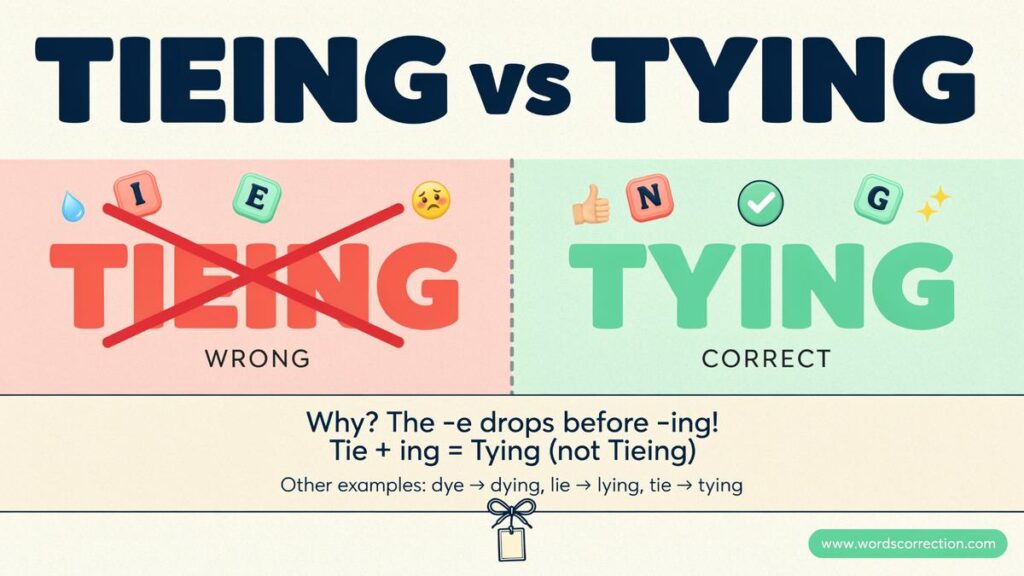
The spelling confusion between tieing vs tying can leave even confident writers second-guessing themselves. Both forms may look reasonable at first glance, yet only one follows standard English spelling rules. The correct choice is tying, not tieing. This small difference comes from a simple but important grammar rule involving verbs that end in -ie. Understanding that rule will help you avoid common spelling mistakes and write with greater confidence. In this guide, you’ll learn the meaning of tying, why tieing is incorrect, how to use the word in sentences, and an easy way to remember the correct spelling.
Tieing vs Tying Which Spelling Is Correct?
Tying is the correct standard spelling in modern English. Tieing is a nonstandard spelling that results from applying the usual suffix rule incorrectly.
The confusion is understandable. When you add -ing to many English verbs, you simply attach the suffix to the base word. For example:
- Jump → Jumping
- Read → Reading
- Walk → Walking
- Help → Helping
However, verbs ending in -ie follow a different pattern. You change ie to y before adding -ing.
Therefore:
- Tie → Tying
- Lie → Lying
- Die → Dying
- Vie → Vying
Consider these examples:
| Incorrect spelling | Correct spelling |
|---|---|
| She is tieing her shoes. | She is tying her shoes. |
| He is tieing his hair. | He is tying his hair. |
| They are tieing the ropes. | They are tying the ropes. |
| I am tieing a ribbon around the box. | I am tying a ribbon around the box. |
The distinction becomes straightforward once you recognize the pattern. Change the final ie to y before adding -ing.
Quick Answer Tying or Tieing?
- Correct spelling: Tying
- Nonstandard spelling: Tieing
Whether you’re writing an email, school assignment, business document, blog post, or casual message, always choose tying.
Learn the difference between tricky words and use them correctly
Distress vs Duress what’s the Difference?
What Is the Difference Between Tieing vs Tying?
The main difference between tieing vs tying involves spelling rather than meaning.
Both forms appear to represent the action of fastening something, but only tying follows standard English spelling conventions. Modern English dictionaries recognize tying as the correct present participle and gerund of the verb tie.
The spelling tieing sometimes appears because writers mistakenly preserve the original ie and attach -ing directly. Although readers can usually understand the intended meaning, that doesn’t make it the correct spelling.
Here’s a closer comparison
| Feature | Tying | Tieing |
|---|---|---|
| Standard spelling | Yes | No |
| Accepted modern form | Yes | No |
| Base verb | Tie | Tie |
| Intended meaning | Fastening, connecting, or making equal | Generally intended to express the same action |
| Grammatical function | Gerund or present participle | Nonstandard spelling |
| Suitable for formal writing | Yes | No |
What Does Tieing Mean?
People who write tieing generally intend to describe the action of tying something. However, the spelling itself is incorrect in standard modern English.
For example:
“She is tieing her shoelaces.”
The intended meaning is clear, but the sentence contains a spelling mistake. The correct version is:
“She is tying her shoelaces.”
This distinction matters because understanding a word’s intended meaning doesn’t automatically make its spelling acceptable.
The searches for tieing meaning and tying meaning generally point to the same intended action. However, tying is the spelling you should use.
Learn the difference between similar English words the easy way
Waring vs Wearing Which Word Is Correct?
What Does Tying Mean? Definition, Meaning, and Usage
The word tying comes from the base verb tie. It describes fastening, securing, connecting, or bringing things together. Depending on the context, it can also refer to making two competing scores equal or establishing a relationship between ideas.
Tying Definition
Verb: The present participle of tie, meaning to fasten, secure, bind, connect, or make something equal through a particular action.
Noun: The gerund form of tie, referring to the activity or process of fastening or connecting something.
The meaning of tying changes slightly depending on how someone uses it.
For example:
- Fastening: She is tying her shoelaces.
- Connecting: He is tying two ropes together.
- Securing: They are tying the package with string.
- Equalizing: The team is tying the score.
- Figurative connection: The report is tying the results to earlier research.
In each example, the word describes an action or activity involving a connection, attachment, or equal result.
Tying as Fastening or Securing Something
The most common meaning of tying involves fastening something with a knot, cord, ribbon, string, or similar material.
You perform this action whenever you tie your shoes, secure a package, fasten a rope, or arrange your hair with a hair tie.
Examples:
- She is tying her shoes before leaving the house.
- Dad is tying the rope around the wooden post.
- I spent ten minutes tying the ribbon around the gift.
- The sailor is tying a secure knot.
- He is tying his necktie before the meeting.
In these sentences, tying describes an action that someone performs to hold something in place.
Tying as Connecting or Attaching Things
Tying can also describe connecting two or more objects. The connection doesn’t always involve a traditional knot. Sometimes the word refers more generally to linking things together.
For instance, imagine connecting two ropes so they form one longer rope. You are tying the ropes together.
Examples:
- She is tying two pieces of fabric together.
- The worker is tying the wires securely.
- They are tying the branches together for support.
- He is tying the documents into a bundle.
This meaning also appears in figurative language. A writer might describe tying two ideas together when explaining how separate concepts relate to one another.
Tying as Making a Game or Score Equal
In sports, tying means bringing the opposing scores to the same level.
Suppose a soccer team trails 1–0. A player scores a goal and makes the result 1–1. That goal ties the game.
Examples:
- The striker scored in the final minute, tying the game.
- Her three-pointer is tying the score at 85–85.
- The visiting team is tying the match after a strong second-half performance.
Notice that tying doesn’t necessarily mean winning. It means making the scores equal.
A team can tie a game and later win it, lose it, or finish with a draw. The final result depends on what happens next and the rules of the competition.
Tying in Figurative Expressions
English speakers also use tying in expressions that don’t involve physical knots.
Here are three common examples:
Tying the knot: This expression means getting married.
Example: “They’re tying the knot in December.”
Tying up loose ends: This means finishing unfinished tasks or resolving remaining details.
Example: “Before launching the website, we need to tie up a few loose ends.”
Tying something to another thing: This means connecting one subject, event, or idea with another.
Example: “The researcher is tying the findings to an earlier scientific study.”
These expressions show how the basic idea of connecting or fastening something extends into everyday communication.
Learn the difference between commonly confused more words in English
Wise vs Wize Which Spelling Is Correct?
Why Is Tying the Correct Spelling?
The reason tying is correct comes from an important English spelling rule involving verbs that end in -ie. When you add the suffix -ing to these verbs, you change the final ie into y.
This rule explains why the correct form is tying rather than tieing.
The IE-to-Y Spelling Rule
In English, verbs ending in -ie generally change ie to y before taking the -ing suffix.
The spelling transformation looks like this:
Verb ending in -ie → Replace ie with y → Add -ing
For example:
| Base verb | Spelling change | Correct -ing form |
|---|---|---|
| Tie | Tie → Ty | Tying |
| Lie | Lie → Ly | Lying |
| Die | Die → Dy | Dying |
| Vie | Vie → Vy | Vying |
The pattern is consistent across these common verbs.
This spelling convention preserves the familiar written form and pronunciation pattern when adding the suffix. Instead of keeping the original ie, English uses y in the resulting form.
Why You Shouldn’t Write Tieing
The mistake usually happens when someone treats tie like a verb such as make or take.
Consider the following spelling changes:
- Make → Making
- Take → Taking
- Write → Writing
- Tie → Tying
In the first three examples, the final silent e disappears before -ing. However, tie ends in ie, so it follows the separate ie-to-y pattern.
Writing tieing means keeping both original letters and adding the suffix. That’s not the standard spelling convention for this verb.
A useful way to remember the difference is:
- Make: Remove the final e.
- Tie: Change ie to y.
- Run: Double the final consonant.
English verbs don’t all follow one spelling formula. Recognizing the base word helps you choose the correct form.
Learn the difference between confusing more English words step by step
Faring vs Fairing what’s the Difference?
How to Use Tying Correctly in a Sentence
Understanding the spelling is only half the job. You also need to know how tying works in a sentence.
Grammatically, tying serves two main functions: it can act as a present participle or a gerund. Although both forms look identical, they perform different jobs.
Tying as an Action in Progress
When tying acts as a present participle, it helps describe an ongoing action. It commonly appears in continuous verb tenses with a form of the helping verb be.
The basic structure is:
Subject + form of be + tying + additional information
Examples:
- She is tying her hair into a ponytail.
- He is tying his necktie before the interview.
- They are tying the boxes together.
- I was tying my shoes when the phone rang.
- The workers were tying the ropes around the equipment.
In each sentence, tying describes an action that is happening or was happening at a particular time.
You can also use it in longer continuous constructions:
- She has been tying gift ribbons all afternoon.
- They will be tying the decorations before the guests arrive.
The word doesn’t change its spelling in these constructions. Only the helping verbs change to express the tense.
Tying as a Gerund
A gerund is a verb form ending in -ing that functions as a noun. In this role, tying names an activity rather than simply describing an action in progress.
For example:
Tying knots requires practice.
Here, tying knots acts as the subject of the sentence.
Consider a few more examples:
- She enjoys tying decorative ribbons.
- Tying shoelaces becomes easier with practice.
- He dislikes tying complicated fishing knots.
- Tying packages is part of her daily job.
- They discussed tying the two projects together.
The gerund form can appear in several positions:
| Grammatical position | Example |
|---|---|
| Subject | Tying knots takes patience. |
| Direct object | She enjoys tying ribbons. |
| Object of a preposition | He is skilled at tying ropes. |
| Subject complement | Her favorite activity is tying fishing flies. |
One useful detail: a gerund can take an object just like an ordinary verb. In tying the rope, the word rope receives the action of tying.
Tying in Different Verb Tenses and Structures
The base verb tie has several forms. Understanding them helps prevent confusion when writing about past, present, and future actions.
| Grammatical form | Correct word | Example |
|---|---|---|
| Base form | Tie | I tie my shoes every morning. |
| Third-person singular | Ties | She ties her hair back. |
| Simple past | Tied | He tied the package yesterday. |
| Past participle | Tied | She has tied the rope securely. |
| Present participle | Tying | They are tying the boxes. |
| Gerund | Tying | Tying knots takes practice. |
Notice that tied and tying are different forms of the same verb.
The past tense doesn’t use tieing either. The correct past-tense spelling is tied.
Grammar tip: When you need to describe an ongoing action, use tying. When you need to describe a completed action in the past, use tied.
Learn the difference between tricky English words with easy explanations
Dought vs Doubt Which Spelling Is Correct?
Tying Examples in Everyday English
The best way to understand a word is to see how people actually use it. Tying appears in everyday conversations, workplace instructions, sports reports, and expressions about relationships.
Here are practical examples organized by context.
Tying Hair
People commonly use tying when describing the action of securing hair with an elastic band, ribbon, or hair tie.
Examples:
- She is tying her hair into a ponytail.
- My sister enjoys tying her hair back before exercising.
- He helped the little girl with tying her hair.
- Tying long hair can keep it away from your face while working.
- She was tying her hair when her friend arrived.
Common mistake: Writing “She is tieing her hair” is incorrect. The correct sentence is “She is tying her hair.”
Tying Shoes and Knots
Tying also appears in sentences about footwear, outdoor activities, and practical tasks.
Examples:
- The child is tying his shoelaces for the first time.
- She learned how to tie a secure knot.
- He is tying his hiking boots before starting the trail.
- The climber checked the rope after tying the knot.
- Tying fishing knots requires patience and practice.
Different knots serve different purposes. A bow knot helps secure shoelaces, while a stronger knot may help secure equipment or connect ropes.
The spelling stays the same regardless of the type of knot.
Tying Packages and Objects
Gift wrapping, shipping, and storage often involve tying objects securely.
Examples:
- She is tying a ribbon around the gift box.
- The employee finished tying the packages.
- He is tying the cardboard boxes with strong string.
- They spent the afternoon tying bundles of newspapers.
- Tying the bags securely prevents items from falling out.
These examples demonstrate the fastening meaning of the word.
Tying the Knot
The expression tying the knot has a figurative meaning. It refers to getting married.
For example:
“After dating for five years, they are finally tying the knot.”
Nobody needs an actual rope or ribbon to perform this action. The expression is an established English idiom that describes marriage.
Other examples include:
- My best friends are tying the knot next spring.
- They’re planning a small ceremony before tying the knot.
- She announced that her brother would be tying the knot in June.
Use this expression when discussing marriage in conversations, articles, or personal stories.
Tying in Sports and Competitions
Sports writers frequently use tying to describe a team or player making the score equal.
Imagine a basketball game in which one team trails 72–68. A successful four-point scoring sequence brings the score to 72–72.
The team has tied the score.
Examples:
- The home team is tying the game in the final seconds.
- Her late goal tied the match at 1–1.
- The player scored twice, tying the competition.
- The visiting team is tying the score after a difficult first half.
One grammatical distinction matters here. You can say tying the game when the score becomes equal. However, a tied game describes the resulting state.
For example:
- The player is tying the game. (Action)
- The game is tied. (Result)
Both expressions are correct, but they describe different things.
Learn the difference between more words people mix up
Really vs Realy Which Spelling Is Correct?
Tieing vs Tying 10 Incorrect and Correct Examples
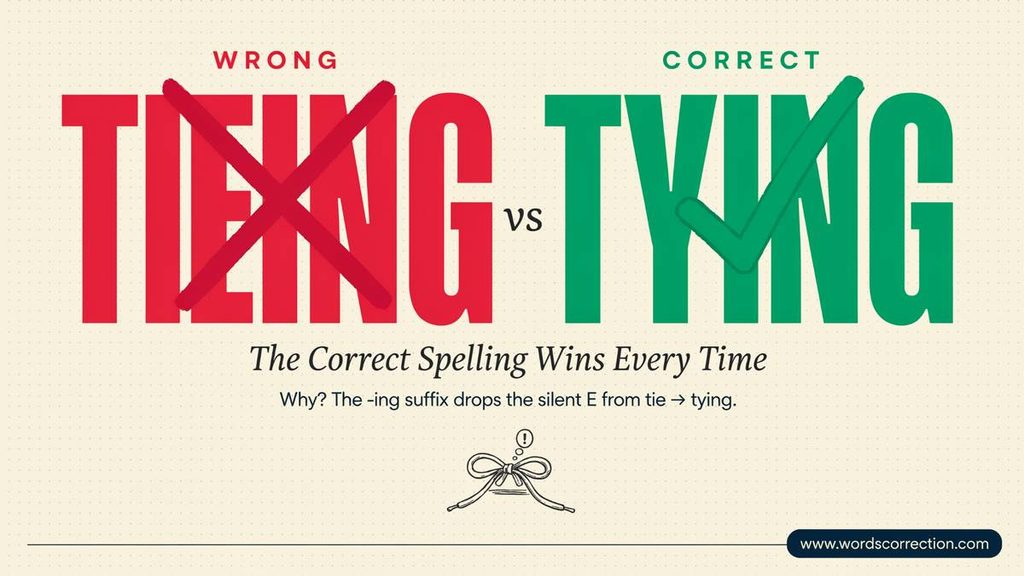
Sometimes the easiest way to remember a spelling rule is to see what happens when someone breaks it.
The following examples show common mistakes involving tieing and their correct versions.
| Incorrect sentence | Correct sentence |
|---|---|
| She is tieing her shoes. | She is tying her shoes. |
| He is tieing his hair. | He is tying his hair. |
| They are tieing the ropes together. | They are tying the ropes together. |
| I am tieing a ribbon around the box. | I am tying a ribbon around the box. |
| She enjoys tieing knots. | She enjoys tying knots. |
| He was tieing the package. | He was tying the package. |
| They started tieing the boxes. | They started tying the boxes. |
| She is tieing the knot next month. | She is tying the knot next month. |
| The team is tieing the score. | The team is tying the score. |
| Tieing your shoes takes practice. | Tying your shoes takes practice. |
The correction is the same in every example: replace tieing with tying.
There is no need to change the sentence structure or meaning. Just correct the spelling.
Learn the difference between everyday English mistakes
Shute vs Chute Which Spelling Is Correct?
Why Do People Confuse Tieing vs Tying?
If tying is the correct form, why does tieing appear so often in writing?
The answer involves how people learn spelling patterns. English has several ways to add suffixes to verbs. Applying the wrong pattern can produce a spelling mistake even when the writer understands the word perfectly.
Adding -Ing Seems Like the Natural Choice
Many English verbs form their present participles by adding -ing directly to the base form.
For example:
- Read → Reading
- Talk → Talking
- Work → Working
- Play → Playing
Someone who knows these patterns might assume that tie becomes tieing. The reasoning seems logical, but English spelling has an additional rule for verbs ending in -ie.
The Original Word Still Looks Recognizable
Writers sometimes prefer to preserve the original letters of a word.
Since tie contains the letters t, i, and e, keeping those letters when adding -ing may seem reasonable.
However, English spelling conventions don’t always preserve the complete base word. Sometimes letters change to accommodate suffixes.
The same thing happens with lie and die:
- Lie → Lying
- Die → Dying
Pronunciation Doesn’t Reveal Every Spelling Rule
Another reason for confusion is pronunciation.
Tying and the intended reading of tieing may look as though they should sound the same. However, pronunciation alone doesn’t tell you which spelling follows standard English conventions.
English contains many words with spelling patterns that aren’t obvious from their sounds. That’s why learning word formation rules matters just as much as learning pronunciation.
Confusion With Other -Ing Forms
English verbs use several different spelling patterns when taking the -ing suffix.
Compare these examples:
| Spelling pattern | Base verb | -Ing form |
|---|---|---|
| Remove final e | Make | Making |
| Change ie to y | Tie | Tying |
| Double final consonant | Run | Running |
| Keep final vowel | Read | Reading |
| Keep final y | Play | Playing |
Trying to apply one rule to every verb creates unnecessary mistakes.
Spell-Checkers Are Not Always Decisive
Spell-checking software can help identify common spelling errors. However, writers shouldn’t rely on it as their only source of guidance.
Different applications use different dictionaries and language settings. Some may also overlook errors when a word appears in a context they don’t recognize.
For important writing, consult a reliable dictionary or grammar reference when you’re unsure.
Translation Can Encourage Literal Spelling
English learners sometimes transfer spelling habits from their first language into English. This can make tieing appear reasonable, even though the standard English spelling is tying. Understanding the difference between Tieing vs Tying helps learners recognize why the spelling changes.
This confusion often occurs when learners memorize individual words without understanding how English suffixes affect spelling.
Learning the ie-to-y spelling rule provides a more reliable solution than memorizing tying as an isolated exception.
Learn the difference between commonly misused words
Grately vs Greatly Which Spelling Is Correct?
Is Tieing Ever Correct in English?
In standard modern English, tying is the accepted spelling. You should avoid tieing in academic writing, professional communication, published articles, and everyday messages. When considering Tieing vs Tying, always choose the standard form, tying.
You may occasionally encounter tieing in older texts, historical documents, or writing that contains spelling errors. However, finding a spelling in an old publication does not automatically make it an accepted modern alternative. Understanding Tieing vs Tying helps you recognize the correct form and avoid unnecessary spelling mistakes.
The distinction is important:
- Tying: The standard present participle and gerund form of tie.
- Tieing: A nonstandard spelling that should generally be treated as an error.
If you are writing an English examination, preparing a business report, or publishing online, always use tying to ensure your writing follows standard English spelling conventions.
Is Tieing a Real Word?
People sometimes ask whether tieing is a real word because search engines, informal websites, and older publications may display it.
The more useful distinction is between a recognizable spelling and a standard spelling. Readers can understand what someone intends by tieing, but that doesn’t make it the accepted form.
For reliable writing, use tying consistently.
Learn the difference between basic English word mistakes
An Hour or A Hour Which one Is Correct?
American vs British English Tieing vs Tying?
American and British English have several spelling differences. For example:
| American English | British English |
|---|---|
| Color | Colour |
| Center | Centre |
| Organize | Organise (also accepted in British English) |
| Traveling | Travelling |
| Defense | Defence |
However, tying isn’t one of those regional spelling differences.
Both American and British English use tying as the standard spelling. Neither variety normally uses tieing as an accepted alternative.
Examples in American English:
- She is tying her shoes before school.
- He enjoys tying fishing knots.
Examples in British English:
- She is tying her hair back.
- The players are tying the score.
The spelling remains unchanged. You don’t need to switch between Tieing vs Tying depending on your audience.
Tying vs Other Commonly Confused -Ing Spellings
Understanding related verbs can help you recognize the same spelling pattern in other English words.
The ie-to-y transformation appears in several common verbs. Learning them together makes the rule easier to remember.
| Base verb | Correct -ing form | Incorrect form |
|---|---|---|
| Tie | Tying | Tieing |
| Lie | Lying | Lieing |
| Die | Dying | Dieing |
| Vie | Vying | Vieing |
Let’s look at each example more closely.
Tie → Tying
The verb tie means to fasten, connect, or secure something.
Example: “She is tying a ribbon around the present.”
Lie → Lying
The verb lie can mean to rest in a horizontal position or to tell something untrue.
Examples:
- The dog is lying on the sofa.
- He is lying about what happened.
Notice that lying can have two different meanings depending on the sentence.
Die → Dying
The verb die means to stop living or cease to exist.
Example: “The flowers are dying because they haven’t received enough water.”
Be careful not to confuse dying with dyeing. The latter comes from dye and means changing the color of something.
For example:
- The plant is dying.
- She is dyeing her hair brown.
This is an excellent example of how one letter can change a word’s meaning.
Vie → Vying
The verb vie means to compete or strive for something.
Example: “Several companies are vying for the same contract.”
Although vie appears less frequently in everyday conversation, it follows the same spelling pattern.
Learn the difference between often confused words
Realist vs Realest What’s the Difference?
How to Remember the Correct Spelling of Tying
Spelling rules become easier when you connect them with familiar examples. Instead of memorizing tying as a separate word, learn the pattern behind it.
Remember the IE-to-Y Rule
The simplest trick is to remember:
When a verb ends in -ie, change -ie to -y before adding -ing.
For example:
- Tie → Tying
- Lie → Lying
- Die → Dying
Once you understand this pattern, you can apply it to other words without guessing.
Learn the Word Family Together
Try remembering these three verbs as a group:
| Base verb | Correct -ing form |
|---|---|
| Tie | Tying |
| Lie | Lying |
| Die | Dying |
This small group provides a useful memory shortcut. Whenever you encounter a similar verb, consider whether it follows the same pattern.
Check Your Spelling Before Publishing
Even experienced writers make spelling mistakes. A quick review can prevent simple errors from appearing in otherwise excellent writing.
Try these practical habits:
- Check unfamiliar words in a reputable dictionary.
- Learn common verb suffix rules.
- Use spell-checking software as a backup.
- Read your sentences before publishing.
- Pay attention to words that look similar but have different spelling patterns.
The goal isn’t to memorize every English spelling rule overnight. It’s to recognize common patterns and use them consistently.
Practice Session Tieing vs Tying
Test your understanding of the correct spelling, meanings, and usage of Tieing vs Tying. Fill in each blank with the appropriate word.
- She is ______ her shoelaces before going outside.
- He enjoys ______ colorful ribbons around gifts.
- They are ______ the knot next month.
- I spent the afternoon ______ my hair back.
- The player scored another goal, ______ the game.
- Please finish ______ the loose ends of the project.
- She was busy ______ a ribbon around the box.
- He is ______ the rope securely to the post.
- The team succeeded in ______ the score.
- My brother is ______ his necktie before work.
- She learned the art of ______ fishing knots.
- They are ______ their ideas together for the presentation.
- He carefully started ______ the package with string.
- The two teams finished the match by ______ the score.
- I am ______ my shoes before the race.
- She spent several minutes ______ her hair into a ponytail.
- The children are ______ balloons to the chairs.
- He is ______ the final details together.
- The athlete succeeded in ______ the competition.
- She is ______ the rope around the wooden post.
- They are ______ their plans to the company’s goals.
- He practiced ______ different types of knots.
- The team is ______ the match in the final minutes.
- She is ______ a bow around the gift box.
- Everyone was busy ______ things together before the event.
Answer Session
- Tying
- Tying
- Tying
- Tying
- Tying
- Tying
- Tying
- Tying
- Tying
- Tying
- Tying
- Tying
- Tying
- Tying
- Tying
- Tying
- Tying
- Tying
- Tying
- Tying
- Tying
- Tying
- Tying
- Tying
- Tying
Remember: The correct spelling is always tying, not tieing, in standard modern English. When adding -ing to the verb tie, change ie to y.
Here’s a trusted source for clear word meanings:
Cambridge Dictionary
FAQs
Is it tying up or tieing up?
“Tying up” is the correct spelling in standard English. It means fastening something securely or completing a task. “Tieing up” is a nonstandard spelling.
Is it tying the knot or tieing the knot?
“Tying the knot” is the correct expression. It is a common idiom that means getting married. For example, “They are tying the knot next summer.”
What does tying in mean?
“Tying in” means connecting one idea, subject, or detail with another. For example, “The conclusion ties in with the main argument.”
Is it correct to say tying out or tieing out?
“Tying out” is the correct spelling when using the verb “tie.” It can refer to fastening or securing something outside. “Tieing out” is a nonstandard spelling.
Which is correct tieing vs tying?
“Tying” is the correct spelling in standard modern English. When adding “-ing” to “tie,” the final “-ie” changes to “y,” producing “tying.”
What does tying it up mean?
“Tying it up” can mean securing something with a knot or bringing a task, discussion, or project to completion. The intended meaning depends on the context.
Is it tying a game or tieing a game?
“Tying a game” is correct. In sports, it means making the scores equal. For example, “The team scored in the final minute, tying the game.”
Is tying spelled correctly?
Yes, “tying” is the correct spelling. It is the present participle and gerund form of the verb “tie.”
What is it called when someone ties another person up?
Restraining or binding someone are common terms for this action. The appropriate word depends on the circumstances and context.
What is another way to say tying up?
Depending on the context, alternatives include fastening, securing, binding, knotting, connecting, and completing. Each word describes a slightly different action.
What does tying something mean?
Tying something means fastening, securing, or connecting it with a string, rope, ribbon, or similar material. For example, tying your shoelaces keeps your shoes securely fastened.
What is another word for tying?
Common synonyms for “tying” include fastening, binding, knotting, securing, attaching, and connecting. The most suitable alternative depends on how the word is used.
What are the two main meanings of tie?
” Tie” commonly refers to fastening two things together with a knot or achieving an equal score in a competition. It can also describe a necktie or a personal connection.
What does tie mean in slang?
In informal English, “tie” can refer to a connection, relationship, or association between people or things. Its specific meaning depends on the conversation.
What is another word for tie?
Depending on the context, synonyms for “tie” include knot, bond, connection, link, fastener, and necktie. The correct alternative depends on the intended meaning.
What does tie mean as a verb?
As a verb, “tie” means to fasten, secure, or connect something using a knot or similar method. In sports, it can also mean making two competing scores equal.
What are the three forms of the verb tie?
The three main forms of the verb “tie” are:
- Base form: Tie
- Past tense: Tied
- Past participle: Tied
The present participle is “tying.”
How do you use tie in a sentence?
“Tie” is used when describing the action of fastening or connecting something. For example, “Please tie your shoelaces before running.” It can also describe an equal score in a competition.
What does tied mean in English?
“Tied” is the past tense and past participle of “tie.” It describes something that has been fastened, secured, or connected. In sports, it can also mean that two competitors have equal scores.
What does it mean to be tied to something?
Being tied to something means being connected, attached, or committed to it. For example, “Her professional success is closely tied to her experience.”
What is the past tense of tie?
The past tense of “tie” is “tied.” For example, “She tied the ribbon around the gift.”
Which is correct tied to or tied with?
Both expressions are grammatically correct, but they have different meanings. “Tied to” generally describes a connection or attachment, while “tied with” can describe fastening something using a material or sharing an equal score.
What does we tied mean?
“We tied” means that two people or teams finished a competition with the same score. For example, “We tied the match 2–2.”
What does the expression my hands are tied mean?
“My hands are tied” is an idiom meaning that someone cannot take action or make a decision because of rules, restrictions, or circumstances. It describes a lack of freedom or control rather than physically restrained hands.
What is another way to say my hands are tied?
Alternative expressions include “I have no choice,” “My options are limited,” “There is nothing I can do,” and “I am unable to help.” These phrases communicate that someone cannot change or influence a particular situation.
Understand confusing English more words simply
Gluing vs Glueing Which Spelling Is Correct?
Conclusion
The difference between Tieing vs Tying may seem confusing, but it follows a simple English spelling rule. Tying is the correct standard spelling because verbs ending in -ie generally change ie to y before adding -ing. The same spelling pattern appears in words such as lying, dying, and vying.
Although tieing may look logical, it is not the accepted spelling in standard modern English. Understanding Tieing vs Tying makes it easier to recognize and avoid this common spelling mistake. Whether you are fastening your shoelaces, securing a package, or tying the knot, always use tying. Remember this straightforward rule to keep your writing accurate and your spelling mistake-free.

Stella AJS is an experienced blogger and dedicated English language writer at Words Correction. She turns confusing grammar, word meanings, spelling, and usage into clear, practical insights that readers can easily understand and apply. With a passion for precise and engaging writing, Stella helps readers avoid common language mistakes, strengthen their vocabulary, and communicate with greater clarity and confidence.




