
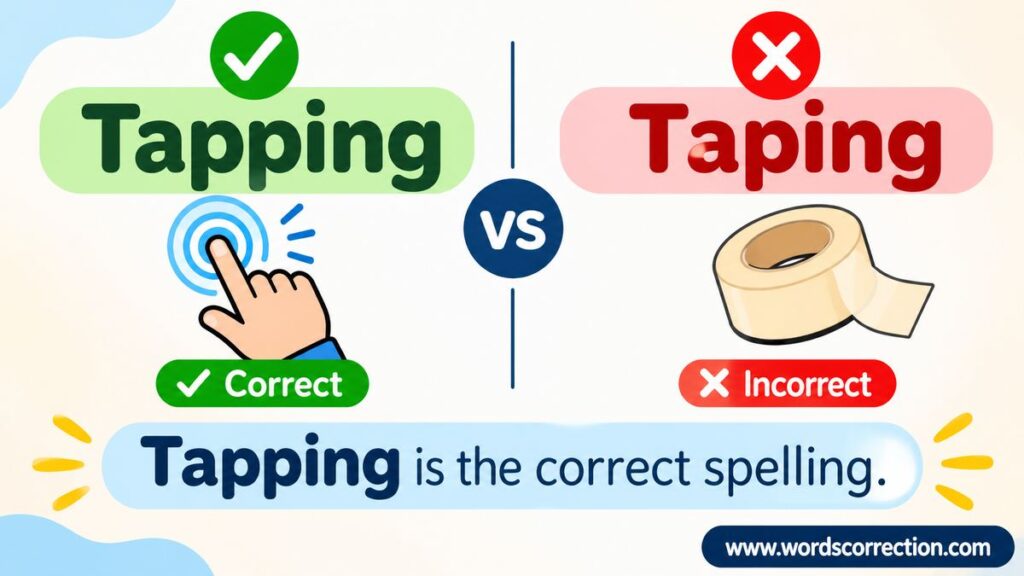
Confusing tapping vs taping is an easy mistake to make, especially when both words look and sound almost alike. Yet, a small spelling difference can completely change the meaning of a sentence. Tapping usually refers to touching something lightly or repeatedly, while taping often means applying adhesive tape or recording an event. Using one in place of the other can lead to awkward sentences and unintended meanings. Fortunately, understanding the difference is simpler than it seems. This guide explains the meanings, spelling rules and correct usage of tapping vs taping, with clear examples to help you avoid common grammar mistakes and write with confidence.
Quick Answer Tapping vs Taping
Tapping means touching, striking, or hitting something lightly, often more than once. It’s the present participle of the verb tap.
Taping means attaching, covering, or securing something with adhesive tape. It can also mean recording audio or video. It’s the present participle of the verb tape.
Both spellings are correct, but they describe different actions.
| Word | Base verb | Meaning | Example |
|---|---|---|---|
| Tapping | Tap | Touching or striking lightly | She is tapping her fingers on the desk. |
| Taping | Tape | Attaching or recording | He is taping a box for shipping. |
Here’s a simple way to remember the difference:
- Tapping: Think of someone tapping their fingers against a table.
- Taping: Think of someone using adhesive tape to seal a cardboard box.
The key is to identify the action before choosing the spelling. If someone makes light contact with something, use tapping. If someone applies tape or records something, use taping.
What Is the Difference Between Tapping vs Taping?
The difference between tapping vs taping starts with their base verbs: tap and tape.
Although these verbs share several letters, they have different meanings and follow different spelling rules when you add the suffix -ing.
The verb tap generally describes a light strike, touch, or repeated movement. You might tap a table with your fingers, tap someone’s shoulder to get their attention, or tap an icon on a smartphone screen.
The verb tape, on the other hand, usually describes attaching or securing something with adhesive tape. You might tape a cardboard box, tape a poster to a wall, or tape an injured ankle. It can also mean recording an event using audio or video equipment.
Consider these examples:
- Tapping: Mark is tapping his fingers against the window.
- Taping: Mark is taping a notice to the window.
The first sentence describes a physical action involving light contact. The second describes attaching something with adhesive tape.
Tapping vs Taping Meaning at a Glance
| Feature | Tapping | Taping |
|---|---|---|
| Base word | Tap | Tape |
| Word form | Present participle | Present participle |
| Main action | Touching or striking lightly | Attaching, covering, or recording |
| Spelling change | Doubles the final P | Removes the final E |
| Common contexts | Screens, surfaces, fingers, and trees | Packages, injuries, painting, and recording |
| Past tense | Tapped | Taped |
| Example | He is tapping the keyboard. | He is taping the package. |
Neither word is more correct than the other. The appropriate choice depends entirely on what you want to describe.
Learn the difference between tricky words and use them correctly
Really vs Realy Which Spelling Is Correct?
What Does Tapping Mean?
Tapping is the present participle of the verb tap. It describes the action of touching, striking, or hitting something lightly. The action may happen once or repeatedly, depending on the context.
In English grammar, tapping commonly appears in continuous verb tenses:
- She is tapping the table.
- They were tapping their feet.
- He has been tapping the screen.
The word can also describe figurative actions, such as accessing available resources or making use of someone’s knowledge.
Let’s explore its most common meanings and applications.
Tapping Something Lightly or Repeatedly
One of the most common uses of tapping involves lightly hitting a surface or object with your fingers, hands, or another item.
Unlike a forceful strike, tapping usually involves gentle contact. It may produce a small sound or communicate a signal.
Examples:
- She kept tapping the wooden desk with her pencil.
- Someone was tapping on the bedroom window.
- The teacher tapped the board to get everyone’s attention.
- He started tapping the glass with a spoon.
- I heard someone tapping at the front door.
Tapping can also describe knocking repeatedly. However, the two actions aren’t always identical. Knocking usually involves striking a door or another surface to get someone’s attention, while tapping can describe many other types of light contact.
If you can picture a finger making light contact with a surface, tapping is probably the word you need.
Tapping a Phone, Screen, or Button
In modern digital communication, tapping has become one of the most familiar actions.
Smartphones, tablets, and other touchscreen devices respond to physical contact. When you gently touch an icon, button, or option on the screen, you’re tapping it.
Examples:
- I’m tapping the settings icon to change my password.
- She is tapping the screen to open the application.
- Tap the green button to continue.
- He accidentally tapped the wrong link.
- The customer is tapping the payment option.
A common question is whether the correct expression is tapping vs taping on a phone.
The correct expression is tapping on a phone screen when you mean touching it to activate an option.
Taping a phone describes a different action. It might mean attaching something to the phone with adhesive tape or recording something using the device.
Tapping Your Fingers or Feet
Tapping also describes repeated movements of body parts, especially fingers and feet.
People often tap their fingers when they’re waiting, thinking, or feeling impatient. Similarly, someone might tap a foot to follow music or express nervous energy.
Examples:
- She was tapping her fingers while waiting for the results.
- He kept tapping his foot during the presentation.
- The child started tapping both hands on the table.
- I caught myself tapping my fingers to the rhythm of the song.
This type of rhythmic tapping doesn’t always have a specific purpose. Sometimes it’s simply a repeated movement that happens while someone concentrates, waits, or listens to music.
Tapping Into Something
Not every use of tapping involves physical contact. The expression tap into has a figurative meaning.
It means accessing, using, or making the most of something that’s available.
For example, a business might tap into a new market. A student might tap into previous knowledge to solve a difficult problem. A company might tap into its employees’ experience to develop a better product.
Consider these sentences:
- The company is tapping into new business opportunities.
- She learned how to tap into her creativity.
- The organization is tapping into local resources.
- He tapped into his savings to pay for the repairs.
- The team is tapping into its collective experience.
The expression can refer to resources, energy, skills, knowledge, creativity, and opportunities.
In this context, tapping doesn’t mean physically hitting something. It describes gaining access to something useful.
Tapping a Tree for Its Sap
Another practical meaning of tapping involves collecting sap from trees.
For example, maple trees are tapped to collect the sap used in maple syrup production. A small opening is made in the tree, and a spout or collection system allows the sap to flow out.
The process is known as tree tapping.
Examples:
- Farmers are tapping maple trees during the sugaring season.
- The workers tapped the trees to collect sap.
- Maple tree tapping requires suitable equipment and proper timing.
This use comes from the verb tap, but it has a specialized meaning related to collecting a natural resource.
EFT Tapping and the Emotional Freedom Technique
You may also encounter the word tapping in discussions about emotional wellness.
EFT tapping, short for Emotional Freedom Technique, is a practice that combines elements of acupressure-inspired tapping with focused attention on a particular thought or feeling.
During the practice, a person gently taps specific points on the body with their fingertips. These are commonly described as acupressure tapping points.
The technique is often discussed in connection with stress management and emotional regulation. However, claims about its effectiveness vary, and it shouldn’t replace appropriate medical or mental health care.
Examples:
- She is learning the EFT tapping technique.
- The instructor demonstrated several acupressure tapping points.
- Some people use tapping exercises as part of their relaxation routine.
This is another example of how tapping describes repeated physical contact rather than the use of adhesive tape.
Learn the difference between similar English words the easy way
Shute vs Chute Which Spelling Is Correct?
What Does Taping Mean?
Taping is the present participle of the verb tape. It generally means attaching, covering, wrapping, or securing something with adhesive tape. It can also mean recording audio or video.
The definition of taping depends on the situation. Everyday life, you might use tape to repair a torn page, close a package, or attach a photograph to a wall. Sports, trainers use specialized tape to support certain body parts. In media, a production team might tape an interview or performance.
Here are the most common uses of taping.
Taping Two Things Together
One of the simplest meanings of taping involves joining two objects with adhesive tape.
You might tape two sheets of paper together, repair a torn document, or attach a small item to another surface.
Examples:
- She is taping two pieces of paper together.
- He taped the broken cardboard before using it.
- The children are taping their drawings to the wall.
- I am taping the loose cable to the floor.
Different types of adhesive tape serve different purposes. Common examples include:
- Masking tape: Often used for temporary labeling and protecting surfaces during painting.
- Electrical tape: Designed for insulating electrical connections when used according to its specifications.
- Packing tape: Commonly used to seal shipping boxes and packages.
- Duct tape: A strong, versatile tape used for various temporary repairs.
- Clear adhesive tape: Often used for paper, crafts, and everyday household tasks.
In each example, the action involves applying tape. Therefore, taping is the correct spelling.
Taping a Package or Box
Have you ever prepared a package for shipping? If so, you’ve probably spent a few minutes taping its edges and openings.
Taping a box means applying adhesive packing tape to hold its flaps together and help prevent the contents from falling out.
Examples:
- My brother is taping the cardboard box.
- She finished taping the package before the courier arrived.
- They are taping the edges of the shipping carton.
- Please tape the box securely before sending it.
Notice the difference:
- Tapping a box: Lightly striking the box with your fingers or another object.
- Taping a box: Applying adhesive tape to close or secure it.
Both expressions are grammatically correct. Their meanings simply describe different actions.
Taping an Area Before Painting
Taping is also an important step in many painting projects.
Before painting a wall, door, or window frame, people often apply masking tape or painter’s tape to protect areas they don’t want to cover with paint.
For example, a painter might tape the edges of a window before painting its frame. This helps create cleaner lines and reduces unwanted paint marks.
Examples:
- The workers are taping the window frames.
- She taped the edges before painting the wall.
- We need to finish taping the trim before applying the paint.
- He is taping the floor to protect it from paint splashes.
This process is sometimes called masking. However, taping specifically refers to applying tape to protect or cover selected areas.
Taping an Interview, Meeting, or Performance
The word taping has another common meaning in journalism, entertainment, and business.
It can describe recording an event using audio or video equipment.
For example, a journalist might tape an interview with a public figure. A television production team might tape a show before its scheduled broadcast. A company might tape a training session so employees can watch it later.
Examples:
- The reporter is taping an interview with the author.
- They are taping the conference for future reference.
- The production team taped the entire performance.
- We are taping the meeting so absent employees can review it.
Although digital recording has largely replaced older tape-based recording systems, the expression taping an interview remains common in English.
In modern usage, it doesn’t necessarily mean that someone is recording onto physical magnetic tape. It can simply mean recording audio or video.
If someone is recording an interview, performance, or meeting, taping is the conventional word.
Taping an Injury or Body Part
Taping also appears frequently in sports, fitness, and physical therapy.
Athletes and trainers use different types of tape to support body parts, help manage movement, or protect vulnerable areas during physical activity.
For example, a trainer might tape an athlete’s ankle before a game. Another athlete might use kinesiology tape as part of a supervised training or rehabilitation plan.
Common forms include:
- Athletic taping: Using sports tape to provide external support or restrict certain movements.
- Kinesiology taping: Applying elastic tape to the skin using specific placement techniques.
- Medical taping: Using appropriate medical tape to secure dressings or support certain treatment needs.
- Ankle taping: Applying sports tape around the ankle to provide external support.
- Knee taping: Applying tape around the knee as part of a sport or rehabilitation plan.
Examples:
- The trainer is taping the athlete’s ankle.
- She taped her wrist before the match.
- The physical therapist demonstrated different taping techniques.
- The coach helped the player with ankle taping.
Taping doesn’t automatically treat an injury or guarantee protection. The right method depends on the person’s condition and the intended purpose. For an injury, a qualified healthcare professional can recommend an appropriate approach.
Learn the difference between commonly confused more words in English
Grately vs Greatly Which Spelling Is Correct?
Tapping vs Taping The Spelling Rule Explained
Now that the meanings are clear, let’s look at the spelling difference.
Why does tap become tapping while tape becomes taping?
The answer lies in two common English spelling rules: consonant doubling and silent e deletion.
Both rules apply when adding the suffix -ing to certain verbs. However, the final letters of the base verbs determine which rule you should follow.
Why Does Tap Become Tapping?
The verb tap becomes tapping because English spelling usually doubles the final consonant of a short consonant-vowel-consonant (CVC) verb before adding -ing.
The word tap has three letters:
- T: First consonant.
- A: Short vowel.
- P: Final consonant.
Its spelling follows the CVC pattern.
When you add -ing, you double the final P.
Tap + ing = Tapping
Without the extra P, the word wouldn’t follow the standard spelling pattern.
Here are some other examples:
| Base verb | Correct -ing form |
|---|---|
| Tap | Tapping |
| Clap | Clapping |
| Stop | Stopping |
| Run | Running |
| Sit | Sitting |
| Plan | Planning |
| Swim | Swimming |
The purpose of consonant doubling is to help preserve the short vowel sound in the base word.
For example:
- Correct: She is tapping the table.
- Incorrect for the intended meaning: She is taping the table.
The second sentence isn’t necessarily grammatically wrong, but it describes a different action.
Why Does Tape Become Taping?
The verb tape follows a different spelling rule because it ends in a silent e.
When a verb ends in a silent e, you generally remove that final letter before adding -ing.
The formula is:
Tape – e + ing = Taping
The final E disappears, but the P doesn’t double.
Here are some additional examples:
| Base verb | Correct -ing form |
|---|---|
| Tape | Taping |
| Hope | Hoping |
| Make | Making |
| Write | Writing |
| Dance | Dancing |
| Bake | Baking |
| Drive | Driving |
This rule explains why taping has only one P.
For example:
- Correct: He is taping the package.
- Incorrect: He is tappeing the package.
- Incorrect: He is tapingg the package.
The correct spelling is always taping when you’re using the present participle of tape.
When Do You Double the Final Consonant Before Adding -Ing?
The consonant-doubling rule applies to many short verbs, but you shouldn’t assume that every verb follows it.
For most one-syllable verbs, double the final consonant when the word ends in a single consonant preceded by a single vowel and follows the relevant short-vowel pattern.
Examples:
- Hop → Hopping
- Cut → Cutting
- Beg → Begging
- Drop → Dropping
- Tap → Tapping
However, don’t double the final consonant when the verb ends in two consonants or follows a different vowel pattern.
Examples:
- Help → Helping
- Read → Reading
- Rain → Raining
- Look → Looking
Longer verbs also require attention to stress. For example:
- Admit → Admitting
- Begin → Beginning
- Visit → Visiting
- Open → Opening
The final syllable’s stress helps determine whether consonant doubling applies in many longer verbs.
The important lesson is simple: Don’t memorize tapping vs taping as two unrelated spellings. Understand the rules that create them. Once you recognize the base verb, the correct form becomes much easier to identify.
Learn the difference between confusing more English words step by step
An Hour or A Hour Which one Is Correct?
Tapping vs Taping Pronunciation Differences
Do tapping vs taping sound different? Yes. Although the words look similar, their vowel sounds distinguish them.
Both words have two syllables:
- Tapping: TAP-ping
- Taping: TAY-ping
In standard American English, tapping contains the short A sound, as in cat or map. Taping contains the long A sound, which sounds like the name of the letter A.
Their pronunciation can be represented using the International Phonetic Alphabet (IPA):
| Word | American English IPA | Main vowel sound |
|---|---|---|
| Tapping | /ˈtæpɪŋ/ | Short A |
| Taping | /ˈteɪpɪŋ/ | Long A |
The difference becomes easier to hear when you say the words aloud.
In tapping, the vowel is short and direct. In taping, the vowel moves into a longer sound.
However, pronunciation shouldn’t be your only spelling guide. When people speak quickly, some vowel differences may be less noticeable. The meaning and base verb provide a more reliable way to choose the correct word.
Learn the difference between tricky English words with easy explanations
Realist vs Realest What’s the Difference?
Tapping vs Taping Examples in Everyday Sentences
Examples make the difference easier to understand because they show how each word works in real situations.
The following examples cover common uses of tapping vs taping.
Examples of Tapping in Sentences
Use tapping when describing light contact, repeated strikes, touchscreen actions, or figurative access to resources.
- She is tapping her fingers against the wooden desk.
- The little boy kept tapping the window.
- I’m tapping the screen to open my email.
- He was tapping his foot while listening to music.
- The teacher started tapping the board with a marker.
- Someone is tapping on the front door.
- The company is tapping into new business opportunities.
- Farmers are tapping maple trees to collect sap.
- She uses EFT tapping as part of her relaxation routine.
- The musician is tapping a rhythm on the table.
Examples of Taping in Sentences
Use taping when describing the application of adhesive tape, securing something, or recording audio and video.
- She is taping two pieces of paper together.
- He is taping the box before shipping it.
- The workers are taping the window frames before painting.
- The journalist is taping an interview.
- The trainer is taping the athlete’s ankle.
- We are taping the cables to the floor.
- They finished taping the package before the courier arrived.
- The production team is taping a television program.
- She is taping a poster to the wall.
- The physical therapist explained several athletic taping techniques.
Tapping vs Taping: Side-by-Side Sentence Comparisons
Sometimes, the easiest way to understand two confusing words is to see them in nearly identical sentences.
| Tapping | Taping |
|---|---|
| She is tapping the table. | She is taping a notice to the table. |
| He is tapping the phone screen. | He is taping the phone’s loose cover. |
| They are tapping the tree. | They are taping a protective cover around the tree. |
| She is tapping her fingers. | She is taping her injured fingers. |
| He is tapping the window. | He is taping paper to the window. |
| The reporter is tapping the microphone. | The reporter is taping an interview. |
Notice how the spelling changes according to the action.
A person can tap a microphone to test whether it’s working. The same person can tape an interview using recording equipment. Both sentences are correct, but they describe different activities.
Learn the difference between more words people mix up
Gluing vs Glueing Which Spelling Is Correct?
Tapped vs Taped What’s the Difference?
The difference between tapped and taped follows the same pattern as tapping and taping. Both are past-tense and past-participle forms of different verbs.
Tapped comes from tap. It describes touching, striking, or hitting something lightly.
Taped comes from tape. It describes attaching something with adhesive tape or recording audio or video.
For example:
- She tapped the desk to get everyone’s attention.
- She taped the notice to the desk.
The first sentence describes a light strike. The second describes attaching something.
When to Use Tapped
Use tapped when someone performed an action involving light contact or accessed a resource.
Examples:
- He tapped my shoulder to get my attention.
- She tapped the screen accidentally.
- The child tapped the glass with a spoon.
- The company tapped its existing resources to fund the project.
- Someone tapped on the bedroom door.
The word can also appear in expressions such as tapped into his experience or tapped for advice.
When to Use Taped
Use taped when someone attached something with tape or recorded an event.
Examples:
- I taped the broken paper together.
- She taped the package before sending it.
- The athlete taped his ankle before the competition.
- The reporter taped the interview yesterday.
- They taped the poster to the classroom wall.
Tapped vs Taped Examples
| Tapped | Taped |
|---|---|
| He tapped the door. | He taped a notice to the door. |
| She tapped the phone screen. | She taped the phone’s back cover. |
| The child tapped the glass. | The child taped a drawing to the glass. |
| The trainer tapped the athlete’s shoulder. | The trainer taped the athlete’s ankle. |
| He tapped the microphone. | He taped the interview. |
If someone made contact by striking or touching something, use tapped. If someone used adhesive tape or recorded something, use taped.
Learn the difference between everyday English mistakes
Tieing vs Tying Which Spelling Is Correct?
Common Mistakes When Using Tapping and Taping
Even experienced writers sometimes confuse these words. The problem usually starts when they focus on the spelling instead of the intended action.
Here are some common mistakes and their corrections.
Writing Taping When You Mean Tapping
Incorrect: She was taping her fingers on the desk.
Correct: She was tapping her fingers on the desk.
Why? The sentence describes repeated light strikes against the desk. No adhesive tape is involved.
Another example:
Incorrect: He kept taping on the window to get my attention.
Correct: He kept tapping on the window to get my attention.
The correct choice is tapping because he is making repeated contact with the window.
Writing Tapping When You Mean Taping
Incorrect: He was tapping the package shut.
Correct: He was taping the package shut.
Why? The action involves using adhesive tape to secure the package.
Consider another example:
Incorrect: She is tapping the poster to the wall.
Correct: She is taping the poster to the wall.
Here, taping describes attaching the poster with adhesive tape.
Confusing Tapped and Taped
The same mistake happens with past-tense forms.
Incorrect: She tapped the photograph to the wall.
Correct: She taped the photograph to the wall.
Incorrect: He taped my shoulder to get my attention.
Correct: He tapped my shoulder to get my attention.
The first correction involves attaching a photograph. The second describes a light touch.
Applying the -Ing Spelling Rule Incorrectly
Some writers understand the meaning but still make spelling mistakes when adding -ing.
Common incorrect forms include:
| Incorrect spelling | Correct spelling |
|---|---|
| Tapingg | Taping |
| Tappeing | Taping |
| Taping when meaning repeated light strikes | Tapping |
| Taping fingers on a desk when meaning repeated contact | Tapping fingers on a desk |
| Tappping | Tapping |
The simplest solution is to identify the original verb before adding the suffix.
- Tap + ing = Tapping
- Tape – e + ing = Taping
Learn the difference between commonly misused words
Enable vs Inable What’s the difference?
Why Do People Confuse Tapping and Taping?
Although their meanings differ, several factors make these words easy to mix up.
Their Spellings Look Almost Identical
Both words begin with tap and contain similar letters. The only visible difference is the extra P in tapping.
When someone writes quickly, that small difference can easily disappear.
Their Pronunciations Have Similar Sounds
Both words have two syllables and share several consonant sounds.
However, tapping has a short A sound, while taping has a long A sound. This distinction matters even when the words sound similar in casual conversation.
Writers Forget the Silent E Rule
The silent E in tape disappears when the suffix -ing is added.
Writers who forget this rule sometimes produce incorrect forms such as tapeing.
The correct spelling is taping.
Writers Overgeneralize Consonant Doubling
Another common problem occurs when writers assume every verb needs a doubled final consonant before -ing.
That isn’t how English spelling works.
Tap doubles its final P because it follows the relevant CVC pattern. Tape loses its silent E instead.
Autocorrect May Not Catch the Error
Spell-checking tools can identify many spelling mistakes, but they don’t always recognize incorrect word choices.
For example, both tapping and taping are correctly spelled English words.
If you write:
“She is taping her fingers on the desk.”
A basic spell-checker might accept the sentence because every word is spelled correctly. However, if you mean that she’s repeatedly striking the desk with her fingers, the sentence uses the wrong word.
Spell-checking can help with spelling, but context determines whether you’ve chosen the correct word.
Learn the difference between basic English word mistakes
Flys vs Flies Which Spelling Is Correct?
Tapping vs Taping A Practical Case Study
Consider a simple situation involving two coworkers preparing an office for an important presentation.
Sarah is arranging documents on a desk. While waiting for her colleague, she starts tapping her fingers against the tabletop.
Meanwhile, James is preparing the presentation materials. He is taping printed charts to a display board so everyone can see them.
Both coworkers are performing different actions.
| Person | Action | Correct word |
|---|---|---|
| Sarah | Repeatedly touching the desk with her fingers | Tapping |
| James | Attaching charts to a display board | Taping |
Now imagine that someone writes the following sentence:
“Sarah was taping her fingers while James was tapping the charts to the board.”
The sentence creates a confusing picture. Sarah appears to be using adhesive tape on her fingers, while James seems to be lightly striking the charts against the board.
The corrected version is:
“Sarah was tapping her fingers while James was taping the charts to the board.”
This example shows why understanding the action matters more than memorizing individual spellings.
Learn the difference between often confused words
Nonresponsive vs Unresponsive which is Correct?
Tapping vs Taping Common Usage Checklist
Before choosing between these words, ask yourself what action you’re describing.
Use tapping when:
- Someone is lightly hitting a surface.
- Someone is knocking repeatedly.
- A person is tapping their fingers or feet.
- Someone is touching a phone or tablet screen.
- A person is tapping into available resources.
- Someone is practicing EFT tapping.
- A worker is tapping a tree to collect sap.
Use taping when:
- Someone is applying adhesive tape.
- A person is sealing a cardboard box.
- Someone is attaching paper or photographs to a surface.
- A painter is protecting edges with masking tape.
- An athlete is using athletic tape.
- A journalist is recording an interview.
- A production team is recording a performance.
If you’re still unsure, return to the base verb. Ask whether the action comes from tap or tape. That small step usually solves the problem.
How to Remember the Difference Between Tapping and Taping
You don’t need to memorize a long list of grammar rules every time you write these words. A simple connection between spelling and meaning can help.
Find the Base Verb First
Start by removing the -ing ending mentally.
- Tapping comes from tap.
- Taping comes from tape.
Once you identify the base verb, the correct spelling becomes much easier.
Think About the Action
Connect each word with something you can picture.
- Tapping: Imagine someone tapping their fingers against a table.
- Taping: Imagine someone sealing a cardboard box with packing tape.
The physical difference makes the spelling easier to remember.
Use the Spelling Rule as a Second Check
If you know the base verb, apply the correct rule:
- Short CVC verb: Double the final consonant before adding -ing when the rule applies.
- Silent-e verb: Remove the final E before adding -ing.
This gives you the correct forms:
- Tap → Tapping
- Tape → Taping
Learn Related Word Families
Learning related forms helps you recognize spelling patterns across English vocabulary.
| Base verb | Present participle | Past tense |
|---|---|---|
| Tap | Tapping | Tapped |
| Tape | Taping | Taped |
| Clap | Clapping | Clapped |
| Hope | Hoping | Hoped |
| Stop | Stopping | Stopped |
| Bake | Baking | Baked |
Once you recognize these patterns, you’ll find it easier to spell many other commonly confused verb forms.
Practice Session Tapping vs Taping
Fill in the blanks with the correct word: tapping vs taping.
1. She was ______ her fingers on the desk while waiting.
2. He is ______ the cardboard box before shipping it.
3. The teacher noticed a student ______ a pencil on the table.
4. They are ______ an interview for the television program.
5. I heard someone ______ on the bedroom door.
6. The athlete is ______ his ankle before the competition.
7. She kept ______ her foot during the meeting.
8. We are ______ the electrical wires to keep them secure.
9. He was ______ the screen to open the application.
10. The production team is ______ a new television episode.
11. The child started ______ his mother on the shoulder.
12. She spent the afternoon ______ gift boxes with decorative tape.
13. The doctor recommended ______ the injured joint for support.
14. Someone was ______ loudly on the window.
15. The technician is ______ the microphone cable to the floor.
16. He was ______ his fingers impatiently while waiting for his turn.
17. The company is ______ into new business opportunities.
18. They finished ______ the package before leaving the office.
19. The child enjoys ______ on the keyboard while playing games.
20. The camera crew is ______ the final scene of the movie.
21. She was ______ the table to get everyone’s attention.
22. The trainer demonstrated the correct method of ______ an athlete’s knee.
23. He kept ______ the button to turn on the device.
24. We are ______ the broken section of the pipe to prevent leaks.
25. The audience heard someone ______ rhythmically during the performance.
Answers
- Tapping
- Taping
- Tapping
- Taping
- Tapping
- Taping
- Tapping
- Taping
- Tapping
- Taping
- Tapping
- Taping
- Taping
- Tapping
- Taping
- Tapping
- Tapping
- Taping
- Tapping
- Taping
- Tapping
- Taping
- Tapping
- Taping
- Tapping
Here’s a trusted source for clear word meanings:
Cambridge Dictionary
FAQs
What is the difference between tapping and taping?
Tapping means lightly hitting, touching, or knocking something, often repeatedly. Taping means attaching or securing something with adhesive tape or recording audio or video.
Which spelling is correct tapping vs taping?
Both spellings are correct, but they have different meanings. Tapping comes from the verb tap, while taping comes from the verb tape. The correct choice depends on the context.
Why does tapping have two P’s?
Tapping has two P’s because the verb tap follows the consonant-doubling rule. When adding the suffix -ing to a one-syllable verb ending in a consonant preceded by a single vowel, the final consonant is doubled.
Why does taping have only one P?
Taping has one P because it comes from the verb tape. When adding -ing, the silent E at the end of the word is dropped, leaving the original P unchanged.
What does tapping mean in everyday English?
Tapping refers to touching, striking, or knocking something lightly, usually more than once. Common examples include tapping your fingers on a table, tapping someone’s shoulder, or tapping a phone screen.
What does taping mean in everyday English?
Taping refers to attaching, covering, or securing something with adhesive tape. It can also describe recording an interview, television program, or other audio or video content.
How do you use tapping in a sentence?
Use tapping when describing a light or repeated touching action. For example: “She was tapping her fingers against the desk while waiting for her meeting to begin.”
How do you use taping in a sentence?
Use taping when referring to applying adhesive tape or recording something. For example: “He was taping the package carefully before sending it to the customer.”
What is the difference between tapped and taped?
Tapped is the past tense of tap and describes lightly touching, striking, or knocking something. Taped is the past tense of tape and refers to attaching something with tape or recording audio or video.
Is tapping the same as knocking?
No. Tapping and knocking are related actions, but they aren’t exactly the same. Tapping generally involves light or repeated contact, while knocking usually refers to striking a surface, such as a door, to attract someone’s attention.
What does tapping on a phone screen mean?
Tapping on a phone screen means briefly touching an icon, button, or other area with your finger to select an option or activate a function. It’s one of the most common ways to interact with touchscreen devices.
What does tapping into something mean?
Tapping into something means accessing or making use of a resource, ability, skill, or opportunity. For example, “The company is tapping into new markets to expand its business.”
What is EFT tapping, and how does it work?
EFT (Emotional Freedom Techniques) tapping is a complementary practice that involves gently tapping specific points on the body while focusing on emotional concerns. People commonly use this technique as part of their stress-management routines.
What is athletic taping used for?
Athletic taping involves applying specialized tape to muscles and joints to provide support, improve stability, or help manage certain sports-related injuries. Athletes and physical therapists commonly use it during training and rehabilitation.
What is the difference between kinesiology taping and regular taping?
Kinesiology taping uses flexible, elastic tape designed to move with the body. Regular athletic taping typically uses less flexible tape to provide firmer support and restrict certain movements around muscles and joints.
Does taping always mean recording a video?
No. Taping has several meanings depending on the context. It can refer to recording audio or video, but it also describes attaching, covering, or securing something with adhesive tape.
What is the difference between tapping and pressing?
Tapping involves making brief, light contact with a surface, often repeatedly. Pressing involves applying continuous or sustained pressure to something. For example, you tap a screen to select an icon but press a button to activate it.
How is tapping pronounced compared to taping?
Tapping has a short A sound, while taping has a long A sound. This difference in vowel pronunciation distinguishes the two words and helps listeners recognize their meanings.
Can tapping and taping be used interchangeably?
No. Tapping and taping have different meanings and cannot be used interchangeably. Tapping describes touching or striking something, whereas taping refers to applying adhesive tape or recording something.
What are some common examples of tapping and taping?
Common examples of tapping include tapping your fingers on a desk, tapping someone’s shoulder, and tapping a touchscreen. Examples of taping include taping a cardboard box, taping an ankle for support, and taping an interview.
Is tapping a noun or a verb?
Tapping can function as both a noun and a verb. As a verb, it describes the action of touching or striking something lightly. As a noun, it refers to the action or process of tapping.
Is taping a noun or a verb?
Taping is the present participle of the verb tape. It can also function as a gerund, acting as a noun to describe an activity, such as applying athletic tape or recording a television program.
What does tapping out mean?
Tapping out can mean signaling surrender or submission by repeatedly striking a surface or another person. This expression is commonly used in wrestling, mixed martial arts, and other combat sports.
What are the most common mistakes when using tapping and taping?
The most common mistake is confusing the two spellings because they look and sound similar. Writers sometimes use taping when they mean touching something or tapping when they mean applying adhesive tape. Understanding their meanings and spelling rules helps prevent these errors.
How can you remember when to use tapping vs taping?
Remember that tapping comes from tap, so you double the final P before adding -ing. In contrast, taping comes from tape, so you remove the silent E before adding -ing. This simple spelling rule makes it easier to choose the correct word.
Learn the difference between confusing word pairs
Breathe vs Breath Difference and Correct Usage
Conclusion
Understanding the difference between tapping vs taping is easier than it may seem. Although these words look and sound similar, they serve different purposes. Tapping means touching something lightly or repeatedly, while taping generally refers to applying adhesive tape or recording an event. Remember, you tap a screen but tape a package. Confusing these words can create awkward sentences and leave readers guessing what you actually mean. By learning their definitions, spelling patterns, and correct usage, you can avoid this common grammar mistake and communicate more clearly. After all, good writing depends on choosing the right word, even when two words are only one letter apart.

Stella AJS is an experienced blogger and dedicated English language writer at Words Correction. She turns confusing grammar, word meanings, spelling, and usage into clear, practical insights that readers can easily understand and apply. With a passion for precise and engaging writing, Stella helps readers avoid common language mistakes, strengthen their vocabulary, and communicate with greater clarity and confidence.




