
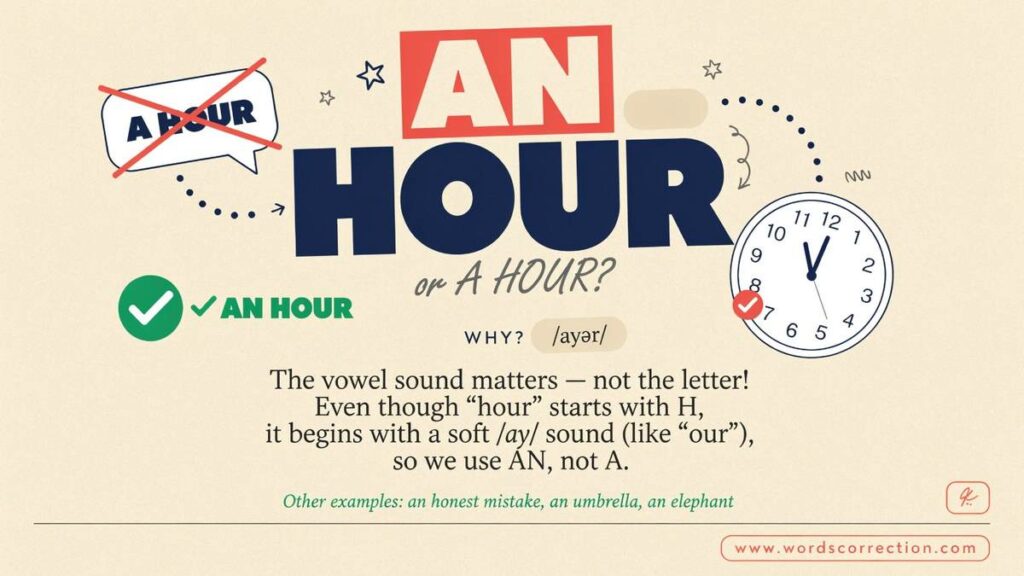
The difference between An Hour or A Hour may seem small, but choosing the wrong one can make your sentence sound awkward. English grammar can be confusing, especially when a word begins with a letter that you don’t pronounce. In this case, the H in hour is silent, so the word starts with a vowel sound. That’s why “an hour” is correct, while “a hour” is a common mistake. The rule is simple once you understand it. Let’s look at the grammar, pronunciation and everyday examples to help you use this phrase correctly and confidently.
Quick Answer An Hour or A Hour?
“An hour” is the grammatically correct expression in standard English. “A hour” is incorrect because the H in “hour” is silent, so the word begins with a vowel sound.
The choice between “a” and “an” depends on the first sound of the following word, not its first written letter.
Examples
- Correct: I waited for an hour.
- Incorrect: I waited for a hour.
- Correct: She called me an hour ago.
- Incorrect: She called me a hour ago.
The quick rule: Use “an” before a vowel sound and “a” before a consonant sound.
Learn the difference between confusing word pairs
Shute vs Chute Which Spelling Is Correct?
Why Is An Hour Correct?
To understand why “an hour” is correct, you need to consider how English speakers pronounce the word.
The word “hour” contains four letters: H, O, U, and R. However, the first letter, H, is silent in standard English pronunciation. Instead of pronouncing the H, speakers begin with the vowel sound represented by the O.
Consequently, “hour” starts with a vowel sound even though its spelling begins with a consonant letter.
English grammar uses the sound of a word to determine which indefinite article comes before it. That’s why we say “an hour” rather than “a hour.”
The Silent H in Hour
The silent H is the main reason people sometimes struggle with this expression.
In many English words, H produces an audible consonant sound. Consider “house,” “happy,” and “hotel.” You can clearly hear the H when you pronounce these words.
However, some English words contain a silent H. In these cases, the pronunciation begins with the following vowel sound.
Here are a few examples
| Word | First spoken sound | Correct expression |
|---|---|---|
| Hour | Vowel sound | An hour |
| Honest | Vowel sound | An honest person |
| Honor | Vowel sound | An honor |
| Heir | Vowel sound | An heir |
| House | Consonant sound | A house |
| Happy | Consonant sound | A happy child |
Notice the difference? The written letter alone doesn’t determine the article. What matters is how the word sounds when spoken.
Why Not A Hour?
The expression “a hour” doesn’t follow the standard English vowel sound rule.
The indefinite article “a” normally appears before a consonant sound. Since the H in “hour” is silent, using “a” creates an incorrect article choice.
For example
- Incorrect: We have a hour before the meeting.
- Correct: We have an hour before the meeting.
- Incorrect: It took a hour to finish the assignment.
- Correct: It took an hour to finish the assignment.
The same rule applies whether you’re speaking casually, writing an email, completing an academic assignment, or preparing a professional document.
Learn the difference between tricky words and use them correctly
Accross vs Across Which Is Correct Spelling?
The An Hour Grammar Rule When to Use A and An
The difference between “a” and “an” is one of the basic English grammar rules. Both words are indefinite articles. They introduce singular countable nouns when the speaker doesn’t identify a particular person, place, object, or thing.
For example
- I bought a book.
- She ate an apple.
- He adopted a dog.
- We waited an hour.
Although both articles have the same basic grammatical purpose, they don’t work interchangeably. Their use depends on pronunciation.
When to Use A
Use “a” before a word that begins with a consonant sound.
Consonant sounds include sounds such as /b/, /d/, /f/, /h/, /k/, /m/, /p/, and /t/.
Examples include
- A house
- A car
- A teacher
- A university
- A European country
- A useful tool
- A one-hour meeting
Some of these words begin with vowel letters. However, their opening sounds are consonants.
For example, “university” begins with a /j/ sound, similar to the beginning of “yes.” Likewise, “one” begins with a /w/ sound. Therefore, we say “a university” and “a one-hour meeting.”
When to Use An
Use “an” before a word that begins with a vowel sound.
The main vowel letters in English are A, E, I, O, and U. However, remember that vowel sounds and vowel letters aren’t always the same thing.
Examples include
- An apple
- An elephant
- An umbrella
- An interesting story
- An honest person
- An hour
- An hourly rate
The article “an” helps connect the words smoothly in spoken English.
Difference Between A and An Sound vs Spelling
Here’s the most important distinction: English chooses indefinite articles according to pronunciation rather than spelling.
A word can begin with a vowel letter but require “a.” Similarly, a word can begin with a consonant letter but require “an.”
| Word | First written letter | First spoken sound | Correct article |
|---|---|---|---|
| Hour | H | Vowel | An hour |
| Honest | H | Vowel | An honest person |
| Apple | A | Vowel | An apple |
| University | U | Consonant | A university |
| European | E | Consonant | A European |
| One | O | Consonant | A one-time offer |
| Umbrella | U | Vowel | An umbrella |
| House | H | Consonant | A house |
Remember: Your ears should guide your article choice, not your eyes.
This simple vowel sound rule will help you avoid many common grammar mistakes beyond the “an hour or a hour” question.
Learn the difference between similar English words the easy way
Present vs Presant which one is Correct?
How to Use An Hour in a Sentence
Knowing the correct article is only the first step. You should also understand how “an hour” works in different sentence structures.
The expression can describe a period of time, the duration of an activity, or the time remaining before an event.
Let’s explore its most common uses.
An Hour Ago
The phrase “an hour ago” refers to something that happened approximately 60 minutes before the present moment.
The word “ago” connects a past event to the current time. You can use this expression in everyday conversations, emails, and professional communication.
Examples
- I received your message an hour ago.
- She left the office an hour ago.
- The movie started an hour ago.
- We finished our lunch an hour ago.
- He called the customer an hour ago.
Common mistake
- Incorrect: My brother arrived a hour ago.
- Correct: My brother arrived an hour ago.
The article doesn’t change when you add “ago.” Since “hour” still begins with a vowel sound, you must use “an.”
For an Hour
Use “for an hour” when you want to describe how long an activity continues or continued.
The preposition “for” introduces a duration.
Examples
- I studied for an hour last night.
- She talked on the phone for an hour.
- We waited for an hour outside the restaurant.
- He exercised for an hour every morning.
- They discussed the project for an hour.
You can also use “for an hour” with different verb tenses.
| Tense | Example |
|---|---|
| Present simple | I work for an hour every evening. |
| Past simple | She studied for an hour yesterday. |
| Present perfect continuous | I have been waiting for an hour. |
| Future | We will practice for an hour tomorrow. |
In every example, “an” remains the correct article.
In an Hour
The phrase “in an hour” generally refers to something that will happen 60 minutes from now.
For example
- The meeting will begin in an hour.
- I’ll call you in an hour.
- Dinner should be ready in an hour.
- The train will arrive in an hour.
Be careful not to confuse “in an hour” with “an hour ago.”
| Expression | Meaning | Example |
|---|---|---|
| An hour ago | 60 minutes before now | She left an hour ago. |
| In an hour | 60 minutes from now | She will return in an hour. |
| For an hour | A duration of 60 minutes | She studied for an hour. |
These expressions communicate different time relationships even though they contain the same noun and article.
Almost an Hour
Use “almost an hour” when something takes slightly less than 60 minutes or approaches that amount of time.
The word “almost” indicates that the full hour hasn’t quite passed or that an event is close to lasting an hour.
Examples
- I’ve been waiting for almost an hour.
- The interview lasted almost an hour.
- It took almost an hour to complete the assignment.
- We spent almost an hour discussing the new project.
- She has been driving for almost an hour.
The correct expression is always “almost an hour,” never “almost a hour.”
About an Hour and More Than an Hour
You can also combine “an hour” with other words to describe approximate or longer periods.
Consider these expressions
- About an hour: Approximately 60 minutes.
- Around an hour: Roughly 60 minutes.
- More than an hour: Longer than 60 minutes.
- Less than an hour: Shorter than 60 minutes.
- Just over an hour: Slightly longer than 60 minutes.
- An hour or so: Approximately one hour.
For example
“Traveling to the airport takes about an hour.”
This sentence suggests that the journey takes approximately 60 minutes, although the actual duration may vary.
Learn the difference between commonly confused more words in English
Skiid vs Skied Which Spelling Is Correct?
An Hour vs A One-Hour What’s the Difference?
Here’s where the grammar gets interesting. Both “an hour” and “a one-hour” can be correct in different sentence structures, but they follow different pronunciation patterns.
The difference comes from the first spoken sound of the word immediately following the article.
Compare these expressions
- An hour: Correct because “hour” begins with a vowel sound.
- A one-hour meeting: Correct because “one” begins with a consonant-like /w/ sound.
Although “hour” and “one” both relate to time, their opening sounds determine which article you should use.
A One-Hour Meeting
The expression “a one-hour meeting” is grammatically correct.
Why? Because the word “one” begins with a /w/ sound, even though its first written letter is O. That sound works like a consonant, so it takes “a.”
Examples
- I have a one-hour meeting this afternoon.
- She scheduled a one-hour training session.
- We attended a one-hour presentation.
- He arranged a one-hour consultation with the manager.
Notice the hyphen in “one-hour.” When two words work together as an adjective before a noun, a hyphen often connects them.
For example
- A one-hour lesson
- A two-hour examination
- A three-hour journey
- A five-minute break
These compound adjectives describe the length or duration of something.
An Hour of Work
Now consider this sentence
“I completed an hour of work before lunch.”
Here, “hour” functions as a noun rather than part of a compound adjective. Since its first sound is a vowel sound, the correct article is “an.”
More examples
- She spent an hour of her afternoon reading.
- We need an hour of preparation before the event.
- He dedicated an hour of practice to improving his English.
- They completed an hour of work before taking a break.
The distinction is simple
| Expression | Correct usage | Reason |
|---|---|---|
| An hour of work | An | Hour begins with a vowel sound. |
| A one-hour meeting | A | One begins with a /w/ sound. |
| An hour-long meeting | An | Hour begins with a vowel sound. |
| A two-hour meeting | A | Two begins with a /t/ sound. |
An Hourly vs A Hourly Which Is Correct?
The correct expression is “an hourly rate,” not “a hourly rate.”
The word “hourly” begins with the same vowel sound as “hour.” Its H is silent, so it takes the indefinite article “an.”
Examples
- The company pays an hourly rate of $20.
- She receives an hourly wage for her work.
- The consultant charges an hourly fee.
- We need an hourly report of the system’s performance.
However, compare these sentences
- An hourly rate: Correct because “hourly” begins with a vowel sound.
- A daily rate: Correct because “daily” begins with a consonant sound.
- An annual salary: Correct because “annual” begins with a vowel sound.
- A weekly schedule: Correct because “weekly” begins with a consonant sound.
The same pronunciation-based grammar rule applies in every case.
Learn the difference between confusing more English words step by step
Moment vs Momment Which Spelling Is Correct?
Other Silent H Words That Take An
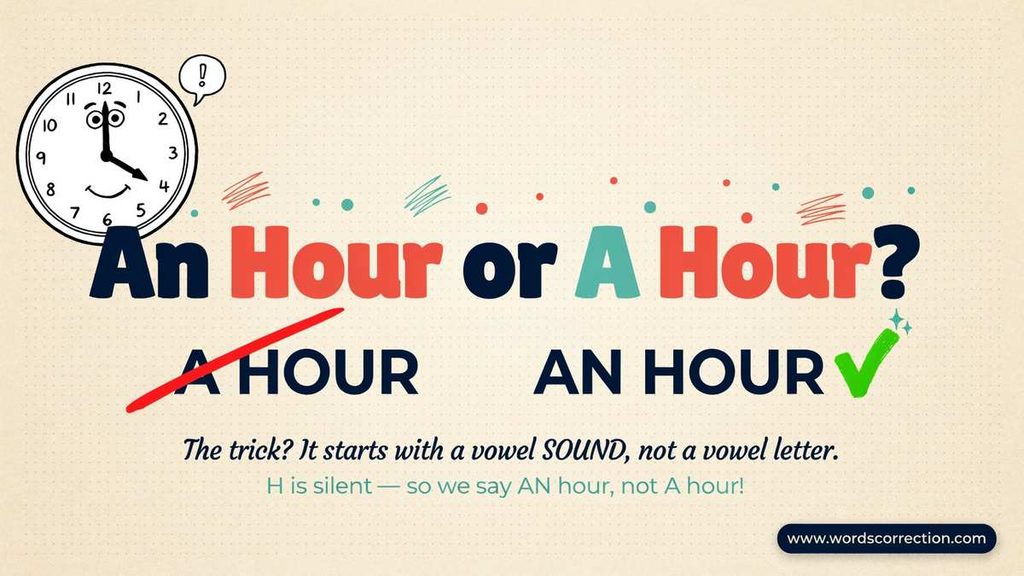
The word “hour” isn’t the only English word with a silent H. Several other common words follow the same pronunciation pattern.
These words are useful examples of how English spelling and pronunciation don’t always match.
An Honest Person
The H in “honest” is silent. The word begins with a vowel sound, so the correct expression is “an honest person.”
Examples
- He is an honest person.
- She gave me an honest answer.
- Telling an honest story builds trust.
- It was an honest mistake.
Notice the final example. We also say “an honest mistake” because the article comes before “honest,” not before “mistake.”
An Honor
The word “honor” also has a silent H in standard American English.
Therefore, you should write “an honor,” not “a honor.”
Examples
- Receiving the award was an honor.
- It is an honor to meet you.
- She considered the invitation an honor.
- Winning the competition was an honor for the entire team.
The same article choice applies to related forms such as “honorable.”
For example: “It was an honorable decision.”
An Heir
The H in “heir” is silent in standard English pronunciation.
An heir is someone who has the legal right to inherit money, property, or another person’s estate.
Examples
- He is an heir to the family business.
- The king appointed an heir to the throne.
- She became an heir after her father’s death.
Because “heir” begins with a vowel sound, “an heir” is correct.
Other Common Silent H Words
Here are additional examples worth remembering
| Word | Correct expression | Meaning |
|---|---|---|
| Hour | An hour | A period of 60 minutes |
| Honest | An honest answer | Truthful or sincere |
| Honor | An honor | Respect or recognition |
| Heir | An heir | Someone entitled to inherit |
| Honorable | An honorable action | Deserving respect |
| Honorary | An honorary degree | A title given as recognition |
Important: Not every English word beginning with H takes “an.” Words such as “house,” “hotel,” “happy,” and “history” have an audible H in standard American English. They therefore take “a.”
Learn the difference between tricky English words with easy explanations
Distress vs Duress what’s the Difference?
Common Mistakes When Using An Hour
Even though the rule is simple, writers and English learners sometimes make mistakes when choosing between “a” and “an.”
Here are the most common problems and their corrections.
| Incorrect expression | Correct expression | Explanation |
|---|---|---|
| A hour | An hour | The H is silent. |
| A hour ago | An hour ago | Hour begins with a vowel sound. |
| Almost a hour | Almost an hour | The article must match the sound of hour. |
| A hourly rate | An hourly rate | The H in hourly is silent. |
| An one-hour meeting | A one-hour meeting | One begins with a /w/ consonant sound. |
| A honest person | An honest person | The H in honest is silent. |
| A honor | An honor | The H in honor is silent. |
| An house | A house | The H in house is pronounced. |
Mistake Choosing an Article Based on the First Letter
One of the most common grammar mistakes is assuming that every word beginning with a vowel letter needs “an” and every word beginning with a consonant letter needs “a.”
That’s not how English works.
For example
- A university, not an university.
- A European country, not an European country.
- An hour, not a hour.
- An honest person, not a honest person.
The correct article depends on the opening sound.
Mistake Confusing A One-Hour With An Hour
Another frequent mistake involves the word “one.”
Because “one” starts with the vowel letter O, some learners assume that “an one-hour meeting” must be correct.
However, the word begins with a /w/ sound. Therefore, “a one-hour meeting” is correct.
Remember this distinction whenever you write about meetings, lessons, training sessions, or other time-based activities.
Learn the difference between more words people mix up
Waring vs Wearing Which Word Is Correct?
Hour Meaning, Pronunciation, and Plural Form
Understanding the word itself can make the article rule easier to remember.
What Does Hour Mean in English?
An hour is a unit of time equal to 60 minutes or 3,600 seconds.
It is commonly used to describe how long an activity takes, when something happens, or how much time remains before an event.
Examples
- There are 24 hours in a standard day.
- An hour contains 60 minutes.
- The class lasts for one hour.
- The journey takes approximately three hours.
- I exercise for an hour every morning.
An hour can also refer to a particular point or period of the day.
For example
- The early hours of the morning.
- Office hours.
- Rush hour.
- Lunch hour.
In each expression, “hour” relates to time, although the precise meaning depends on the context.
How Do You Pronounce Hour?
In standard American English, “hour” is commonly pronounced /ˈaʊ.ɚ/.
The opening sound is the vowel diphthong /aʊ/, similar to the vowel sound in “out” and “house.”
The H is silent.
This pronunciation explains why English speakers use “an hour” instead of “a hour.”
In British English, the word is commonly pronounced /ˈaʊə/. The final sound differs slightly from the typical American pronunciation, but the opening vowel sound remains the same.
Therefore, the correct article doesn’t change between standard American and British English.
Is the H Silent in Hour?
Yes. The H in “hour” is silent in standard American and British English.
You don’t pronounce the word as though it begins with the H sound in “house.” Instead, the opening sound comes directly from the vowel.
This is also why the expressions below are correct
- An hour
- An hour ago
- An hour later
- An hour earlier
- An hour and a half
- An hour-long lesson
What Is the Plural of Hour?
The plural of “hour” is “hours.”
You use “hour” for one unit of time and “hours” for two or more units.
| Singular | Plural |
|---|---|
| An hour | Two hours |
| One hour | Three hours |
| An hour of work | Several hours of work |
| A one-hour class | Two one-hour classes |
Examples
- I waited for an hour.
- She studied for two hours.
- We spent several hours preparing the presentation.
- The journey took five hours.
Remember that “a” and “an” generally introduce singular countable nouns. You don’t use either article directly before the ordinary plural noun “hours.”
For example
- Incorrect: An hours of work.
- Correct: Hours of work.
- Correct: An hour of work.
Also, when you want to show possession or duration, you can use the expression “an hour’s work.”
Example: “The assignment required an hour’s work.”
The apostrophe and S indicate that the work took approximately one hour.
Learn the difference between everyday English mistakes
Wise vs Wize Which Spelling Is Correct?
An Hour or A Hour Practical Examples in Everyday English
Examples make grammar rules easier to understand and remember. Instead of memorizing definitions alone, look at how English speakers use “an hour” in different situations.
An Hour Examples in Everyday Conversation
Here are some natural examples from everyday life:
- I waited for an hour before the doctor called my name.
- She spends an hour reading books every evening.
- We reached the shopping mall an hour ago.
- He needs an hour to prepare dinner.
- The children played outside for an hour.
- I’ll meet you in an hour.
- It took almost an hour to find the right address.
- My father watches television for an hour after dinner.
- The bus was delayed by an hour.
- We talked for more than an hour yesterday.
Examples in Professional and Academic Writing
The expression also appears frequently in workplaces, schools, universities, and professional communication.
- Workplace: The manager scheduled an hour for the project discussion.
- Education: Students spent an hour completing the examination.
- Business: The consultant charges $50 for an hour of work.
- Training: The instructor delivered an hour-long presentation.
- Healthcare: The patient waited for an hour before the appointment.
- Scheduling: We have an hour available before the next meeting.
Correct vs Incorrect Examples
Use this comparison table to check your understanding
| Incorrect sentence | Correct sentence |
|---|---|
| I need a hour to finish this. | I need an hour to finish this. |
| She arrived a hour ago. | She arrived an hour ago. |
| It took almost a hour. | It took almost an hour. |
| We talked for a hour. | We talked for an hour. |
| He will return in a hour. | He will return in an hour. |
| I have a hourly appointment. | I have an hourly appointment. |
The correction is the same in every example: use “an” when the following word begins with a vowel sound.
Learn the difference between commonly misused words
Faring vs Fairing what’s the Difference?
A Quick Case Study How One Silent Letter Changes the Article
Imagine that two English learners are writing an email to their manager.
The first learner writes
“Good morning. I need a hour to complete the report.”
The second learner writes
“Good morning. I need an hour to complete the report.”
Both sentences communicate the same basic idea. However, only the second follows standard English grammar.
Why?
- The noun “hour” begins with the letter H.
- The H is silent in standard pronunciation.
- The opening sound is a vowel sound.
- English uses “an” before vowel sounds.
- Therefore, “an hour” is correct.
This example highlights an important lesson: English grammar doesn’t always follow the spelling of a word. Pronunciation plays a major role in article selection.
As a language learner, recognizing this difference will help you make better choices in both spoken and written English.
Learn the difference between basic English word mistakes
Dought vs Doubt Which Spelling Is Correct?
Practice session An Hour or A Hour
Instructions: Choose the correct article (A or An) to complete each sentence. Pay attention to the pronunciation of the word that follows the blank.
It took us _____ hour and a half to finish the journey.
I will complete my assignment in _____ hour.
She arrived at the office _____ hour ago.
We waited for _____ hour before the doctor arrived.
It takes almost _____ hour to reach the airport.
He spent _____ hour reading his favorite book.
The teacher gave us _____ honest explanation.
She is _____ hardworking student.
We visited _____ historic building yesterday.
He made _____ important announcement.
My brother bought _____ new laptop yesterday.
It was _____ honor to meet the professor.
She lives in _____ beautiful house near the park.
I need _____ umbrella because it is raining.
He is _____ university student.
They organized _____ interesting event last weekend.
We watched _____ exciting movie last night.
She made _____ useful suggestion during the meeting.
The manager scheduled _____ hour-long training session.
He waited for _____ entire hour outside the building.
She gave me _____ unusual gift.
We need _____ European travel guide.
He is _____ honest and responsible employee.
I will return in _____ minute.
They spent _____ afternoon exploring the museum.
Answer Key
- An
- An
- An
- An
- An
- An
- A
- A
- An
- A
- An
- A
- An
- A
- An
- An
- A
- An
- An
- An
- A
- An
- A
- An
- An
Here’s a trusted source for clear word meanings:
Cambridge Dictionary
FAQs
Is it correct to write an hour or a hour?
“An hour” is correct because the H in “hour” is silent, making the word begin with a vowel sound. The phrase “a hour” is grammatically incorrect.
Why do we use an before the word hour?
We use “an” before “hour” because its initial H is silent. English grammar requires “an” before words that begin with vowel sounds, regardless of their first written letter.
Is the H silent in the word hour?
Yes, the H in “hour” is silent. The word is pronounced like “our,” beginning with a vowel sound. This is why we say “an hour” rather than “a hour.”
Should I say an hour or a hour in spoken English?
You should say “an hour” in spoken English. Since the H is not pronounced, the word begins with a vowel sound, making “an” the grammatically correct article.
What does an hour mean?
“An hour” refers to a period of 60 minutes. It is commonly used to describe the duration of an activity, meeting, journey, or event.
Is it correct to say an hour ago?
Yes, “an hour ago” is correct. It refers to something that happened 60 minutes before the present time. For example: “She left the office an hour ago.”
Should I write almost an hour or almost a hour?
“Almost an hour” is correct because “hour” begins with a vowel sound. The word “almost” does not change the article rule. For example: “I waited almost an hour for the bus.”
Is it in an hour or in a hour?
“In an hour” is grammatically correct. It describes something expected to happen after approximately 60 minutes. For example: “The meeting will begin in an hour.”
Do we use an before every word starting with H?
No, we do not use “an” before every H-word. The choice depends on pronunciation. Use “an” before silent-H words such as “hour” and “honest,” but use “a” before pronounced-H words such as “house” and “hotel.”
Why do we say an hour but a house?
We say “an hour” because its H is silent, so it begins with a vowel sound. In “house,” the H is pronounced, creating a consonant sound. Therefore, the correct expressions are “an hour” and “a house.”
Is it an hourly rate or a hourly rate?
“An hourly rate” is correct because “hourly” begins with a vowel sound. Its initial H is silent, so the indefinite article “an” is required.
Should I use a or an before honest?
Use “an” before “honest” because its initial H is silent. For example: “He is an honest person.” The same pronunciation rule applies to “hour.”
Is it an honor or a honor?
“An honor” is correct because the H in “honor” is silent. The word begins with a vowel sound, so it takes the article “an.”
What is the difference between a and an?
Both “a” and “an” are indefinite articles used before singular countable nouns. Use “a” before consonant sounds and “an” before vowel sounds. For example, “a book” and “an hour.”
Does the choice between a and an depend on spelling or pronunciation?
The choice depends on pronunciation, not spelling. Use “an” before vowel sounds and “a” before consonant sounds. This explains why “an hour” is correct even though the word begins with the letter H.
Is a hour grammatically incorrect?
Yes, “a hour” is incorrect in standard English. Since the H in “hour” is silent, the word begins with a vowel sound and requires “an” instead.
Can I use an hour at the beginning of a sentence?
Yes, “an hour” can begin a sentence when the sentence structure requires it. For example: “An hour passed before the guests arrived.” The phrase remains grammatically correct regardless of its position.
Is it correct to write one hour instead of an hour?
Yes, both “one hour” and “an hour” are correct. “One hour” emphasizes the exact duration, while “an hour” is a more general way to express a period of 60 minutes.
Is an hour’s time grammatically correct?
Yes, “an hour’s time” is grammatically correct. The apostrophe shows possession and expresses a period of one hour. For example: “We will leave in an hour’s time.”
Should I write an hour-long meeting or a hour-long meeting?
“An hour-long meeting” is correct because “hour” begins with a vowel sound. The compound adjective describes a meeting that lasts 60 minutes.
Is it an hour and a half or a hour and a half?
“An hour and a half” is correct. It describes a duration of 90 minutes. The article “an” is used because “hour” begins with a vowel sound.
How do you pronounce the word hour correctly?
The word “hour” is pronounced like “our,” with a silent H. Its pronunciation begins with a vowel sound, which is why it takes “an” rather than “a.”
Does the word hour begin with a vowel sound?
Yes, “hour” begins with a vowel sound because its initial H is silent. Although the written word starts with a consonant, its pronunciation determines the correct article.
What are some examples of sentences using an hour?
Here are some examples of the correct phrase “an hour” in everyday English
- I will finish my assignment in an hour.
- She waited for an hour outside the office.
- The class lasted an hour.
- We arrived at the airport an hour ago.
- It takes almost an hour to reach the city.
How can I remember when to use an before silent H words?
Remember that English articles depend on sounds rather than written letters. Use “an” before silent-H words such as “hour,” “honest,” and “honor.” Use “a” when the H is pronounced, as in “house” and “happy.”
Learn the difference between often confused words
Really vs Realy Which Spelling Is Correct?
Conclusion
Choosing between an hour or a hour may seem like a small grammar issue, but using the correct article makes your writing clearer and more natural. The correct phrase is always “an hour” because the H is silent, and the word begins with a vowel sound. Remember, English grammar follows pronunciation rather than spelling. That’s why we say “an hour” but “a house.” Once you understand this simple rule, you can avoid this common mistake with ease. So, the next time you write about time, remember to use “an hour.” It’s a small detail that makes a big difference in your English.

Stella AJS is an experienced blogger and dedicated English language writer at Words Correction. She turns confusing grammar, word meanings, spelling, and usage into clear, practical insights that readers can easily understand and apply. With a passion for precise and engaging writing, Stella helps readers avoid common language mistakes, strengthen their vocabulary, and communicate with greater clarity and confidence.




