
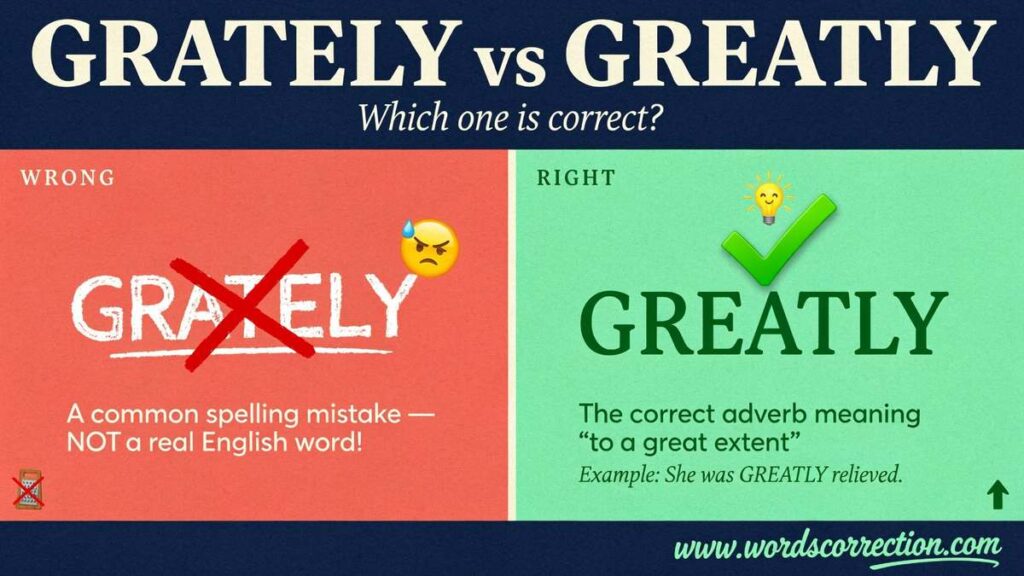
Is it grately vs greatly? A small spelling mistake can make even a professional sentence look confusing. Although these two spellings may seem similar, only one is correct in standard English. Many people make this mistake because of pronunciation, typing habits, or confusion with words like great and grateful. So, how can you avoid this common error? In this guide, you’ll learn the correct spelling, understand what greatly means and explore simple examples and grammar tips. By the end, you’ll know exactly when to use greatly and how to keep your writing clear, correct and professional.
Grately vs Greatly Which Spelling Is Correct?
Greatly is the correct spelling. It is a standard English adverb used to describe the degree or extent of an action, change, feeling, or condition.
Grately is not a standard English word. It is usually a misspelling of greatly.
Consider these examples
- Correct: Your support is greatly appreciated.
- Incorrect: Your support is grately appreciated.
The correct sentence uses greatly because it explains how much the support is appreciated.
Quick Comparison Grately vs Greatly
| Feature | Grately | Greatly |
|---|---|---|
| Correct spelling | No | Yes |
| Part of speech | Not a standard English word | Adverb |
| Meaning | No established standard meaning | To a large degree or extent |
| Standard usage | Incorrect in ordinary writing | Accepted in standard English |
| Example | Incorrect spelling | The project greatly improved. |
The easiest way to remember the difference is to use greatly whenever you want to express a significant degree or amount.
Learn the difference between confusing more English words
Accross vs Across Which Is Correct Spelling?
What Does Greatly Mean?
Greatly is an adverb that means considerably, significantly, or to a large extent. It describes the degree to which something happens, changes, matters, or affects someone or something.
Writers commonly use greatly to emphasize the importance, size, or intensity of an action or situation.
For example
- Technology has greatly changed the way people communicate.
- Your advice helped me greatly.
- The new policy greatly improved workplace efficiency.
- We greatly appreciate your cooperation.
In each sentence, greatly adds emphasis by showing the extent of the action or feeling.
Greatly Definition
Greatly (adverb): To a large degree, extent, or amount; considerably or significantly.
Simple Explanation of Greatly
In everyday English, greatly means very much or by a significant amount.
For example
- I greatly appreciate your help.
1. This means that I appreciate your help very much.
- Her confidence has greatly improved.
2. This means that her confidence has improved significantly.
- The weather greatly affected our plans.
3. This means that the weather had a strong effect on our plans.
Greatly makes a sentence more precise when you want to describe the extent of something.
Learn the difference between commonly mixed-up more words
Present vs Presant which one is Correct?
Why Do People Confuse Grately vs Greatly?
The confusion between grately vs greatly usually comes from pronunciation, spelling habits, and similarities between English words.
Although grately may look reasonable to some writers, it is not the accepted spelling.
Here are the main reasons people make this mistake.
1. Pronunciation Can Be Confusing
Greatly is pronounced as two syllables: GRAYT-lee.
When people hear the word, they may focus on its sound rather than its spelling. This can lead them to write grately instead of greatly.
However, pronunciation does not always reveal the correct spelling of an English word. Some words sound different from the way people expect them to look.
2. Confusion With the Word Great
The word great is an adjective that means excellent, important, or very good.
When you add the suffix -ly to form an adverb, the correct spelling becomes greatly.
Some writers mistakenly remove the final e and produce grately. However, the standard spelling retains the e.
3. Confusion With Grateful
Another possible source of confusion is the word grateful.
Grateful is an adjective that describes someone who feels thankful or appreciative.
For example
- I am grateful for your support.
- She felt grateful for the opportunity.
Because grateful and greatly share similar letters, some writers may mix up their spelling patterns.
Remember that greatly and grateful have different meanings and grammatical functions.
4. Typing and Autocorrect Mistakes
Fast typing can also cause spelling errors. You might accidentally type grately without noticing the mistake.
Autocorrect does not always identify every incorrect word, especially when a spelling resembles a possible word pattern.
For this reason, proofreading remains important, particularly in professional emails, academic assignments, reports, and business documents.
Learn the difference between tricky grammar more words
Skiid vs Skied Which Spelling Is Correct?
How Is Greatly Formed?
The word greatly comes from the adjective great and the adverb-forming suffix -ly.
The formation is straightforward
Great + -ly = Greatly
The final e remains in the standard spelling.
Examples of similar word formations include
| Adjective | Adverb |
|---|---|
| Complete | Completely |
| Immediate | Immediately |
| Accurate | Accurately |
| Extreme | Extremely |
| Appropriate | Appropriately |
| Great | Greatly |
These examples show how the suffix -ly helps form adverbs from adjectives.
However, English spelling rules are not always consistent. It is useful to learn common word patterns, but you should also remember the established spelling of frequently used words.
Greatly in Sentences Examples and Usage
The best way to understand a word is to see how people use it in real sentences.
Greatly often appears with verbs that describe changes, effects, feelings, appreciation, and improvements.
Here are several examples.
Examples of Greatly in Everyday English
- I greatly appreciate your kindness.
- Her English skills have greatly improved.
- This decision will greatly affect our future.
- We greatly enjoyed the event.
- His confidence increased greatly after the training.
- Your advice has helped me greatly.
- The new technology has greatly simplified the process.
- The company greatly values its employees.
- Regular practice can greatly improve your writing.
- Their contribution greatly benefited the community.
Each sentence uses greatly to emphasize the extent of an action, change, or feeling.
Examples of Greatly in Professional Writing
Greatly is also useful in formal and professional communication. It can help express appreciation, describe improvements, and explain the impact of decisions.
| Sentence | Purpose |
|---|---|
| Your assistance is greatly appreciated. | Expressing professional gratitude |
| The new strategy greatly improved productivity. | Describing a significant improvement |
| We greatly value your feedback. | Showing appreciation |
| The changes have greatly reduced operating costs. | Explaining an important result |
| Your cooperation would be greatly appreciated. | Making a polite request |
These examples work well in workplace communication, reports, business emails, and formal documents.
Examples of Greatly in Academic Writing
In academic writing, greatly can describe significant changes, effects, or contributions.
Examples include
- Climate change has greatly influenced environmental research.
- The discovery greatly contributed to scientific understanding.
- Educational technology has greatly expanded access to learning.
- These findings greatly support the central argument.
- The new method greatly improved the accuracy of the results.
When writing academically, use greatly only when the evidence supports the level of emphasis. If the effect is small or uncertain, a more measured word may be appropriate.
Learn the difference between confusing word pairs
Moment vs Momment Which Spelling Is Correct?
Common Grammar Mistakes With Greatly
Although greatly is easy to understand, writers sometimes use it incorrectly. Learning its grammatical role can help you avoid these mistakes.
1. Using Greatly Instead of Great
Great and greatly are different parts of speech.
Great is an adjective. It describes a noun.
Greatly is an adverb. It describes a verb, adjective, or another adverb.
Incorrect: She is greatly at writing.
Correct: She is great at writing.
Correct: Her writing skills have greatly improved.
In the first correct sentence, great describes her ability. In the second, greatly modifies the verb improved.
2. Using Grately Instead of Greatly
This is the main spelling mistake discussed in this article.
Incorrect: I grately appreciate your support.
Correct: I greatly appreciate your support.
Always use greatly when you mean very much or to a significant extent.
3. Placing Greatly in the Wrong Position
Greatly usually appears before the verb or adjective it modifies, although its position can vary depending on the sentence.
Examples
- The service greatly improved.
- We greatly appreciate your patience.
- The results were greatly different from our expectations.
Incorrect placement can make a sentence sound unnatural or confusing. Read the sentence aloud to check whether the adverb clearly modifies the intended word.
4. Using Greatly When a More Specific Word Is Better
Greatly is useful, but it is not always the most precise choice.
For example
- The price increased greatly.
This sentence is grammatically correct, but a more specific expression may communicate the change more clearly.
- The price increased substantially.
- The price increased by 25%.
Whenever possible, choose wording that accurately describes the situation.
Learn the difference between often confused words
Distress vs Duress what’s the Difference?
Synonyms of Greatly
Several words can replace greatly, depending on the context. These alternatives help you avoid repetition and make your writing more precise.
| Synonym | Meaning | Example |
|---|---|---|
| Significantly | To an important or noticeable degree | Sales increased significantly. |
| Substantially | By a large amount | Costs were substantially reduced. |
| Considerably | To a noticeable extent | The situation has considerably improved. |
| Remarkably | In a surprising or impressive way | Her performance improved remarkably. |
| Immensely | To a very great degree | We enjoyed the experience immensely. |
| Profoundly | In a deep or powerful way | The experience profoundly affected him. |
| Extensively | Over a wide range or to a great extent | The topic has been extensively researched. |
| Dramatically | In a sudden or noticeable way | The results changed dramatically. |
| Enormously | To a very large degree | The decision helped enormously. |
| Tremendously | To an exceptionally large degree | Your support means tremendously much. |
The last example is not natural English. A better sentence would be:
Your support means a tremendous amount to me.
This illustrates why synonyms should be selected according to sentence structure and meaning rather than substituted mechanically.
Which Synonym Should You Use?
Different synonyms of greatly carry slightly different meanings.
- Use significantly when describing an important or measurable change.
- Use substantially when referring to a large amount or degree.
- Use considerably when describing a noticeable difference.
- Use immensely when expressing a very high degree.
- Use profoundly when describing a deep emotional or intellectual effect.
- Use dramatically when describing a striking or major change.
Choosing the right word makes your writing clearer and more accurate.
Learn the difference between basic English word mistakes
Waring vs Wearing Which Word Is Correct?
Great vs Greatly vs Grateful What Is the Difference?
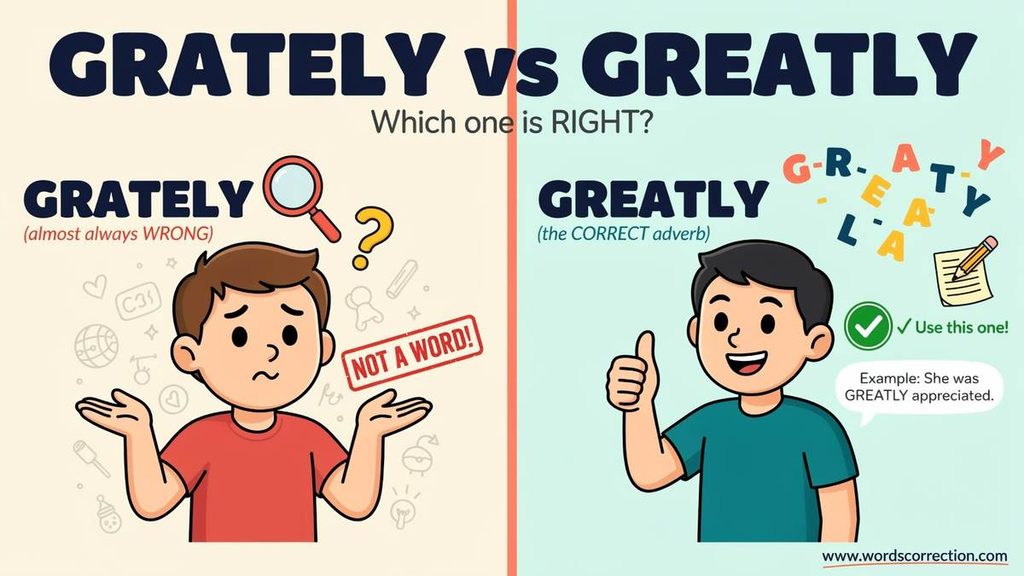
They may look similar, but they serve different grammatical purposes.
Understanding their meanings will help you avoid confusion.
| Word | Part of Speech | Meaning | Example |
|---|---|---|---|
| Great | Adjective | Excellent, important, or very good | She did a great job. |
| Greatly | Adverb | To a large degree or extent | Her work has greatly improved. |
| Grateful | Adjective | Feeling thankful or appreciative | I am grateful for your help. |
Great
Great describes a person, thing, experience, or quality.
Examples:
- He is a great teacher.
- We had a great experience.
- That was a great achievement.
Greatly
Greatly describes the extent or degree of an action or condition.
Examples
- Your support helped greatly.
- The situation has greatly improved.
- We greatly appreciate your effort.
Grateful
Grateful describes a feeling of appreciation or thankfulness.
Examples:
- I am grateful for your guidance.
- She felt grateful for the opportunity.
- We are grateful to everyone who helped.
Remember these simple distinctions
- Great describes something.
- Greatly explains how much or to what extent.
- Grateful describes a feeling of thankfulness.
Learn the difference between commonly misused words
Wise vs Wize Which Spelling Is Correct?
Is Grately a Real Word?
In standard modern English, grately is not an accepted word with an established dictionary meaning. It is generally considered a misspelling of greatly.
You should avoid using grately in
- Academic assignments
- Professional emails
- Business reports
- Formal letters
- Blog posts
- Everyday writing
If you want to express a high degree or significant amount, use greatly.
For example
Incorrect: The new system has grately improved our performance.
Correct: The new system has greatly improved our performance.
Using the standard spelling helps your writing remain clear and professional.
Is Greatly the Same in American and British English?
Yes. Greatly has the same spelling and meaning in both American and British English.
Unlike some words that have different regional spellings, greatly does not change between the two varieties.
| English Variety | Correct Spelling | Example |
|---|---|---|
| American English | Greatly | We greatly appreciate your help. |
| British English | Greatly | We greatly appreciate your help. |
The spelling remains the same regardless of whether you are writing for an American or British audience.
Learn the difference between everyday English mistakes
Faring vs Fairing what’s the Difference?
How to Remember the Correct Spelling of Greatly
Remembering the correct spelling becomes easier when you connect it to the original adjective.
Here are some practical methods.
1. Start With Great
The word greatly comes from great. Add -ly to the adjective and retain the final e.
Great + ly = Greatly
This is the simplest way to remember the spelling.
2. Connect It With Its Meaning
Greatly means to a large degree or extent.
For example
- Greatly improved
- Greatly appreciated
- Greatly affected
- Greatly increased
Think of greatly whenever you want to emphasize how much something has changed or how strongly something has affected a situation.
3. Memorize a Common Sentence
A useful sentence to remember is
Your help is greatly appreciated.
This expression appears frequently in professional and everyday communication. Remembering it can help you recognize the correct spelling whenever you need it.
4. Use a Spelling Checker
A spelling checker can identify mistakes such as grately, but do not depend on technology alone.
Read your writing carefully before submitting or publishing it. A quick review can catch errors that automated tools may miss.
Learn the difference between more words people mix up
Dought vs Doubt Which Spelling Is Correct?
Common Misspellings and Related Words
Writers sometimes confuse greatly with other words that look or sound similar.
The following table explains the differences.
| Word or Phrase | Correct Usage | Explanation |
|---|---|---|
| Grately | Incorrect in standard English | Common misspelling of greatly |
| Greatly | Correct | Adverb meaning to a large degree |
| Great | Correct | Adjective meaning excellent or important |
| Grateful | Correct | Adjective meaning thankful |
| Gratitude | Correct | Noun meaning thankfulness |
| Greatness | Correct | Noun describing the quality of being great |
| Greatful | Incorrect | Common misspelling of grateful |
Pay particular attention to greatly and grateful. Both are correct words, but they have different meanings.
For example
- I am grateful for your help.
- Your help has greatly improved my work.
The first sentence expresses appreciation. The second describes the extent of an improvement.
Learn the difference between tricky English words with easy explanations
Really vs Realy Which Spelling Is Correct?
A Practical Example Greatly in Workplace Communication
Imagine that a company introduces a new training program to improve employee performance.
Before the training, employees take longer to complete their tasks. After several weeks, the company notices a clear improvement in productivity.
A manager might write
The new training program has greatly improved employee productivity.
This sentence communicates that the improvement was significant.
Now consider an incorrect version
The new training program has grately improved employee productivity.
Although the intended meaning is clear, the spelling mistake makes the sentence look less polished.
This example shows why correct spelling matters. A single error may not change the meaning of a sentence, but it can affect how readers perceive the quality of your writing.
Practice Exercise Grately vs Greatly
Test your understanding of Grately vs Greatly with these 25 fill in the blank questions. Choose the correct word or expression to complete each sentence.
1. Your kindness is ______ appreciated by everyone.
2. Her writing skills have improved ______ over the past year.
3. We ______ appreciate your continued support.
4. The new software has ______ increased productivity.
5. Your contribution to this project is ______ valued.
6. The company has ______ benefited from the new strategy.
7. I am ______ for everything you have done for me.
8. She was ______ impressed by his outstanding performance.
9. Your assistance would be ______ appreciated.
10. The changes have ______ improved the quality of our services.
11. We are truly ______ for your generosity.
12. His confidence has grown ______ since joining the team.
13. The teacher was ______ pleased with the students’ progress.
14. Your feedback is ______ appreciated and valued.
15. The new policy has ______ reduced unnecessary expenses.
16. I feel ______ for having such supportive friends.
17. Her advice has ______ influenced my career decisions.
18. The audience ______ enjoyed the wonderful performance.
19. Your patience and understanding are ______ appreciated.
20. The new training program has ______ enhanced employee performance.
21. We are extremely ______ for your valuable assistance.
22. The situation has changed ______ since our last meeting.
23. His efforts have ______ contributed to the success of the project.
24. Your generous donation will be ______ appreciated by the organization.
25. The experience has ______ strengthened her communication skills.
Answers
- Greatly
- Greatly
- Greatly
- Greatly
- Greatly
- Greatly
- Grateful
- Greatly
- Greatly
- Greatly
- Grateful
- Greatly
- Greatly
- Greatly
- Greatly
- Grateful
- Greatly
- Greatly
- Greatly
- Greatly
- Grateful
- Greatly
- Greatly
- Greatly
- Greatly
Here’s a trusted source for clear word meanings:
Cambridge Dictionary
FAQs
What is the difference between grately vs greatly?
Greatly is the correct English spelling, meaning very much, considerably, or to a large extent. Grately is an incorrect spelling and is not recognized as a standard English word.
Is grately a recognized English word?
No, grately is not a recognized word in standard English dictionaries. It is a common misspelling of greatly, which is the correct spelling.
How do you spell greatly correctly?
The correct spelling is greatly, written as G-R-E-A-T-L-Y. It is formed by adding the suffix -ly to the adjective great without removing any letters.
Why do people commonly misspell greatly as grately?
People often confuse grately with greatly because the two spellings look similar and are easy to mistype. The correct spelling retains the E from great before adding the suffix -ly.
What does greatly mean in English?
Greatly is an adverb meaning very much, considerably, or to a large extent. It describes the degree or intensity of an action, feeling, condition, or change.
Can grately ever be used in standard English writing?
No, grately should not be used in standard English writing because it is a misspelling of greatly. For example, write “Your contribution is greatly appreciated,” rather than “Your contribution is grately appreciated.”
What part of speech is greatly?
Greatly is an adverb that modifies verbs, adjectives, and other adverbs. For example, in the sentence “Her confidence has improved greatly,” it describes the extent of the improvement.
What is the root word of greatly?
The root word of greatly is great, an adjective that describes something excellent, important, impressive, or significant. Adding the suffix -ly transforms it into the adverb greatly.
Is greatly spelled the same in American and British English?
Yes, greatly has the same spelling in both American and British English. Unlike some words that have regional spelling variations, greatly remains unchanged in both varieties.
What are the best synonyms for greatly?
Common synonyms for greatly include considerably, significantly, substantially, immensely, profoundly, and extensively. The most appropriate alternative depends on the meaning and context of the sentence.
What is the opposite of greatly?
Greatly does not have one universal opposite, but words such as slightly, minimally, marginally, and minimally can express a smaller degree. The best choice depends on the intended meaning.
Is greatly appreciated grammatically correct?
Yes, greatly appreciated is a grammatically correct and widely accepted expression. It communicates sincere gratitude and is commonly used to acknowledge someone’s help, kindness, effort, or support.
Should I write greatly appreciated or grately appreciated?
Always use greatly appreciated because greatly is the correct spelling. The expression is suitable for professional emails, formal messages, business communication, and everyday conversations.
What does your help is greatly appreciated mean?
The expression means that someone sincerely values your assistance, kindness, or support. It is a polite and professional way to acknowledge another person’s contribution.
Can greatly be used at the beginning of a sentence?
Yes, greatly can begin a sentence when the grammatical structure is appropriate. For example, “Greatly impressed by the results, the manager praised the entire team.”
What is the difference between great and greatly?
Great is an adjective that describes something excellent, impressive, or significant, whereas greatly is an adverb meaning very much or considerably. For example, “She is a great writer” and “Her writing has improved greatly.”
Is greatly appropriate for formal and professional writing?
Yes, greatly is suitable for formal, academic, and professional writing. It is frequently used in business correspondence, reports, presentations, and professional emails to express degree, appreciation, or impact.
How do you use greatly in everyday sentences?
Use greatly when describing something that has changed, improved, influenced, or affected something to a significant extent. For example, “Regular practice has greatly improved her English pronunciation.”
Is greatly another way of saying very much?
Yes, greatly can often replace very much when describing the degree or extent of an action or feeling. However, greatly generally sounds more formal and is particularly common in professional and academic writing.
Can greatly be used to describe someone’s personality?
Greatly does not usually describe a person’s personality directly because it is an adverb. However, it can modify actions or qualities associated with someone, as in “She greatly impressed everyone with her kindness.”
What is the difference between greatly and significantly?
Both greatly and significantly describe a considerable degree or extent. However, significantly often emphasizes importance or measurable impact, while greatly generally highlights the intensity or extent of an action, feeling, or change.
Does greatly have a positive or negative meaning?
Greatly is a neutral adverb, so its meaning depends on the surrounding context. It can describe positive situations, such as “greatly appreciated,” as well as negative experiences, such as “greatly disappointed.”
Why does greatly retain the letter E?
Greatly retains the letter E because it is formed by adding the suffix -ly directly to the complete adjective great. The original spelling remains unchanged, producing greatly rather than grately.
Is greatly improved or grately improved the correct expression?
Greatly improved is the correct expression because greatly is the standard English adverb. It indicates that something has improved considerably or undergone a significant positive change.
What is the easiest way to remember the spelling of greatly?
The easiest way to remember greatly is to break it into two parts: GREAT + LY = GREATLY. Keep the E in great when adding -ly, and you will avoid the common misspelling grately.
Learn the difference between confusing more English words step by step
Shute vs Chute Which Spelling Is Correct?
Conclusion
Understanding the difference between Grately vs Greatly may seem like a small detail, but choosing the correct spelling makes your writing clearer, more accurate, and professional. When comparing Grately vs Greatly, remember that greatly is the only correct spelling in standard English. It means to a large degree, considerably, or very much, whereas grately is simply a common spelling mistake. The easiest way to remember Grately vs Greatly is with this simple formula: great + ly = greatly. The final e stays in place! Whether you’re writing a professional email, completing an academic assignment, or expressing appreciation, always use gr eatly when appropriate. Mastering Grately vs Greatly will help you avoid spelling errors and communicate with greater confidence, clarity, and precision.

Stella AJS is an experienced blogger and dedicated English language writer at Words Correction. She turns confusing grammar, word meanings, spelling, and usage into clear, practical insights that readers can easily understand and apply. With a passion for precise and engaging writing, Stella helps readers avoid common language mistakes, strengthen their vocabulary, and communicate with greater clarity and confidence.




