
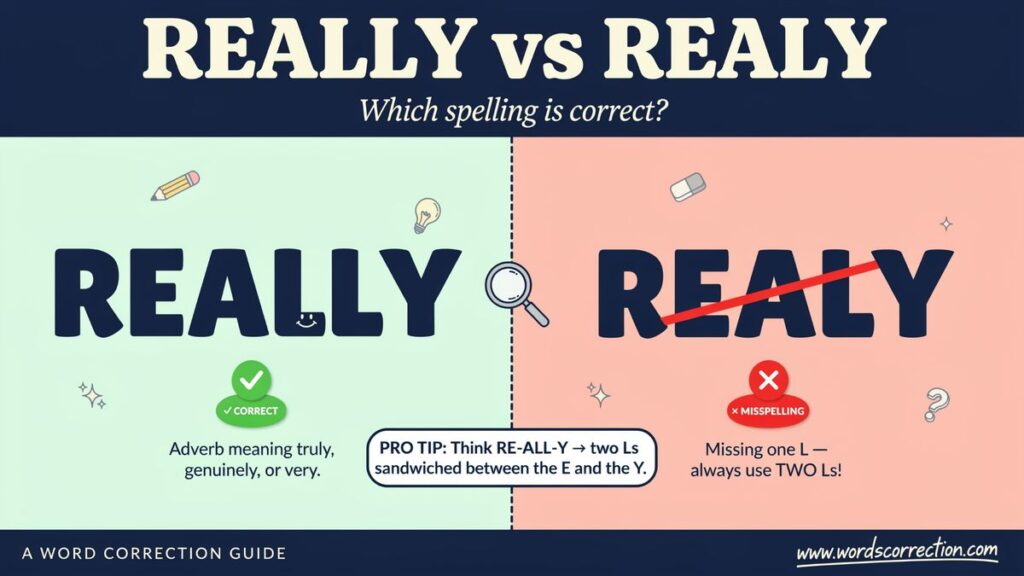
The difference between really vs realy may seem like a minor spelling issue, but one missing letter can make a noticeable difference in your writing. Realy in a hurry, only to question whether your spelling was correct? It’s an easy mistake to make, especially when English spelling doesn’t always follow predictable rules. However, only one form is correct: really. In this guide, you’ll discover why realy is a misspelling, understand the meaning of really, and learn how to use it correctly in everyday sentences. Let’s clear up this common spelling confusion and make your writing more accurate and confident.
Really vs Realy Quick Answer
When comparing Really vs Realy, the correct spelling is really, with two Ls. The spelling realy, with only one L, is incorrect in standard English.
The word really is an adverb that means truly, actually, or very, depending on the context. It is commonly used to emphasize a statement, express surprise, describe the degree of something, or confirm information.
In contrast, realy is simply a misspelling of really. It is not recognized as a standard English word, even though it may appear in text messages, social media posts, online searches, and informal writing. This is the key distinction in Really vs Realy.
Examples of correct and incorrect usage
- Correct: I really enjoyed the movie.
- Incorrect: I realy enjoyed the movie.
- Correct: Are you really interested in learning English?
- Incorrect: Are you realy interested in learning English?
Quick takeaway: In Really vs Realy, always choose really when writing in standard English. Remember that really contains two Ls, while realy is a spelling error.The difference comes down to one letter. Always use the double L in really.
Quick Takeaway
| Word | Correct or Incorrect? | Explanation |
|---|---|---|
| Really | Correct | Standard English adverb |
| Realy | Incorrect | Common misspelling of really |
| Real | Correct | An adjective meaning genuine or actual |
| Truly | Correct | An adverb meaning genuinely or truthfully |
Easy rule: Remember that really contains two Ls. If you write realy with one L, you’ve made a spelling mistake.
Learn the difference between tricky words and use them correctly
Rug vs Rag What Is the Difference?
What Does Really Mean?
The word really has several related meanings in English. Depending on its position and context, it can mean actually, truly, genuinely, or very.
People use it in everyday conversation to strengthen statements, describe the degree of something, or express a reaction to unexpected information.
For example
- I really like your new house.
- She is really talented.
- Did he really say that?
- I really need some rest.
In the first sentence, really emphasizes how much the speaker likes the house. In the second, it strengthens the adjective talented. The third expresses surprise or disbelief, while the fourth emphasizes the speaker’s need for rest.
Really Definition
Really (adverb): In a way that is genuine, actual, or true; to a significant degree; or as an expression of surprise, interest, or emphasis.
Here are the main meanings of really
| Meaning | Explanation | Example |
|---|---|---|
| Actually | Refers to something that is true or factual | I really live near the airport. |
| Truly | Expresses sincerity or genuine feelings | I really appreciate your support. |
| Very | Increases the degree of an adjective or adverb | The exam was really difficult. |
| Emphasis | Makes a statement stronger | I really want to succeed. |
| Surprise | Shows an unexpected reaction | Really? That’s wonderful! |
The meaning of really in English depends heavily on context. The same word can communicate different feelings or levels of emphasis depending on how you use it.
Really as an Adverb
The part of speech of really is an adverb. An adverb is a word that modifies a verb, adjective, another adverb, or sometimes an entire sentence.
In simple terms, an adverb provides additional information about an action, quality, or statement.
For example
- She speaks really clearly.
- The food tastes really delicious.
- He works really hard.
- I really understand your concern.
Notice how really changes the strength or meaning of the words around it.
First example, it modifies the adverb clearly. Second, it modifies the adjective delicious. Third, it strengthens hard. In the final example, it emphasizes the verb understand.
Really is also commonly described as an adverb of degree because it indicates how much or to what extent something happens or exists.
For English language learners, understanding this grammatical role makes it easier to use really correctly rather than inserting it randomly into sentences.
Really as a Word of Emphasis
Sometimes a sentence needs a little extra emphasis. That’s where really comes in.
People use it to strengthen feelings, opinions, intentions, and personal experiences. It can make a statement sound more sincere or convincing.
Examples
- I really appreciate everything you’ve done.
- We really need to finish this project today.
- She really loves spending time with her family.
- This restaurant really serves excellent food.
Without really, these sentences still make sense. However, the adverb adds emphasis and makes the speaker’s feelings or intentions more noticeable.
Really to Express Surprise or Doubt
Really can also work as a reaction to unexpected information. In spoken English, people frequently use it as a short question or exclamation.
For example
- Really? I thought you were staying longer.
- You really won the competition?
- Really! That’s amazing news.
- Did she really finish the entire book in one day?
The speaker’s tone matters here. A rising tone can suggest curiosity or surprise, while a skeptical tone may communicate doubt.
Important: Really doesn’t always mean very. Sometimes it questions whether something is true.
Learn the difference between similar English words the easy way
Tetroxide vs Tetraoxide Which Spelling Is Correct?
Is Realy a Real Word?
No. Realy is not a standard English word. It’s an incorrect spelling of really.
When people type realy, they usually intend to write really but accidentally leave out one L. This mistake doesn’t create a different adverb or an alternative spelling.
Standard English dictionaries recognize really as the correct spelling. Realy isn’t an accepted spelling variation in ordinary American or British English.
For example
- Incorrect: I realy hope everything goes well.
- Correct: I really hope everything goes well.
The incorrect version may still communicate the intended message. Most readers will understand what the writer means. Nevertheless, correct spelling matters when you’re writing professional emails, academic assignments, business documents, or published content.
Why Is Realy Incorrect?
The problem comes from the way the word is formed.
Really comes from the adjective real and the suffix -ly.
When you add -ly to real, the final L of the base word remains. The suffix also begins with L. As a result, the two letters appear together.
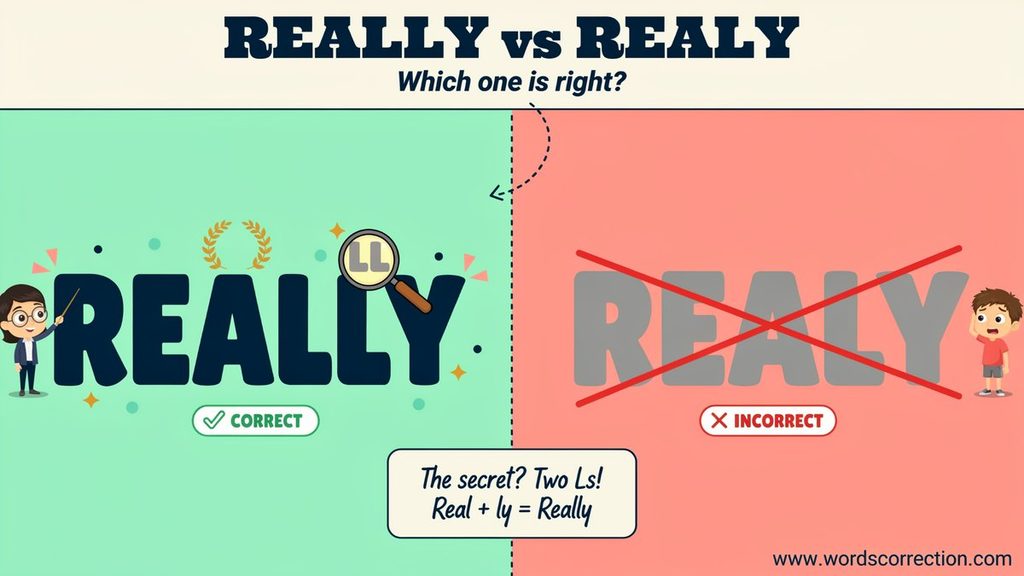
Real + ly = Really
Let’s break it down
- Real: R-E-A-L
- Suffix: L-Y
- Final spelling: R-E-A-L-L-Y
The spelling realy leaves out one of those letters. That’s why it doesn’t follow the correct word formation.
Why Do People Write Realy Instead of Really?
Even though really is a familiar English word, people still make this spelling mistake. Several factors explain why.
Double-letter confusion: English contains many words with repeated consonants. Remembering exactly where to use double letters can be difficult, especially for people learning English.
Fast typing: When someone types quickly, it’s easy to skip a letter without noticing. The brain often focuses on the meaning of a sentence rather than every individual character.
Pronunciation habits: In spoken English, the two written Ls don’t produce two separate sounds. Therefore, listening to the word doesn’t necessarily remind someone to write both letters.
Autocorrect mistakes: Spellcheckers and autocorrect tools can catch many errors, but they don’t replace careful proofreading. Depending on the application and its settings, a typing mistake might remain unnoticed.
Visual familiarity: Because realy looks similar to really, readers may recognize the intended word without noticing the missing letter.
These factors explain the common spelling confusion, but they don’t make realy an acceptable alternative.
Learn the difference between commonly confused more words in English
Accross vs Across Which Is Correct Spelling?
Really vs Realy Key Differences
The easiest way to understand really vs realy is to compare the two spellings directly.
| Feature | Really | Realy |
|---|---|---|
| Spelling | Correct | Incorrect |
| Number of Ls | Two | One |
| Dictionary status | Standard English word | Common misspelling |
| Part of speech | Adverb | No standard grammatical role |
| Meaning | Actually, truly, or very | No standard meaning |
| Usage | Everyday and formal English | Typographical error |
| Example | I really like coffee. | I realy like coffee. |
The distinction is straightforward. Really is the correct English word, while realy is simply a spelling error.
Really vs Realy Examples
Seeing the two forms in complete sentences makes the difference easier to remember.
| Incorrect Spelling | Correct Spelling |
|---|---|
| I realy like this book. | I really like this book. |
| She is realy happy today. | She is really happy today. |
| Do you realy understand? | Do you really understand? |
| This is realy important. | This is really important. |
| He works realy hard. | He works really hard. |
| I realy enjoyed the event. | I really enjoyed the event. |
| They realy need our help. | They really need our help. |
Remember: The intended meaning doesn’t change between these examples. The correction simply makes the spelling accurate.
Learn the difference between confusing more English words step by step
Present vs Presant which one is Correct?
How to Use Really in a Sentence
Understanding really grammar is just as important as knowing its correct spelling. Although people use it frequently, its placement can affect how a sentence sounds and what the speaker wants to emphasize.
Let’s explore its most common uses.
Using Really Before Adjectives
An adjective describes a person, place, thing, or situation. Really can come before an adjective to increase its intensity.
Examples
- The weather is really pleasant today.
- That was a really difficult question.
- My sister is really creative.
- This restaurant is really popular.
- The new website looks really professional.
In these sentences, really acts as an adverb of degree. It tells the reader how pleasant, difficult, creative, popular, or professional something is.
Using Really Before Adverbs
Really can also modify another adverb.
Examples
- She sings really beautifully.
- He drives really carefully.
- The students worked really efficiently.
- They arrived really early.
- My brother runs really fast.
Here, really strengthens the meaning of the adverb that follows it.
Using Really With Verbs
When really modifies a verb, it often emphasizes the action, intention, or feeling.
Examples
- I really enjoy reading novels.
- She really wants to become a doctor.
- We really appreciate your kindness.
- They really believe in their goals.
- He really needs some advice.
In these examples, really makes the action or feeling more emphatic.
Using Really in Questions and Responses
Really is particularly useful in questions because it can express surprise, curiosity, or disbelief.
Examples
- Do you really think that’s a good idea?
- Are they really coming tomorrow?
- Did you really finish the assignment?
- Is this really your first visit?
- Really? I didn’t expect that!
In conversation, a single-word response such as “Really?” can communicate several things. Your tone and the surrounding conversation help listeners understand whether you’re surprised, interested, or doubtful.
Learn the difference between tricky English words with easy explanations
Skiid vs Skied Which Spelling Is Correct?
Really vs Real What’s the Difference?
Although really and real look similar, they have different grammatical functions.
Real is an adjective. It describes something genuine, actual, or not imaginary.
Really is an adverb. It describes how something happens or indicates the degree to which something is true or exists.
Consider these examples
- This is a real diamond.
- This diamond is really expensive.
In the first sentence, real describes the diamond. It tells you that the diamond is genuine rather than artificial.
In the second sentence, really modifies expensive. It explains the degree of the diamond’s cost.
What Does Real Mean?
Real means genuine, actual, or existing in fact rather than being imaginary or artificial.
Examples
- Is this a real leather jacket?
- She has a real talent for painting.
- The story is based on real events.
- That was a real surprise.
Real is an adjective, so it usually describes a noun or follows a linking verb.
What Does Really Mean?
Really generally means actually, truly, or very.
Examples
- I really believe in your abilities.
- She is really good at mathematics.
- Are you really serious?
- We really enjoyed our vacation.
Unlike real, really usually modifies verbs, adjectives, and adverbs.
Real vs Really Comparison Table
| Real | Really |
|---|---|
| Adjective | Adverb |
| Describes nouns | Modifies verbs, adjectives, and adverbs |
| Means genuine or actual | Means truly, actually, or very |
| A real friend | I really trust my friend. |
| A real problem | This problem is really serious. |
| Real happiness | She is really happy. |
Grammar tip: Use real when describing what something is. Use really when explaining how true, intense, or genuine something is.
Learn the difference between more words people mix up
Moment vs Momment Which Spelling Is Correct?
Really Synonyms What Words Can You Use Instead?
Sometimes really appears too frequently in a paragraph. Repeating it in every sentence can make your writing sound less polished.
Fortunately, English offers several alternatives. However, the best synonym depends on the meaning you want to communicate.
Synonyms of Really Meaning Actually
When really means actually or truly, you can consider these alternatives
| Synonym | Meaning | Example |
|---|---|---|
| Actually | In reality or fact | I actually enjoyed the presentation. |
| Truly | Genuinely or sincerely | I truly appreciate your help. |
| Indeed | Certainly or without doubt | The task is indeed challenging. |
| Certainly | Without question | She certainly deserves the award. |
| Definitely | Without uncertainty | I definitely recommend this book. |
These words work well when you want to confirm information or communicate sincerity.
Synonyms of Really Meaning Very
When really strengthens an adjective or adverb, the following words may work better
| Synonym | Example |
|---|---|
| Extremely | The weather is extremely hot. |
| Particularly | This topic is particularly interesting. |
| Exceptionally | She is exceptionally talented. |
| Incredibly | The view was incredibly beautiful. |
| Remarkably | He performed remarkably well. |
| Highly | This course is highly recommended. |
For example
- Original: The movie was really interesting.
- Alternative: The movie was incredibly interesting.
- Alternative: The movie was exceptionally interesting.
Each alternative has a slightly different tone or level of emphasis. Choose one that fits the context.
Synonyms of Really for Expressing Surprise
In everyday conversation, you can use different expressions to communicate surprise or disbelief.
- Seriously?
- Honestly?
- For real?
- Is that so?
- Are you kidding?
- You don’t say!
For example
Person A: I got accepted into my dream university!
Person B: Seriously? That’s fantastic!
These expressions are common in informal conversation. However, they aren’t always suitable replacements in professional or academic writing.
Learn the difference between everyday English mistakes
Distress vs Duress what’s the Difference?
Really Pronunciation How to Pronounce Really
Correct spelling and pronunciation are two essential aspects of learning English. You may know how to spell a word correctly but still be unsure about its pronunciation. This is an important distinction to understand when comparing Really vs Realy.
The word really has slight pronunciation variations among English speakers. In American English, it is commonly pronounced with two syllables, although some speakers pronounce the vowel sounds more distinctly. Importantly, the two written Ls do not represent two separate L sounds.
When learning Really vs Realy, remember that really is the correct spelling, but its pronunciation may vary slightly depending on the speaker’s accent.
How to Pronounce Really
Follow these simple steps to pronounce the word correctly:
- Start with the initial R sound.
- Pronounce the vowel sound clearly.
- Move smoothly into the L sound.
- Finish with the unstressed ending.
For better pronunciation, listen to native American English speakers and repeat the word in complete sentences. Regular practice can help you improve your speaking skills and sound more natural.
Really Pronunciation Examples
- I really like your idea.
- She is really interested in science.
- Are you really going to leave?
- I really appreciate your help.
- Is this really what you wanted?
Pronunciation Tip: Do not assume that every written letter produces a separate sound. English spelling and pronunciation do not always match perfectly. Understanding this difference makes the Really vs Realy spelling comparison easier to remember.
Remember, really is the correct spelling, with two Ls, while realy is an incorrect spelling in standard English.
Learn the difference between commonly misused words
Waring vs Wearing Which Word Is Correct?
Why Does Really Have Two Ls?
The reason really has two Ls is its formation from the base word real and the suffix -ly.
The word real already ends with L. When you add the suffix -ly, you retain that final L and add the L that begins the suffix.
Real + ly = Really
This is a simple example of English word formation.
The same pattern appears in other words where a base ending in L combines with a suffix beginning with L.
For example
- Actual + ly = Actually
- Equal + ly = Equally
- Final + ly = Finally
- Usual + ly = Usually
- Natural + ly = Naturally
These examples demonstrate why double-letter spelling matters.
Understanding the Double L Rule
There isn’t one universal double L rule that explains every English word. However, the formation of really is straightforward.
The base word ends in L. The suffix begins with L. Both letters remain in the finished word.
This distinction matters because English spelling rules depend on word structure. Simply removing a repeated letter because it looks unnecessary can produce an incorrect spelling.
Learn the difference between basic English word mistakes
Wise vs Wize Which Spelling Is Correct?
Really in Formal and Informal Writing
Is really appropriate in professional writing? Yes. Really is a standard English word, and you can use it in both formal and informal communication.
However, its suitability depends on context.
Really in Professional Writing
In professional emails and business communication, really can express genuine appreciation or emphasize an important point.
Examples
- We really appreciate your continued support.
- This improvement is really important to our team.
- I really value your feedback.
Although these sentences are grammatically correct, some situations call for more precise wording.
For instance
- Less precise: The new system is really effective.
- More precise: The new system reduced processing time by 25%.
The second sentence communicates a measurable result rather than relying on a general intensifier.
Really in Academic Writing
Academic writing usually favors specific language over repeated emphasis.
You can use really when it contributes to the meaning, but alternatives such as significantly, particularly, substantially, or genuinely may communicate your point more accurately.
Examples
- Less formal: The results were really important.
- More academic: The results were statistically significant.
Remember that these alternatives aren’t always interchangeable. Statistically significant has a specific research meaning that really important doesn’t express.
Really in Everyday Conversation
Really is perfectly natural in everyday speech.
Examples
- I really need a vacation.
- That sounds really exciting.
- Do you really think so?
- I really don’t understand this question.
It’s one of those familiar words that helps conversations sound natural.
Really in Emails and Social Media
People frequently use really in text messages, emails, captions, and social media posts.
Examples
- I really enjoyed meeting everyone today.
- Really excited about this new opportunity!
- Thank you! I really appreciate it.
- I really can’t wait for the weekend.
The important thing is to maintain the correct spelling regardless of the communication platform.
Learn the difference between often confused words
Faring vs Fairing what’s the Difference?
Common Spelling Mistakes With Really
Even experienced English writers make occasional spelling errors. Really is particularly easy to mistype because the missing letter doesn’t dramatically change the word’s appearance.
Here are some mistakes worth avoiding.
Writing Realy With One L
This is the main error discussed throughout this article.
- Incorrect: I realy enjoyed the conference.
- Correct: I really enjoyed the conference.
Always check that really contains two Ls.
Confusing Really With Real
Real and really are both correct words, but they don’t perform the same grammatical function.
- Incorrect: She is a really person.
- Correct: She is a real person.
- Correct: She is really kind.
The first sentence uses really incorrectly because the noun person requires an adjective in that construction.
Forgetting the Double L When Adding -Ly
The suffix -ly appears in many English adverbs. However, adding it doesn’t mean you should remove the final letter of the base word.
- Real + ly = Really
- Equal + ly = Equally
- Final + ly = Finally
Remember the structure instead of guessing the spelling.
Overusing Really in Writing
Although really is grammatically correct, using it repeatedly can weaken your writing.
Consider this example
“I really like this product because it is really useful and really affordable. It really helps people save time.”
The paragraph repeats really four times. That repetition makes the writing less engaging.
A stronger version would be:
“I genuinely like this product because it’s useful and affordable. It also helps people save time.”
The revised version communicates the same general idea with more variety.
Incorrect Placement in a Sentence
Really can appear in different positions depending on what it modifies.
Compare
- I really like this book.
- I like this book really much.
The first sentence is natural and correct. The second is not standard English usage. A better alternative is “I like this book very much.”
Correct word placement helps maintain natural sentence structure.
How to Remember the Correct Spelling of Really
Memorizing the correct spelling doesn’t have to be difficult. A few practical techniques can help you avoid the realy spelling mistake.
Remember Real + Ly = Really
This is the simplest method.
Break the word into its two parts:
REAL + LY = REALLY
The final L in real stays in place. The suffix contributes another L.
Once you understand the word formation, the spelling becomes easier to remember.
Look for the Double L
Whenever you write really, check the middle of the word.
You should see two consecutive Ls:
R-E-A-L-L-Y
If there’s only one L, correct the spelling.
Use Really in Practice Sentences
Writing the word in different contexts helps reinforce its spelling and grammar.
Try these examples
- I really enjoy learning new things.
- This lesson is really helpful.
- She really understands the topic.
- Are you really interested in this opportunity?
- We really appreciate your patience.
Practice using the word in meaningful sentences rather than copying it repeatedly without context.
Proofread for Missing Letters
Before submitting an assignment, sending an email, or publishing an article, check for missing letters.
A spelling checker or grammar checker can help identify errors. However, don’t rely on technology alone. Read your work carefully because automated tools may overlook certain mistakes.
A Practical Case Study Why One Letter Matters
Imagine a student preparing an important university assignment.
The student writes
“I realy enjoyed researching this subject because it helped me understand English grammar.”
The meaning is clear. A teacher can easily understand the sentence. However, the spelling error makes the assignment look less polished.
After correction, the sentence becomes
“I really enjoyed researching this subject because it helped me understand English grammar.”
Only one letter changed, but the corrected sentence follows standard English spelling.
The same issue can affect professional emails, website content, business proposals, and job applications.
For example, a website that repeatedly uses realy instead of really may appear less carefully edited. Search engines can often understand common misspellings, but accurate spelling improves the quality and professionalism of the content.
The lesson: Small spelling mistakes don’t always prevent communication, but correcting them helps you present your ideas more clearly and professionally.
practice session
Instructions: Choose the correct word from the two options given in each sentence Really / Realy.
- Are you ______ coming to the party?
- I ______ enjoyed the movie.
- Is this ______ your final decision?
- She is ______ good at writing.
- Do you ______ believe that story?
- He was ______ happy with the results.
- I ______ need your help.
- Are you ______ sure about this?
- The weather is ______ pleasant today.
- Did they ______ win the competition?
- I ______ appreciate your support.
- This book is ______ interesting.
- She ______ wants to learn English.
- Are you ______ feeling better now?
- That was a ______ beautiful performance.
- He ______ likes playing football.
- I am ______ excited about the trip.
- Did you ______ finish your homework?
- The food tastes ______ delicious.
- They are ______ friendly people.
- I ______ miss my old friends.
- Is this ______ the correct answer?
- She looked ______ surprised.
- We ______ enjoyed our vacation.
- Do you ______ want to try again?
Answers
- Really
- Really
- Really
- Really
- Really
- Really
- Really
- Really
- Really
- Really
- Really
- Really
- Really
- Really
- Really
- Really
- Really
- Really
- Really
- Really
- Really
- Really
- Really
- Really
- Really
Here’s a trusted source for clear word meanings:
Cambridge Dictionary
FAQs
Which spelling is correct really vs realy?
Really is the correct spelling in standard English. Realy is a common spelling error that occurs when one of the two Ls is omitted. Always use really in formal and informal writing.
Is realy a recognized English word?
No, realy is not a recognized standard English word. It is an incorrect spelling of really, which means actually, truly, or very.
What does the word really mean?
Really is an adverb that means actually, genuinely, truly, or very. It is commonly used to emphasize a statement, describe the degree of something, or express surprise.
Why does really have two Ls?
Really has two Ls because it is formed by adding the suffix -ly to the adjective real. The original L in real remains, and the suffix contributes another L, producing the correct spelling really.
What is the main difference between really vs realy?
The main difference is spelling and grammatical validity. Really is the correct English adverb, whereas realy is a misspelling and has no accepted meaning in standard English.
How is really used correctly in a sentence?
Really is used to emphasize an action, quality, or statement. For example: “I really appreciate your support.” In this sentence, really emphasizes the speaker’s appreciation.
What are some common examples of really in everyday English?
Here are three common examples
- She is really good at mathematics.
- I really enjoyed the presentation.
- Are you really going to travel tomorrow?
In each example, really adds emphasis to the statement or question.
How do you pronounce really correctly?
Really is commonly pronounced /ˈrɪəli/ or /ˈrɪli/, depending on the speaker’s accent. It generally has two syllables, although pronunciation can vary between English dialects.
Is really an adverb or an adjective?
Really is an adverb, not an adjective. It modifies adjectives, other adverbs, and verbs to express emphasis, degree, or truth. For example: “The weather is really pleasant.”
Can really be used as a synonym for very?
Yes, really can be used instead of very when emphasizing the degree of an adjective or adverb. For example, “The movie was really interesting” has a similar meaning to “The movie was very interesting.”
What are the most common synonyms for really?
Common synonyms for really include actually, truly, genuinely, indeed, certainly, definitely, and absolutely. The most appropriate synonym depends on the context and intended meaning of the sentence.
Is really appropriate for formal and informal writing?
Yes, really is appropriate in both formal and informal English. However, in academic or professional writing, alternatives such as genuinely, indeed, and actually may provide a more precise or formal tone in certain contexts.
Can really be used at the beginning of a sentence?
Yes, really can appear at the beginning of a sentence to express emphasis, surprise, or disagreement. For example “Really, I did not expect such a positive result.”
Can really be used as a standalone question?
Yes, really can be used independently as a question to express surprise, disbelief, or curiosity. For example: “Really? You completed the entire project in one day?”
Is really spelled the same way in British and American English?
Yes, really has the same spelling in both British and American English. Realy is considered an incorrect spelling in both varieties of standard English.
Why do people frequently misspell really as realy?
People frequently misspell really as realy because they accidentally omit the second L while typing or are unfamiliar with the correct spelling pattern. This is a common typing and spelling mistake.
What is the difference between real and really?
Real is an adjective that describes something genuine, authentic, or not imaginary. Really is an adverb used to express truth, emphasis, or degree. For example: “This is a real opportunity” and “This is really important.”
Can really modify verbs in English sentences?
Yes, really can modify verbs to emphasize an action, feeling, or statement. For example: “I really appreciate your honesty.” Here, really emphasizes the strength of the speaker’s appreciation.
Is really considered an adverb of degree?
Yes, really can function as an adverb of degree when it modifies an adjective or another adverb. For example: “The examination was really difficult.” It indicates the intensity of the difficulty.
What is the opposite of really?
The opposite of really depends on the context. When really means genuinely or actually, falsely or supposedly may express an opposing idea. When it indicates a high degree, barely or hardly may provide a contrasting meaning.
How can I remember the correct spelling of really?
An easy way to remember the spelling is to break the word into real + ly. Keep the original L in real and add the L from the suffix -ly. This gives you really, with two Ls.
Is realy an alternative spelling of really?
No, realy is not an accepted alternative spelling of really. It is simply a spelling mistake. The standard and grammatically correct form is really.
Can spell-checking tools detect the misspelling realy?
Yes, most modern spelling and grammar-checking tools can identify realy as an incorrect spelling and recommend really as the correct form. However, manually reviewing your writing is still important.
Should I Use Really or Truly in a Sentence?
Use really to emphasize a statement, describe a quality, or express a degree. Use truly when you want to convey sincerity, honesty, or a genuine feeling. Understanding this distinction also helps clarify the meaning of Really vs Realy.
What is the easiest way to avoid confusing really vs realy?
The easiest way is to remember that really always contains two Ls. Associate the word with the spelling formula real + ly = really, and use a spell-checking tool to identify mistakes before submitting or publishing your writing.of the most common spelling mistakes involving the word.
Learn the difference between confusing more English words
Dought vs Doubt Which Spelling Is Correct?
Conclusion
Understanding the difference between Really vs Realy is a simple yet important step toward improving your English spelling and writing skills. The correct spelling is really, with two Ls, while realy is a common misspelling that should be avoided in standard English.
The easiest way to remember the correct spelling in Really vs Realy is to focus on the double L. Whether you are emphasizing an idea, expressing surprise, or adding emphasis to a statement, using really correctly makes your sentences clearer and more professional.
Although English spelling can sometimes be challenging, the Really vs Realy mistake is easy to avoid. Simply remember that really contains two Ls, not one.
By understanding Really vs Realy, you can avoid this common spelling mistake, improve your writing accuracy, and communicate more confidently in everyday English.

Stella AJS is an experienced blogger and dedicated English language writer at Words Correction. She turns confusing grammar, word meanings, spelling, and usage into clear, practical insights that readers can easily understand and apply. With a passion for precise and engaging writing, Stella helps readers avoid common language mistakes, strengthen their vocabulary, and communicate with greater clarity and confidence.




