Choosing between Allie or ally can be confusing because the two spellings look remarkably similar, yet they serve very different purposes. Ally is a standard English word that refers to a supporter, friend, partner, or nation that cooperates with another. Allie, on the other hand, is usually a person’s name or nickname. Using the wrong spelling can turn a simple sentence into an unexpected grammar puzzle. In this guide, you’ll learn the difference between Allie and ally, their meanings, pronunciations, correct usage, and common spelling mistakes. By the end, you’ll know exactly when to use each form and avoid this common English confusion.
Allie vs Ally What’s the Difference?
The key difference between Allie vs. ally is grammatical and contextual.
Ally is an ordinary English word. As a noun, it describes someone or something that provides support or shares an interest, goal, or agreement with another person or group. As a verb, it means to join, connect, or cooperate with another person or group.
Allie, on the other hand, is most commonly a person’s name. It can be a standalone given name or a nickname for several names that have a similar sound.
Consider these two sentences:
Allie helped me finish the project.
Here, Allie is a person’s name.
Sarah has always been an ally in difficult situations.
Here, ally means a supporter.
The words may look like close relatives on the page, but they are not interchangeable.
Quick Rule Ally or Allie?
When deciding between Ally or Allie, use this simple rule:
Use “ally” for a supporter, partner, or person or group that joins with another. Use “Allie” when you mean a person’s name or nickname spelled that way.
| Word | Main Use | Example |
| Ally | Supporter or partner | “She became an important ally.” |
| Ally | Verb meaning to join or cooperate | “The two groups allied against a common threat.” |
| Allie | Given name or nickname | “Allie called me yesterday.” |
| Ally | Can also be a personal name | “Ally is joining us for dinner.” |
Capitalization matters, too. Allie is normally capitalized because it is a proper noun when used as a person’s name.
Ally Meaning and Definition
The basic ally meaning centers on support, cooperation, and association.
An ally can be an individual who supports another person. It can also be an organization, political group, or country that cooperates with another group. The relationship may be informal, such as two coworkers helping each other, or formal, such as countries connected through a treaty or strategic alliance.
A useful ally definition is:
An ally is a person, group, or country that supports, cooperates with, or is formally associated with another.
The exact meaning depends on context.
For example:
- A friend can be an ally when they support you during a difficult situation.
- A country can be an ally when it cooperates with another country.
- An organization can become an ally of a community by supporting its goals.
- A political figure can have an ally who supports the same policy or objective.
The meaning of ally therefore goes beyond simple friendship. An ally and a friend may overlap, but they do not necessarily mean the same thing.
Ally as a Noun
Ally as a noun refers to someone or something that offers support or shares a common interest.
For example:
- “She found an ally in her new manager.”
- “The country has several military allies.”
- “He became a strong ally of the environmental organization.”
- “A trusted ally can make difficult situations easier to handle.”
The noun can describe an individual, group, organization, or nation.
It also appears in phrases such as:
- a trusted ally
- a close ally
- a loyal ally
- a political ally
- a military ally
- an important ally
- a strategic ally
An ally does not have to agree with you about everything. The relationship usually centers on a particular interest, objective, or form of support.
Ally as a Verb
Ally as a verb means to join, unite, or associate with another person or group.
For example:
- “The two organizations allied to improve access to education.”
- “The smaller group allied with a larger coalition.”
- “She refused to ally herself with the organization.”
- “Several countries allied against a common enemy.”
The verb commonly appears as “ally with” or “ally oneself with.”
Its forms include:
| Form | Example |
| Base form | ally |
| Third-person singular | allies |
| Past tense | allied |
| Past participle | allied |
| -ing form | allying |
Notice the spelling change:
ally → allies → allied → allying
This pattern becomes particularly useful when learning the ally plural form and other forms of the word.
Learn the difference between confusing more English words
Blackout or Backout which is correct?
Ally Plural Form Allies
The standard ally plural form is allies.
When a singular noun ends in a consonant followed by -y, English often changes the y to i and adds -es.
So:
ally → allies
Examples:
- “The country has several allies.”
- “The two leaders met with their international allies.”
- “Her allies supported the proposal.”
- “The organization worked with several community allies.”
The same spelling principle appears in other words:
- country → countries
- party → parties
- company → companies
- family → families
Therefore, forms such as “allys” are incorrect when you mean the plural of the noun.
Ally’s Plural Form
The phrase ally’s plural form can cause another small confusion.
If Ally is someone’s name, you do not normally turn the name into “allies.” A person’s name remains their name.
For example:
“I spoke with Ally yesterday.”
If you are talking about more than one person who happens to be named Ally, you would normally say:
“I spoke with two people named Ally.”
The plural allies belongs to the common noun ally. It does not automatically apply to the personal name Ally.
Learn the difference between commonly mixed-up more words
Stabilise or Stabilize Difference in Usage
What Does Ally Mean in Different Contexts?
The word becomes more precise when you place it in a particular context.
Ally as a Friend or Supporter
In everyday conversation, an ally can be someone who stands beside you when you need help.
For example:
“My older sister was my ally when I had to make the difficult decision.”
This does not necessarily mean that the sister is a formal partner. It simply emphasizes support.
An ally can be a:
- friend
- supporter
- advocate
- colleague
- partner
- collaborator
- trusted person
However, an ally does not have to be a close friend.
Someone may support your goal without having a personal friendship with you.
Political Ally Meaning
A political ally is a person, political group, or organization that cooperates with another because they share particular interests, goals, or positions.
For example:
“The senator gained a political ally during the negotiations.”
Political alliances can be temporary or long-term. They may form around legislation, elections, negotiations, policy goals, or other shared interests.
The word ally does not automatically mean that two political actors agree on every issue. It simply identifies a supportive or cooperative relationship in a particular context.
Military Ally Meaning
The military ally meaning is especially common in discussions of war and international relations.
A military ally is a country or group that cooperates with another in military or security matters. The relationship can involve defense agreements, shared operations, intelligence cooperation, logistical support, or other forms of military coordination.
For example:
“The country relied on its military allies during the conflict.”
Historically, the capitalized term “the Allies” has also referred to groups of countries that fought together during major wars.
This is why you may see phrases such as:
- the Allied forces
- the Western Allies
- the Allied nations
- an Allied country
The broader concept is connected to an alliance, which describes the relationship or agreement between allied parties.
Social Justice Ally
In social advocacy, an ally can describe someone who supports a group or cause without necessarily being a member of that group.
For instance:
“She became an ally of the disability rights organization.”
In this sense, being an ally involves more than simply saying you agree. The word can imply active support, advocacy, cooperation, or action.
Learn the difference between tricky grammar more words
Palate or Palette Difference and Usage
Ally Synonym What Words Can Replace Ally?
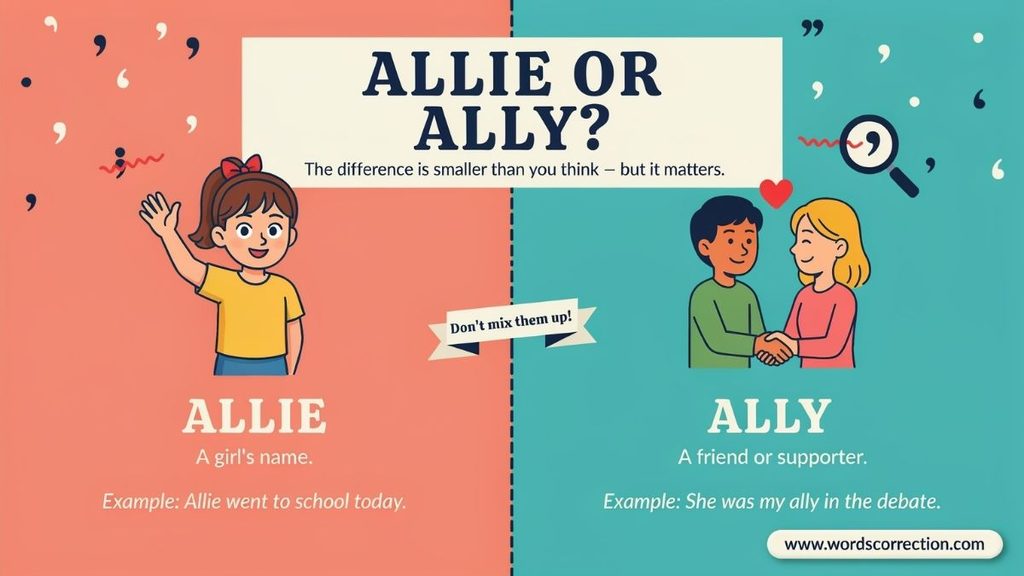
The best ally synonym depends on the sentence.
Possible alternatives include:
- supporter
- partner
- advocate
- collaborator
- associate
- companion
- friend
- backer
- confederate
However, these words are not perfect substitutes in every context.
For example, supporter may describe someone who favors a cause, while ally can suggest a stronger relationship or shared objective.
Similarly, a partner may be an ally, but not every partner is an ally.
This is why choosing synonyms based on context produces more precise writing.
What Does Allie Mean?
The Allie meaning is different because Allie is primarily used as a personal name or nickname.
Allie is commonly recognized as a feminine given name and a diminutive associated with names such as Alison, Allison, and Alexandra. It can also be connected with other names that begin with a similar sound.
The exact source of someone’s name should not be assumed, though. One person’s Allie may be short for Allison, while another person’s Allie may be their full given name.
That distinction matters.
Allie Name Meaning
The Allie name meaning depends partly on the longer name from which it developed.
Allie is commonly associated with names such as Alison, Allison, and Alexandra. However, there is no single meaning that applies to every person named Allie.
If someone introduces herself as Allie, the safest approach is simple: use Allie unless she tells you otherwise.
Allie as a Nickname
Allie as a nickname is common enough to be recognizable in English-speaking contexts.
It can serve as a short form of:
- Allison
- Alison
- Alexandra
- Alice
- Aliana
- other names beginning with a similar sound
However, these relationships are not fixed rules. A nickname belongs to the person who uses it.
For example, someone named Alexandra may choose Allie rather than Alex. Another person named Alexandra may never use Allie at all.
Allie as a Girl’s Name
Allie as a girl’s name is widely recognizable in English-language naming.
It can function as:
- A nickname.
- A short form of a longer name.
- A standalone given name.
- A spelling variant of similar short names.
Allie and Ally can both be used as feminine given names. The preferred spelling depends on the individual.
Is Allie a Word?
A common question is, “Is Allie a word?”
The answer depends on what you mean by “word.”
Allie is primarily used as a proper name, not as the standard common noun meaning “supporter” or “partner.”
For example:
“Allie is waiting outside.”
Here, Allie is a proper noun.
You would not normally replace ally with Allie in:
“She is my ally.”
Writing “She is my Allie” changes the appearance of the sentence and may make the reader think you are referring to a person named Allie.
This illustrates the difference between a name and a common noun.
Is Ally a Word?
Yes. Ally is a standard English word.
It works as both a noun and a verb.
As a noun:
“He became an ally of the organization.”
As a verb:
“The groups decided to ally with one another.”
So if you are asking, “Is ally a word?” the answer is clearly yes.
The word has a long history in English and is closely connected to words such as alliance and allied.
Learn the difference between confusing word pairs
Tomorrow’s or Tomorrows Usage and difference?
The Origin of Ally and Allie
The histories of these two spellings are worth separating because similar spelling does not mean identical origin.
Origin of Ally
The English word ally traces back through Old French to Latin alligare, meaning “to bind” or “to tie.” The underlying idea is connection or joining.
The word developed in English through historical forms related to the idea of joining or association.
That history explains the connection among:
- ally
- alliance
- allied
- allies
The central idea remains association or being joined together.
Origin of Allie
Allie, when used as a personal name, has a different naming history. It is commonly treated as a diminutive or short form of names such as Alison, Allison, and Alexandra, as well as other names beginning with similar sounds.
Therefore, Ally and Allie are not simply two spellings of the same English noun.
The similarity becomes clearer when you recognize that names can develop their own spelling traditions. A name may use -ie, -y, -i, or another ending without following ordinary English noun-spelling rules.
Learn the difference between often confused words
Tier or Teir Which One Is Right?
Are Allie and Ally Homophones?
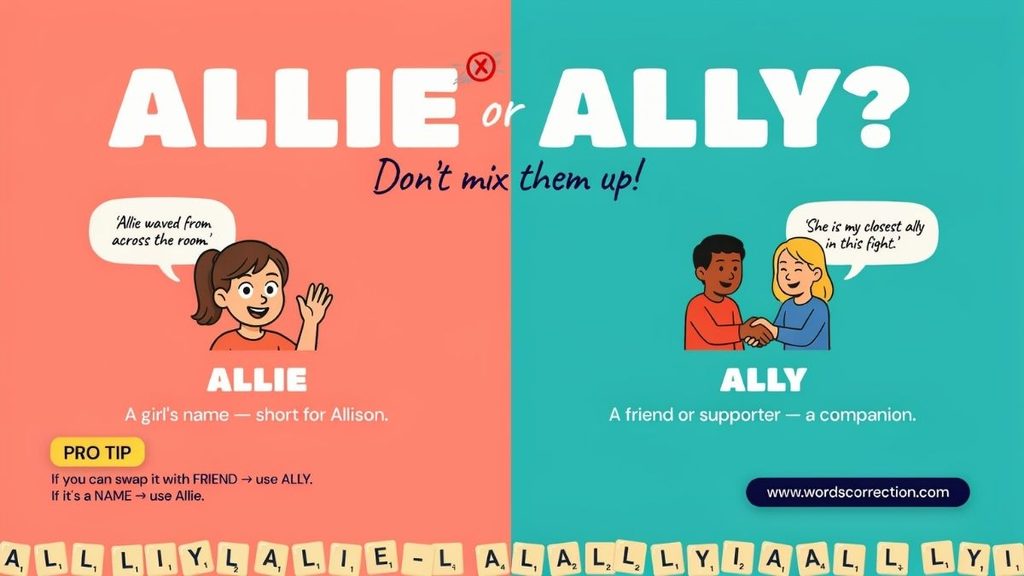
The question “Are Allie and ally homophones?” needs some care.
When Allie is pronounced as the common short-name form, it is typically pronounced with two syllables and a long “ee” sound at the end.
The noun ally is generally pronounced with a long “eye” sound at the end, while the verb ally has stress on the second syllable.
So the two forms are generally not exact homophones in standard English.
This distinction matters because spelling alone can be misleading.
Allie or Ally Pronunciation
For Allie, a common pronunciation is approximately:
AL-ee
For the noun ally, the common pronunciation is approximately:
AL-eye
For the verb ally, the stress shifts:
uh-LIE
That means the noun and verb forms of ally themselves have a pronunciation difference.
| Form | Common Pronunciation Pattern | Meaning |
| Allie | AL-ee | Personal name |
| ally, noun | AL-eye | Supporter or partner |
| ally, verb | uh-LIE | Join or unite |
This is why the question “Why are Allie and ally pronounced differently?” has a straightforward answer: they are different words or names with different conventional pronunciations.
Ally Pronunciation
Ally pronunciation depends on whether the word functions as a noun or a verb.
As a noun:
ally → /ˈæl.aɪ/
As a verb:
ally → /əˈlaɪ/
The spelling stays the same, but the stress changes.
For example:
“She is an ally.”
“They decided to ally with the larger group.”
The noun receives stress on the first syllable, while the verb receives stress on the second.
Allie Pronunciation
Allie pronunciation is generally different from the pronunciation of the noun ally.
A common pronunciation of the name is:
Allie → /ˈæl.i/
That produces the familiar two-syllable name sound.
However, names can vary according to personal preference, accent, family tradition, or language background. If a particular person says their name differently, their pronunciation takes priority.
Learn the difference between basic English word mistakes
Personel or Personnel Which is Correct?
Allie or Ally in a Sentence
Looking at Allie or ally in a sentence makes the distinction much easier.
Ally as a Noun
- “Maria became a trusted ally during the negotiations.”
- “The country has several important allies.”
- “He found an ally in his new colleague.”
- “The organization gained an influential ally.”
- “A loyal ally can provide support when circumstances become difficult.”
Examples of Ally as a Verb
- “The two groups decided to ally against the proposal.”
- “The organization chose to ally with local communities.”
- “She refused to ally herself with the campaign.”
- “Several smaller companies allied to solve the problem.”
the Allie as a Name
- “Allie sent the message this morning.”
- “I met Allie at the conference.”
- “Allie and her sister opened the door.”
- “The package belongs to Allie.”
The meaning becomes obvious once you look at the role the word plays.
Learn the difference between commonly misused words
Pair or Pare what’s the difference?
Ally for Alliance How the Words Connect
The phrase ally for alliance points to an important word relationship.
An ally is a person, group, or country connected through cooperation or shared interests.
An alliance is the relationship, agreement, or arrangement that brings those parties together.
Think of it this way:
ally = participant
alliance = relationship or agreement
For example:
“The two countries became allies after forming a strategic alliance.”
The sentence uses both terms correctly because they refer to different things.
Ally in War Meaning
The ally in war meaning is particularly important because the word has a long history in military contexts.
During a conflict, countries may cooperate because they share a strategic interest or face a common opponent. Such countries can be described as allies.
The capitalized term “the Allies” has also been used historically for groups of countries that fought together in major wars.
This differs from saying that two countries are simply friendly nations. A friendly nation may have good relations with another country without being a formal military ally.
Likewise, a strategic alliance can involve cooperation without requiring the same level of military commitment as a defense pact.
Context matters.
Learn the difference between everyday English mistakes
Maximise or Maximize which one is correct?
British English vs American English
One point deserves special attention because it causes unnecessary confusion.
Allie is not simply an American spelling of ally, and ally is not simply a British spelling of Allie.
The two forms normally have different functions.
- Ally is the standard English word for a supporter or partner.
- Allie is generally a personal name or nickname.
- Ally can also be used as a personal name.
- Personal names can have individual spelling preferences.
Therefore, a British-versus-American comparison does not explain the main difference.
If you are writing about someone named Allie, use that person’s chosen spelling. If you are talking about a supporter, use ally.
Common Spelling Mistakes With Allie and Ally
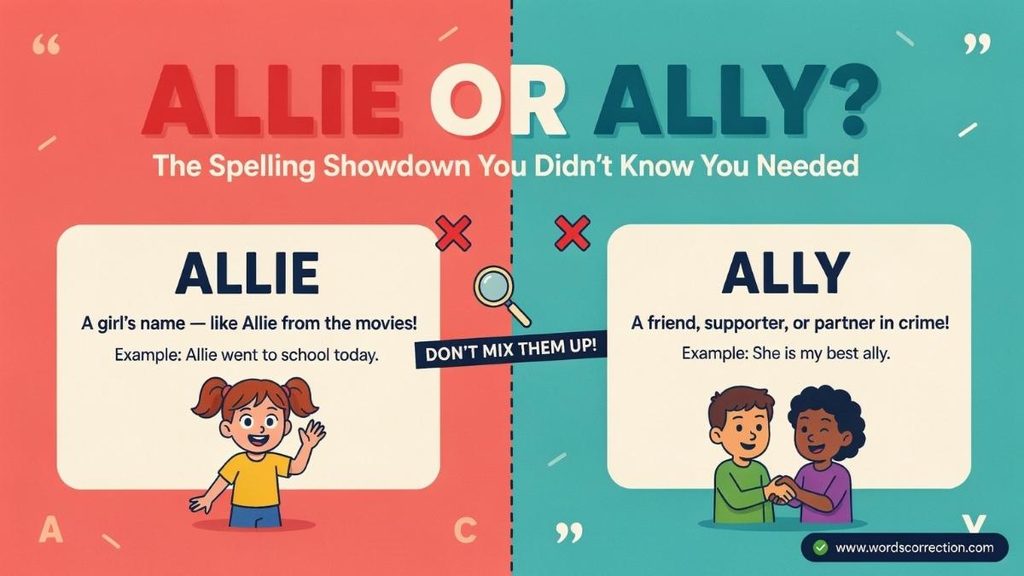
These two forms generate several predictable mistakes.
Mistake Writing Allie for the Common Noun
Incorrect:
“She has always been an Allie to the organization.”
Correct:
“She has always been an ally to the organization.”
The second sentence uses the common noun correctly.
Mistake Writing Ally Instead of Someone’s Name
Suppose someone’s name is Allie.
Correct:
“Allie will join us tomorrow.”
Writing “Ally will join us tomorrow” changes the spelling of the person’s name.
Names deserve the same care as any other proper noun.
Mistake Writing Allys Instead of Allies
Incorrect:
“The country strengthened its relationships with its allys.”
Correct:
“The country strengthened its relationships with its allies.”
The ally plural form is allies.
Learn the difference between more words people mix up
Invision or Envision Which Is Correct?
Mistake Assuming Every Allie Comes From Allison
An Allie may be short for Allison or Alison, but that is not universal.
It may also be associated with Alexandra or other names. Some people use Allie as their full given name.
“Never assume someone’s legal name based only on their nickname.”
Allie vs Ally Comparison Table
| Feature | Ally | Allie |
| Primary function | Common English word | Personal name or nickname |
| Part of speech | Noun and verb | Proper noun when used as a name |
| Basic meaning | Supporter, partner, or to join/support | Usually a person’s name |
| Capitalization | Usually lowercase | Usually uppercase |
| Noun plural | Allies | Depends on the naming context |
| Pronunciation | Noun: “AL-eye”; verb: “uh-LIE” | Commonly “AL-ee” |
| Related concept | Alliance | Personal naming |
| Example | “She is an ally.” | “Allie is here.” |
When to Use Ally
Use ally when you are talking about someone or something that supports another person, group, or cause.
Choose ally when the sentence describes:
- cooperation
- support
- partnership
- shared interests
- international relations
- military cooperation
- political cooperation
- social advocacy
- strategic relationships
Examples:
“He became an important ally during the negotiations.”
“The two nations have remained close allies.”
“She decided to ally with the community organization.”
“The company found an unexpected ally in a smaller competitor.”
The easiest test is to replace the word with supporter or partner. If the sentence still makes sense, ally may be the word you need.
When to Use Allie
Use Allie when you are referring to a person whose name is spelled Allie.
Examples:
“I emailed Allie about the meeting.”
“Allie lives nearby.”
“The invitation was addressed to Allie.”
“Have you spoken with Allie today?”
If the person’s name is spelled Ally, use Ally instead.
This is one situation where there is no universal spelling rule. Personal preference comes first.
Is Allie Short for Allison?
Yes, Allie can be short for Allison, and it can also be associated with Alison.
However, it is not exclusively a nickname for Allison.
Allie may also be used for names such as Alexandra, and some people use it independently as a given name.
So the answer to “Is Allie short for Allison?” is:
It can be, but it does not have to be.
Is Allie Short for Alexandra?
Yes. Allie can be used as a short form or nickname for Alexandra, although Alex, Lexi, Lex, and other forms are also common.
Nicknames do not always follow a fixed formula.
One Alexandra may use Allie. Another may use Alex. A third person may use her full name.
Is Allie Short for Alice?
Allie can also be used as a nickname for Alice, although this is less predictable than some other nickname relationships.
Names evolve through family traditions and personal choices. Therefore, Allie can be associated with Alice without meaning that every Alice should be called Allie.
Learn the difference between commonly confused more words in English
Families or Familys which one is correct?
Case Study How One Letter Changes the Meaning
Consider this pair:
“Jordan is my ally.”
This means Jordan supports or cooperates with the speaker.
Now compare it with:
“Allie is my colleague.”
Here, Allie is the person’s name.
Now change the capitalization:
“Jordan became an Ally.”
Without additional context, this could look like a person’s name rather than the common noun ally.
The lesson is simple: spelling and capitalization work together to communicate meaning.
How to Use Ally Correctly
If you are unsure how to use ally correctly, ask yourself one question:
Am I describing a supporter or referring to someone’s name?
If you are describing support:
“She is a strong ally.”
If you are referring to a person named Allie:
“Allie is coming to the meeting.”
If you are describing the action of joining:
“The groups decided to ally with each other.”
This three-way distinction handles most everyday cases.
Learn the difference between commonly confused more words in English
Happend or Happened Which Spelling Is Correct?
Quick Memory Trick Ally vs Allie
A simple memory trick can save you from second-guessing the spelling.
Ally = Aid
Think:
Ally = aid, support, partnership
“An ally helps.”
Allie = A Person
Think:
Allie = someone’s name
“Allie called.”
The extra -ie ending can remind you that you are looking at a personal name rather than the ordinary noun.
It is not a grammatical rule, but it works as a practical memory aid.
Practice Session
Fill in each blank with the correct word: Allie or ally.
- Sarah has always been a loyal ______ to her best friend.
- ______ is coming to the party tonight.
- The two countries became ______ during the war.
- My sister’s name is ______.
- He found an ______ who supported his idea.
- We need to work with our ______ to achieve this goal.
- ______ is a common nickname for Allison.
- The country has several powerful ______.
- I consider my brother my strongest ______.
- ______ called me yesterday evening.
- A good friend can also be a trusted ______.
- The soldiers fought alongside their ______.
- Her name is ______, not Ally.
- He decided to ______ himself with the local group.
- ______ is my new classmate.
- The two nations remained close ______ for many years.
- She is an important ______ in the community.
- ______ enjoys playing with her dog.
- The organization gained a powerful ______.
- My friend ______ helped me with my homework.
- Countries sometimes form alliances with their ______.
- ______ is often used as a nickname for Alice or Allison.
- He needed an ______ during the difficult situation.
- ______ sent me a message this morning.
- A person who supports you can be called an ______.
Answer Session
- ally
- Allie
- allies
- Allie
- ally
- allies
- Allie
- allies
- ally
- Allie
- ally
- allies
- Allie
- ally
- Allie
- allies
- ally
- Allie
- ally
- Allie
- allies
- Allie
- ally
- Allie
- ally
Here’s a trusted source for clear more words Comparison:
Grammar Update
Frequently Asked Questions About Allie or Ally
The following FAQs explain the meanings, spelling, pronunciation, and correct usage of “Allie” and “ally,” with examples to help readers understand the difference.
Is it Allie or ally in war?
The correct word is ally when referring to a country or group that cooperates with another during a war. For example, “The two nations became allies during the conflict.”
Is an ally a friend?
Yes, an ally can be a friend who offers support, encouragement, or assistance. However, an ally can also be a person, organization, or country that cooperates with another to achieve a shared goal.
What is an ally?
An ally is a person, group, or country that supports or cooperates with another. The word can function as a noun, meaning a supporter or partner, or as a verb, meaning to unite or cooperate with someone.
Is it spelled Allie or ally?
Both spellings are correct, but they have different meanings. “Allie” is a personal name or nickname, while “ally” refers to a supporter, partner, or friend.
What does Allie mean in war?
“Allie” is not the correct spelling for a partner in war. The appropriate word is “ally,” which refers to a country or group that cooperates with another during a conflict.
What does Allie mean?
Allie is a given name commonly used as a nickname for Allison, Alexandra, or Alice. It is often used as a girl’s name and is capitalized when referring to a person’s name.
What is the difference between ally and Allie?
“Ally” is a common noun or verb referring to a supporter, partner, or act of cooperation. “Allie” is a proper noun used as a personal name or nickname. For example, “Allie is my friend, and she has always been my ally.”
How do I spell ally as in a friend?
The correct spelling is “ally” when referring to a friend or supporter. For example, “She has always been a loyal ally who supports me in difficult situations.”
How do I spell ally?
The correct spelling is A-L-L-Y. Its plural form is “allies.” For example, “The two countries are important allies.”
Is it ally or ally?
Both options are spelled the same way. “Ally” is the correct spelling for a supporter, partner, or friend. If you are referring to a person’s name, “Allie” may be the intended spelling.
How do you spell ally for a girl?
If you are referring to a girl’s name, “Allie” is a common spelling. However, if you mean a girl who supports or stands by someone, the correct word is “ally.”
What is a better word for ally?
Suitable alternatives include supporter, partner, advocate, collaborator, associate, and teammate. The best choice depends on the context. For example, “advocate” is appropriate for someone who actively supports a cause or another person’s rights.
Is ally a real word?
Yes, “ally” is a standard English word. As a noun, it refers to a supporter or partner. As a verb, it means to unite or cooperate with another person or group.
What is an example of an ally?
A colleague who supports another employee facing unfair treatment is an example of an ally. Similarly, a country that cooperates with another country for mutual security can be described as an ally.
What is the opposite of an ally?
Common opposites of “ally” include enemy, opponent, and adversary. The appropriate term depends on the situation. An opponent may disagree or compete with someone without being a personal enemy.
What exactly does “ally” mean?
An ally is someone who provides support, shares common interests, or works with another person or group toward a common goal. The word is also frequently used to describe countries that cooperate politically, economically, or militarily.
What is another word for friend or ally?
Depending on the context, alternatives include companion, supporter, confidant, partner, and associate. “Companion” emphasizes friendship, while “supporter” highlights the act of helping or standing up for someone.
What makes a good ally?
A good ally listens carefully, respects others, offers meaningful support, and takes appropriate action when needed. Good allyship also involves recognizing mistakes, learning from others, and remaining dependable.
What makes someone an ally?
Someone becomes an ally by consistently supporting another person or group through respectful words and meaningful actions. Genuine allyship involves understanding others’ experiences, respecting their needs, and helping address challenges they face.
Is being an ally good or bad?
Being an ally is generally considered positive because it involves cooperation, support, and standing up for others. However, effective allyship requires respectful behavior, a willingness to learn, and actions that genuinely support the people involved.
How can you be a better ally?
You can become a better ally by listening without judgment, learning about other people’s experiences, challenging unfair treatment, and respecting individual needs. Consistent, thoughtful actions demonstrate support more effectively than words alone.
Can a straight person be an ally?
Yes, a straight person can be an LGBTQ+ ally by respecting LGBTQ+ individuals, supporting equal rights, challenging discrimination, and promoting inclusive environments. Allyship is demonstrated through respectful behavior and practical support.
What is ally slang for?
In informal English, “ally” refers to a friend, supporter, or someone who has your back. The word is also commonly used for someone who supports a particular community, cause, or movement.
Is Ally a good girl’s name?
Yes, Ally is commonly used as a girl’s name and can also be a nickname for Allison. “Allie” is another popular spelling. Both forms are accepted as personal names, and the choice depends on individual preference.
What does “Trump ally” mean?
A “Trump ally” refers to a person, politician, organization, or group that supports Donald Trump or cooperates with him politically. In this phrase, “ally” describes a political supporter or partner rather than a personal name.
Conclusion
The difference between Allie or ally may seem like a small spelling detail, but that extra letter can change the meaning and purpose of the word. Ally is the standard English word for a supporter, friend, partner, or cooperating nation. Allie, in contrast, is generally used as a personal name or nickname.
Understanding this distinction makes the choice much easier. When you’re referring to someone who supports you or works with you, use ally. When you’re referring to a person named Allie, use Allie and capitalize it. Once you remember this simple rule, you can avoid the confusion and write with greater accuracy and confidence.

Stella AJS is an experienced blogger and dedicated English language writer at Words Correction. She turns confusing grammar, word meanings, spelling, and usage into clear, practical insights that readers can easily understand and apply. With a passion for precise and engaging writing, Stella helps readers avoid common language mistakes, strengthen their vocabulary, and communicate with greater clarity and confidence.