Choosing between blackout or backout can feel surprisingly tricky. The words look similar, but their meanings are worlds apart. Blackout can describe a power failure, a period of darkness, memory loss, or even restricted information. Back out, on the other hand, usually means withdrawing from a plan, agreement, deal, or commitment. Then there’s backout, a less common form that can make the spelling even more confusing. English certainly knows how to turn a tiny space into a big grammar problem. Fortunately, the difference is straightforward once you understand how each term works. Let’s clear up the confusion with simple explanations and practical examples.
Blackout or Backout Quick Answer
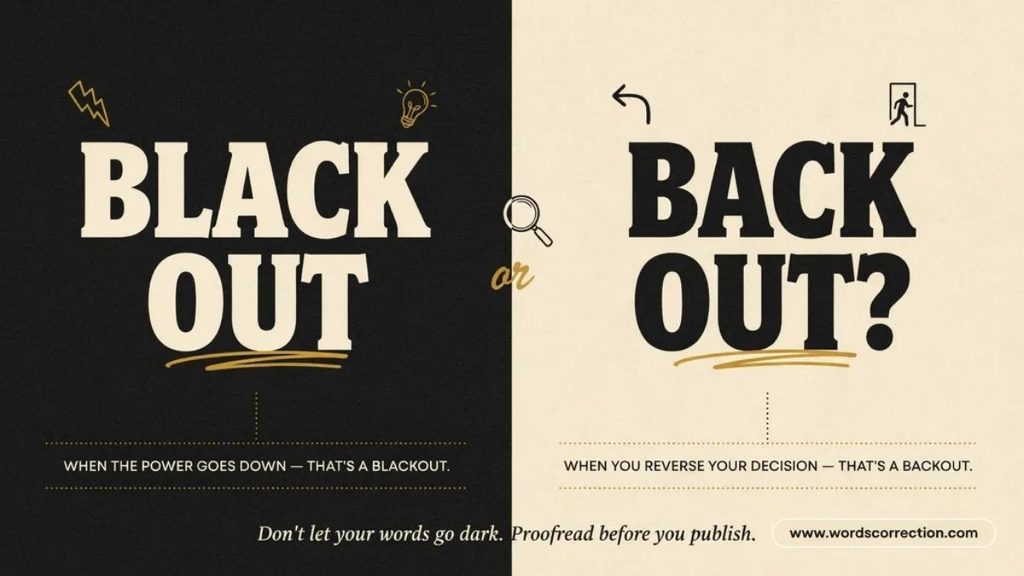
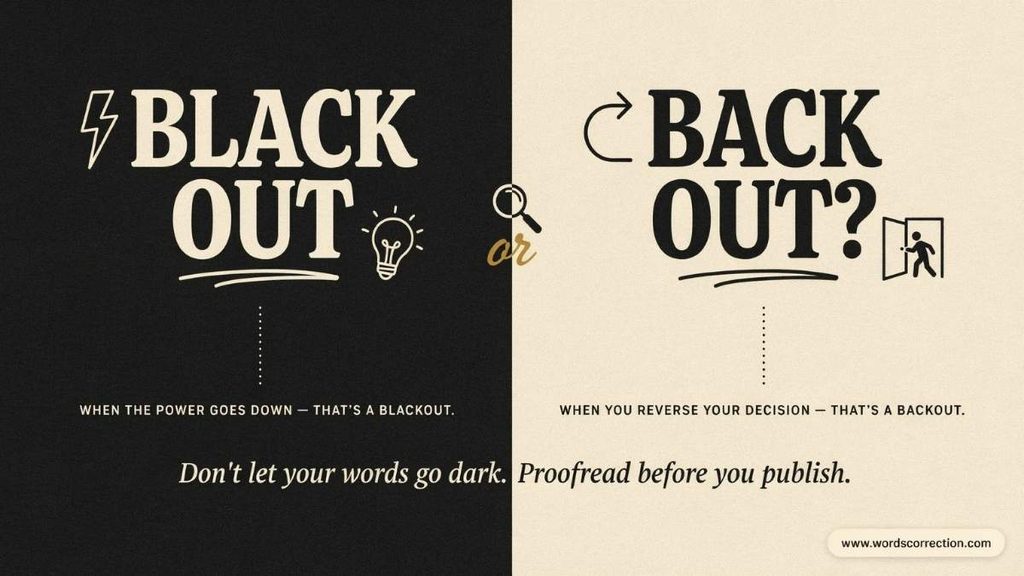
The easiest way to remember the difference is this:
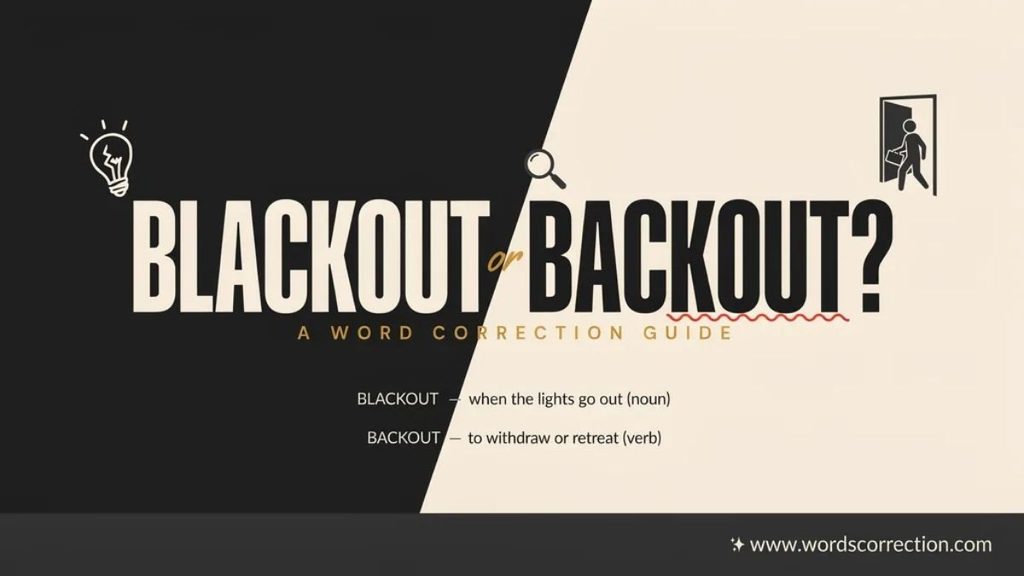
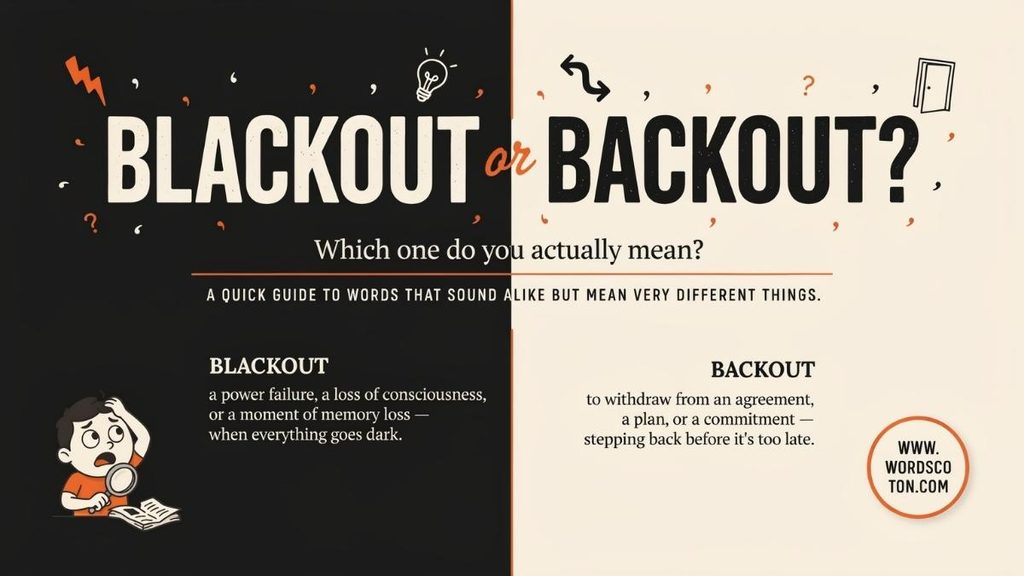
- Blackout = a noun referring to darkness, a power failure, a loss of consciousness or memory, or restricted information.
- Back out = a phrasal verb meaning to withdraw from a plan, agreement, promise, commitment, or other arrangement.
- Backout = a less common noun that can refer to an instance of withdrawing or, in specialized technical usage, a reversal or undoing of previous actions.
For example:
The storm caused a blackout.
Here, blackout refers to a loss of electrical power.
Now compare it with:
She backed out of the agreement.
Here, backed out means she withdrew from something she had previously agreed to do.
The word blackout has several established meanings, including electrical failure, deliberate darkness, information restrictions, and temporary loss of consciousness or memory. The phrasal verb back out refers to withdrawing from something that has already been planned or agreed upon.
The Quick Rule
If the sentence involves power, darkness, memory, consciousness, or information being withheld, think blackout.
If it involves withdrawing from a decision, agreement, plan, promise, or commitment, think back out.
What Does Blackout Mean?
The blackout meaning depends on the context, but the word generally describes something becoming dark, unavailable, hidden, or temporarily lost.
As a noun, blackout has several established meanings.
Blackout Meaning Power Failure
One of the most familiar meanings refers to an interruption of electrical power.
A power blackout occurs when electricity stops reaching an area, leaving homes, businesses, streets, or other facilities without normal electrical service.
For example:
- The storm caused a widespread blackout.
- The entire neighborhood lost power during the blackout.
- The hospital prepared for a possible electrical blackout.
- A sudden loss of electricity caused the traffic lights to stop working.
A blackout can last seconds, minutes, hours, or much longer depending on the cause and the condition of the electrical system.
The terms power blackout and electrical blackout are especially common when the context involves an interruption to an electrical network.
A rolling blackout is more specific. Instead of electricity disappearing from an entire network at once, power is deliberately interrupted in different areas at different times. This approach can help manage demand when a power system cannot supply enough electricity to everyone at once.
Learn the difference between more words people mix up
Uncapable or Incapable Which Spelling Is Correct?
Blackout Meaning Loss of Consciousness or Memory
Blackout can also describe a temporary loss of consciousness, sight, or memory.
For example:
She had a blackout and couldn’t remember what happened.
This meaning appears in both everyday and medical contexts. However, the exact experience can vary.
A person who experiences an alcohol-related blackout, for instance, may remain awake and interact with other people while later being unable to remember some or all of what happened. A blackout in this sense doesn’t necessarily mean that the person physically collapsed or became completely unconscious.
Context therefore matters.
Blackout Meaning Information Suppression
A blackout can involve information rather than electricity.
A news blackout or media blackout describes a situation in which information about an event, person, or subject isn’t publicly reported or is deliberately restricted.
For example:
The organization imposed a media blackout during the investigation.
In this context, the word has nothing to do with lights going out. The idea is figurative. Information has effectively been kept out of public view.
Blackout Meaning Deliberate Darkness
Historically, blackout has also referred to deliberately extinguishing or covering lights, particularly during wartime.
During wartime blackouts, cities or buildings could turn off or cover visible lights to make locations harder to identify from the air.
This historical meaning helps explain the strong connection between blackout and darkness.
Blackout Definition at a Glance
| Meaning | Example |
| Electrical power failure | The storm caused a blackout. |
| Loss of consciousness or memory | He experienced a blackout. |
| Information restriction | The organization imposed a news blackout. |
| Deliberate darkness | The city observed a wartime blackout. |
| Temporary service interruption | The website experienced a service blackout. |
What Does Back Out Mean?
The back out meaning is more specific than the meaning of blackout.
Back out is a phrasal verb. In its figurative sense, it means to withdraw from something you previously agreed to do.
For example:
He backed out of the deal at the last minute.
The person had apparently agreed to participate in the deal. Later, he changed his mind and withdrew.
The phrase often suggests that someone is retreating from a decision, arrangement, or commitment that had already been made.
Back Out of a Deal
One of the most common patterns is:
back out of + agreement, deal, arrangement, or plan
Examples include:
- The buyer backed out of the deal.
- The company backed out of the agreement.
- They backed out of the contract before signing the final documents.
- She refused to back out of the deal.
The phrase can carry a slightly different tone from simply saying cancel.
If someone cancels a meeting, the cancellation itself may be neutral. If someone backs out of an agreement, the expression can suggest that the person is retreating from something they had already accepted or promised to do.
Back Out of a Plan
You can also back out of a plan.
We planned to travel together, but Mark backed out at the last minute.
Here, Mark changed his mind and decided not to participate.
Other examples include:
- She backed out of the trip.
- They backed out of the project.
- He backed out of the competition.
- I don’t want to back out of our plans.
Learn the difference between everyday English mistakes
Analyses or Analysis Meaning, Difference and Usage
Back Out of a Promise or Commitment
The phrase can also describe withdrawing from something you promised or committed to do.
She promised to help, so she didn’t want to back out of her commitment.
The meaning of backing out here is essentially withdrawing after making a commitment.
Related expressions include:
- withdraw from a plan
- withdraw from an agreement
- cancel a commitment
- change your mind
- break a promise
- abandon an arrangement
These expressions aren’t always perfect substitutes. Back out specifically emphasizes the act of retreating from something that had already been accepted, promised, or planned.
Back Out as Physical Movement
There is also a literal meaning.
Back out can mean to move a vehicle backward from a confined space.
For example:
She backed out of the driveway carefully.
Here, nobody is canceling a promise. The car is simply moving backward.
Other examples include:
- He backed out of the garage.
- The driver backed out of the parking space.
- She slowly backed the car out of the driveway.
The literal and figurative meanings are connected by the basic idea of moving backward or withdrawing.
both Meaning The Grammatical Difference
One of the easiest ways to understand the difference between blackout and backout is to stop thinking about spelling for a moment and look at grammar.
Blackout Is Usually a Noun
In ordinary usage, blackout is a noun.
The blackout lasted three hours.
The word names an event or condition.
You can talk about:
- a blackout
- the blackout
- several blackouts
- a power blackout
- a news blackout
- a memory blackout
The noun can also take a plural form:
The region experienced several blackouts that summer.
Black Out Is a Verb
The related verb is normally written as black out, with two words.
The storm blacked out the city.
Or:
The entire city blacked out after the power failure.
The verb can also describe becoming unconscious:
He blacked out suddenly.
This creates an important noun-versus-verb distinction:
| Noun | Verb |
| The city experienced a blackout. | The storm blacked out the city. |
| There was a blackout. | The power failure blacked out the area. |
| He suffered a blackout. | He blacked out suddenly. |
So, is blackout one word? Yes, when you are using the noun blackout.
Learn the difference between commonly misused words
Devide or Divide Difference, Meaning and Usage
Back Out Is a Phrasal Verb
The ordinary verb is back out, not backout.
Its forms include:
| Verb form | Example |
| back out | Don’t back out now. |
| backs out | She always backs out at the last minute. |
| backed out | He backed out of the deal. |
| backing out | They are backing out of the agreement. |
This is one reason the backout spelling can cause confusion. English contains many compounds written as one word, but that doesn’t mean every verb phrase becomes one word.
Is It Blackout or Backout?
If the sentence concerns electricity, darkness, memory, consciousness, or information restrictions, use blackout.
If it concerns withdrawing from an agreement, plan, promise, or commitment, use back out.
For example:
The storm caused a blackout.
The investor backed out of the agreement.
The two expressions may look related because both contain out, but their meanings are completely different.
Is It Blackout or Back Out Correct?
Both are correct, but they’re correct in different situations.
Blackout is correct as a noun:
We experienced a blackout last night.
Back out is correct as the ordinary phrasal verb:
We decided to back out of the deal.
Writing:
We decided to blackout of the deal.
would be incorrect because blackout doesn’t mean withdraw from an agreement.
Writing:
We decided to backout of the deal.
is also not the standard form of the ordinary phrasal verb.
Learn the difference between basic English word mistakes
Businesses or Business’s Meaning, Grammar and Correct Usage
Backout or Back Out Is Backout One Word or Two?
The answer depends on whether you mean the ordinary phrasal verb or the less common noun.
Back Out The Standard Phrasal Verb
When you mean “withdraw from something,” use two words:
She backed out of the agreement.
Don’t back out now.
They are backing out of the project.
This is the form most readers expect in general English.
Backout A Less Common Noun
Backout does exist as a noun.
It can refer to an instance of withdrawing from an agreement in informal usage. It can also appear in specialized technical contexts where it describes reversing or undoing a previous action.
For example, technical writing may refer to a backout procedure for reversing a software change or undoing a set of operations.
That specialized noun does not change the normal rule for everyday English.
If the sentence means withdraw, write:
They decided to back out.
Not:
They decided to backout.
Is Backout One Word or Two?
A useful rule is:
- back out = standard phrasal verb
- backout = less common noun, especially in specialized or informal contexts
This distinction prevents a common mistake: assuming that because backout exists as a word, it can always replace back out.
Learn the difference between often confused words
Alternately or Alternatively Meaning, Usage and Examples
Black Out vs Blackout Another Important Distinction
The blackout spelling creates another grammatical question: when should blackout be one word, and when should black out be two?
The answer depends on whether you’re using the noun or the verb.
Blackout as a Noun
The blackout affected thousands of homes.
Here, blackout names the event.
Black Out as a Verb
The power failure blacked out thousands of homes.
Here, black out describes the action or result.
It can also mean becoming unconscious:
He blacked out after the accident.
This noun-and-verb distinction is one of the most useful details to remember when learning the blackout vs. back out meaning.
Blackout vs Backout Examples
Compare these sentences:
| Sentence | Meaning |
| The storm caused a blackout. | Electricity failed. |
| The storm blacked out the area. | The storm caused the area to lose power. |
| She experienced a blackout. | She temporarily lost consciousness or memory. |
| She blacked out. | She became temporarily unconscious. |
| He backed out of the deal. | He withdrew from the agreement. |
| He announced a backout. | A less common noun describes the withdrawal or reversal. |
The grammar becomes much easier once the meaning is clear.
Learn the difference between confusing word pairs
Tie or Tye Meaning, Difference and Usage
Common Mistakes With Blackout and Back Out
The most common errors happen when writers focus on how the words look instead of what they mean.
Mistake Writing “Backout” as the Ordinary Verb
Incorrect:
He decided to backout of the deal.
Standard everyday form:
He decided to back out of the deal.
The phrase back out functions as a phrasal verb.
Mistake Using “Blackout” as the Ordinary Verb
Incorrect:
She decided to blackout of the agreement.
Correct:
She decided to back out of the agreement.
Blackout doesn’t mean withdraw from an agreement.
Mistake Confusing Black Out With Blackout
Incorrect:
The city blackout after the storm.
Correct:
The city blacked out after the storm.
Or:
The city experienced a blackout after the storm.
The first version uses the verb. The second uses the noun.
Mistake Treating Blackout and Backout as Spelling Variants
They aren’t.
The difference between blackout and backout isn’t comparable to common spelling variations such as color and colour. These terms have different meanings and grammatical roles.
That is the key point.
Learn the difference between tricky grammar more words
Mater or Matter Difference in Meaning and Usage
Origin and History of Blackout and Back Out
The history of these expressions explains why they share the word out while developing different meanings.
Origin of Blackout
The word blackout developed from the verbal phrase black out.
Historical records connect the noun blackout with the theatrical sense of a darkened stage in the early 20th century. Later meanings developed around darkness, loss of memory, wartime light restrictions, and electrical failures.
The development can be viewed broadly like this:
black + out
↓
make something dark or cover it
↓
darkened theatrical stage
↓
loss of memory
↓
wartime light restrictions
↓
electrical failure and other modern meanings
The modern word therefore developed several related senses rather than appearing with only one meaning.
Origin of Back Out
Back out follows a different path.
The basic concept combines back, which can describe movement backward, with out, which can indicate movement away or outward.
The physical meaning is easy to picture:
The driver backed out of the garage.
From there, the figurative meaning of withdrawing from something becomes easier to understand. Someone who backs out of a commitment is figuratively moving backward from something they previously agreed to do.
The modern phrasal verb has established uses involving agreements, promises, plans, and other commitments.
Why the Confusion Exists
The confusion makes sense once you look at the words visually.
Both expressions contain:
___ + out
They also sound similar when spoken quickly.
But English frequently uses out in phrasal verbs and compound words with many different meanings. Compare:
- black out
- back out
- break out
- carry out
- find out
- run out
- turn out
Changing the first word can completely change the meaning.
So, although the spelling may look like a small detail, that detail changes the entire sentence.
Learn the difference between commonly mixed-up more words
Emigrate or Immigrate Difference, Meaning and Usage
both in American and British English
There is no simple US-versus-UK spelling rule that turns back out into backout.
Blackout in American English
American English uses blackout as a noun:
The blackout lasted for several hours.
It can refer to electrical failure, loss of memory or consciousness, information restrictions, and other established meanings.
Blackout in British English
British English also uses blackout as a noun.
The major meanings remain broadly the same, including electrical failure, information restrictions, wartime darkness, and temporary loss of consciousness or memory.
Some regional differences exist in particular meanings and collocations. However, neither variety turns the ordinary verb back out into backout.
Back Out in American English
American English normally writes the phrasal verb as two words:
They backed out of the agreement.
Back Out in British English
British English also uses back out as the ordinary phrasal verb:
She backed out of the project.
Is Backout a US vs UK Spelling Difference?
Not in the way many learners assume.
Back out is the standard phrasal verb in both major varieties of English.
The noun backout has more limited usage and appears in informal and specialized contexts.
Therefore, writing backout as one word isn’t simply a British spelling or American spelling of the ordinary verb.
How to Use Blackout and Back Out Correctly
When you’re unsure, identify the meaning and grammatical function before choosing the spelling.
Use Blackout When You Mean:
- A power failure
- Darkness
- A loss of memory
- A loss of consciousness
- A restriction on news or information
- A period when a service is unavailable
- A historical wartime light restriction
Examples:
The blackout affected the entire district.
The company announced a temporary service blackout.
Use Back Out When You Mean:
- Withdraw from an agreement
- Withdraw from a deal
- Withdraw from a plan
- Cancel a commitment
- Change your mind about participating
- Refuse to follow through on a promise
- Move a vehicle backward from a confined space
Examples:
She backed out of the agreement.
He backed out of the driveway.
The difference becomes almost impossible to miss when you focus on the action described by the sentence.
Learn the difference between confusing more English words
Persuing or Pursuing Meaning, Difference and Correct Spelling
Blackout vs Back Out in Business Writing
Business communication makes this distinction particularly important because back out often appears alongside contracts, commitments, investments, and negotiations.
Consider:
The investor backed out of the agreement.
The investor withdrew from an arrangement.
Now compare:
The system experienced a blackout.
The second sentence describes an operational failure.
These situations might even appear in the same report:
A power blackout delayed the meeting after one investor backed out of the agreement.
One sentence can contain both expressions because they describe completely different events.
Business Examples
- The supplier backed out of the contract.
- The company refused to back out of its commitment.
- A regional blackout disrupted production.
- The website experienced a temporary service blackout.
- The buyer backed out at the last minute.
Notice how the surrounding words make the intended meaning clear.
Blackout and Back Out in News Writing
News writing also uses blackout frequently.
A news report might discuss:
- a power blackout
- a media blackout
- a news blackout
- a communications blackout
- a blackout caused by severe weather
The term can therefore describe both physical and informational interruptions.
Back out, meanwhile, commonly appears when a person, organization, investor, participant, or company withdraws from something.
For example:
The company backed out of the proposed partnership.
The phrase communicates a withdrawal from an arrangement.
Learn the difference between tricky English words with easy explanations
Access or Acess Which Spelling Is Correct?
Blackout or Backout in Technical Writing
Technical writing creates one of the few situations where backout may appear naturally as a single word.
In computing and engineering contexts, a backout can refer to reversing or undoing a previous change or operation.
For example, a technical document might discuss a backout procedure.
That doesn’t mean general English has changed its rule for the phrasal verb.
Compare:
The administrator decided to back out of the change.
This uses the phrasal verb.
Now compare:
The administrator initiated a backout procedure.
This uses a specialized noun.
The distinction is subtle but important.
Case Study One Missing Space, Two Different Meanings
Imagine a sentence in a business report:
The company decided to backout of the contract.
Most readers will understand the intended meaning. However, the standard form is:
The company decided to back out of the contract.
Now change the context:
The company experienced a blackout during the overnight maintenance window.
Here, blackout is appropriate because the sentence describes a loss of power or service.
The lesson is simple: don’t choose the spelling based on appearance. Choose it based on meaning and grammatical function.
Learn the difference between confusing more English words step by step
Bat or Bet Which Is correct spelling?
Commonly Confused English Words Why Context Matters
Blackout and back out belong to a broader group of commonly confused English words and expressions.
English contains many cases where spacing changes grammatical function:
- setup / set up
- backup / back up
- breakdown / break down
- checkout / check out
- makeup / make up
- blackout / black out
These patterns aren’t random. English often develops nouns from phrasal verbs, but the noun and verb don’t necessarily share the same spelling.
For example:
The computer needs a backup.
Here, backup is a noun.
Please back up the files.
Here, back up is a verb phrase.
The same pattern helps explain:
There was a blackout.
versus:
The power failure blacked out the area.
Learning these noun-and-verb distinctions makes many English spelling questions easier.
Practice Exercises Blackout or Backout
Fill in the Blanks
1. The severe storm caused a sudden ______ across the entire neighborhood.
2. He decided to ______ of the agreement at the last minute.
3. The city experienced a power ______ during the heavy rain.
4. She felt as though she might ______ after standing in the heat for too long.
5. They ______ of the deal because the terms had changed.
6. The editor used a digital tool to ______ the confidential information.
7. Are you really ______ of the plan we discussed yesterday?
8. The theater went dark during a ______ between scenes.
9. He promised to help us, but he eventually decided to ______.
10. The driver carefully ______ of the narrow driveway.
11. An alcohol-related ______ can cause a person to forget events.
12. She is considering ______ of the competition.
13. The entire building lost electricity during the ______.
14. He became ______ and could not remember parts of the evening.
15. The company ______ of the contract before the project began.
16. Please do not ______ of your promise at the last minute.
17. The security team decided to ______ the sensitive details from the report.
18. The lights may ______ automatically during the performance.
19. I cannot believe they are ______ of the agreement now.
20. A sudden power ______ interrupted the television broadcast.
21. She ______ of the arrangement because she had another commitment.
22. The word ______ is commonly used as a noun to describe a power failure.
23. He began to ______ after becoming severely dehydrated.
24. They are ______ of the plan because of unexpected expenses.
25. Before agreeing to the deal, make sure you will not ______ later.
Answers
- Blackout
- Back out
- Blackout
- Black out
- Backed out
- Black out
- Backing out
- Blackout
- Back out
- Backed out
- Blackout
- Backing out
- Blackout
- Blackout drunk
- Backed out
- Back out
- Black out
- Black out
- Backing out
- Blackout
- Backed out
- Blackout
- Black out
- Backing out
- Back out
Here’s a trusted source for clear more words Comparison:
Grammar Update
FAQ’s about blackout or backout
What do blackout and back out mean?
“Blackout” refers to a sudden loss of electricity, a temporary loss of memory, or a period of darkness. “Back out” is a phrasal verb meaning to withdraw from a commitment, agreement, or plan. The correct expression depends on the context.
Is it black out or blackout?
Both forms are correct, but they serve different grammatical functions. “Blackout” is generally a noun, as in “The storm caused a blackout.” “Black out” is a verb phrase, as in “The confidential information was blacked out.”
Is backout one word or two?
When referring to withdrawing from a commitment or agreement, the standard expression is “back out,” written as two words. For example, “He decided to back out of the deal.” The one-word form is uncommon for this meaning.
What is Blackout or Backout?
Blackout or Backout can refer to a party card game featuring questions and social challenges. The phrase can also describe a grammar comparison between “blackout” and “back out,” which have different meanings and uses.
Is Blackout or Backout a drinking game?
Yes, Blackout or Backout is known as a party card game associated with drinking and answering questions. The rules and format may vary depending on the edition. Players can also adapt the game to use non-alcoholic drinks.
How do you play Blackout or Backout?
The game generally involves drawing cards and responding to prompts or completing challenges according to the edition’s rules. Before playing, participants should review the instructions, agree on boundaries, and ensure that everyone can participate voluntarily.
Can you play Blackout or Backout without alcohol?
Yes. Players can replace alcoholic drinks with water, soft drinks, points, or alternative challenges. This allows participants to enjoy the game without consuming alcohol.
What is the difference between Blackout or Backout and a regular blackout?
A regular blackout refers to an event such as a power failure or a period of memory loss. Blackout or Backout, when used as a game name, refers to a party activity rather than an episode of memory loss.
Is it blacked out drunk or blackout drunk?
Both expressions are used in English, but they function differently. “Blacked out drunk” describes someone who became intoxicated and experienced memory loss. “Blackout drunk” describes a state of intoxication associated with the risk of an alcohol-related blackout.
What does it mean to black out from drinking?
An alcohol-related blackout occurs when a person cannot form or retain memories of events while intoxicated. The person may remain conscious during this period. An alcohol blackout is a warning sign of potentially dangerous alcohol consumption and should not be treated as harmless.
Can someone experience an alcohol blackout without vomiting?
Yes. Vomiting is not a necessary symptom of an alcohol-related blackout. A person may experience memory loss without vomiting, and the absence of vomiting does not mean the person is safe from alcohol poisoning.
What is the difference between blacking out and passing out?
Blacking out from alcohol generally involves memory loss while a person may remain conscious. Passing out usually means losing consciousness. Both can be associated with serious risks when alcohol is involved and should be taken seriously.
What does it mean to back out of an agreement?
To “back out of an agreement” means to withdraw from a commitment or decide not to proceed with an arrangement. For example, “The company backed out of the agreement before the project began.”
What is the past tense of back out?
The past tense of “back out” is “backed out.” For example, “She backed out of the competition at the last minute.” The -ing form is “backing out,” as in “He is backing out of the agreement.”
Can blackout be used as a verb?
“Blackout” is primarily used as a noun, while “black out” is the corresponding verb phrase. It can mean to lose consciousness or memory, darken an area, or conceal information. For example, “The editor blacked out the confidential details.”
How do you use blackout in a sentence?
Here are three examples demonstrating the correct use of “blackout”:
- The entire neighborhood experienced a blackout after the storm.
- He could not remember the events because of an alcohol-related blackout.
- The theater used a blackout to transition between scenes.
How do you use back out in a sentence?
“Back out” is used when someone withdraws from a plan, agreement, or commitment. For example, “I promised to help with the project, so I cannot back out now.”
What are some good questions for a Blackout or Backout party game?
Good party-game questions are entertaining, easy to understand, and appropriate for the group. Players can use funny hypothetical situations, lighthearted personal questions, memorable experiences, or “Who is most likely to…” prompts to encourage conversation.
Can you play Blackout or Backout with couples or friends?
Yes. Friends and couples can adapt the game to suit their group. They can choose funny, personal, or relationship-themed prompts, provided everyone feels comfortable participating and can skip any question without pressure.
What should players do if a question makes someone uncomfortable?
Players should respect the person’s boundaries and allow them to skip the question or choose another prompt. Establishing clear boundaries before the game begins helps keep the activity comfortable, respectful, and enjoyable for everyone.
What is the difference between Blackout or Backout and Never Have I Ever?
Blackout or Backout is associated with a specific party-game format, whereas Never Have I Ever is a group game in which participants respond to statements about experiences they have or have not had. Both games can be adapted for alcohol-free play.
Is back out a phrasal verb?
Yes. “Back out” is a phrasal verb consisting of the verb “back” and the particle “out.” It commonly means to withdraw from a commitment, agreement, or arrangement. For example, “They backed out of the deal.”
Does blackout always refer to an electrical failure?
No. “Blackout” has several meanings. It can refer to a power failure, a period of memory loss, or the deliberate concealment of information. Its intended meaning depends on how it is used in a sentence.
Why are blackout and back out commonly confused?
“Blackout” and “back out” are easily confused because they look and sound similar. However, their meanings differ significantly. “Blackout” commonly refers to darkness, a power failure, or memory loss, while “back out” means to withdraw from a plan or commitment.
How can I remember the difference between blackout and back out?
Remember this simple distinction: a “blackout” is usually an event involving darkness, a power failure, or memory loss. To “back out” means to withdraw from a commitment or change your decision about a plan. If the electricity fails, there is a blackout; if someone abandons an agreement, they back out.
Conclusion
The blackout or backout confusion may seem like a small spelling issue, but that tiny difference can completely change the meaning of a sentence. Blackout is generally a noun that refers to a power failure, darkness, memory loss, loss of consciousness, or restricted information. Black out is the corresponding verb phrase. Back out, meanwhile, is a phrasal verb that means to withdraw from a plan, agreement, deal, promise, or commitment. It can also mean to reverse a vehicle.
The simplest way to remember the difference is this: blackout is connected with darkness or loss, while back out means withdrawing or moving backward. Once you understand that distinction, these commonly confused terms become much easier to use correctly. After all, one missing space should not be powerful enough to cause a complete grammar blackout.

Stella AJS is an experienced blogger and dedicated English language writer at Words Correction. She turns confusing grammar, word meanings, spelling, and usage into clear, practical insights that readers can easily understand and apply. With a passion for precise and engaging writing, Stella helps readers avoid common language mistakes, strengthen their vocabulary, and communicate with greater clarity and confidence.