English spelling has a funny way of making simple words feel like tricky puzzles. The confusion over invision or envision is a perfect example. Both spellings may look reasonable at first, but only one is the standard English verb for imagining or picturing something. If you’ve ever typed “invision” and paused to wonder whether it was correct, you’re certainly not alone. In this guide, we’ll clear up the invision vs. envision confusion, explain their meanings, highlight common spelling mistakes, and show you how to use the correct form in everyday, academic, and professional writing. By the end, you’ll know exactly which spelling to choose.
Invision or Envision Quick Answer
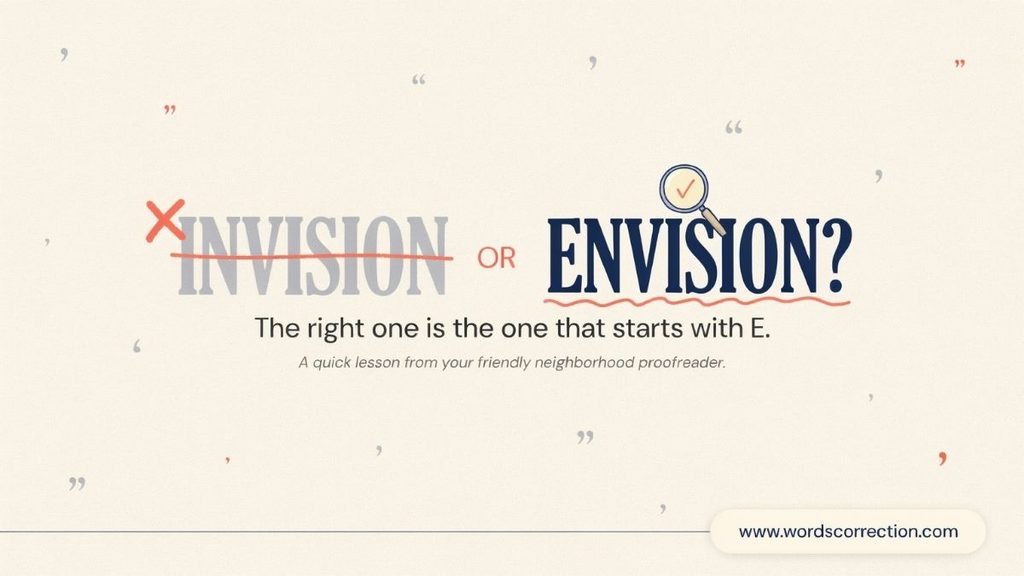
The correct word is envision when you want to say that someone imagines or pictures something in their mind, especially something that may happen in the future.
Envision means:
- To imagine something clearly
- To picture something mentally
- To imagine a future possibility
- To anticipate or conceive of something
- To form a mental image of an idea, situation, or outcome
Examples:
- I envision a future where technology makes education more accessible.
- She envisions herself leading the company one day.
- They envision a new approach to solving the problem.
By contrast, invision is generally a spelling mistake when used as the ordinary English verb.
| Word | Standard English word? | Meaning |
| Envision | Yes | To imagine, picture, or foresee something |
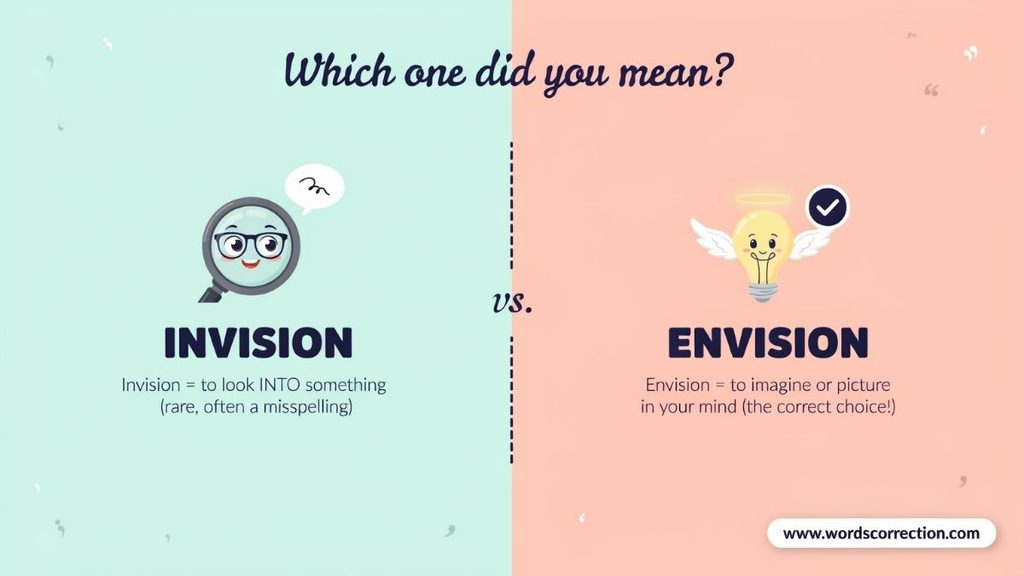
| Invision | Generally no | Usually an incorrect spelling of envision |
| InVision | Yes, as a proper name | A brand/product name associated with digital design |
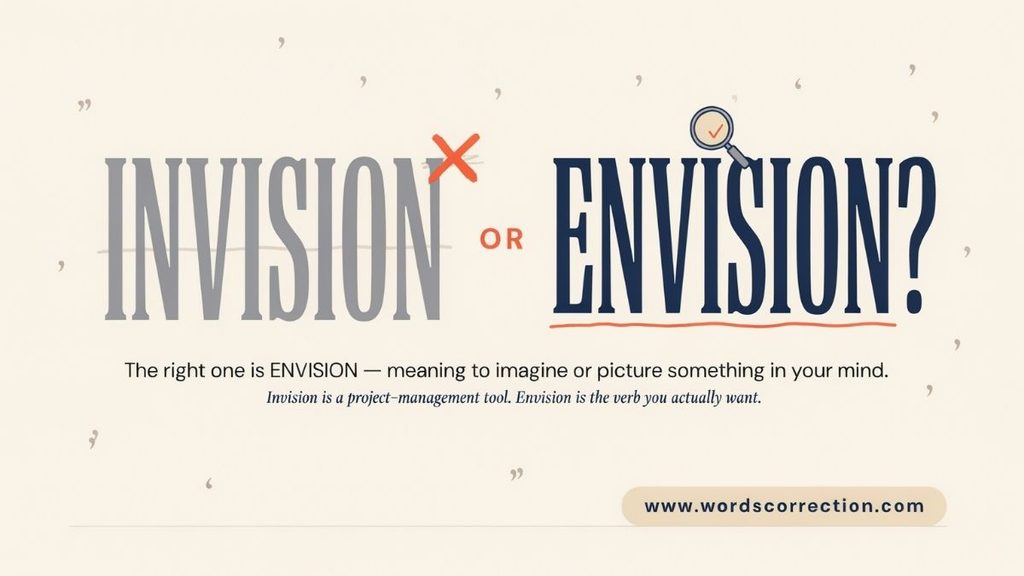
So, if you are asking, “Is invision or envision correct?”, the answer is envision when you mean “to imagine” or “to picture.”
What Does Envision Mean?
The envision meaning is to imagine or picture something in your mind.
The envision definition can be expressed simply as:
Envision means to form a mental picture of something, especially a future event, possibility, plan, or situation.
The word often suggests more than a passing thought. When you envision something, you mentally picture it as a possibility or imagine how it might look, happen, or develop.
For example:
She envisions a successful career in medicine.
This means she imagines herself having that career in the future.
Another example:
The company envisions a more sustainable approach to manufacturing.
Here, the company has a particular idea or picture of what the future could look like.
Envision Meaning in English
In everyday English, envision is closely connected to words such as:
- Imagine
- Picture
- Visualize
- Conceive
- Foresee
- Anticipate
- Dream of
- Think about
- Form an image of
However, these words are not always interchangeable.
Envision often focuses on forming a mental picture of something, especially a future condition, goal, plan, or possibility.
Learn the difference between more words people mix up
Persuing or Pursuing Meaning, Difference and Correct Spelling
Envision as a Verb
Yes, envision is a verb.
It describes an action performed by the mind. You can envision a person, situation, outcome, plan, possibility, or future.
Common structures include:
Envision + noun
She envisioned a better solution.
They envisioned a new business model.
He envisioned a peaceful future.
Envision + -ing form
You can also use envision with a gerund.
I can’t envision working there for another ten years.
She envisions building her own company.
They envision expanding the project next year.
Envision + object + as
This structure describes how someone imagines something.
The designers envisioned the building as a flexible workspace.
She envisioned the project as a long-term investment.
These structures make envision especially useful in professional, academic, and business writing.
Examples of Envision in a Sentence
Here are several examples showing how the word works in different contexts:
- I envision a future where renewable energy is widely available.
- She envisions herself becoming an entrepreneur.
- The architect envisioned a building that would blend into its surroundings.
- We need to envision what the project could become.
- He never envisioned such a dramatic change.
- The team envisions several possible solutions.
- Can you envision a world without traditional classrooms?
- They envisioned the plan as a way to reduce unnecessary costs.
Notice that the word frequently appears when people discuss future events, goals, possibilities, ideas, plans, and imagined outcomes.
Learn the difference between everyday English mistakes
Access or Acess Which Spelling Is Correct?
Invision vs Envision What Is the Difference?
The central difference is straightforward.
Envision is the standard English spelling of the verb meaning “to imagine” or “to picture.”
Invision is generally not the correct spelling of that verb.
For example:
Correct:
I envision a better future.
Incorrect:
I invision a better future.
The second sentence contains a common spelling mistake.
Is Invision a Word?
If you are asking “is invision a word?”, the answer requires a little context.
As an ordinary English verb meaning “to imagine,” invision is not the standard spelling. You should use envision instead.
However, InVision can appear as a proper name. Proper names can follow their own capitalization and spelling conventions, so seeing InVision in a product name does not make “invision” an alternative spelling of the verb.
This distinction explains why some people may encounter the form online and assume it is a legitimate variant of envision.
Is Invision Correct?
If you are writing a normal English sentence and want to express the idea of imagining something, use envision.
For example:
Correct: We envision several opportunities for growth.
Incorrect: We invision several opportunities for growth.
The second version should be changed to envision.
Why Do People Spell Envision as Invision?
The confusion is understandable because invision looks like it should follow a familiar English spelling pattern.
Several factors contribute to the mistake.
The word contains “vision”
People immediately recognize the word vision inside envision.
Because “vision” begins with a strong vowel sound, writers may instinctively add the familiar prefix in- and create invision.
The actual spelling, however, is envision.
Learn the difference between commonly misused words
Bat or Bet Which Is correct spelling?
The pronunciation can cause confusion
Depending on the speaker and accent, the beginning of envision may not make the spelling immediately obvious.
When people hear a word before seeing it written, they sometimes spell it according to the sound they expect.
“In-” is a familiar English prefix
English contains many words beginning with in-, such as:
- Incomplete
- Inactive
- Inaccurate
- Invisible
- Insecure
- Independent
That pattern can make invision look convincing even though it is not the standard spelling of the verb.
InVision appears as a proper name
People may also encounter InVision in technology and design contexts.
That capitalization can reinforce the mistaken belief that invision is an ordinary English spelling.
InVision vs Envision The Proper-Name Confusion
One of the most important distinctions is between envision and InVision.
Envision is an English verb.
InVision is a proper name that has been used for a digital product and company associated with collaborative design and prototyping.
Compare these examples:
The team envisions a more efficient workflow.
Here, envisions is an ordinary English verb.
The designer used InVision.
Here, InVision is a proper name.
Capitalization matters because proper names do not necessarily follow the spelling patterns of ordinary vocabulary.
If you see InVision in a software or design context, don’t automatically assume it is another spelling of envision.
Learn the difference between basic English word mistakes
Blackout or Backout which is correct?
Envision vs Vision What Is the Difference?
Another common source of confusion is envision vs vision.
The two words are related, but they perform different grammatical roles.
Vision is usually a noun.
Envision is a verb.
| Word | Part of speech | Basic meaning | Example |
| Vision | Noun | An idea, image, or ability to see | She has a clear vision for the company. |
| Envision | Verb | To imagine or picture something | She envisions a successful company. |
You can think of the relationship this way:
Vision = the idea or mental picture
Envision = the act of creating or imagining that picture
For example:
His vision is to build an affordable school.
He envisions building an affordable school.
The first sentence focuses on the idea or goal.
The second focuses on the act of imagining that goal.
Envision vs Imagine
The question “Is envision the same as imagine?” has a mostly straightforward answer: they are closely related, but they are not always identical.
Imagine is broader and more common in everyday speech.
Envision often sounds more deliberate and is frequently used for future situations, plans, goals, and possibilities.
Compare:
Imagine living on Mars.
This sounds like an invitation to think about an unusual possibility.
Scientists envision future missions to Mars.
This sounds more deliberate and connected to planning or expectation.
Learn the difference between often confused words
Stabilise or Stabilize Difference in Usage
Envision vs Imagine Simple Comparison
| Envision | Imagine |
| Often focuses on a future possibility | Can refer to almost anything |
| Common in formal and professional writing | Very common in everyday conversation |
| Often suggests a mental picture | Can mean simply thinking of something |
| Frequently relates to plans and goals | Has a broader range of uses |
You can often replace envision with imagine, but the tone and emphasis may change.
Envision Synonyms
If you need another word for envision, the best choice depends on the sentence.
Common envision synonyms include:
- Imagine
- Picture
- Visualize
- Conceive
- Foresee
- Anticipate
- Contemplate
- Dream of
- See in your mind
- Form a mental image of
For example:
She envisions a successful future.
You could write:
She imagines a successful future.
Or:
She visualizes a successful future.
However, foresee and anticipate can suggest prediction rather than imagination.
That difference matters.
If you say:
I envision a major change in the industry.
you are describing a picture or possibility you have in mind.
If you say:
I foresee a major change in the industry.
you are more strongly suggesting that you expect the change to happen.
Learn the difference between confusing word pairs
Palate or Palette Difference and Usage
How to Use Envision Correctly
Learning the definition is useful, but knowing the grammar makes your writing more natural.
Here are the most common patterns.
Envision a Future
The organization envisions a future with greater access to education.
This structure is especially common in business, education, technology, and public planning.
Envision a Possibility
Can you envision the possibility of working remotely?
Here, the speaker asks someone to mentally consider a possible situation.
Envision a Goal
She envisions a goal of reaching more customers internationally.
A more natural version might be:
She envisions reaching more customers internationally.
This example shows why envision + -ing can sometimes produce smoother writing.
Envision an Idea
The designer envisioned an idea that would simplify the user experience.
Depending on context, developed, proposed, or imagined might be more precise. Still, envision works when the emphasis is on mentally forming the idea.
Envision Something Happening
I can’t envision that happening anytime soon.
This is a common conversational structure.
Envision Pronunciation
The pronunciation of envision can also contribute to spelling confusion.
It is commonly pronounced approximately as:
en-VIZH-un
The middle sound resembles the sound found in words such as vision.
This is one reason the word is easy to connect mentally with vision.
However, pronunciation does not determine spelling. If you remember only one spelling rule, remember this:
Envision begins with “en,” not “in.”
Learn the difference between tricky grammar more words
Tomorrow’s or Tomorrows Usage and difference?
Envision Past Tense
The past tense of envision is envisioned.
Examples:
She envisioned a different future.
They envisioned the project several years ago.
He had never envisioned such a result.
The spelling follows the normal pattern of adding -ed to the verb.
What Does Envisioned Mean?
Envisioned means imagined, pictured, or mentally planned in the past.
For example:
The founders envisioned a company that would serve a global audience.
This means the founders imagined or planned such a company.
What Does Envisioning Mean?
Envisioning is the present participle or gerund form of envision.
It means the act of imagining, picturing, or mentally developing an idea or future situation.
Examples:
She is envisioning a new career path.
The team is envisioning how the product could evolve.
Envisioning the final result helped them plan the project.
The word can describe both practical planning and creative thinking.
Is Envision a Word?
Yes. Envision is a standard English word.
If you are wondering “is envision a word?”, the answer is clearly yes.
It functions as a verb and has a long-established place in English.
The word is especially common when discussing:
- Future plans
- Goals
- Possibilities
- Business strategies
- Creative ideas
- Personal ambitions
- New developments
- Expected changes
- Imagined situations
Learn the difference between commonly mixed-up more words
Tier or Teir Which One Is Right?
Envision in British English vs American English
it is used in both American and British English.
However, British English also commonly uses envisage, which has the same general meaning.
| Meaning | American English | British English |
| Imagine or picture something | Envision | Envision / Envisage |
| Formal future planning | Envision | Envision / Envisage |
| Mental picture | Envision | Envision / Envisage |
For example:
American English:
We envision a major transformation in the industry.
British English:
We envisage a major transformation in the industry.
Both forms are understandable, but envisage is particularly well established in British usage.
This does not make envision incorrect in British English.
Envision in Professional and Academic Writing
Envision works well in professional writing because it can express a future objective without sounding overly casual.
Business example:
The company envisions expanding into new international markets.
Academic example:
Researchers envision several applications for the technology.
Educational example:
Students should envision how their skills could apply to real-world problems.
Personal development example:
She envisions building a career that combines creativity and technology.
The word is especially useful when you want to connect an idea in the present with a possible outcome in the future.
Learn the difference between confusing more English words
Personel or Personnel Which is Correct?
Common Mistakes With Envision
Several mistakes appear repeatedly.
Mistake Writing Invision Instead of Envision
Incorrect:
We invision a better future.
Correct:
We envision a better future.
Mistake Assuming Invision Is a Variant Spelling
English sometimes has British and American spelling variants, such as colour/color and organise/organize.
That does not mean every spelling difference represents a legitimate regional variant.
Invision is not the standard American/British spelling variant of envision.
Mistake Confusing InVision With Envision
A proper name can look similar to an ordinary word without being an alternative spelling.
If you’re referring to the English verb, use envision.
If you’re referring to a specific product or brand called InVision, preserve the proper name.
Mistake Confusing Envision With Envisage
Both envision and envisage can mean to imagine or picture something.
The main distinction is regional preference and usage frequency.
For American audiences, envision is generally the natural choice.
For British audiences, envisage is also common.
Learn the difference between tricky English words with easy explanations
Pair or Pare what’s the difference?
Case Study How One Letter Changes the Meaning of a Search
Imagine you’re writing a company report.
You type:
Our team invisions a major expansion next year.
The intended meaning is obvious, but the spelling is incorrect.
The corrected sentence is:
Our team envisions a major expansion next year.
Now imagine a different sentence:
The designer created the prototype in InVision.
Here, InVision may refer to the name of a specific design platform.
The two forms can appear similar on the page, but they serve completely different purposes.
This is why context matters when checking spelling.
Invision or Envision Correct Examples
Here are some quick examples to reinforce the difference.
Correct Uses of Envision
- I envision a better future for the community.
- She envisions becoming a successful writer.
- They envision several ways to improve the system.
- Can you envision that happening?
- The company envisions expanding its services.
- He had never envisioned such an opportunity.
- The architect envisioned a modern, energy-efficient building.
Incorrect Uses of Invision
When invision is intended to mean “imagine,” replace it with envision.
- I invision a better future. → I envision a better future.
- She invisions herself as a leader. → She envisions herself as a leader.
- They invision a new approach. → They envision a new approach.
Proper-Name Use
- The team previously used InVision for design collaboration.
In this case, InVision is a name rather than the ordinary verb envision.
Learn the difference between confusing more English words step by step
Maximise or Maximize which one is correct?
Invision vs Envision Comparison Table
| Feature | Envision | Invision |
| Standard English verb | Yes | No |
| Means “imagine” | Yes | No |
| Means “picture mentally” | Yes | No |
| Can describe a future goal | Yes | No |
| Used as a normal verb | Yes | No |
| Common spelling mistake | No | Yes |
| Can appear as a proper name | Not usually | Yes, as InVision |
| Correct spelling for “imagine” | Yes | No |
Which Spelling Should You Use?
If you’re writing a normal English sentence, choose envision.
Use it when you mean:
- Imagine
- Picture
- Visualize
- Conceive
- Foresee a possibility
- Imagine a future outcome
For example:
We envision a future in which everyone has access to quality education.
Don’t write:
We invision a future in which everyone has access to quality education.
Unless you are referring to a specific proper name, envision is the form you want.
A Simple Memory Trick for Envision Spelling
Here’s an easy way to remember the spelling.
Think:
Envision = En + vision
The word begins with en, followed by vision.
So:
E + N + VISION = ENVISION
Not:
I + N + VISION = INVISION
You can also connect the word with envisioning the future.
When you envision something, you create a picture of it in your mind.
That mental picture is your vision.
Envision in Spanish
The exact Spanish translation of envision depends on context.
Common equivalents include:
- Imaginar — to imagine
- Visualizar — to visualize
- Concebir — to conceive or formulate
- Prever — to foresee or anticipate
For example:
She envisions a better future.
can be translated as:
Ella imagina un futuro mejor.
The best translation depends on whether the original sentence emphasizes imagination, planning, visualization, or anticipation.
Envision, Foresee, and Anticipate
These words overlap, but they carry different shades of meaning.
Envision focuses on imagining or picturing something.
Foresee focuses more strongly on recognizing or expecting something before it happens.
Anticipate often means expecting something or preparing for it.
Compare:
envision a successful business.
I imagine it.
I foresee challenges ahead.
expect challenges.
We anticipate higher demand next year.
We expect higher demand and may be preparing for it.
Choosing the right word makes your meaning more precise.
Envision vs Visualize
Visualize is another close synonym.
Both words can involve creating a mental image.
However, visualize often emphasizes the mental picture itself, while envision can carry a stronger sense of possibility, planning, or future development.
For example:
The athlete visualized winning the race.
This emphasizes the mental image.
The organization envisions a major change in its operations.
This emphasizes a broader future possibility or plan.
The difference isn’t absolute, but the distinction can help you choose the more natural word.
Envision vs Imagine When Should You Use Each?
Use imagine when you are speaking casually or referring to almost any mental thought.
Use envision when you want to emphasize a mental picture, future possibility, goal, or deliberate concept.
For example:
Casual:
Imagine living by the ocean.
More deliberate:
I envision living by the ocean after retirement.
Both sentences describe mental thinking. The second gives the idea a stronger sense of a possible
Practice Session
Fill in each blank with the correct word.
- We ______ a better future for our community.
- She can ______ herself working in a large company.
- He ______ a successful career in medicine.
- The team ______ a new plan for the project.
- Can you ______ what your life will be like in five years?
- They ______ a world without pollution.
- I can ______ a peaceful place in my mind.
- She ______ herself becoming a professional writer.
- The manager ______ a stronger future for the business.
- We ______ the project being completed next month.
- He ______ a bright future for his children.
- The word ______ means to imagine or picture something.
- “Envision” is a ______.
- “Envisioned” is the ______ tense of “envision.”
- “Envisioning” means ______ something in your mind.
- “Imagine” is a common ______ of “envision.”
- The correct spelling is ______, not “invision.”
- She can easily ______ the final result.
- They ______ a successful event.
- I ______ myself living in a new city.
- The company ______ expanding its services.
- He ______ a better solution to the problem.
- We should ______ our goals before making a plan.
- She ______ a peaceful future for her family.
- The architect ______ a modern building for the city.
Answer Session
- envision
- envision
- envisioned
- envisioned
- envision
- envision
- envision
- envisions
- envisions
- envision
- envisions
- envision
- verb
- past
- imagining
- synonym
- envision
- envision
- envisioned
- envision
- envisions
- envisioned
- envision
- envisions
- envisioned
Here’s a trusted source for clear more words Comparison:
Grammar Update
FAQs
Here are some common questions about the correct spelling and usage of “envision” and “invision.”
Is envision or invision the correct spelling?
“Envision” is the correct spelling of the verb meaning to imagine, picture, or visualize something. “Invision” is generally considered an incorrect spelling in this context.
What does envision mean in simple words?
“Envision” means to imagine or picture something in your mind, especially something that may happen in the future.
What does it mean to envision something?
To envision something means to create a mental picture of it or imagine it as a possibility.
What does invision mean?
“Invision” is not the standard spelling of the verb meaning “to imagine.” It is commonly used as a misspelling of “envision.”
How do you use envision in a sentence?
“Envision” is used when talking about imagining a situation, possibility, goal, or future event. For example: “She envisions a successful career in medicine.”
What part of speech is envision?
“Envision” is a verb because it describes the action of imagining or mentally picturing something.
What are common synonyms for envision?
Common synonyms include “imagine,” “visualize,” “picture,” “foresee,” “conceive,” and “anticipate.”
What is the noun form related to envision?
“Vision” is a related noun that can describe a mental image, idea, or desired future outcome. The exact noun depends on the context.
What is the opposite of envision?
There is no single exact opposite of “envision.” Depending on the context, words such as “ignore,” “disregard,” or “overlook” may express an opposing idea.
What does envisioned mean?
“Envisioned” is the past tense and past participle of “envision.” It means imagined, pictured, or considered as a possibility.
What does envisioning mean?
“Envisioning” is the -ing form of “envision” and means imagining or mentally picturing something.
What is an example of envisioning something?
Imagining yourself achieving a career goal, starting a business, or moving to a new place is an example of envisioning a future situation.
What does it mean to envision yourself?
To envision yourself means to imagine yourself in a particular situation, role, place, or future circumstance.
What does it mean to envision someone?
To envision someone means to imagine or picture that person in a particular situation, role, or setting.
How do you spell envision?
The correct spelling is envision. It is spelled E-N-V-I-S-I-O-N.
How is envision pronounced?
“Envision” is pronounced with the main stress on the second syllable.
Is envisage the same as envision?
Yes. “Envisage” and “envision” can both mean to imagine or picture something. “Envisage” is particularly common in British English, while “envision” is widely used in American English.
Which is correct I envisage or I envision?
Both are grammatically correct. “I envisage” is more common in British English, while “I envision” is widely used in American English.
Is envision the same as imagine?
They have similar meanings, but “envision” often emphasizes forming a mental picture of something, particularly a future situation or possibility.
What is the difference between envision and vision?
“Envision” is a verb meaning to imagine or mentally picture something. “Vision” is generally a noun referring to sight, a mental image, or a future goal.
What does InVision mean?
“InVision” with a capital I can refer to a brand or product name. It should not be confused with the standard English verb “envision.”
What does Evision mean?
“Evision” is not the standard spelling of the English verb meaning “to imagine.” Depending on the context, it may be a name, brand, or spelling error.
What is a more sophisticated word for “see” similar to envision?
Depending on the context, words such as “visualize,” “perceive,” “foresee,” or “observe” may be suitable alternatives. However, their meanings are not identical.
What are some alternatives to the word “vision”?
Depending on the intended meaning, alternatives include “foresight,” “insight,” “perspective,” “outlook,” and “aspiration.”
Can envision be used when talking about future goals?
Yes. “Envision” is commonly used to describe imagining a future goal, outcome, or possibility, such as envisioning a successful career or a new project.
Conclusion
The invision or envision confusion may seem like a small spelling issue, but one misplaced letter can make your writing look less polished. The correct standard English verb is envision, which means to imagine, picture, or consider a possible future. Invision is generally an incorrect spelling when used with this meaning, although InVision may appear as a proper name.
The easiest way to remember the difference is simple: when you mean “imagine,” use “envision.” So, the next time your fingers type “invision,” pause for a quick grammar check. One small correction can keep your sentence clear, accurate, and professional.

Stella AJS is an experienced blogger and dedicated English language writer at Words Correction. She turns confusing grammar, word meanings, spelling, and usage into clear, practical insights that readers can easily understand and apply. With a passion for precise and engaging writing, Stella helps readers avoid common language mistakes, strengthen their vocabulary, and communicate with greater clarity and confidence.