

English spelling can be surprisingly sneaky. One tiny letter can turn a perfectly correct word into a spelling mistake, and happened or happend is a classic example. If you’ve ever paused before typing “happened” and wondered whether that final “e” belongs there, you’re certainly not alone. The confusion often comes from pronunciation and the way regular verbs form their past tense. Fortunately, the rule is much simpler than it looks. In this guide, you’ll learn the correct spelling of happened, understand why “happend” is incorrect, and discover how to use the word naturally in everyday sentences. By the end, this common grammar trap will be history.
Happend or Happened Quick Answer
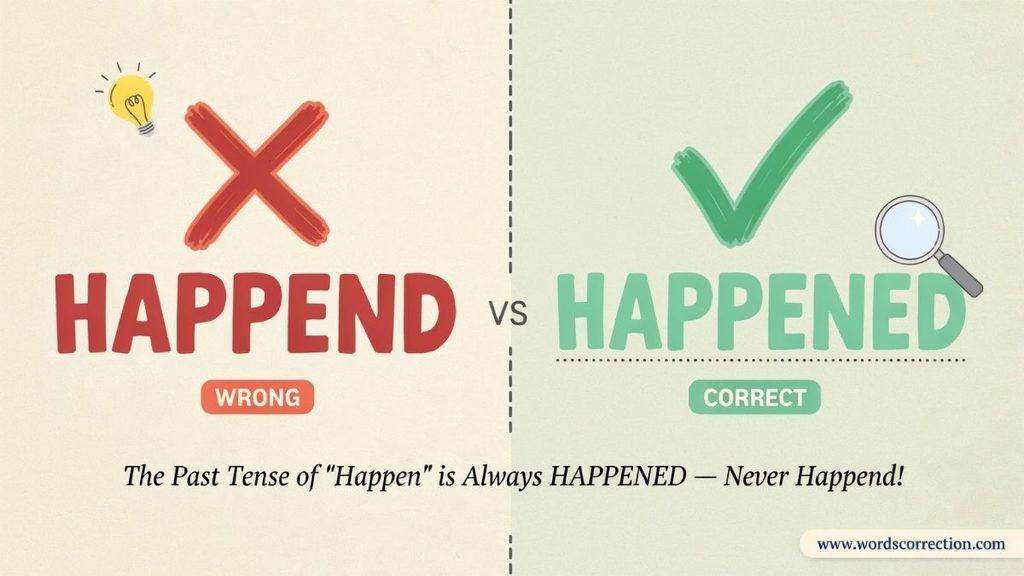
The correct spelling is happened.
Happend is an incorrect spelling of the past tense of happen. Standard English uses happened in American English, British English, and other major varieties of English.
| Spelling | Correct? | Explanation |
| happened | Yes | Correct past tense and past participle of happen |
| happend | No | Common spelling mistake |
| happen | Yes | Base form of the verb |
| happens | Yes | Present-tense form for third-person singular |
| happening | Yes | Present participle or gerund |
For example:
- Correct: Something strange happened yesterday.
- Incorrect: Something strange happend yesterday.
The difference is only one letter, but that letter matters.
What Does “Happened” Mean?
The happened meaning is straightforward. It means that something occurred, took place, or became a past event.
Happened is the simple past form of the verb happen. We use it when an event, action, incident, or situation occurred in the past.
For example:
- The meeting happened yesterday.
- An accident happened near the school.
- Something unexpected happened last night.
- The same thing happened to me before.
- Nothing unusual happened during the trip.
The happened definition can therefore be summarized as:
Happened: occurred or took place in the past.
The word can describe planned events, unexpected incidents, ordinary experiences, or significant occurrences. The context tells you what kind of event you’re discussing.
Learn the difference between more words people mix up
Bat or Bet Which Is correct spelling?
Happened Examples in Everyday English
Consider these happened examples:
- What happened at the party?
- She explained what happened after lunch.
- The power outage happened without warning.
- I don’t know what happened.
- The mistake happened because of a misunderstanding.
- Nothing important happened during the meeting.
- The event happened exactly as planned.
Notice that happened generally refers to something viewed as completed or occurring in the past.
Why Is “Happened” the Correct Spelling?
The correct spelling of happened comes from the base verb happen plus the past-tense ending -ed.
The basic formation is:
happen + ed = happened
The spelling retains the complete base word before the past-tense ending.
This gives you:
- happen → happened
- open → opened
- listen → listened
- clean → cleaned
The mistake happend occurs when a writer drops the final e from the written form.
Compare the two forms carefully:
happen → happened
Not:
happen → happend
The correct word contains the letters h-a-p-p-e-n-e-d.
The Happened Spelling Pattern
The spelling becomes easier to remember when you stop thinking of happened as a completely new word.
Instead, look at the structure:
HAPPEN + D = HAPPENED
The base word happen remains visible.
This simple approach is one of the easiest ways to remember the happened spelling.
There is also an important spelling feature inside the base word itself. Happen has two p’s, and adding the past-tense ending does not remove either one.
The complete sequence is:
h-a-p-p-e-n + e-d → h-a-p-p-e-n-e-d
Why Is “Happend” Wrong?
The happend spelling is incorrect because happend is not the standard English past-tense form of happen.
It may look reasonable at first glance. Many English verbs form their past tense by adding -ed, and spoken English doesn’t always make every letter easy to hear. However, spelling follows established written forms rather than simply reproducing pronunciation.
For example:
- happen → happened
- not: happen → happend
The missing e creates the spelling error.
Learn the difference between everyday English mistakes
Blackout or Backout which is correct?
A Common Spelling Mistake Happend or Happened
Happend is a good example of how pronunciation and spelling can pull in different directions.
When people say happened naturally, the ending can sound compressed. That can make it tempting to write what you think you hear.
English contains many words where the written form isn’t an exact representation of every sound in ordinary speech. That’s why a useful spelling habit is to return to the base verb.
If the base word is happen, the correct past form is happened.
This helps distinguish the incorrect spelling of happened from the correct word form.
Happen or Happened What’s the Difference?
The difference between happened or happend is a spelling issue. However, the difference between happened vs happen is grammatical.
Happen is the base form of the verb. Happened is its simple past form and past participle.
| Verb form | Main use | Example |
| happen | Base form | Accidents can happen. |
| happens | Present tense, third-person singular | It happens sometimes. |
| happened | Simple past | It happened yesterday. |
| happening | Present participle or gerund | It is happening now. |
Understanding this difference is more useful than memorizing one spelling in isolation.
For example:
- Something will happen.
- Something happens every day.
- Something happened yesterday.
- Something is happening now.
The event remains conceptually related, but the verb conjugation changes according to tense and grammatical structure.
Learn the difference between commonly misused words
Stabilise or Stabilize Difference in Usage
Happen, Happens, Happened, and Happening
English verb forms can seem confusing when several versions of the same word appear close together. Fortunately, happen, happens, happened, and happening each have a clear role.
Happen
Happen is the base form.
It appears after modal verbs, auxiliary verbs, and in infinitive constructions.
Examples:
- Things happen for a reason.
- What will happen next?
- Accidents can happen anywhere.
- I didn’t expect that to happen.
Happens
Happens is the present-tense form used with a singular third-person subject.
Examples:
- It happens every year.
- This mistake happens often.
- What happens next?
- Something unusual happens whenever they meet.
Happened
Happened describes an event that occurred in the past.
Examples:
- It happened yesterday.
- The accident happened at midnight.
- I remember what happened.
- Something unexpected happened during the trip.
Happening
Happening is the present participle of happen.
It commonly appears with forms of be to describe something in progress.
Examples:
- What is happening?
- Something strange is happening.
- The event is happening now.
Learn the difference between basic English word mistakes
Palate or Palette Difference and Usage
When Should You Use “Happened”?
The use of happened is appropriate when you describe something that occurred in the past.
Time expressions often make this especially clear.
Common examples include:
- yesterday
- last night
- last week
- last month
- earlier
- a few minutes ago
- in 2020
- before
- recently
- at that time
For example:
The incident happened yesterday.
We met after what happened last night.
She told me what happened earlier.
However, you don’t always need an explicit past-time expression. The surrounding context can establish the time.
I walked into the room and immediately knew something happened.
The reader understands that the event occurred before the current moment.
Happened in a Sentence
A simple happened in a sentence example is:
Something unexpected happened during the meeting.
Here, happened functions as the past tense of the verb happen.
Another example is:
What happened after you left?
In this question, the speaker asks about a completed past event.
“Did Happen” or “Did Happened”?
This is one of the most important grammar points connected with happened grammar.
After the auxiliary verb did, use the base form happen, not happened.
Therefore:
- Correct: Did it happen?
- Incorrect: Did it happened?
Why? Because did already carries the past tense.
The basic structure is:
did + base verb
So:
- did happen
- did go
- did see
- did come
- did work
Not:
- did happened
- did went
- did saw
- did came
- did worked
Examples
Correct:
- Did something happen?
- Why did that happen?
- When did it happen?
- I didn’t know what happened.
Notice the last example carefully:
I didn’t know what happened.
The word didn’t belongs to the main clause, while happened belongs to the embedded clause. The auxiliary did doesn’t directly control the verb happened in that clause.
This distinction often causes confusion. Once you identify which verb belongs to which clause, the grammar becomes much easier.
Happened or Happening
The difference between happened and happening is primarily about time and aspect.
Happened describes an event as completed or occurring in the past.
Happening describes something currently in progress or an ongoing situation.
Compare:
accident happened yesterday.
The accident occurred in the past.
The accident is happening now.
The event is occurring at the current time.
| Word | Meaning | Example |
| happened | Occurred in the past | It happened last night. |
| happening | Occurring now or around now | It is happening now. |
Choosing between them depends on the timeline of the event.
Happened or Had Happened
Another useful distinction in English grammar involves happened and had happened.
Happened is the simple past.
Had happened uses the past perfect. We use the past perfect when we want to show that one past event occurred before another past event.
Consider:
The meeting happened at 3 p.m.
This simply tells you when the meeting occurred.
Now consider:
The meeting had happened before I arrived.
Here, two past events exist:
- The meeting happened.
- I arrived later.
The past perfect makes their order clear.
A simple timeline looks like this:
Meeting happened → I arrived → Now
This is especially useful when several past events appear in the same sentence.
Learn the difference between often confused words
Tomorrow’s or Tomorrows Usage and difference?
Common Spelling and Grammar Mistakes With Happend or Happened
The word happened attracts several predictable errors. Most are easy to correct once you understand the underlying pattern.
Happend vs Happened
Incorrect: It happend yesterday.
Correct: It happened yesterday.
The incorrect version drops the e before d.
Hapened vs Happened
Incorrect: What hapened?
Correct: What happened?
Here, the writer drops one of the two p’s.
Remember:
happen has two p’s.
Therefore:
happened also has two p’s.
Happenned vs Happened
Incorrect: It happenned last week.
Correct: It happened last week.
This version adds an unnecessary n.
The correct sequence is:
h-a-p-p-e-n-e-d
Not:
h-a-p-p-e-n-n-e-d
Did Happened vs Did Happen
Incorrect: Did it happened?
Correct: Did it happen?
After did, use the base form.
Happen vs Happened
Incorrect: Yesterday, something strange happen.
Correct: Yesterday, something strange happened.
The past-time word yesterday tells us that the completed event needs the past-tense form.
Happened vs Happening
Incorrect: Something strange happened right now.
Better: Something strange is happening right now.
Use happened for a completed past event and is happening for an event in progress.
How to Spell “Happened”
If you’re wondering how to spell happened, use the base word as your starting point.
The Simple Method
1: Start with happen.
2: Keep both p’s.
3: Keep the final e.
4: Add d.
5: You get happened.
So:
happen + d = happened
This is an easier memory trick than trying to memorize every letter separately.
Quick Spelling Test Happend or Happened
Which sentence is correct?
A. Something strange happend last night.
B. Something strange happened last night.
The answer is B.
Now try another:
A. What did happen after that?
B. What did happened after that?
The answer is A.
The first test checks spelling. The second checks grammar.
Learn the difference between confusing word pairs
Tier or Teir Which One Is Right?
Happened Pronunciation and Spelling
The happened pronunciation can contribute to the spelling mistake because natural speech doesn’t always make every written letter equally noticeable.
In standard American English, happened is commonly pronounced approximately as /ˈhæpənd/. The final -ed doesn’t sound like a separate full syllable in the way some learners might expect.
That’s important because English spelling and pronunciation don’t always match perfectly.
You shouldn’t remove a letter simply because you don’t clearly hear it.
For spelling purposes, return to the written base word:
happen → happened
The pronunciation may be compressed in everyday speech, but the spelling remains unchanged.
Is “Happened” a Word?
Yes. Happened is a standard English word.
So if you’re asking is happened a word, the answer is yes. It functions as both the simple past form and the past participle of the regular verb happen.
Examples:
- It happened yesterday.
- Something has happened.
- I know what happened.
- I wondered what had happened.
The grammatical role changes depending on the sentence, but the spelling remains happened.
Is “Happend” a Word?
If you’re asking is happend a word, the answer in standard English is no when you mean the past form of happen.
Happend is generally a spelling error.
That doesn’t mean you will never encounter the sequence of letters online. It can appear in usernames, names, informal posts, typos, or other contexts where standard spelling isn’t being followed. However, it isn’t the standard past-tense form of happen.
For normal writing, use happened.
Learn the difference between tricky grammar more words
Personel or Personnel Which is Correct?
Happend or Happened as a Past Tense Verb
The happen past tense form is happened.
Happen is a regular verb, which means it forms its simple past and past participle using the regular -ed pattern.
| Base verb | Simple past | Past participle |
| happen | happened | happened |
This makes happen different from irregular verbs such as:
- go → went → gone
- see → saw → seen
- take → took → taken
With happen, the past form doesn’t change into a completely different word.
What Is the Past Tense of Happen?
The past tense of happen is:
happened
Examples:
- Something happened last night.
- The event happened unexpectedly.
- I remember what happened.
- The incident happened near the station.
Therefore, if you’re searching for the past tense of “happen”, remember one simple form: happened.
Happened as a Past Participle
Happened is also the past participle of happen.
A past participle can appear with auxiliary verbs such as has, have, and had.
Examples:
- Something has happened.
- Something has already happened.
- What has happened here?
- I wondered what had happened.
- Several changes had happened before the announcement.
Compare the structures:
Simple past:
Something happened.
Present perfect:
Something has happened.
Past perfect:
Something had happened.
The word happened stays the same because it serves as the past participle in the perfect constructions.
Learn the difference between commonly mixed-up more words
Pair or Pare what’s the difference?
Happened Grammar Understanding the Verb Form
The grammar of happened becomes much easier when you identify its role in a sentence.
As a happened verb, it can function as the main verb describing a completed event:
The accident happened yesterday.
It can also function as a past participle:
Something has happened.
The same spelling appears in both structures, but the grammar around it changes.
Simple Past
Something happened.
This describes a past event.
Present Perfect
Something has happened.
This connects a past event with the present.
Past Perfect
Something had happened.
This places the event before another past event.
Understanding these structures helps you move beyond memorizing spelling and start understanding happened usage in real English.
Happened Synonyms
The best happened synonyms depend on the context.
Common alternatives include:
- occurred
- took place
- transpired
- came about
- unfolded
- arose
- developed
However, these aren’t always perfect substitutes.
For example:
The accident happened yesterday.
You could say:
The accident occurred yesterday.
But occurred sounds more formal.
Likewise:
The ceremony happened at noon.
could become:
The ceremony took place at noon.
The second version emphasizes the event itself rather than simply the fact that it occurred.
For everyday conversation, happened is usually the most natural choice.
Learn the difference between confusing more English words
Maximise or Maximize which one is correct?
Happend or Happened Usage in Different Contexts
The word appears in many types of writing and conversation.
Everyday Conversation
What happened?
I don’t know what happened.
It happened so quickly.
These are ordinary and natural uses.
Emails
I wanted to explain what happened during the meeting.
Here, the word helps describe a previous event clearly.
Formal Writing
The incident happened during the final stage of the project.
Depending on the context, a more formal word such as occurred may be preferable.
News Writing
The incident happened shortly after midnight.
News writers may also use occurred, particularly in formal reporting.
Text Messages
What happened?
I can’t believe that happened!
The spelling remains the same even in informal communication.
Learn the difference between tricky English words with easy explanations
Invision or Envision Which Is Correct?
Case Study Why the Extra “E” Matters
Imagine someone writes:
I don’t know what happend.
A reader will probably understand the meaning immediately. Yet the sentence still contains a spelling error.
Now change it to:
I don’t know what happened.
The meaning hasn’t changed. The difference is simply that the second sentence follows standard English spelling.
This illustrates an important point: a spelling mistake doesn’t always make a sentence impossible to understand. It can still reduce accuracy and polish.
In professional writing, academic work, applications, reports, and published content, the standard form should always be happened.
Case Study Why “Did Happened” Sounds Wrong
Consider this sentence:
Why did it happened?
The problem isn’t spelling. Happened itself is spelled correctly. The problem is the verb form.
The corrected sentence is:
Why did it happen?
The auxiliary did already expresses the past tense. Therefore, the main verb returns to its base form.
This is an important lesson in English verb forms:
did + happen, not did + happened
The same principle applies to many regular and irregular verbs.
“What Happend or Happened?” vs “What Has Happened?”
These two questions look similar, but their meanings can differ.
What Happened?
This usually asks about a past event.
What happened at the meeting?
The speaker wants information about what occurred.
What Has Happened?
This uses the present perfect.
What has happened to the computer?
The speaker is asking about a past event that has a connection with the current situation.
For example, if a computer is suddenly broken, someone might ask:
What has happened to it?
The distinction depends on context and the relationship between the past event and the present.
“What Had Happened?”
What had happened? uses the past perfect.
It asks about something that occurred before another point in the past.
For example:
When I arrived, everyone looked worried. I asked what had happened.
The sequence is:
Something happened → I arrived → I asked
The past perfect helps make that earlier event clear.
“Did Something Happen?” vs. “Did Something Happened?”
The correct question is:
Did something happen?
Not:
Did something happened?
The reason is simple. Did is the past-tense auxiliary, so the following main verb uses its base form.
You can remember the pattern as:
Did + base verb
Examples:
- Did something happen?
- Did she leave?
- Did they arrive?
- Did he call?
- Did it work?
Not:
- Did something happened?
- Did she left?
- Did they arrived?
- Did he called?
- Did it worked?
This is one of the most useful grammar rules to remember when using happened.
Learn the difference between confusing more English words step by step
Families or Familys which one is correct?
How to Use “Happened” Correctly
If you’re unsure about the use of happened, ask yourself two questions:
- Am I talking about something that occurred in the past?
- Does another auxiliary verb already carry the past tense?
If the answer to the first question is yes and the second is no, happened will often be the correct form.
For example:
The accident happened yesterday.
But if did appears:
Did the accident happen yesterday?
And if has appears:
The accident has happened before.
The surrounding grammar determines the correct verb form.
Practice Session about Happend or Happened
Fill in the blanks
- What ______ yesterday at the office?
- Accidents sometimes ______ unexpectedly.
- Did anything ______ after I left?
- The meeting ______ last Monday.
- What will ______ if we are late?
- Something strange ______ last night.
- These mistakes often ______ when people are in a hurry.
- What did ______ to your phone?
- The event ______ earlier than expected.
- Let it ______ naturally.
- What usually ______ when you press this button?
- It ______ to me last year.
- Nothing will ______ if we wait a little longer.
- The accident ______ on the main road.
- Why does this ______ every morning?
- I don’t know what ______ next.
- Something unexpected ______ during the meeting.
- What ______ when the power goes out?
- The problem ______ because of a technical error.
- Did anything ______ while I was away?
- Good things sometimes ______ when you least expect them.
- I was surprised by what ______ yesterday.
- What could ______ if we cancel the plan?
- The change ______ very suddenly.
- Nobody knows exactly what ______ that evening.
Answers
- happened
- happen
- happen
- happened
- happen
- happened
- happen
- happen
- happened
- happen
- happens
- happened
- happen
- happened
- happen
- happens
- happened
- happens
- happened
- happen
- happen
- happened
- happen
- happened
- happened
Here’s a trusted source for clear more words Comparison:
Grammar Update
FAQs about Happend or Happened
Is “happened” or “happend” the correct spelling?
“Happened” is the correct spelling. “Happend” is a common spelling error and is not the standard form of the word.
What is the difference between “happen” and “happened”?
“Happen” is the base form of the verb, while “happened” is the past tense and past participle of “happen.”
When should you use “happen”?
Use “happen” when referring to something that occurs in the present, future, or in general situations. It is also used after auxiliary verbs such as “did,” “will,” and “can.”
When should you use “happened”?
Use “happened” when describing an event or situation that occurred in the past.
Why is “What happened?” grammatically correct?
“What happened?” is grammatically correct because “happened” already expresses the past tense. No additional past-tense verb is needed.
Is “What happened?” or “What happen?” correct?
“What happened?” is correct when asking about a past event. “What happen?” is generally incorrect as a standalone question.
Should you say “What happened?” or “What has happened?”
Both are correct, but they have different meanings. “What happened?” asks about a past event, while “What has happened?” emphasizes an event that occurred and may still affect the present.
Is “It happened to me” grammatically correct?
Yes. “It happened to me” is the standard expression for describing something that occurred to you or affected you.
Is “It happened with me” correct English?
“It happened to me” is the standard expression when referring to an experience that occurred to you. “It happened with me” is generally not used for this meaning.
Is “It happened” or “It was happened” correct?
“It happened” is correct. “It was happened” is incorrect because “happen” is not normally used in the passive voice.
Can “happened” be used without a direct object?
Yes. “Happen” can be used without a direct object because the event itself can be the subject of the sentence. For example, “Something unexpected happened.”
Can you use “happened” after “did”?
No. After “did,” use the base form “happen.” For example, “What did happen?” is grammatically correct, while “What did happened?” is incorrect.
Is “Did it happen?” correct grammar?
Yes. “Did it happen?” is grammatically correct because “did” already marks the sentence as past tense, so the main verb remains in its base form.
What is the difference between “has happened” and “had happened”?
“Has happened” refers to an event connected to the present, while “had happened” describes an event that occurred before another past event.
Is “What has happened?” grammatically correct?
Yes. “What has happened?” is a correct question used to ask about an event that has occurred, particularly when its effects are still relevant.
What does “It just happened” mean?
“It just happened” means that something occurred very recently or occurred unexpectedly.
What does “Something happened” mean?
“Something happened” means that an event, action, or change occurred, without specifying exactly what it was.
How can you use “happened” in a sentence?
You can use “happened” to describe a completed past event. For example: “The accident happened early in the morning.”
What are some synonyms for “happened”?
Depending on the context, synonyms for “happened” include “occurred,” “took place,” “transpired,” “arose,” and “came about.”
What are other ways to ask “What happened?”
Depending on the context, you can say “What occurred?”, “What took place?”, “What went wrong?”, or “What’s going on?”
What is the difference between “happens” and “happened”?
“Happens” is a present-tense form used with singular third-person subjects, while “happened” refers to an event that occurred in the past.
When should you use “happens” instead of “happened”?
Use “happens” for events that occur regularly, generally, or in the present. Use “happened” for events that have already occurred.
Is “It happen” grammatically correct?
“It happen” is generally incorrect as a standalone present-tense statement. The correct form is usually “It happens.” However, “happen” can follow certain auxiliary verbs, as in “Let it happen.”
What is the past tense of “happen”?
The past tense of “happen” is “happened.” It is formed by adding “-ed” to the base verb “happen.”
How is “happened” pronounced?
“Happened” is pronounced with two syllables, with the stress on the first syllable. The final “-ed” has a /d/ sound rather than forming a separate syllable.
Conclusion
The happened or happend confusion may look like a small spelling issue, but one missing letter can make a sentence incorrect. The correct spelling is happened, which serves as both the simple past tense and past participle of the regular verb happen. Happend is not the standard English spelling.
A simple way to remember the correct forms is happen → happened → happening. Use happened when describing something that took place in the past, such as, “What happened yesterday?” However, after did, always use the base form: “Did it happen?” not “Did it happened?”
Once these patterns become familiar, the confusion becomes much easier to avoid. After all, mistakes happen but happend shouldn’t happen in your writing.

Stella AJS is an experienced blogger and dedicated English language writer at Words Correction. She turns confusing grammar, word meanings, spelling, and usage into clear, practical insights that readers can easily understand and apply. With a passion for precise and engaging writing, Stella helps readers avoid common language mistakes, strengthen their vocabulary, and communicate with greater clarity and confidence.




