
The English language has a talent for making simple words surprisingly confusing. Palate or palette is a perfect example. These two words look almost identical, sound the same, and yet they have entirely different meanings. One relates to the roof of your mouth, your sense of taste, or your food preferences. The other belongs to art, color, and design. No wonder even careful writers occasionally mix them up. Fortunately, the distinction is easier than it first appears. In this guide, you’ll learn the meanings, differences, pronunciation, common mistakes, and practical examples of palate vs palette, so you can choose the correct word with confidence in any context.
Palate vs Palette Quick Answer
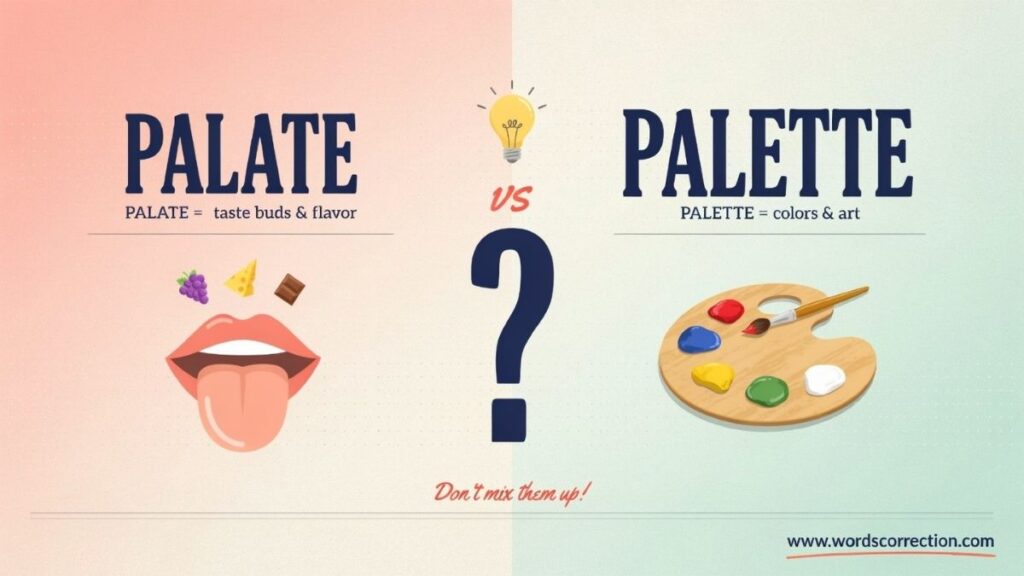
If you’re looking for the palate vs palette meaning, use this simple distinction:
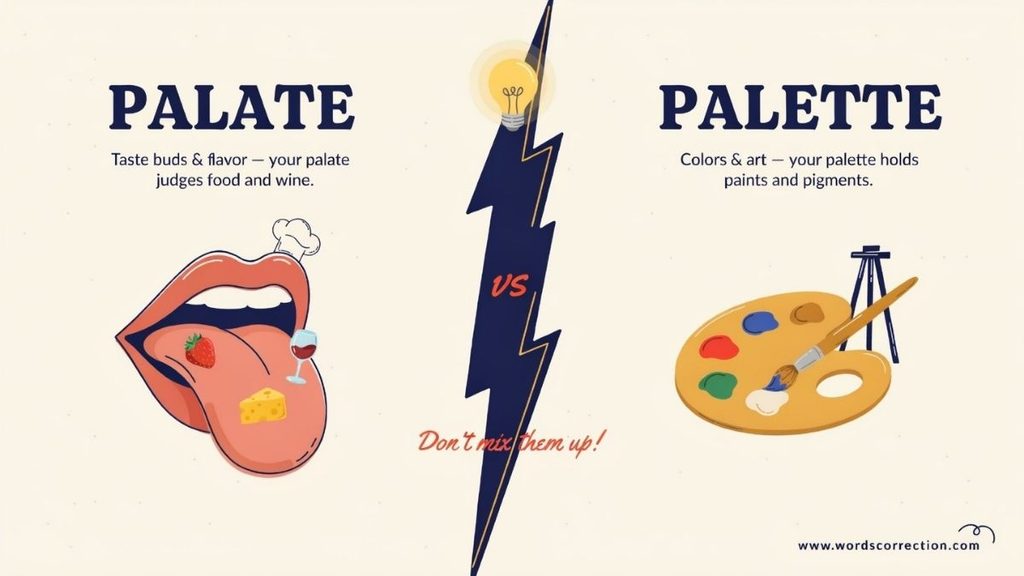
Palate = mouth, taste, or preference.
Palette = paint, colors, or a selected range.
Here are three quick examples:
- The chef has a refined palate.
- The painter chose a warm palette of reds and oranges.
- The dentist examined the patient’s hard palate.
The first sentence concerns taste. The second concerns colors. The third concerns anatomy.
Both palate and palette are nouns. Their meanings, however, come from different linguistic histories and developed along separate paths.
Quick Tip to Remember Palate vs Palette
Here’s an easy memory trick:
Palette contains two t’s. Think of the extra t as a visual reminder of the word’s connection with tools, paint, and art.
An even simpler association is:
Palette → paint → colors
If the sentence involves flavor, food, taste, or the roof of your mouth, choose palate.
If it involves paint, colors, design, or an artistic range, choose palette.
That distinction handles most everyday examples of palate vs palette spelling.
Palate vs Palette The Core Difference
The difference between palate and palette becomes much easier to understand when you look at what each word describes.
| Word | Main Meaning | Common Context | Example |
| Palate | Roof of the mouth | Anatomy | The dentist examined her palate. |
| Palate | Ability to taste and judge flavors | Food and wine | He has a sophisticated palate. |
| Palate | Personal preference or taste | Figurative use | The novel may not suit everyone’s palate. |
| Palette | Board used by an artist | Painting | She mixed the colors on her palette. |
| Palette | Range of colors | Art and design | The room uses a neutral palette. |
| Palette | A range or selection of creative elements | Figurative use | The composer expanded his musical palette. |
| Pallet | Platform for transporting goods | Shipping and logistics | The boxes arrived on a wooden pallet. |
Notice an important point: palate and palette aren’t alternative spellings of the same word. They are separate nouns with separate meanings.
That distinction matters because the wrong spelling can make an otherwise polished sentence look careless.
Learn the difference between confusing more English words
Devide or Divide Difference, Meaning and Usage
The Origin of Palate vs Palette
Their similar appearance is partly responsible for the confusion, but their histories are different.
Origin of Palate
Palate comes from the Latin word palatum, which referred to the roof of the mouth. The word entered English through French and retained its anatomical connection to the mouth.
Over time, its meaning expanded beyond anatomy.
Because the palate became associated with the experience of eating and tasting, palate developed a figurative sense connected with a person’s ability to recognize and appreciate flavors. That’s why English speakers can talk about a refined palate, sensitive palate, or discerning palate.
The modern word therefore has a logical connection between its physical and figurative meanings. The physical palate is involved in eating, while the figurative palate describes someone’s ability to appreciate flavors and develop preferences.
Origin of Palette
Palette took a different linguistic path. The word came into English through French and was originally associated with a small flat implement. It eventually became associated with the flat board artists use to hold and mix paint.
From there, palette gained its familiar modern meaning: a range of colors used by an artist or another creative professional.
Today, the word isn’t limited to traditional painting. Designers, photographers, filmmakers, makeup artists, and digital artists all use palette when discussing color choices.
Why the Confusion Exists
The confusion has several obvious causes.
First, the spellings differ by only one letter:
- palate
- palette
Second, the words are pronounced the same in standard American English.
Third, both words can appear in discussions involving aesthetics, food, creativity, and personal preferences. That overlap can make the distinction harder to remember.
For example, food writing may describe a dish as having a broad range of flavors. Because palette can mean a range or selection, writers sometimes mistakenly use it when they mean a person’s sense of taste.
The context usually reveals the correct word.
Palate Meaning
The palate meaning has two major senses: an anatomical meaning and a figurative meaning related to taste.
Palate as the Roof of the Mouth
The palate is the roof of your mouth.
It has two main sections:
- Hard palate: The firm, bony front section.
- Soft palate: The softer rear section.
The hard palate separates the oral cavity from the nasal cavity. The soft palate is located farther back and contains muscle and soft tissue.
This gives you a straightforward way to understand the palate definition in anatomy.
For example:
- The dentist noticed a small irritation on the palate.
- The baby was born with a cleft palate.
- The food felt unusually hot against the roof of his mouth.
- The doctor examined the patient’s soft palate.
The word remains palate whether you’re discussing the hard or soft portion.
Palate as the Sense of Taste
The second major meaning concerns taste and flavor.
When someone says, “She has a refined palate,” they aren’t talking only about the physical roof of her mouth. They’re describing her ability to notice, distinguish, and appreciate flavors.
This usage is especially common when discussing:
- Food
- Wine
- Coffee
- Tea
- Cheese
- Chocolate
- Spices
- Fine dining
For example:
A trained sommelier develops a sensitive palate that can distinguish subtle differences in wine.
Here, palate refers to sensory judgment rather than anatomy.
It’s worth noting that palate and taste buds aren’t exact synonyms. Taste buds are sensory structures that detect taste. A person’s palate, in the figurative sense, refers more broadly to their ability to experience and judge flavors.
Learn the difference between commonly mixed-up more words
Businesses or Business’s Meaning, Grammar and Correct Usage
Palate as Personal Preference
English also uses palate more broadly to describe preferences.
For example:
- The spicy dish may not suit everyone’s palate.
- The restaurant offers something for every palate.
- The novel has a dark tone that may not appeal to every reader’s palate.
- Her sophisticated palate led her toward more complex flavors.
This meaning can overlap with the ordinary word taste.
In other words, when someone asks, “What does palate mean?” the answer isn’t always “the roof of the mouth.” Depending on the context, it can also mean a person’s taste, preference, or ability to appreciate particular qualities.
Palate Synonyms
The best palate synonym depends on the meaning.
For the anatomical sense:
- Roof of the mouth
- Oral roof
the taste-related sense:
- Taste
- Flavor perception
- Sensitivity to flavor
- Sensory judgment
preference-related sense:
- Taste
- Preference
- Inclination
- Sensibility
These aren’t perfect one-for-one replacements in every sentence. Context still matters.
Learn the difference between tricky grammar more words
Alternately or Alternatively Meaning, Usage and Examples
Palette Meaning
The palette meaning centers on art, color, and selection.
Palette as an Artist’s Tool
A traditional paint palette is a flat surface where an artist places and mixes paints.
Historically, painters often used handheld palettes with a thumb hole. Modern artists use many different designs and materials, including wood, plastic, porcelain, and disposable surfaces.
For example:
- The artist mixed blue and yellow on her palette.
- He cleaned his palette after finishing the painting.
- The painter arranged several pigments across the artist’s palette.
The physical meaning remains closely tied to painting and mixing colors.
Palette as a Range of Colors
The other major meaning of palette is a selection or range of colors.
This usage is extremely common in modern design.
You might encounter:
- Color palette
- Warm palette
- Cool palette
- Neutral palette
- Muted palette
- Pastel palette
- Earth-tone palette
- Monochromatic palette
- Limited palette
For example:
The designer chose a muted color palette of beige, gray, cream, and olive.
Here, nobody is talking about a physical board. Palette means the selected group of colors.
Learn the difference between confusing word pairs
Tie or Tye Meaning, Difference and Usage
Palette in Design, Photography, and Makeup

The word has moved far beyond traditional painting.
A graphic designer might create a design palette for a website. A photographer might edit an image to achieve a warmer color palette. A makeup artist might choose an eyeshadow palette containing complementary shades.
You can therefore see palette in:
- Graphic design
- Web design
- Interior design
- Photography
- Film
- Fashion
- Branding
- Illustration
- Makeup
- Digital painting
An eyeshadow palette, for example, is a collection of makeup shades. It has nothing to do with taste or the mouth.
Palette as a Broader Range
Palette can also be used figuratively for a range of creative or expressive choices.
For example:
- The composer uses a broad palette of sounds.
- The filmmaker works with a dark palette of visual themes.
- The writer draws from a rich palette of emotions.
In these examples, palette doesn’t literally mean paint. It refers to a range of elements available to the creator.
That figurative use explains why palette sometimes appears in contexts that aren’t strictly about colors.
Palette Synonyms
A useful palette synonym depends on the context.
For colors:
- Color scheme
- Color range
- Selection of colors
- Spectrum
- Set of hues
a broader creative range:
- Range
- Selection
- Variety
- Repertoire
- Collection
the physical object:
- Paint board
- Mixing surface
Again, these words aren’t interchangeable in every sentence.
Learn the difference between often confused words
Mater or Matter Difference in Meaning and Usage
Palate vs Palette Pronunciation
One of the biggest reasons people search for palate vs palette pronunciation is that pronunciation doesn’t reliably tell you which spelling to use.
In standard American English, both words are pronounced the same way.
| Word | US Pronunciation | Meaning |
| Palate | /ˈpæl.ət/ | Mouth, taste, preference |
| Palette | /ˈpæl.ət/ | Paint board, colors, range |
This makes palate and palette homophones in standard American English.
If someone says, “She has a refined palate,” you can’t determine the spelling from sound alone. You have to understand the meaning.
That is a classic example of how English homophones can create spelling problems.
Palate and Palette in Common Phrases
Certain phrases make the distinction especially easy to see.
Common Expressions With Palate
Some frequent expressions include:
- Refined palate
- Sensitive palate
- Discerning palate
- Develop your palate
- Cleanse the palate
- Appeal to the palate
- Suit someone’s palate
For example:
Traveling can help you develop a more adventurous palate.
Common Expressions With Palette
Common expressions include:
- Color palette
- Artist’s palette
- Paint palette
- Warm palette
- Cool palette
- Muted palette
- Limited palette
- Makeup palette
- Palette of colors
For example:
The website uses a clean color palette of white, navy, and gold.
Learn the difference between basic English word mistakes
Emigrate or Immigrate Difference, Meaning and Usage
Why “Palate Cleanser” Is Correct
The phrase palate cleanser causes a remarkable number of spelling mistakes.
The correct expression is:
palate cleanser
A palate cleanser is something used to refresh the sense of taste between foods or courses. In traditional dining, it might be a small serving of sorbet or another refreshing item.
The phrase can also be used figuratively.
For example:
After watching three intense dramas, the light comedy felt like a palate cleanser.
Why isn’t it palette cleanser?
Because the phrase refers metaphorically to cleansing or refreshing your sense of taste, not to colors. Therefore, the correct spelling is palate.
Palate vs Palette in a Sentence
Understanding palate vs palette in a sentence becomes much easier when you compare the words directly.
Food and Taste Examples
- The chef created a dish that delighted my palate.
- She has a highly refined palate.
- The wine has a complex flavor that develops across the palate.
- The spicy sauce may be too intense for a sensitive palate.
- The dessert offers a pleasant contrast that refreshes the palate.
Art and Design Examples
- The artist cleaned her palette before starting a new painting.
- The room uses a warm palette of terracotta and cream.
- The photographer prefers a muted color palette.
- The designer selected a neutral palette for the website.
- The makeup artist opened an eyeshadow palette.
Palate vs Palette Examples Side by Side
| Incorrect | Correct | Why |
| The chef has a refined palette. | The chef has a refined palate. | Taste → palate |
| The designer chose a warm palate. | The designer chose a warm palette. | Colors → palette |
| This sorbet cleanses the palette. | This sorbet cleanses the palate. | Taste → palate |
| The painter mixed red on her palate. | The painter mixed red on her palette. | Paint → palette |
| The dish didn’t suit my palette. | The dish didn’t suit my palate. | Food preference → palate |
These palate vs palette sentence examples show the distinction more clearly than memorizing definitions alone.
Learn the difference between commonly misused words
Persuing or Pursuing Meaning, Difference and Correct Spelling
Common Mistakes With Palate or Palette

There are following common mistakes.
Mistake 1 Using Palette for Taste
This is one of the most common mistakes.
Incorrect:
The chef has an impressive palette.
Correct:
The chef has an impressive palate.
When you’re discussing someone’s ability to detect or appreciate flavors, use palate.
Mistake 2 Using Palate for Colors
The reverse mistake often appears in design and art writing.
Incorrect:
The designer chose a calming blue palate.
Correct:
The designer chose a calming blue palette.
The presence of colors should immediately make palette your first choice.
Mistake 3 Writing “Palette Cleanser”
This error often happens because the writer remembers the phrase but forgets its connection to taste.
Correct:
The lemon sorbet acted as a palate cleanser.
Not:
The lemon sorbet acted as a palette cleanser.
Mistake 4 Assuming the Words Are Interchangeable
They aren’t.
You can’t treat palate and palette as alternate spellings. They are separate vocabulary items.
The same principle applies to many commonly confused words in English. Similar spelling or pronunciation doesn’t automatically mean shared meaning.
Mistake 5 Relying Only on Sound
If you hear someone say either word, you may not know which spelling they mean.
That’s normal.
Instead, identify the context:
Taste? → palate.
Colors? → palette.
Shipping platform? → pallet.
That three-way distinction solves most problems involving palate vs pallet vs palette.
Learn the difference between everyday English mistakes
Access or Acess Which Spelling Is Correct?
Difference Between Palate, Palette, and Pallet
The third word deserves attention because pallet often gets pulled into the same spelling confusion.
| Word | Meaning | Example |
| Palate | Roof of mouth; sense of taste; preference | The dish pleased her palate. |
| Palette | Artist’s paint board; range of colors | The artist used a limited palette. |
| Pallet | Flat platform for transporting goods | The warehouse worker moved the pallet. |
Pallet vs Palette
A pallet is commonly used in warehouses, factories, shipping operations, and logistics. Goods are stacked on it so they can be moved with equipment such as a forklift or pallet jack.
A palette, by contrast, belongs to the world of art and color.
So:
The boxes were stacked on a wooden pallet.
But:
The artist mixed the paint on a wooden palette.
The words may look like close relatives, but their meanings are completely different.
Pallet vs Palate
The distinction is equally important:
The dentist examined the patient’s palate.
The warehouse received a new pallet of supplies.
One belongs to anatomy. The other belongs to logistics.
Learn the difference between more words people mix up
Bat or Bet Which Is correct spelling?
Palate or Palette Grammar and Usage
From a grammar perspective, both palate and palette are primarily countable nouns.
Plural of Palate
The plural of palate is:
palates
Examples:
- Different people have different palates.
- The restaurant creates dishes for adventurous palates.
- Doctors examined several patients’ palates.
If you’re wondering about the palate plural, simply add -s.
Plural of Palette
The plural of palette is:
palettes
Examples:
- The artist owns several palettes.
- Designers experimented with different color palettes.
- The makeup collection includes several eyeshadow palettes.
The spellings remain easy to distinguish:
- palate → palates
- palette → palettes
Palate or Palette Usage
Use palate when the noun connects to:
- The mouth
- Taste
- Flavor
- Food preferences
- Sensory judgment
- Personal taste in certain figurative contexts
Use palette when it connects to:
- Paint
- Colors
- Artistic choices
- Design
- Photography
- Makeup
- A broader creative range
Context is the deciding factor.
Learn the difference between tricky words and use them correctly
Blackout or Backout which is correct?
How to Spell Palate and Palette
If you’re asking how to spell palate, remember the word connected to taste and the mouth:
P-A-L-A-T-E
If you’re asking how to spell palette, remember the word connected to paint and colors:
P-A-L-E-T-T-E
The extra t in palette is one of the easiest visual clues.
Correct Spelling of Palate
Palate is the correct spelling when referring to:
- The roof of the mouth
- Taste
- Flavor judgment
- A person’s culinary preferences
Example:
She has an adventurous palate.
Correct Spelling of Palette
Palette is the correct spelling when referring to:
- An artist’s paint board
- A collection of colors
- A design color scheme
- A makeup color collection
- A figurative range of creative choices
Example:
The designer selected a soft pastel palette.
British English vs American English Spelling
Unlike words such as color and colour, palate and palette don’t have separate standard British and American spellings.
The spellings remain:
- British English: palate
- American English: palate
- British English: palette
- American English: palette
The meanings also remain essentially the same.
| Word | American English | British English | Meaning |
| Palate | palate | palate | Mouth, taste, preference |
| Palette | palette | palette | Paint board, colors, range |
| Pallet | pallet | pallet | Transport platform |
There can be pronunciation differences between varieties of English, but they don’t turn palate into palette or vice versa.
This is therefore a vocabulary distinction rather than a British-versus-American spelling issue.
Which Spelling Should You Use?
The right choice depends entirely on meaning.
When You Mean Taste or the Mouth
Use palate.
Examples:
- The soup was gentle on my palate.
- She has a sophisticated palate.
- The doctor examined his palate.
- The sorbet cleansed the palate.
When You Mean Colors or an Artist’s Tool
Use palette.
Examples:
- The painter loaded her palette with fresh colors.
- The website uses a blue-and-white palette.
- The photographer prefers a warm palette.
- The designer created a minimalist color palette.
When You Mean a Range or Selection
Use palette when you’re describing a range of creative or expressive elements.
For example:
The composer uses a broad palette of sounds.
Here, palette doesn’t literally mean paint. It means a range of available creative elements.
That figurative use is well established in English and appears in writing about music, design, photography, literature, and other creative fields.
A Simple Editing Test
When proofreading, ask one question:
What am I talking about?
If the answer is taste or mouth, write palate.
the answer is paint or colors, write palette.
answer is shipping or storage, write pallet.
That simple three-word test is often more useful than memorizing a complicated rule.
Learn the difference between similar English words the easy way
Stabilise or Stabilize Difference in Usage
Palate or Palette Three Practical Cases
Case Study Food Writing
Consider this sentence:
The restaurant’s menu is designed for adventurous palates.
The word palates is correct because the writer refers to people’s taste preferences.
Now change the subject:
The restaurant’s interior uses a warm palette of cream, copper, and brown.
Here, palette is correct because the sentence describes colors.
The two sentences could easily appear in the same restaurant review. That’s precisely why context matters.
Case Study Art and Design
Consider:
The painter experimented with a restricted palette.
This means the painter deliberately worked with a limited set of colors.
Now consider:
The critic praised the painter’s ability to appeal to a sophisticated palate.
That sentence shifts from visual color to taste or aesthetic preference.
Although both words can appear in discussions of art and creativity, their meanings remain distinct.
Case Study The Palate Cleanser
A restaurant review might say:
A small citrus sorbet served as a palate cleanser between courses.
This is clearly about taste.
The phrase doesn’t refer to a palette of colors. The spelling palate is therefore essential.
The same phrase can move into figurative writing:
After several difficult chapters, the humorous essay was a welcome palate cleanser.
The literal taste meaning has become a metaphor for something refreshing or different.
Palate vs Palette A Complete Comparison
| Feature | Palate | Palette |
| Part of speech | Noun | Noun |
| Main meaning | Roof of the mouth | Artist’s paint board |
| Figurative meaning | Taste, preference | Range of colors or creative choices |
| Food context | Very common | Usually incorrect when referring to taste |
| Art context | Usually unrelated to color | Very common |
| Anatomy context | Correct | Incorrect |
| Color context | Incorrect | Correct |
| Common phrase | Refined palate | Color palette |
| Another common phrase | Palate cleanser | Artist’s palette |
| Plural | Palates | Palettes |
| US pronunciation | /ˈpæl.ət/ | /ˈpæl.ət/ |
| British spelling | palate | palette |
| American spelling | palate | palette |
Practice Sesssion
Fill-in-the-Blanks
- The roof of the mouth is called the ______.
- An artist uses a ______ to mix paints.
- A wooden ______ is used to transport goods.
- A chef needs a refined ______ to recognize subtle flavors.
- The designer chose a warm color ______.
- The correct spelling for the sense of taste is ______.
- The artist cleaned her paint ______ after finishing.
- The warehouse worker placed the boxes on a wooden ______.
- A person’s appreciation of flavors is called their ______.
- Red, blue, and yellow were included in the artist’s ______.
- The hard and soft ______ form the roof of the mouth.
- The chef prepared a dish that appealed to my ______.
- The plural of palette is ______.
- A range of colors used in a painting is called a color ______.
- The workers loaded the products onto a ______.
- The artist selected a vibrant ______ for the painting.
- A person with a good ______ can recognize different flavors.
- The correct word for a paint-mixing board is ______.
- Palate, palette, and pallet are examples of ______.
- The designer created a neutral color ______ for the bedroom.
- A small wooded area may be called a ______.
- A dense growth of shrubs is called a ______.
- One synonym for tiny is ______.
- A person who works with wood is called a ______.
- The scientist observed a ______ particle under the microscope.
Answer Session
- Palate
- Palette
- Pallet
- Palate
- Palette
- Palate
- Palette
- Pallet
- Palate
- Palette
- Palates
- Palate
- Palettes
- Palette
- Pallet
- Palette
- Palate
- Palette
- Homophones
- Palette
- Grove
- Thicket
- Minuscule
- Woodworker
- Tiny
Here’s a trusted source for clear more words Comparison:
Grammar Update
Frequently Asked Questions
What is the difference between palate and palette?
Palate refers to the roof of the mouth or a person’s sense of taste, while palette refers to a board used for mixing paints or a range of colors used in art and design.
Is it food palate or taste palate?
Both expressions relate to taste, but palate is the standard word for a person’s ability to recognize and appreciate flavors. For example, “She has a refined palate for fine dining.”
How do you spell palate when referring to taste?
The correct spelling is palate. It refers to a person’s sense of taste or the roof of the mouth.
What does “palette” mean?
A palette is a flat surface used by artists to mix paints. The word can also describe a selection of colors used in painting, fashion, graphic design, or interior decoration.
Is the roof of your mouth a pallet?
No. The correct term is palate. The palate forms the roof of the mouth, while a pallet is a platform commonly used to store and transport goods.
What is another word for palette?
Depending on the context, synonyms for palette include color scheme, color range, assortment, and selection. In art, the appropriate synonym depends on whether the word refers to a physical mixing board or a range of colors.
What does your palate mean?
Your palate refers to the roof of your mouth or your ability to perceive and appreciate different tastes. In everyday language, it often describes personal preferences for particular foods and flavors.
What is the meaning of pallet?
A pallet is a flat platform, usually made of wood or plastic, used to support, store, and transport goods. In some contexts, the word can also refer to a simple bed or sleeping surface.
Can you use “palette” in a sentence?
Yes. Here is an example: “The artist selected a vibrant palette of blue, green, and yellow for the landscape painting.”
What is another word for palate?
Depending on the context, alternatives for palate include sense of taste, taste preference, and flavor preference. When referring to anatomy, the word describes the roof of the mouth.
What does “pallet” mean in slang?
The word pallet is not widely used as modern slang. In some regional or informal contexts, it refers to a simple bed or sleeping surface. Its intended meaning depends on the context in which it appears.
What does it mean if someone has a good palate?
Having a good palate means being able to recognize, distinguish, and appreciate different flavors. People with a well-developed palate may notice subtle differences in ingredients, seasonings, and food quality.
What is someone’s palette?
Someone’s palette is the range of colors they choose or use in creative work. For example, an interior designer might select a neutral palette of beige, cream, and gray for a room.
What is the difference between palette and palette?
There is no difference because both spellings are identical. You may be thinking of palate, which relates to taste or the roof of the mouth, or pallet, which usually refers to a platform for transporting goods.
Can you use the word “pallet” in a sentence?
Yes. Here is an example: “The warehouse employee stacked the boxes securely on a wooden pallet before shipping them.”
Is taste a palette or palate?
The correct word is palate. It refers to a person’s sense of taste or preferences for different flavors. For example, “The chef prepared a dish that appealed to my palate.”
What words commonly go with palette?
Common expressions include color palette, paint palette, warm palette, cool palette, neutral palette, limited palette, and makeup palette. These combinations are frequently used in art, fashion, beauty, and design.
What can I use instead of a palette?
For mixing paint, you can use a mixing tray, a disposable palette, or a suitable flat surface. When discussing colors in design, you can use terms such as color scheme, color selection, or range of colors.
What is a homophone for “palette”?
Palate and pallet are homophones of palette. All three words are generally pronounced the same but have different spellings and meanings.
What is another word for pallet?
Depending on the context, alternatives for pallet include platform or skid when referring to a structure used for transporting goods. When referring to a simple sleeping surface, bed or mattress may be appropriate.
What is the plural form of palette?
The plural form of palette is palettes. For example, “The artist experimented with several different palettes for the exhibition.”
What is the opposite of a pallet?
There is no standard antonym for pallet. The word describes an object rather than a quality with a direct opposite, so the appropriate alternative depends on the context.
What is a sophisticated word for wood?
Timber is a common alternative, particularly when referring to wood used in construction. Other terms, such as lumber or hardwood, may be appropriate depending on the type and intended use of the material.
What is a sophisticated word for carpenter?
Woodworker is a suitable alternative for someone who makes or repairs wooden objects. A joiner is a related term for a craftsperson who constructs or fits wooden components, particularly joints, doors, and frames.
What do you call a small piece of wood?
A small piece of wood can be called a wood chip, splinter, shaving, or fragment. The most appropriate term depends on its size, shape, and how it was produced.
Conclusion
The difference between palate and palette may seem minor, but using the wrong word can change the meaning of an otherwise clear sentence. Palate refers to the roof of the mouth, the sense of taste, or a person’s food preferences. Palette, on the other hand, refers to an artist’s tool for mixing paint, a range of colors, or a selection of visual elements in design.
A simple memory trick can help: connect palette with paint. When you’re writing about taste, flavor, or the mouth, use palate. When you’re discussing colors, art, or design, use palette.
Once you understand the distinction, this commonly confused pair becomes easy to use correctly. With the right spelling, your writing can have excellent taste and a well-chosen palette, too!

Stella AJS is an experienced blogger and dedicated English language writer at Words Correction. She turns confusing grammar, word meanings, spelling, and usage into clear, practical insights that readers can easily understand and apply. With a passion for precise and engaging writing, Stella helps readers avoid common language mistakes, strengthen their vocabulary, and communicate with greater clarity and confidence.




