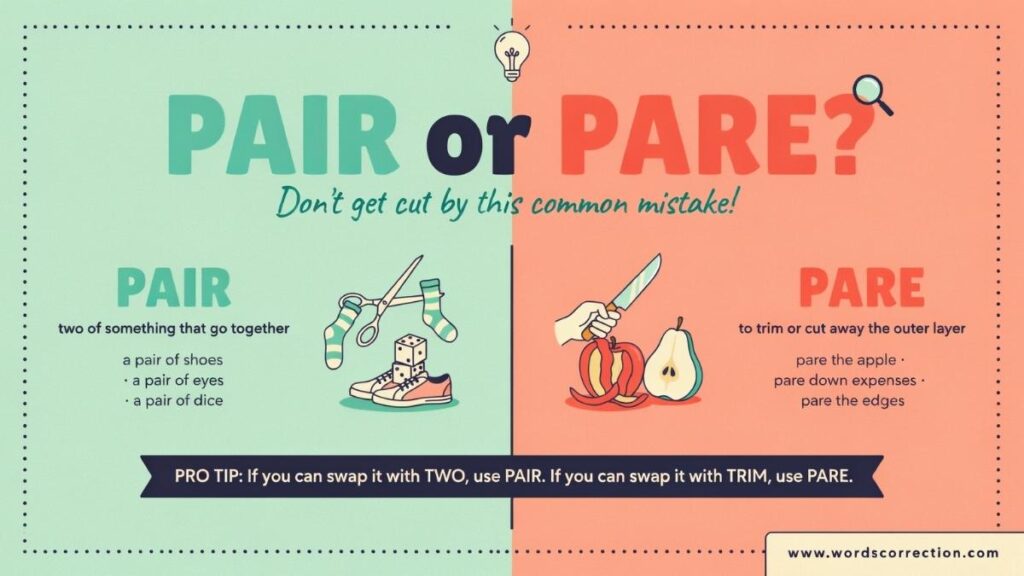
The difference between pair or pare can create an unexpected grammar headache. These words sound exactly alike, yet their meanings are completely different. One brings two things together, while the other means to cut, trim, or reduce something. A small spelling mistake can quickly change the meaning of a sentence, turning clear writing into a confusing puzzle. Fortunately, the distinction is easy to understand once you connect each word with its purpose. This guide explains the meaning, grammar, usage, and common mistakes involving pair and pare. With clear examples and practical tips, you’ll learn how to choose the correct word confidently and avoid common spelling errors.
What Is the Difference Between Pair and Pare?
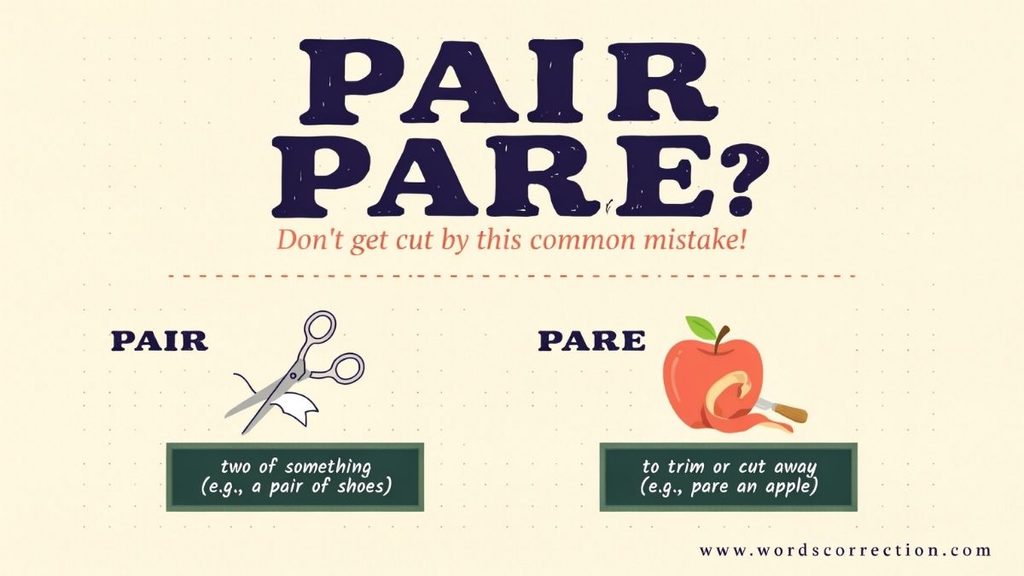
The difference between pair and pare comes down to meaning and grammatical function.
Pair usually refers to two things or people that belong together. It can function as both a noun and a verb.
Pare is primarily a verb. It means to cut away an outer layer or reduce something in size, amount, or scope.
| Word | Main Meaning | Part of Speech | Example |
| Pair | Two related or matching things | Noun | I bought a pair of shoes. |
| Pair | To put two things together | Verb | Pair the devices before using them. |
| Pare | To cut away an outer layer | Verb | Pare the apple carefully. |
| Pare | To reduce or make smaller | Verb | We need to pare down the list. |
So, when asking, “What is the difference between pair and pare?” focus on the meaning of the word in the sentence.
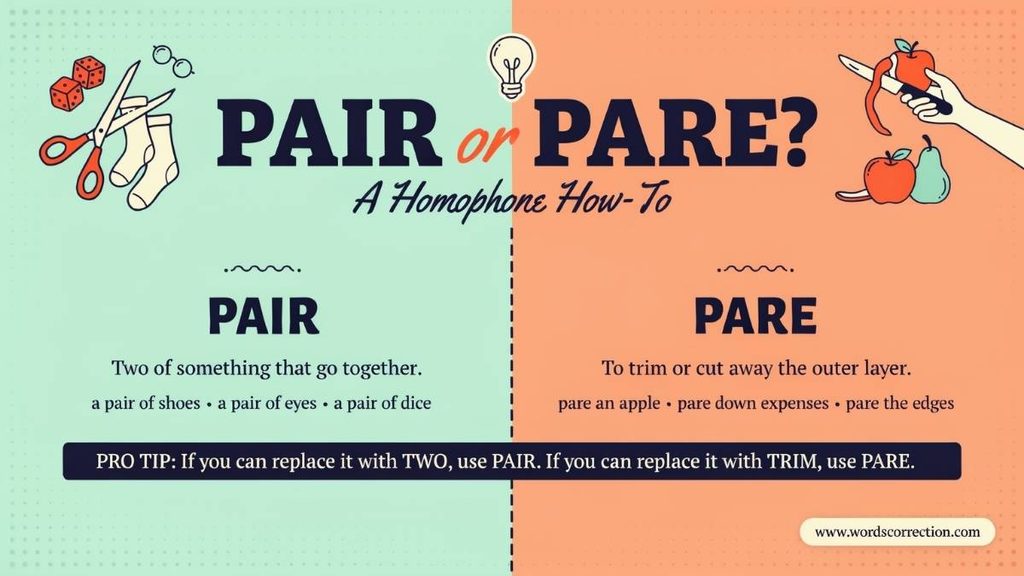
If you mean two things together, use pair.
If you mean cutting, trimming, removing, or reducing, use pare.
Pair or Pare The Fastest Memory Trick
Think of the words as having opposite directions:
- Pair = put together
- Pare = take away
For example:
- Pair the students. → Put two students together.
- Pare the apple. → Cut away part of the apple’s skin.
- Pair the shoes. → Match the two shoes.
- Pare the budget. → Reduce the budget.
This distinction answers most pair or pare grammar questions quickly.
Learn the difference between more words people mix up
Mater or Matter Difference in Meaning and Usage
What Does Pair Mean?
The pair meaning centers on the idea of two things or people considered together.
A pair can consist of objects that match physically, objects that work together, two people working together, or two parts that form one functional item.
Common examples include:
- a pair of shoes
- a pair of socks
- a pair of glasses
- a pair of gloves
- a pair of scissors
- a pair of people
- a pair of teams
The word can describe two similar objects or two things designed to work together.
Pair as a Noun
When pair acts as a noun, it names a set of two.
Consider these sentences:
- I need a new pair of shoes.
- She bought a pair of sunglasses.
- We found a matching pair of socks.
- The teacher asked us to work in pairs.
- A pair of scissors was lying on the desk.
The phrase pair of shoes means two shoes considered as a matching set.
Notice the grammar in the phrase “a pair of.” The noun that follows it is normally plural:
- a pair of shoes
- a pair of gloves
- a pair of socks
When referring to more than one set, pair becomes plural:
- one pair of shoes
- two pairs of shoes
- five pairs of socks
Pair as a Verb
Pair can also function as a verb. In this form, it means to match, connect, or put two people or things together.
For example:
- The teacher paired the students.
- The app lets you pair your phone with a computer.
- The designer paired the jacket with dark trousers.
- The chef paired the dish with a fresh salad.
- The two researchers were paired for the project.
The basic idea remains the same: two things are being brought together.
The verb is also common in technology. Devices can be paired so they can communicate with each other.
Pair Up Meaning
The expression pair up means to join with another person or form a group of two.
Examples include:
- Pair up with a partner.
- The students paired up for the exercise.
- Everyone should pair up before the game begins.
- We paired up to complete the assignment.
The expression focuses on the process of forming a pair.
Pair Up in a Sentence
Here are several natural examples:
Please pair up with someone sitting near you.
The students paired up to practice the dialogue.
We paired up for the final round of the competition.
In each sentence, pair up means to form a group of two.
Learn the difference between everyday English mistakes
Emigrate or Immigrate Difference, Meaning and Usage
Pair Off and Pair With
Two other useful expressions are pair off and pair with.
Pair off means to form separate pairs:
The dancers paired off for the next song.
Pair with means to combine one thing with another because they work well together:
This sauce pairs well with grilled vegetables.
The same central concept appears in both expressions: pairing creates a relationship between two things.
What Does Pare Mean?
The pare meaning is very different from the meaning of pair.
Pare means to cut away an outer layer or unwanted part of something. It can also mean to reduce something in amount, size, scope, or complexity.
For example:
- Pare the apple before slicing it.
- She pared the carrots.
- He pared away the damaged parts.
- The editor pared the article down.
- The company pared back its expenses.
The word can describe both a physical action and a figurative reduction.
Pare as a Verb
Pare is a verb, and it normally describes an action.
For example:
Pare the apple before cutting it.
She carefully pared the vegetables before cooking them.
The editor pared the article down to its essential points.
The past tense and past participle are pared, while the present participle is paring.
The forms are:
- present: pare
- past: pared
- past participle: pared
- present participle: paring
How to Use Pare in a Sentence
The physical meaning is easy to understand when food is involved.
She used a small knife to pare the apple.
Here, pare means to cut away the apple’s outer layer.
You can also use it with vegetables:
He carefully pared the carrots before cooking them.
The word can overlap with peel, but the two aren’t always interchangeable.
Peel is the more general everyday term for removing the skin of fruits or vegetables. Pare often emphasizes cutting or trimming away the outer layer with a knife.
For example:
- Peel the banana.
- Peel the orange.
- Pare the apple with a small knife.
Pare Down Meaning
The pare down meaning is to reduce something, often by removing a significant amount.
You can pare down:
- a list
- a budget
- expenses
- a schedule
- a proposal
- a workforce
- a menu
- a collection
- a report
- a plan
For example:
We need to pare down the guest list.
The sentence means that the guest list needs to become smaller.
Another example:
The editor pared down the article by removing repetitive sections.
Nothing is physically peeled in this example. Instead, unnecessary material is removed from the writing.
Pare Down a List
A list can contain more information than you need. In that situation, you can pare down a list by removing unnecessary entries.
For example:
The committee started with 50 proposals and pared the list down to 10.
The expression suggests deliberate reduction. The goal isn’t simply to remove things randomly. Instead, you reduce the list by cutting out items that aren’t necessary.
Learn the difference between commonly misused words
Persuing or Pursuing Meaning, Difference and Correct Spelling
Pare Down Costs and Expenses
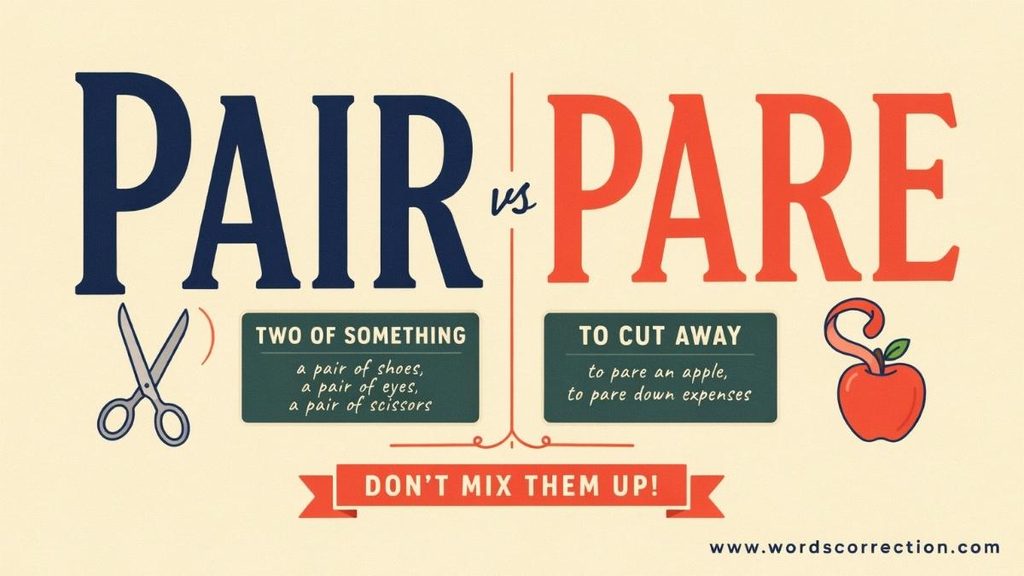
Business and financial writing frequently use pare down.
Examples include:
- The company plans to pare down costs.
- The department needs to pare down expenses.
- The retailer is trying to pare down its inventory.
- The organization pared down its operating budget.
The expression also works in everyday situations:
We decided to pare down our monthly expenses.
Here, the goal is to reduce spending by eliminating unnecessary costs.
Pare Back Meaning
Pare back has the same basic idea as pare down reduce something.
For example:
The company decided to pare back its expansion plans.
We need to pare back the number of meetings.
The designer pared back the color scheme to create a simpler look.
Both expressions can describe reducing something in size, scope, amount, or complexity.
Pare Something to a Specific Amount
You can also use pare when reducing something to a particular amount.
For example:
The committee pared the list to five finalists.
The restaurant pared the menu to six main dishes.
The company pared the budget to $2 million.
This construction clearly shows the idea of reducing something until it reaches a specific limit.
Learn the difference between basic English word mistakes
Access or Acess Which Spelling Is Correct?
Pair vs Pare vs Pear
The confusion doesn’t stop with two words. English has a third word that sounds the same: pear.
The pair vs pare vs pear comparison is straightforward once you look at their meanings.
| Word | Meaning | Example |
| Pair | Two related or matching things | I bought a pair of shoes. |
| Pare | Cut, trim, or reduce | Pare the apple before serving it. |
| Pear | A type of fruit | She ate a ripe pear. |
These words are homophones because they generally share the same pronunciation while having different spellings and meanings.
That makes pair, pare, and pear a classic example of commonly confused words in English.
Pair and Pear Homophones
Pair and pear sound alike but have unrelated meanings.
Compare:
I bought a pair of shoes.
I bought a pear at the market.
The first sentence involves two matching objects. The second involves fruit.
Pair and Pare Homophones
The same pronunciation creates the pair and pare homophones problem.
Compare:
Pair the students for the exercise.
Pare the vegetables before cooking.
The sound doesn’t tell you which spelling belongs on the page. Meaning and context do.
This is why homophones can cause spelling errors. When you hear a word, several spellings may represent that same sound. Writing requires you to select the spelling that matches the intended meaning.
Pair or Pare Down Which Is Correct?
When you mean reduce, the correct expression is pare down.
Pare Down or Pair Down?
Pare down is the standard expression when you mean reduce something.
Correct:
We need to pare down the list.
The company pared down its expenses.
The editor pared down the article.
Incorrect for this meaning:
We need to pair down the list.
Why is pair down wrong here? Because pair means to bring two things together or make them a pair. It doesn’t mean reduce.
Consider the contrast:
- Pair up → bring two people or things together.
- Pare down → reduce something.
The expressions almost point in opposite directions.
Is “Pair Down” Ever Correct?
When you mean reduce, the standard expression is pare down, not pair down.
For example:
Incorrect:
The editor decided to pair down the introduction.
Correct:
The editor decided to pare down the introduction.
The second sentence uses the correct spelling because the editor is removing unnecessary material.
Learn the difference between often confused words
Bat or Bet Which Is correct spelling?
Examples of Pair and Pare in Sentences
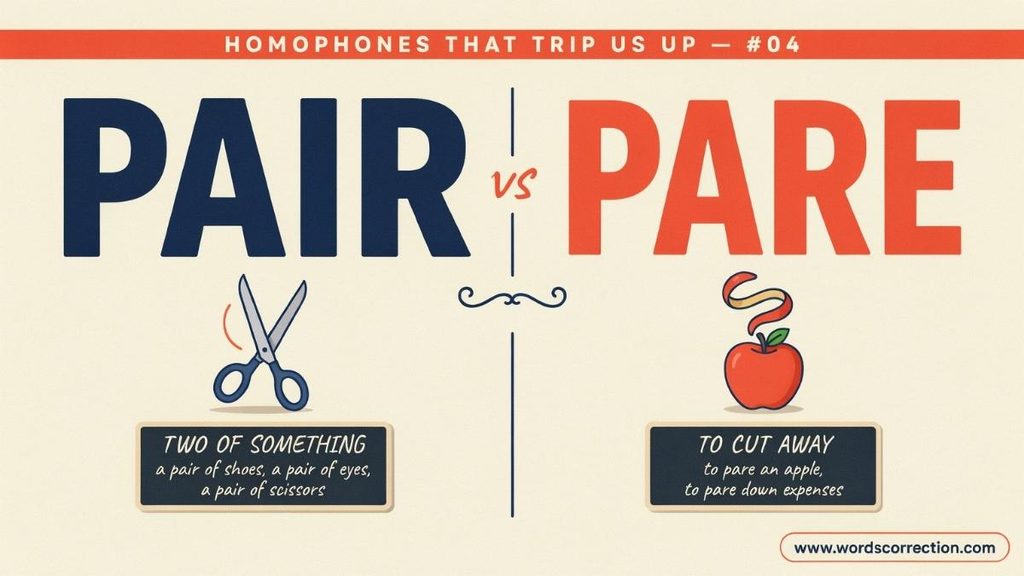
Real examples make the pair and pare difference easier to remember.
Pair or Pare Examples
| Sentence | Correct Word | Why? |
| I need a new ___ of shoes. | pair | Two shoes form a matching set. |
| ___ the students for the activity. | Pair | The students need to be grouped into twos. |
| She used a knife to ___ the apple. | pare | She is cutting away the skin. |
| We need to ___ down the list. | pare | The list needs to be reduced. |
| He bought a ___ of socks. | pair | Socks are being treated as a set of two. |
| The company will ___ back its spending. | pare | Spending will be reduced. |
| The teacher asked everyone to ___ up. | pair | Students need to form groups of two. |
| She ate a ripe ___. | pear | The word refers to fruit. |
Pair and Pare in a Sentence
Sometimes both words can appear naturally in the same sentence:
Pair the students, then pare down the number of project ideas they have to choose from.
The first verb means put people together. The second means reduce the number.
Another example:
After the students paired up, the teacher pared down the reading list.
The sentence clearly demonstrates the distinction because both words appear in the same context without overlapping in meaning.
Pair Definition and Examples
A useful pair definition and examples can be organized around three major uses.
Pair as Two Things
I bought a pair of gloves.
Here, pair means two matching or related objects.
Pair as Two People
The pair worked together on the project.
Here, pair refers to two people considered together.
Pair as a Verb
Pair each student with a partner.
Here, pair means to put two people together.
The noun identifies a set of two, while the verb describes the process of joining or matching.
What Is an Example of a Pair?
A pair doesn’t always have to consist of identical objects. The important point is that the two items belong together in some meaningful way.
Examples include:
- two shoes designed to be worn together
- two socks intended as a matching set
- two gloves
- two people working together
- two devices connected for communication
- two foods selected to complement each other
Learn the difference between confusing word pairs
Blackout or Backout which is correct?
Pare Definition and Examples
The pare definition and examples can be organized around two major meanings.
Physical Meaning
Pare means to cut away an outer layer or unwanted part.
Pare the apple before cutting it.
She pared the carrots before cooking them.
Figurative Meaning
Pare means to reduce something.
The editor pared the article down.
The company pared back its expenses.
The committee pared the list to three finalists.
This figurative use appears frequently in professional, financial, editorial, and business writing.
Learn the difference between confusing more English words step by step
Personel or Personnel Which is Correct?
The Origin of both
The modern words may sound alike, but their histories are different.
Origin of Pair
The noun pair entered Middle English during the 13th century. Its history can be traced through Old French to Medieval Latin and ultimately to Latin roots associated with the idea of equality or matching.
That history fits the modern meaning. A pair consists of two things regarded as corresponding or belonging together.
The verb developed later from the noun and came to describe bringing two people or things together.
Origin of Pare
Pare has a different history. It entered English through Old French and ultimately connects with Latin roots associated with preparing, arranging, or making something ready.
Over time, the English meaning developed toward cutting or trimming an outer layer. Its figurative meaning later expanded to include reducing something in amount or scope.
That development explains why English can use pare for both an apple and a budget:
Pare the apple.
Pare the budget.
The physical action provides the basic image. The figurative meaning extends that image to the idea of cutting something down.
Learn the difference between tricky grammar more words
Stabilise or Stabilize Difference in Usage
Pair or Pare Spelling Which Is Correct?
There isn’t one universally correct spelling between pair and pare. The correct spelling depends on what you mean.
Use pair when you mean:
- two things
- two people
- a matching set
- something consisting of two parts
- joining or matching two things
Use pare when you mean:
- cut away
- trim
- remove an outer layer
- reduce
- simplify
- make smaller
Correct Spelling of Pair
If you’re talking about two matching or connected things, the correct spelling of pair is:
pair
Examples:
- pair of shoes
- pair of glasses
- pair of socks
- pair of scissors
- pair up
- pair with
Correct Spelling of Pare
If you’re talking about trimming or reducing, the correct spelling of pare is:
pare
Examples:
- pare an apple
- pare the skin
- pare away excess material
- pare down a list
- pare back expenses
Learn the difference between commonly mixed-up more words
Palate or Palette Difference and Usage
Pair or Pare Grammar Parts of Speech
Understanding the grammar makes word choice much easier.
| Word | Noun | Verb | Common Uses |
| Pair | Yes | Yes | a pair of shoes; pair two students |
| Pare | No in standard modern use | Yes | pare an apple; pare down costs |
Pair as a Noun
That pair of shoes is expensive.
Here, pair is a noun.
Pair as a Verb
Pair each student with a partner.
Here, pair is a verb.
Pare as a Verb
Pare the list down to five names.
Here, pare is a verb.
The past tense is pared, while the present participle is paring.
Learn the difference between tricky English words with easy explanations
Tier or Teir Which One Is Right?
Commonly Confused Words
The words pair, pare, and pear show why spelling cannot always be predicted from sound.
| Word | Meaning | Example | Memory Cue |
| Pair | Two things together | A pair of shoes | Pair = two |
| Pare | Cut or reduce | Pare the apple | Pare = trim |
| Pear | Fruit | Eat the pear | Pear = fruit |
This is one of many examples of homophones in English. Other familiar examples include:
- right / write
- flower / flour
- sea / see
- here / hear
- two / to / too
The best way to handle homophones is to focus on meaning and context, not sound alone.
How to Use Pair and Pare Correctly
When you’re unsure, ask one simple question:
Am I bringing two things together, or am I taking something away?
If you’re bringing two things together, choose pair.
Pair the students.
If you’re taking something away, choose pare.
Pare the apple.
If you’re reducing something, choose pare.
Pare down the budget.
If you’re talking about fruit, choose pear.
Eat the pear.
This method works better than memorizing isolated spellings because it connects the spelling with the word’s actual meaning.
Learn the difference between confusing more English words
Tomorrow’s or Tomorrows Usage and difference?
When to Use Pair or Pare
Use this quick guide whenever the spelling feels uncertain.
Use Pair When You Mean:
- two matching objects
- two related objects
- two people
- a set of two
- matching or connecting
- grouping people into twos
- combining two things
Examples:
I bought a pair of shoes.
Pair the devices before using them.
The students paired up.
Use Pare When You Mean:
- cut away the outside
- trim
- remove an outer layer
- remove unnecessary material
- reduce an amount
- simplify
- decrease the size or scope
Examples:
Pare the apple.
Pare down the list.
The company pared back its spending.
Practice Session
Complete each sentence with the correct word pair, pare, or pear. Choose the word that best fits the meaning of each sentence.
Fill in the Blanks
1. I bought a new ______ of shoes yesterday.
2. She used a knife to ______ the skin off the apple.
3. A juicy ______ is a delicious and healthy snack.
4. My mother gave me a ______ of socks.
5. Please ______ the potatoes before cooking them.
6. He ate a ripe ______ after lunch.
7. The teacher asked the students to work in a ______.
8. We need to ______ down the list of unnecessary expenses.
9. She picked a fresh ______ from the tree.
10. I need a ______ of scissors for my art project.
11. The chef will ______ the fruit before serving it.
12. A ______ of birds sat on the garden fence.
13. He packed a ______ of gloves for the winter.
14. You can ______ the edges of the vegetables with a sharp knife.
15. My favorite fruit is the green ______.
16. The manager decided to ______ back the project budget.
17. I bought a ______ of matching earrings.
18. She placed a ripe ______ in her lunchbox.
19. The workers were asked to ______ the design to make it simpler.
20. I cannot find my other shoe from this ______.
21. Please ______ the outer layer of the carrot.
22. The farmer harvested a large, sweet ______.
23. The coach asked the players to ______ up for the exercise.
24. We should ______ unnecessary details from the report.
25. He ate a ______ and then went for a walk.
Answer Session
- Pair
- Pare
- Pear
- Pair
- Pare
- Pear
- Pair
- Pare
- Pear
- Pair
- Pare
- Pair
- Pair
- Pare
- Pear
- Pare
- Pair
- Pear
- Pare
- Pair
- Pare
- Pear
- Pair
- Pare
- Pear
Here’s a trusted source for clear more words Comparison:
Grammar Update
FAQs about Pair or Pare
These FAQs explain the meanings and correct usage of pair, pare, and pear with simple examples.
What does pare mean?
“Pare” is a verb that means to peel, trim, or cut away the outer layer of something. It can also mean to reduce or simplify something gradually. For example, “She used a knife to pare the apple.”
How do you spell pare when referring to peeling fruit?
The correct spelling is “pare” when referring to peeling or trimming fruit. For example, “He used a small knife to pare the skin from the pear.”
Why is the fruit called a pear?
A pear is a sweet, edible fruit that grows on a pear tree. The word “pear” has historical roots in Old English and related European languages. It is different from “pare,” which means to peel, trim, or reduce something.
Which is correct pare it back or pair it back?
“Pare it back” is the correct expression when you mean to reduce, simplify, or make something less extensive. For example, “The company decided to pare back its expenses.” The phrase “pair it back” is not standard in this context.
What is the difference between pear and pare?
“Pear” is a noun referring to a fruit, while “pare” is a verb meaning to peel, trim, or reduce something. Both words are pronounced alike, but their meanings and spellings are different.
Fruit and Nutrition FAQs
Is eating two pears a day too much sugar?
For many healthy adults, eating two whole pears a day can be part of a balanced diet. Pears contain natural sugars, dietary fiber, and essential nutrients. People managing blood sugar levels may need to consider portion sizes and their overall carbohydrate intake.
Are there fruits that should not be eaten together?
Most fruits can be safely eaten together as part of a balanced diet. There is no strong scientific evidence that ordinary fruit combinations are inherently harmful to healthy people. Individual digestive sensitivities may influence which combinations feel comfortable.
Which is healthier a pear or an apple?
Both pears and apples provide dietary fiber, water, vitamins, and beneficial plant compounds. Pears are a useful source of fiber, while apples also contribute important nutrients. Including both fruits in your diet can provide variety and support overall health.
What is the healthiest fruit to eat every day?
There is no single fruit that is healthiest for everyone. Berries, apples, pears, oranges, and kiwis all provide valuable nutrients. Eating a variety of whole fruits helps you obtain different vitamins, minerals, antioxidants, and types of fiber.
Which fruits are suitable to eat before bedtime?
Kiwis, bananas, berries, and cherries can be convenient evening snacks. However, no fruit guarantees better sleep. Choose a moderate portion and avoid foods that trigger heartburn, bloating, or other digestive discomfort before bed.
Food and Nutrition FAQs
Which foods are beneficial for older adults?
Older adults can benefit from a balanced diet that includes vegetables, fruits, whole grains, legumes, lean proteins, and suitable sources of calcium and vitamin D. Individual dietary requirements may vary according to health conditions, medication use, and nutritional needs.
Is there a food that contains 92 essential minerals?
No commonly recognized food is established as containing exactly 92 essential minerals. The human body requires a specific range of essential minerals, which can be obtained through a varied diet containing foods such as nuts, seeds, legumes, whole grains, and vegetables.
Which single food could sustain a person for the longest time?
No single ordinary food provides every nutrient required for long-term health. Although foods such as potatoes, milk, and legumes supply several important nutrients, relying exclusively on one food can result in nutritional deficiencies.
Which foods contain almost entirely protein?
Protein isolates, such as certain whey or soy protein products, can contain a very high percentage of protein. Among everyday foods, egg whites and very lean meats are protein-rich options, although they also contain water and other components.
Which dietary habits are associated with a shorter lifespan?
Long-term dietary patterns that include frequent consumption of processed meats, excessive sodium, sugary drinks, and highly processed foods may be associated with increased health risks. Overall diet quality, physical activity, smoking, and other lifestyle factors also influence long-term health.
Food Storage and Shelf-Life FAQs
Which foods can last for many years without spoiling?
Properly stored salt, granulated sugar, honey, and some dry staples can have exceptionally long shelf lives. However, storage conditions, moisture, contamination, and packaging can affect their quality and usability.
Which canned foods have a long shelf life?
Commercially canned beans, vegetables, meats, fish, and soups can remain shelf-stable for extended periods when stored in a cool, dry place. Follow the manufacturer’s storage guidance and discard cans that are bulging, leaking, or badly damaged.
Is it safe to eat food that has been frozen for 20 years?
Food maintained continuously at 0°F (-18°C) may remain safe for a long time, although its quality can deteriorate. For food frozen for 20 years, the storage history and packaging integrity are difficult to verify, so its safety cannot be guaranteed.
Can canned food remain safe for 40 years?
Canned food that is 40 years old should not be assumed safe to eat. Its storage conditions and packaging integrity may be uncertain. Do not taste it to check its safety; discard it if there is any concern about its condition.
What foods are suitable for long-term emergency storage?
Suitable emergency staples include white rice, dried beans, oats, pasta, canned vegetables, canned fish, and shelf-stable milk. Store them according to their packaging instructions, rotate supplies regularly, and maintain a varied food supply to meet nutritional needs.
Carbohydrates, Snacks, and Weight Management FAQs
Which carbohydrates should people limit?
People may benefit from limiting foods and drinks high in added sugar, including sugary beverages, sweets, and some highly processed snacks. Whole grains, legumes, vegetables, and whole fruits provide carbohydrates alongside fiber and other beneficial nutrients.
What are some healthy, low-carbohydrate snack options?
Low-carbohydrate snack options include boiled eggs, cheese, cucumber slices, olives, and moderate portions of unsweetened nuts. The nutritional value depends on serving size, ingredients, and individual dietary requirements.
Does popcorn contain a high amount of carbohydrates?
Popcorn contains carbohydrates because it is made from whole-grain corn. However, plain popcorn also provides dietary fiber. Its overall nutritional profile depends on the serving size and additions such as butter, sugar, or salt.
Is popcorn healthier than potato chips?
Plain, air popped popcorn generally provides fiber and may contain less fat per comparable serving than many fried potato chips. However, added butter, oil, salt, and portion sizes can affect the comparison.
Is microwave popcorn a healthy snack?
Microwave popcorn can be part of a balanced diet. Its nutritional value depends on the ingredients, portion size, and preparation method. Choosing varieties with less added sodium and saturated fat can help make it a more balanced snack.
Conclusion
The pair or pare confusion may seem small, but one misplaced letter can change the meaning of an otherwise perfectly clear sentence. Pair is about bringing two things together, while pare means to cut, trim, or reduce. Then there’s pear, which simply wants to be included in the conversation as a fruit. Thankfully, remembering the difference doesn’t require a heroic battle with the dictionary. Think of it this way: pair = two, pare = trim, pear = fruit. Once you connect each spelling with its meaning, common mistakes such as “pair down” become much easier to avoid. Good grammar isn’t about memorizing every rule; it’s about choosing words that communicate your meaning clearly.

Stella AJS is an experienced blogger and dedicated English language writer at Words Correction. She turns confusing grammar, word meanings, spelling, and usage into clear, practical insights that readers can easily understand and apply. With a passion for precise and engaging writing, Stella helps readers avoid common language mistakes, strengthen their vocabulary, and communicate with greater clarity and confidence.