
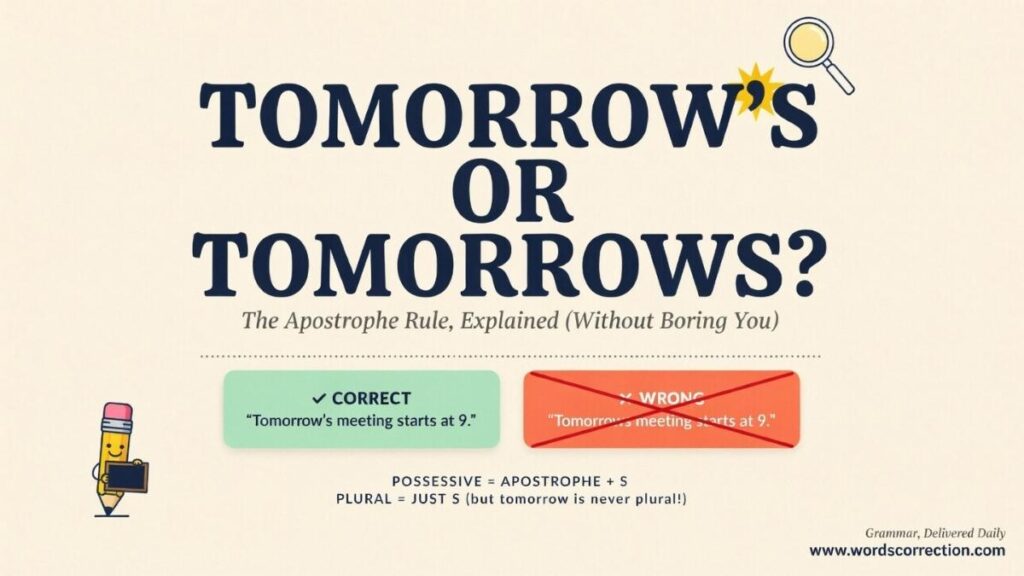
English grammar has a talent for making simple words surprisingly confusing. If you’ve ever hesitated over tomorrows or tomorrow’s, you’re not alone. That small apostrophe may look insignificant, but it can completely change the meaning and grammatical function of the word. Tomorrow refers to the day after today, while tomorrows and tomorrow’s have distinct uses that shouldn’t be confused. Fortunately, the difference is easier to understand than it might seem. In this guide, you’ll learn exactly when to use each form, explore common mistakes, review clear examples, and discover simple tips that will help you choose the correct form confidently every time.
Tomorrow’s or Tomorrows Quick Answer
The easiest way to remember the difference is:
- Tomorrow means the day after today.
- Tomorrows means more than one future day.
- Tomorrow’s means something associated with tomorrow. It can also be a contraction of tomorrow is or tomorrow has.
Consider these examples:
Tomorrow is another day.
There will be many tomorrows.
Tomorrow’s meeting starts at 10 a.m.
The apostrophe in tomorrow’s matters because English uses apostrophes to show possession and contractions. An apostrophe does not normally make a noun plural.
Quick Comparison
| Form | Grammatical Function | Meaning | Example |
| tomorrow | Noun or adverb | The following day | “I’ll call you tomorrow.” |
| tomorrows | Plural noun | Multiple future days | “There will be many tomorrows.” |
| tomorrow’s | Possessive noun or contraction | Associated with tomorrow; “tomorrow is/has” | “Tomorrow’s meeting is important.” |
Therefore, tomorrow’s vs tomorrows is not simply a choice between two spellings of the same word. Each form performs a different grammatical function.
Tomorrow, Tomorrows, and Tomorrow’s at a Glance
Before looking closely at tomorrow’s grammar and tomorrows grammar, it helps to understand the basic role of each form.
Tomorrow
Tomorrow refers to the day following today. It can function as an adverb:
“We’re leaving tomorrow.”
It can also function as a noun:
“Tomorrow will be busy.”
The word can also refer more broadly to the future in certain contexts.
Tomorrows
Tomorrows is the plural noun form of tomorrow.
“There will be better tomorrows.”
Here, the word does not refer to one specific day. It refers to multiple future days or, depending on context, multiple future opportunities.
Tomorrow’s
Tomorrow’s has two major grammatical uses.
First, it can function as a possessive or associative form:
“Tomorrow’s schedule is full.”
Second, it can function as a contraction:
“Tomorrow’s going to be busy.”
In the second example, tomorrow’s means tomorrow is.
That distinction matters because the same spelling can represent two different grammatical structures.
The Origin of Tomorrow, Tomorrows, and Tomorrow’s
The history of tomorrow helps explain why the word behaves somewhat differently from many ordinary nouns.
The modern word developed from an older expression associated with the following day or the next morning. Over time, that expression became the single word tomorrow used in modern English.
Once tomorrow became established as a noun, English could form related grammatical structures from it.
For example:
- tomorrow → tomorrows
- tomorrow → tomorrow’s
The difference comes from what you want the word to do.
Adding -s creates a plural:
tomorrow → tomorrows
Adding ’s creates a singular possessive:
tomorrow → tomorrow’s
This follows a broader pattern in English grammar. Singular nouns commonly take ’s to show possession or association.
Learn the difference between tricky more English words
Businesses or Business’s Meaning, Grammar and Correct Usage
Tomorrow’s Meaning and Usage
The most important part of understanding tomorrow’s meaning is recognizing that the apostrophe does not always indicate literal ownership.
In English, a possessive can express a relationship or association.
For example:
“Tomorrow’s meeting starts at noon.”
Tomorrow does not literally own the meeting. Instead, the phrase means the meeting associated with tomorrow or scheduled for tomorrow.
The same pattern appears in expressions such as:
- tomorrow’s weather
- tomorrow’s schedule
- tomorrow’s appointment
- tomorrow’s deadline
- tomorrow’s class
- tomorrow’s event
- tomorrow’s activities
The possessive apostrophe connects tomorrow with the noun that follows it.
Tomorrow’s as a Possessive Form
When tomorrow’s comes before another noun, it commonly functions as a possessive or genitive construction.
Examples include:
“Tomorrow’s meeting has been moved.”
“Tomorrow’s deadline is approaching.”
“ weather Tomorrow’s should be warmer.”
This construction follows the standard English pattern for singular possessive nouns.
Tomorrow’s Meaning “Associated With Tomorrow”
Possession does not always mean physical ownership.
Compare:
“the teacher’s desk”
with:
“tomorrow’s meeting”
The first phrase can indicate ownership or association with a teacher. The second identifies a meeting connected with a particular future day.
This explains the tomorrow’s event meaning.
Tomorrow’s event means an event scheduled for, occurring on, or otherwise associated with tomorrow.
For example:
“Please bring your identification to tomorrow’s event.”
The event does not belong to tomorrow. The apostrophe simply establishes a grammatical relationship between the day and the event.
Avoid everyday grammar mistakes with simple tips
Alternately or Alternatively Meaning, Usage and Examples
Tomorrow’s as a Contraction
There is another important use of tomorrow’s.
It can represent:
- tomorrow is
- tomorrow has
For example:
“Tomorrow’s going to be hectic.”
Expand the contraction:
“Tomorrow is going to be hectic.”
Another example is:
“Tomorrow’s been a long time coming.”
In this sentence, tomorrow’s can represent tomorrow has, depending on context.
A useful test is to expand the apostrophe.
If replacing tomorrow’s with tomorrow is or tomorrow has produces a sensible sentence, you are dealing with a contraction.
Tomorrows Meaning and Usage
The tomorrows meaning is much simpler.
Tomorrows is the plural form of tomorrow.
It means multiple future days.
For example:
“There will be many tomorrows.”
The sentence suggests that many future days remain.
Another example is:
“Don’t sacrifice all your tomorrows for one difficult day.”
Here, tomorrows refers figuratively to future days or future opportunities.
Tomorrows Plural Form
The tomorrows plural form follows the standard English plural pattern:
tomorrow + s = tomorrows
There is no apostrophe.
This creates an important distinction:
- one tomorrow
- several tomorrows
- one tomorrow’s meeting
The apostrophe does not indicate plurality.
In standard English, apostrophes generally do not create ordinary plurals. They serve grammatical purposes such as showing possession or indicating omitted letters in contractions.
Is Tomorrows a Word?
Yes. Tomorrows is a grammatically valid plural noun.
However, it is less common in everyday conversation than tomorrow.
That is because people usually discuss one particular future day:
“I’ll see you tomorrow.”
They do not often need to talk about several individual tomorrows.
The plural becomes more natural when discussing the future in a broader, figurative, philosophical, or literary way:
“There are still many tomorrows ahead.”
“We need to think about our tomorrows, not just today.”
So if you are wondering, “Is tomorrows a word?”, the answer is yes. The more important question is whether the context actually calls for a plural.
Learn the difference between confusing more English words
Tie or Tye Meaning, Difference and Usage
Tomorrow’s Date Meaning
Tomorrow’s date refers to the calendar date of the day following today.
For example, if today is September 28, tomorrow’s date is September 29.
The grammatical structure is:
tomorrow’s + date
Examples include:
- “What is tomorrow’s date?”
- “Please write down tomorrow’s date.”
- “I need to confirm tomorrow’s date before booking the appointment.”
The phrase uses the possessive form of tomorrow because the date is associated with tomorrow.
Why “Tomorrows Date” Is Incorrect
This is a common apostrophe error.
Incorrect: “What is tomorrows date?”
Correct: “What is tomorrow’s date?”
Tomorrows means multiple future days. It does not provide the possessive relationship required in the phrase tomorrow’s date.
The correct use of apostrophes depends on grammatical function rather than pronunciation.
Learn the difference between commonly mixed-up more words
Mater or Matter Difference in Meaning and Usage
Tomorrow’s Event Meaning
The phrase tomorrow’s event means an event associated with or scheduled for tomorrow.
For example:
“Are you attending tomorrow’s event?”
“The organizers changed the location of tomorrow’s event.”
“Please arrive early for tomorrow’s event.”
This follows the same grammatical structure as tomorrow’s meeting.
Tomorrow’s Event or Tomorrows Event?
The correct form is:
tomorrow’s event
Not:
tomorrows event
The reason is simple. You are describing one event associated with one future day.
| Incorrect | Correct | Reason |
| tomorrows event | tomorrow’s event | The event is associated with tomorrow |
| tomorrow event | tomorrow’s event | The possessive construction is needed |
| tomorrows’ event | tomorrow’s event | The intended meaning is not multiple possessors |
Learn the difference between tricky grammar more words
Emigrate or Immigrate Difference, Meaning and Usage
Tomorrow’s Meeting or Tomorrows Meeting?
This is one of the most common practical examples.
The correct expression is:
tomorrow’s meeting
For example:
“I’ll send the documents before tomorrow’s meeting.”
The phrase means the meeting scheduled for tomorrow.
Why “Tomorrows Meeting” Is Wrong
Tomorrows meeting treats tomorrows as though it were a possessive form. It is not.
Remember:
- tomorrows = multiple future days
- tomorrow’s = associated with tomorrow
Therefore:
Incorrect: “Tomorrows meeting starts at 9.”
Correct: “Tomorrow’s meeting starts at 9.”
The difference is only one punctuation mark, but that apostrophe changes the grammatical structure.
Learn the difference between confusing word pairs
Persuing or Pursuing Meaning, Difference and Correct Spelling
Tomorrow’s Morning or Tomorrow Morning?
This is another common point of confusion.
In ordinary English, the natural expression is:
tomorrow morning
Not:
tomorrow’s morning
For example:
“I’ll call you tomorrow morning.”
“We’re leaving tomorrow morning.”
“The class starts tomorrow morning.”
Why “Tomorrow’s Morning” Usually Sounds Unnatural
Tomorrow already works naturally as a time expression before morning. You do not normally need to make it possessive.
Compare:
- tomorrow morning — a natural time expression
- tomorrow’s meeting — a possessive or associative construction
- tomorrow’s weather — a possessive or associative construction
In specialized writing, tomorrow’s morning may appear when a writer deliberately treats the morning as a particular period associated with tomorrow. For ordinary conversation and practical writing, however, tomorrow morning is the natural choice.
Learn the difference between often confused words
Access or Acess Which Spelling Is Correct?
Tomorrow’s Grammar When to Use Tomorrow’s

Understanding tomorrow’s grammar becomes easier when you look at the word that follows it and the role the entire phrase plays in the sentence.
Use tomorrow’s when it functions as a possessive or when it contracts tomorrow is or tomorrow has.
Possessive Examples
- Tomorrow’s meeting is at 10.
- Tomorrow’s schedule looks crowded.
- Tomorrow’s weather should be cooler.
- Tomorrow’s appointment is confirmed.
- Tomorrow’s deadline is approaching.
- Tomorrow’s class begins at noon.
- Tomorrow’s activities include a workshop.
Contraction Examples
- Tomorrow’s going to be busy.
- Tomorrow’s already looking complicated.
Try expanding the contraction:
“Tomorrow’s going to be busy.”
becomes:
“Tomorrow is going to be busy.”
This test can help you identify when ’s functions as a contraction.
Tomorrows Grammar When to Use Tomorrows
The basic tomorrows grammar rule is equally simple:
Use tomorrows when tomorrow functions as a plural noun referring to multiple future days.
Examples include:
“There will be many tomorrows.”
“We have more tomorrows ahead.”
“Some choices affect not only today but also our tomorrows.”
Notice that tomorrows can stand alone as a plural noun. It does not require another noun immediately after it.
When to Use Tomorrows
Use tomorrows when your sentence genuinely refers to multiple future days.
Typical contexts include:
- philosophical writing
- literary writing
- motivational writing
- discussions about the future
- figurative references to future opportunities
- comparisons between today and future days
In everyday practical writing, you will usually need tomorrow, not tomorrows.
Learn the difference between basic English word mistakes
Bat or Bet Which Is correct spelling?
Tomorrow’s vs Tomorrows The Core Difference
The difference between tomorrow’s and tomorrows comes down to possession versus plurality.
| Tomorrow’s | Tomorrows |
| Contains an apostrophe | No apostrophe |
| Usually singular | Plural |
| Can show association | Refers to multiple future days |
| Can be a contraction | Not a contraction |
| “Tomorrow’s meeting” | “Many tomorrows” |
| “Tomorrow’s weather” | “Our tomorrows” |
| “Tomorrow’s going to be busy” | “There will be more tomorrows” |
This also answers the question:
What Is the Difference Between Tomorrow’s and Tomorrows?
Tomorrow’s can mean something connected with tomorrow. It can also mean tomorrow is or tomorrow has.
Tomorrows means multiple future days.
That is the central tomorrow’s or tomorrows difference.
Learn the difference between commonly misused words
Blackout or Backout which is correct?
Common Mistakes With Tomorrow’s and Tomorrows
Apostrophes are small punctuation marks with important grammatical functions. Most mistakes occur when writers confuse possession with plurality.
Writing “Tomorrows Meeting” When You Mean “Tomorrow’s Meeting”
Incorrect:
“I’ll attend tomorrows meeting.”
Correct:
“I’ll attend tomorrow’s meeting.”
The meeting is associated with one future day.
Writing “Tomorrow’s” When You Mean “Tomorrows”
Incorrect:
“We have many tomorrow’s ahead.”
Correct:
“We have many tomorrows ahead.”
Here, tomorrows is plural. It does not show possession.
Writing “Tomorrow’s Morning”
Usually unnatural:
“I’ll see you tomorrow’s morning.”
Natural:
“I’ll see you tomorrow morning.”
Using an Apostrophe to Make a Plural
An apostrophe does not normally create a plural.
Compare:
one book → two books
and:
one tomorrow → several tomorrows
Not:
several tomorrow’s
This distinction is part of the broader rules governing apostrophes in English grammar.
Learn the difference between everyday English mistakes
Stabilise or Stabilize Difference in Usage
Tomorrow’s or Tomorrows Examples
These tomorrow’s or tomorrows examples demonstrate the difference in practical contexts.
Tomorrow’s Examples
- “Tomorrow’s meeting will begin at 9 a.m.”
- “Have you checked tomorrow’s schedule?”
- “The weather service updated tomorrow’s weather forecast.”
- “I need to prepare for tomorrow’s class.”
- “Please confirm tomorrow’s appointment.”
- “The team must meet tomorrow’s deadline.”
- “Tomorrow’s event starts at 6 p.m.”
- “Tomorrow’s plan depends on the weather.”
- “Tomorrow’s activities include a workshop.”
- “The manager has outlined tomorrow’s expectations.”
Tomorrows Examples
- “There will be many tomorrows.”
- “We still have several tomorrows to make things right.”
- “Good decisions can shape our tomorrows.”
- “The future contains countless tomorrows.”
- “We should not sacrifice all our tomorrows for one difficult day.”
The first group connects tomorrow with another noun. The second group uses tomorrows as a plural noun.
Tomorrow’s in Everyday Writing
The possessive form appears frequently in practical writing because people often refer to things scheduled for the following day.
Emails
“I’ll send the revised document before tomorrow’s meeting.”
Work
“Please finish tomorrow’s work before the end of today.”
School
“Don’t forget to bring your textbook to tomorrow’s class.”
Appointments
“I need to confirm tomorrow’s appointment.”
Notice that not every sentence about the following day needs tomorrow’s.
“Your appointment is tomorrow.”
Here, tomorrow functions as a time expression.
But:
“Tomorrow’s appointment has been confirmed.”
Here, tomorrow’s modifies appointment.
This distinction is one of the most useful practical lessons in correct word usage.
Tomorrow’s vs Tomorrows in Formal Writing
Both forms can appear in formal writing, but they serve different purposes.
Tomorrow’s is common in schedules, reports, notices, emails, announcements, and professional communication:
“Tomorrow’s presentation will cover the final section of the report.”
Tomorrows is less common. It tends to appear when a writer discusses the future in a broad, figurative, literary, or philosophical sense:
“The decisions we make today can influence our tomorrows.”
For straightforward business or academic writing, use tomorrows only when you genuinely mean multiple future days. Do not add it merely to make a sentence sound more formal.
British English vs American English Spelling
There is no significant British-American spelling difference between these forms.
| Form | American English | British English |
| tomorrow | Correct | Correct |
| tomorrows | Correct | Correct |
| tomorrow’s | Correct | Correct |
| tomorrow morning | Correct | Correct |
| tomorrow’s meeting | Correct | Correct |
The grammatical distinction remains the same.
Whether you are writing for readers in the United States or the United Kingdom, tomorrows is the plural and tomorrow’s is the possessive or contraction.
The underlying apostrophe rules also remain consistent: apostrophes serve grammatical purposes such as indicating possession or omitted letters rather than simply creating ordinary plurals.
Tomorrow’s Tomorrow Meaning
The phrase tomorrow’s tomorrow meaning can seem confusing at first.
If tomorrow is the day after today, then tomorrow’s tomorrow can be understood as the day after tomorrow.
Think of the sequence:
Today → Tomorrow → Tomorrow’s tomorrow
For example:
“The meeting is not tomorrow. It’s tomorrow’s tomorrow.”
The phrase is understandable, but it is not the most natural expression in everyday English.
Most speakers would simply say:
the day after tomorrow
Therefore, while tomorrow’s tomorrow may work in creative, philosophical, playful, or highly contextual writing, the day after tomorrow is clearer for ordinary communication.
How to Remember the Difference Between Tomorrows and Tomorrow’s
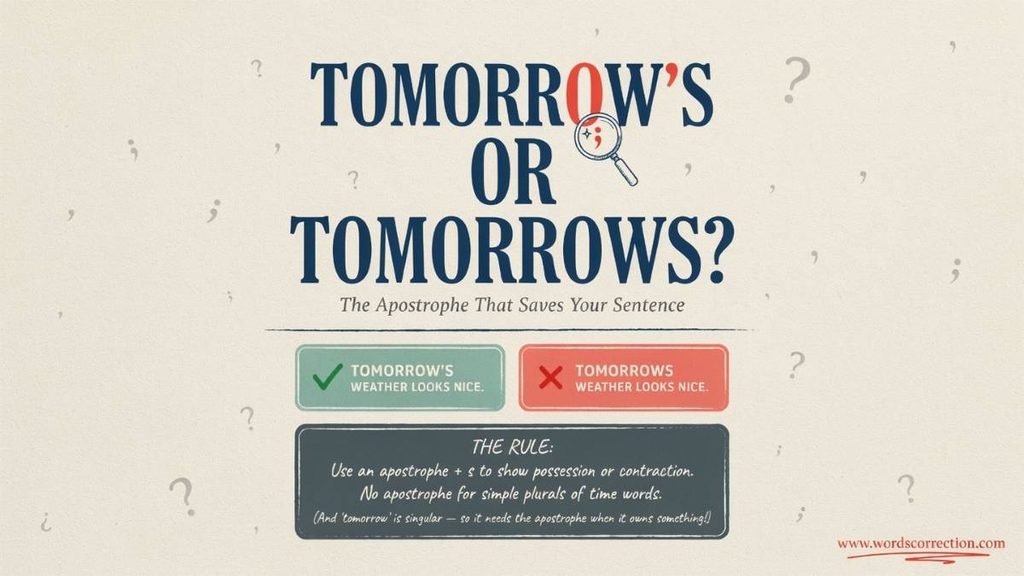
A simple memory rule can make this distinction much easier:
No apostrophe means plural. Apostrophe + s means possession or contraction.
Test 1 Are You Talking About Multiple Future Days?
Use tomorrows.
“There will be many tomorrows.”
Test 2 Is Something Associated With the Following Day?
Use tomorrow’s.
“Tomorrow’s meeting is at 9.”
Test 3 Can You Replace “Tomorrow’s” With “Tomorrow Is”?
Use tomorrow’s as a contraction.
“Tomorrow’s going to be busy.”
becomes:
“Tomorrow is going to be busy.”
Test 4 Can You Replace It With “Tomorrow Has”?
If the sentence still makes sense, tomorrow’s may represent tomorrow has.
This substitution method makes tomorrow’s grammar much easier to apply.
Learn the difference between commonly confused more words in English
Palate or Palette Difference and Usage
Comparison Table Tomorrow vs Tomorrows vs Tomorrow’s
| Word | Meaning | Function | Example |
| tomorrow | The following day | Noun or adverb | “We leave tomorrow.” |
| tomorrows | Multiple future days | Plural noun | “There will be better tomorrows.” |
| tomorrow’s | Associated with tomorrow | Possessive | “Tomorrow’s event is canceled.” |
| tomorrow’s | Tomorrow is/has | Contraction | “Tomorrow’s going to be busy.” |
This table captures the essential tomorrow’s or tomorrows difference in a few lines.
Is Tomorrow’s a Word?
Yes. Tomorrow’s is a valid English form.
Its meaning depends on its grammatical role.
It can be possessive:
“Tomorrow’s deadline is important.”
Or it can be a contraction:
“Tomorrow’s going to be difficult.”
Therefore, the question “Is tomorrow’s a word?” has a straightforward answer: yes. It is a grammatical form of tomorrow rather than a separate vocabulary item.
Is Tomorrows a Word?
Yes.
Tomorrows is the plural noun form of tomorrow.
For example:
“There are many tomorrows ahead.”
It is not normally used when referring to one particular following day.
If you mean one future day, use tomorrow:
“I’ll finish it tomorrow.”
If you mean something associated with that day, use tomorrow’s:
“Tomorrow’s deadline is Friday.”
If you mean multiple future days, use tomorrows:
“We have many tomorrows ahead.”
Is Tomorrow’s a Contraction or a Possessive?
It can be either.
That is one reason this form sometimes causes confusion.
Possessive
“Tomorrow’s schedule is full.”
Here, tomorrow’s identifies a schedule associated with tomorrow.
Contraction
“Tomorrow’s going to be busy.”
Here, tomorrow’s means:
“Tomorrow is going to be busy.”
Context determines which grammatical function applies.
The apostrophe itself does not tell you whether ’s means possession or a contraction. You need to examine the surrounding sentence.
What Is the Correct Spelling of Tomorrow’s?
The correct spelling of tomorrow’s includes the apostrophe before the s:
tomorrow’s
When you mean possession, do not write:
tomorrows
And do not use an apostrophe simply because the word ends in s.
If you are referring to multiple future days, the correct form is:
tomorrows
No apostrophe is needed.
What Are the Most Common Tomorrow’s and Tomorrows Errors?
The most common errors include:
- Using tomorrow’s as an ordinary plural.
- Using tomorrows as a possessive.
- Writing tomorrow’s morning instead of tomorrow morning in ordinary contexts.
- Writing tomorrows meeting instead of tomorrow’s meeting.
- Writing tomorrows event instead of tomorrow’s event.
- Adding an unnecessary apostrophe to tomorrows.
- Confusing tomorrow’s as a possessive with tomorrow’s as a contraction.
A useful proofreading habit is to ask what the apostrophe is doing.
If it indicates possession or a contraction, tomorrow’s may be correct.
If you simply mean multiple future days, use tomorrows.
Practice Session
Fill in the Blanks
Complete the following sentences with tomorrow, tomorrow’s, or tomorrows.
- I will visit my friend ______.
- We hope for brighter ______.
- I have a meeting ______.
- ______ weather will be sunny.
- She will call me ______.
- We are preparing for ______ event.
- I will finish my homework ______.
- We dream of better ______.
- The teacher changed ______ lesson.
- I will see you ______.
- He is preparing for ______ interview.
- We look forward to happier ______.
- The school announced ______ schedule.
- I have an exam ______.
- ______ meeting starts at nine.
- We hope for peaceful ______.
- She will travel ______.
- I need to prepare for ______ class.
- They are planning for better ______.
- I will submit the assignment ______.
- ______ event begins at noon.
- We believe our ______ will be brighter.
- He will return ______.
- I have to attend ______ meeting.
- We are working toward better ______.
Answers
- tomorrow
- tomorrows
- tomorrow
- Tomorrow’s
- tomorrow
- tomorrow’s
- tomorrow
- tomorrows
- tomorrow’s
- tomorrow
- tomorrow’s
- tomorrows
- tomorrow’s
- tomorrow
- Tomorrow’s
- tomorrows
- tomorrow
- tomorrow’s
- tomorrows
- tomorrow
- Tomorrow’s
- tomorrow
- tomorrow
- tomorrow’s
- tomorrows
Here’s a trusted source for clear more words Comparison:
Grammar Update
FAQs about Tomorrow’s or Tomorrows
What is the meaning of “tomorrow’s”?
“Tomorrow’s” is the possessive form of “tomorrow” and refers to something associated with or happening on the day after today. For example, “Tomorrow’s meeting starts at 10 a.m.”
What is the plural of “tomorrow”?
The plural of “tomorrow” is “tomorrows.” It refers to multiple future days, as in “We are working toward better tomorrows.”
Is it correct to say “tomorrow’s event”?
Yes. “Tomorrow’s event” is grammatically correct because the apostrophe shows that the event is associated with the following day.
Should “tomorrow’s” have an apostrophe?
Yes, when “tomorrow’s” is used as a possessive form, it requires an apostrophe. For example, “Tomorrow’s schedule has changed.”
Is it correct to say “tomorrow’s”?
Yes. “Tomorrow’s” can function as a possessive form or as a contraction of “tomorrow is” or “tomorrow has.” The meaning depends on the context.
Is there a word for tomorrow’s tomorrow?
The standard expression is “the day after tomorrow.” It refers to the day that comes two days after today.
Is it “tomorrow’s meeting” or “tomorrow meeting”?
“Tomorrow’s meeting” is the standard grammatical form when referring to a meeting scheduled for the following day.
Is it “tomorrow morning” or “tomorrow’s morning”?
“Tomorrow morning” is the natural and standard expression. For example, “I will call you tomorrow morning.”
Which is correct “tomorrow’s class” or “tomorrow class”?
“Tomorrow’s class” is correct when referring to a class scheduled for the following day.
What does “tomorrow’s tomorrow” mean?
“Tomorrow’s tomorrow” can be understood as the day after tomorrow, although “the day after tomorrow” is the standard and clearer expression.
What is a cool way to say “tomorrow”?
Depending on the tone, you can use “the next day,” “the day ahead,” or “the morrow.” “The morrow” has a more literary or old-fashioned feel.
What is the slang word for “tomorrow”?
There is no single universally accepted slang word for “tomorrow.” In informal digital communication, abbreviations such as “tmr” and “tmrw” are commonly used.
How do you say “tomorrow” in Gen Z slang?
There is no specific Gen Z slang term that universally replaces “tomorrow.” Short forms such as “tmr” and “tmrw” may be used in casual texting.
What is an old-fashioned word for “tomorrow”?
“Morrow” is an old-fashioned or literary term associated with “tomorrow.” For example, “We shall meet on the morrow.”
What is the new word for “tomorrow”?
There is no officially recognized modern replacement for the word “tomorrow.” Informal abbreviations such as “tmr” and “tmrw” are used in digital communication.
How do you say “tomorrow” in fancy Old English?
“Morrow” is a literary or archaic alternative to “tomorrow.” Historical English also used different spellings, depending on the period.
What is short slang for “tomorrow”?
Common informal abbreviations include “tmr,” “tmrw,” and “2moro.” These forms are generally appropriate for casual messages rather than formal writing.
How do you say “tomorrow” in different ways?
Depending on the context, alternatives include “the next day,” “the following day,” “the day ahead,” and “the morrow.”
How do you say “tomorrow” in a short way?
In informal texting, “tmr” and “tmrw” are common shortened forms of “tomorrow.” In formal writing, it is best to use the complete word.
How did they say “tomorrow” in medieval times?
Historical English used forms such as “tomorwe” and “to-morrow.” Spelling varied considerably across different periods and regions.
What can I say instead of “see you tomorrow”?
Depending on the context, you can say “See you then,” “Until tomorrow,” “Talk to you tomorrow,” or “Catch you tomorrow.”
Does TMM mean tomorrow?
“TMM” is not a universally recognized abbreviation for “tomorrow.” In informal texting, “tmr” and “tmrw” are more commonly understood.
Is “tomorrow” spelled correctly?
Yes. “Tomorrow” is the standard spelling for the day after today. It is spelled t-o-m-o-r-r-o-w.
What are some idioms that use the word “tomorrow”?
Common expressions include “tomorrow is another day” and “never put off until tomorrow what you can do today.” These expressions often relate to future plans, opportunities, or taking action.
Which is correct “tomorrows” or “tomorrow’s”?
Both are correct, but they serve different grammatical purposes. “Tomorrows” is the plural form of “tomorrow,” while “tomorrow’s” is the possessive form or a contraction of “tomorrow is” or “tomorrow has.”
Conclusion
Understanding the difference between tomorrows or tomorrow’s becomes much easier once you know what the apostrophe is doing. Tomorrow refers to the day after today, tomorrows is the plural form used for multiple future days, and tomorrow’s can indicate possession or function as a contraction of “tomorrow is” or “tomorrow has.” These forms may look nearly identical, but using the wrong one can change the meaning of your sentence. When in doubt, take a moment to consider what you mean. Are you referring to several future days, or something associated with tomorrow? Once you know the purpose, choosing the correct form is simple—and that’s one less grammar puzzle to solve tomorrow.

Stella AJS is an experienced blogger and dedicated English language writer at Words Correction. She turns confusing grammar, word meanings, spelling, and usage into clear, practical insights that readers can easily understand and apply. With a passion for precise and engaging writing, Stella helps readers avoid common language mistakes, strengthen their vocabulary, and communicate with greater clarity and confidence.




