
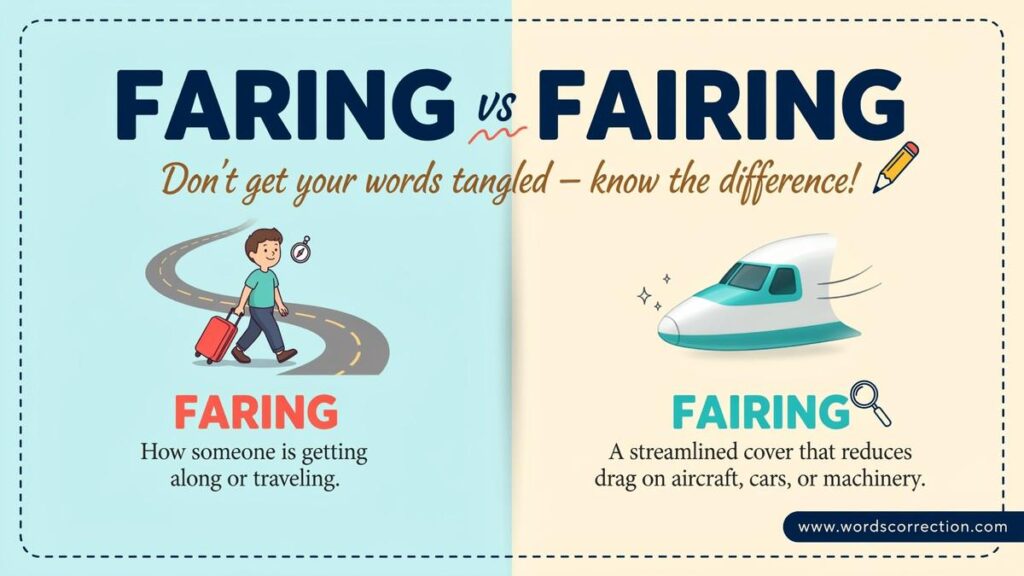
The words faring and fairing may sound the same, but they have very different meanings. This makes faring vs fairing a common source of confusion in everyday writing. Faring describes how someone is doing or how a situation is progressing, while fairing refers to a smooth covering used on vehicles, aircraft and other machines. Using the wrong word can turn a simple question about someone’s well-being into an unexpected discussion about engineering. Understanding their meanings, spelling and correct usage will help you avoid this mistake and choose the right word with confidence.
What Is the Difference Between Faring vs Fairing?
The main difference between faring vs fairing lies in their meanings and grammatical functions. Faring is the present participle of the verb fare, meaning to do, manage, or get along. Fairing is primarily a noun that describes a streamlined covering used to improve airflow around a vehicle or machine.
Here’s a quick comparison
| Feature | Faring | Fairing |
|---|---|---|
| Meaning | Doing, progressing, or managing | A streamlined covering or structure |
| Root word | Fare | Fair |
| Part of speech | Verb form | Primarily a noun |
| Main context | Everyday conversation and personal progress | Engineering and vehicle design |
| Common expression | Faring well | Motorcycle fairing |
| Example | She is faring well at college. | The motorcycle’s fairing protects its front components. |
Consider these two sentences
- Faring: How are you faring after starting your new job?
- Fairing: The motorcycle’s fairing protects its front components.
Both sentences use the correct spelling. However, replacing one word with the other would completely change the meaning.
Faring vs Fairing Are They Homophones?
Yes. Faring vs fairing are homophones, which means they have the same pronunciation but different spellings and meanings.
In standard American English, both words sound like “FAIR-ing.” Their identical pronunciation makes them easy to confuse, especially when you’re writing quickly or relying on spellcheck.
English contains many words that sound alike but serve different purposes. For example
- Pair and pear: A pair means two things, while a pear is a fruit.
- Flour and flower: Flour is used in baking, while a flower grows on a plant.
- Brake and break: A brake slows a vehicle, while break means to damage something or take a rest.
- Fare and fair: Fare can mean a transportation charge, while fair can mean just or reasonable.
The same principle applies to faring vs fairing. Their pronunciation won’t help you identify the correct spelling. You must understand the sentence.
Learn the difference between tricky words and use them correctly
Triple vs Tripple Which Spelling Is Correct?
What Does Faring Mean?
Faring means doing, progressing, managing, or getting along in a particular situation. It describes how someone or something performs, develops, or experiences certain circumstances.
The word comes from fare, a verb with several meanings. In this context, fare refers to someone’s condition, progress, or experience.
For example
- She is faring well in her new position.
- The business is faring better than expected.
- How are the children faring at school?
- The family is faring poorly after the financial setback.
In each sentence, faring describes a condition or how someone is managing a situation.
Faring Definition and Grammatical Role
The faring definition is straightforward: it is the present participle of the verb fare.
A present participle is a verb form that typically ends in -ing. Writers use it in continuous tenses or as a gerund.
Look at the different forms of the verb
| Verb Form | Word | Example |
|---|---|---|
| Base form | Fare | I hope you fare well. |
| Third-person singular | Fares | She fares better under pressure. |
| Past tense | Fared | They fared well last year. |
| Present participle | Faring | He is faring well. |
| Gerund | Faring | Faring well requires patience. |
Notice that the past tense is fared, not faringed or fareded.
The spelling also follows a straightforward English rule. When you add -ing to fare, you remove the final silent e.
- Fare + ing = Faring
- Care + ing = Caring
- Share + ing = Sharing
- Prepare + ing = Preparing
Therefore, fareing is incorrect. The correct spelling is faring when you mean the present participle of fare.
What Does Faring Mean in Everyday English?
In everyday English, faring describes how someone is handling life, work, education, relationships, or difficult circumstances.
It often appears in questions about personal well-being and progress.
For example
- How are you faring at your new school?
- How is your business faring this year?
- Are the patients faring well after treatment?
- How are things faring with your latest project?
The word doesn’t necessarily describe success. It can communicate positive, negative, or neutral progress depending on the surrounding words.
For instance, someone who is faring well is managing successfully. Someone who is faring poorly is experiencing difficulties.
What Does Faring Well Mean?
The expression faring well means doing successfully, managing comfortably, or making satisfactory progress in a particular situation.
People use this expression when discussing someone’s condition, performance, or overall circumstances.
Here are some examples
- Work: Maria is faring well in her new management position.
- Education: The students are faring well in their science classes.
- Business: The restaurant is faring well despite rising operating costs.
- Personal life: After a difficult year, James is finally faring well.
- Health: The patient is faring well during recovery.
The meaning of faring well depends on context. It might describe financial progress, academic performance, personal well-being, or the ability to handle challenging circumstances.
Important distinction: Faring well doesn’t always mean achieving extraordinary success. Sometimes it simply means managing a difficult situation without major problems.
What Does Not Faring Well Mean?
The expression not faring well describes someone or something that is struggling, experiencing difficulties, or making poor progress.
It communicates the opposite of faring well.
For example
- The company is not faring well because of declining sales.
- He isn’t faring well after losing his job.
- The team is not faring well in the tournament.
- Several small businesses are faring poorly during the economic slowdown.
This expression works in both casual and professional communication.
You might use it when discussing a business that is losing customers or a student who is struggling with a particular subject.
However, context matters. Saying someone is not faring well doesn’t automatically mean they’re failing completely. It simply indicates that their current circumstances aren’t favorable.
How Are You Faring? Meaning and Appropriate Answers
“How are you faring?” is a grammatically correct English question that means “How are you doing?”, “How are you managing?”, or “How are things going for you?”
People use it to ask about someone’s general condition or progress, particularly when that person faces a new experience or challenging situation.
For example
- A colleague might ask how you’re faring in a new position.
- A friend might ask how you’re faring after moving to another city.
- A teacher might ask how students are faring during exam season.
- A family member might ask how you’re faring during a difficult period.
The phrase sounds slightly more formal or thoughtful than “How are you doing?” However, it remains natural in modern English.
How should you answer “How are you faring?”
Your response depends on how you’re actually doing. Here are some natural options
| Answer | Meaning |
|---|---|
| I’m doing well, thanks. | Things are going positively. |
| I’m faring pretty well. | You’re managing successfully. |
| I’m getting by. | You’re managing, although things may be difficult. |
| I’ve been better. | You’re experiencing some problems. |
| Things are improving. | Your situation is getting better. |
| I’m managing one day at a time. | You’re handling a challenging period gradually. |
| Better than I expected. | Things are going more smoothly than anticipated. |
You don’t need to use the word faring in your answer. Responding with “I’m doing well” is perfectly natural.
Learn the difference between similar English words the easy way
Vinal vs Vinyl Which Spelling Is Correct?
What Does Fairing Mean?
Fairing is a noun that usually refers to a smooth covering or structure designed to improve the aerodynamic shape of a vehicle or machine. Engineers use fairings to manage airflow, reduce drag, and protect certain mechanical or structural components.
You’ll commonly encounter this word in motorcycle, aircraft, automotive, and aerospace terminology.
For example
- A motorcycle fairing covers parts of the engine and frame.
- An aircraft fairing smooths the transition between different structural components.
- A rocket’s payload fairing protects its cargo during launch.
- A vehicle’s aerodynamic fairing helps reduce air resistance.
Unlike faring, which describes how someone is doing, fairing generally identifies a physical component.
Fairing Definition and Technical Meaning
The fairing definition refers to a streamlined structure or covering that helps reduce aerodynamic drag or provides protection.
To understand its purpose, it helps to know a little about aerodynamics.
Aerodynamics is the study of how air moves around objects. When a vehicle travels through the air, it encounters resistance called aerodynamic drag. This force opposes its forward movement and can affect speed, fuel efficiency, stability, and overall performance.
A fairing helps engineers create smoother external surfaces. Instead of allowing air to encounter abrupt edges, exposed components, or irregular shapes, the structure guides airflow more effectively.
However, fairings don’t eliminate drag completely. Their effectiveness depends on the vehicle’s shape, speed, size, and operating conditions.
Common functions of a fairing include
- Reducing aerodynamic drag.
- Improving airflow around a vehicle.
- Covering exposed mechanical components.
- Protecting sensitive parts from weather and debris.
- Creating a smoother external appearance.
- Supporting better aerodynamic performance.
Not every fairing performs all these functions. Its design depends on the machine and the engineering problem it needs to solve.
What Does Fairing Mean on a Motorcycle?
A motorcycle fairing is a body panel or covering attached to a motorcycle to improve airflow and sometimes protect the rider and mechanical components.
Motorcycle manufacturers use different fairing designs depending on the bike’s purpose, speed, and overall styling.
Motorcycle fairings generally fall into three common categories
Full fairing: A full fairing covers a large portion of the motorcycle’s front and sides. Sport motorcycles often use this design to improve aerodynamic performance at higher speeds.
Half fairing: A half fairing covers the upper front section while leaving more of the engine and lower frame exposed. It offers some wind protection without covering the entire motorcycle.
Quarter fairing: A quarter fairing usually covers a smaller area around the headlight and upper front section. It provides limited wind protection and often serves a styling purpose.
Why Do Motorcycles Have Fairings?
Motorcycle fairings serve several practical purposes.
- Wind protection: Larger fairings help redirect airflow away from the rider’s body.
- Drag reduction: Their streamlined shapes can reduce aerodynamic resistance.
- Component protection: They can shield certain engine and mechanical parts from road debris and weather.
- Appearance: Fairings give sport and touring motorcycles their distinctive body shapes.
- Airflow management: Carefully designed panels guide air around the motorcycle.
The meaning of fairing on a motorcycle is therefore quite different from the meaning of faring in a conversation.
For example
- Correct: The mechanic replaced the motorcycle’s damaged fairing.
- Incorrect: The mechanic replaced the motorcycle’s damaged faring.
The second sentence uses the wrong spelling because it refers to a physical motorcycle component.
What Is an Aircraft Fairing?
An aircraft fairing is a streamlined covering that smooths the shape around structural joints, connections, or other components.
Aircraft contain many areas where different parts meet. These transitions can create unnecessary aerodynamic resistance if engineers leave them exposed or poorly shaped.
Fairings help create smoother external surfaces.
Common examples include
- Wing-to-body fairings: Smooth the transition between an aircraft’s wings and fuselage.
- Landing gear fairings: Cover certain landing gear components to improve airflow.
- Engine-related fairings: Help streamline structural connections around engine installations.
- Structural joint fairings: Cover connections between different aircraft components.
An aircraft fairing isn’t necessarily a major structural component. Many fairings primarily improve aerodynamic performance or protect equipment rather than carry the aircraft’s main structural loads.
What Is a Rocket Payload Fairing?
Rocket fairings have a specialized purpose.
A payload fairing is the protective outer covering around a rocket’s payload during the early stages of flight. It shields satellites and other cargo from aerodynamic forces, atmospheric pressure, heat, and environmental exposure during launch.
Once the rocket reaches an altitude where atmospheric resistance becomes sufficiently low, the fairing separates. This allows the payload to continue its journey without carrying unnecessary weight.
For example, rockets used to launch satellites commonly have payload fairings that protect the spacecraft during ascent.
This is another technical use of fairing. It has nothing to do with someone’s personal condition or progress.
Can Fairing Be Used as a Verb?
Yes. Although fairing most commonly appears as a technical noun, it can also function as a verb form.
The verb is fair, which can mean to make a surface smooth or streamline a structure, particularly in engineering and construction.
For example
- The engineers are fairing the aircraft’s outer surface.
- The technician spent several hours fairing the composite panels.
- Workers are fairing the surface before applying the final finish.
In these examples, fairing describes the process of smoothing or shaping a surface.
This use is less common in everyday conversation. You’ll mainly encounter it in technical discussions involving aircraft construction, boatbuilding, composite materials, and engineering.
It also demonstrates why context matters. Although both words can function as verb forms, they don’t express the same action.
Learn the difference between commonly confused more words in English
Rug vs Rag What Is the Difference?
Faring vs Fairing Key Differences Explained
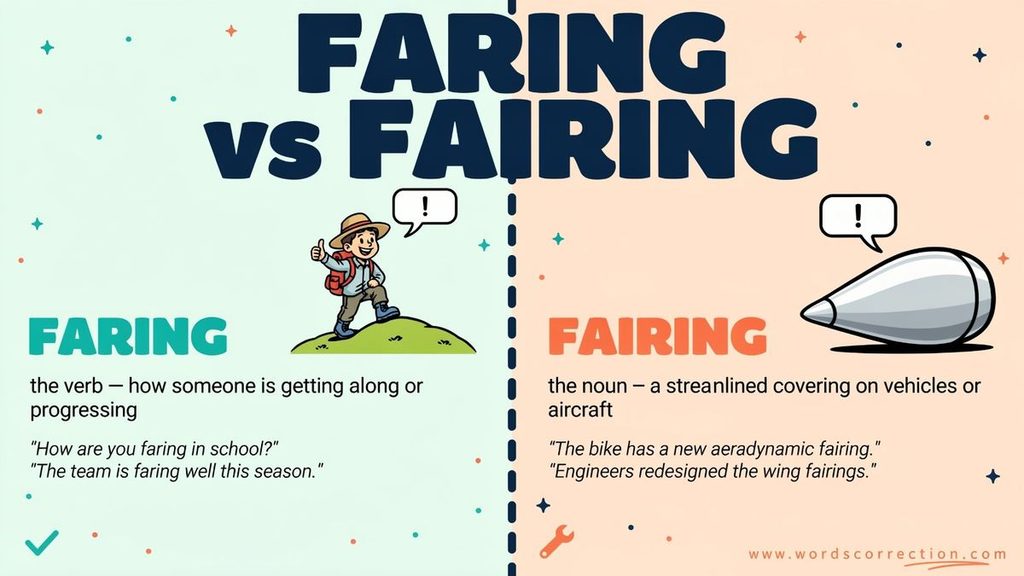
Now that the individual meanings are clear, let’s examine the difference between faring vs fairing more closely.
The distinction involves more than one letter. These words have different roots, grammatical roles, and applications.
Difference in Meaning
The most important difference is what each word communicates.
- Faring: Describes how someone or something is doing, progressing, or managing.
- Fairing: Describes a streamlined covering or the technical process of smoothing a surface.
Compare these examples
| Faring | Fairing |
|---|---|
| The business is faring well. | The motorcycle has a damaged fairing. |
| How are the students faring? | The aircraft needs a new fairing. |
| She is faring better now. | The rocket’s fairing protects its payload. |
| The team is faring poorly. | Engineers are fairing the surface. |
The first column discusses progress or performance. The second focuses on engineering or physical structures.
Difference in Part of Speech
Although both words end in -ing, their grammatical roles differ.
Faring is the present participle of fare. It commonly appears in continuous verb constructions.
For example
- She is faring well.
- They are faring better this season.
- The company has been faring poorly.
It can also function as a gerund:
- Faring well during difficult times requires patience.
Fairing is primarily a noun
- The motorcycle’s fairing is cracked.
- The aircraft’s fairing improves its external shape.
It can also function as a present participle or gerund of the technical verb fair
- Fairing the surface takes time.
- The technician is fairing the panel.
Difference in Context
Context makes choosing the correct spelling much easier.
Use faring when discussing
- Personal well-being.
- Academic performance.
- Business progress.
- Professional development.
- Financial circumstances.
- Difficult experiences.
- Success or failure.
Use fairing when discussing
- Motorcycle bodywork.
- Aircraft components.
- Rocket payload protection.
- Aerodynamic design.
- Vehicle engineering.
- Smoothing or shaping surfaces.
A useful rule: If you’re talking about how someone is doing, choose faring. If you’re talking about a streamlined covering, choose fairing.
Difference in Word Origins
The two words have different linguistic backgrounds.
Faring comes from the verb fare, an Old English word associated with traveling, proceeding, or getting along. Over time, its meaning expanded to include how someone performs or manages a situation.
Fairing comes from the technical use of fair, meaning to make something smooth, even, or properly shaped. In engineering, this developed into the term for a streamlined covering or structure.
The connection between fairing and fair isn’t the same as the everyday meaning of fair in phrases such as “a fair decision.”
Understanding these origins makes the spelling distinction easier to remember.
Learn the difference between confusing more English words step by step
Tetroxide vs Tetraoxide Which Spelling Is Correct?
How Are You Faring vs Fairing?
One of the most common questions surrounding these words is whether to write “How are you faring?” or “How are you fairing?”
The correct expression is
How are you faring?
This question asks about someone’s well-being, progress, or ability to manage a situation.
For example
- How are you faring in your new position?
- How are you faring after the recent changes?
- How are you faring with your studies?
- How are you faring through these difficult times?
Writing “How are you fairing?” is incorrect when asking about someone’s condition because fairing primarily refers to a technical covering.
What Does How Are You Faring Mean?
The expression asks how someone is managing or progressing.
Its meaning is similar to
- How are you doing?
- How are things going?
- How are you managing?
- How is everything working out?
- Are things going well for you?
However, “How are you faring?” often carries a slightly more thoughtful tone. People frequently use it when they know someone is dealing with a particular challenge or transition.
For example, imagine a friend recently started working at a demanding company. Asking “How are you faring?” shows interest in how they’re handling the experience.
How Should You Answer How Are You Faring?
You can answer naturally without repeating the word faring.
Here are several examples
Positive answers
- I’m doing great, thanks for asking.
- Things are going really well.
- I’m making good progress.
- Better than I expected!
Neutral answers
- I’m managing.
- Things are going all right.
- I’m taking things one day at a time.
- Can’t complain too much.
Negative answers
- I’ve been struggling lately.
- Things haven’t been easy.
- I’m not doing particularly well.
- I’m going through a difficult period.
The best response depends on the situation and your relationship with the person asking.
Learn the difference between tricky English words with easy explanations
Accross vs Across Which Is Correct Spelling?
Common Expressions Using Faring
The word faring appears in several common expressions. Learning these phrases will help you understand its meaning and use it correctly.
Faring Well
Faring well means doing successfully or managing a situation effectively.
Examples
- The new employee is faring well in her position.
- Our local team is faring well this season.
- The company is faring well despite increased competition.
- He’s faring well after recovering from his illness.
Meaning: Making progress, experiencing positive results, or handling circumstances successfully.
Not Faring Well
Not faring well means experiencing difficulties or failing to make satisfactory progress.
Examples:
- The business is not faring well in the current market.
- She isn’t faring well after the unexpected changes.
- The team is not faring well against stronger opponents.
- Several crops are faring poorly because of unfavorable weather.
Meaning: Struggling, performing poorly, or facing unfavorable circumstances.
Faring Better Than Me
The expression faring better than me means someone is managing a situation more successfully or experiencing better circumstances than the speaker.
For example
- You’re faring better than me in mathematics.
- My brother is faring better than me at his new job.
- Everyone seems to be faring better than me during this busy season.
The phrase can be serious or humorous depending on the conversation.
For example
“You’re faring better than me with this assignment. I haven’t even finished the first question!”
Here, the speaker casually compares their progress with someone else’s.
Faring Through the Storm
The expression faring through the storm describes managing or surviving a difficult period.
The word storm can refer to an actual storm or a figurative challenge such as financial trouble, personal loss, workplace pressure, or unexpected change.
Examples
- The family is faring through the storm with patience and determination.
- Small businesses are trying to fare well through the economic storm.
- Despite several setbacks, the organization is faring better than expected.
A useful grammatical distinction: “Faring through the storm” can appear as a participial phrase, but “faring well through the storm” sounds more natural when describing how someone is managing the difficulty.
Also, fare itself can take an adverbial phrase in different constructions. For instance, “They fared well through the crisis” is a natural way to describe the outcome.
Learn the difference between more words people mix up
Present vs Presant which one is Correct?
Faring vs Fairing Examples Correct Usage in Everyday English
Examples are one of the easiest ways to understand commonly confused words. Instead of memorizing definitions alone, look at how each word works in a complete sentence.
The following examples demonstrate their correct spelling and meaning in different situations.
Correct Examples of Faring
| Sentence | Explanation |
|---|---|
| How are you faring these days? | Asks about someone’s general well-being. |
| The students are faring well in their exams. | Describes academic performance. |
| Our business is faring better this year. | Describes business progress. |
| She is faring poorly after the unexpected setback. | Describes an unfavorable situation. |
| The team has been faring well throughout the season. | Describes consistent performance. |
| How is your brother faring at university? | Asks about someone’s experience. |
| The family fared well during the difficult period. | Uses the past tense of fare. |
| Small companies are faring differently in the current market. | Describes varying business outcomes. |
Correct Examples of Fairing
| Sentence | Explanation |
|---|---|
| The motorcycle’s fairing was damaged in the accident. | Refers to a motorcycle body component. |
| The aircraft uses a lightweight fairing. | Refers to an aerodynamic covering. |
| Engineers designed a new fairing for the vehicle. | Describes an engineering component. |
| The rocket’s payload fairing protects its cargo. | Refers to protective rocket equipment. |
| The mechanic replaced the cracked front fairing. | Describes motorcycle maintenance. |
| The aircraft fairing helps streamline its exterior. | Explains an aerodynamic function. |
| The technician is fairing the composite panel. | Uses fairing as a technical verb form. |
Incorrect vs Correct Faring vs Fairing Usage
A small spelling mistake can change the meaning of a sentence. Here’s how to identify and correct common errors.
| Incorrect Sentence | Correct Sentence | Reason |
|---|---|---|
| How are you fairing? | How are you faring? | The question concerns personal well-being. |
| She is fairing well at school. | She is faring well at school. | It describes academic progress. |
| The motorcycle needs a new faring. | The motorcycle needs a new fairing. | It refers to a physical component. |
| The aircraft’s faring is damaged. | The aircraft’s fairing is damaged. | It describes an aerodynamic covering. |
| The company is fairing poorly. | The company is faring poorly. | It describes business performance. |
| The mechanic replaced the front faring. | The mechanic replaced the front fairing. | It refers to motorcycle bodywork. |
Remember that neither word is inherently incorrect. The mistake happens when you use the correct word in the wrong context.
Learn the difference between everyday English mistakes
Skiid vs Skied Which Spelling Is Correct?
Faring vs Fairing vs Fare vs Fair
The confusion doesn’t stop with faring vs fairing. Their root words, fare and fair, also have different meanings.
Understanding all four words gives you a clearer picture of their spelling and grammatical relationships.
| Word | Part of Speech | Meaning | Example |
|---|---|---|---|
| Fare | Verb or noun | To do or get along; also a transportation charge | How did you fare in the interview? |
| Fared | Verb | Past tense of fare | She fared well in the competition. |
| Faring | Verb form or gerund | Present participle of fare | He is faring well. |
| Fair | Adjective or noun | Just, reasonable, or an exhibition | That seems like a fair decision. |
| Fairing | Noun or verb form | Streamlined covering or smoothing process | The motorcycle’s fairing is damaged. |
Fare The Root Verb of Faring
The word fare has several meanings in English.
As a verb, it means to get along, perform, or experience a particular outcome.
Examples
- I hope you fare well in your new position.
- The team fared better than expected.
- How did your business fare last year?
As a noun, fare can refer to the price paid for transportation.
Examples
- The bus fare increased this month.
- Passengers must pay their fares before boarding.
- The train fare is cheaper than the flight.
These meanings are different, but the spelling remains the same.
The connection between fare and faring is important because it explains the correct word formation
- Fare = Base verb
- Fared = Past tense
- Faring = Present participle
Fair The Word Behind Fairing
The word fair has several common meanings.
As an adjective, it describes something just, reasonable, or impartial.
Examples
- The teacher made a fair decision.
- Everyone deserves a fair opportunity.
- That doesn’t seem like a fair price.
As a noun, fair can describe a public event where people gather to enjoy entertainment, exhibitions, rides, or commercial displays.
Examples
- We visited the county fair last weekend.
- The annual book fair attracted hundreds of visitors.
- The agricultural fair displayed local products.
In technical language, the related verb fair means to smooth or shape a surface. Its -ing form is fairing.
This technical connection explains why fairing appears in engineering and vehicle design.
Important: A motorcycle fairing doesn’t mean something that belongs to a public fair. The technical term refers to the shape and function of the component.
Faring vs Fare What’s the Difference?
Fare is the base verb, while faring is its present participle.
Compare
- I hope you fare well in your new job.
- I hope you are faring well in your new job.
Both sentences are correct. The first uses the base verb after hope. The second uses the present continuous form.
Here’s another example
- How did the students fare in their exams?
- How are the students faring in their exams?
The first asks about a completed experience. The second asks about their current progress.
Fairing vs Fair What’s the Difference?
Fair is an ordinary adjective or noun in most everyday situations. Fairing is primarily a technical noun referring to an aerodynamic covering.
Compare
- The mechanic charged a fair price.
- The mechanic replaced the motorcycle’s fairing.
The first sentence discusses a reasonable price. The second describes a vehicle component.
Learn the difference between commonly misused words
Moment vs Momment Which Spelling Is Correct?
Why Do People Confuse Faring vs Fairing?
Even experienced writers sometimes confuse these spellings. The reason isn’t necessarily poor grammar. Both words sound alike, and their written forms differ by only one letter.
Here are the main reasons behind this common mistake.
They Sound Exactly the Same
The biggest reason is pronunciation.
In standard American English, faring vs fairing are homophones. Both have the same spoken form.
When you hear someone say either word, you can’t identify the intended spelling from pronunciation alone.
For example, if someone says, “How are you faring?” you need the sentence’s meaning to determine the spelling.
Their Spellings Look Almost Identical
Both words contain nearly the same letters in the same order.
- Faring
- Fairing
The additional i in fairing makes the difference.
Because the words look similar, writers sometimes type one spelling automatically without considering the intended meaning.
Writers Think of Fair Instead of Fare
Some people associate faring with fair because the words sound alike.
However, faring comes from fare, not fair.
This is why remembering the root word is useful. When discussing how someone is doing, think of fare.
Spellcheck May Not Catch the Error
Spellcheck programs usually identify misspelled words. However, they don’t always recognize incorrect word choices.
Both faring and fairing are legitimate English words. Therefore, a basic spelling checker may accept either spelling even when the sentence requires the other.
For example
“How are you fairing?”
A spelling checker may not flag this sentence because fairing exists as a valid word.
However, the sentence uses the wrong word for its intended meaning.
Practical tip: Always review the meaning of a sentence rather than relying entirely on automatic spelling suggestions.
Learn the difference between basic English word mistakes
Distress vs Duress what’s the Difference?
How to Remember the Difference Between Faring and Fairing
You don’t need to memorize complicated grammar rules to distinguish these words. A simple connection between spelling and meaning can help you remember them.
Remember That Faring Comes From Fare
Whenever you’re discussing how someone is doing, think of the verb fare.
For example
- How are you faring?
- She is faring well.
- The company is faring poorly.
The connection is straightforward:
Fare → Faring → Progress or performance
Remember That Fairing Contains AIR
The word fairing contains the letters AIR.
Think of airflow, aerodynamics, and vehicles moving through the air.
For example
- Motorcycle fairing
- Aircraft fairing
- Rocket payload fairing
This association connects the spelling with its technical meaning.
An easy memory trick
| Faring | Fairing |
|---|---|
| How are you doing? | What covers the motorcycle? |
| Personal progress | Aerodynamic design |
| Comes from fare | Associated with smoothing and airflow |
| Faring well | Motorcycle fairing |
Remember Fare is about how things go. Fairing is about smoothing airflow.
Use Context to Choose the Correct Spelling
Before writing either word, ask yourself one question
Am I describing someone’s progress or referring to a physical structure?
- If you’re discussing progress, use faring.
- If you’re discussing an aerodynamic covering, use fairing.
- If you’re describing a technical smoothing process, fairing can also be correct as a verb form.
This simple check will prevent most spelling mistakes.
Learn the difference between often confused words
Waring vs Wearing Which Word Is Correct?
American vs British English Faring vs Fairing
Some English words have different spellings in American and British English. For example, Americans generally write color, while British writers use colour.
However, faring and fairing retain the same spellings and meanings in both varieties of English.
| Word | American English | British English |
|---|---|---|
| Faring | Faring | Faring |
| Fairing | Fairing | Fairing |
| Fare | Fare | Fare |
| Fair | Fair | Fair |
The difference isn’t regional. It comes from the words’ meanings and grammatical functions.
For example
- American English: How are you faring at university?
- British English: How are you faring at university?
Both sentences use the same spelling and meaning.
The same applies to technical expressions such as motorcycle fairing and aircraft fairing.
Faring vs Fairing in Real-Life Situations
Understanding definitions is useful, but seeing how people use these words in everyday situations makes the distinction even clearer.
Consider the following practical examples.
Workplace Situation
Imagine two colleagues discussing their new jobs.
Colleague A: “How are you faring in your new position?”
Colleague B: “Pretty well! I’m getting used to the responsibilities.”
Here, faring is correct because the conversation concerns professional progress and personal experience.
Writing “How are you fairing?” would be incorrect.
Motorcycle Repair Situation
Now imagine a motorcycle owner visiting a repair shop.
Owner: “The front of my motorcycle looks damaged. Can you check it?”
Mechanic: “Yes. The front fairing is cracked, so we’ll need to replace it.”
In this situation, fairing is correct because the mechanic refers to a physical motorcycle component.
Business Performance Situation
A business owner might say
“Our sales dropped last quarter, but we’re faring better this month.”
The word faring describes the company’s financial performance.
Engineering Situation
An aircraft engineer might explain
“We redesigned the aircraft fairing to improve airflow around the structural connection.”
Here, fairing refers to an aerodynamic component used in vehicle design.
A Practical Comparison: One Letter, Two Different Meanings
Consider these two statements
“The motorcycle is faring well.”
“The motorcycle’s fairing is working well.”
Both sentences are grammatically correct, but they communicate different ideas.
The first describes the motorcycle’s condition or performance. The second describes the condition or function of its aerodynamic covering.
This small distinction shows why spelling matters. One letter can change the entire meaning of a sentence.
Practice Session Faring vs Fairing
Instructions: Choose the correct word, “faring” or “fairing,” to complete each sentence.
- How are you ______ in your new job?
- The motorcycle has a stylish aerodynamic ______.
- She is ______ well in her college studies.
- How is your brother ______ after the surgery?
- The aircraft’s ______ helps reduce air resistance.
- The students are ______ better this semester.
- How is everyone ______ during the difficult situation?
- The mechanic repaired the motorcycle’s front ______.
- He is not ______ well in his new business.
- How are you ______ after moving to another city?
- The racing bike has a lightweight ______.
- Our team is ______ well in the competition.
- The engineer designed a new aircraft ______.
- How is she ______ in her recovery?
- The company is ______ better than expected.
- The motorcycle’s side ______ was damaged in the accident.
- Are you ______ well in your new environment?
- The aircraft uses a special ______ to improve aerodynamics.
- How are the employees ______ under the new management?
- He is ______ well despite facing several challenges.
- The manufacturer developed a stronger motorcycle ______.
- The students are ______ successfully in their examinations.
- How is your family ______ after the storm?
- The aircraft’s nose ______ improves its aerodynamic performance.
- Everyone is ______ well under the circumstances.
Answers
- Faring
- Fairing
- Faring
- Faring
- Fairing
- Faring
- Faring
- Fairing
- Faring
- Faring
- Fairing
- Faring
- Fairing
- Faring
- Faring
- Fairing
- Faring
- Fairing
- Faring
- Faring
- Fairing
- Faring
- Faring
- Fairing
- Faring
Here’s a trusted source for clear word meanings:
Cambridge Dictionary
FAQs
Is it faring vs fairing well?
The correct expression is “faring well.” It describes someone who is doing well, making progress, or successfully managing a particular situation.
Is How are you faring? grammatically correct?
Yes, “How are you faring?” is grammatically correct. It is a polite way to ask about someone’s well-being, progress, or current circumstances.
Is it God-faring or God-fairing?
Neither spelling is correct. The appropriate expression is “God-fearing,” which describes someone who has deep respect or reverence for God.
How do you spell refaring or faring?
The correct spelling is “faring” when referring to someone’s progress or condition. “Refaring” is not a standard English word with this meaning.
What is the difference between fairing and faring?
Faring is the present participle of “fare” and describes how someone is doing or progressing. Fairing is primarily a noun referring to an aerodynamic covering used on vehicles and aircraft.
What does I am faring well mean?
“I am faring well” means that things are going positively and that you are managing your current circumstances successfully.
What does faring mean?
Faring is the present participle of the verb “fare.” It means getting along, making progress, or experiencing a particular outcome in a situation.
What is another word for faring?
Depending on the context, synonyms for faring include progressing, managing, coping, performing, doing, and getting along.
What does How are we faring mean?
“How are we faring?” is a question about how a group is progressing or managing a particular situation, project, or challenge.
How do you use faring in a sentence?
Use “faring” when describing someone’s progress or condition. For example: “The students are faring well in their final examinations.”
What does How’s she faring mean?
“How’s she faring?” means “How is she doing?” It asks about a woman’s well-being, progress, or ability to manage her current circumstances.
What does the phrase not faring well mean?
“Not faring well” means experiencing difficulties, struggling with a situation, or making less progress than expected.
Is How are you faring appropriate in professional communication?
Yes, this expression is appropriate in professional communication. It can be used to ask about someone’s workload, progress, adjustment to a new role, or general well-being.
Is it correct to say faring well?
Yes, “faring well” is a grammatically correct expression. It describes someone who is making satisfactory progress or managing circumstances successfully.
What does How is everyone faring mean?
This question asks about the overall well-being, condition, or progress of a group of people. It is commonly used when checking on several individuals.
Is it faring okay or fairing okay?
“Faring okay” is the correct expression when asking whether someone is managing a situation satisfactorily. “Fairing” is incorrect in this context.
What does How are you faring now mean?
“How are you faring now?” asks about someone’s current condition or progress, particularly after experiencing a difficult situation or significant change.
How do you ask how someone is faring?
You can ask, “How are you faring?” or “How is everything going?” Both expressions inquire about someone’s current situation, although the first sounds slightly more formal.
What does faring mean in English?
In English, faring refers to getting along, progressing, or managing a particular situation. It is derived from the verb “fare.”
Is How’s your day faring grammatically correct?
Although understandable, “How’s your day faring?” sounds unnatural in everyday English. More natural alternatives include “How is your day going?” and “How has your day been?”
What is meant by How are you faring?
“How are you faring?” is an expression used to ask how someone is managing life, work, personal challenges, or recent experiences.
What does faring well mean in everyday conversation?
In everyday conversation, “faring well” means doing satisfactorily, handling circumstances successfully, or experiencing positive progress.
What does How’s he faring mean?
“How’s he faring?” means “How is he doing?” It asks about a man’s current condition, progress, or ability to manage his circumstances.
How do you spell faring correctly in English?
The correct spelling is F-A-R-I-N-G. It contains one R and is formed by adding -ing to the verb “fare.”
Is fairing a verb?
“Fairing” is primarily a noun referring to an aerodynamic covering on vehicles or aircraft. However, it can also function as the present participle of the verb “fair,” which means making something fair or equitable.
Learn the difference between confusing word pairs
Wise vs Wize Which Spelling Is Correct?
Conclusion
Understanding the difference between faring vs fairing becomes easy once you know how to use each word. “Faring” describes how someone is doing or how a situation is progressing, while “fairing” refers to a streamlined covering used on vehicles, aircraft, and other machines. Although the two words sound alike, their meanings are quite different, so using one in place of the other can create confusion. Remember this simple rule: use “faring” when talking about progress or well-being and “fairing” when discussing vehicle design or aerodynamics. With this distinction in mind, you can avoid common spelling mistakes and keep your writing clear, accurate, and professional.

Stella AJS is an experienced blogger and dedicated English language writer at Words Correction. She turns confusing grammar, word meanings, spelling, and usage into clear, practical insights that readers can easily understand and apply. With a passion for precise and engaging writing, Stella helps readers avoid common language mistakes, strengthen their vocabulary, and communicate with greater clarity and confidence.




