
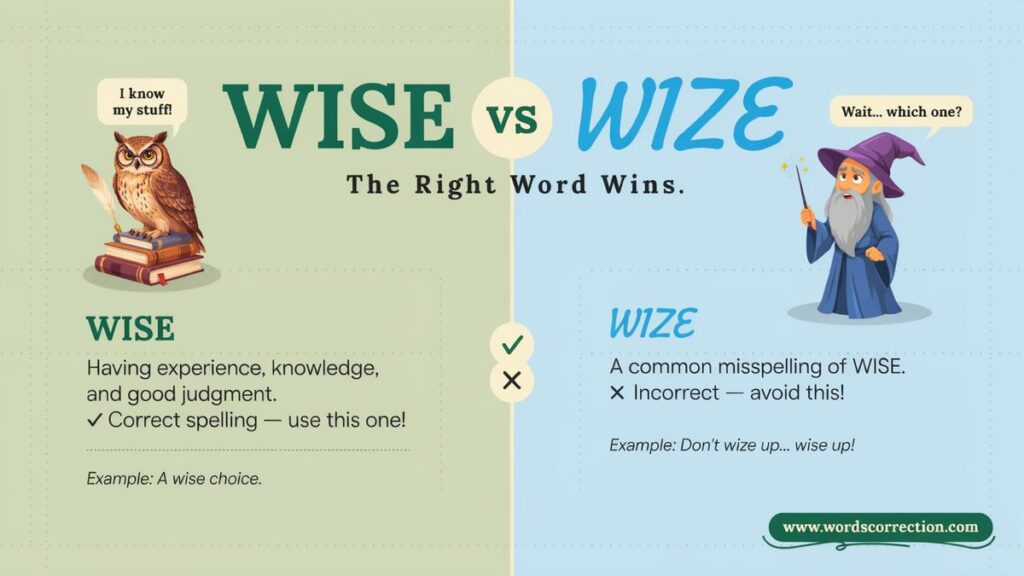
English spelling can be confusing, especially when a word sounds different from the way it looks. The difference between wise vs wize is a good example. Since the final sound in wise resembles the letter Z, many people mistakenly spell it as wize. However, only one spelling is correct in standard English. In this guide, you’ll learn the correct spelling, understand the meaning of each term, explore why this mistake happens, and review simple examples to help you use the word wise correctly in everyday writing.
Wise vs Wize Which Is Correct?
Wise is the correct spelling. It is a standard English adjective that describes someone who has good judgment, practical knowledge, experience, and the ability to make sensible decisions.
On the other hand, wize isn’t an accepted alternative spelling of the adjective wise in standard modern English. Although people sometimes use it informally or creatively, you shouldn’t substitute it for wise in ordinary writing.
Consider these examples
- Correct: My grandfather is a wise man.
- Incorrect: My grandfather is a wize man.
- Correct: Choosing quality over quantity was a wise decision.
- Incorrect: Choosing quality over quantity was a wize decision.
The pronunciation explains why people sometimes make this mistake. Both spellings are generally intended to represent the same sound: /waɪz/. However, English spelling doesn’t always follow pronunciation letter by letter.
The standard spelling remains wise, regardless of how its final letter sounds.
Wise vs Wize at a Glance
| Feature | Wise | Wize |
|---|---|---|
| Standard spelling | Correct | Nonstandard |
| Part of speech | Adjective | Not a standard adjective spelling |
| Meaning | Having good judgment and experience | No established standard meaning as a replacement for wise |
| Pronunciation | /waɪz/ | Usually intended to imitate /waɪz/ |
| Dictionary status | Established English word | Not an accepted standard variant of wise |
| Formal writing | Appropriate | Avoid |
| Academic writing | Appropriate | Incorrect when intended to mean wise |
| Everyday usage | Widely accepted | Generally a misspelling |
| Brand names | Can be used | Can appear as a stylized name |
Remember: If you want to describe someone as sensible, experienced, or thoughtful, always write wise.
Learn the difference between tricky words and use them correctly
Comming vs Coming Which Spelling Is Correct?
What Does Wise Mean?
The word wise describes someone who demonstrates good judgment, understanding, and the ability to make sensible decisions. It usually refers to knowledge gained through learning, observation, and experience.
In standard English, wise is an adjective associated with sound judgment and practical understanding.
For example
- She is a wise teacher who understands her students.
- My father gave me wise advice about managing money.
- It was wise to save some money for emergencies.
- A wise person thinks before making an important decision.
In everyday English, the word describes much more than intelligence. Someone might know a great deal about mathematics or science but still make poor personal decisions. Wisdom involves applying knowledge in practical situations.
Wise as an Adjective
The most common grammatical role of wise is an adjective.
An adjective describes a noun or pronoun. In this case, wise tells you something about a person’s judgment, behavior, or decisions.
For example
- A wise woman understands the importance of patience.
- He made a wise investment.
- Their teacher shared some wise words.
- We need a wise approach to solve this problem.
Notice how the word describes different nouns in these sentences. It can refer to a person, investment, words, or approach.
Wise doesn’t simply mean smart. Intelligence involves the ability to understand information and solve problems. Wisdom involves knowing how to apply that understanding effectively.
Wise to Describe a Person
When you call someone a wise person, you’re suggesting that the individual has sound judgment and understands how to handle different situations.
A wise individual doesn’t necessarily know everything. Instead, they recognize their limitations, consider different perspectives, and learn from previous experiences.
For example
- My grandmother is a wise woman who always gives thoughtful advice.
- A wise leader listens to different opinions before making decisions.
- She became wiser after learning from her mistakes.
A person can develop wisdom over time through education, experience, reflection, and careful observation.
Wise to Describe a Decision or Choice
You can also use wise to describe an action, decision, or choice that demonstrates good judgment.
A wise decision usually considers possible outcomes rather than focusing only on immediate benefits.
For example
- Buying a reliable car instead of an expensive luxury vehicle was a wise choice.
- It would be wise to read the contract before signing it.
- Saving money every month is a wise financial decision.
- Taking a break before responding to an argument was a wise move.
In these examples, wise describes the quality of the decision rather than the person making it.
Wise to Describe Experience and Understanding
Wisdom often develops through experience. People who reflect on their mistakes and learn from difficult situations may develop better judgment.
For instance, someone who has managed a business for 20 years may understand financial risks better than a beginner. Their experience can help them make more practical decisions.
However, experience alone doesn’t automatically make someone wise. A person must also learn from what happens and apply that knowledge thoughtfully.
Examples:
- He became a wise businessman through years of experience.
- Her wise judgment helped the company avoid unnecessary expenses.
- A wise individual knows when to ask for help.
Learn the difference between similar English words the easy way
Triple vs Tripple Which Spelling Is Correct?
What Does Wize Mean?
The word wize is generally a nonstandard spelling used when someone intends to write wise. It doesn’t have an established meaning as a standard English adjective equivalent to wise.
You may still encounter this spelling in different places, including
- Business and product names.
- Social media usernames.
- Online gaming profiles.
- Creative writing.
- Informal messages.
- Stylized advertising and marketing.
For example, a company might choose Wize as part of its brand identity because it looks distinctive. That doesn’t mean the spelling has become an accepted English alternative.
Wize Definition in English
If someone asks for the Wize definition in English, the important distinction is that wize isn’t a conventional alternative spelling of the adjective wise.
When people write wize in ordinary sentences, they usually intend to communicate the meaning of wise.
For example
- Nonstandard: He is a wize person.
- Standard: He is a wise person.
Therefore, the intended meaning may be understandable even though the spelling isn’t correct in standard English.
Is Wize a Real Word?
The answer depends on what you mean by a real word.
People can create words, adopt unusual spellings, and use invented terms in specific communities. A company can also register or adopt Wize as a name.
However, Wize isn’t a recognized standard alternative spelling of wise in contemporary general English.
This distinction matters because a word’s appearance in a username, website, or business name doesn’t automatically establish it as standard vocabulary.
For everyday communication, use wise.
Wize as an Informal Spelling
Some people use wize intentionally because they want a different visual style. Others write it because they assume the /z/ sound requires the letter z.
In casual online communication, readers might understand what the writer means. Nevertheless, informal familiarity doesn’t make a spelling grammatically standard.
Compare
- Standard: Be wise when spending your money.
- Nonstandard: Be wize when spending your money.
The first sentence follows standard English spelling conventions. The second uses a nonstandard substitution.
Learn the difference between commonly confused more words in English
Vinal vs Vinyl Which Spelling Is Correct?
Why Is Wize Considered a Misspelling?
The main reason is straightforward: English has an established spelling for the adjective wise, and that spelling uses s, not z.
Although the final consonant sounds like /z/, English spelling doesn’t require the letter z every time that sound appears.
Several factors explain this confusion.
The Pronunciation Creates Confusion
The pronunciation of wise is /waɪz/.
It contains one syllable and rhymes with words such as
- Rise
- Size
- Prize
- Eyes
- Lies
Because the final sound resembles the sound of the letter z, some writers assume that wize must be the correct spelling.
However, pronunciation and spelling follow different conventions.
For example
| Word | Final Letter | Final Sound |
|---|---|---|
| Wise | S | /z/ |
| Rise | S | /z/ |
| Nose | S | /z/ |
| Please | S | /z/ |
| Size | Z | /z/ |
| Prize | Z | /z/ |
These examples show that English can represent the same sound with different letters.
Why Is Wise Spelled With an S?
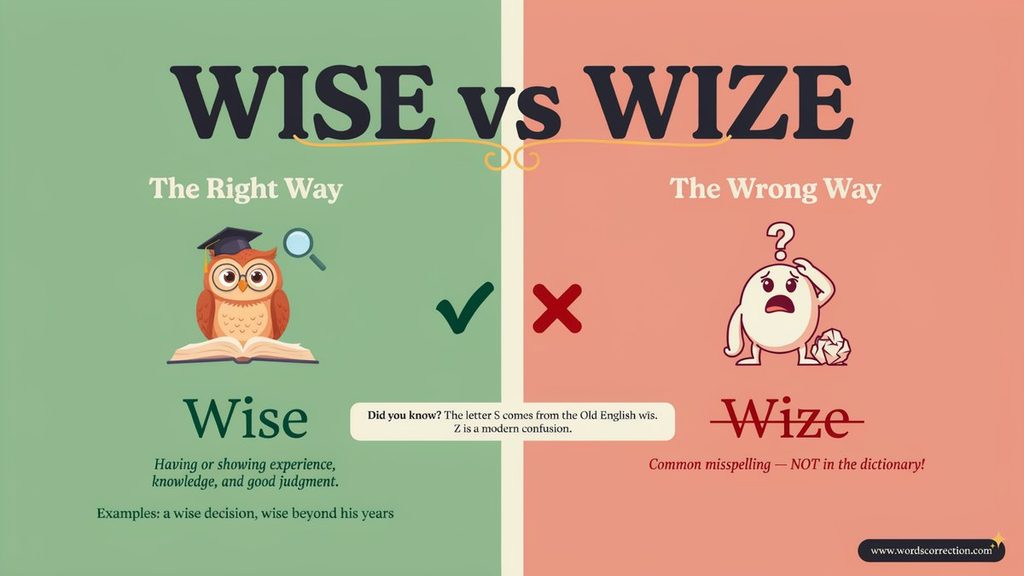
The spelling wise comes from the Old English word wīs, which meant knowledgeable, learned, or experienced.
Its spelling developed through the history of the English language and remained established with the letter s.
Modern pronunciation doesn’t determine whether a word should use s or z. Historical spelling patterns often remain even when pronunciation changes.
That’s why the spelling wise remains correct even though its final consonant sounds like /z/.
English Spelling Isn’t Always Phonetic
English spelling developed over centuries through influences from Germanic languages, French, Latin, Greek, and other sources.
As a result, the relationship between letters and sounds isn’t always consistent.
Consider these examples
- Island: The letter s is silent.
- Phone: The letters ph represent the /f/ sound.
- Enough: The letters gh represent an /f/ sound.
- Sign: The letter g is silent.
- Wise: The letter s represents the /z/ sound.
These examples demonstrate why spelling a word according to sound alone can lead to mistakes.
Influence of Brand Names and Usernames
Another reason people confuse wise vs wize is the use of creative spellings online.
Businesses sometimes replace letters to create memorable brand identities. Social media users may also choose unusual spellings because their preferred usernames are already taken.
For example, someone might use WizeGuy instead of WiseGuy as a username.
Such choices are acceptable as creative naming decisions. However, they don’t change the standard spelling of the original word.
Autocorrect and Spellcheck Confusion
Digital writing tools can also contribute to spelling confusion.
Some platforms may accept unusual words because they recognize names, brands, or custom dictionary entries. Others may fail to identify an error in a username or stylized phrase.
Therefore, don’t assume that a spelling is correct simply because your device doesn’t underline it.
When you’re uncertain, consult a reliable dictionary to confirm the standard spelling, definition, and pronunciation.
Learn the difference between confusing more English words step by step
Rug vs Rag What Is the Difference?
Wise vs Wize Key Differences
Understanding the difference between wise vs wize becomes easier when you compare their spelling, grammatical role, and practical usage.
The following points summarize the main distinctions.
| Category | Wise | Wize |
|---|---|---|
| Standard English | Yes | No, not as an alternative to wise |
| Meaning | Having wisdom and good judgment | No standard equivalent meaning |
| Grammar | Adjective | Nonstandard substitution |
| Correct in essays | Yes | No |
| Correct in business writing | Yes | No, unless part of a proper name |
| Correct in everyday sentences | Yes | Generally no |
| Creative naming | Yes | Yes |
| Related words | Wisdom, wisely, wiser, wisest | No standard related word family |
The key difference is standard usage. Wise is an established English word, while wize is generally a misspelling when used with the same intended meaning.
How to Use Wise in a Sentence
Knowing the correct spelling is only the first step. You also need to understand how wise works in different sentence structures.
Because wise is an adjective, it usually describes a noun or follows a linking verb such as is, was, seems, or becomes.
Here are several common ways to use it correctly.
Wise to Describe a Person
Use wise when describing someone who demonstrates good judgment, knowledge, or practical understanding.
Examples
- My grandfather is a wise person who always thinks carefully before speaking.
- A wise teacher encourages students to ask questions.
- She is wise enough to recognize her mistakes.
- We should listen to people who offer wise advice.
In the first sentence, wise describes the grandfather. In the second, it describes the teacher.
Wise to Describe a Decision
Use wise when explaining that an action or decision shows good judgment.
Examples
- It was wise to compare prices before buying the laptop.
- Choosing a reliable supplier was a wise business decision.
- Taking time to understand the situation was wise.
- Investing in education can be a wise long-term choice.
A wise decision doesn’t always produce an immediate reward. Sometimes it prevents future problems or creates better opportunities over time.
Wise in the Expression Wise of Someone
The expression wise of someone describes a sensible action performed by a particular person.
The usual structure is
It was wise of + person + to + verb.
Examples
- It was wise of you to save some money.
- It was wise of her to ask for professional advice.
- It was wise of them to check the documents before signing.
- It was wise of John to avoid unnecessary arguments.
This construction emphasizes the person’s good judgment.
Compare
- It was a wise decision.
- It was wise of you to make that decision.
Both sentences communicate a similar idea but use different grammatical structures.
Wise in the Expression Wise To
The expression wise to can have different meanings depending on the sentence.
First, it can describe someone who understands a situation or knows about something.
For example
- She is wise to the company’s marketing tactics.
- Experienced buyers are wise to common sales tricks.
In these sentences, wise to means aware of or knowledgeable about something.
It can also appear in advice or recommendations
- You would be wise to check the information.
- He would be wise to accept the offer.
Here, the expression suggests that an action would be sensible.
Wise in the Phrase None the Wiser
The phrase none the wiser means that someone hasn’t gained any additional knowledge or understanding about a situation.
For example
- I explained the problem twice, but he was none the wiser.
- She read the instructions but remained none the wiser.
- After listening to the confusing explanation, we were none the wiser.
This expression is common in everyday English and works naturally in both conversations and informal writing.
Wise in Words Such as Otherwise
The word wise also appears in compounds and expressions with a slightly different grammatical function.
For example, otherwise means in another way or if something different happens.
Examples
- Follow the instructions; otherwise, you might make a mistake.
- The weather was pleasant, but the roads were otherwise quiet.
- She is a talented student and an otherwise responsible person.
The ending -wise can also form adverbs that mean in a particular way or with respect to something.
Examples
- Money-wise, the business is doing well.
- Time-wise, the new schedule is more convenient.
- Lengthwise, the table fits the room perfectly.
These constructions are generally informal or context-dependent. However, they still use the conventional spelling with s.
Learn the difference between tricky English words with easy explanations
Tetroxide vs Tetraoxide Which Spelling Is Correct?
Common Examples of Wise in Everyday English
One of the easiest ways to learn a word is to see how people use it in real situations.
The following examples demonstrate how wise works in everyday communication.
| Sentence | Meaning |
|---|---|
| She made a wise choice. | Her decision showed good judgment. |
| My father is a wise man. | He has knowledge and practical understanding. |
| It is wise to plan ahead. | Planning ahead is sensible. |
| He gave me wise advice. | His advice was thoughtful and useful. |
| A wise leader listens to others. | Good leaders consider different opinions. |
| You would be wise to wait. | Waiting would be a sensible action. |
| She became wiser with age. | Her judgment improved through experience. |
| That was an unwise decision. | The decision showed poor judgment. |
| He is wise beyond his years. | He demonstrates maturity beyond what people expect for his age. |
| The wise investor considers the risks. | A sensible investor evaluates possible losses. |
Wise vs Wize Examples Incorrect and Correct Sentences
Spelling mistakes become easier to recognize when you compare them directly with their corrected versions.
| Incorrect Sentence | Correct Sentence |
|---|---|
| She is a wize woman. | She is a wise woman. |
| That was a wize decision. | That was a wise decision. |
| You should be wize with money. | You should be wise with money. |
| He gave me wize advice. | He gave me wise advice. |
| My grandfather is very wize. | My grandfather is very wise. |
| It would be wize to wait. | It would be wise to wait. |
| She is getting wizer. | She is getting wiser. |
| He is the wisest person I know. | He is the wisest person I know. |
The final example is already correct. It demonstrates that the superlative form also retains the standard wis- spelling.
A Practical Case Study Writing a Professional Email
Imagine you’re writing an email to a manager about an upcoming business project.
You want to recommend reviewing the budget before approving additional expenses.
Here are two possible versions
Correct version
“Before approving the additional expenses, it would be wise to review the project budget and consider the available options.”
Incorrect version
“Before approving the additional expenses, it would be wize to review the project budget and consider the available options.”
Both sentences communicate the same idea. However, the first follows standard English spelling conventions.
This small difference matters in professional communication because spelling errors can distract readers and make otherwise strong writing appear less polished.
Lesson: Always use wise when describing a sensible action, recommendation, or decision.
Learn the difference between more words people mix up
Accross vs Across Which Is Correct Spelling?
Wise vs Wize in American and British English
Some English words have different spellings in American and British English. For example, Americans generally write color while British writers use colour.
However, wise has the same standard spelling in both varieties of English.
| American English | British English |
|---|---|
| Wise | Wise |
| Wiser | Wiser |
| Wisest | Wisest |
| Wisdom | Wisdom |
| Wisely | Wisely |
| Unwise | Unwise |
There is no standard American or British spelling rule that changes wise into wize.
Whether you’re writing an American school assignment, a British business report, or an international email, the correct spelling remains wise.
Learn the difference between everyday English mistakes
Present vs Presant which one is Correct?
Is Wize Ever Acceptable in Brand Names?
Yes. A business, product, or individual can use Wize as a creative or stylized name.
This is an important distinction because proper names don’t always follow ordinary spelling conventions.
For example, a company might choose an unusual spelling to create a distinctive identity. A social media platform might also allow users to create usernames that contain alternative spellings.
However, these uses don’t change standard English vocabulary.
Wise as a Financial Technology Company
Wise is also the name of an international financial technology company formerly known as TransferWise.
Its services include international money transfers and multi-currency account features.
In this context, Wise is a company name rather than an ordinary adjective.
The distinction is important
- Wise person: An adjective describing someone with good judgment.
- Wise decision: An adjective describing a sensible decision.
- Wise money transfer: A reference to the financial services brand.
- Wize username: A possible creative username rather than a standard spelling of the adjective.
The capital letter in a brand name identifies a proper noun. It doesn’t create a new spelling rule for the ordinary English word.
Can Wize Be Used as a Brand Name?
Absolutely. Businesses can choose creative names that differ from conventional English spelling.
For example, a fictional technology company could call itself Wize Solutions. That name would be acceptable as a brand identity.
However, if the same company writes, “Our team makes wise decisions,” it should use the standard spelling.
A brand name can be unconventional without making the underlying spelling convention incorrect.
Learn the difference between commonly misused words
Skiid vs Skied Which Spelling Is Correct?
Wise vs Wize Common Mistakes to Avoid
Even experienced English writers sometimes make spelling mistakes. The best way to avoid them is to understand why they happen.
Here are some common mistakes associated with wise vs wize.
Writing Wize Because It Sounds Correct
This is probably the most obvious mistake.
Since wise ends with a /z/ sound, writers sometimes replace its final s with z.
Incorrect: My mother gave me wize advice.
Correct: My mother gave me wise advice.
Remember that pronunciation doesn’t always reveal the correct spelling.
Assuming Z Always Represents the /z/ Sound
English uses both s and z to represent the /z/ sound.
For example
- Wise
- Rise
- Nose
- Please
- Size
- Prize
The spelling of each word follows established English conventions rather than a simple sound-based rule.
Treating Wize as a Modern Alternative
Some people assume that wize is an acceptable modern variation because they encounter it online.
However, informal spelling choices don’t automatically become recognized dictionary variants.
When writing essays, reports, emails, or professional documents, use wise.
Confusing Brand Names With Standard Vocabulary
A stylized business name doesn’t determine how an ordinary English word should be spelled.
Always distinguish between proper names and standard vocabulary.
Using the Wrong Related Word
Another common problem involves choosing the wrong grammatical form.
For example
- Incorrect: She handled the situation very wise.
- Correct: She handled the situation very wisely.
The adjective wise describes a noun or follows a linking verb. The adverb wisely describes how someone performs an action.
Understanding this difference will help you improve your overall sentence structure.
Learn the difference between basic English word mistakes
Moment vs Momment Which Spelling Is Correct?
Words Related to Wise and Their Correct Spellings
The word wise belongs to a family of related English words. Learning these forms makes spelling easier because you can recognize their shared spelling pattern.
| Word | Part of Speech | Meaning | Example |
|---|---|---|---|
| Wise | Adjective | Having good judgment | She is a wise person. |
| Wisdom | Noun | Good judgment and understanding | Wisdom often develops through experience. |
| Wisely | Adverb | In a sensible manner | He spent his money wisely. |
| Wiser | Comparative adjective | Having more wisdom | She became wiser with age. |
| Wisest | Superlative adjective | Having the greatest wisdom | He is the wisest person here. |
| Unwise | Adjective | Lacking good judgment | It was an unwise decision. |
Wisdom
Wisdom is the noun form of wise. It refers to the quality of having good judgment, knowledge, and practical understanding.
Example: Experience can help people develop wisdom.
Wisely
Wisely is the adverb form. It explains how someone performs an action.
Example: She wisely decided to wait before making a purchase.
Wiser
Wiser is the comparative form of wise. Use it when comparing two people or situations.
Example: He is wiser now than he was ten years ago.
Wisest
Wisest is the superlative form. It describes the person or thing with the greatest degree of wisdom within a comparison.
Example: She is the wisest member of the team.
Unwise
Unwise means lacking good judgment or showing poor reasoning.
Example: Spending all your savings on unnecessary purchases is unwise.
Spelling tip: These words retain the wis- spelling. You don’t need to replace the s with z when changing the grammatical form.
Learn the difference between often confused words
Distress vs Duress what’s the Difference?
Wise vs Wize Common Expressions and Idioms
English contains several expressions that use wise. Understanding them will help you recognize the word in different contexts.
A Word to the Wise
This expression introduces advice or a warning for someone who can understand its importance.
Example
“A word to the wise: Always read the terms and conditions before accepting an offer.”
Wise Beyond Your Years
This phrase describes someone who demonstrates maturity and judgment beyond what people normally expect for their age.
Example
“Although she is only 18, she is wise beyond her years.”
None the Wiser
This expression means that someone hasn’t gained any additional knowledge or understanding.
Example
“I explained the situation to him, but he was none the wiser.”
Wise Up
Wise up is a phrasal verb that means to become aware of something or understand a situation more clearly.
Examples
- You need to wise up and stop believing every online advertisement.
- He finally wised up to the company’s dishonest practices.
Notice that wise up can change tense. Its past form is wised up.
Get Wise to Something
This expression means to become aware of something, especially something that someone might be trying to hide.
Example
“The customers eventually got wise to the misleading sales tactics.”
In No Wise
The expression in no wise means in no way or not at all.
It is an old-fashioned or formal expression and appears less often in everyday modern English.
Example
“The decision was in no wise intended to cause harm.”
The important point is that wise retains its standard spelling in all these expressions.
What Are the Synonyms and Opposites of Wise?
Learning synonyms and antonyms can help you expand your vocabulary and understand the meaning of wise more clearly.
However, not every synonym has exactly the same meaning. Some emphasize intelligence, while others focus on experience, practical knowledge, or good judgment.
Synonyms of Wise
Here are some useful words with similar meanings
| Synonym | Meaning | Example |
|---|---|---|
| Sensible | Showing good judgment | She made a sensible choice. |
| Intelligent | Having strong mental abilities | He is an intelligent student. |
| Thoughtful | Considering others or a situation carefully | That was a thoughtful decision. |
| Prudent | Careful about possible risks | A prudent investor studies the market. |
| Knowledgeable | Having considerable knowledge | She is knowledgeable about history. |
| Judicious | Showing careful and sensible judgment | He made a judicious investment. |
| Experienced | Having practical knowledge from past activities | She is an experienced manager. |
| Insightful | Showing a deep understanding | His comments were insightful. |
| Discerning | Having the ability to judge quality | A discerning buyer compares products. |
| Astute | Quick to understand situations and make good judgments | The astute businessman noticed the opportunity. |
What Is the Opposite of Wise?
The opposite of wise is generally unwise or foolish.
Other antonyms include
- Foolish
- Unwise
- Irrational
- Careless
- Reckless
- Senseless
- Imprudent
- Short-sighted
- Thoughtless
For example
- Wise: Saving money for emergencies is sensible.
- Unwise: Spending all your savings unnecessarily is foolish.
These opposites demonstrate how wise relates to careful thinking, practical reasoning, and sound judgment.
Is Wise an Adjective or a Noun?
Wise is primarily an adjective in modern English. It describes someone or something that demonstrates good judgment, knowledge, or practical understanding.
For example
- She is a wise woman.
- That was a wise decision.
- His advice was wise.
However, wise also appears in compounds and expressions with other grammatical functions.
Consider these examples
| Word or Expression | Grammatical Role | Example |
|---|---|---|
| Wise | Adjective | He is wise. |
| Wisdom | Noun | Wisdom comes with experience. |
| Wisely | Adverb | She acted wisely. |
| Wise up | Phrasal verb | You should wise up. |
| Otherwise | Adverb | Otherwise, we may lose time. |
A useful distinction is that wise describes a quality while wisdom names that quality.
Compare
- Wise: My teacher is wise.
- Wisdom: My teacher shares valuable wisdom.
What Is the Correct Past Tense or Related Form of Wise?
This question often causes confusion because wise is primarily an adjective, not a regular action verb.
Adjectives don’t have past-tense forms in the same way verbs do.
For example
- Present: She is wise.
- Past: She was wise.
- Comparative: She is wiser.
- Superlative: She is the wisest.
However, the phrasal verb wise up does have a past-tense form.
| Form | Example |
|---|---|
| Base form | You should wise up. |
| Past tense | He wised up after making mistakes. |
| Present participle | She is wising up to the situation. |
| Past participle | He has wised up. |
Therefore, wised is correct in the expression wised up. It isn’t the past tense of the adjective wise.
Tips to Remember the Correct Spelling of Wise
Remembering the correct spelling doesn’t have to be difficult. A few simple techniques can help you avoid confusing wise vs wize.
Connect Wise With Wisdom
The easiest memory trick is to connect wise with wisdom.
Both words use the same opening spelling: wis-.
For example
- Wise person
- Wise decision
- Wisdom
- Wisely
- Wiser
- Wisest
Whenever you remember the spelling of wisdom, you can use that knowledge to remember wise.
Focus on Standard Spelling Rather Than Sound
Don’t assume that a word needs the letter z just because you hear a /z/ sound.
English contains many words in which the letter s represents that sound.
For example, wise, rise, and please all contain an s that sounds like /z/.
Learn Related Word Forms Together
Learning words in groups can make spelling patterns easier to remember.
Try remembering this simple group:
Wise → Wisdom → Wisely → Wiser → Wisest → Unwise
Each word retains the standard wis- spelling.
Read Reliable English Sources
Reading books, reputable websites, newspapers, and educational materials exposes you to standard spelling.
Whenever you encounter an unfamiliar word, check its dictionary entry rather than relying entirely on pronunciation or autocorrect.
Use Wise in Your Own Sentences
Practice helps turn spelling knowledge into a lasting habit.
Try writing these sentences
- It is wise to think before speaking.
- My parents always give me wise advice.
- She made a wise financial decision.
- Experience can make people wiser.
- A wise person learns from mistakes.
Once you become familiar with these examples, the correct spelling will feel more natural.
Practice Session Wise vs Wize
Test your understanding of Wise vs Wize by completing the following sentences with the correct word. Choose between Wise vs Wize to practice the correct spelling and usage.
- It is always _____ to think carefully before making an important decision.
- My grandfather is a _____ man who gives excellent advice.
- Choosing to save money for the future was a _____ decision.
- A _____ person learns from past experiences.
- She made a _____ choice by accepting the job offer.
- Listening to experienced people can be a _____ idea.
- He is known for his _____ judgment and thoughtful behavior.
- Making a _____ investment requires careful planning.
- The teacher gave us some _____ advice about our studies.
- It was _____ of her to ask questions before agreeing.
- A _____ person considers the consequences of their actions.
- Reading books can help people become more _____.
- His parents taught him to make _____ decisions.
- Being patient is often a _____ approach to solving problems.
- She showed _____ judgment during the difficult situation.
- It is _____ to check your work before submitting it.
- My grandmother always shares _____ words with our family.
- Making careful plans is a _____ way to prepare for the future.
- He became _____ by learning from his mistakes.
- A _____ leader listens to different opinions before deciding.
- Choosing quality over quantity can be a _____ approach.
- Her _____ advice helped me solve the problem.
- It was a _____ decision to prepare for the examination early.
- People often become more _____ as they gain experience.
- Using the correct spelling is a _____ choice when writing professionally.
Answers
- Wise
- Wise
- Wise
- Wise
- Wise
- Wise
- Wise
- Wise
- Wise
- Wise
- Wise
- Wise
- Wise
- Wise
- Wise
- Wise
- Wise
- Wise
- Wise
- Wise
- Wise
- Wise
- Wise
- Wise
- Wise
Here’s a trusted source for clear word meanings:
Cambridge Dictionary
FAQs
Is it Wize or Wise?
Wise is the correct standard English spelling. It describes someone who demonstrates good judgment, knowledge, and experience. Wize is generally considered a misspelling and should be avoided in formal writing.
Is Wize an officially recognized English word?
No, Wize is not a standard English word with the same meaning as Wise. It may appear in brand names, usernames, or informal writing, but Wise is the accepted spelling in standard English.
Does Wize appear in standard English dictionaries?
Wize is not generally recognized as a standard dictionary spelling of the adjective Wise. Major English dictionaries recognize Wise as the correct form for describing someone with good judgment or knowledge.
Is Whise another spelling of Wise?
No, Whise is not a standard alternative spelling of Wise. The correct spelling is Wise, with an S. Whise is generally considered a spelling mistake.
What is the meaning of Wize?
Wize does not have an established meaning in standard English. People sometimes use it as an incorrect spelling of Wise or as a creative variation in brand names and informal contexts.
Can Wize be used in formal writing?
Wize should generally be avoided in formal writing because it is not the accepted spelling of Wise. Use Wise when describing someone who makes sensible decisions or demonstrates sound judgment.
Is Wize accepted in the Scrabble dictionary?
Wize is generally not accepted as a standard English Scrabble word. However, players should check the official word list used for their particular Scrabble game or competition.
What does Wise mean in everyday conversation?
Wise means having good judgment, practical knowledge, and the ability to make sensible decisions. For example, someone who carefully considers the consequences before making a choice can be described as wise.
How can you describe someone who makes thoughtful decisions?
A person who makes thoughtful decisions can be described as wise, sensible, prudent, or level-headed. These words suggest that the individual considers different possibilities before choosing a course of action.
What is the difference between being smart and being wise?
Being smart generally means having strong intelligence or the ability to understand information quickly. Being wise involves applying knowledge, experience, and good judgment to make appropriate decisions.
What does it mean to be wise beyond your years?
Being wise beyond your years means demonstrating maturity, understanding, and judgment that are considered advanced for your age. It describes someone whose thinking reflects considerable experience or insight.
Can someone become wiser through life experiences?
Yes, people can develop wisdom through life experiences, reflection, learning, and thoughtful decision-making. Understanding past situations can help individuals make better choices in the future.
What qualities are commonly associated with a wise person?
A wise person is often associated with patience, sound judgment, emotional maturity, practical knowledge, and careful thinking. Such individuals consider different perspectives before reaching conclusions.
How does wisdom influence everyday decision-making?
Wisdom helps people evaluate situations, consider possible consequences, and choose sensible solutions. It encourages thoughtful actions rather than decisions based only on immediate emotions or assumptions.
What does the expression Wise Guy mean?
Wise guy is an informal expression that usually describes someone who makes sarcastic, cheeky, or overly clever remarks. Depending on the context, it can also refer to someone behaving disrespectfully or acting as though they know everything.
Is calling someone wise considered a compliment?
Yes, calling someone wise is generally a compliment. It recognizes their ability to make thoughtful decisions, understand difficult situations, and use knowledge and experience effectively.
What are the most common synonyms for Wise?
Common synonyms for Wise include intelligent, sensible, prudent, knowledgeable, insightful, thoughtful, and judicious. The best alternative depends on the context and the specific quality being described.
What are some formal alternatives to the word Wise?
Formal alternatives include judicious, prudent, discerning, sagacious, perceptive, and knowledgeable. These words are useful in professional and academic writing when you want to express a particular aspect of wisdom.
What is the difference between Wise and Wisdom?
Wise is an adjective used to describe someone who demonstrates good judgment and understanding. Wisdom is a noun that refers to the quality of having knowledge, experience, and sound judgment.
What is the noun form of the adjective Wise?
The noun form of Wise is Wisdom. For example, in the sentence “Her wisdom helped the team make a better decision,” wisdom describes her ability to use knowledge and judgment effectively.
What is the opposite of Wise in English?
The opposite of Wise is generally foolish or unwise. Other antonyms include imprudent, senseless, reckless, and shortsighted, depending on the context.
What are some common expressions that use the word Wise?
Common expressions include “wise decision,” “wise choice,” “wise words,” “wise advice,” “wise beyond your years,” and “a penny wise and pound foolish.” These expressions describe good judgment, practical thinking, or different attitudes toward decision-making.
What does Wise mean in biblical teachings?
In biblical teachings, being wise generally means understanding God’s teachings, making righteous decisions, and living with humility and discernment. Biblical wisdom emphasizes applying spiritual understanding to everyday life.
How is biblical wisdom different from ordinary knowledge?
Ordinary knowledge involves understanding facts and information, while biblical wisdom emphasizes applying spiritual teachings and moral understanding to daily decisions. It focuses on living with humility, righteousness, and good judgment.
What are some similes and comparisons used to describe a wise person?
A wise person can be described using comparisons such as “as wise as an owl” or “as thoughtful as a seasoned teacher.” These expressions highlight intelligence, experience, careful thinking, and sound judgment.
Learn how to use confusing more words correctly
Waring vs Wearing Which Word Is Correct?
Conclusion
The difference between Wise vs Wize becomes clear when you understand their correct spelling and usage. Wise is the standard English word used to describe someone who demonstrates good judgment, knowledge, and common sense. In contrast, Wize is not an accepted alternative spelling in standard English, even though its pronunciation may make it seem correct.
When exploring Wise vs Wize, it is important to remember that English spelling does not always follow pronunciation. The Z sound in wise can make the incorrect spelling seem reasonable, but the accepted spelling remains unchanged. Whether you are writing an email, completing an assignment, or sharing valuable advice, choosing the correct spelling makes your writing clearer and more professional.
Understanding Wise vs Wize also helps you avoid common spelling mistakes and communicate more effectively. While Wize may occasionally appear in creative brand names or informal contexts, it should not replace Wise in standard English writing.
Ultimately, Wise vs Wize has a simple distinction: Wise is the correct spelling, while Wize is generally considered a misspelling. Remembering this rule will help you write accurately, improve your vocabulary, and maintain a professional writing style.

Stella AJS is an experienced blogger and dedicated English language writer at Words Correction. She turns confusing grammar, word meanings, spelling, and usage into clear, practical insights that readers can easily understand and apply. With a passion for precise and engaging writing, Stella helps readers avoid common language mistakes, strengthen their vocabulary, and communicate with greater clarity and confidence.




