
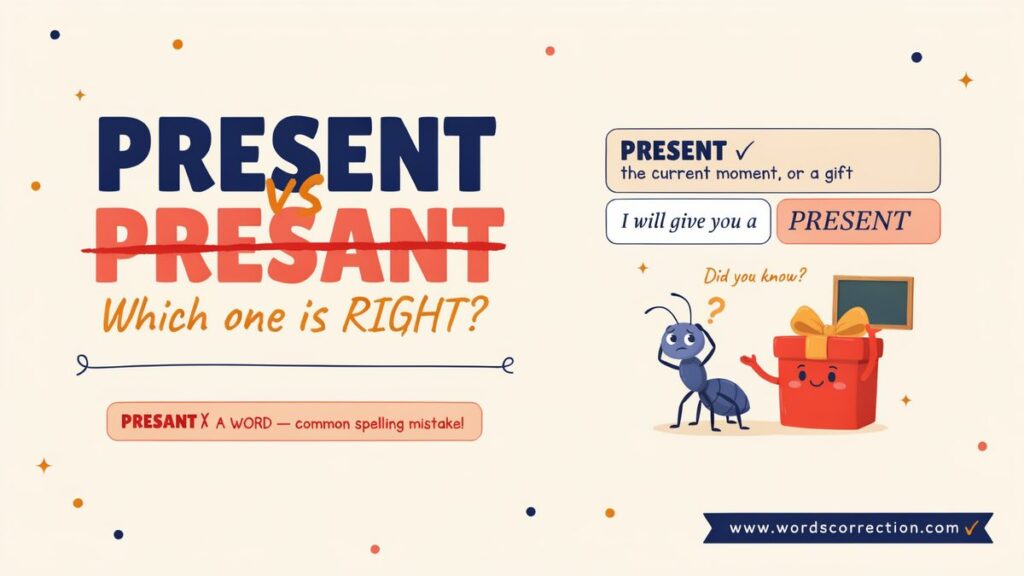
English spelling can be tricky, especially when two spellings sound almost the same. Present vs Presant is a common example of this confusion. Whether you’re writing about a birthday gift, talking about the current time, or saying someone is in a place, using the correct spelling matters. So, which spelling is correct in Present vs Presant? The answer is simple present is the correct English spelling, while presant is a misspelling. In this article, you’ll learn the meaning, pronunciation and correct use of present, along with simple examples to help you understand the difference and avoid this common spelling mistake.
Present vs Presant Which Spelling Is Correct?
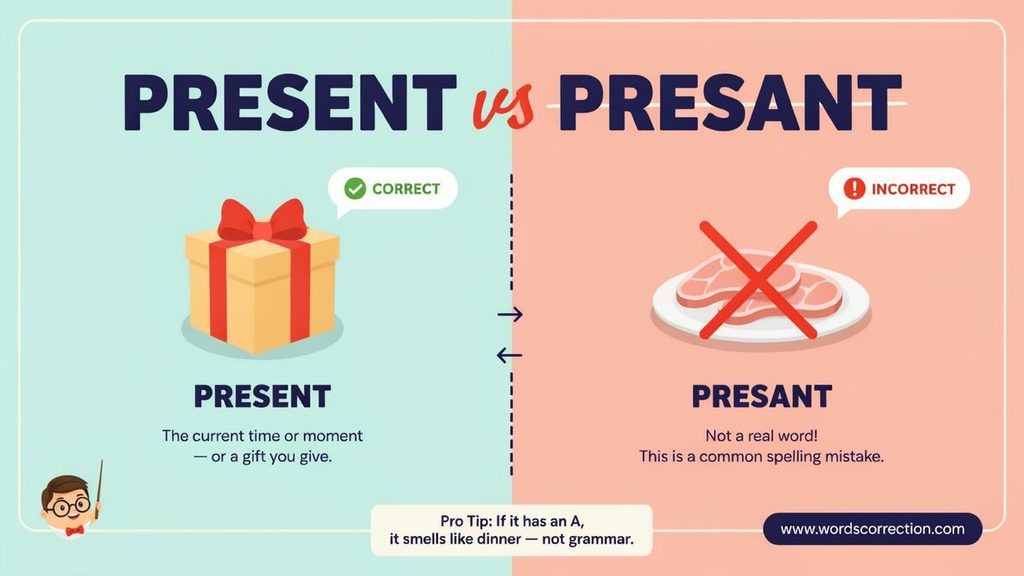
Present is the correct spelling in standard English. Presant is an incorrect spelling and does not have an established meaning as a standard English word.
Although the two spellings may sound similar when spoken, you should always write Present when referring to a gift, the current time, someone’s attendance, or the act of showing or giving something.
Consider these examples
- Correct: I bought my sister a birthday present.
- Incorrect: I bought my sister a birthday presant.
- Correct: Everyone was present at the meeting.
- Incorrect: Everyone was presant at the meeting.
- Correct: She will present her research tomorrow.
- Incorrect: She will presant her research tomorrow.
The difference involves just one letter, but that small change matters. Standard English dictionaries recognize Present, not Presant, as the correct word.
| Feature | Present | Presant |
|---|---|---|
| Spelling | Correct | Incorrect |
| Dictionary status | Standard English word | Common misspelling |
| Meaning | Gift, current time, attendance, or showing something | No standard English meaning |
| Grammatical role | Noun, verb, adjective | None in standard English |
| Pronunciation | Changes with grammatical use | Not applicable as a standard word |
| Correct usage | Everyday and professional writing | Should be avoided |
Is Present the Correct Spelling?
Yes. The correct spelling of Present contains the letters P-R-E-S-E-N-T.
A useful way to remember it is to focus on the ending: -ent, not -ant.
For example
- Present
- Presence
- Presentation
- Presentable
These related words can help reinforce the correct spelling. However, each word has its own meaning and grammatical function.
Is Presant a Word?
No. Presant is not a standard English word with an accepted dictionary definition. People sometimes use it because they confuse similar vowel sounds or simply type the wrong letters.
If you encounter Presant in a message, school assignment, email, or online article, the intended word is almost certainly Present. Correcting this spelling mistake makes your writing clearer and more professional.
Learn the difference between tricky words and use them correctly
Photostat or Photostate Which one Is Correct?
What Does Present Mean? Understanding Its Different Meanings
The word Present has several meanings. Depending on the sentence, it can describe a gift, the current time, someone’s location, or an action involving giving or showing something.
Its grammatical role also changes. It can function as a noun, adjective, or verb.
Understanding these differences helps you identify the intended meaning and use the word correctly.
Present as a Noun Meaning a Gift
One of the most familiar meanings of Present is something you give to another person without expecting payment. In this context, a present is a gift given to show appreciation, affection, kindness, or celebration.
People commonly exchange presents on birthdays, holidays, weddings, anniversaries, and other special occasions.
For example
- My parents gave me a beautiful birthday present.
- She wrapped the Christmas present in golden paper.
- He bought his friend a present for graduation.
- The children opened their presents on Christmas morning.
Present gift meaning: Something given voluntarily to another person, usually during a special occasion or as an expression of appreciation.
Gift vs Present Is There a Difference?
The words Gift and Present are very similar. Both describe something given to another person without payment.
In everyday American English, people often use them interchangeably.
However, Gift can also describe a natural ability or talent, while Present generally refers to something given or awarded.
Compare these examples
| Gift | Present |
|---|---|
| She has a gift for writing. | He gave her a birthday present. |
| Music is his greatest gift. | I received a present from my uncle. |
| They donated gifts to children. | She wrapped the Christmas presents. |
Notice the difference in the first two examples. You can have a gift for something, but you wouldn’t normally say you have a present for writing.
Every present can be a gift, but the word Gift has additional meanings that Present doesn’t share.
Present as a Noun Meaning the Current Time
The word Present also describes the time happening right now. It refers to the period between the past and the future.
For example
- We should focus on the present rather than worry about yesterday.
- The present is an opportunity to make better decisions.
- She prefers living in the present.
- Nobody knows exactly what the future holds.
Present time meaning: The period that exists now rather than a time that has already passed or one that hasn’t happened yet.
You may also encounter expressions such as
- At present
- In the present
- Present moment
- Present day
- The present time
Here are some examples
| Expression | Meaning | Example |
|---|---|---|
| At present | Currently | At present, the office is closed. |
| In the present | During the current period | Try to live in the present. |
| Present moment | Right now | Enjoy the present moment. |
| Present day | Modern times | Technology plays a major role in present-day life. |
The word also appears in discussions about history, philosophy, psychology, and everyday life.
For instance, a historian might compare life in the past with life in the present. Meanwhile, someone discussing mindfulness might encourage others to pay attention to the present moment instead of worrying about what could happen tomorrow.
Present as an Adjective Meaning Current or Existing
When Present functions as an adjective, it can describe something that exists or applies at the current time.
For example
- The present situation requires careful attention.
- Our present goal is to improve customer service.
- The present system needs a few changes.
- We must consider the present economic conditions.
In these sentences, Present describes the condition, goal, system, or circumstances that exist now.
Present as an adjective often appears in professional, academic, and everyday writing.
Common expressions include
- Present circumstances
- Present situation
- Present conditions
- Present requirements
- Present challenges
- Present opportunities
Be careful not to confuse Present with Current in every situation. They often have similar meanings, but they don’t always fit naturally into the same expressions.
For example, both the present situation and the current situation are correct.
Present as an Adjective Meaning Being in a Place
Another important meaning describes someone or something that is physically in a particular location.
When a teacher says, “All students are present,” the teacher means everyone has arrived and is attending class.
Examples include
- All employees were present at the meeting.
- Only five students were present today.
- The manager was present during the interview.
- Her parents were present at the graduation ceremony.
This meaning also appears in attendance records and official documents.
| Sentence | Meaning |
|---|---|
| She was present in class. | She attended the class. |
| The director was present. | The director attended the event. |
| All members must be present. | Every member must attend. |
| Several problems are present. | Several problems exist. |
The final example shows that Present can describe not only people but also things that exist or occur in a particular situation.
Present as a Verb Meaning to Give or Award
When you use Present as a verb, it can mean formally giving something to another person.
This meaning frequently appears in award ceremonies, official events, and professional situations.
For example
- The principal will present the certificates to the students.
- The company presented an award to its best employee.
- The mayor presented the trophy to the winning team.
- They will present the scholarship to the selected candidate.
In these examples, someone gives or awards something to another person.
The verb often follows this structure:
Person + present + something + to someone
Example: The director presented the award to the employee.
You can also use the structure Present someone with something:
- The school presented her with a certificate.
- The organization presented him with an achievement award.
Both sentence structures are grammatically correct.
Present as a Verb Meaning to Show or Introduce
The verb Present can also mean to show, explain, or formally introduce information, an idea, or a subject to an audience.
This use is particularly common in schools, workplaces, conferences, and business meetings.
Examples
- She will present her research findings tomorrow.
- The students presented their science projects.
- He presented a new business idea to the investors.
- Our team will present the results at the conference.
You may also hear the phrase Give a presentation. It means delivering information to an audience in an organized way.
Compare
- She will present the project tomorrow.
- She will give a presentation tomorrow.
Both sentences are correct, but their grammatical structures differ.
The first uses Present as a verb. The second uses Presentation as a noun.
Present as a Verb Meaning to Submit or Offer
Another use of Present involves formally submitting or offering something for consideration.
For example
- The lawyer presented the evidence in court.
- She presented her proposal to the board.
- The student presented his application to the admissions office.
- The company presented a detailed report to its clients.
This meaning is common in legal, academic, administrative, and business communication.
The verb can describe submitting evidence, offering a proposal, or putting forward an idea for discussion.
Learn the difference between similar English words the easy way
Pricy or Pricey Which Spelling Is Correct?
What Does Presant Mean?
The spelling Presant does not have a recognized meaning in standard English. It is usually a spelling mistake caused by confusion between similar vowel sounds.
If someone writes, “I bought you a presant,” the intended sentence is “I bought you a present.”
Similarly, if someone writes, “She will presant her project,” the correct sentence is “She will present her project.”
There is no separate grammatical rule that makes Presant correct in these situations.
Presant meaning: It has no established standard English definition. It is generally an incorrect spelling of Present.
Here are a few corrections
| Incorrect sentence | Correct sentence |
|---|---|
| I received a presant. | I received a present. |
| She was presant yesterday. | She was present yesterday. |
| He will presant the report. | He will present the report. |
| Enjoy the presant moment. | Enjoy the present moment. |
The important lesson is simple: Don’t create a new spelling just because a word sounds as though it could be written differently.
Learn the difference between commonly confused more words in English
Encode vs Incode Which Is Correct?
Present vs Presant Key Differences
The main difference between Present vs Presant is spelling. One is a standard English word with several meanings, while the other is a common spelling error.
Understanding this distinction becomes easier when you compare their spelling, grammatical roles, and practical uses.
| Comparison | Present | Presant |
|---|---|---|
| Correct spelling | Yes | No |
| Standard English word | Yes | No |
| Meaning as a gift | Yes | No |
| Meaning as current time | Yes | No |
| Meaning as attendance | Yes | No |
| Can function as a noun | Yes | No |
| Can function as a verb | Yes | No |
| Can function as an adjective | Yes | No |
| Suitable for formal writing | Yes | No |
What Is the Present vs Presant Difference in Everyday Writing?
The difference becomes obvious when you use the words in real situations.
Imagine you’re writing a birthday card. You want to tell your friend that you bought something special. The correct sentence is:
“I bought you a beautiful present.”
Now imagine you’re writing a school attendance report. You want to confirm that a student attended class. You should write:
“The student was present today.”
The spelling stays the same even though the meanings change.
This is an important feature of English vocabulary. A single word can perform several grammatical functions without changing its spelling.
Learn the difference between confusing more English words step by step
Conex or Connex What Is the Difference?
How to Pronounce Present Noun vs Verb Pronunciation
The word Present has two common pronunciations in American English. The difference depends on whether you’re using it as a noun or adjective, or as a verb.
This is one reason learners sometimes find the word confusing. The spelling remains identical, but the stress moves from one syllable to another.
| Grammatical use | Pronunciation | Stress |
|---|---|---|
| Noun | /ˈprez.ənt/ | First syllable |
| Adjective | /ˈprez.ənt/ | First syllable |
| Verb | /prɪˈzent/ | Second syllable |
Present Pronunciation as a Noun
When Present means a gift or the current time, you stress the first syllable.
For example
- I bought her a birthday present.
- We should appreciate the present.
- He opened his Christmas present.
In American English, the first syllable receives the emphasis.
Present Pronunciation as an Adjective
The adjective follows the same general pronunciation pattern as the noun.
Examples
- Everyone is present.
- These are our present circumstances.
- The present situation needs attention.
Again, the stress falls on the first syllable.
Present Pronunciation as a Verb
When Present functions as a verb, the stress shifts to the second syllable.
Examples:
- She will present her project.
- They will present the award.
- He needs to present the documents.
The second syllable receives the emphasis.
Pronunciation tip: Stress the first syllable when talking about a gift or someone’s attendance. Stress the second syllable when talking about showing, giving, or introducing something.
This difference is called stress shift. English uses it in several other word pairs too, including:
- REcord (noun) vs reCORD (verb).
- PREsent (noun) vs preSENT (verb).
- OBject (noun) vs obJECT (verb).
The spelling doesn’t change, but the pronunciation helps listeners understand the intended grammatical meaning.
How to Use Present Correctly in a Sentence
Knowing the definition is only half the job. You also need to understand how to place Present correctly in a sentence.
Its position and grammatical role depend on what you want to communicate.
Present Used as a Noun
A noun names a person, place, thing, or idea. When Present works as a noun, it usually refers to a gift or the current period.
Examples
- My brother gave me a birthday present.
- The present is more important than the past.
- She received several presents at her wedding.
- Living in the present can help you appreciate everyday experiences.
Notice that you can use articles and descriptive words before the noun.
For example
- A present
- The present
- A special present
- An expensive present
- A birthday present
Present Used as an Adjective
An adjective describes a noun. When Present functions as an adjective, it can describe something current or someone who is in attendance.
Examples
- The present manager has introduced new rules.
- All present members approved the proposal.
- The present circumstances require patience.
- Every student present received a certificate.
In these examples, Present describes the situation or the people attending.
Present Used as a Verb
A verb expresses an action or state. When you use Present as a verb, it usually means to give, show, introduce, or formally submit something.
Examples
- I will present my project tomorrow.
- The teacher presented the students with certificates.
- She presented her business proposal to the investors.
- They presented the evidence during the trial.
You can use different verb forms depending on the tense
| Verb form | Example |
|---|---|
| Present | I present my findings today. |
| Presents | She presents the report every month. |
| Presented | He presented the proposal yesterday. |
| Presenting | They are presenting their research now. |
| Will present | We will present our plan tomorrow. |
Remember that Present as a verb and Present as a noun have different stress patterns. Their spelling, however, remains unchanged.
Learn the difference between tricky English words with easy explanations
Encorporate vs Incorporate Which Spelling Is Correct?
Present vs Presant Correct and Incorrect Examples
Examples make spelling rules easier to remember. Instead of memorizing definitions alone, look at how Present appears in everyday communication.
Present Meaning a Gift
When you talk about something given to another person, use Present.
| Incorrect | Correct |
|---|---|
| I bought a presant for my mother. | I bought a present for my mother. |
| She loved her birthday presant. | She loved her birthday present. |
| He gave me a Christmas presant. | He gave me a Christmas present. |
Present Meaning Current or Existing
Use Present when describing the current period or existing conditions.
| Incorrect | Correct |
|---|---|
| We should focus on the presant. | We should focus on the present. |
| The presant situation is difficult. | The present situation is difficult. |
| At presant, I work from home. | At present, I work from home. |
Present Meaning Being There
When someone attends an event or remains in a particular place, use Present.
| Incorrect | Correct |
|---|---|
| All students were presant. | All students were present. |
| My teacher was presant today. | My teacher was present today. |
| Nobody was presant at the meeting. | Nobody was present at the meeting. |
Present Meaning Give or Show Something
When you describe an action involving an idea, report, award, or project, use Present as a verb.
| Incorrect | Correct |
|---|---|
| She will presant her project. | She will present her project. |
| He presanted the award. | He presented the award. |
| They are presanting their findings. | They are presenting their findings. |
Learn the difference between more words people mix up
Seal vs Seel What Is the Difference?
Why Do People Spell Present as Presant?
If Present is the correct spelling, why does Presant appear so often?
The answer involves pronunciation, spelling habits, and the unpredictable nature of English vowel sounds.
Similar Pronunciation of Weak Vowel Sounds
One major reason involves the unstressed vowel in the final syllable of Present.
In American English, the final vowel in the noun and adjective pronunciation often has a weak sound called a schwa. The schwa appears in many English words and can make spelling less obvious.
For example, the final syllables of Present vs Presant may seem similar to someone who relies mainly on sound when writing.
However, pronunciation alone cannot determine the correct spelling. English contains many words whose written vowels don’t match what learners expect to hear.
Confusion Between -Ent and -Ant Endings
Another reason involves the endings -ent and -ant.
Both appear in standard English words. However, they aren’t interchangeable.
Consider these examples
| -Ent ending | -Ant ending |
|---|---|
| Present | Important |
| Different | Assistant |
| Excellent | Pleasant |
| Student | Brilliant |
| Patient | Relevant |
These words follow their established spellings. You cannot replace one ending with another simply because the pronunciation sounds similar.
For example, Important is correct, but that doesn’t mean Presant should be correct too.
Influence of Other English Words
English learners often recognize spelling patterns from familiar words and apply them to unfamiliar situations. This can sometimes lead to confusion when choosing the correct spelling.
For example, words such as pleasant, assistant, and important end in -ant. Someone familiar with these words might mistakenly assume that present follows the same pattern, resulting in the incorrect spelling presant.
Unfortunately, English doesn’t always follow predictable spelling patterns. This is why Present vs Presant can be confusing for learners who rely on familiar word endings.
The best solution is to understand the correct spelling of frequently used words rather than relying entirely on pronunciation or assumed spelling patterns.
Fast Typing and Everyday Spelling Habits
Sometimes, the mistake has nothing to do with grammar or vocabulary knowledge.
People type quickly, skip proofreading, or accidentally select the wrong spelling while writing messages.
A person might know that Present is correct but still type Presant because of a simple keyboard mistake.
This happens frequently in
- Text messages
- Social media comments
- Online conversations
- School assignments
- Workplace emails
A quick proofreading check can prevent most of these mistakes.
Dependence on Autocorrect and Spellcheck
Digital writing tools can help identify common spelling errors. However, they aren’t perfect.
Spellcheck may miss errors when a word resembles another valid English spelling. It can also fail to understand the meaning you intend.
For example, a sentence may contain a correctly spelled word but still communicate the wrong idea.
That’s why you should check both spelling and context instead of trusting autocorrect completely.
Learn the difference between everyday English mistakes
Comming vs Coming Which Spelling Is Correct?
Common Mistakes to Avoid When Using Present
Even after learning the correct spelling, writers may confuse Present vs Presant with other words that look or sound similar. Understanding these differences can help you avoid common spelling and grammar mistakes.
Here are some common mistakes worth avoiding
- Writing Presant instead of Present: Always use the correct spelling, P-R-E-S-E-N-T, rather than the incorrect form Presant.
- Confusing Present with Presence: Present describes attendance or something current, while presence refers to the state or fact of being somewhere.
- Confusing Present with Presents: Presents can mean multiple gifts or the third-person singular form of the verb present.
- Misusing Presently: This word can mean soon or currently, depending on the context.
- Ignoring verb stress: The verb present has second-syllable stress, unlike the noun and adjective.
- Using Present when Current sounds more natural: Both words can describe something existing now, but certain expressions favor one over the other.
Understanding these distinctions makes Present vs Presant easier to remember and helps you use the correct spelling confidently in everyday writing.
A Quick Common Mistakes Checklist
Before publishing or submitting your writing, check the following
- Did you spell Present correctly?
- Did you use the correct grammatical form?
- Does the word mean a gift, current time, attendance, or an action?
- Did you confuse Present with Presence?
- Does the sentence sound natural?
- Did you check the context instead of relying only on spellcheck?
These simple checks can help improve your spelling and overall writing accuracy.
Learn the difference between commonly misused words
Triple vs Tripple Which Spelling Is Correct?
Present vs Past vs Future Understanding the Difference
The words Present, Past, and Future describe three different periods of time.
Although they often appear together in grammar lessons and everyday conversations, each word has a distinct meaning.
| Word | Meaning | Example |
|---|---|---|
| Present | The time happening now | I am studying English at present. |
| Past | A time that has already happened | I studied English yesterday. |
| Future | A time that has not happened yet | I will study English tomorrow. |
What Is the Present Tense Meaning?
In English grammar, the present tense describes actions, situations, habits, and facts connected with the present.
However, it doesn’t always mean something is happening at this exact second.
English has four commonly taught present-tense forms
| Present tense form | Example | Main use |
|---|---|---|
| Simple present | She works every day. | Habits and general facts |
| Present continuous | She is working now. | Actions happening around now |
| Present perfect | She has finished her work. | Past actions connected to the present |
| Present perfect continuous | She has been working for two hours. | Actions continuing over a period |
For example, “I work in an office” describes a regular situation, while “I am working right now” describes an action happening at this moment.
The word Present in grammar therefore has a broader role than simply describing the current time.
Present vs Past
The Present refers to now, while the Past refers to something that already happened.
Examples
- Present: I live in Islamabad.
- Past: I lived in Lahore.
- Present: She works at a school.
- Past: She worked at a school.
The difference is especially important when choosing verb tenses.
Present vs Future
The Present describes current situations, while the Future refers to events that haven’t happened yet.
Examples
- Present: We attend classes every Monday.
- Future: We will attend classes next Monday.
- Present: He prepares reports.
- Future: He will prepare a report tomorrow.
Remember: Present means now, Past means before now, and Future means after now.
Learn the difference between basic English word mistakes
Vinal vs Vinyl Which Spelling Is Correct?
Present vs Presence vs Presents vs Presently
Several English words look similar to Present, but their meanings and grammatical roles differ. Understanding these distinctions can prevent another type of English word confusion.
Present vs Presence
The words Present and Presence are related, but you cannot use them interchangeably.
Present can describe someone attending a place or something existing in a particular situation. Presence is a noun that refers to the state or fact of being somewhere or existing.
Examples
- Present: The manager was present at the meeting.
- Presence: The manager’s presence made everyone feel confident.
Compare their meanings
| Present | Presence |
|---|---|
| Describes attendance | Describes the state of being somewhere |
| Can be a noun, verb, or adjective | Noun |
| She is present today. | Her presence is important. |
Present vs Presents
The word Presents has two common uses.
First, it is the plural form of the noun Present when referring to gifts.
- She received three birthday presents.
- The children opened their presents.
Second, Presents is the third-person singular form of the verb Present.
- He presents the report every Monday.
- The teacher presents new lessons to the students.
The sentence determines which meaning applies.
Present vs Presently
Presently is an adverb formed from Present and the suffix -ly.
In American English, it commonly means soon or in a short time. It can also mean currently, although Currently is often clearer when you want to describe something happening now.
Examples
- The manager will be with you presently. (Soon.)
- The company is presently reviewing applications. (Currently.)
- She will return presently. (Soon.)
For clear everyday writing, use Currently when you mean now and Soon when you mean in a short time.
Learn the difference between often confused words
Rug vs Rag What Is the Difference?
Present in Everyday and Professional English
The word Present appears in many situations. You might use it while chatting with a friend, attending a class, writing an email, or explaining a business proposal.
Its meaning depends on the situation, but the spelling never changes.
Present in Everyday Conversations
In everyday conversations, people frequently use Present to discuss gifts, time, and attendance.
Examples
- What present did you buy for your brother?
- Let’s focus on the present.
- Everyone was present at the party.
- I received a beautiful present yesterday.
These sentences show how naturally the word fits into daily communication.
Present in Workplace Communication
Professional communication often uses Present when discussing meetings, reports, proposals, and business decisions.
Examples
- I will present the monthly report tomorrow.
- All department heads must be present.
- The director presented a new strategy.
- Please present your proposal to the management team.
In business English, the verb often sounds more formal than simply saying Show.
For example, “I will present the findings” sounds appropriate in a professional meeting. However, “I’ll show you the findings” is perfectly natural in a casual conversation.
Present in Academic Writing
Students and teachers use Present in several academic contexts.
Examples
- The student will present her research.
- All participants must be present during the examination.
- The study presents evidence of a strong relationship.
- The professor discussed the present education system.
Academic writing also uses the present tense when describing established facts, research findings, and general truths.
Present in Emails and Formal Documents
In emails, applications, and official documents, Present often describes the submission or introduction of information.
Consider these examples
- I would like to present my proposal for your consideration.
- Please find the documents I wish to present for review.
- We are pleased to present our annual report.
- The applicant must be present for the interview.
Using the correct spelling is especially important in professional communication. A spelling mistake in an important email can distract readers from the message itself.
Real-Life Examples Understanding Present Through Different Situations
Sometimes, the easiest way to understand a word is to see how people use it in realistic situations.
Consider these short case studies.
Case Study A Birthday Celebration
Sarah wants to surprise her younger brother on his birthday. She buys him a watch and wraps it in a gift box.
She writes this message on the card:
“Happy Birthday! I hope you love your present.”
Here, Present is a noun because it refers to something she gives her brother.
Writing Presant would be incorrect.
Case Study A School Attendance Record
A teacher checks attendance before beginning a lesson.
She marks each student’s name according to whether they have arrived.
Later, she writes:
“Twenty-eight students were present today.”
In this situation, Present is an adjective because it describes the students who attended class.
Case Study A Business Meeting
A marketing manager prepares a report about a company’s latest advertising campaign.
During the meeting, she explains the results to the management team.
She says:
“I will present the campaign results and discuss our next marketing strategy.”
Here, Present is a verb because it describes the action of showing and explaining information.
These examples demonstrate why understanding context matters. The same spelling can communicate different meanings depending on how you use it.
Easy Tricks to Remember the Correct Spelling of Present
Remembering the correct spelling doesn’t require complicated grammar rules. A few simple techniques can help you avoid writing Presant.
Remember the -Ent Ending
The easiest trick is to memorize the final three letters.
Present = P-R-E-S-E-N-T
The ending is -ent, not -ant.
Whenever you write about a gift, current time, attendance, or showing something, remember this spelling.
Connect Present With a Gift
Think about a birthday present.
You give someone a present on their birthday. You don’t give them a presant.
Connecting the spelling with a familiar situation can make it easier to remember.
Associate Present With Right Now
Another useful technique is to connect Present with the phrase “right now.”
For example
- At present, I am learning English.
- The present situation requires attention.
- Enjoy the present moment.
These expressions reinforce the correct spelling through repetition.
Learn Related Words
Learning a word family can also strengthen your spelling skills.
| Word | Meaning |
|---|---|
| Present | A gift, current time, or an action of showing |
| Presence | The state of being somewhere |
| Presentation | An organized talk or display of information |
| Presentable | Suitable or attractive enough to be shown |
| Presently | Soon or currently, depending on context |
These words share the same spelling base, although their meanings and grammatical roles differ.
Separate Spelling From Pronunciation
Never assume that a word’s spelling must match the way you hear it.
English pronunciation doesn’t always provide enough information to identify the correct letters.
For example, Present has different stress patterns depending on whether you use it as a noun, adjective, or verb. However, the spelling remains the same.
Learning the written form alongside its pronunciation will help you avoid unnecessary spelling mistakes.
Practice Session about Present vs Presant
Test your understanding of the correct spelling, meanings, and usage of Present vs Presant. Complete each sentence with the correct word.
1. I bought a birthday ______ for my younger brother.
2. ______ is the correct spelling in standard English.
3. We should enjoy the ______ instead of worrying about the past.
4. She received several beautiful ______ on her birthday.
5. All students must be ______ during the examination.
6. The teacher will ______ the new lesson tomorrow.
7. Is this a birthday ______ for your friend?
8. He was not ______ at yesterday’s meeting.
9. The manager will ______ the award to the winner.
10. We should focus on the ______ moment.
11. My parents gave me a special Christmas ______.
12. The students will ______ their projects in class.
13. Everyone was ______ at the school event.
14. She opened all her birthday ______ happily.
15. The speaker will ______ an interesting topic.
16. The word ______ can refer to a gift or the current time.
17. I want to live in the ______ and appreciate every moment.
18. The principal will ______ certificates to the students.
19. My sister bought a lovely ______ for her best friend.
20. The word Presant is an incorrect ______ of Present.
21. The teacher asked everyone to be ______ in class.
22. He will ______ his research at the conference.
23. These ______ are for my family members.
24. The past, ______, and future are different periods of time.
25. Always use the correct spelling, Present, instead of ______.
Answers
- Present
- Present
- Present
- Presents
- Present
- Present
- Present
- Present
- Present
- Present
- Present
- Present
- Present
- Presents
- Present
- Present
- Present
- Present
- Present
- Spelling
- Present
- Present
- Presents
- Present
- Presant
Here’s a trusted source for clear word meanings:
Cambridge Dictionary
FAQs
Is it Presant or Present?
Present is the correct spelling in standard English. Presant is an incorrect spelling and is not recognized as a standard English word. Use present when referring to a gift, the current time, or the act of showing something.
Does the word Present have more than one meaning?
Yes, present has several meanings depending on its grammatical use. It can refer to a gift, the current moment, someone being in attendance, or the act of formally showing or introducing something.
How do you spell Present when referring to a gift?
The correct spelling is present. For example, “I bought a birthday present for my sister.” The spelling remains the same whether you are talking about a birthday gift, holiday gift, or another special occasion.
What does Present mean in simple English?
In simple English, present can mean a gift, something happening right now, or being somewhere at a particular time. It can also mean showing or introducing something to another person.
What is the difference between Present as a gift and Present as time?
Present as a gift means something given to another person, usually on a special occasion. As a time-related noun, it refers to the moment happening now. The spelling is identical, but the meaning depends on the context.
Are Present and Present Pronounced Differently?
Yes. The pronunciation of present changes depending on its grammatical role. When used as a noun or adjective, it is generally pronounced PREZ-unt. When used as a verb meaning to show or introduce something, it is pronounced pri-ZENT. This difference in syllable stress is an important part of understanding Present vs Presant and using the word correctly in spoken English.
Why Is a Gift Called a Present?
A gift is called a present because the word is historically connected to the idea of offering or presenting something to another person. Over time, it became a common expression for gifts exchanged on birthdays, holidays, and other special occasions. Understanding this meaning also helps clarify Present vs Presant, as present is the correct spelling when referring to something given as a gift.
What does it mean when someone says they are Present?
When someone says they are present, it means they are physically in a particular place or attending an event. For example, “All students were present during the morning assembly.”
Does Present mean something happening right now?
Yes. As a noun, present refers to the current moment or period of time. For example, “We should focus on the present rather than worry about the past or future.”
What is the difference between Present and Present Simple?
Present refers to the current time or a grammatical category, while present simple is a specific English verb tense. The present simple describes habits, routines, general truths, and repeated actions.
When should you use Present instead of Presents?
Use present when referring to one gift or using the word in its singular form. Use presents when referring to multiple gifts. For example, “She received a present” and “She received three presents.”
What does the word Presents mean as a noun?
As a noun, presents is the plural form of present and refers to two or more gifts. For example, “The children opened their presents on Christmas morning.”
What does Presents mean as a verb?
As a verb, presents is the third-person singular form of present. It means to show, introduce, offer, or formally deliver something. For example, “The teacher presents a new lesson every Monday.”
Is the phrase I present to you grammatically correct?
Yes, “I present to you” is grammatically correct when introducing someone or something formally. For example, “I present to you our new team leader.” It is commonly used in speeches, ceremonies, and formal introductions.
What are some formal alternatives to the word Present?
Depending on the context, formal alternatives include introduce, demonstrate, deliver, submit, showcase, and propose. For example, you can say “I would like to introduce my research” instead of “I would like to present my research.”
What is another word for Present when giving something to someone?
When referring to giving something to another person, suitable alternatives include give, offer, provide, award, and bestow. The best choice depends on the situation and level of formality.
What are some synonyms for the verb Present?
Common synonyms for the verb present include show, introduce, demonstrate, display, deliver, submit, and exhibit. These words describe different ways of making information, ideas, or objects available to others.
What is a more sophisticated word for Gift or Present?
Some more sophisticated alternatives include offering, token, contribution, donation, and memento. For formal writing, offering or token may be appropriate, depending on the meaning you want to express.
What is a shorter word for Present?
The word gift is a simple and shorter alternative when present refers to something given to another person. However, it cannot replace present when the word refers to current time, attendance, or showing something.
Is there a difference between Gifts and Presents?
Generally, gifts and presents have the same meaning things given to someone without expecting payment. However, gift can also be used for natural abilities or talents, such as “She has a gift for writing.”
How do you use Present as a noun in a sentence?
As a noun, present can refer to a gift or the current moment. Examples include “He bought me a birthday present” and “Enjoy the present instead of worrying about tomorrow.”
How Do You Use Present as a Verb in Everyday English?
As a verb, present means to show, explain, introduce, or formally offer something to another person. Understanding its usage also helps clarify the difference in Present vs Presant, as only present is the correct spelling. For example, “The students will present their science projects tomorrow.” Using present correctly in everyday communication makes your sentences clearer and more grammatically accurate.
What does Present mean when describing someone’s location?
When describing someone’s location, present means being physically available or attending a particular place or event. For example, “The manager was present at the conference.”
What is the opposite of Present when referring to time?
When present refers to the current time, its common contrasting terms are past and future. The past describes time that has already happened, while the future refers to time that has not yet occurred.
How can you remember the correct spelling of Present?
A simple way to remember the spelling is to focus on the ending: Present is spelled P-R-E-S-E-N-T, not P-R-E-S-A-N-T. Practicing the word in sentences and checking a reliable dictionary can help reinforce the correct spelling.
Learn the difference between confusing word pairs
Tetroxide vs Tetraoxide Which Spelling Is Correct?
conclusion
Understanding the difference between Present vs Presant is easy once you learn the correct spelling and meaning. Present is the only correct form in standard English and can refer to a gift, the current moment, or being in a particular place. Presant is simply a misspelling and has no recognized meaning in standard English. Although both forms may sound similar, only one is appropriate in written communication. Remember to use Present vs Presant correctly when writing about a birthday gift, describing someone’s attendance, or discussing the here and now. Learning the distinction between Present vs Presant can help you avoid common spelling errors. A little attention to spelling and word usage can make your writing clearer, more accurate, and more professional.

Stella AJS is an experienced blogger and dedicated English language writer at Words Correction. She turns confusing grammar, word meanings, spelling, and usage into clear, practical insights that readers can easily understand and apply. With a passion for precise and engaging writing, Stella helps readers avoid common language mistakes, strengthen their vocabulary, and communicate with greater clarity and confidence.




