
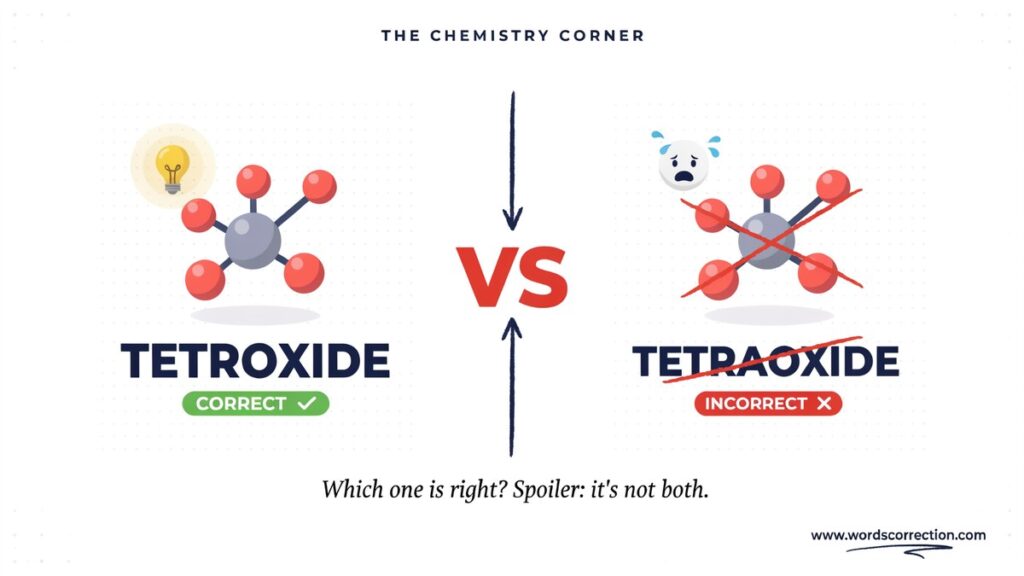
Chemical names can be confusing, especially when two spellings look almost identical. If you have ever wondered about tetroxide vs tetraoxide, you are not alone. Both forms seem correct at first glance, but which one should you use? Is the final “a” necessary, or does it simply disappear? Chemistry already has enough complicated terms, so spelling shouldn’t add to the confusion. In this guide, you’ll learn the meaning, spelling rules and key differences between tetroxide vs tetraoxide. Simple explanations and clear examples will help you understand both forms and know when to use each one.
Tetroxide vs Tetraoxide The Quick Answer
Tetroxide vs tetraoxide are two chemical naming forms associated with compounds containing four oxygen atoms. Their main difference involves how the numerical prefix tetra- combines with the word oxide.
- Tetroxide: The familiar shortened form used in established chemical names such as dinitrogen tetroxide and osmium tetroxide.
- Tetraoxide: The form that retains the final “a” of the prefix tetra-. It follows the vowel-retention convention used in systematic compositional nomenclature.
The distinction becomes clearer when you examine actual chemical references.
For example, the National Institute of Standards and Technology (NIST) identifies dinitrogen tetroxide as N₂O₄ and lists dinitrogen tetraoxide as another name for the same compound. PubChem also records both spellings among its chemical synonyms.
The International Union of Pure and Applied Chemistry (IUPAC) provides an important additional detail. Its inorganic nomenclature guidance generally retains the final vowels of multiplicative prefixes in systematic compositional names. The guide illustrates this convention with examples such as tetraoxide and pentaoxide. Monoxide is a recognized exception.
Therefore, neither spelling should be judged without considering the naming system.
| Feature | Tetroxide | Tetraoxide |
|---|---|---|
| Word structure | Tetr + oxide | Tetra + oxide |
| Numerical meaning | Four | Four |
| Oxygen count indicated | Four | Four |
| Common usage | Established chemical names | Systematic compositional naming |
| Final vowel | Removed | Retained |
| Example | Dinitrogen tetroxide | Dinitrogen tetraoxide |
Quick takeaway: Use established names such as dinitrogen tetroxide and osmium tetroxide when referring to these familiar compounds. Use tetraoxide when following the IUPAC vowel-retention convention for systematic compositional naming.
Learn the difference between tricky words and use them correctly
Omelet or Omelette Which Spelling Is Correct?
What Is Tetroxide? Meaning, Definition, and Chemical Usage
The word tetroxide combines a numerical prefix with the term oxide. In chemical terminology, it indicates four oxygen atoms in the named chemical entity.
Tetroxide Meaning and Definition
The tetroxide definition comes from two components
- Tetra-: A Greek-derived numerical prefix meaning four.
- Oxide: A chemical naming term used for compounds containing oxygen combined with another element.
Together, these components communicate that four oxygen atoms are present in the relevant chemical entity.
For example, dinitrogen tetroxide has the molecular formula N₂O₄. Each molecule contains two nitrogen atoms and four oxygen atoms.
The prefix di- identifies the two nitrogen atoms, while tetroxide indicates the four oxygen atoms.
This naming structure helps scientists understand a compound’s basic composition without examining its molecular formula first.
What Is Tetroxide in Chemistry?
In chemistry, tetroxide appears in the names of different oxygen-containing compounds. It does not identify one specific substance by itself.
Instead, the complete chemical name identifies the element combined with oxygen.
Consider these examples
| Chemical name | Formula | Oxygen atoms |
|---|---|---|
| Dinitrogen tetroxide | N₂O₄ | 4 |
| Osmium tetroxide | OsO₄ | 4 |
| Dinitrogen pentoxide | N₂O₅ | 5 |
The first two compounds contain four oxygen atoms. The third contains five, which is why its name uses pentoxide rather than tetroxide.
Notice that the numerical prefix identifies the number of oxygen atoms, not the oxidation state of the other element. These are separate chemical concepts.
Tetroxide Chemical Name Why the Complete Name Matters
A numerical prefix alone cannot identify a chemical compound.
For example, tetroxide indicates four oxygen atoms, but it does not tell you whether those atoms are bonded to nitrogen, osmium, or another element.
The complete chemical name provides that information.
Dinitrogen tetroxide and osmium tetroxide have different chemical compositions and properties, even though both contain four oxygen atoms.
This distinction matters in scientific writing because a correct chemical name must communicate more than an oxygen count. It must also identify the relevant element or chemical entity.
Learn the difference between similar English words the easy way
Dieing or Dying Which Spelling Is Correct?
What Is Tetraoxide? Meaning, Definition, and Chemical Usage
Although tetroxide appears frequently in chemical references, tetraoxide also has a legitimate place in chemical nomenclature.
Its meaning comes directly from the prefix tetra- and the word oxide.
Tetraoxide Meaning and Definition
The tetraoxide definition is straightforward. It is a systematic naming form that combines tetra- (four) with oxide.
Unlike tetroxide, which drops the final “a,” tetraoxide preserves the complete numerical prefix.
This spelling follows the IUPAC convention of retaining the final vowels of multiplicative prefixes in systematic compositional names, except in recognized cases such as monoxide.
For example
- Tetra + oxide = tetraoxide.
- Penta + oxide = pentaoxide.
- Mono + oxide = monoxide.
The rule may seem unusual if you learned chemical naming through introductory chemistry textbooks. Many educational resources teach the traditional vowel-dropping convention, which produces familiar forms such as tetroxide.
However, formal inorganic nomenclature follows its own conventions. That is why both forms appear in scientific literature.
Tetraoxide in Chemical Nomenclature
Tetraoxide is relevant to systematic chemical naming because it preserves the original numerical prefix.
The IUPAC Brief Guide to Inorganic Nomenclature explains that multiplicative prefixes such as di-, tri-, tetra-, and penta- identify the number of entities in a chemical name. It also explains that their final vowels are generally retained.
The guide illustrates vowel retention with examples such as tetraaqua and pentaoxide.
These examples demonstrate how systematic chemical names can preserve the final vowel of a numerical prefix.
| Formula | Systematic compositional name |
|---|---|
| N₂O₄ | Dinitrogen tetraoxide |
| Fe₃O₄ | Triiron tetraoxide |
The IUPAC Red Book provides further guidance on these naming conventions.
Is Tetraoxide an Alternative Spelling of Tetroxide?
Yes. The two forms can appear as alternative names for the same compound.
Dinitrogen tetroxide and dinitrogen tetraoxide both identify N₂O₄. NIST lists the latter as another name for the compound, while PubChem includes both among its synonyms.
However, this does not mean every chemical name containing tetroxide should automatically be rewritten as tetraoxide in every context.
A chemical database may list established names, systematic names, historical names, and synonyms together. Their presence does not mean every naming form has the same status or follows the same convention.
The important distinction is between identifying the same chemical substance and following a particular naming system.
Learn the difference between commonly confused more words in English
Photostat or Photostate Which one Is Correct?
Tetroxide vs Tetraoxide The Main Differences Explained
At first glance, the difference between tetroxide vs tetraoxide seems limited to one letter. Yet that small difference reflects two approaches to chemical word formation.
The Difference Between Tetroxide vs Tetraoxide in Spelling
The most visible difference is the final “a” in tetra-.
- Tetroxide drops the final “a” before oxide.
- Tetraoxide retains the final “a” and combines it directly with oxide.
Both spellings communicate the same numerical prefix when used as alternative names for the same chemical compound.
This is not a case where changing one letter creates a different oxygen count. Both forms indicate four oxygen atoms.
The Difference in Chemical Naming Conventions
The two spellings reflect different naming practices.
Traditional educational conventions often remove the final vowel of a prefix when the next element name begins with a vowel. Under that approach, tetraoxide becomes tetroxide.
Formal IUPAC compositional nomenclature generally takes a different approach. It retains the final vowels of multiplicative prefixes.
For example
- Traditional form: Dinitrogen tetroxide.
- Systematic compositional form: Dinitrogen tetraoxide.
The difference is not simply a matter of one spelling being universally correct and the other being universally wrong. It reflects the naming convention being followed.
Tetroxide vs Tetraoxide Comparison of Their Uses
| Comparison point | Tetroxide | Tetraoxide |
|---|---|---|
| Prefix meaning | Four | Four |
| Final vowel | Removed | Retained |
| Naming approach | Established or traditional form | Systematic compositional form |
| Scientific references | Widely used | Also documented |
| Example compound | Osmium tetroxide | Osmium tetraoxide as an alternative name |
| Chemical identity | Depends on the complete name and formula | Depends on the complete name and formula |
The most reliable approach is to check the complete chemical name and its molecular formula rather than relying on one spelling difference.
Learn the difference between confusing more English words step by step
Pricy or Pricey Which Spelling Is Correct?
Why Is Tetroxide Spelled Without an A?
The spelling tetroxide developed through a common chemical naming convention that simplifies the combination of numerical prefixes and element names.
When the prefix tetra- comes before oxide, some naming systems remove the final “a” to avoid consecutive vowel sounds.
This produces tetroxide.
The Traditional Vowel-Dropping Convention
Many introductory chemistry textbooks teach students to remove the final vowel of a numerical prefix when the following element name begins with a vowel.
For example
- Mono + oxide becomes monoxide.
- Tetra + oxide becomes tetroxide.
- Penta + oxide becomes pentoxide.
This convention produces familiar chemical names that are widely recognized in scientific education.
However, it should not be confused with the formal IUPAC vowel-retention rule for compositional inorganic nomenclature.
The IUPAC Vowel-Retention Rule
IUPAC generally retains the final vowels of multiplicative prefixes when constructing systematic compositional names.
For example
- Tetraoxide retains the “a.”
- Pentaoxide retains the “a.”
- Tetraaqua retains the “a.”
Monoxide is a recognized exception.
This explains why you may encounter dinitrogen tetraoxide in a systematic naming context even though many chemistry textbooks and scientific references use dinitrogen tetroxide.
Why Monoxide Is Different
The word monoxide deserves special attention because it follows a widely accepted exception.
Its numerical prefix is mono-, meaning one. If the vowel were retained, the result would be monooxide.
However, monoxide is the established form.
For example
| Formula | Established name |
|---|---|
| CO | Carbon monoxide |
| CO₂ | Carbon dioxide |
| NO | Nitrogen monoxide |
This exception shows why chemical naming rules cannot always be reduced to one simple spelling formula.
Learn the difference between tricky English words with easy explanations
Encode vs Incode Which Is Correct?
Tetroxide vs Other Oxide Names Understanding Chemical Prefixes
To understand tetroxide spelling, it helps to examine other numerical prefixes used in inorganic chemistry.
These prefixes come from Greek numerical naming traditions and help identify the number of atoms or entities in a chemical formula.
What Does the Prefix Tetra Mean in Chemistry?
The prefix tetra- means four.
Chemists use it in systematic names to communicate quantities. It appears in several areas of chemical nomenclature, including molecular compound names and coordination chemistry.
Here are some common Greek numerical prefixes
| Number | Prefix | Chemical naming example |
|---|---|---|
| 1 | Mono- | Carbon monoxide |
| 2 | Di- | Carbon dioxide |
| 3 | Tri- | Sulfur trioxide |
| 4 | Tetra- | Dinitrogen tetroxide |
| 5 | Penta- | Dinitrogen pentoxide |
| 6 | Hexa- | Sulfur hexafluoride |
| 7 | Hepta- | Dichlorine heptoxide |
| 8 | Octa- | Octasulfur |
These prefixes help communicate molecular composition. However, not every chemical naming system uses them in precisely the same way.
Tetroxide vs Dioxide
The difference between tetroxide and dioxide is the number of oxygen atoms indicated by the prefix.
- Dioxide: Two oxygen atoms.
- Tetroxide: Four oxygen atoms.
For example, carbon dioxide has the formula CO₂. It contains one carbon atom and two oxygen atoms.
Dinitrogen tetroxide has the formula N₂O₄. It contains two nitrogen atoms and four oxygen atoms.
Both names follow a numerical naming pattern, but they describe different molecular compositions.
Tetroxide vs Trioxide
Trioxide indicates three oxygen atoms, while tetroxide indicates four.
Consider sulfur trioxide (SO₃). Its molecular formula contains one sulfur atom and three oxygen atoms.
By comparison, osmium tetroxide (OsO₄) contains one osmium atom and four oxygen atoms.
This comparison illustrates how numerical prefixes distinguish compounds with different oxygen counts.
Tetroxide vs Oxide
The word oxide is broader than tetroxide.
An oxide is a chemical compound containing oxygen combined with another element. The term does not automatically indicate how many oxygen atoms are present.
Tetroxide provides a more specific numerical description.
For example
- Magnesium oxide: MgO.
- Carbon dioxide: CO₂.
- Osmium tetroxide: OsO₄.
The prefix helps distinguish the composition of one compound from another.
Learn the difference between more words people mix up
Conex or Connex What Is the Difference?
Real Chemical Examples of Tetroxide vs Tetraoxide
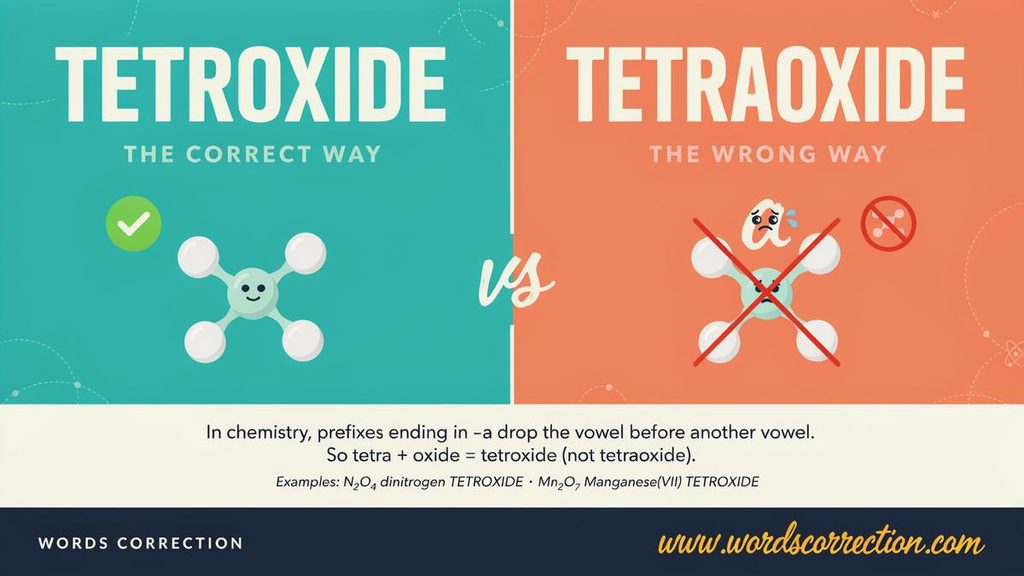
Chemical examples provide the clearest way to understand how these naming forms work. Several well-documented compounds demonstrate the relationship between their names, formulas, and properties.
Dinitrogen Tetroxide (N₂O₄)
Dinitrogen tetroxide is one of the most familiar examples associated with the tetroxide spelling.
Its molecular formula is N₂O₄, which means each molecule contains:
- Two nitrogen atoms.
- Four oxygen atoms.
The compound has a molecular weight of approximately 92.01 g/mol.
Dinitrogen tetroxide is a red-brown liquid under suitable temperature and pressure conditions. It can also exist as a gas and participates in an equilibrium with nitrogen dioxide (NO₂).
The chemical relationship is represented by
N₂O₄ ⇌ 2NO₂
This equilibrium is particularly interesting because nitrogen dioxide is brown while dinitrogen tetroxide is nearly colorless in its pure gaseous form. Temperature changes can shift the equilibrium and affect the observed color.
Dinitrogen tetroxide has several industrial applications, including its use as an oxidizer in specialized rocket propulsion systems. It is also a hazardous substance that requires strict handling controls.
Interestingly, NIST and PubChem list dinitrogen tetraoxide as an alternative name for the same N₂O₄ compound.
This makes it an excellent real-world example of how tetroxide vs tetraoxide can coexist in scientific terminology.
Osmium Tetroxide (OsO₄)
Osmium tetroxide provides another important example of an established chemical name using tetroxide.
Its formula is OsO₄.
The formula contains
- One osmium atom.
- Four oxygen atoms.
Osmium tetroxide is a highly toxic and volatile chemical compound. It generally appears as a colorless crystalline solid or a pale-yellow mass.
Unlike many compounds discussed only in introductory chemistry lessons, osmium tetroxide has important laboratory applications.
One of its best-known uses involves staining biological samples for electron microscopy.
What Is Osmium Tetroxide Used For?
Osmium tetroxide is especially useful in microscopy because it reacts with certain components of biological samples and helps improve image contrast.
Its applications include
- Transmission electron microscopy: It helps stain biological specimens for detailed examination.
- Cellular imaging: It helps reveal structures within cells, particularly membrane-rich areas.
- Lipid staining: It reacts with unsaturated lipids and helps preserve and visualize membrane structures.
- Laboratory research: Researchers use it in specialized sample preparation procedures.
For example, scientists preparing biological samples for transmission electron microscopy may use osmium tetroxide as part of a fixation and staining process. This helps preserve cellular structures and makes them easier to examine under an electron microscope.
Why Is Osmium Tetroxide Toxic?
Osmium tetroxide presents serious health hazards.
Exposure can damage the eyes, skin, and respiratory system. Its vapors are particularly dangerous because people can inhale them without direct contact with the liquid or solid substance.
According to the US National Institute for Occupational Safety and Health (NIOSH), workers who handle osmium tetroxide may face exposure risks in laboratories and industrial settings.
Proper ventilation, specialized protective equipment, and appropriate chemical handling procedures are essential.
Important safety fact: Osmium tetroxide is not an ordinary laboratory stain. It requires strict safety controls and should only be handled by trained personnel following approved safety procedures.
Is Sulfur Tetroxide a Correct Chemical Name?
Sulfur tetroxide sometimes appears in searches related to tetroxide compounds. However, its chemical identity requires careful treatment.
A formula such as SO₄ contains one sulfur atom and four oxygen atoms. However, the formula alone does not establish that a familiar, stable neutral molecular compound exists under ordinary conditions.
It is also important not to confuse SO₄ with the sulfate ion.
The sulfate ion has the formula SO₄²⁻, which carries a negative two charge. It is not neutral sulfur tetroxide.
For this reason, avoid using sulfur tetroxide as a routine example of a well-established neutral oxide without a reliable chemical reference that confirms the intended species.
This distinction highlights an important scientific writing principle: a chemically plausible formula does not automatically establish that a compound is a recognized substance.
Learn the difference between everyday English mistakes
Encorporate vs Incorporate Which Spelling Is Correct?
How to Read Chemical Formulas and Identify Tetroxide Compounds
A chemical name tells you about a compound’s composition, but its molecular formula provides a direct representation of the atoms present.
Learning to read formulas makes chemical nomenclature much easier.
Understanding the Tetroxide Chemical Formula
There is no single molecular formula for tetroxide because the term appears in the names of different compounds.
The complete chemical name determines the formula.
For example
| Compound | Molecular formula | Composition |
|---|---|---|
| Dinitrogen tetroxide | N₂O₄ | 2 nitrogen + 4 oxygen |
| Osmium tetroxide | OsO₄ | 1 osmium + 4 oxygen |
| Dinitrogen pentoxide | N₂O₅ | 2 nitrogen + 5 oxygen |
The subscript after an element symbol indicates how many atoms of that element appear in the formula.
If no subscript appears, the formula represents one atom of that element in the chemical entity.
How to Identify Four Oxygen Atoms
Look for the number 4 immediately after the oxygen symbol, O.
For example
OsO₄
- Os represents osmium.
- O represents oxygen.
- The subscript 4 indicates four oxygen atoms.
The same principle applies to N₂O₄.
The formula contains two nitrogen atoms and four oxygen atoms. Its name reflects both quantities through the prefixes di- and tetra-.
Why Chemical Formulas Matter More Than Spelling Alone
Chemical names can have synonyms, traditional forms, and systematic alternatives. A molecular formula helps confirm whether two names refer to the same composition.
For example, dinitrogen tetroxide and dinitrogen tetraoxide both identify N₂O₄ in major chemical databases.
However, formulas do not always reveal the complete molecular structure or chemical behavior.
Two substances can share a molecular formula while having different structures or arrangements of atoms. Therefore, chemical identification may also require structural information, oxidation states, and other properties.
Learn the difference between commonly misused words
Seal vs Seel What Is the Difference?
Common Mistakes When Using Tetroxide vs Tetraoxide
Even people familiar with chemistry can become confused when they encounter different naming conventions.
The following mistakes are worth avoiding.
Assuming Tetraoxide Is Always Incorrect
This is one of the most common misunderstandings.
Many introductory chemistry resources use tetroxide because they teach the traditional vowel-dropping convention.
However, IUPAC’s systematic compositional naming guidance generally retains the final vowel of multiplicative prefixes.
Therefore, tetraoxide is not automatically an invalid chemical spelling.
Assuming Tetroxide vs Tetraoxide Always Identify Different Compounds
The spelling difference does not necessarily indicate a difference in molecular composition.
Dinitrogen tetroxide and dinitrogen tetraoxide both refer to N₂O₄ in established chemical references.
Always check the complete chemical name and formula before concluding that two names describe different substances.
Confusing Oxygen Count With Oxidation State
The prefix tetra- indicates four entities, not an oxidation state of +4 or -4.
For example, osmium tetroxide has four oxygen atoms. In the usual oxidation-state assignment, each oxygen has an oxidation state of -2, giving osmium an oxidation state of +8.
These concepts relate to chemical composition but describe different properties.
Treating Every Search Result as a Verified Chemical Compound
A search engine may return phrases such as sulfur tetroxide or nitrogen tetraoxide. However, a search result does not establish whether the named substance is stable, commonly recognized, or correctly described.
Use authoritative databases and nomenclature references when verifying unfamiliar chemical terms.
Confusing Sulfate With Sulfur Tetroxide
The sulfate ion, SO₄²⁻, is a familiar polyatomic ion.
It contains one sulfur atom and four oxygen atoms, but it is not the same thing as a neutral sulfur tetroxide molecule.
The charge matters. Chemical formulas must include ionic charges when appropriate.
Learn the difference between basic English word mistakes
Comming vs Coming Which Spelling Is Correct?
Tetroxide vs Tetraoxide Correct and Incorrect Usage Examples
Examples help turn chemical naming rules into practical writing habits.
The following table distinguishes established names, systematic naming forms, and incorrect interpretations.
| Example | Status | Explanation |
|---|---|---|
| Dinitrogen tetroxide (N₂O₄) | Correct | Established chemical name |
| Dinitrogen tetraoxide (N₂O₄) | Correct | Alternative systematic naming form |
| Osmium tetroxide (OsO₄) | Correct | Established chemical name |
| Osmium tetraoxide (OsO₄) | Systematically formed alternative | Retains the final vowel |
| Carbon monoxide (CO) | Correct | Recognized monoxide exception |
| Carbon monooxide (CO) | Not the established form | The standard exception is monoxide |
| Sulfate (SO₄²⁻) called neutral sulfur tetroxide | Incorrect | Confuses an ion with a neutral compound |
Correct Usage in Scientific Writing
Here are examples of how these terms can appear naturally in scientific explanations.
- Dinitrogen tetroxide has the molecular formula N₂O₄.
- Dinitrogen tetraoxide is listed as an alternative name for the same compound.
- Osmium tetroxide is used as a staining agent in electron microscopy.
- The prefix tetra- indicates four in systematic chemical nomenclature.
- IUPAC generally retains the final vowel of multiplicative prefixes in compositional names.
Incorrect Usage to Avoid
Avoid statements such as
- “Tetroxide always means a compound with four nitrogen atoms.” It indicates four oxygen atoms, not four nitrogen atoms.
- “Tetraoxide and tetroxide always represent different chemicals.” They can be alternative names for the same compound.
- “SO₄ is the molecular formula of neutral sulfur tetroxide.” SO₄²⁻ is the sulfate ion.
- “IUPAC always removes the final vowel from tetra-.” Its general compositional naming guidance retains that vowel.
Learn the difference between often confused words
Triple vs Tripple Which Spelling Is Correct?
How to Choose Between Tetroxide vs Tetraoxide in Scientific Writing
Choosing between the two forms becomes easier once you identify your writing context.
If you’re writing a school assignment, laboratory report, scientific article, or chemistry guide, consistency matters.
Follow Your Required Naming Convention
Your textbook, instructor, journal, or scientific organization may specify a particular naming convention.
Follow that requirement rather than switching between different forms throughout the same document.
Use Established Chemical Names When Appropriate
Some compounds have widely recognized names that appear consistently in scientific literature.
Examples include
- Dinitrogen tetroxide.
- Osmium tetroxide.
- Nitrogen dioxide.
- Carbon monoxide.
These names are familiar to chemists and appear in established scientific references.
Use Systematic Names When the Context Requires Them
When constructing a compositional name under the relevant IUPAC convention, retain the final vowel of the numerical prefix unless a recognized exception applies.
For example, the systematic compositional name for N₂O₄ is dinitrogen tetraoxide.
Verify Unfamiliar Chemical Names
Before using an unfamiliar chemical name, consult reliable scientific references such as
- IUPAC nomenclature publications for chemical naming rules.
- PubChem for chemical properties, formulas, and synonyms.
- NIST Chemistry WebBook for established chemical names and physical data.
These references help distinguish a recognized alternative name from an unsupported spelling or chemical interpretation.
Practice session about Tetroxide vs Tetraoxide
Complete the following sentences using the correct words.
- The commonly used spelling is __________.
- The prefix “tetra” means __________.
- Tetroxide contains __________ oxygen atoms.
- The chemical formula of dinitrogen tetroxide is __________.
- The chemical formula of osmium tetroxide is __________.
- Dinitrogen tetroxide contains __________ nitrogen atoms.
- The word “oxide” refers to __________.
- Tetroxide is a chemical __________.
- N₂O₄ is called dinitrogen __________.
- OsO₄ is called osmium __________.
- An alternative spelling of tetroxide is __________.
- The prefix “di” means __________.
- Nitrogen dioxide has the formula __________.
- Chemical names follow specific __________ rules.
- Both tetroxide vs tetraoxide refer to compounds containing __________ oxygen atoms.
- The chemical symbol for oxygen is __________.
- The chemical symbol for nitrogen is __________.
- The chemical symbol for osmium is __________.
- Dinitrogen tetroxide contains __________ elements.
- The formula N₂O₄ represents __________ atoms in total.
- The prefix “mono” means __________.
- Carbon dioxide has the chemical formula __________.
- Carbon tetrachloride contains __________ chlorine atoms.
- The formula for carbon tetrachloride is __________.
- The correct spelling commonly used in chemistry is __________.
Answers
- Tetroxide
- Four
- Four
- N₂O₄
- OsO₄
- Two
- Oxygen
- Name
- Tetroxide
- Tetroxide
- Tetraoxide
- Two
- NO₂
- Nomenclature
- Four
- O
- N
- Os
- Two
- Six
- One
- CO₂
- Four
- CCl₄
- Tetroxide
Here’s a trusted source for clear word meanings:
Cambridge Dictionary
FAQs
Why is tetroxide spelled without the letter a?
Tetroxide is spelled without the letter “a” because it is the established form used in certain chemical names. It combines the numerical prefix tetra- with oxide, although chemical naming conventions and established compound names determine the preferred spelling.
Is tetraoxide an accepted alternative spelling of tetroxide?
Yes, tetraoxide is used as an alternative spelling in some chemical references and databases. However, tetroxide is the established spelling in names such as dinitrogen tetroxide. The preferred form depends on the compound and its recognized chemical name.
Which spelling is preferred in chemical nomenclature tetroxide or tetraoxide?
Tetroxide is the established spelling in several widely recognized chemical compound names, including dinitrogen tetroxide and osmium tetroxide. Tetraoxide also appears in some chemical databases as an alternative name, so the appropriate form depends on the specific compound.
Does tetroxide indicate that a compound contains four oxygen atoms?
Yes. The prefix tetr- in tetroxide indicates four oxygen atoms in the named molecular compound. For example, dinitrogen tetroxide (N₂O₄) contains two nitrogen atoms and four oxygen atoms.
What is the difference between the prefixes tetra- and tetr- in chemical names?
Tetra- is a Greek numerical prefix meaning four, while tetr- can appear as a shortened form in established chemical names. In compound names such as tetroxide, the shortened form reflects accepted naming conventions rather than a different numerical meaning.
How is the Greek prefix tetra- used in chemical nomenclature?
The Greek prefix tetra- indicates that four atoms or groups of a particular element are present in a compound. For example, carbon tetrachloride (CCl₄) contains four chlorine atoms bonded to one carbon atom.
Why are some vowels removed from numerical prefixes in chemical names?
Some established chemical names use shortened numerical prefixes to make compound names easier to pronounce and recognize. However, vowel removal is not a universal rule in modern systematic nomenclature, and the preferred form depends on the applicable naming conventions.
Is dinitrogen tetraoxide another name for dinitrogen tetroxide?
Yes. Dinitrogen tetraoxide is an alternative name for dinitrogen tetroxide, a chemical compound with the molecular formula N₂O₄. Both names refer to the same substance, although dinitrogen tetroxide is the more commonly established form.
How is dinitrogen tetroxide represented in chemical notation?
Dinitrogen tetroxide is represented by the chemical formula N₂O₄. The formula indicates that each molecule contains two nitrogen atoms and four oxygen atoms.
What is the molecular structure of dinitrogen tetroxide?
Dinitrogen tetroxide (N₂O₄) has a structure consisting of two nitrogen dioxide units joined by a nitrogen–nitrogen bond. Its molecular arrangement is relatively symmetrical, with each nitrogen atom bonded to two oxygen atoms.
How many nitrogen and oxygen atoms are present in one molecule of N₂O₄?
One molecule of N₂O₄ contains six atoms in total: two nitrogen atoms and four oxygen atoms. The subscript 2 represents nitrogen atoms, while the subscript 4 represents oxygen atoms.
What is the molecular weight of dinitrogen tetroxide?
The molar mass of dinitrogen tetroxide (N₂O₄) is approximately 92.01 grams per mole. This value is calculated by adding the atomic masses of two nitrogen atoms and four oxygen atoms.
How does nitrogen dioxide differ from dinitrogen tetroxide?
Nitrogen dioxide (NO₂) and dinitrogen tetroxide (N₂O₄) are related nitrogen oxides but have different molecular formulas. Nitrogen dioxide contains one nitrogen and two oxygen atoms, whereas dinitrogen tetroxide contains two nitrogen and four oxygen atoms.
Can dinitrogen tetroxide exist in equilibrium with nitrogen dioxide?
Yes. Dinitrogen tetroxide and nitrogen dioxide exist in a reversible chemical equilibrium. As temperature increases, N₂O₄ tends to dissociate into NO₂, while lower temperatures favor the formation of N₂O₄.
Why is N₂O₄ sometimes called a nitrogen dioxide dimer?
N₂O₄ is called a nitrogen dioxide dimer because it forms when two nitrogen dioxide (NO₂) molecules combine. This association creates a larger molecule containing two nitrogen atoms and four oxygen atoms.
What is the oxidation state of nitrogen in dinitrogen tetroxide?
The average oxidation state of nitrogen in dinitrogen tetroxide (N₂O₄) is +4. Oxygen generally has an oxidation state of −2, so the two nitrogen atoms collectively balance the four oxygen atoms to produce a neutral molecule.
How are tetroxide compounds named according to IUPAC conventions?
Chemical compounds are named using recognized nomenclature rules that identify their constituent elements and numerical proportions. For molecular compounds, Greek prefixes such as mono-, di-, tri-, and tetra- indicate the number of atoms of each element.
What is the difference between tetroxide and trioxide?
Tetroxide and trioxide indicate different numbers of oxygen atoms in a chemical compound. Tetroxide represents four oxygen atoms, whereas trioxide represents three. Their prefixes help distinguish the molecular composition of chemical substances.
How does tetroxide differ from dioxide in chemical composition?
Tetroxide and dioxide differ in the number of oxygen atoms indicated by their names. Tetroxide represents four oxygen atoms, while dioxide represents two. The complete molecular formula identifies which other elements are present.
Are tetroxides and peroxides the same type of chemical compound?
No. Tetroxide is a naming term indicating four oxygen atoms in a compound, whereas peroxide refers to compounds containing an oxygen–oxygen single bond or the peroxide ion (O₂²⁻). They describe different chemical characteristics.
What is the difference between an oxide and a tetroxide?
An oxide is a general term for a chemical compound containing oxygen bonded to another element. Tetroxide is a more specific naming component indicating four oxygen atoms in a molecular compound, such as osmium tetroxide (OsO₄).
Can tetraoxide be used in scientific writing?
Yes. Tetraoxide can appear in scientific writing as an alternative chemical name. However, writers should follow the recognized name used by authoritative chemical references or nomenclature databases for the specific compound being discussed.
Why do chemical dictionaries and scientific databases sometimes use different spellings?
Chemical dictionaries and databases may list different spellings because of alternative systematic names, historical naming practices, and variations in chemical nomenclature. Some databases retain alternative names for identification, even when one form is more commonly established.
What are some other chemical compounds that use the prefix tetra-?
Several chemical compounds use tetra- to indicate four atoms or groups. Examples include carbon tetrachloride (CCl₄), silicon tetrachloride (SiCl₄), and tetraphosphorus decaoxide (P₄O₁₀).
How can you identify the number of oxygen atoms from a chemical compound’s name?
You can identify the number of oxygen atoms by examining the numerical prefix in the compound’s name. For example, monoxide indicates one oxygen atom, dioxide indicates two, trioxide indicates three, and tetroxide indicates four.
Learn the difference between confusing word pairs
Vinal vs Vinyl Which Spelling Is Correct?
Conclusion
The difference between Tetroxide vs Tetraoxide may come down to a single letter, but both spellings have a place in chemical terminology. Tetroxide is the more familiar form in established names such as dinitrogen tetroxide and osmium tetroxide. However, tetraoxide follows the general convention of retaining the final vowel in certain systematic chemical names. The correct choice depends on the naming rules and context. Understanding this distinction can help you avoid spelling mistakes and use chemical terms with confidence. After all, chemistry is complicated enough without letting one missing letter create an unnecessary reaction.

Stella AJS is an experienced blogger and dedicated English language writer at Words Correction. She turns confusing grammar, word meanings, spelling, and usage into clear, practical insights that readers can easily understand and apply. With a passion for precise and engaging writing, Stella helps readers avoid common language mistakes, strengthen their vocabulary, and communicate with greater clarity and confidence.




