
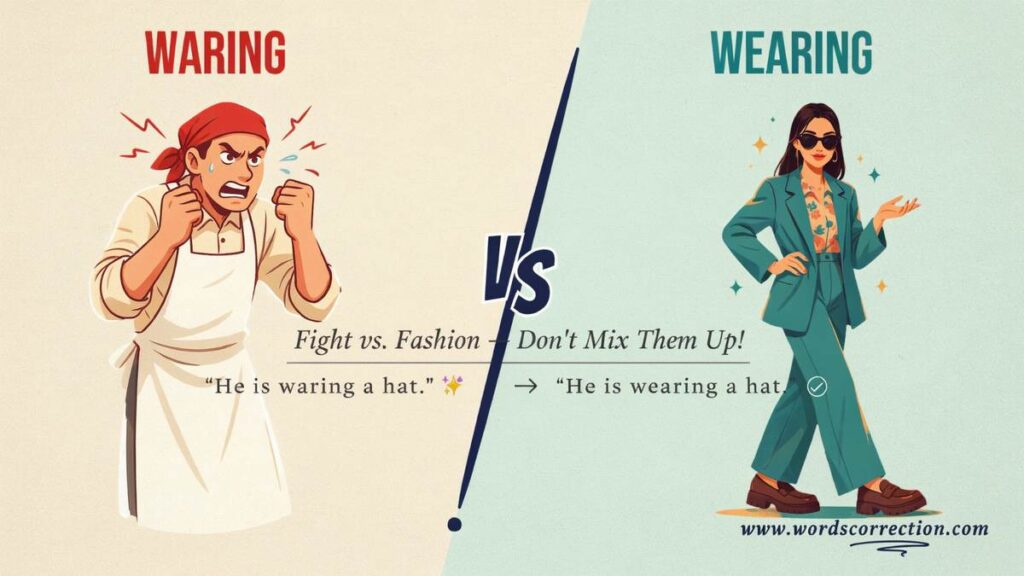
The words Waring and Wearing look almost identical, but they have different meanings and uses. This small spelling difference can create confusion and lead to mistakes in everyday writing. Understanding Waring vs Wearing is important if you want to write clearly and use the correct word in each sentence. Wearing is the standard word used when talking about clothes or having something on your body. Waring is much less common and may appear as a surname or in rare historical usage. In this guide, you’ll learn their meanings, differences and correct usage through simple explanations and practical examples.
What Is the Difference Between Waring vs Wearing?
The main difference between Waring vs Wearing lies in their meanings, spelling, and grammatical functions. Although they look and sound similar, they serve different purposes in everyday English.
Wearing is the present participle of the verb wear. You use it when someone has clothes, shoes, jewelry, or another item on their body. It can also describe something that causes physical or emotional exhaustion.
Waring, on the other hand, isn’t the standard spelling of the clothing-related verb form. It most commonly appears as a surname or proper name. It also has rare historical and regional uses.
Consider these examples
- Correct: Sarah is wearing a red dress.
- Incorrect: Sarah is waring a red dress.
- Correct: Mr. Waring teaches English.
- Incorrect: Mr. Wearing teaches English, if the person’s actual surname is Waring.
The last example highlights an important point: proper names have established spellings. You shouldn’t change someone’s surname simply because another spelling looks more familiar.
Waring vs Wearing Quick Comparison
| Feature | Waring | Wearing |
|---|---|---|
| Word type | Primarily a proper noun | Verb form and adjective |
| Main use | Surname or proper name | Having something on the body |
| Root word | Not the standard form of wear | Wear |
| Clothing-related meaning | No standard modern usage | Yes |
| Common in everyday English | Mainly as a name | Yes |
| Example | Mr. Waring arrived early. | She is wearing a jacket. |
The simplest rule: If you’re talking about clothes, accessories, or having something on your body, use wearing. If you’re referring to someone named Waring, preserve the name’s original spelling.
Learn the difference between confusing more English words
Seal vs Seel What Is the Difference?
What Does Wearing Mean?
The word wearing has several meanings in English. Most commonly, it describes having clothing or an accessory on your body. However, it can also refer to something that causes tiredness or gradually reduces the condition of an object.
Grammatically, wearing is the present participle of the verb wear. It can function as part of a continuous verb tense, a gerund, or an adjective.
For example
- Emma is wearing a black sweater.
- Wearing comfortable shoes makes walking easier.
- The long journey was wearing.
In each sentence, wearing performs a slightly different grammatical role. Understanding these uses will help you recognize the word in different contexts.
Wearing as the Present Participle of Wear
To understand the spelling of wearing, start with its root word: wear.
The verb wear describes having clothes, shoes, accessories, or other items on your body. When you add -ing to wear, you get wearing.
Wear + ing = Wearing
This follows the standard English spelling pattern for verbs that end in a consonant preceded by a vowel sound. You simply add -ing without removing the final E.
Here are the main forms of the verb
| Verb form | Word | Example |
|---|---|---|
| Base form | Wear | I wear glasses. |
| Third-person singular | Wears | She wears glasses. |
| Past tense | Wore | He wore a blue shirt. |
| Past participle | Worn | They have worn these uniforms before. |
| Present participle | Wearing | She is wearing a blue shirt. |
Notice that wearing doesn’t replace the other forms of the verb. Each form has its own grammatical purpose.
For example, you wouldn’t say, “Yesterday, I wearing a jacket.” The correct sentence is “Yesterday, I wore a jacket.”
You can use wearing in several continuous constructions
- Present continuous: He is wearing a new suit.
- Past continuous: She was wearing a winter coat.
- Future continuous: They will be wearing matching uniforms.
- Present perfect continuous: He has been wearing the same shoes all day.
The verb form remains wearing while the helping verbs change to express time.
Wearing Clothes, Shoes, and Accessories
The most familiar wearing meaning relates to clothing and personal appearance. Whenever someone has an item on their body, you can generally use wearing to describe it.
This includes
- Clothing: Shirts, trousers, dresses, sweaters, jackets, and coats.
- Footwear: Shoes, boots, sandals, and slippers.
- Accessories: Watches, necklaces, bracelets, rings, and belts.
- Protective equipment: Helmets, gloves, safety goggles, and masks.
- Other personal items: Glasses, contact lenses, and hearing aids.
For example
- She is wearing a beautiful evening gown.
- My brother is wearing black sneakers.
- The students are wearing their school uniforms.
- He was wearing a leather jacket during the trip.
- I prefer wearing comfortable clothes at home.
- The worker is wearing protective gloves.
- Maria is wearing a silver necklace.
In all these examples, wearing describes something a person has on their body.
A useful distinction: Wearing and putting on aren’t exactly the same.
- Putting on describes the action of getting dressed or placing something on your body.
- Wearing describes the condition of having that item on your body.
Compare these sentences
- She is putting on her shoes.
- She is wearing her shoes.
The first sentence describes an action in progress. The second describes what she currently has on.
Wearing Can Mean More Than Clothing
Although people commonly associate wearing with clothing and fashion, the word has additional meanings. It can describe facial expressions, emotional exhaustion, and physical tiredness.
This is where context becomes important.
Wearing a smile: This expression means displaying a smile on your face.
Example: She walked into the room wearing a cheerful smile.
Wearing a particular expression: You can use wearing to describe someone’s facial appearance.
Example: He entered the office wearing a confused expression.
A wearing experience: As an adjective, wearing can describe something that gradually makes you tired or frustrated.
Example: Looking after several energetic children all day can be wearing.
Wearing someone down: This expression means gradually exhausting someone’s physical or emotional strength.
Example: The constant pressure at work was wearing him down.
These examples show why you shouldn’t assume that wearing always refers to clothing. Its meaning depends on the surrounding words and the situation.
What Does Wearing on Me Mean?
The expression wearing on me describes something that gradually becomes irritating, tiring, or emotionally difficult.
For example
- This constant noise is wearing on me.
- The long working hours are wearing on me.
- Her repeated complaints are starting to wear on me.
Here, the expression doesn’t describe clothing. Instead, it communicates growing frustration or exhaustion.
If you’re asking whether to write wearing or waring on me, the correct expression is wearing on me.
The phrase waring on me is a spelling mistake in this context.
Learn the difference between commonly mixed-up more words
Comming vs Coming Which Spelling Is Correct?
Is Waring a Correct English Word?
Yes, Waring can be a legitimate written form. However, its meaning depends on the context.
The important distinction is that Waring isn’t the standard present participle of wear. You cannot use it as a substitute for wearing when describing clothes.
For example
- Incorrect: He is waring a white shirt.
- Correct: He is wearing a white shirt.
However, consider this sentence
“Mr. Waring will attend the meeting tomorrow.”
Here, Waring is a surname. It doesn’t need an extra E because the spelling belongs to the person’s name.
Waring as a Last Name
One of the most familiar uses of Waring is as a family name. Like other surnames, it has a specific spelling that should remain unchanged.
You might encounter the name in
- Historical documents.
- Family records.
- Books and biographies.
- Business names.
- Academic references.
- Personal correspondence.
For example
- Mr. Waring works at the university.
- The Waring family organized a reunion.
- I received an email from Elizabeth Waring.
- Professor Waring published a research paper.
In these sentences, Waring functions as a proper noun. It identifies a particular person or family rather than describing an action.
Remember that proper nouns usually begin with capital letters. That’s another useful clue when distinguishing Waring from wearing.
Waring as a Rare Historical Word
There is also a historical side to the word waring. Older and regional English vocabulary includes forms associated with the verb ware, which can mean to be cautious, aware, or on guard.
Such uses are uncommon in modern everyday English. Most readers won’t encounter them in ordinary conversations, school assignments, or workplace writing.
Therefore, it’s important not to make an overly broad claim that Waring can never be a word.
A more accurate explanation is
- Wearing is the standard modern form of the verb wear with -ing.
- Waring can function as a proper name.
- Rare historical or regional uses may appear in specialized dictionaries.
- Waring isn’t correct for ordinary sentences about clothing.
This distinction provides a more accurate answer to the question, “Is Waring a word?”
Learn the difference between tricky grammar more words
Triple vs Tripple Which Spelling Is Correct?
Wearing vs Waring Meaning and Usage
Now that both forms are clear, let’s look at how their meanings affect sentence construction.
The correct spelling depends on what you’re trying to communicate. A sentence about clothing requires wearing, while a sentence about someone with the surname Waring requires that exact name.
| Situation | Correct form | Example |
|---|---|---|
| Talking about clothes | Wearing | She is wearing a blue dress. |
| Describing footwear | Wearing | He is wearing new shoes. |
| Discussing accessories | Wearing | Lisa is wearing a gold watch. |
| Describing an expression | Wearing | He was wearing a serious expression. |
| Describing exhaustion | Wearing | The long journey was wearing. |
| Referring to a surname | Waring | Mr. Waring called yesterday. |
| Referring to a family | Waring | The Waring family moved abroad. |
Waring vs Wearing Clothing Which One Should You Use?
When discussing clothing, wearing is the correct choice.
For example, if someone asks what you’re wearing to a wedding, you might answer:
“I’m wearing a navy-blue suit.”
You wouldn’t write, “I’m waring a navy-blue suit.”
The same rule applies to every ordinary clothing-related situation. Whether you’re discussing casual outfits, formal attire, school uniforms, or work clothes, the standard spelling remains wearing.
Learn the difference between confusing word pairs
Vinal vs Vinyl Which Spelling Is Correct?
Examples of Wearing in Sentences
Learning a spelling rule becomes easier when you see it in everyday situations. The following wearing examples demonstrate how the word works in different grammatical structures.
Everyday Clothing Examples
- My sister is wearing a pink sweater today.
- I enjoy wearing comfortable clothes at home.
- He was wearing a black jacket when I saw him.
- The children are wearing matching uniforms.
- Are you wearing your new shoes?
- She prefers wearing cotton dresses during summer.
Workplace and Professional Examples
- The employees are wearing formal business attire.
- The construction workers are wearing safety helmets.
- Our manager was wearing a gray suit.
- Everyone attending the event must wear an identification badge.
School and Educational Examples
- The students are wearing their school uniforms.
- She is wearing a backpack while walking to class.
- The teacher was wearing glasses during the lecture.
- All laboratory students must wear protective equipment.
Examples of Wearing Beyond Clothing
- He entered the room wearing a nervous smile.
- The repeated delays are wearing everyone down.
- Working long shifts can be physically wearing.
- The constant criticism is wearing on her.
- The exhausting schedule has been wearing him out.
These sentences demonstrate the different meanings of wearing. The word can describe appearance, clothing, or something that gradually causes tiredness.
Learn the difference between basic English word mistakes
Rug vs Rag What Is the Difference?
Waring in a Sentence Correct Examples
Although Waring isn’t the correct form for clothing-related sentences, it can appear naturally when used as a surname.
Here are some examples
- Mr. Waring is the new department manager.
- Sarah Waring won the writing competition.
- The Waring family has lived in the town for generations.
- I spoke with Professor Waring after the lecture.
- James Waring sent an invitation to the conference.
Notice that each sentence uses Waring to identify a person or family.
Important: If you encounter Waring in a person’s name, don’t automatically change it to Wearing. Correct spelling also means respecting proper names.
Learn the difference between tricky English words with easy explanations
Skiid vs Skied Which Spelling Is Correct?
Common Synonyms for Wearing
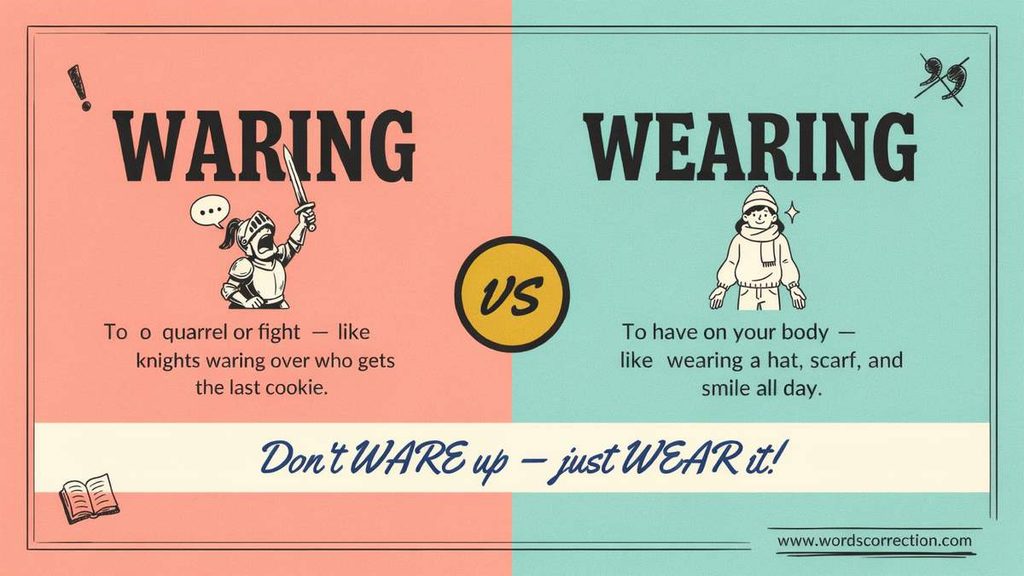
The synonyms of wearing depend on its meaning. Since the word has several uses, no single replacement works in every sentence.
For example, dressed in works when discussing clothes, while exhausting works when describing something tiring.
Synonyms of Wearing When Referring to Clothing
| Synonym or alternative | Meaning | Example |
|---|---|---|
| Dressed in | Having particular clothes on | She was dressed in a blue gown. |
| Clad in | Covered or dressed in something | He was clad in a warm coat. |
| Attired in | Wearing particular clothing | The guests were attired in formal outfits. |
| Donning | Putting on clothing or equipment | The workers were donning safety helmets. |
| Sporting | Informally wearing something noticeable | He was sporting a new jacket. |
These alternatives aren’t always interchangeable. For instance, donning emphasizes the action of putting something on, while wearing generally describes having it on.
Synonyms of Wearing When Referring to Exhaustion
| Synonym | Meaning | Example |
|---|---|---|
| Exhausting | Causing significant tiredness | The trip was exhausting. |
| Draining | Reducing physical or emotional energy | The discussion was draining. |
| Tiring | Making someone feel tired | It was a tiring day. |
| Fatiguing | Causing fatigue | The repetitive task was fatiguing. |
| Taxing | Requiring considerable effort | The assignment was mentally taxing. |
| Demanding | Requiring a lot of energy or attention | It was a demanding week. |
Choose synonyms according to context. Replacing wearing with exhausting in a sentence about a dress would completely change the meaning.
Learn the difference between commonly misused words
Tetroxide vs Tetraoxide Which Spelling Is Correct?
Why Do People Confuse Waring vs Wearing?
The confusion between Waring vs Wearing usually comes from their similar appearance and pronunciation. Only one letter separates the two spellings, making it easy to overlook the difference while typing.
However, several other factors can contribute to this common spelling confusion.
Similar Pronunciation
In many English accents, Waring vs wearing can sound very similar. Some speakers may pronounce them almost identically.
This creates a problem when people rely on hearing rather than spelling.
For example, someone might hear a sentence such as “She is wearing a coat” and remember the sound without remembering the exact spelling.
The solution is to connect the word with its base form. Once you recognize wear, the correct spelling becomes easier to remember.
Missing the Letter E
The difference between the two spellings is small
- Waring
- Wearing
However, that extra E matters.
The correct formation follows this pattern
Wear + ing = Wearing
The word wear already contains the letter E. You keep that letter when adding -ing.
A similar spelling pattern appears in other English verbs
- Hear → Hearing
- Fear → Fearing
- Clear → Clearing
- Appear → Appearing
These examples reinforce the spelling pattern. You don’t remove the E simply because you’re adding -ing.
Typing Errors and Autocorrect
Fast typing can lead to accidental spelling mistakes. Sometimes, a writer leaves out a letter without noticing it.
Autocorrect doesn’t always solve the problem. It may recognize an unusual name or word as valid even when that word doesn’t fit the sentence.
For example, a spellchecker might not flag Waring if it appears in a name database. However, that doesn’t mean it belongs in a sentence about clothing.
Always review the meaning of the sentence rather than trusting an automated correction tool completely.
Translation Interference
People who learn English as an additional language sometimes transfer spelling or sentence patterns from their first language.
This can lead to confusion between words that sound similar but have different written forms.
The best approach is to learn the complete word rather than memorize its pronunciation alone.
For example, remember the relationship between
- Wear: the base verb.
- Wearing: the present participle.
- Wore: the simple past tense.
- Worn: the past participle.
Understanding these forms makes the spelling more logical.
Learn the difference between everyday English mistakes
Accross vs Across Which Is Correct Spelling?
Common Spelling Mistakes to Avoid
Even a small spelling error can change the meaning of a sentence or make your writing look less polished. Here are some common mistakes to watch for when using wearing and related words.
Writing Waring Instead of Wearing
This is the most common mistake in clothing-related sentences.
- Incorrect: My brother is waring a blue shirt.
- Correct: My brother is wearing a blue shirt.
Always use wearing when you describe clothes or accessories that someone has on.
Confusing Wearing With Warring
The words wearing and warring have different meanings.
Warring is the present participle of war. It describes fighting, conflict, or opposing groups involved in a dispute.
Examples
- The two warring countries signed an agreement.
- The warring groups refused to negotiate.
- Several warring factions controlled different areas.
Compare the words
| Word | Root word | Meaning |
|---|---|---|
| Wearing | Wear | Having something on the body |
| Warring | War | Fighting or engaging in conflict |
| Waring | Waring | Primarily a surname or rare historical form |
Remember: wearing relates to clothes or gradual exhaustion, while warring relates to conflict.
Using the Wrong Verb Form
Another common mistake involves mixing up wear, wore, worn, and wearing.
Consider these sentences
- Incorrect: Yesterday, she wearing a red dress.
- Correct: Yesterday, she wore a red dress.
- Incorrect: He has wore these shoes before.
- Correct: He has worn these shoes before.
- Incorrect: They are wear their uniforms.
- Correct: They are wearing their uniforms.
Each verb form has a specific grammatical role. Choosing the correct one is just as important as choosing the correct spelling.
Assuming Every Dictionary Word Fits Every Sentence
A word can exist in English without being suitable for every situation.
For example, Waring may appear in a surname or historical reference. That doesn’t make it an acceptable replacement for wearing.
Always consider three things
- What does the word mean?
- What grammatical role does it perform?
- Does it make sense in the sentence?
These questions can prevent many common English spelling mistakes.
Learn the difference between more words people mix up
Present vs Presant which one is Correct?
How to Remember the Correct Spelling of Wearing
Remembering the correct spelling doesn’t require complicated grammar rules. A simple connection between the root word and its -ing form can solve the problem.
Remember the Base Word Wear
Start with the verb wear. When you add -ing, you get wearing.
Wear + ing = Wearing
The original E stays in the word. That’s the easiest spelling trick to remember.
Connect Wearing With Clothing
Think about familiar items
- Wearing a shirt.
- Wearing shoes.
- Wearing a jacket.
- Wearing sunglasses.
- Wearing a school uniform.
Whenever you picture someone having clothing or accessories on their body, remember the spelling wearing.
Keep Waring Separate as a Name
Think of Waring as a person’s surname.
For example
“Mr. Waring is wearing a black jacket.”
This sentence includes both forms and demonstrates their different functions.
- Waring: Identifies the person.
- Wearing: Describes what the person has on.
Use the Three-Word Memory Trick
Remember these three forms
- Waring: A surname or rare historical form.
- Wearing: Having something on or causing tiredness.
- Warring: Fighting or being involved in conflict.
This quick comparison makes it easier to select the correct spelling.
Learn the difference between confusing more English words step by step
Moment vs Momment Which Spelling Is Correct?
Practice Session Waring vs Wearing vs Warring
Choose the correct word to complete each sentence. This exercise will help you understand the spelling, meaning, and usage of Waring, Wearing, and Warring.
- She is ______ a beautiful red dress today.
- The long working hours are ______ me out.
- The correct spelling is ______, not Waring, when referring to clothes.
- The two ______ groups refused to make peace.
- The medicine’s effects are slowly ______ off.
- He was ______ his favorite pair of shoes.
- The conflict between the ______ nations lasted for years.
- Walking for several hours was very ______.
- She enjoys ______ comfortable clothes.
- The two ______ factions finally reached an agreement.
- The paint on the old wall is ______ away.
- My younger brother is ______ a blue jacket.
- The constant noise is ______ me out.
- The ______ countries continued their disagreement.
- He wore a coat yesterday, but today he is ______ a sweater.
- The excitement is gradually ______ off.
- The correct word for groups involved in conflict is ______.
- Wearing is the present participle of the verb ______.
- The tiring journey was extremely ______.
- The soldiers belonged to two ______ factions.
- She is ______ a new pair of glasses.
- The effects of the treatment are ______ off.
- The word ______ describes people involved in fighting.
- I am ______ my favorite outfit to the party.
- The difficult experience was mentally ______.
Answers
- Wearing
- Wearing
- Wearing
- Warring
- Wearing
- Wearing
- Warring
- Wearing
- Wearing
- Warring
- Wearing
- Wearing
- Wearing
- Warring
- Wearing
- Wearing
- Warring
- Wear
- Wearing
- Warring
- Wearing
- Wearing
- Warring
- Wearing
- Wearing
Here’s a trusted source for clear word meanings:
Cambridge Dictionary
FAQs
Is it Waring vs Wearing?
Wearing is the correct spelling in standard English when referring to putting on clothes, shoes, or accessories. Waring is generally considered a misspelling when used in this context.
What does the word Waring mean?
Waring is not a standard English word with an established meaning related to clothing or exhaustion. However, it may appear as a surname, brand name, or other proper noun.
Is it Wearing or Waring Off?
“Wearing off” is the correct expression. It describes something gradually losing its effect, strength, or intensity. For example, “The medicine’s effects are wearing off.”
Is it Wearing or Waring Me Out?
“Wearing me out” is the correct expression. It means making someone feel extremely tired or exhausted. For example, “The demanding work schedule is wearing me out.”
How Do You Spell Waring Correctly?
If you are referring to putting on clothes or something gradually losing its effect, the correct spelling is usually “wearing.” Waring is not the standard spelling for these meanings.
Is Waring a Real English Word?
Waring is not a standard English vocabulary word used to describe wearing clothes or becoming tired. However, it can appear as a proper noun, surname, or brand name.
What Does Wearing Mean in English?
Wearing is the present participle of the verb “wear.” It refers to having clothes, shoes, or accessories on your body. It can also function as an adjective describing something that causes physical or mental exhaustion.
Is It Warring or Waring?
Warring is the correct spelling when referring to conflict, fighting, or opposing groups. Waring is not the standard spelling of this word.
What Does Warring Mean?
Warring describes individuals, countries, or groups involved in conflict or fighting. For example, “The warring nations eventually agreed to negotiate a peaceful settlement.”
How Do You Use Warring in a Sentence?
Warring is used to describe groups, individuals, or nations engaged in conflict or disagreement. For example, “The two warring groups struggled to reach a peaceful agreement.”
What Does Waringly Mean?
Waringly is not a recognized standard English adverb. It is generally considered a nonstandard word formation or misspelling rather than an accepted term in everyday English.
What Is the Difference Between Wearing and Warring?
Wearing refers to putting on clothes or describes something that causes exhaustion, whereas warring relates to fighting, conflict, or opposition. Both are correctly spelled words with different meanings and uses.
How Do You Pronounce Warring?
Warring is generally pronounced with two syllables, with the first syllable receiving the stress. Its pronunciation begins with the same sound as “war” and ends with the sound of “ring.”
How Do You Pronounce Waring?
Waring can have different pronunciations depending on whether it is used as a surname, brand name, or proper noun. Its pronunciation may vary according to personal or regional preferences.
What Are Warring Groups?
Warring groups are two or more organizations, communities, or factions involved in conflict with one another. The expression is commonly used in historical, political, and social contexts.
Is Wearing a Verb or an Adjective?
Wearing is primarily the present participle of the verb “wear.” It can also function as an adjective when describing something that causes physical or mental tiredness, such as a demanding experience.
What Are the Synonyms of Wearing?
When referring to clothing, synonyms and related expressions include dressed in, clothed in, and having on. When describing exhaustion, suitable alternatives include tiring, exhausting, draining, and demanding.
What Is the Difference Between Wear, Wore, and Wearing?
Wear is the base form of the verb, wore is its simple past tense, and wearing is its present participle. For example: “I wear a coat,” “I wore a coat,” and “I am wearing a coat.”
Can Wearing Mean Something Is Exhausting?
Yes, wearing can describe an activity, experience, or situation that causes physical or mental exhaustion. For example, “Working long hours every day can be very wearing.”
What Does Wearing Off Mean?
Wearing off means gradually losing strength, effectiveness, or intensity. It is commonly used when describing the fading effects of medicine, excitement, emotions, or other experiences. For example, “The excitement started wearing off after a few hours.”
What Is the Past Tense of Wearing?
The simple past tense of the verb “wear” is “wore,” while its past participle is “worn.” Wearing is the present participle. For example, “She wore a blue dress yesterday.”
What Are Some Examples of Wearing in Everyday English?
Here are three examples of wearing in everyday sentences
- She is wearing a beautiful dress.
- He is wearing his favorite pair of shoes.
- Working long hours can be very wearing.
Why Do People Confuse Waring vs Wearing?
People often confuse Waring vs Wearing because their spellings and pronunciations are similar. However, wearing contains an additional “e” and is the correct spelling when referring to clothing or something that causes exhaustion.
Is Warring Related to War?
Yes, warring is derived from the word “war” and describes individuals, groups, or nations involved in fighting or conflict. For example, “The warring factions eventually signed a peace agreement.”
How Can I Remember the Difference Between Waring, Wearing, and Warring?
You can remember the differences by focusing on the meaning of each word:
Waring: Generally a misspelling in standard English, although it can be used as a proper name.
Wearing: Refers to putting on clothes or something that causes exhaustion.
Warring: Describes fighting, conflict, or opposing groups.
Learn the difference between commonly confused more words in English
Distress vs Duress what’s the Difference?
Conclusion
Understanding the difference between Waring vs Wearing helps you avoid common spelling mistakes and communicate more clearly. Although these words look similar, they have different meanings and uses. Wearing is the correct word when referring to clothes, accessories, or something you have on your body. Waring, by contrast, is mainly used as a surname and may appear in rare historical contexts.
The easiest way to remember the difference is to connect Wearing with the verb “wear.” A small spelling mistake can change the meaning of your sentence, so always choose your words carefully. With a little practice, you can use both terms correctly and make your writing clearer and more professional.

Stella AJS is an experienced blogger and dedicated English language writer at Words Correction. She turns confusing grammar, word meanings, spelling, and usage into clear, practical insights that readers can easily understand and apply. With a passion for precise and engaging writing, Stella helps readers avoid common language mistakes, strengthen their vocabulary, and communicate with greater clarity and confidence.




