
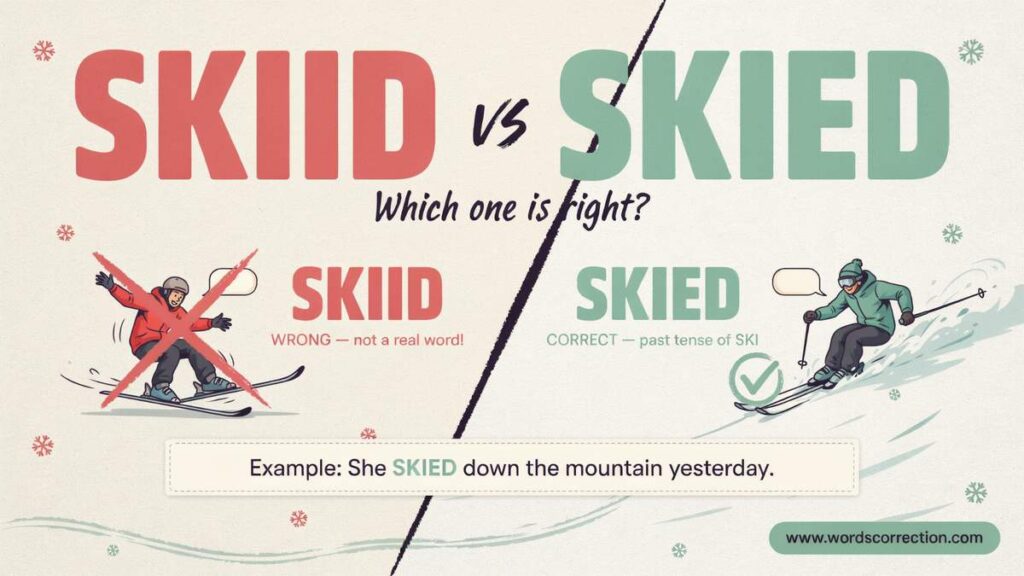
English spelling can sometimes feel like a slippery ski slope. One tiny mistake and your sentence goes downhill fast. The confusion between skiid vs skied is a perfect example. Both spellings may look reasonable at first glance, but only one follows standard English spelling rules. If you’ve ever wondered whether to write “I skiid down the mountain” or “I skied down the mountain,” you’re not alone. The good news is that the correct choice is simple once you understand how the verb “ski” changes in the past tense. Let’s clear up this spelling confusion with easy rules and practical examples.
Skiid vs Skied The Quick Answer
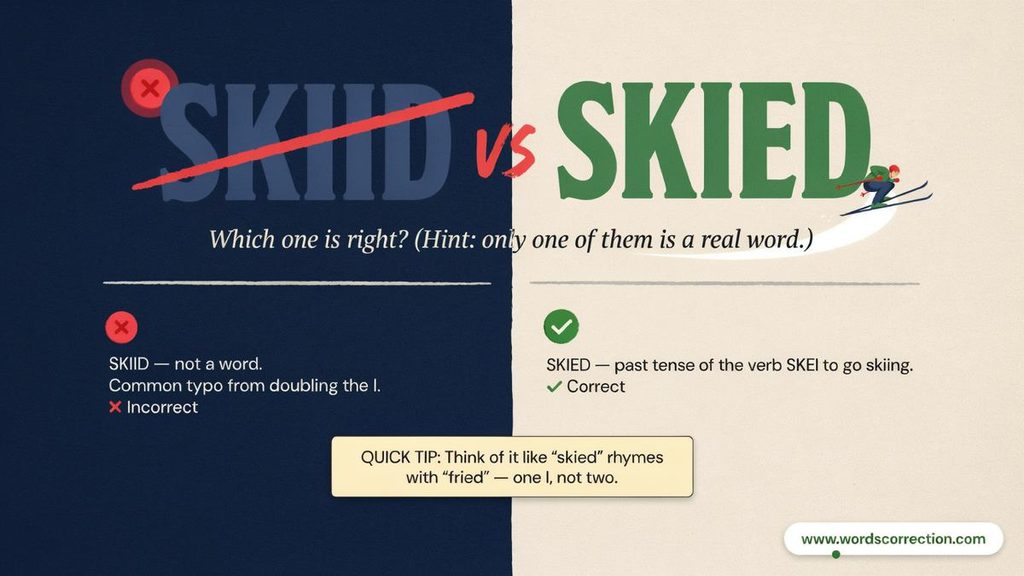
Skied is the correct spelling, while skiid and skiied are incorrect. Use skied when describing an activity that someone completed in the past or when forming a perfect tense.
The verb ski follows the regular pattern of adding -ed to form its simple past tense and past participle.
Consider these examples
- Present: I ski every winter.
- Past: I skied last weekend.
- Past participle: I have skied at several mountain resorts.
- Present participle: I am skiing today.
Notice that skied contains one i followed by e and d. The spelling skiid adds an unnecessary second i. Similarly, skiied contains an extra i that doesn’t belong in the standard past-tense form.
Here’s a quick comparison
| Spelling | Correct or Incorrect? | Explanation |
|---|---|---|
| Skied | Correct | Standard past tense and past participle of ski |
| Skiid | Incorrect | Nonstandard spelling |
| Skiied | Incorrect | Contains an unnecessary extra i |
| Skiing | Correct | Present participle and gerund of ski |
| Ski | Correct | Base form of the verb |
The easiest way to remember the correct form is to follow this simple formula
Ski + ed = Skied
For example
- Correct: We skied down the mountain yesterday.
- Incorrect: We skiid down the mountain yesterday.
- Incorrect: We skiied down the mountain yesterday.
The first sentence follows standard English spelling rules. The other two contain spelling mistakes.
Learn the difference between confusing more English words
Encode vs Incode Which Is Correct?
What Is the Difference Between Skiid vs Skied?
The main difference between skiid vs skied is spelling accuracy. Although people sometimes use these forms interchangeably by mistake, only skied represents the standard past-tense form of the verb ski.
Understanding the difference also requires looking at each form’s meaning and grammatical role.
Skied Meaning and Definition
Skied is the simple past tense and past participle of the verb ski. It describes the action of moving over snow using skis attached to your feet.
According to standard English usage, the word refers to an activity someone performed in the past or an action expressed with an auxiliary verb.
Skied definition: Moved or traveled over snow on skis.
For example
- Sarah skied at a beautiful mountain resort during her winter vacation.
- We skied for five hours before taking a break.
- He has skied in several countries.
- They had skied down the steepest slope before the weather changed.
In each sentence, skied describes an action involving skiing.
The word also appears in different grammatical structures
| Grammatical Form | Example |
|---|---|
| Simple past | She skied yesterday. |
| Present perfect | She has skied before. |
| Past perfect | She had skied that slope previously. |
The word remains skied in all three examples. The auxiliary verbs change the grammatical structure, but the past participle retains the same spelling.
Skiid Meaning and Usage
Is skiid a word? It isn’t a standard English spelling of the past tense of ski.
People sometimes type skiid because they assume the word needs another i before the past-tense ending. However, this assumption doesn’t follow the accepted spelling pattern.
The meaning of skiid is usually understood from context because readers can recognize the intended word. Nevertheless, understanding a spelling mistake doesn’t make it correct.
Consider these examples
- Incorrect: My brother skiid for the first time last year.
- Correct: My brother skied for the first time last year.
- Incorrect: We skiid down the hill together.
- Correct: We skied down the hill together.
- Incorrect: They have skiid at this resort before.
- Correct: They have skied at this resort before.
If you’re writing a school assignment, travel article, professional blog post, or social media update, always choose skied.
A reader might understand skiid, but standard English requires skied.
Skiid vs Skied Comparison Table
The following table summarizes the differences between the two spellings.
| Feature | Skied | Skiid |
|---|---|---|
| Standard spelling | Yes | No |
| Accepted past form | Yes | No |
| Grammatical function | Past-tense verb and past participle | Misspelling |
| Based on the verb ski | Yes | Intended but incorrect |
| Suitable for formal writing | Yes | No |
| Accepted in standard English | Yes | No |
| Example | We skied yesterday. | We skiid yesterday. |
The distinction is straightforward: skied is the correct form, while skiid is a spelling error.
Learn the difference between commonly mixed-up more words
Conex or Connex What Is the Difference?
Why Is Skied the Correct Spelling?
The reason skied is correct comes from English verb conjugation. Once you understand how the base form changes, the spelling becomes much easier to remember.
The Basic Rule for Forming the Past Tense of Ski
The verb ski is a regular verb. Regular verbs generally form their simple past tense and past participle by adding -ed to the base form.
For example
| Base Verb | Simple Past | Past Participle |
|---|---|---|
| Walk | Walked | Walked |
| Talk | Talked | Talked |
| Jump | Jumped | Jumped |
| Clean | Cleaned | Cleaned |
| Ski | Skied | Skied |
The same basic process applies to ski.
Follow these steps
- Start with the base form: ski.
- Add the past-tense ending: -ed.
- Combine the letters: skied.
This produces the correct past tense of ski.
One important detail deserves attention: English spelling doesn’t always look predictable when you add a suffix. Some combinations appear unusual, but that doesn’t make them incorrect.
For instance, skied might look strange because the letters i and e appear together. However, this combination is perfectly acceptable in standard English.
Why Skied Has One I Before the E
The word skied contains one i because the base verb ski already has one i. You simply add the past-tense ending -ed.
The result is
- Ski + ed = skied.
- Ski + ing = skiing.
The second example produces two consecutive i’s because the base word ends in i and the suffix begins with i.
This difference explains much of the confusion.
Compare the two forms
- Skied: The past-tense ending begins with e.
- Skiing: The present-participle ending begins with i.
The spelling changes because the suffixes differ. There’s no reason to add an extra letter to skied.
Why Skiid Is Incorrect
The spelling skiid incorrectly inserts an additional i before the past-tense ending.
Writers sometimes assume that because skiing contains two i’s, its past-tense version should also contain two. However, this reasoning overlooks the difference between the suffixes -ed and -ing.
Consider the following forms
- Ski already contains one i.
- Adding -ed produces skied.
- Adding -ing produces skiing.
The extra i in skiid doesn’t serve a grammatical purpose. It isn’t required for pronunciation or verb conjugation.
That’s why standard English uses skied rather than skiid.
Learn the difference between tricky grammar more words
Encorporate vs Incorporate Which Spelling Is Correct?
How to Use Skied Correctly in a Sentence
Knowing the correct spelling is only the first step. You also need to understand where skied belongs in a sentence.
It can function as a simple past-tense verb or a past participle, depending on the sentence structure.
Skied as the Simple Past Tense
Use skied when describing an action that happened and finished in the past.
The simple past tense works particularly well with expressions such as
- Yesterday
- Last week
- Last winter
- Two days ago
- During my vacation
- When I was younger
For example
- We skied at a beautiful resort last winter.
- My parents skied together during their honeymoon.
- Daniel skied down the steep slope yesterday.
- I skied for the first time when I was twelve.
- They skied across the mountain before sunset.
Each sentence describes a completed activity.
A useful grammar tip: Don’t use the base form ski when your sentence clearly describes a completed past action.
| Incorrect | Correct |
|---|---|
| She ski yesterday. | She skied yesterday. |
| We ski last weekend. | We skied last weekend. |
| He ski down the mountain. | He skied down the mountain. |
| They ski during their vacation last year. | They skied during their vacation last year. |
The past-time expression helps establish when the action happened. The verb must match that time.
Skied as a Past Participle
The past participle of ski is also skied. It works with auxiliary verbs such as have, has, and had to create perfect tenses.
Although the spelling stays the same, the auxiliary verb changes the grammatical structure.
Present perfect tense
Use has or have with skied to describe a past activity connected to the present.
Examples
- I have skied in Colorado several times.
- She has skied on some of the world’s most famous slopes.
- We have skied together for many years.
Past perfect tense
Use had skied when one past activity happened before another past event.
Examples
- We had skied for three hours before the snowstorm started.
- He had skied on that mountain before joining the competition.
- They had skied all morning when the resort closed.
Here’s a quick comparison
| Tense | Structure | Example |
|---|---|---|
| Simple past | Skied | I skied yesterday. |
| Present perfect | Has/have + skied | I have skied before. |
| Past perfect | Had + skied | I had skied before sunset. |
Remember that skied remains unchanged in all these constructions.
Skied in Passive Constructions
Although people usually use skied in active sentences, it can also appear in passive constructions.
A passive sentence places more attention on the action or the person or thing receiving it than on the person performing it.
For example
- The difficult course was skied by several professional athletes.
- The final section of the mountain was skied during the competition.
These sentences are grammatically possible. However, active constructions generally sound more natural in everyday writing
- Several professional athletes skied the difficult course.
- The competitors skied the final section of the mountain.
Use the active voice when you want a direct, clear sentence. Passive voice can work when the course or event deserves more attention than the people skiing it.
Skied in Everyday Conversation
People often use skied when discussing vacations, sports, hobbies, and outdoor activities.
The word doesn’t require a complicated sentence. A simple statement can communicate the entire experience.
Consider these conversational examples
- “I skied all day, and now my legs hurt.”
- “We skied at a small resort near the mountains.”
- “Have you ever skied in deep powder?”
- “My sister skied better than I expected.”
- “They skied until the lifts stopped running.”
These examples sound natural because they use the verb in familiar situations.
Learn the difference between confusing word pairs
Seal vs Seel What Is the Difference?
Ski, Skied, Skiing, and Skis Understanding the Different Forms
The word ski has several grammatical forms. Each one serves a different purpose, and confusing them can create unnecessary spelling and grammar mistakes.
Understanding the relationship between ski, skied, and skiing also explains why skiid and skiied aren’t correct.
Ski: The Base Form
Ski is the base form of the verb. It describes the action of moving over snow using skis.
You can use it with subjects such as I, you, we, and they in the simple present tense.
Examples
- I ski every winter.
- We ski whenever we visit the mountains.
- They ski at a nearby resort.
- You can ski on beginner-friendly slopes.
However, the third-person singular form takes an -s ending.
- She skis every weekend.
- He skis professionally.
- My brother skis during the winter season.
The word ski can also function as a noun. In that context, it refers to one of the long, narrow pieces of equipment attached to a skier’s boots.
For example
- One ski was damaged during the trip.
- He bought a new pair of skis.
Context tells you whether ski refers to the activity or the equipment.
Skied The Past Tense and Past Participle
Skied describes a completed skiing activity or appears with an auxiliary verb in perfect tenses.
Examples
- We skied through the fresh snow.
- She skied down the mountain yesterday.
- I have skied at that resort before.
- He had skied several difficult courses.
The spelling stays the same whether you’re using the simple past or past participle.
Skiing The Present Participle and Gerund
Skiing is the present participle and gerund form of ski.
It contains two consecutive i’s because the base verb ends in i and the suffix -ing begins with i.
You can use skiing in two main ways.
As a present participle
- I am skiing with my friends.
- They were skiing when the weather changed.
- She has been skiing since early morning.
As a gerund
A gerund is a verb form ending in -ing that functions as a noun.
Examples
- Skiing is an exciting winter sport.
- I enjoy skiing with my family.
- Skiing requires balance and coordination.
- Learning skiing takes practice.
This distinction is important because skiing doesn’t follow the same visible spelling pattern as skied.
Skis: The Third-Person Singular Form and Plural Noun
The word skis has two common grammatical uses.
As a verb: It is the third-person singular form of ski.
- My father skis every winter.
- Sarah skis better than her brother.
- The instructor skis down the beginner slope.
As a noun: It is the plural form of ski.
- The shop sells professional skis.
- She cleaned her skis after the trip.
- Their skis were covered in snow.
The surrounding words help you identify the correct meaning.
Ski Verb Forms at a Glance
| Verb Form | Word | Example |
|---|---|---|
| Base form | Ski | I ski every winter. |
| Third-person singular | Skis | He skis regularly. |
| Simple past | Skied | We skied yesterday. |
| Past participle | Skied | I have skied before. |
| Present participle | Skiing | She is skiing now. |
These are the standard ski verb forms. Once you learn them, choosing the correct spelling becomes much easier.
Learn the difference between often confused words
Comming vs Coming Which Spelling Is Correct?
Skiid vs Skied Correct and Incorrect Examples
Examples make spelling rules easier to understand. Instead of memorizing a definition, compare the incorrect form with the correct one and notice how the word works in context.
Here are ten practical examples.
| Incorrect Sentence | Correct Sentence |
|---|---|
| We skiid down the mountain. | We skied down the mountain. |
| She skiid with her friends. | She skied with her friends. |
| I skiid last winter. | I skied last winter. |
| They skiid at the resort. | They skied at the resort. |
| He skiid for the first time. | He skied for the first time. |
| My brother skiid all day. | My brother skied all day. |
| We have skiid together before. | We have skied together before. |
| She had skiid on that slope. | She had skied on that slope. |
| The children skiid near the village. | The children skied near the village. |
| I skiied during my vacation. | I skied during my vacation. |
Notice that the correct form remains skied regardless of the subject or tense.
More Skied Examples in Different Situations
During a ski vacation
- We skied in the mountains throughout our vacation.
- My family skied every morning before lunch.
- They skied at a popular resort in Switzerland.
During a competition
- The athlete skied through the course in record time.
- She skied confidently during the final round.
- Several competitors skied down the challenging slope.
When describing personal experiences
- I skied for the first time last December.
- My friends have skied in the Alps.
- He skied with his father when he was younger.
In travel writing
- Visitors skied across the snowy mountain trails.
- We skied through fresh powder during our winter trip.
- The group skied from the upper slopes to the village.
These examples show how skied fits naturally into different types of writing.
Learn the difference between basic English word mistakes
Triple vs Tripple Which Spelling Is Correct?
Why Do People Misspell Skied as Skiid or Skiied?
The confusion surrounding Skiid vs Skied doesn’t come from a complicated definition. Instead, it comes from the unusual appearance of the word and the way English spelling patterns work.
English has many spelling rules, and learners sometimes apply one pattern to words that follow another. This is exactly what happens with Skiid vs Skied. Some people assume that adding an extra “i” makes the spelling look more natural, while others are unsure how to form the past tense of ski. However, skied is the only correct standard spelling.
Pronunciation Can Cause Spelling Confusion
Pronunciation doesn’t always reveal the correct spelling of a word. This is another reason why Skiid vs Skied can confuse English learners.
For example, skied is pronounced with a long e sound followed by a d sound. This pronunciation may make the word seem as though it needs an extra letter. However, English spelling depends on established word forms rather than simply representing every sound with additional letters.
The standard pronunciation of skied in its skiing-related meaning is /skiːd/.
It rhymes with words such as
- Seed
- Need
- Feed
- Speed
Although its spelling might look unusual, the pronunciation is straightforward. Understanding this difference makes Skiid vs Skied easier to remember and helps prevent common spelling mistakes.
Remember that skied is formed by adding -ed to ski. You do not need to add another “i.” Once you understand this simple rule, the confusion between Skiid vs Skied becomes much easier to avoid.orward.
Confusion With the Word Skiing
This is one of the easiest sources of confusion to understand.
Look at these words
- Skiing
- Skied
Both come from the same base verb. However, they use different endings.
Skiing contains two i’s because the suffix -ing begins with i.
Skied contains one i because the past-tense form adds -ed.
A useful comparison
| Word | Formation |
|---|---|
| Skied | Ski + ed |
| Skiing | Ski + ing |
Once you recognize the different suffixes, the spelling becomes easier to remember.
Adding Extra Letters Based on Sound
Some writers add extra letters because they think the word needs to represent a particular sound.
This can happen when someone learns English spelling through pronunciation alone.
However, spelling and pronunciation don’t always match letter for letter. The correct form of a word depends on accepted English spelling conventions.
For instance, skied already contains the necessary letters. Adding another i doesn’t improve its pronunciation or make its grammar more accurate.
The Unusual Appearance of Skied
Some words look familiar because you see them frequently. Others look strange simply because they’re less common.
The word skied falls into the second category for people who don’t regularly read about winter sports.
When you encounter a word like skied, you might expect a different spelling because the final combination of letters looks unfamiliar.
Still, unusual appearance doesn’t mean incorrect spelling.
The same principle applies to many English words. Their accepted forms aren’t always the ones that look most predictable.
Confusion With Other English Spelling Rules
English contains several suffix rules that can influence how people form past-tense verbs.
For example
| Base Form | Past Tense |
|---|---|
| Try | Tried |
| Cry | Cried |
| Carry | Carried |
| Play | Played |
| Enjoy | Enjoyed |
| Ski | Skied |
Notice that verbs ending in a consonant followed by y often change the y to i before adding -ed.
However, ski already ends in i. It doesn’t need that transformation.
This is why writing skiied by analogy with tried is incorrect.
Autocomplete and Spellcheck Can Reinforce Mistakes
Typing quickly can create spelling errors, especially when a word isn’t part of your everyday vocabulary.
A writer might enter skiid or skiied without noticing the extra letter. Depending on the software and its dictionary, spellcheck may flag the mistake or fail to catch it.
For important writing, don’t depend entirely on automatic corrections.
A dictionary provides a more reliable way to confirm unfamiliar word forms.
Learn the difference between commonly misused words
Vinal vs Vinyl Which Spelling Is Correct?
Common Mistakes to Avoid When Using Skied
Even after learning the correct spelling, you might make mistakes when using skied in different sentence structures.
Here are some common problems and how to avoid them.
| Common Mistake | Correct Usage | Reason |
|---|---|---|
| Skiid | Skied | Incorrect extra i |
| Skiied | Skied | Incorrect double-i spelling |
| She ski yesterday. | She skied yesterday. | Missing past-tense ending |
| He has ski before. | He has skied before. | Requires the past participle |
| They was skied yesterday. | They skied yesterday. | Incorrect auxiliary construction |
| She is skied now. | She is skiing now. | Continuous action requires -ing |
Keep these points in mind
- Use skied for completed past actions.
- Use has skied or have skied for present perfect constructions.
- Use had skied for past perfect constructions.
- Use skiing for continuous actions.
- Use ski for the base form.
- Never add an unnecessary i to skied.
A quick review before publishing an article or submitting an assignment can prevent these mistakes.
Learn the difference between everyday English mistakes
Rug vs Rag What Is the Difference?
Skied vs Went Skiing Which Expression Sounds More Natural?
Both skied and went skiing are correct English expressions. They describe the same general activity, but they can place slightly different emphasis on the experience.
Understanding the difference will help you choose the expression that sounds most natural in a particular situation.
When to Use Skied
Use skied when you want to describe the action directly.
It’s short, clear, and especially useful when discussing a specific skiing activity or performance.
Examples
- We skied down the mountain.
- She skied for six hours.
- The athletes skied through the final course.
- I skied with my cousins last winter.
This form works well in sports reports, travel stories, personal accounts, and everyday conversations.
When to Use Went Skiing
Use went skiing when describing an outing or trip for the purpose of skiing.
This expression often focuses on the overall activity or experience rather than a particular movement.
Examples
- We went skiing during our winter vacation.
- My family went skiing last weekend.
- They went skiing in Colorado.
- I went skiing with my friends for the first time.
Both expressions are natural. The choice depends on what you want to emphasize.
Skied vs Went Skiing Example Comparison
| Skied | Went Skiing |
|---|---|
| We skied yesterday. | We went skiing yesterday. |
| She skied in the Alps. | She went skiing in the Alps. |
| They skied during their vacation. | They went skiing during their vacation. |
| He skied with his friends. | He went skiing with his friends. |
Which should you choose?
Use skied when focusing on the action itself. Choose went skiing when talking about an outing or recreational experience.
Neither expression is grammatically superior in every situation.
Learn the difference between more words people mix up
Tetroxide vs Tetraoxide Which Spelling Is Correct?
Is Skied Grammatically Correct in American and British English?
Yes. Skied is the standard past-tense and past-participle spelling in both American and British English.
Unlike some words that have different spellings across English varieties, this word doesn’t change between the two.
For example
- American English: We skied in Colorado last winter.
- British English: We skied in the Scottish Highlands last winter.
Both sentences use the same spelling.
The standard forms are
| English Variety | Correct Past Tense | Correct Present Participle |
|---|---|---|
| American English | Skied | Skiing |
| British English | Skied | Skiing |
| Canadian English | Skied | Skiing |
| Australian English | Skied | Skiing |
Therefore, you don’t need to change the spelling depending on your audience.
How to Remember the Correct Spelling of Skied
Remembering the spelling becomes much easier when you connect the word to its base form.
Instead of memorizing skied as a completely separate word, think about how it develops from ski.
Use the Simple Spelling Formula
The easiest memory trick is:
SKI + ED = SKIED
The base word already contains one i. Add the past-tense ending -ed without inserting another letter.
Keep this formula in mind whenever you write about a completed skiing activity.
Don’t Copy the Pattern From Skiing
One of the biggest spelling mistakes comes from transferring the double-i pattern in skiing to skied.
Remember
- Skiing = Ski + ing
- Skied = Ski + ed
The suffix determines the final spelling.
Look at the Verb Form
Before choosing a spelling, identify the action’s tense.
Ask yourself
- Is the action happening now? Use ski or skiing, depending on the sentence.
- Did the action happen in the past? Use skied.
- Does the sentence require a past participle? Use skied.
- Are you talking about the equipment? Use ski or skis, depending on the number.
This simple check can prevent several common grammar mistakes.
Check the Auxiliary Verb
Auxiliary verbs provide another useful clue.
For example
- I have skied before.
- She had skied that mountain.
- They are skiing today.
- He will ski tomorrow.
The auxiliary verb helps determine which form belongs in the sentence.
Learn the difference between tricky English words with easy explanations
Accross vs Across Which Is Correct Spelling?
A Practical Case Study Choosing Between Skiid, Skied, and Skiing
Consider a simple situation.
Emma writes a short travel blog about her winter vacation. She wants to describe her experience at a mountain resort.
Her original paragraph reads
“Last winter, I skiid with my friends. We were skiing every morning and enjoyed the beautiful mountain views. I have skiied at other resorts before, but this was my favorite trip.”
The paragraph communicates the experience clearly, but it contains two spelling mistakes.
Here’s the corrected version
“Last winter, I skied with my friends. We went skiing every morning and enjoyed the beautiful mountain views. I have skied at other resorts before, but this was my favorite trip.”
What changed?
- Skiid became skied because the simple past tense requires the standard form.
- Skiied became skied because an extra i doesn’t belong in the past participle.
- Skiing remained unchanged because it correctly describes the ongoing activity.
This example demonstrates an important point: you don’t need to change every form of the word just because one spelling is incorrect.
Each form has its own grammatical purpose.
What Does “Skied It” Mean in Football?
The expression skied it can have another meaning in sports, particularly soccer.
In soccer, when someone says a player skied it, they usually mean the player kicked the ball too high. The shot may fly over the crossbar instead of reaching the goal.
For example
- He had a clear chance to score but skied it over the goal.
- The striker skied the penalty into the stands.
- She skied her final shot during the match.
This usage comes from the verb sky, which can mean to send or hit something high into the air.
Interestingly, skied is also the past tense of sky. Therefore, the word has two possible meanings depending on context
| Meaning | Example |
|---|---|
| Past tense of ski | We skied down the mountain. |
| Past tense of sky | The striker skied the ball over the crossbar. |
The spelling is identical, but the pronunciation and meaning differ.
In the skiing context, skied is pronounced /skiːd/. In the sports expression derived from sky, it is pronounced /skaɪd/.
This distinction is useful because the surrounding sentence tells you which verb the writer intends.
Practice Session about Skiid vs Skied
Test your understanding of the correct spelling, meaning, and grammatical usage of Skiid vs Skied. Complete each sentence with the appropriate word.
- She ______ down the snowy mountain last winter.
- The correct past tense of ski is ______.
- We ______ at a beautiful ski resort during our vacation.
- He has ______ on several mountain slopes.
- My brother ______ for the first time last year.
- They ______ together during their winter holiday.
- I have never ______ on such a steep mountain.
- Sarah ______ through the snow with great confidence.
- The children ______ all afternoon yesterday.
- My parents ______ in the Alps last winter.
- He enjoys ______ during the winter season.
- The correct plural form of ski is ______.
- The spelling ______ is incorrect in standard English.
- She has ______ since she was a teenager.
- We ______ on fresh snow early in the morning.
- The past participle of ski is ______.
- He said that he had ______ before.
- They went ______ during their holiday.
- The correct spelling is skied, not ______.
- My friends ______ down the hill yesterday.
- Ski becomes ______ when written in the simple past tense.
- She loves ______ in the mountains.
- The word ______ describes someone who traveled on skis in the past.
- He has ______ at many famous ski destinations.
- Remember that ______ is the correct past-tense form of ski.
Answers
- Skied
- Skied
- Skied
- Skied
- Skied
- Skied
- Skied
- Skied
- Skied
- Skied
- Skiing
- Skis
- Skiid
- Skied
- Skied
- Skied
- Skied
- Skiing
- Skiid
- Skied
- Skied
- Skiing
- Skied
- Skied
- Skied
Here’s a trusted source for clear word meanings:
Cambridge Dictionary
FAQs
Is it Skiid vs Skied?
Skied is the correct spelling in standard English. It is the simple past tense and past participle of the verb ski. The spelling skiid is incorrect and should be avoided in formal and informal writing.
What does the word Skied mean?
Skied means to have traveled or moved over snow using skis. It describes a completed skiing activity, usually performed on a snowy slope or mountain.
Is Skied a valid Scrabble word?
Yes, skied is an accepted word in Scrabble. It is the past-tense form of ski and can be used in word games according to standard dictionary rules.
What is the past tense of Ski?
The past tense of ski is skied. It follows the regular English spelling pattern of adding -ed to the base verb. For example, “We skied in the mountains last winter.”
Is Skiied a correct spelling?
No, skiied is not the standard English spelling. The correct form is skied, with one i followed by -ed. Adding another i creates a spelling error.
Is Skiid a recognized English word?
No, skiid is not recognized as the standard past-tense form of ski. It is a common spelling mistake. The correct spelling is skied.
Why is Skied spelled with one I?
The verb ski forms its past tense by adding -ed directly to the base word. This produces skied, not skiied. The spelling follows the regular English verb-ending pattern.
How do you pronounce Skied?
Skied is pronounced as one syllable, rhyming with tried, cried, and dried. Its pronunciation is straightforward, although its spelling may confuse English learners.
What is the difference between Ski and Skied?
Ski is the base form of the verb, while skied is its simple past tense and past participle. Use ski when discussing the activity generally and skied when referring to a completed action.
Is Ski a regular or irregular verb?
Ski is a regular English verb because it forms its simple past tense and past participle by adding -ed. Therefore, both forms are spelled skied.
What is the past participle of Ski?
The past participle of ski is skied. It is commonly used with auxiliary verbs such as has, have, and had. For example, “She has skied in several European countries.”
What is the difference between Skied and Skiing?
Skied refers to a completed skiing action, whereas skiing describes an ongoing activity or the sport itself. For example, “He skied yesterday” and “He enjoys skiing.”
How do you use Skied in a sentence?
Use skied when describing an activity that happened in the past. For example, “My family skied in the mountains during our winter vacation.” It clearly indicates that the skiing activity has already taken place.
Is Skied grammatically correct?
Yes, skied is grammatically correct and follows standard English spelling rules. It is the accepted past-tense and past-participle form of ski and is appropriate for both formal and informal writing.
What is the plural form of Ski?
The plural form of ski is skis. It refers to two or more pieces of equipment used for traveling over snow. The spelling skiis is incorrect in standard English.
Is it Skis or Skiis?
Skis is the correct plural spelling. The word is formed by adding -s to ski, without repeating the letter i. Therefore, skiis is a spelling error.
What are the three main forms of the verb Ski?
The three main verb forms are ski (base form), skied (simple past), and skied (past participle). Its present participle form is skiing.
Can Skied be used as an adjective?
Yes, skied can function as a participial modifier in certain contexts, although it is primarily used as a verb. Its meaning depends on the sentence structure and the word it modifies.
What is the difference between Skied and Skid?
Skied is the past tense of ski and refers to traveling over snow using skis. Skid is a different word that describes sliding or slipping, often because of reduced traction or control.
Is Skidded the past tense of Skid?
Yes, skidded is the correct simple past tense and past participle of skid. It describes an action in which something slides or slips, often unintentionally. For example, “The car skidded on the wet road.”
Does Ski follow the regular English past-tense rule?
Yes, ski follows the regular English past-tense formation rule. Adding -ed to the base verb creates skied. There is no need to double the final letter or add another i.
What is the difference between Skied and Skis?
Skied is a verb form that describes an action completed in the past, while skis is a plural noun referring to the equipment used in skiing. The correct choice depends on whether you are describing an action or naming an object.
Can Skied be used in the present perfect tense?
Yes, skied is used in the present perfect tense with has or have. For example, “I have skied on several mountain slopes.” This tense connects a past activity with the present.
What are the most common spelling mistakes involving Skied?
The most common spelling mistakes include skiid and skiied. Both forms are incorrect in standard English. Remember that skied is the correct past-tense spelling of ski.
What is the opposite of Skied?
There is no direct antonym for skied because it describes a specific sporting activity. Depending on the context, alternatives such as walked, hiked, or stayed off the slopes may express a different activity.se and past-participle form of ski.
Learn the difference between tricky more English words
Present vs Presant which one is Correct?
Conclusion
Understanding the difference between Skiid vs Skied is easy once you know the correct spelling rule. Skied is the standard past tense and past participle of the verb “ski,” while “skiid” is an incorrect spelling. The spelling rule behind Skiid vs Skied is simple: when you add “-ed” to “ski,” the word becomes “skied.” Remembering this small detail can help you avoid a common spelling mistake and write with greater confidence. So, the next time you describe a trip down a snowy mountain, choose “skied.” Skiid vs Skied is a small spelling challenge, but getting it right shouldn’t be an uphill battle. Skiing may test your balance, but correct spelling is easy to master.

Stella AJS is an experienced blogger and dedicated English language writer at Words Correction. She turns confusing grammar, word meanings, spelling, and usage into clear, practical insights that readers can easily understand and apply. With a passion for precise and engaging writing, Stella helps readers avoid common language mistakes, strengthen their vocabulary, and communicate with greater clarity and confidence.




