
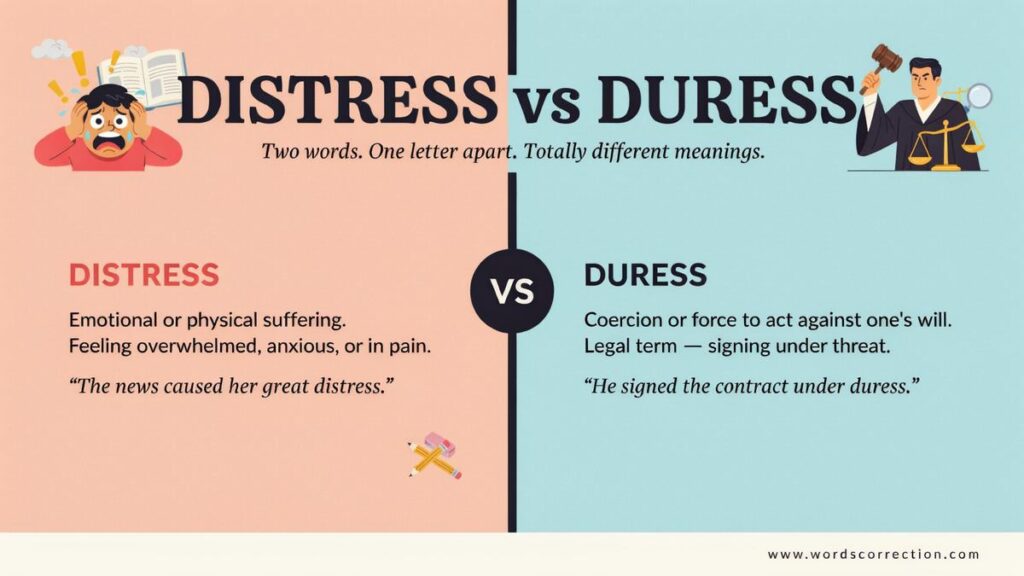
Distress vs duress may look and sound similar, but they have different meanings. Mixing them up can easily confuse your readers or change the meaning of a sentence. One describes a state of suffering, while the other refers to pressure or force that makes someone act against their will. Understanding distress vs duress is important for clear communication, especially in everyday conversations and legal situations. Although confusing these words won’t cause a grammar disaster, using the wrong one can lead to misunderstandings. Let’s explore their meanings, key differences, examples, and correct usage so you can use both words with confidence.
What Is the Difference Between Distress vs Duress?
The main difference between distress vs duress lies in what each word describes. Distress refers to a state of suffering, hardship, or serious discomfort. Duress refers to coercion, threats, or force that compels someone to do something against their will.
In simple terms
- Distress = Suffering or difficulty.
- Duress = Coercion or forced action.
Consider two situations. A student feels anxious because an important examination is approaching. The student experiences distress because the situation causes emotional pressure and worry.
Now imagine someone threatens that student and forces them to hand over their examination notes. The student may act under duress because a threat has influenced their decision.
The distinction becomes easier when you ask one simple question: Are you describing someone’s suffering or the pressure forcing someone to act?
| Feature | Distress | Duress |
|---|---|---|
| Meaning | Suffering, hardship, or serious discomfort | Coercion, threats, or force |
| Main idea | A difficult condition | Pressure that interferes with free choice |
| Common causes | Emotional, physical, or financial problems | Threats, intimidation, or coercive pressure |
| Part of speech | Noun and verb | Noun |
| Emotional connection | Directly describes suffering | May involve emotional pressure |
| Legal connection | Often relates to injury or suffering | Relates to coercion and consent |
| Common expression | In distress | Under duress |
| Example | She experienced emotional distress. | He signed the agreement under duress. |
Remember: Distress describes what someone experiences. Duress describes the coercive circumstances that pressure someone into an action.
Learn the difference between confusing more English words
Encorporate vs Incorporate Which Spelling Is Correct?
What Is Distress? Meaning, Definition, and Usage
Distress Meaning and Definition
Distress refers to severe discomfort, suffering, anxiety, or hardship. It can describe emotional pain, physical difficulty, financial trouble, or a dangerous situation.
The word functions as both a noun and a verb. As a noun, it identifies a condition of suffering. As a verb, it describes the act of causing someone emotional pain, worry, or discomfort.
For example
- The family experienced financial distress after losing its main source of income.
- The accident caused considerable emotional distress.
- The injured hiker sent a distress signal for help.
- The sudden announcement distressed the employees.
In each example, distress communicates some form of difficulty or suffering. However, its precise meaning depends on the surrounding sentence.
Distress as a Noun
When you use distress as a noun, you’re describing a condition or experience rather than an action.
People commonly use it in emotional, physical, financial, and emergency-related situations.
Emotional Distress
Emotional distress refers to psychological suffering caused by upsetting experiences. These experiences may include grief, relationship problems, family conflict, workplace difficulties, or traumatic events.
Examples
- She experienced emotional distress after losing a close friend.
- Constant criticism caused him considerable emotional distress.
- The unexpected separation left the entire family in distress.
Financial Distress
Financial distress describes serious money-related difficulties. A person, household, or business may experience it when their income, savings, or available resources cannot cover financial obligations.
Examples
- The company entered financial distress after several years of declining sales.
- Rising expenses pushed the family into financial distress.
- The business struggled to pay its suppliers during a period of financial hardship.
Physical Distress
Physical distress describes bodily suffering or serious discomfort. It may occur because of an injury, illness, exhaustion, or an emergency.
Examples
- The rescue team found the climber in physical distress.
- The patient showed signs of respiratory distress.
- The exhausted runner experienced physical distress during the race.
Distress Signals
A distress signal is a message or warning that communicates an urgent need for assistance. Ships, aircraft, and people in dangerous situations may use these signals to request help.
Examples
- The pilot sent a distress signal after discovering an engine problem.
- The stranded boat transmitted a distress call.
- The hikers used a whistle to signal distress.
Distress as a Verb
Unlike duress, distress can also function as a verb. It means to cause someone anxiety, sadness, worry, or emotional suffering.
The verb usually takes a person as its object.
Examples
- The news distressed her deeply.
- His rude comments distressed the entire team.
- The possibility of losing their home distressed the family.
- The sudden change in plans distressed the children.
You can also use related forms such as distressed and distressing.
| Word | Grammatical role | Meaning | Example |
|---|---|---|---|
| Distress | Noun | Suffering or hardship | The patient was in distress. |
| Distress | Verb | To cause suffering | The news may distress him. |
| Distressed | Adjective | Experiencing suffering | She looked distressed. |
| Distressing | Adjective | Causing emotional pain | It was a distressing experience. |
How to Use Distress in Everyday English
Distress appears in everyday conversations because people regularly discuss worry, hardship, discomfort, and difficult experiences.
Here are some natural sentence patterns
- In distress: The child was crying and appeared to be in distress.
- Emotional distress: The argument caused her emotional distress.
- Financial distress: The restaurant closed because of financial distress.
- Distress someone: His careless behavior distressed his parents.
- Distressing experience: Losing a job without warning can be a distressing experience.
Distress doesn’t always describe a permanent condition. Someone may experience temporary distress after receiving upsetting news. Another person may face long-term distress because of ongoing financial or personal difficulties.
The word describes the suffering itself rather than the length of time it lasts.
Learn the difference between commonly mixed-up more words
Seal vs Seel What Is the Difference?
What Is Duress? Meaning, Definition, and Usage
Duress Meaning and Definition
Duress is a noun that describes a situation in which someone uses threats, force, intimidation, or coercive pressure to make another person do something against their will.
Unlike ordinary stress or emotional discomfort, duress involves pressure that interferes with someone’s freedom to choose.
For example, imagine a business owner who signs an agreement because another person threatens to damage the business unless they agree. The owner may have signed the document under duress.
The important point is that the person didn’t make the decision freely.
Examples
- The employee claimed that management forced him to sign the document under duress.
- She gave the statement under duress.
- The witness said that threats forced him to cooperate.
- He refused to accept an agreement obtained through duress.
Duress is primarily a noun. Unlike distress, it doesn’t normally function as a verb in standard modern English. You generally say that someone subjects another person to duress or forces someone to act under duress.
What Does Under Duress Mean?
The expression under duress means acting or making a decision because of threats, force, intimidation, or coercive pressure.
It often appears in legal, professional, and formal conversations.
Examples
- She signed the contract under duress.
- The witness claimed that he made the statement under duress.
- He transferred the money under duress after receiving threats.
- The employee argued that the resignation wasn’t voluntary because the employer placed him under duress.
The phrase emphasizes the circumstances surrounding an action. It suggests that someone faced pressure that interfered with their ability to make a free decision.
However, simply feeling uncomfortable or nervous doesn’t automatically mean someone is under duress.
A demanding deadline may create stress. A difficult conversation may cause emotional distress. Neither situation necessarily involves coercion.
Duress in Everyday English
Although duress appears frequently in legal writing, you can also use it in ordinary conversations.
However, it sounds more formal than words such as pressure, force, or intimidation.
Examples
- He agreed to the proposal under duress.
- She insisted that nobody should make important decisions under duress.
- The employee said that his resignation resulted from duress.
- They believed the agreement resulted from coercive pressure.
In casual conversations, someone might say, “I only agreed because they threatened me.” In a more formal discussion, the same situation might be described as acting under duress.
Emotional Duress and Mental Duress
People sometimes use the expressions emotional duress and mental duress to describe situations involving intense psychological pressure, intimidation, or manipulation.
For example, a person may feel forced to make a decision because someone threatens to reveal private information or harm someone they love.
However, these expressions need careful handling.
Emotional duress isn’t simply another name for emotional distress. Emotional distress describes psychological suffering. Duress emphasizes coercive pressure that influences someone’s actions or decisions.
Similarly, mental duress isn’t a universal clinical diagnosis. In legal discussions, the relevant question is whether the pressure satisfies the applicable legal standard for duress.
Learn the difference between tricky grammar more words
Comming vs Coming Which Spelling Is Correct?
Distress vs Duress Key Differences Explained
Although the two words share a similar appearance, their meanings, grammatical functions, and common applications differ considerably. Looking at these differences individually makes it easier to recognize the correct word in any context.
Meaning and Definition
Distress describes a condition of suffering or hardship. Duress describes coercive pressure that makes someone act against their wishes.
For example
- Distress: The unexpected medical bill caused the family considerable distress.
- Duress: The business owner signed the agreement under duress after receiving threats.
The first sentence describes a difficult experience. The second describes an action influenced by coercion.
Emotional Suffering vs External Coercion
One of the easiest ways to understand the distress vs duress difference is to examine the role of emotions and external pressure.
Distress focuses on the person’s experience. Someone may feel sadness, fear, anxiety, grief, or mental anguish without anyone forcing them to do anything.
Duress focuses on the circumstances that influence someone’s decision. Threats, intimidation, or other improper pressure may interfere with a person’s free choice.
However, the two experiences can overlap. Someone threatened by an aggressive individual may act under duress while also experiencing emotional distress.
Cause and Circumstances
Distress can develop from many different circumstances. Some causes involve other people while others arise from personal or external events.
Common causes include
- Losing a loved one.
- Experiencing financial hardship.
- Facing a serious illness.
- Going through a difficult separation.
- Losing employment.
- Experiencing an accident or natural disaster.
Duress usually involves an external source of coercion or improper pressure.
Examples include
- Threatening someone with physical harm.
- Forcing an employee to sign a document.
- Intimidating a witness into making a statement.
- Using improper threats to obtain money.
- Compelling someone to enter an agreement against their will.
The distinction matters because a person can experience distress without anyone deliberately causing it. Duress, by contrast, involves coercive circumstances.
Effect on a Person
Distress affects someone’s emotional, mental, or physical well-being. Depending on the circumstances, it may cause anxiety, fear, sadness, sleep difficulties, or other symptoms.
Duress affects someone’s freedom to make decisions. A person may agree to something they would otherwise reject because they fear the consequences of refusing.
For example, an employee who worries about an upcoming performance review may experience distress. An employee who signs a resignation letter after an unlawful threat may have grounds to claim that they acted under duress.
Grammatical Function
Grammar offers another useful way to distinguish these words.
| Grammatical feature | Distress | Duress |
|---|---|---|
| Noun | Yes | Yes |
| Verb | Yes | No, not in ordinary modern usage |
| Adjective form | Distressed, distressing | No common direct adjective form |
| Common preposition | In distress | Under duress |
| Example | The incident distressed her. | He acted under duress. |
One important detail deserves attention: you can write “The incident distressed her” because distress functions as a verb. You cannot normally write “The incident duressed her” in standard English.
Legal Significance
Distress vs duress also appear in legal discussions, but they refer to different concepts.
Emotional distress may form part of a civil claim involving personal injury or harmful conduct. Duress may affect whether someone gave valid consent or entered an agreement voluntarily.
For example, a person may seek compensation for serious emotional suffering caused by another person’s conduct. Another person may challenge a contract because threats forced them to sign it.
The legal requirements depend on the type of claim and the applicable jurisdiction.
Learn the difference between confusing word pairs
Triple vs Tripple Which Spelling Is Correct?
Distress vs Duress Comparison Table
The following table brings together the most important differences for quick reference.
| Feature | Distress | Duress |
|---|---|---|
| Core meaning | Suffering or hardship | Coercion or forced action |
| Part of speech | Noun and verb | Noun |
| Main focus | A person’s condition | Pressure affecting a person’s choices |
| Common causes | Grief, illness, financial problems, accidents | Threats, intimidation, force, coercion |
| Emotional connection | Direct | May occur as a result |
| Physical connection | Can describe physical suffering | Can involve threats of physical harm |
| Financial connection | Financial hardship | Economic coercion |
| Legal application | Emotional suffering and related claims | Consent, contracts, and legal defenses |
| Common expression | In distress | Under duress |
| Verb form | Distress | No common standard verb form |
| Example | She experienced emotional distress. | She signed under duress. |
Distress vs Duress Examples in Sentences
Definitions help you understand the words, but examples show how they work in real communication. The following sentences demonstrate the correct usage of both terms.
Examples of Distress
| Sentence | Explanation |
|---|---|
| The family experienced emotional distress after the accident. | Describes psychological suffering. |
| The company faced financial distress during the recession. | Describes serious financial difficulty. |
| The injured passenger was in distress. | Describes physical suffering or an emergency. |
| The news distressed her deeply. | Uses distress as a verb. |
| The documentary showed the distress of displaced families. | Describes personal suffering. |
| The patient appeared visibly distressed. | Uses distressed as an adjective. |
| The captain sent a distress signal. | Describes an emergency request for help. |
| The incident was deeply distressing for everyone involved. | Uses distressing to describe something upsetting. |
Examples of Duress
| Sentence | Explanation |
|---|---|
| He signed the agreement under duress. | Threats or coercion influenced his decision. |
| The witness claimed that someone forced him to testify under duress. | Describes a statement allegedly obtained through coercion. |
| She refused to make a decision under duress. | She wanted to avoid coercive pressure. |
| The employee alleged that management forced her resignation under duress. | Describes an allegedly involuntary resignation. |
| The victim transferred the money under duress. | The transfer resulted from coercive pressure. |
| The court examined whether the agreement resulted from duress. | Refers to a legal issue involving consent. |
| He argued that his confession was made under duress. | Describes an allegedly coerced confession. |
| The company challenged the agreement on grounds of economic duress. | Refers to improper economic pressure. |
Distress vs Duress in Similar Situations
Sometimes, two sentences can describe nearly identical events while communicating different meanings.
Workplace Situation
- Distress: The employee experienced distress after receiving a warning from management.
- Duress: The employee signed the resignation letter under duress after management threatened unlawful consequences.
The first sentence describes emotional suffering. The second describes coercion affecting a decision.
Financial Problems
- Distress: The business entered financial distress after losing several major customers.
- Duress: The business owner signed an unfavorable agreement under duress after receiving improper threats.
Financial difficulty alone doesn’t establish duress. The second situation includes coercive pressure.
Family Conflict
- Distress: The argument caused considerable emotional distress.
- Duress: She agreed to the arrangement under duress after someone threatened her.
The first example focuses on emotional pain. The second focuses on a decision made under coercion.
Legal Documents
- Distress: The legal dispute caused the defendant considerable distress.
- Duress: The defendant claimed that he signed the settlement agreement under duress.
One describes suffering associated with a legal dispute. The other raises a question about whether the agreement resulted from genuine consent.
Learn the difference between often confused words
Vinal vs Vinyl Which Spelling Is Correct?
Distress vs Duress vs Stress What Is the Difference?
The words stress, distress, and duress relate to difficult experiences, but each communicates a different idea.
Stress describes a mental or physical response to demands or challenges. Distress describes suffering or significant discomfort. Duress describes coercive pressure that influences someone’s actions.
For example, preparing for a job interview may create stress. Receiving devastating personal news may cause distress. Being threatened into accepting a job contract may involve duress.
What Does Stress Mean?
Stress is the physical or psychological response to demands, challenges, or changes.
It doesn’t always have a negative meaning. A certain level of stress can motivate someone to prepare for an examination, complete a project, or meet an important deadline.
Examples
- She felt stressed before the interview.
- The approaching deadline increased his stress.
- Regular exercise helped him manage stress.
How Stress Differs From Distress
Stress refers to the response to a demand or challenge. Distress generally emphasizes suffering or an unpleasant state.
For example
- Stress: He felt stressed while preparing for his final examination.
- Distress: He experienced severe distress after learning that he had failed.
Stress can develop into distress when circumstances become overwhelming. However, the words aren’t interchangeable in every sentence.
How Duress Differs From Stress
Stress doesn’t necessarily involve threats or coercion. Duress does.
A demanding workload may cause stress. An employer who uses unlawful threats to force an employee to sign an agreement may create circumstances involving duress.
Comparison Table Stress, Distress, and Duress
| Feature | Stress | Distress | Duress |
|---|---|---|---|
| Basic meaning | Response to demands | Suffering or hardship | Coercion or forced action |
| Emotional connection | Yes | Yes | May involve emotions |
| External pressure | Possible | Possible | Central to the concept |
| Threats required | No | No | Often, depending on the context |
| Legal usage | Common | Common | Particularly important |
| Example | Exam stress | Emotional distress | Signing under duress |
Easy way to remember: Stress is a response, distress is suffering, and duress is coercion.
Learn the difference between basic English word mistakes
Rug vs Rag What Is the Difference?
Distress vs Duress in Psychology
Psychology and law sometimes use related vocabulary differently. Understanding this distinction helps prevent confusion between emotional experiences and legally significant pressure.
Psychological Meaning of Distress
In psychology, distress refers to an unpleasant emotional or mental state. It may involve anxiety, sadness, fear, frustration, grief, or psychological discomfort.
A person may experience psychological distress after
- Losing a family member.
- Going through a difficult relationship.
- Experiencing workplace harassment.
- Facing financial uncertainty.
- Living through a traumatic event.
- Dealing with ongoing personal hardship.
Emotional distress may also affect everyday functioning. Someone experiencing significant psychological suffering may struggle to sleep, concentrate, maintain relationships, or complete ordinary responsibilities.
Understanding Duress in Psychological Contexts
Duress isn’t a standard psychological diagnosis. Instead, it describes coercive circumstances that can create intense psychological pressure.
For example, imagine someone repeatedly threatens to reveal another person’s private information unless that person follows certain instructions.
The threatened individual may experience
- Fear and intimidation.
- Severe anxiety.
- Emotional suffering.
- Difficulty making independent decisions.
- A sense of helplessness.
The person may experience psychological distress because of the situation while also facing duress because of the coercive threats.
What Is the Difference Between Emotional Distress and Emotional Duress?
Emotional distress describes the emotional suffering itself. Emotional duress describes coercive psychological pressure that influences someone’s behavior or choices.
Consider the following comparison
| Emotional distress | Emotional duress |
|---|---|
| Focuses on emotional suffering | Focuses on coercive pressure |
| May result from grief or loss | May result from threats or intimidation |
| Doesn’t require another person to force an action | Involves pressure that interferes with free choice |
| Can occur without coercion | May cause emotional distress |
| Example: Grieving after a loss | Example: Agreeing to something because of threats |
Can someone experience distress without duress? Absolutely. A person who loses a job may experience emotional and financial distress without anyone coercing them.
Likewise, someone experiencing duress may also suffer emotionally. The two concepts can overlap without becoming identical.
Learn the difference between commonly misused words
Tetroxide vs Tetraoxide Which Spelling Is Correct?
Distress vs Duress Legal Meaning and Correct Usage
Legal writing makes the distinction especially important. Although both words may appear in legal documents, they describe different issues.
What Is the Legal Definition of Duress?
In US law, duress generally refers to improper or unlawful threats or coercive behavior that causes someone to act against their will.
The central legal concern is free will and voluntary choice.
However, not every uncomfortable situation qualifies as legal duress. Courts examine the nature of the pressure, the conduct involved, the available alternatives, and the relevant legal rules.
Duress in Contract Law
Duress in contract law concerns situations where improper threats or coercion influence someone to enter an agreement.
Imagine a supplier threatens to damage a customer’s business unless the customer signs a new agreement with unfavorable conditions. The customer signs because they fear the threatened consequences.
Depending on the evidence and applicable law, the customer may argue that the agreement resulted from economic duress.
A contract affected by duress may be voidable by the party subjected to the coercion. This means the affected party may have grounds to seek to avoid the agreement rather than treating it as automatically invalid in every situation.
Important factors may include
- Whether the other party made an improper threat.
- Whether the threat influenced the decision.
- Whether the affected person had a reasonable alternative.
- Whether the person acted voluntarily.
- Whether the affected party later affirmed the agreement.
The exact requirements vary across jurisdictions.
What Does Being Under Duress Mean Legally?
Being under duress legally means that someone claims an improper threat or coercive act forced them to take an action they wouldn’t otherwise have taken.
This concept can appear in different legal situations.
Contract Disputes: A person may claim that threats forced them to sign an agreement.
Criminal Law: A defendant may raise duress as a defense when arguing that a serious threat compelled their criminal conduct. The availability and requirements of this defense vary by jurisdiction and offense.
Witness Statements: A person may challenge the reliability or voluntariness of a statement obtained through threats or coercion.
Financial Transactions: Someone may argue that another party used improper pressure to obtain money or property.
A useful distinction is that legal duress generally involves more than feeling pressured. The law examines whether the conduct meets the applicable standard.
Learn the difference between everyday English mistakes
Accross vs Across Which Is Correct Spelling?
What Is Distress in Legal Terms?
Distress can appear in civil law when someone experiences emotional or mental suffering because of another person’s conduct.
For example, US tort law recognizes claims involving intentional or negligent infliction of emotional distress. However, the legal requirements differ depending on the claim and state.
Intentional infliction of emotional distress generally involves conduct that is sufficiently extreme or outrageous and intentionally or recklessly causes severe emotional suffering.
Negligent infliction of emotional distress involves psychological suffering caused by negligent conduct. States differ considerably in the circumstances under which someone can recover damages.
Important: Emotional distress doesn’t automatically establish a legal claim. The claimant must satisfy the relevant legal requirements and provide sufficient evidence.
Case Study Distress vs Duress in a Contract Dispute
Consider this hypothetical situation.
A small business owner faces serious financial difficulties after losing several customers. The company struggles to pay its employees and suppliers.
This situation involves financial distress. The owner faces economic hardship but hasn’t necessarily experienced duress.
Now imagine a supplier takes advantage of the business owner’s situation. The supplier threatens to unlawfully damage the company’s operations unless the owner signs an agreement with significantly worse terms.
The owner signs because of the threat.
The situation now raises a possible question of economic duress.
| Situation | Correct term | Reason |
|---|---|---|
| The business cannot pay its bills. | Financial distress | The company faces financial hardship. |
| The owner worries about losing the company. | Emotional distress | The situation causes psychological suffering. |
| The supplier makes improper threats. | Duress | The supplier uses coercive pressure. |
| The owner signs because of those threats. | Under duress | The agreement may not reflect voluntary consent. |
This example shows why the difference between distress vs duress matters in legal and business communication.
It also demonstrates that one situation can involve both concepts.
Learn the difference between more words people mix up
Present vs Presant which one is Correct?
Common Expressions In Distress vs Under Duress
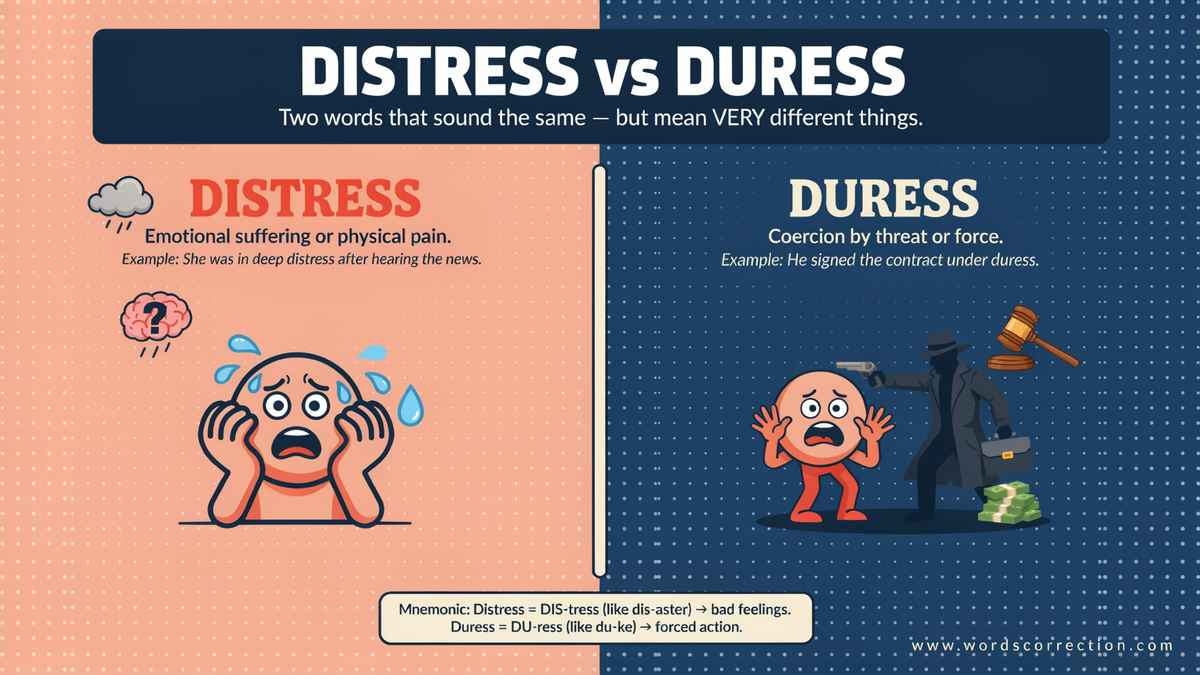
One of the most common mistakes involving these words happens when people choose the wrong preposition. Although in distress and under duress may appear similar, they describe different circumstances.
What Does In Distress Mean?
The expression in distress describes someone or something experiencing suffering, danger, hardship, or serious difficulty.
It commonly appears in emotional, physical, financial, and emergency situations.
Examples
- The missing child was found in distress.
- The injured passenger appeared to be in distress.
- The family was in distress after losing its home.
- The company remained in financial distress for several months.
- The rescue team responded to a vessel in distress.
Under distress meaning: People sometimes search for this expression when they mean in distress. However, under distress isn’t the usual standard expression for describing a person who is suffering. In most ordinary sentences, in distress sounds more natural and idiomatic.
For example
- Less natural: She was under distress after the accident.
- Better: She was in distress after the accident.
You can also write, “She experienced severe distress after the accident.”
What Does Under Duress Mean?
The expression under duress describes someone acting because of coercion, threats, intimidation, or improper pressure.
Examples
- He signed the agreement under duress.
- The witness claimed that she provided the statement under duress.
- The employee resigned under duress.
- The company transferred the funds under duress.
- She refused to make an important decision under duress.
The preposition under works naturally because it suggests that someone is subject to coercive pressure.
Can You Say Under Distress?
You may encounter under distress in informal writing or nonstandard expressions. However, it generally isn’t the preferred phrase when you want to describe emotional suffering or danger.
Choose the expression according to your intended meaning
| Intended meaning | Natural expression |
|---|---|
| Someone is suffering emotionally. | In distress |
| Someone is facing physical danger. | In distress |
| A company is experiencing financial problems. | In financial distress |
| Someone is forced to sign an agreement. | Under duress |
| Someone is forced to make a decision. | Under duress |
| Someone is experiencing emotional pain. | Experiencing emotional distress |
The difference is straightforward: people are generally in distress but may act under duress.
Learn the difference between tricky words and use them correctly
Skiid vs Skied Which Spelling Is Correct?
Common Mistakes When Using Distress vs Duress
Even experienced English speakers occasionally confuse similar-looking words. Fortunately, a few simple corrections can prevent most mistakes.
Using Duress to Describe Ordinary Stress
Not every difficult situation involves duress.
A demanding examination, a busy work schedule, or an unexpected bill may cause stress or distress. However, these situations don’t automatically involve coercion.
Incorrect: I am under duress because I have three assignments to finish.
Correct: I am stressed because I have three assignments to finish.
Another natural option is:
“I am experiencing distress because of my overwhelming workload.”
Use duress only when the situation involves coercive pressure.
Using Distress When You Mean Coercion
Distress describes suffering rather than the act of forcing someone to do something.
Incorrect: He signed the contract under distress because his employer threatened him.
Correct: He signed the contract under duress because his employer threatened him.
You could also write:
“The employer’s threats caused him considerable emotional distress.”
Both words may appear in the same discussion, but each communicates a different part of the situation.
Confusing In Distress With Under Duress
These expressions aren’t interchangeable.
Incorrect: The injured passenger was under duress.
Correct: The injured passenger was in distress.
The first sentence suggests coercion rather than physical suffering. Unless someone is forcing the passenger to act, in distress communicates the intended meaning more accurately.
Assuming Distress vs Duress Are Interchangeable
Similar spelling doesn’t make two words synonyms.
Incorrect: The company experienced financial duress after losing its customers.
Better: The company experienced financial distress after losing its customers.
However, you might correctly write:
“The company owner signed the financial agreement under duress after receiving threats.”
The first sentence describes financial hardship. The second describes coercion.
Ignoring the Difference Between Suffering and Forced Action
Sometimes, writers focus on the unpleasant nature of a situation and overlook what actually happened.
Consider these two examples
- She felt distress because her family faced a difficult situation.
- She accepted the offer under duress because someone threatened her.
The first sentence describes an emotional response. The second describes a decision influenced by coercion.
Before choosing either word, identify the main idea you want to communicate.
Distress vs Duress Synonyms and Related Words
Synonyms help expand your vocabulary, but choosing the wrong replacement can change a sentence’s meaning.
Although distress vs duress both relate to difficult experiences, their synonyms belong to different meaning groups.
Distress vs Duress Synonyms
Distress Synonyms
Generally describe suffering, worry, discomfort, or hardship.
Common alternatives include
- Suffering
- Anguish
- Misery
- Anxiety
- Hardship
- Grief
- Pain
- Trouble
- Worry
- Adversity
Duress Synonyms
Duress synonyms generally describe coercion, force, threats, or unwanted pressure.
Common alternatives include
- Coercion
- Compulsion
- Intimidation
- Force
- Constraint
- Oppression
- Threat
- Pressure
- Harassment
Comparison of Distress and Duress Synonyms
| Distress synonyms | Duress synonyms | Main difference |
|---|---|---|
| Suffering | Coercion | Experiencing pain vs being forced |
| Anguish | Intimidation | Emotional suffering vs fear-based pressure |
| Misery | Compulsion | Unhappiness vs forced action |
| Hardship | Force | Difficult circumstances vs physical or coercive power |
| Anxiety | Threat | Mental worry vs an expression of intended harm |
| Grief | Constraint | Emotional pain vs restricted freedom |
| Trouble | Oppression | Difficulty vs unfair control |
| Adversity | Harassment | Challenging circumstances vs repeated unwanted conduct |
Why Distress vs Duress Are Not Exact Synonyms
The key difference is the type of experience each word describes.
For example, anguish can replace distress in a sentence about emotional suffering:
“She experienced considerable distress after the loss.”
“She experienced considerable anguish after the loss.”
Both sentences communicate emotional pain.
However, replacing duress with anguish would change the meaning of a sentence:
“He signed the agreement under duress.”
“He signed the agreement under anguish.”
The second sentence sounds unnatural because anguish describes emotional suffering rather than coercive circumstances.
Likewise, pressure can sometimes replace duress in general writing, but it doesn’t always carry the same legal meaning. Ordinary pressure may be unpleasant without meeting the legal requirements for duress.
Distress vs Duress American vs British English
Do American and British English use distress and duress differently?
Generally, no. Both varieties use the words with the same core meanings.
| Feature | American English | British English |
|---|---|---|
| Distress | Suffering or hardship | Suffering or hardship |
| Duress | Coercion or forced action | Coercion or forced action |
| In distress | Standard expression | Standard expression |
| Under duress | Standard expression | Standard expression |
| Distressed | Correct | Correct |
| Distressing | Correct | Correct |
For example, an American writer might say:
“The witness signed the statement under duress.”
A British writer can use exactly the same sentence.
Similarly, both varieties use emotional distress, financial distress, and distress signal.
The pronunciation and spelling also remain consistent in standard usage. Regional accents may influence how people pronounce the words, but they don’t change their basic definitions.
Distress vs Duress Formal and Informal Usage
Both words work in formal writing, but their frequency and tone differ.
Formal and Academic Writing
Distress appears in academic writing, medical discussions, psychology, business reports, and legal documents.
Examples
- The study examined psychological distress among university students.
- The company reported financial distress during the economic downturn.
- The patient displayed signs of respiratory distress.
Duress appears more frequently in legal discussions and formal descriptions of coercive behavior.
Examples
- The defendant claimed that he acted under duress.
- The agreement was challenged on grounds of duress.
- The witness alleged that threats influenced her statement.
Legal and Professional Communication
In legal writing, choose the word that describes the specific issue.
Use distress when discussing suffering, emotional injury, or psychological harm.
Use duress when discussing coercion, consent, or forced decisions.
For example
“The employee experienced emotional distress following the incident.”
“The employee alleged that management forced her to sign the resignation letter under duress.”
Both sentences are professional and grammatically correct. They simply describe different aspects of the situation.
Everyday Conversation
Distress is more common in ordinary conversations because people regularly discuss emotional struggles and difficult circumstances.
Examples
- She looked distressed after the meeting.
- The family is going through a difficult time.
- The news caused him a lot of distress.
Duress is less common in casual conversations. People often use simpler expressions such as pressure, threats, or being forced.
For example, instead of saying, “I agreed under duress,” someone might say, “I only agreed because they threatened me.”
Both communicate the general idea, but the first sounds more formal.
How to Remember the Difference Between Distress vs Duress
Remembering similar-looking words becomes easier when you connect each word with a specific idea.
A Simple Memory Trick
Use this simple formula:
DISTRESS = Suffering, sadness, or hardship
Think about someone experiencing emotional pain, financial problems, or physical discomfort.
Example: She was in distress after the accident.
DURESS = Threats, coercion, or forced action
Think about someone being forced to make a decision against their wishes.
Example: He signed the agreement under duress.
A Quick Decision Test
Before using either word, ask yourself:
- Is the sentence describing emotional or physical suffering? Choose distress.
- Is it describing financial hardship? Choose distress.
- Is someone being forced to act through threats or coercion? Choose duress.
- Is someone making a decision because of improper pressure? Consider duress.
For example, if someone loses their job and feels overwhelmed, they experience distress. If someone threatens that person to force them to sign an agreement, the situation may involve duress.
This simple distinction will help you choose the right word without second-guessing yourself.
Practice session
- __________ means emotional suffering.
- __________ means force or coercion.
- Positive stress is called __________.
- Negative stress is called __________.
- Long-lasting stress is __________ stress.
- Short-term stress is __________ stress.
- Threats can cause __________.
- Anxiety is a sign of __________.
- Eustress encourages personal __________.
- Duress involves external __________.
- Grief can cause emotional __________.
- Exercise helps manage __________.
- Financial problems can cause __________.
- Eustress promotes __________.
- Chronic stress lasts a long __________.
- Coercion is associated with __________.
- Fear can contribute to __________.
- Meditation helps reduce __________.
- Acute stress is usually __________-term.
- Duress can affect free __________.
- Learning new skills can create __________.
- Distress involves emotional __________.
- Stress management improves mental __________.
- Unemployment can cause __________.
- Duress is commonly used in __________ contexts.
Answers
- Distress
- Duress
- Eustress
- Distress
- Chronic
- Acute
- Duress
- Distress
- Growth
- Pressure
- Distress
- Stress
- Distress
- Motivation
- Time
- Duress
- Distress
- Stress
- Short
- Will
- Eustress
- Suffering
- Health
- Distress
- Legal
Here’s a trusted source for clear word meanings:
Cambridge Dictionary
FAQs
What qualifies as duress?
Duress occurs when a person uses threats, physical force, intimidation, or unlawful pressure to compel someone to act against their free will. In legal contexts, duress may affect the validity of a contract, agreement, or decision if a person was forced to consent.
What are the two types of duress?
The two commonly discussed types of duress are physical duress and psychological duress. Physical duress involves physical force or threats of bodily harm, whereas psychological duress involves intimidation, emotional manipulation, or severe mental pressure.
What is an example of distress?
An example of distress is experiencing intense anxiety after unexpectedly losing a job. Financial uncertainty, emotional pressure, and concerns about the future can cause persistent worry, sadness, and difficulty sleeping.
What are five examples of eustress?
Five common examples of eustress include:
- Preparing for an important job interview.
- Training for a competitive sporting event.
- Starting a new business.
- Learning a challenging skill.
- Preparing for a major personal achievement.
These situations create positive pressure that encourages motivation, personal development, and productive behavior.
What are the three types of stress?
The three commonly recognized types of stress are acute stress, episodic acute stress, and chronic stress. Acute stress occurs in response to an immediate challenge, episodic acute stress happens repeatedly, and chronic stress develops when pressure continues over an extended period.
Can you give examples of eustress and distress?
Examples of eustress include receiving a promotion, preparing for a competition, and learning a new skill. Examples of distress include experiencing financial difficulties, losing a loved one, and dealing with prolonged workplace pressure. Eustress generally encourages growth, while distress can negatively affect emotional well-being.
How can you turn distress into eustress?
You can transform distress into a more positive experience by changing your perspective and developing healthy coping strategies. Set achievable goals, break challenging tasks into manageable steps, practice positive thinking, and focus on solutions rather than potential problems. These approaches can help make difficult situations feel more manageable.
Which situations are examples of distress?
Situations that create overwhelming emotional, physical, or psychological pressure can lead to distress. Common examples include relationship conflicts, unemployment, serious illness, financial hardship, and the loss of a loved one. These experiences can interfere with daily activities and emotional stability.
What are the four main types of stressors?
Four commonly discussed categories of stressors are environmental, social, psychological, and physiological stressors. Environmental stressors involve external conditions, social stressors arise from relationships and interactions, psychological stressors involve emotional or mental challenges, and physiological stressors affect the body’s physical functioning.
Which event is an example of negative stress?
Unexpected unemployment is a common example of negative stress. Losing a job can create financial uncertainty, emotional distress, and anxiety about future employment. When these pressures become overwhelming or prolonged, they may negatively affect a person’s overall well-being.
What are five effective stress management techniques?
Five effective stress management techniques include:
- Deep breathing: Practice controlled breathing to reduce tension.
- Regular exercise: Engage in physical activities to support emotional well-being.
- Adequate sleep: Maintain a consistent sleeping schedule.
- Healthy routines: Organize daily responsibilities and allow time for relaxation.
- Mindfulness and meditation: Develop awareness of your thoughts and emotional responses.
Practicing these techniques regularly can help improve stress management and emotional balance.
Which situation is an example of eustress?
Preparing for a marathon is an example of eustress. Although training requires effort and discipline, the challenge can create excitement, strengthen motivation, and encourage personal achievement. The pressure becomes positive when it inspires progress rather than causing overwhelming distress.
What are examples of positive and negative stress?
Positive stress, known as eustress, includes starting a new career, getting married, preparing for a competition, and learning a challenging skill. Negative stress, known as distress, includes experiencing financial problems, facing a serious illness, losing a loved one, or dealing with ongoing personal difficulties.
What are the three biggest stressors in life?
Three major life stressors include the death of a loved one, divorce or relationship breakdown, and serious illness. These experiences can create significant emotional pressure and require considerable psychological adjustment.
What are the seven types of stress?
Stress can be categorized into several forms based on its duration, source, and effects. Seven commonly discussed categories include:
- Acute stress
- Episodic acute stress
- Chronic stress
- Emotional stress
- Physical stress
- Psychological stress
- Environmental stress
These categories help explain how different circumstances can influence a person’s mental and physical well-being.
What is considered eustress?
Eustress is a positive form of stress that motivates individuals to face challenges, develop new skills, and achieve meaningful goals. It often creates excitement, improves focus, and encourages personal growth. Unlike distress, eustress generally makes challenging experiences feel productive and rewarding.
What are the five levels of stress?
Stress is sometimes described using five general levels: minimal, mild, moderate, high, and severe. These levels provide a simple way to describe the intensity of stress, although they are not a universal clinical classification system.
What is the most damaging form of stress?
Chronic stress can be particularly harmful because it persists over an extended period without sufficient recovery. Long-term exposure to stress may contribute to sleep disturbances, anxiety, difficulty concentrating, emotional exhaustion, and other physical health concerns.
What are the four D’s of stress management?
The four D’s of stress management are Delete, Delegate, Defer, and Do. This approach helps individuals prioritize responsibilities and manage their workloads more effectively.
- Delete: Eliminate unnecessary tasks.
- Delegate: Assign suitable responsibilities to others.
- Defer: Postpone activities that are not immediately important.
- Do: Complete essential tasks without unnecessary delay.
What are the signs of toxic stress in adults?
Possible signs of prolonged toxic stress in adults include persistent anxiety, sleep disturbances, irritability, difficulty concentrating, emotional exhaustion, and trouble managing everyday responsibilities. These symptoms may interfere with relationships, work performance, and overall quality of life.
What are the four A’s of stress management?
The four A’s of stress management are Avoid, Alter, Adapt, and Accept. These strategies provide practical ways to respond to challenging circumstances.
- Avoid: Stay away from unnecessary stressors whenever possible.
- Alter: Make changes to situations that create avoidable pressure.
- Adapt: Adjust your expectations and approach to challenges.
- Accept: Recognize circumstances that cannot be changed and focus on managing your response.
What are some mental signs of stress?
Common mental signs of stress include excessive worrying, racing thoughts, difficulty concentrating, forgetfulness, irritability, indecisiveness, and persistent feelings of being overwhelmed. These symptoms can make it harder to manage everyday responsibilities and maintain emotional balance.
What is the difference between distress and eustress?
Distress is a negative form of stress that can cause anxiety, emotional discomfort, and overwhelming pressure. Eustress is positive stress that encourages motivation, productivity, and personal development. Although both occur in response to challenging situations, they differ in how individuals experience and respond to those challenges.
What are seven warning signs of stress?
Seven common warning signs of stress include
- Frequent headaches.
- Difficulty sleeping.
- Persistent worrying.
- Increased irritability.
- Changes in appetite.
- Muscle tension.
- Difficulty concentrating.
Recognizing these symptoms early can help individuals manage stress before it begins to interfere significantly with daily life.
What is the difference between duress and psychological stress?
Duress involves threats, coercion, intimidation, or pressure that compromises a person’s freedom to make a voluntary decision. Psychological stress is an emotional or mental response to challenging circumstances. A person may experience psychological stress because of work, relationships, or personal difficulties without necessarily being under duress.hes, use duress.
Learn the difference between similar English words the easy way
Moment vs Momment Which Spelling Is Correct?
Final Thoughts
Understanding the difference between distress vs duress becomes simple once you know what each word means. Although they look and sound similar, they describe very different situations. Distress refers to emotional or physical suffering, worry, or hardship, while duress describes pressure, threats, or force that make someone act against their will.
A simple way to remember the distinction is to connect distress with suffering and duress with pressure or coercion. This small reminder can help you avoid common word-choice mistakes and communicate your ideas more clearly.
The next time you use either word, consider the meaning you want to express. Are you describing someone who is suffering or someone who is being forced to act? Choosing the correct term will make your writing more accurate, natural, and professional. After all, one small word can make a big difference in meaning.

Stella AJS is an experienced blogger and dedicated English language writer at Words Correction. She turns confusing grammar, word meanings, spelling, and usage into clear, practical insights that readers can easily understand and apply. With a passion for precise and engaging writing, Stella helps readers avoid common language mistakes, strengthen their vocabulary, and communicate with greater clarity and confidence.




