
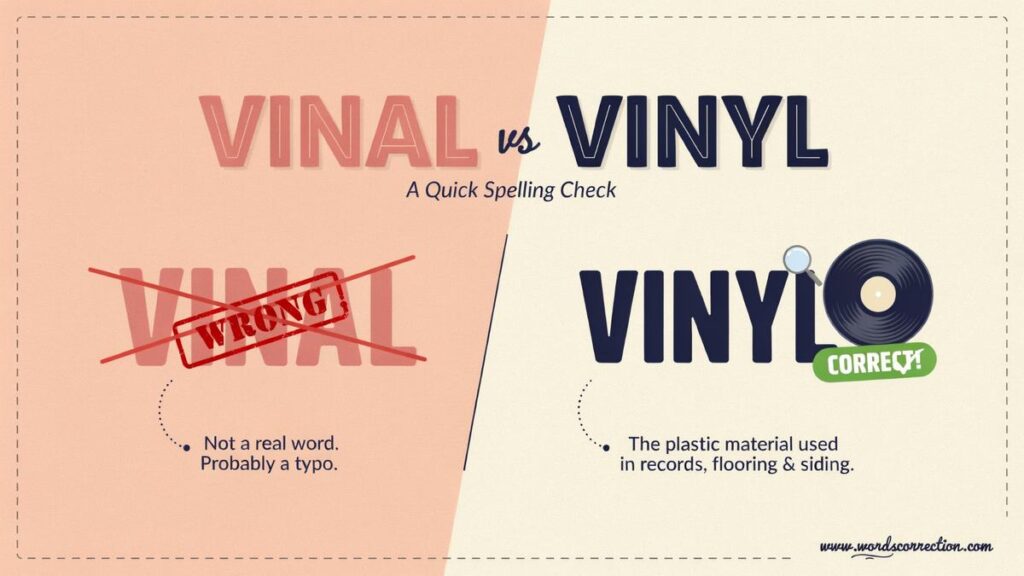
Is it vinal vs vinyl, or can one small spelling difference turn an ordinary word into a confusing vocabulary challenge? If “vinal” when searching for vinyl flooring, music records, or plastic products, you’re certainly not alone. Although these words look and sound similar, they have different meanings and uses. Vinyl is the familiar term for a versatile material found in countless everyday products, while vinal has more specialized meanings. Confusing the two can lead to spelling mistakes and unclear writing. Let’s examine their definitions, differences, pronunciation and practical examples so you can use the correct word with confidence.
Vinal vs Vinyl The Quick Answer
The correct spelling depends on what you’re trying to describe. Although vinal vs vinyl differ by only one letter, they refer to different things.
Vinyl is the correct and widely recognized spelling for the synthetic plastic material used in flooring, furniture coverings, records, stickers, and many other products. It’s also a chemical term associated with a particular molecular group.
Vinal, on the other hand, is a legitimate but uncommon English word. It refers to a synthetic textile fiber made from polyvinyl alcohol. The word also appears in botanical terminology and rare historical vocabulary.
Here’s the simplest way to distinguish them
| Word | Meaning | Common Usage |
|---|---|---|
| Vinal | Specialized synthetic textile fiber; also a plant name and rare adjective | Textile terminology and specialized references |
| Vinyl | Chemical group and synthetic plastic material | Flooring, records, furniture, and manufacturing |
Consider these examples
- Correct: The contractor installed vinyl flooring in the living room.
- Incorrect: The contractor installed vinal flooring in the living room.
- Correct: The manufacturer developed a fabric using vinal fiber.
- Incorrect: The manufacturer developed vinyl fiber (when the intended material is specifically vinal).
The key distinction is that these words aren’t interchangeable. If you’re talking about a record collection or a plastic surface, choose vinyl. If you’re discussing the specialized synthetic fiber, vinal may be the appropriate term.
Learn the difference between confusing word pairs
Triple vs Tripple Which Spelling Is Correct?
What Does Vinyl Mean?
Vinyl is a noun and adjective associated with a chemical group and a family of synthetic materials. In everyday English, the word most often describes a durable plastic material used to manufacture products such as flooring, furniture coverings, pipes, clothing, and decorative items.
The word also has a familiar meaning in the music industry. People use vinyl to describe phonograph records, especially traditional discs that play music through a turntable.
From home improvement to music collecting, vinyl appears in many parts of everyday life. Its popularity comes from its versatility, durability, and ability to take different shapes and finishes.
Vinyl as a Plastic Material
Vinyl is commonly associated with polyvinyl chloride (PVC), one of the most widely used synthetic plastics. Manufacturers produce PVC by polymerizing vinyl chloride, a chemical compound.
The resulting plastic can be rigid or flexible depending on its formulation and the additives used during manufacturing.
For example, rigid PVC works well for pipes, fittings, and construction products. Flexible PVC appears in cable insulation, flooring, upholstery, and other applications where the material needs to bend.
Common vinyl products include
- Vinyl flooring and floor tiles
- Vinyl sheets for construction and decoration
- Vinyl siding for exterior walls
- Vinyl furniture coverings
- Vinyl upholstery for vehicles
- Vinyl stickers and decorative decals
- Electrical cable insulation
- Certain pipes and plumbing products
One reason manufacturers use vinyl is its adaptability. They can create different thicknesses, textures, colors, and levels of flexibility to meet specific product requirements.
For instance, vinyl flooring can imitate the appearance of hardwood, stone, or ceramic tiles. This gives homeowners several design options without requiring natural materials.
However, vinyl isn’t automatically identical to PVC in every technical context. Vinyl is a broader chemical term, while PVC refers to a specific polymer.
Vinyl in Music and Records
When music lovers talk about vinyl, they’re usually referring to phonograph records. These flat discs contain grooves that store sound information in physical form.
A record player or turntable reads those grooves with a stylus. The equipment converts the mechanical movement into an electrical audio signal that produces sound through speakers.
Vinyl records remain popular among collectors and music enthusiasts because they offer a physical listening experience. People can browse album artwork, collect different pressings, and enjoy the process of playing a record.
A few common expressions include
- Vinyl record: A physical disc containing recorded audio.
- Vinyl album: A music album released in vinyl format.
- Vinyl collection: A person’s collection of records.
- Vinyl turntable: Equipment designed to rotate records for playback.
- Vinyl player: An informal term for a record-playing device.
For example
- She bought a vinyl album from her favorite band’s latest release.
- My grandfather has a large vinyl record collection.
- We listened to jazz on an old record player.
Are vinyl records made of plastic?
Yes. Most modern vinyl records use PVC-based material. Manufacturers press the heated material into discs with grooves that contain the recorded audio information.
Although digital music has changed how people listen to songs, vinyl records continue to have a dedicated audience.
Vinyl in Chemistry
Beyond flooring and music, vinyl has a specific meaning in chemistry.
A vinyl group is a chemical structure derived from ethene, commonly known as ethylene. Its molecular formula is:
[
\mathrm{CH_2=CH-}
]
This structure contains two carbon atoms connected by a double bond. The remaining bonding position allows the vinyl group to attach to another part of a molecule.
Vinyl compounds play an important role in polymer chemistry and industrial manufacturing.
Some familiar examples include
| Compound | Common Application |
|---|---|
| Vinyl chloride | Production of PVC |
| Polyvinyl chloride (PVC) | Pipes, flooring, and cable insulation |
| Polyvinyl acetate (PVAc) | Adhesives and certain coatings |
| Polyvinyl alcohol (PVA) | Films, coatings, and specialized textile applications |
These materials have different chemical structures and properties. For example, polyvinyl acetate is commonly used in adhesives, while PVC is widely used in construction.
This chemical background also helps explain why vinyl appears in technical writing. It’s not simply another name for plastic. It has a defined meaning in chemistry.
Learn the difference between tricky words and use them correctly
Follow Up vs Follow-Up Which Is Correct?
What Does Vinal Mean?
Unlike vinyl, vinal is an uncommon word that most people won’t encounter in everyday conversations. However, that doesn’t make it incorrect.
The vinal meaning depends on the context. In textile terminology, it identifies a synthetic fiber made from polyvinyl alcohol. It also appears as the common name of a South American plant and as a rare adjective associated with wine.
These meanings are specialized. Therefore, writers should check the intended definition before deciding whether vinal represents a spelling mistake.
Vinal as a Synthetic Fiber
One important definition of vinal relates to synthetic textile fibers.
Vinal is a manufactured fiber based on polyvinyl alcohol. This polymer can form fibers with useful properties, including strength and resistance to certain environmental conditions.
The material has applications in textile manufacturing and other specialized industrial uses.
What is vinal fiber used for?
Depending on its formulation and processing, vinal fiber can be used in:
- Textile products
- Industrial fabrics
- Certain specialty materials
- Applications requiring particular fiber strength and durability
The exact properties depend on the manufacturing process and chemical treatment.
Vinal fiber belongs to the broader family of synthetic textile materials. It shouldn’t be confused with ordinary vinyl fabric, which generally refers to a textile or backing coated with a PVC-based material.
For example
- The textile manufacturer researched vinal fiber for specialized fabric production.
- Vinal is associated with polyvinyl alcohol-based synthetic fibers.
This is a legitimate technical use of the word. It’s not an alternative spelling for vinyl.
Vinal as an Adjective Related to Wine
Vinal also appears as a rare adjective connected with wine.
In this specialized or historical sense, it describes something associated with wine or derived from it.
This meaning is uncommon in modern everyday English. Most writers would use clearer expressions such as wine-related, wine-derived, or produced from wine.
For example
- The historical text discussed a vinal substance derived from wine.
Because the adjective is rare, readers may not immediately understand it. When clarity matters, a more familiar expression is usually the better choice.
Vinal as a Plant Name
Another meaning of vinal comes from botanical terminology.
Vinal is a common name associated with Prosopis ruscifolia, a thorny tree or shrub native to parts of South America. The plant belongs to the legume family, Fabaceae.
This botanical use has nothing to do with plastic, records, or synthetic fibers.
The name appears in regional plant references, particularly those covering South American vegetation.
For example
- Vinal grows in parts of South America and is recognized for its thorny branches.
This meaning demonstrates why context matters when interpreting unfamiliar words. A botanical reference to vinal isn’t necessarily a spelling error.
Learn the difference between similar English words the easy way
Omelet or Omelette Which Spelling Is Correct?
Vinal vs Vinyl Key Differences
Now that both definitions are clear, comparing the words side by side makes the distinction easier to remember.
The biggest difference between vinal vs vinyl involves their meanings and practical applications. Vinyl appears frequently in everyday English, while vinal generally belongs to specialized vocabulary.
Vinal vs Vinyl Comparison Table
| Feature | Vinal | Vinyl |
|---|---|---|
| Spelling | V-I-N-A-L | V-I-N-Y-L |
| Pronunciation | Commonly VY-nuhl | Commonly VY-nuhl |
| Main meaning | Synthetic textile fiber | Chemical group and synthetic material |
| Other meanings | Botanical name and rare wine-related adjective | Records and vinyl-based products |
| Grammar | Noun or adjective | Noun or adjective |
| Everyday usage | Uncommon | Very common |
| Technical usage | Textile and botanical terminology | Chemistry, manufacturing, and music |
| Example | Vinal fiber | Vinyl flooring |
| Interchangeable | No | No |
One interesting detail is that the two words can have very similar pronunciations in English. That’s one reason spelling confusion occurs.
However, their definitions remain different even when people pronounce them similarly.
Vinal vs Vinyl Pronunciation
Pronunciation can help you recognize a word, but it doesn’t always tell you how to spell it.
In American English, vinyl is generally pronounced VY-nuhl.
Its IPA transcription is
[
/ˈvaɪ.nəl/
]
Vinal is also commonly pronounced similarly: VY-nuhl.
The exact pronunciation may vary depending on the speaker and dictionary entry.
Since both words can sound alike, listening alone may not help you identify the correct spelling. You need to consider the meaning.
For example, if someone says they’re collecting old records, the intended word is almost certainly vinyl. If they’re discussing polyvinyl alcohol-based textile fibers, vinal may be correct.
Difference Between Vinal vs Vinyl in Grammar
Both words can function as nouns. Their grammatical roles depend on how writers use them.
Vinyl as a noun
- The vinyl needs careful cleaning.
- He purchased several vinyl records.
- The flooring contains a protective vinyl layer.
Vinyl as an adjective
- We selected vinyl flooring for the kitchen.
- She bought a vinyl record player.
- The company manufactures vinyl products.
Vinal as a noun
- The manufacturer tested the vinal fiber.
- Vinal is used in specialized textile terminology.
Vinal as an adjective
- The botanical reference identified the vinal plant.
The main lesson is simple: both spellings can be grammatically valid. However, grammatical correctness doesn’t mean you can substitute one for the other.
Learn the difference between commonly confused more words in English
Dieing or Dying Which Spelling Is Correct?
How to Use Vinyl Correctly in Everyday English
Understanding the definition of vinyl is only half the job. You also need to know how people use it naturally in sentences.
The word appears in several industries, including construction, interior design, music, advertising, and manufacturing. Although its meaning changes slightly with context, the spelling remains the same.
Here are the most common situations where vinyl is the correct choice.
Vinyl Flooring and Wall Coverings
Vinyl flooring is a popular flooring option in residential and commercial buildings. Manufacturers produce it in different styles, including planks, tiles, and sheets.
Some products imitate natural materials such as hardwood and stone. Others feature simple patterns or solid colors.
The term vinyl is also used for wall coverings made from vinyl-based materials. These products can provide decorative finishes and practical surface protection.
Examples
- We chose vinyl flooring because it was suitable for our renovation project.
- The contractor completed the vinyl flooring installation last week.
- Vinyl sheets can cover large floor areas with fewer visible seams.
- The designer recommended a washable vinyl wall covering.
Notice that vinal flooring and vinal wall covering are incorrect when referring to ordinary vinyl-based building products.
Vinyl Stickers, Decals, and Signs
Vinyl is widely used in the advertising and printing industries. Manufacturers use thin vinyl sheets to create stickers, labels, vehicle graphics, and promotional signs.
These products come in different colors, finishes, and thicknesses. Some vinyl materials also have adhesive backing, making them suitable for application to smooth surfaces.
For example, businesses use vinyl decals on shop windows, vehicles, doors, and display boards.
Examples
- The company ordered custom vinyl stickers for its packaging.
- She decorated her laptop with colorful vinyl decals.
- The advertising agency printed a large vinyl sign.
- The car owner added a vinyl graphic to the vehicle’s door.
In all these examples, vinyl is the correct spelling.
Vinyl Siding for Exterior Walls
Vinyl siding is an exterior building material commonly used on residential properties.
It consists of panels designed to protect and decorate the outside walls of a building. Manufacturers offer different colors, textures, and profiles to create various architectural styles.
Homeowners often choose vinyl siding because it requires relatively little maintenance compared with some traditional exterior materials.
For example
- The homeowner replaced the damaged wood siding with vinyl siding.
- Vinyl siding comes in several colors and styles.
- The contractor inspected the vinyl panels before installation.
The word remains vinyl, even when it describes a specific construction product.
Vinyl Furniture, Upholstery, and Clothing
Vinyl fabric usually refers to a textile material coated with a vinyl-based plastic layer, often PVC.
Manufacturers use it for furniture upholstery, car seats, protective covers, and certain clothing items. Its surface can resemble leather, although the materials aren’t the same.
Vinyl upholstery is especially common in settings where people want a surface that’s relatively easy to wipe clean.
Common applications include
- Restaurant seating
- Vehicle interiors
- Office furniture
- Protective furniture covers
- Decorative upholstery
- Certain fashion accessories
Examples
- The restaurant replaced its old chairs with vinyl upholstery.
- The car has comfortable vinyl seats.
- The furniture manufacturer offers several vinyl fabric options.
Remember that vinyl fabric and vinal fiber refer to different materials. Their similar spelling doesn’t make them identical.
Learn the difference between confusing more English words step by step
Photostat or Photostate Which one Is Correct?
Vinal vs Vinyl Correct and Incorrect Examples
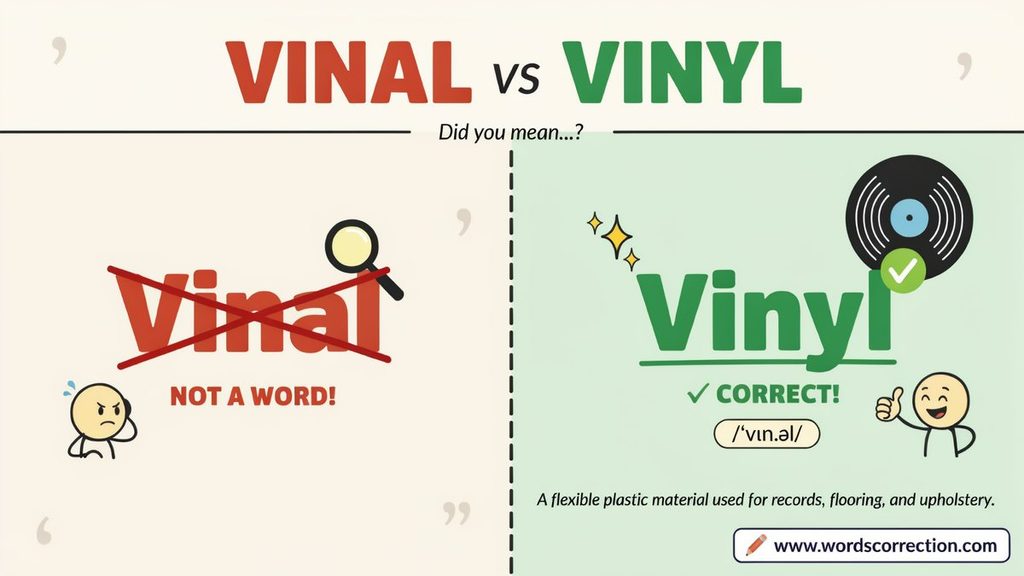
Examples often make spelling differences easier to understand than definitions alone. When you see the words in actual sentences, their meanings become more obvious.
The following examples show when to use vinyl, when vinal may be appropriate, and how to avoid common spelling mistakes.
Common Vinyl Spelling Mistakes
Writers sometimes replace the letter Y with A when typing vinyl. This creates vinal, which may be incorrect if the sentence discusses records, flooring, or plastic products.
Consider these examples
| Incorrect Sentence | Correct Sentence |
|---|---|
| We installed vinal flooring in the kitchen. | We installed vinyl flooring in the kitchen. |
| She collects old vinal records. | She collects old vinyl records. |
| The company produces vinal stickers. | The company produces vinyl stickers. |
| I bought a vinal record player. | I bought a vinyl record player. |
| The furniture has a vinal covering. | The furniture has a vinyl covering. |
| They replaced the wooden panels with vinal siding. | They replaced the wooden panels with vinyl siding. |
The incorrect versions don’t work because they use a specialized word where the standard material name is required.
Correct Uses of Vinal
Although vinal is uncommon, it can be correct when the intended meaning matches one of its recognized definitions.
Here are examples
- The research team examined the properties of vinal fiber.
- The textile manufacturer studied polyvinyl alcohol-based vinal material.
- The botanical guide identified the vinal plant in the region.
- The historical passage used a rare wine-related vinal adjective.
These examples demonstrate that vinal isn’t automatically a spelling error.
However, context matters. If you’re writing about ordinary plastic products, changing vinyl to vinal will usually introduce an incorrect spelling.
Vinal in a Sentence How Context Changes the Meaning
Let’s compare a few sentences to see how one letter changes the intended meaning.
Example 1
- The company manufactures vinyl sheets for flooring.
- The company researches vinal fibers for textile applications.
The first sentence discusses a building material. The second describes a specialized synthetic fiber.
Example 2
- He purchased a collection of vinyl records.
- The technical report discusses vinal fiber production.
Both sentences are correct because each word matches its intended subject.
Example 3
- The contractor selected vinyl siding for the house.
- The botanical guide describes the vinal plant.
Again, the difference comes from context rather than grammar.
Learn the difference between tricky English words with easy explanations
Pricy or Pricey Which Spelling Is Correct?
Why Do People Confuse Vinal vs Vinyl?
Spelling confusion often happens when two words look or sound similar. Vinal vs vinyl are a good example because they share five letters and differ only in their final vowel.
Although the distinction seems small, it changes the word’s identity.
Several factors contribute to this confusion.
Similar Pronunciation
One major reason people confuse these words is their similar pronunciation.
In many American English accents, both words sound approximately like VY-nuhl. When people hear the words without seeing them written, they may struggle to identify the correct spelling.
This happens with many English words. Similar sounds don’t always represent similar spellings.
For example
- Their and there
- Principal and principle
- Complement and compliment
- Stationary and stationery
The same general spelling challenge applies to vinal vs vinyl.
The Difference Between A and Y
The words differ by one letter
- V-I-N-A-L
- V-I-N-Y-L
Because the difference appears near the end of the word, readers may overlook it when typing quickly.
The letter Y also represents different sounds in English. Its pronunciation can vary depending on the word and surrounding letters.
As a result, writers who haven’t memorized the spelling may choose A instead of Y.
Limited Familiarity With Vinal
Most people encounter vinyl regularly. They see it on flooring packages, music records, product descriptions, and home improvement websites.
Vinal is much less familiar.
When someone encounters an uncommon word, they may assume it’s a spelling mistake. The opposite can also happen: someone may use a familiar-looking spelling without checking whether it fits the intended meaning.
A little dictionary research can prevent both problems.
Typing and Autocorrect Mistakes
Typing errors are another common source of spelling confusion.
For example, someone might type vinal while writing a product description about vinyl flooring. An autocorrect tool may not always identify the intended meaning because both spellings can appear in dictionaries.
Spellcheck tools also have limitations. They can recognize a correctly spelled word without understanding whether you’ve used the right word in the sentence.
A useful rule: Don’t rely on spellcheck alone when two words have different meanings. Check the context as well.
Learn the difference between more words people mix up
Encode vs Incode Which Is Correct?
Vinyl vs PVC Are They the Same Thing?
Vinyl and polyvinyl chloride (PVC) are closely related terms, but they don’t mean exactly the same thing.
This distinction matters because people often use the words interchangeably when discussing flooring, pipes, and other plastic products.
Vinyl refers to a chemical group and is also used as a common name for certain synthetic materials.
PVC stands for polyvinyl chloride. It’s a specific synthetic polymer made by joining many vinyl chloride molecules through a chemical process called polymerization.
In simpler terms, PVC is one important vinyl-based plastic.
Understanding Vinyl Chloride
Vinyl chloride is a chemical compound with the formula
[
\mathrm{CH_2=CHCl}
]
Manufacturers use it to produce PVC.
The polymerization process converts vinyl chloride molecules into long molecular chains. These chains form the basis of polyvinyl chloride plastic.
PVC has many applications because manufacturers can adjust its properties through formulation and processing.
For example:
- Rigid PVC is used in pipes, fittings, and construction products.
- Flexible PVC is used in cable insulation, flooring, and upholstery.
- Specialized PVC formulations appear in different industrial and commercial products.
Vinyl chloride itself is a hazardous chemical and is not the same thing as finished PVC products. Industrial production requires strict safety controls.
Vinyl vs PVC Comparison
| Feature | Vinyl | PVC |
|---|---|---|
| Full Meaning | Chemical group and common material term | Polyvinyl chloride |
| Chemical Relationship | Can refer to the vinyl group | A specific vinyl polymer |
| Applications | Flooring, records, coatings, and other products | Pipes, flooring, insulation, and construction |
| Chemical Formula | Vinyl group: CH₂=CH– | (C₂H₃Cl)ₙ |
| Everyday Usage | Broad term | Specific plastic material |
Understanding this distinction helps you avoid technical inaccuracies.
For example, calling a PVC pipe a vinyl product may be acceptable in some everyday contexts. However, a chemistry discussion should use the more precise term when referring specifically to polyvinyl chloride.
Learn the difference between everyday English mistakes
Conex or Connex What Is the Difference?
Common Mistakes to Avoid When Using Vinal vs Vinyl
Even experienced writers make spelling mistakes. The best way to avoid them is to understand the meaning of each word instead of relying on how it sounds.
Here are some common mistakes worth watching for
- Using vinal for vinyl flooring: The correct term for ordinary plastic flooring is vinyl flooring.
- Calling vinyl records vinal records: Music records use the spelling vinyl.
- Assuming vinal doesn’t exist: Vinal has legitimate specialized meanings, particularly in textile terminology.
- Treating vinyl and PVC as exact synonyms: PVC is a specific polymer, not a replacement for every technical use of the word vinyl.
- Confusing vinyl fabric with vinal fiber: These terms describe different materials and applications.
- Trusting autocorrect without checking context: A spelling tool may accept a word even when it doesn’t fit your sentence.
- Ignoring technical terminology: Scientific and manufacturing contexts sometimes require a more precise definition than everyday conversation.
A useful proofreading checklist can help
| Question | What to Check |
|---|---|
| Am I discussing flooring? | Use vinyl. |
| Am I discussing music records? | Use vinyl. |
| Am I discussing plastic products? | Usually use vinyl. |
| Am I discussing a specialized textile fiber? | Check whether vinal is intended. |
| Am I describing a botanical plant? | Check the botanical reference for vinal. |
| Am I discussing chemistry? | Use the specific chemical terminology. |
The goal isn’t to memorize every possible definition. It’s to recognize the subject and select the word that expresses it accurately.
Learn the difference between commonly misused words
Encorporate vs Incorporate Which Spelling Is Correct?
How to Remember the Difference Between Vinal vs Vinyl
Remembering the correct spelling becomes easier when you connect each word with something familiar.
Instead of repeatedly checking a dictionary, use these simple memory techniques.
Associate Vinyl With Records and Plastic
Think about vinyl records, vinyl flooring, and vinyl stickers.
These familiar products all use the same spelling: V-I-N-Y-L.
You can also remember the phrase
Y for Your records and flooring.
It’s a simple reminder that vinyl is the word you need for everyday products made from vinyl-based materials.
Remember Vinal as a Specialized Word
Vinal is much less common, so associate it with specialized terminology.
Think about
- Vinal fiber
- Textile manufacturing
- Botanical references
- Historical wine-related vocabulary
This association helps separate the two spellings in your memory.
Check the Meaning Before Choosing the Spelling
The most reliable technique is to identify what you’re describing before writing the word.
For example
- Talking about a music collection? Write vinyl.
- Describing a flooring product? Write vinyl.
- Discussing a polyvinyl alcohol-based textile fiber? Check whether vinal is the intended term.
- Referring to the South American plant? Use vinal when that is the intended botanical name.
Remember: Similar pronunciation doesn’t mean identical spelling or meaning.
Learn the difference between basic English word mistakes
Seal vs Seel What Is the Difference?
Practice Session about Vinal vs Vinyl
1. ______ is the correct spelling for the synthetic plastic material.
2. Vinyl flooring is commonly used in ______ improvement projects.
3. ______ is a rare term associated with a synthetic textile fiber.
4. Vinyl records are used to store and play ______.
5. The correct spelling contains the letter ______ instead of A.
6. PVC is also known as polyvinyl ______.
7. ______ is commonly used in stickers, flooring, and upholstery.
8. The word Vinyl is pronounced as ______.
9. ______ is generally used as an uncountable noun when referring to the material.
10. Vinal and Vinyl have similar ______.
11. Vinyl is a type of ______ material.
12. A record player is used to play ______ records.
13. ______ can be used as a surname or proper name.
14. Vinyl is commonly used in home ______ products.
15. Polyvinyl chloride is abbreviated as ______.
16. Vinyl materials are often valued for their ______ and versatility.
17. The correct spelling of the flooring material is ______.
18. ______ is associated with certain synthetic textile fibers.
19. Vinyl is widely used in the construction and manufacturing ______.
20. The plural expression for individual records is vinyl ______.
21. Vinyl is a ______ noun when referring to the material itself.
22. Vinal is not interchangeable with ______ in every context.
23. Vinyl upholstery is commonly used to cover ______.
24. The word Vinyl contains the letter ______ in its spelling.
25. When writing about vinyl records, always use the spelling ______.
Answers
- Vinyl
- Home
- Vinal
- Music
- Y
- Chloride
- Vinyl
- VY-nuhl
- Vinyl
- Pronunciations
- Synthetic
- Vinyl
- Vinal
- Improvement
- PVC
- Durability
- Vinyl
- Vinal
- Industries
- Records
- Uncountable
- Vinyl
- Furniture
- Y
- Vinyl
Here’s a trusted source for clear word meanings:
Cambridge Dictionary
FAQs
What is the main difference between Vinal vs Vinyl?
Vinyl is the standard English spelling for a synthetic material commonly used in flooring, records, stickers, and other products. Vinal is a rare term associated with a specific synthetic textile fiber, although it is often used mistakenly when referring to vinyl.
Is Vinal an accepted English word?
Yes, Vinal is a recognized but uncommon word in specialized contexts. It refers to a particular type of synthetic textile fiber. However, it is not the correct spelling when referring to the common plastic material known as vinyl.
Why do people confuse Vinal with Vinyl?
People often confuse Vinal and Vinyl because their spellings and pronunciations are similar. The difference is only one letter, making it easy to mistype or misunderstand the words, especially when discussing plastic materials and vinyl products.
How do you correctly spell Vinyl?
The correct spelling is Vinyl, with a Y in the middle. It is the standard spelling used for the synthetic material, vinyl flooring, music records, and related products.
What is the dictionary definition of Vinyl?
Vinyl refers to a synthetic material or chemical group associated with vinyl compounds. In everyday language, it commonly describes a durable plastic material used in flooring, upholstery, records, and other manufactured products.
Does Vinal have a different meaning from Vinyl?
Yes. Vinal is a specialized term associated with a synthetic textile fiber, while Vinyl generally refers to a group of chemical compounds and materials used in plastics and various commercial products. Their meanings depend on context.
How is Vinyl pronounced in English?
Vinyl is pronounced VY-nuhl, with the emphasis on the first syllable. The word has two syllables and is commonly pronounced the same way in American and British English.
Is Vinal ever used in scientific terminology?
Yes. Vinal appears in technical and scientific terminology, particularly in references to certain synthetic textile fibers. However, it is much less common than vinyl in everyday writing and general discussions.
What type of material is Vinyl?
Vinyl is a synthetic material derived from vinyl-based chemical compounds. Many common vinyl products are made from polyvinyl chloride (PVC), which is widely used in construction, flooring, pipes, and consumer goods.
Is Vinyl considered a synthetic polymer?
Vinyl-based materials can be synthetic polymers. For example, polyvinyl chloride (PVC) is a widely used synthetic polymer known for its durability, versatility, and resistance to moisture.
What is Vinal fiber, and how is it made?
Vinal is a synthetic textile fiber associated with polyvinyl alcohol-based materials. It is produced through industrial chemical processing and can be used in textile applications because of its useful physical properties.
Is Vinal related to vinyl alcohol?
Vinal is associated with polyvinyl alcohol-based synthetic fibers. Although the terms are chemically related, Vinal refers to a fiber, while vinyl alcohol is a chemical compound used in producing certain polymers.
Can Vinal be used as a person’s name or surname?
Yes. Vinal can appear as a personal surname or proper name. In such cases, it is a name rather than a reference to vinyl material, and its spelling should be preserved.
Is Vinal a place name or geographical term?
Yes. Vinal can appear in geographical names and place-related references. For example, Vinalhaven is the name of an island town in Maine, United States. Its use in a place name does not make it interchangeable with vinyl.
What are the most common uses of Vinyl?
Vinyl is used in numerous industries, including construction, manufacturing, music, and home improvement. Common applications include vinyl flooring, records, wall coverings, electrical insulation, upholstery, stickers, and window frames.
Is Vinyl the same as polyvinyl chloride (PVC)?
Not exactly. Vinyl is a broader chemical term, while polyvinyl chloride (PVC) is a specific type of vinyl polymer. PVC is one of the most widely used materials in vinyl-based products.
Why is Vinyl used in flooring and home improvement products?
Vinyl is popular in flooring and home improvement because it is durable, moisture-resistant, versatile, and relatively easy to maintain. It is available in different styles and finishes, making it suitable for residential and commercial spaces.
What is the difference between Vinyl and plastic?
Plastic is a broad category of synthetic or semi-synthetic materials, while vinyl refers to a particular family of chemical compounds and materials. Many vinyl products are plastics, but not every plastic product is made from vinyl.
Can Vinyl be used to describe different types of fabric?
Yes. Vinyl can describe synthetic materials used in upholstery, clothing accessories, furniture coverings, and other fabric-like applications. Vinyl-coated fabrics are commonly selected for their durability and easy-care properties.
What is the plural form of Vinyl?
Vinyl is generally used as an uncountable noun when referring to the material. However, when discussing individual vinyl records, people commonly use the plural expression vinyl records rather than simply vinyls.
Is Vinyl a countable or uncountable noun?
Vinyl is usually an uncountable noun when referring to the material itself. For example, you can say, “The furniture is covered with vinyl.” When referring to individual records, the countable expression “vinyl records” is more appropriate.
Can you use Vinyl as an adjective in a sentence?
Yes. Vinyl can function as a noun modifier to describe products made from or associated with vinyl material. For example, “She installed vinyl flooring in the kitchen” uses vinyl to describe the type of flooring.
What are some examples of Vinyl used in everyday English?
Vinyl appears in everyday language when discussing different materials and products. Examples include vinyl flooring, vinyl records, vinyl stickers, vinyl siding, vinyl upholstery, and vinyl wall coverings.
How can you remember the correct spelling of Vinyl?
A simple way to remember the spelling is to associate Vinyl with familiar expressions such as vinyl records and vinyl flooring. Remember that the standard spelling contains a Y, not an A.
What should you write when referring to vinyl material instead of Vinal?
You should write Vinyl when referring to the common synthetic material, plastic products, flooring, or music records. Use Vinal only when the context specifically refers to the technical fiber term or a proper name.hat the word doesn’t exist.
Learn the difference between often confused words
Comming vs Coming Which Spelling Is Correct?
Conclusion
Understanding the difference between Vinal vs Vinyl helps you avoid a small but noticeable spelling mistake. Vinyl is the correct term for the versatile plastic material used in flooring, music records, stickers, and many other everyday products. Vinal, by contrast, has more specialized meanings and should not be used as an alternative to vinyl. Although the two words look similar, their meanings and applications are quite different. Remember, a single letter can change the meaning of a word and create confusion in your writing. Before relying on autocorrect, take a moment to check the spelling. Use vinyl for familiar products and reserve vinal for contexts where its specific meaning applies.

Stella AJS is an experienced blogger and dedicated English language writer at Words Correction. She turns confusing grammar, word meanings, spelling, and usage into clear, practical insights that readers can easily understand and apply. With a passion for precise and engaging writing, Stella helps readers avoid common language mistakes, strengthen their vocabulary, and communicate with greater clarity and confidence.




