
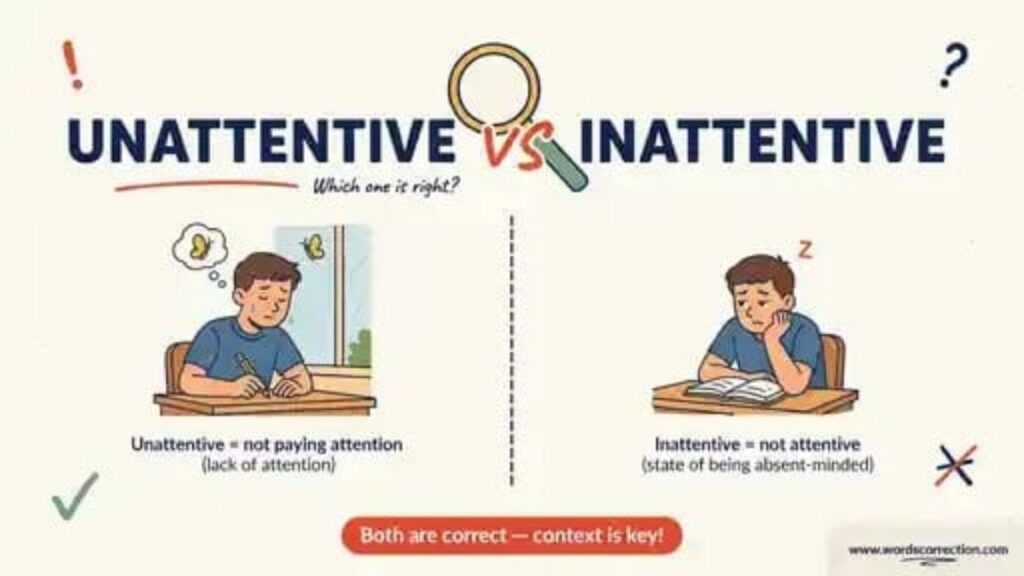
The confusion between unattentive or inattentive is easy to understand. Both words look nearly identical, and that extra “un” can make English feel like it is playing a small spelling trick. Both words mean essentially “not paying attention,” but they are not equally common in modern English. Inattentive is the standard and more natural choice, while unattentive is a valid but uncommon alternative. In this guide, you’ll learn the meaning, difference, usage, spelling, and correct choice between unattentive and inattentive, with clear examples to help you avoid this common English confusion and choose the right word with confidence.
Quick Answer Unattentive or Inattentive
Inattentive is the preferred word in modern standard English when you mean “not paying attention.”
Unattentive is also a real English adjective. It means essentially the same thing, but it is much less common and can sound unusual or dated to many readers.
| Word | Meaning | Usage | Best choice |
| Inattentive | Not paying attention | Very common | Yes |
| Unattentive | Not attentive | Less common | Usually no |
| Attentive | Paying close attention | Very common | Yes |
For example:
- The inattentive student missed several important instructions.
- The driver was inattentive and failed to notice the warning sign.
- The employee became inattentive during the long meeting.
You may encounter unattentive in dictionaries and older or less common writing. However, inattentive is the natural choice for most modern contexts.
Inattentive Meaning
The inattentive meaning is straightforward: not giving attention to someone or something.
In other words, an inattentive person isn’t focusing properly on what is happening. They may be distracted, unfocused, careless about details, or simply failing to notice something.
Inattentive Definition
The inattentive definition can be summarized as:
Not paying attention or failing to give something the attention it requires.
The word commonly describes a temporary behavior or a person’s general tendency.
For example:
- An inattentive student may miss important instructions.
- An inattentive employee may overlook details in a task.
- An inattentive driver may fail to notice traffic signals.
- An inattentive listener may forget what someone just said.
Learn the difference between confusing more English words
Emerse or Immerse Correct Spelling and Use
Inattentive Meaning in English
The inattentive meaning in English is closely connected to a lack of attention, concentration, or focus.
It does not necessarily mean that someone is careless by nature. A person can become inattentive because of tiredness, distraction, stress, boredom, noise, or a demanding environment.
For example:
After several hours of studying, Maya became inattentive and started missing important details.
Here, Maya is not necessarily a careless person. Her attention simply declined.
Unattentive Meaning
The unattentive meaning is also “not attentive” or “not paying attention.”
The word is formed from un- plus attentive.
For example:
The receptionist seemed unattentive to the customer’s concerns.
The sentence is understandable. However, most modern readers would find this more natural:
The receptionist seemed inattentive to the customer’s concerns.
Unattentive Definition
The unattentive definition is essentially:
Not attentive, focused, or sufficiently aware of what is happening.
Some dictionaries recognize unattentive as a legitimate English adjective. Its existence is therefore not the main issue.
The real issue is frequency and natural usage.
Although unattentive is grammatically possible, inattentive is far more established and familiar in everyday, professional, and academic English.
Unattentive vs Inattentive What’s the Difference?
When comparing unattentive vs inattentive, the biggest difference is not meaning. It is usage and frequency.
Both words describe a failure to pay attention.
The distinction can be summarized like this:
Inattentive = standard, common, and preferred
Unattentive = recognized, less common, and often less natural
Think of them as two roads leading to the same destination. One road is wide, familiar, and regularly used. The other is technically open, but far fewer people take it.
Inattentive vs Unattentive
The same principle applies when the question is inattentive vs unattentive.
Consider these examples:
The inattentive student forgot to submit the assignment.
This sounds completely natural.
The unattentive student forgot to submit the assignment.
This is understandable, but it sounds unusual to many English speakers.
That difference matters when you’re writing for a broad audience. A word can be technically valid yet still be a poor choice if a more familiar alternative communicates the same idea more naturally.
Is Inattentive a Word?
Yes. Inattentive is a well-established English word.
It is an adjective used to describe someone or something that lacks attention.
For example:
The inattentive driver did not notice the pedestrian crossing.
The word has been used in English for centuries and appears regularly in modern dictionaries and standard writing.
Is Inattentive Correct?
Yes. Inattentive is correct English.
It is the preferred spelling when you want to express the idea of not being attentive.
The correct spelling of inattentive is:
i-n-a-t-t-e-n-t-i-v-e
A common spelling mistake is to leave out one of the letters in the middle or confuse the word with another adjective beginning with “in-.”
Is Inattentive Correct English?
Yes. Inattentive is standard English and works well in American English, British English, academic writing, professional writing, and everyday communication.
There is no need to replace it with another form simply because the word begins with “in-.”
Is Unattentive a Word?
Yes. Unattentive is a word.
This is where the issue becomes slightly more interesting.
Some people assume that unattentive must be incorrect because inattentive is much more common. However, that conclusion is too strong.
Major dictionaries recognize unattentive as an adjective meaning “not attentive.”
Therefore, asking is unattentive a word has a simple answer:
Yes, it is.
The more useful question is whether it is the best word for your sentence.
In most modern contexts, inattentive is the safer and more natural option.
Is Unattentive Correct?
Yes, unattentive is grammatically valid, but it is uncommon compared with inattentive.
That distinction is important.
Calling it completely wrong would be inaccurate. At the same time, recommending it as the normal modern choice would not reflect common usage.
Is Unattentive Correct English?
Yes, it can be correct English. However, it is less common in standard modern usage.
If your goal is clear and natural professional writing, choose inattentive.
Learn the difference between commonly mixed-up more words
Lader or Ladder Which One Is Correct?
Which Is Correct Inattentive or Unattentive?

If you’re asking which is correct, inattentive or unattentive, both can be found in English.
However, inattentive is the preferred choice.
This is especially true when you’re writing:
- Professional emails
- Academic assignments
- Business documents
- Articles and blog posts
- Formal reports
- Educational materials
- Applications and essays
For example:
Preferred:
The inattentive employee overlooked several important details.
Less common:
The unattentive employee overlooked several important details.
The first sentence sounds more natural to most readers.
Why Is Inattentive More Common?
The answer becomes clearer when you look at how English forms negative adjectives.
The prefix in- often creates a negative meaning.
For example:
- attentive → inattentive
- complete → incomplete
- accurate → inaccurate
- visible → invisible
- direct → indirect
English also uses un- to create negative forms:
- happy → unhappy
- fair → unfair
- clear → unclear
- helpful → unhelpful
- attentive → unattentive
So both inattentive and unattentive are structurally understandable.
However, English does not always choose one negative prefix consistently. Historical usage determines which form becomes established and common.
In this case, inattentive became the dominant form.
Learn the difference between tricky grammar more words
Presence or Presense Which Spelling Is Correct?
The Root of Inattentive
Understanding the root of inattentive can make the spelling easier to remember.
The word is related to attentive, which comes from the broader word family built around attention and attend.
The idea behind these words involves directing your mind toward something.
That gives us a useful word family:
- attend
- attention
- attentive
- attentively
- inattentive
- inattention
- inattentiveness
Once you recognize this family, the spelling becomes easier to remember.
Inattentive Pronunciation
The pronunciation of inattentive can initially look more intimidating than it actually is.
It is commonly pronounced approximately like:
in-uh-TEN-tiv
The main stress falls on TEN.
Try saying it naturally rather than pronouncing every letter separately:
in-uh-TEN-tiv
The pronunciation is the same basic word whether you’re using American or British English, although the exact vowel sounds can vary slightly by accent.
Inattentiveness Meaning
The noun inattentiveness refers to the state or quality of being inattentive.
For example:
His inattentiveness during the meeting caused him to miss an important announcement.
Here, the focus is not on the person as an “inattentive person.” Instead, the sentence describes the condition or behavior of failing to pay attention.
Another related noun is inattention, which means a failure to pay attention.
Inattention vs Inattentiveness
Both nouns are related to inattentive behavior.
Inattention is often more direct:
The accident was caused by inattention.
Inattentiveness emphasizes the quality or tendency:
Her inattentiveness during lectures affected her performance.
Both are useful, but the best choice depends on the sentence.
Learn the difference between confusing word pairs
Gos or Goes Which One Is Right?
Inattentive ADHD
The phrase inattentive ADHD is commonly used when discussing attention-related symptoms associated with attention-deficit/hyperactivity disorder.
In clinical terminology, the more precise phrase is predominantly inattentive presentation of ADHD.
This presentation can involve difficulties with:
- Staying focused
- Following through on tasks
- Organization
- Paying close attention to details
- Listening consistently
- Maintaining concentration
- Managing distractions
However, ordinary inattentive behavior does not automatically mean someone has ADHD.
Everyone becomes distracted or loses focus sometimes. ADHD involves a persistent pattern of symptoms that can significantly affect functioning and is evaluated using established diagnostic criteria.
Therefore, inattentive is a general adjective, while inattentive ADHD refers to a specific clinical context.
Inattentive or Unattentive ADHD?
If you’re discussing ADHD, inattentive is the appropriate and established term.
Use:
inattentive ADHD
or, in more formal clinical writing:
predominantly inattentive presentation of ADHD
Avoid replacing inattentive with unattentive in this context.
For example:
Preferred:
The article explains common characteristics associated with inattentive ADHD.
Less natural:
The article explains common characteristics associated with unattentive ADHD.
The first version follows established terminology.
How to Use Inattentive
Learning how to use inattentive is easier when you connect it with situations involving reduced attention or concentration.
Inattentive in a Sentence
Here are several natural examples:
- The inattentive student missed the teacher’s instructions.
- The driver became inattentive after several hours on the road.
- An inattentive employee may overlook important details.
- She was inattentive during the presentation.
- The manager warned the team about inattentive behavior.
- The child appeared inattentive during the lesson.
- His inattentive approach caused several errors.
- The doctor noticed that the patient seemed inattentive during the conversation.
Notice how naturally inattentive fits into these sentences.
How to Use Unattentive
If you’re wondering how to use unattentive, the grammar is straightforward.
It functions as an adjective:
The waiter was unattentive to the customer’s request.
However, the sentence sounds more natural as:
The waiter was inattentive to the customer’s request.
This illustrates an important point about English usage: grammatical possibility and natural usage are not always the same thing.
A word can be understandable and dictionary-listed while still being an unusual choice.
Unattentive in a Sentence
Here are examples that demonstrate the word:
The unattentive listener missed several important points.
The teacher noticed that some students were unattentive during the lecture.
His unattentive attitude created problems for the team.
These sentences are understandable. However, replacing unattentive with inattentive generally produces more natural modern English.
Learn the difference between often confused words
To or Too Clear Difference, Meaning and Usage
Common Mistakes
Because the two words look so similar, several mistakes are common.
Mistake 1: Assuming Unattentive Is Not a Word
This is too absolute.
Unattentive is recognized as an English adjective.
The better explanation is that it is uncommon compared with inattentive.
Mistake 2: Treating Them as Equally Common
They are not equally common.
Inattentive is substantially more familiar and widely used.
Mistake 3: Assuming the Difference Is American vs British English
The distinction is not simply a matter of American versus British spelling.
Inattentive is used in both varieties of English.
Unattentive can also be found in English usage, but it is much less common.
Mistake 4: Using Unattentive in Formal Writing Without Considering the Audience
A reader may understand it perfectly. However, an uncommon word can make otherwise simple writing feel awkward.
If a familiar alternative communicates the same idea, inattentive is usually the better choice.
Inattentive vs Careless
Although inattentive and careless can overlap, they aren’t identical.
Inattentive focuses primarily on a lack of attention.
Careless suggests insufficient care or caution.
For example:
The inattentive student missed the instructions.
The problem is a lack of attention.
The careless student submitted an unfinished assignment.
The problem is a lack of care.
Someone can be inattentive without being generally careless.
Inattentive vs Distracted
These words are also related but slightly different.
Inattentive describes a failure to pay attention.
Distracted suggests that something else has drawn a person’s attention away.
For example:
The student was inattentive during the lesson.
This tells us that the student wasn’t paying attention.
The student was distracted by noise outside the classroom.
This explains what pulled the student’s attention away.
The distinction can be useful when choosing the most precise word.
Inattentive Synonyms
If you need another word for inattentive, several options are available depending on context.
Common alternatives include:
- Distracted
- Unfocused
- Absent-minded
- Heedless
- Unmindful
- Careless
- Neglectful
- Oblivious
- Inobservant
However, these words are not perfect substitutes in every sentence.
For example, neglectful often suggests failing to give proper care. Absent-minded can suggest forgetfulness. Distracted usually implies that something has diverted attention.
Therefore, inattentive is often the most neutral option when you simply mean “not paying attention.”
Learn the difference between basic English word mistakes
Inact or Enact Which Spelling Is Correct?
What Is the Opposite of Inattentive?
The direct opposite of inattentive is attentive.
An attentive person pays attention, listens carefully, and notices relevant details.
Compare:
The inattentive student missed the instructions.
with:
The attentive student carefully followed the instructions.
Other possible opposites include:
- Focused
- Alert
- Observant
- Concentrated
- Mindful
- Engaged
The best antonym depends on the context.
Inattentive Behavior
Inattentive behavior refers to actions that show a lack of attention.
Examples include:
- Missing instructions
- Overlooking details
- Failing to listen
- Forgetting information that was just provided
- Losing focus during a task
- Becoming easily distracted
- Making avoidable mistakes because of poor attention
For example:
The manager noticed a pattern of inattentive behavior during important meetings.
The phrase can describe everyday behavior without implying any medical condition.
Inattentive Student
An inattentive student may struggle to maintain focus during lessons.
For example:
The inattentive student missed several key points during the lecture.
However, the label should be used carefully. A student may appear inattentive because of boredom, tiredness, distractions, difficulty with the material, or many other temporary factors.
One moment of poor attention does not define a student’s overall ability.
Inattentive Employee
An inattentive employee may overlook details, miss instructions, or fail to notice important information.
For example:
The inattentive employee overlooked a critical detail in the report.
In professional writing, however, it can sometimes be more constructive to describe the specific behavior instead of labeling the person.
Instead of:
He is inattentive.
You could write:
He occasionally overlooks important details during routine reviews.
The second sentence is more specific and gives the reader useful information.
Inattentive Driving
Inattentive driving refers to driving without giving sufficient attention to the road and surrounding conditions.
Possible causes include:
- Phone use
- Conversation
- Fatigue
- Adjusting controls
- Looking away from the road
- External distractions
For example:
Inattentive driving can increase the risk of missing important road signals.
Here, inattentive is the natural and standard choice.
Learn the difference between commonly misused words
Maxxed or Maxed: Which Spelling Is Correct?
Inattentive or Unattentive in American English
For American English, choose inattentive when you want the most familiar and conventional wording.
For example:
The inattentive employee missed the deadline.
This sounds natural in everyday American English and professional writing.
Unattentive can still be understood. However, it is not the form most writers would normally choose.
Inattentive or Unattentive in British English
The same general recommendation applies to British English.
Use inattentive as the normal modern choice.
The distinction is therefore not a simple American-versus-British spelling issue.
Instead, it is mainly a difference in frequency, familiarity, and stylistic preference.
Inattentive Spelling: How Do You Spell It?
If you’re unsure about the inattentive spelling, remember the base word:
attentive
Then add in-:
in + attentive = inattentive
The correct spelling is:
inattentive
Not:
- inattentiv
- inattentieve
- unattentive, when you specifically intend the standard common form
- inatentive
A useful memory trick is to keep the entire base word attentive visible:
in + attentive → inattentive
Unattentive Spelling
The unattentive spelling is:
u-n-a-t-t-e-n-t-i-v-e
It is formed from:
un + attentive → unattentive
Again, the spelling itself is not the primary problem. The issue is that the word is much less common.
Is Unattentive a Correct Word?
Yes.
Unattentive is a correct word in the sense that it is recognized and used as an English adjective.
However, correctness isn’t always the only factor that matters in writing.
When two words express essentially the same idea, the more familiar one is often preferable because it improves clarity and reduces the chance that the reader will pause and wonder whether the word is unusual or mistaken.
That is why inattentive is generally the better choice.
Inattentive Standard English
If your goal is inattentive standard English, the answer is simple:
Use inattentive.
It is established, widely understood, and suitable for:
- Everyday English
- Professional writing
- Academic writing
- Educational content
- Business communication
- American English
- British English
It also works naturally with nouns such as:
- inattentive student
- inattentive driver
- inattentive listener
- inattentive employee
- inattentive behavior
- inattentive person
Unattentive Standard English
Unattentive is also recognized English. However, it is not the form to reach for first when you want conventional modern wording.
If you’re writing for students, customers, colleagues, clients, or a general online audience, inattentive will usually sound more natural.
This is especially useful for language learners who want to develop strong standard English habits.
When Should You Use Inattentive?
Use inattentive when you mean that someone is:
- Not paying attention
- Failing to concentrate
- Easily distracted
- Not listening carefully
- Missing important details
- Not sufficiently focused
For example:
The inattentive listener missed the main point of the conversation.
The inattentive driver failed to notice the warning sign.
When Should You Use Unattentive?
There are situations where unattentive may appear, particularly in historical writing, older texts, or contexts where the writer deliberately chooses that form.
However, there is usually no practical reason for an English learner or professional writer to prefer it over inattentive.
If you’re uncertain, follow this simple rule:
Choose inattentive.
It is clear, familiar, and widely accepted.
Inattentive or Unattentive A Practical Comparison
| Feature | Inattentive | Unattentive |
| Is it a word? | Yes | Yes |
| Meaning | Not paying attention | Not paying attention |
| Grammar | Adjective | Adjective |
| Common in modern English | Yes | No, relatively uncommon |
| Suitable for professional writing | Yes | Usually better avoided |
| Used in American English | Yes | Less common |
| Used in British English | Yes | Less common |
| Best choice for learners | Yes | Usually no |
| Related noun | Inattentiveness | Unattentiveness |
The key takeaway is that meaning alone does not determine the best word choice. Frequency and natural usage matter too.
Practice Session Inattentive vs Unattentive
Fill in the Blanks
- The __________ student missed several important instructions during the lesson.
- The manager warned the employee not to be __________ while handling the customer’s request.
- Because he was __________, he failed to notice the warning sign.
- An __________ driver can put other people at risk on the road.
- The teacher asked the __________ class to pay closer attention.
- She became __________ during the long meeting and missed an important announcement.
- The report contained several errors because the writer was __________ to detail.
- The doctor advised the patient to avoid becoming __________ while completing the task.
- His __________ behavior caused him to overlook several important details.
- The supervisor noticed that the employee had become increasingly __________ during training.
- The child was __________ during the instructions and later asked questions that had already been answered.
- A(n) __________ approach to important tasks can lead to avoidable mistakes.
- The teacher was concerned about the student’s __________ attitude in class.
- She was so __________ that she forgot to write down the deadline.
- The employee’s __________ handling of the documents resulted in several mistakes.
- If you remain __________ during the presentation, you may miss important information.
- The coach reminded the players that an __________ attitude could affect their performance.
- The customer complained about the representative’s __________ response to her concerns.
- The student looked __________ and kept staring out the window.
- The accident happened because the driver was __________ to the traffic around him.
- The editor carefully reviewed the article because even a slightly __________ writer can overlook errors.
- The teacher encouraged the students to remain attentive rather than __________.
- His __________ manner suggested that he wasn’t listening to the conversation.
- The employee was criticized for being __________ when checking the figures.
- In modern English, __________ is generally preferred over the less common word unattentive.
Answer Key
- inattentive
- inattentive
- inattentive
- inattentive
- inattentive
- inattentive
- inattentive
- inattentive
- inattentive
- inattentive
- inattentive
- inattentive
- inattentive
- inattentive
- inattentive
- inattentive
- inattentive
- inattentive
- inattentive
- inattentive
- inattentive
- inattentive
- inattentive
- inattentive
- inattentive
Here’s a trusted source for clear more words Comparison:
Grammar Update
Frequently Asked Questions
Is “inattentive” a correct word?
Yes. Inattentive is a standard English adjective that describes someone who fails to pay attention or give something enough consideration.
Is “unattentive” a correct word?
Yes. Unattentive is a recognized English word, but it is uncommon in modern usage. Inattentive is generally the more familiar and preferred choice.
Which is more common: “inattentive” or “unattentive”?
Inattentive is considerably more common in contemporary English. It’s the better choice when you want clear, natural, and widely accepted wording.
Can “inattentive” describe a person?
Yes. Inattentive can describe someone who fails to listen, notice something, or concentrate properly. For example, The inattentive student missed the teacher’s instructions.
Is “inattentive” formal or informal?
Inattentive works in both formal and informal contexts. You can use it in everyday conversation as well as academic, professional, and business writing.
Is “inattentive” an adjective or a noun?
Inattentive is an adjective. It describes someone or something that fails to give proper attention. The corresponding noun is inattentiveness.
What is the noun form of “inattentive”?
The noun form is inattentiveness. It refers to the state or quality of failing to pay attention.
What is the difference between “inattentive” and “inattention”?
Inattentive is an adjective that describes a person or behavior, while inattention is a noun referring to a lack of attention. For example, The inattentive driver caused an accident because of his inattention.
Can “inattentive” mean “distracted”?
Yes, depending on the context. A distracted person may become inattentive because their focus has shifted away from the person, task, or situation that requires their attention. However, the two words aren’t always interchangeable.
What is the difference between “inattentive” and “careless”?
Inattentive refers specifically to a failure to pay attention, while careless suggests a lack of caution, care, or thoroughness. Someone may be inattentive without necessarily being careless.
What is the difference between “inattentive” and “absent-minded”?
Inattentive describes a failure to give something adequate attention. Absent-minded usually describes someone who is distracted, preoccupied, or forgetful and consequently overlooks things.
Can “inattentive” describe behavior?
Yes. Inattentive behavior refers to actions that show a lack of focus or attention. For example, repeatedly ignoring instructions could be described as inattentive behavior.
Can “inattentive” describe a lack of attention to detail?
Yes. You can describe someone who frequently overlooks details as inattentive, particularly when the problem results from failing to concentrate carefully.
What is the opposite of “inattentive”?
The most direct opposite of inattentive is attentive. Other context-dependent opposites include focused, observant, alert, and conscientious.
What is the comparative form of “inattentive”?
The comparative form is more inattentive, while the superlative is most inattentive. For example, The second student was more inattentive than the first.
What is the prefix in “inattentive”?
The word inattentive contains the negative prefix in-, which gives the adjective attentive the opposite sense. In this case, it indicates a lack of attention.
Why are “unattentive” and “inattentive” confused?
The two words have similar meanings and both appear to be formed by adding a negative prefix to attentive. However, inattentive is far more established and common in contemporary English, which makes it the safer choice in most writing.
Which word should you use in professional writing?
Use inattentive in most professional and academic contexts. It is widely recognized, natural-sounding, and appropriate for formal writing. Unattentive may sound unusual or dated to many readers.
Can “unattentive” replace “inattentive” in every sentence?
Not necessarily. Although the words can convey a similar idea, inattentive is the more natural choice in modern English. When clarity and conventional usage matter, choose inattentive.
Conclusion
The confusion between unattentive or inattentive is understandable. Both words exist, and both mean essentially “not paying attention.” However, inattentive is the more common and natural choice in modern English.
Unattentive is a valid but uncommon alternative. It may be understood, but it can sound unusual to many readers. So, for professional emails, academic writing, articles, and everyday communication, inattentive is usually the better choice.
Remember the simple rule:
Attentive = paying attention
Inattentive = not paying attention
When in doubt, choose inattentive. It keeps your writing clear, natural, and grammatically sound. After all, there’s no need to let one extra prefix distract you from the right word.

Stella AJS is an experienced blogger and dedicated English language writer at Words Correction. She turns confusing grammar, word meanings, spelling, and usage into clear, practical insights that readers can easily understand and apply. With a passion for precise and engaging writing, Stella helps readers avoid common language mistakes, strengthen their vocabulary, and communicate with greater clarity and confidence.




