
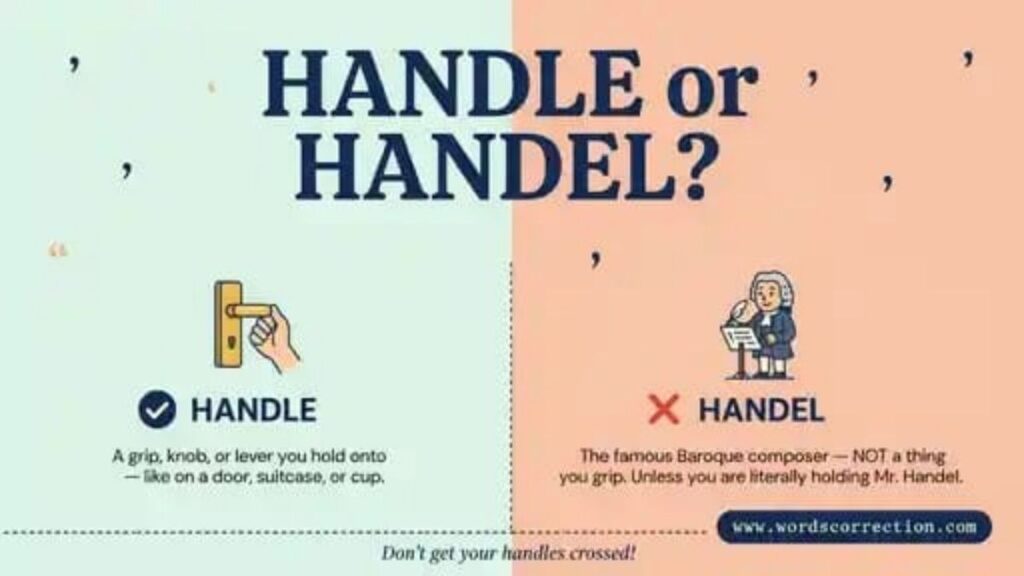
Some spelling mistakes are easy to spot, while others can fool even careful writers. Handle or Handel is one of those tricky word pairs that looks almost identical but carries completely different meanings. Although the two words may sound remarkably similar, choosing the wrong spelling can change the entire meaning of your sentence. Handle is the everyday English word used when you mean to manage a situation, hold an object, deal with a person, or refer to an online username. Handel, in contrast, is primarily a proper name, most famously associated with composer George Frideric Handel. Let’s clear up the confusion and make the correct choice easy to remember.
Handle or Handel Quick Answer
For ordinary English vocabulary, handle is the correct spelling.
Handle can function as both a noun and a verb. As a noun, it can mean a part of an object that you hold, such as a door handle or suitcase handle. As a verb, it can mean to manage, deal with, control, or take responsibility for something.
Handel, on the other hand, is normally a proper noun. It is best known as a surname, particularly the surname of the Baroque composer George Frideric Handel.
Here is the difference at a glance:
| Word | What it is | Main meaning or use | Example |
| Handle | Noun | A part designed to be held | “The drawer has a metal handle.” |
| Handle | Verb | Manage or deal with something | “She can handle the situation.” |
| Handle | Noun | An online username or account name | “What’s your Instagram handle?” |
| Handel | Proper noun | A surname or personal name | “Handel wrote Messiah.” |
So, which is correct, handle or handel? For the ordinary English word, choose handle.
Is Handle or Handel Correct?
If you’re writing a sentence such as:
- “Can you handle this problem?”
- “Grab the door handle.”
- “He knows how to handle difficult customers.”
- “What’s your social media handle?”
the answer is handle.
If the sentence refers to the composer or someone whose surname is Handel, use Handel.
Is Handel a Word in English?
Handel appears in English writing, but that doesn’t make it an alternative spelling of handle. It is primarily encountered as a proper name.
For example:
“George Frideric Handel was a major composer of the Baroque era.”
Here, Handel identifies a person. It doesn’t mean manage, hold, or deal with.
Learn the difference between tricky words and use them correctly
Emerse or Immerse Correct Spelling and Use
What Does Handle Mean?
The handle meaning changes slightly according to context. The word has several established uses, which explains why you see it in everyday conversation, workplace communication, product descriptions, social media, and informal speech.
At its core, many meanings of handle connect to the ideas of holding, managing, or dealing with something.
Handle as a Noun
The handle as a noun usually refers to a part of an object that you can hold, pull, turn, or use to operate it.
Consider these examples:
- “The door handle is loose.”
- “She picked up the suitcase by its handle.”
- “The mug has a comfortable handle.”
- “Turn the handle slowly.”
- “The cabinet handle broke yesterday.”
In each sentence, handle identifies a physical feature designed for use by the hand.
This physical sense helps explain why the word also developed broader meanings connected with managing things.
Handle as a Verb
The handle as a verb has a much broader range of uses.
It can mean:
- manage something
- deal with something
- take care of something
- be responsible for something
- treat something in a particular way
- interact with someone
- cope with a difficult situation
For example:
“Maria handled the customer complaint professionally.”
Here, handled doesn’t mean that Maria physically touched the customer. It means she dealt with the complaint and managed the situation appropriately.
Other examples include:
- “I can handle the project.”
- “He handled the emergency calmly.”
- “She handles customer requests every morning.”
- “Can you handle this responsibility?”
- “The technician handled the equipment carefully.”
The handle definition therefore depends heavily on context.
Learn the difference between similar English words the easy way
Lader or Ladder Which One Is Correct?
Handle Meaning in English The Main Uses

If you’re searching for handle meaning in English, several common uses are worth knowing.
To Hold or Operate Something
This is the most literal sense.
“Use the handle to open the door.”
The handle gives you something to grip or manipulate.
To Manage Something
This is one of the most common figurative uses.
“She can handle a busy schedule.”
Here, handle means manage or cope with.
To Deal With a Problem
You can also use handle when discussing a problem, task, complaint, or stressful situation.
“The technician handled the problem quickly.”
The person took responsibility and dealt with the issue.
To Treat Something in a Particular Way
Handle can describe how someone treats an object.
“Handle the glass carefully.”
This means you should use careful treatment because the glass could break.
To Deal With a Person
When handle refers to a person, it generally means deal with, manage, or interact with that person effectively in a particular situation.
“She knows how to handle difficult customers.”
The phrase doesn’t necessarily imply controlling the person. It usually means responding appropriately to that person’s behavior or needs.
Handle Someone Meaning
The phrase handle someone meaning can confuse learners because handle someone doesn’t have one fixed interpretation in every situation.
Generally, to handle someone means to deal with or manage that person’s behavior, needs, reactions, or actions in a particular circumstance.
For example:
“The supervisor knows how to handle difficult employees.”
The supervisor knows how to respond to difficult behavior and maintain a professional working environment.
However, context matters.
What Does Handle Someone Mean?
When someone asks what does handle someone mean, the simplest explanation is:
It usually means dealing with, managing, or responding to someone in a particular situation.
Examples include
- “She knows how to handle an angry customer.”
- “He handled the demanding client with patience.”
- “The teacher handled the disruptive student calmly.”
- “I don’t know how to handle his attitude.”
The phrase doesn’t automatically mean control someone. In many contexts, deal with is a better interpretation.
Handle Someone Meaning in Relationship
The phrase handle someone meaning in relationship requires extra attention because handle can sound stronger when used about a romantic partner.
For example
“She knows how to handle him when he’s upset.”
This generally means she knows how to respond to his behavior or emotions in that situation.
It doesn’t necessarily mean that she controls him.
Depending on the context, handle someone in a relationship could suggest:
- responding to difficult behavior
- managing conflict
- communicating during an argument
- dealing with emotional reactions
- setting boundaries
- remaining calm during stressful moments
A more respectful alternative may sometimes be communicate with, support, respond to, or work through an issue with.
For instance:
“They’ve learned how to handle disagreements calmly.”
This sounds more balanced than suggesting one partner needs to manage the other.
Please Handle Someone Meaning
The phrase please handle someone meaning depends strongly on the complete sentence.
If someone says:
“Please handle the customer.”
they usually mean please deal with the customer or take responsibility for the situation.
However, handle someone can sound blunt when used in personal situations. In professional communication, more specific wording often sounds better:
- “Please speak with the customer.”
- “Please assist the client.”
- “Please address the issue with the employee.”
- “Please follow up with the customer.”
Clear wording prevents unnecessary confusion.
Learn the difference between more words people mix up
Presence or Presense Which Spelling Is Correct?
How to Handle Someone in Different Situations
The question how to handle someone isn’t really a grammar question. It’s a usage question involving the meaning of handle.
The best interpretation depends on the person’s behavior and the situation.
How to Handle Difficult People
When someone is difficult, handle usually means deal with the person’s behavior effectively.
For example:
“The receptionist handled the difficult customer with patience.”
Here are practical ways the phrase may be used:
- Handle someone calmly rather than reacting emotionally.
- Listen before responding.
- Focus on the specific behavior or problem.
- Set reasonable boundaries.
- Keep your tone professional.
- Avoid turning disagreement into a personal attack.
- Address the issue instead of labeling the person’s personality.
Handle Someone at Work
The phrase handle someone at work often appears when discussing customers, clients, employees, coworkers, or managers.
For example
“She knows how to handle demanding clients.”
A workplace context may involve:
| Situation | Natural use of handle |
| Angry customer | “He handled the complaint well.” |
| Difficult client | “She knows how to handle demanding clients.” |
| Employee conflict | “The manager handled the dispute professionally.” |
| Heavy workload | “I can handle the additional work.” |
| Stressful meeting | “She handled the meeting calmly.” |
Handle Someone Professionally
To handle someone professionally means to interact with that person in a respectful, appropriate, and work-focused manner.
For example:
“The manager handled the employee’s complaint professionally.”
The emphasis falls on professional behavior, not on controlling the employee.
Handle Someone’s Behavior
The phrase handle someone’s behavior means dealing with the way that person acts.
“The teacher knew how to handle the student’s disruptive behavior.”
This construction is particularly common when discussing children, customers, employees, or people in situations requiring authority or responsibility.
Handle Someone’s Attitude
The phrase handle someone’s attitude generally means dealing with a person’s negative, difficult, dismissive, or confrontational manner.
“The supervisor handled the employee’s attitude without escalating the conflict.”
Again, handle means deal with rather than necessarily control.
What Does Handel Mean?
The Handel meaning is quite different from the ordinary handle meaning.
Handel is primarily used as a proper name. The most famous person associated with the name is George Frideric Handel, the German-born composer who later became associated with Britain and whose music remains central to the Baroque repertoire.
He was born in 1685 in Halle and died in 1759 in London.
Among his best-known works are:
- Messiah
- Water Music
- Music for the Royal Fireworks
Therefore, when you see Handel in a sentence about classical music, composers, or music history, you’re probably looking at the surname rather than the English word handle.
Handel Spelling
The Handel spelling is:
H-A-N-D-E-L
The ordinary English word is:
H-A-N-D-L-E
The letters may look deceptively similar, but the placement of L and E differs.
Compare them carefully:
handle → H-A-N-D-L-E
Handel → H-A-N-D-E-L
That difference is enough to change the word completely.
Handle Spelling: How to Remember It
The handle spelling is:
H-A-N-D-L-E
One useful memory aid is to connect the word with hand.
A handle is something you commonly use with your hand. The spelling begins with “hand” and continues with “-le”:
HAND + LE = HANDLE
This works as a practical spelling reminder.
For example:
- handle a problem
- handle a customer
- handle a suitcase
- handle a situation
- handle a responsibility
If you’re using the word as an ordinary English noun or verb, handle is almost certainly the spelling you need.
Learn the difference between everyday English mistakes
Gos or Goes Which One Is Right?
Handle vs Handel Origin and Word History
The two words don’t represent British and American versions of the same spelling.
Origin of Handle
The word handle is historically connected with hand and developed from the idea of something associated with the hand or designed to be held.
Its physical meaning came first. A handle is something that allows you to grip or operate an object.
Over time, the word gained figurative meanings. If you can physically hold something, the metaphorical leap to being able to manage or deal with something is natural.
That helps explain expressions such as:
- handle a problem
- handle a responsibility
- handle pressure
- handle a complaint
- handle a difficult situation
The modern word therefore carries both physical and figurative meanings.
Origin of Handel
Handel has a separate history as a surname and proper name. It shouldn’t be treated as a shortened or regional version of handle.
This distinction becomes especially important when discussing George Frideric Handel. His surname is part of his proper name, so changing it to Handle would create a spelling error.
Why Does Handel Appear?
You may encounter Handel in several contexts:
- classical music
- music history
- biographies
- surnames
- historical records
- names of people and organizations
The appearance of Handel doesn’t mean English speakers have another spelling for handle. It simply means the proper name Handel is being used.
Is Handel the British Spelling of Handle?
No.
This is one of the most important points in the handle vs Handel discussion.
British English uses handle for the ordinary word. American English also uses handle.
For example:
American English:
“Can you handle this problem?”
British English:
“Can you handle this problem?”
The spelling doesn’t change to handel.
Some English words genuinely have British and American spelling differences, such as colour and color or centre and center. Handle and Handel aren’t examples of that pattern.
Handle vs Handel in British and American English
| Meaning | American English | British English |
| Part of an object | handle | handle |
| Manage a situation | handle | handle |
| Deal with a person | handle | handle |
| Online username | handle | handle |
| Composer’s surname | Handel | Handel |
The important point is consistency: handle remains handle in both major varieties of English.
Handle vs Handel Pronunciation
Spelling and pronunciation can create another layer of confusion.
In standard English pronunciation, handle and the surname Handel are commonly pronounced very similarly and can sound the same in ordinary speech.
That means context becomes particularly important.
If someone says:
“I can handle it.”
you understand the meaning from the sentence.
If someone says:
“I listened to Handel last night.”
the context tells you that Handel refers to the composer or his music.
This is a useful reminder that pronunciation alone doesn’t always identify a word. English contains many words and names that sound alike or nearly alike while having different spellings and meanings.
Handle Meaning in a Sentence
Seeing handle in real sentences makes its different meanings easier to recognize.
Handle as a Noun
“The suitcase handle broke during the trip.”
Here, handle means a physical part used for gripping.
“The door handle needs replacing.”
Again, it refers to a physical object.
Handle as a Verb
“She handled the complaint professionally.”
Here, handled means dealt with.
“Can you handle the extra responsibility?”
Here, it means manage or cope with.
“The technician handled the equipment carefully.”
Here, it refers to physical treatment.
Handel as a Proper Name
“Handel’s Messiah remains widely performed.”
Here, Handel is a surname.
“George Frideric Handel was a major Baroque composer.”
Again, the word identifies a person.
Handle Meaning on Social Media
The handle meaning social media users encounter is different from the physical-object meaning.
A social media handle is the identifying username or account name associated with a person, brand, organization, or account.
For example:
“What’s your Instagram handle?”
The speaker is asking for the account’s username or identifying name.
Social Media Handle Meaning
The social media handle meaning is essentially an account identifier used on a social platform.
Depending on the platform, a handle may appear with an @ symbol.
Examples include:
- @username
- @brandname
- @creatorname
The exact format and rules vary by platform.
Instagram Handle Meaning
The Instagram handle meaning generally refers to the account’s @username.
For example, if an account’s username is @example, someone might say:
“Send me your Instagram handle.”
They want the account identifier that allows them to find or mention the account.
Online Handle Meaning
The online handle meaning is broader than social media.
An online handle can refer to a name someone uses to identify themselves on the internet, including certain communities, forums, gaming platforms, or social networks.
The word can therefore describe an online identity without necessarily referring to someone’s legal or real-world name.
Learn the difference between basic English word mistakes
To or Too Clear Difference, Meaning and Usage
Username vs Handle
The distinction between username vs handle is usually small, but the terms aren’t always perfectly interchangeable.
A username is generally the name or identifier assigned to an account.
A handle is often an informal term for an online identifier, particularly one used publicly or socially.
| Term | General idea |
| Username | An account identifier used to identify an account |
| Handle | An informal or public name used to identify someone online |
| Display name | The name shown publicly on a profile, which may differ from the username |
The exact distinction depends on the platform.
So, if someone asks:
“What’s your handle?”
they may simply be asking for your online username.
Handle Meaning Slang
The phrase handle meaning slang can be misleading because handle isn’t exclusively slang.
The word has been part of standard English vocabulary for centuries. Its use for an online name is informal and modern compared with its older physical and figurative meanings.
In some informal contexts, handle can mean a nickname, alias, or identifying name.
For example:
“His online handle is easy to remember.”
Here, handle means an informal name used to identify someone.
The key is context. You shouldn’t assume every use of handle is slang.
Common Mistakes With Handle and Handel
Mistake: Using Handel as the Verb
Incorrect:
“I can handel this problem.”
Correct:
“I can handle this problem.”
Handel isn’t the ordinary English verb meaning manage or deal with.
Mistake: Thinking Handel Is a British Spelling
Incorrect idea:
“Americans write handle, but British speakers write handel.”
That’s false.
Both use handle.
Mistake: Confusing a Name With a Common Word
Consider these two sentences:
“She can handle the situation.”
“She listened to Handel’s music.”
The first sentence uses handle as a verb. The second uses Handel as a surname.
Mistake: Ignoring Capitalization
Handle is normally lowercase when used as an ordinary English word.
Handel is capitalized when it functions as a proper name.
Compare:
- handle a problem
- door handle
- social media handle
- George Frideric Handel
- Handel’s music
Capitalization can therefore provide a useful clue, although capitalization alone isn’t enough to determine meaning in every context.
Mistake: Trusting Autocorrect Too Much
Spell-check tools can catch many spelling errors, but they don’t always understand meaning.
If you type Handel, the software may recognize it as a correctly spelled name. It won’t necessarily know that you actually intended handle.
That’s why proofreading should involve more than checking whether a word is technically spelled correctly.
Ask:
“Does this word make sense in the sentence?”
That simple question catches many commonly confused words.
Learn the difference between often confused words
Inact or Enact Which Spelling Is Correct?
Handle or Handel: Everyday Examples
Examples as a Verb
- I can handle the workload.
- She handled the complaint professionally.
- He knows how to handle difficult customers.
- Can you handle this situation?
- The manager handled the conflict calmly.
- We need someone who can handle pressure.
- She knows how to handle someone’s behavior without escalating the problem.
as a Noun
- The door handle is broken.
- The suitcase has a strong handle.
- Grab the handle carefully.
- The cup has a wooden handle.
- The drawer handle came loose.
Examples of Handle in Relationships
- They learned how to handle disagreements respectfully.
- She knows how to handle conflict in a relationship.
- He doesn’t know how to handle difficult conversations.
- They try to handle each other’s concerns calmly.
Notice that these examples focus on dealing with situations rather than controlling another person.
Examples of Handle on Social Media
- What’s your Instagram handle?
- I couldn’t find her social media handle.
- His online handle is different from his real name.
- The brand changed its social media handle.
Examples of Handel
- Handel composed Messiah.
- George Frideric Handel was a Baroque composer.
- We studied Handel in music history.
- The concert included music by Handel.
Handle vs Handel: Mini Case Studies
Rather than memorizing a rule in isolation, look at how context determines the correct spelling.
Case Study: A Workplace Problem
Suppose a manager says:
“I need someone who can ___ this client complaint.”
The intended meaning is deal with or manage.
Therefore:
“I need someone who can handle this client complaint.”
Handel would be incorrect.
Case Study: Classical Music
Now consider:
“The orchestra performed music by ___.”
The sentence refers to a composer.
Therefore:
“The orchestra performed music by Handel.”
Here, Handel is correct because it is the composer’s surname.
Case Study: Social Media
Imagine someone asks:
“What’s your Instagram ___?”
The intended meaning is the account’s username.
Therefore:
“What’s your Instagram handle?”
Using Handel would be a spelling error unless the account itself deliberately uses that name.
Case Study: A Physical Object
Consider:
“The kitchen cabinet ___ is loose.”
The sentence describes a physical part.
Therefore:
“The kitchen cabinet handle is loose.”
Again, handle is the correct word.
Learn the difference between confusing word pairs
Maxxed or Maxed: Which Spelling Is Correct?
Handle vs Handel: Comparison Table
| Feature | Handle | Handel |
| Standard common English word | Yes | No, not in the same sense |
| Common noun | Yes | No |
| Verb | Yes | No |
| Physical object | Yes | No |
| Meaning “manage” | Yes | No |
| Meaning “deal with” | Yes | No |
| Referring to a person | Can occur in phrases such as “handle someone” | Yes, as a proper name or surname |
| Social media term | Yes | No |
| Username or online identity | Yes | No |
| Proper name | Not normally | Yes |
| Associated with George Frideric Handel | No | Yes |
| Capitalization | Usually lowercase | Usually uppercase as a name |
| British spelling | handle | Handel as a proper name |
| American spelling | handle | Handel as a proper name |
How to Remember Handle vs Handel
A simple memory trick can save you from this spelling trap.
Think about the word hand.
A handle is something you can use with your hand. The spelling begins with “hand” and continues with “-le”:
HAND + LE = HANDLE
When you mean manage or deal with something, keep that same spelling:
- handle a problem
- handle a customer
- handle pressure
- handle responsibility
- handle a situation
When you see Handel, think of a name, especially the composer.
Handle = manage, hold, deal with, or online name.
Handel = proper name.
When to Use Handle vs Handel
when the word functions as an ordinary English noun or verb.
Handle For:
- a door handle
- a suitcase handle
- a cup handle
- handling a problem
- handling a customer
- handling a complaint
- handling responsibility
- handling pressure
- handling difficult people
- handling someone’s behavior
- handling a stressful situation
- a social media handle
- an online handle
Handel use when you’re referring to the proper name.
Use Handel For:
- George Frideric Handel
- Handel’s compositions
- Handel’s Messiah
- Handel’s Water Music
- a person whose surname is Handel
Learn the difference between tricky grammar more words
Unattentive or Inattentive Meaning and Usage
Which Is Correct: Handle or Handel?
The answer is straightforward once you identify the meaning.
If your sentence means manage, deal with, cope with, hold, treat, or online username, use handle.
If you’re referring to Handel as a person’s name, use Handel.
Quick Decision Guide
| If you mean… | Use |
| Manage a project | handle |
| Deal with a problem | handle |
| Deal with a customer | handle |
| Respond to a difficult person | handle |
| Hold an object | handle |
| A physical grip | handle |
| Social media username | handle |
| Online identity | handle |
| George Frideric Handel | Handel |
| The composer’s surname | Handel |
| A person named Handel | Handel |
Practice Session
Fill in the Blanks
Instructions: Choose the correct word or phrase to complete each sentence.
- She knows how to ______ difficult customers professionally.
- Please ______ this situation calmly and carefully.
- I don’t think he can ______ the pressure of the new job.
- “I can ______ you” can mean that someone is confident they can deal with your behavior.
- She said, “I can ______ myself,” meaning she does not need anyone’s help.
- His social media ______ is easy to remember.
- You can find her account by searching for her Instagram ______.
- The manager knows how to ______ customer complaints effectively.
- The word “______” can refer to a username on social media.
- “Handel” is commonly used as a proper name, especially for the composer George Frideric ______.
- Please ______ the equipment with care.
- She has learned how to ______ stressful situations at work.
- The phrase “I can’t ______ you” may mean that someone feels unable to deal with another person’s behavior.
- He created a unique online ______ for his gaming account.
- As a verb, “______” can mean to manage, deal with, or take care of something.
- The supervisor will ______ the customer’s complaint.
- The company hired an experienced employee to ______ difficult clients.
- “Manhandle” means to treat or move someone ______.
- In a relationship, “handle someone” can refer to knowing how to deal with their personality, emotions, or ______.
- The manager remained calm and knew how to ______ the difficult employee.
- “Handle” and “Handel” are not interchangeable because they have different ______.
- George Frideric ______ was a famous composer.
- Her username serves as her social media ______.
- If you can ______ yourself in a stressful situation, you can remain calm and manage your behavior.
- Choose “handle” when you mean manage or deal with something, but choose “Handel” when referring to the composer’s ______.
Answer Session
- handle
- handle
- handle
- handle
- handle
- handle
- handle
- handle
- handle
- Handel
- handle
- handle
- handle
- handle
- handle
- handle
- handle
- roughly
- behavior
- handle
- meanings
- Handel
- handle
- handle
- name
Here’s a trusted source for clear more words Comparison:
Grammar Update
Frequently Asked Questions
What does “handle” mean in slang?
In slang or informal conversation, “handle” can mean to deal with, manage, or cope with someone or something. On social media, however, a “handle” usually refers to a username or account identifier.
What does “handling” mean in slang?
In informal usage, “handling” generally means dealing with, managing, or coping with a person or situation. Its precise meaning depends on the context and tone.
What does it mean to manhandle someone?
To manhandle someone means to treat, move, or control them roughly or with unnecessary physical force. The term generally carries a negative connotation and implies rough treatment.
What does “handle a woman” mean?
“Handle a woman” generally means being able to deal with or respond to her personality, behavior, emotions, or expectations. Because the phrase can sound objectifying, expressions such as “understand,” “communicate with,” or “get along with” may be more appropriate in respectful contexts.
What does “I can handle you” mean?
“I can handle you” means “I can deal with you” or “I can manage the situation involving you.” Depending on the context, it may sound confident, playful, challenging, or flirtatious.
What does it mean to handle someone?
To handle someone means to deal with, manage, or interact with that person effectively. The phrase is often used when someone’s behavior, personality, or actions require patience or particular attention.
What does “handle someone” mean in a relationship?
In a relationship, “handle someone” usually means knowing how to deal with that person’s behavior, emotions, personality, or needs. In positive communication, terms such as “understand,” “support,” and “communicate with” are often more appropriate.
What does “I can’t handle you” mean?
“I can’t handle you” means that someone feels unable to deal with another person’s behavior, emotions, personality, or actions. Depending on the situation, it can express frustration, amusement, affection, or feeling overwhelmed.
What does “I can handle myself” mean?
“I can handle myself” means “I can take care of myself” or “I can manage the situation without assistance.” It commonly expresses independence, confidence, or self-reliance.
What does “handle me” mean?
“Handle me” generally means “deal with me” or “know how to respond to me.” The intended meaning depends on the context and may relate to someone’s behavior, personality, emotions, or a particular relationship dynamic.
What does it mean to handle yourself?
To handle yourself means to manage your behavior, emotions, or reactions appropriately in a particular situation. It can also describe remaining calm, composed, and capable when facing pressure.
What is a good way to handle a difficult person?
A good approach is to remain calm, communicate clearly, establish reasonable boundaries, and avoid unnecessary arguments. If difficult behavior continues, limiting contact may be appropriate.
When should you walk away from a person?
You should consider walking away when a relationship consistently involves disrespect, manipulation, intimidation, or repeated boundary violations and constructive efforts to resolve the issue have not worked.
How do you stop letting people bother you?
You can become less affected by other people’s behavior by focusing on what you can control, setting boundaries, and avoiding unnecessary reactions. Creating emotional distance can also help you maintain perspective.
How do you deal with people who constantly put you down?
Stay composed, identify the behavior, communicate your boundaries clearly, and reduce contact when necessary. Repeated criticism, insults, or belittling should not be accepted as healthy communication.
How can you tell if someone is trying to put you down?
Common signs include repeated criticism, dismissive comments, public embarrassment, minimizing your accomplishments, or negative remarks disguised as jokes. A consistent pattern is more meaningful than an isolated comment.
How do you deal with two-faced people?
Maintain clear boundaries, avoid sharing unnecessary personal information, remain professional, and judge the relationship by consistent actions rather than promises. You do not need to engage in every conflict or confrontation.
What does “handle” mean on social media?
On social media, a handle is the username or identifier associated with an account. It is often displayed with an @ symbol and allows other users to find, mention, or tag the account.
Is a social media handle the same as a username?
A social media handle and username often refer to the same thing, but the terminology can vary by platform. A handle generally identifies an account publicly and may be used when mentioning or tagging that account.
What does “handle” mean as a verb?
As a verb, “handle” means to manage, deal with, operate, control, or take care of someone or something. For example, “She handles customer complaints professionally” means she deals with customer complaints effectively.
Is “Handel” the same as “handle”?
No. “Handle” and “Handel” have different uses. “Handle” is a common English word, while “Handel” is primarily a proper name, especially associated with the composer George Frideric Handel.
Which is correct: “handle” or “Handel”?
Both can be correct, depending on the context. Use “handle” when referring to managing, dealing with, holding, or operating something. Use “Handel” when referring to the proper name, such as the composer George Frideric
Conclusion
The handle or Handel confusion may involve only one letter, but that small difference can completely change the meaning of a sentence. Handle is the correct word when you mean to manage a situation, deal with a person, hold an object, or refer to an online username. Handel, by contrast, is primarily a proper name, most famously associated with the renowned composer George Frideric Handel.
A simple way to remember the difference is to connect handle with hand. If you’re talking about managing, holding, or dealing with something, use handle. If you’re referring to the composer or someone whose name is Handel, use Handel.
Once spelling and meaning click into place, this confusing pair becomes much easier to handle.

Stella AJS is an experienced blogger and dedicated English language writer at Words Correction. She turns confusing grammar, word meanings, spelling, and usage into clear, practical insights that readers can easily understand and apply. With a passion for precise and engaging writing, Stella helps readers avoid common language mistakes, strengthen their vocabulary, and communicate with greater clarity and confidence.




