
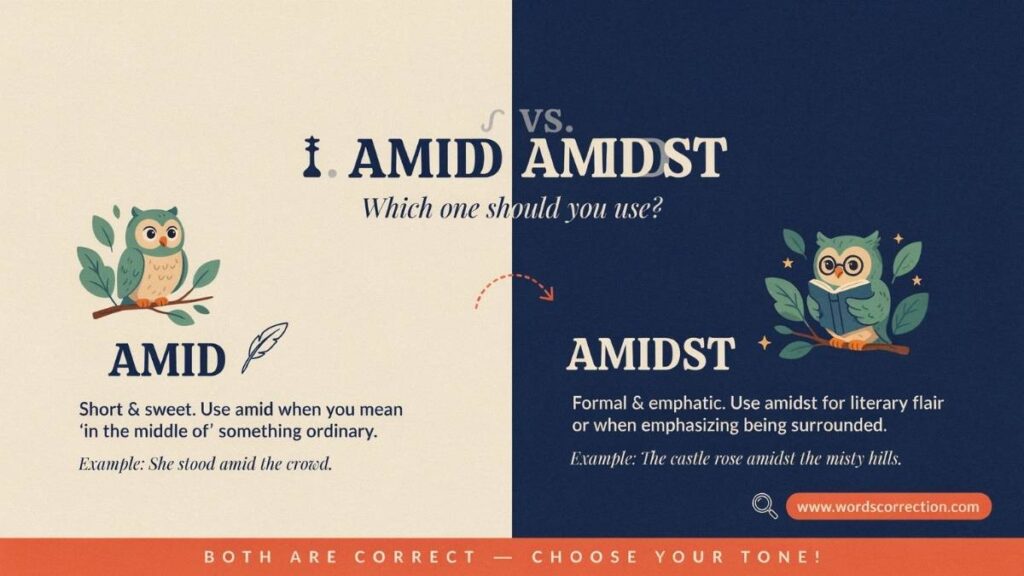
Choosing between amid or amidst can be confusing. One word is shorter, while the other may sound more formal. So, which one should you use? The good news is that both words are correct and have almost the same meaning. However, knowing how to use them can help you avoid common grammar mistakes and make your writing clearer. In this guide, you’ll learn the difference between amid and amidst, see simple examples, and discover when to use each word. By the end, you’ll feel more confident choosing the right word without turning a small grammar question into a big headache.
Amid or Amidst The Quick Answer
Amid and amidst are both correct English words. They have nearly identical meanings and can often replace each other without changing the meaning of a sentence.
The main difference is style. Amid is more common in modern writing, particularly in American English. Amidst can sound slightly more literary, traditional, or formal, depending on the context.
Consider these examples
- The team remained focused amid the pressure.
- The team remained focused amidst the pressure.
Both sentences are grammatically correct. They communicate the same idea: the team stayed focused while experiencing pressure.
For most everyday, academic, and professional writing, amid is a practical choice. However, there is no need to avoid amidst when it suits your tone.
Learn the difference between confusing more English words
Accel or Excel Which Spelling Is Correct?
What Does Amid Mean?
Amid is a preposition that means in the middle of something, surrounded by something, or while something is happening.
It often appears before a noun or noun phrase that describes a situation, event, feeling, or environment.
For example
- The announcement came amid growing public concern.
- She remained calm amid the confusion.
- The company expanded amid economic uncertainty.
- The children played amid the trees.
- He continued working amid constant interruptions.
In each sentence, amid connects an action or situation with the circumstances surrounding it.
The word can describe physical surroundings, such as trees or crowds. It can also describe abstract conditions, including uncertainty, excitement, criticism, or change.
Examples of Amid in Different Contexts
News writing
- The government introduced new measures amid rising inflation.
- The company announced its plans amid speculation about a merger.
- Talks continued amid growing tensions between the two sides.
For professional communication
- The department maintained productivity amid organizational changes.
- The project continued amid several unexpected delays.
- Employees adapted quickly amid new workplace policies.
In everyday conversation
- She found time to relax amid her busy schedule.
- He stayed cheerful amid all the confusion.
- We managed to finish dinner amid the noise.
In creative writing
- A small cottage stood amid the rolling hills.
- She searched for hope amid the ruins.
- Birds sang amid the rustling leaves.
These examples show that amid works in many contexts. It can describe a physical setting, an emotional experience, or a broader situation.
Learn the difference between commonly mixed-up more words
Authorised or Authorized Which Spelling Is Correct?
What Does Amidst Mean?
Amidst is also a preposition. It means in the middle of, surrounded by, or during something. Its meaning is almost identical to that of amid.
For example
- The village stood amidst green fields.
- She remained hopeful amidst the difficulties.
- The decision was announced amidst widespread criticism.
- The children laughed amidst the celebrations.
- The team continued working amidst uncertainty.
Each sentence could use amid without changing its essential meaning.
Amidst sometimes gives a sentence a more literary or traditional feel. Writers may choose it when describing a scene, creating atmosphere, or developing a particular voice.
However, this difference is a matter of style rather than a strict grammatical rule. Amidst is not automatically more formal or more appropriate for serious writing.
Examples of Amidst in Different Contexts
For descriptive writing
- The castle stood amidst towering mountains.
- Wildflowers bloomed amidst the tall grass.
- A narrow path wound amidst the ancient trees.
In emotional situations
- She discovered strength amidst adversity.
- He found peace amidst the chaos.
- Their friendship grew amidst difficult circumstances.
In storytelling
- A faint light appeared amidst the darkness.
- The traveler rested amidst the ruins of an old city.
- Laughter echoed amidst the celebrations.
Formal writing
- The organization continued its work amidst financial challenges.
- The announcement came amidst ongoing negotiations.
- Researchers conducted the study amidst changing environmental conditions.
These examples demonstrate that amidst works in both descriptive and formal contexts. The best choice depends on the tone you want to create and the style you want to maintain.
Learn the difference between tricky grammar more words
Manuel or Manual An Easy Guide to the Correct Word
Amid vs Amidst Key Differences
The main difference between amid and amidst is their style and frequency of use, not their meaning.
| Feature | Amid | Amidst |
|---|---|---|
| Meaning | In the middle of, surrounded by, or during | In the middle of, surrounded by, or during |
| Grammatical role | Preposition | Preposition |
| Common usage | Widely used in modern English | Correct but often less common |
| American English | Generally the more common choice | Used, but may sound more literary |
| British English | Common and accepted | Commonly accepted and sometimes preferred stylistically |
| Tone | Neutral and direct | Can sound more literary or traditional |
| Formal writing | Suitable | Also suitable |
| Creative writing | Suitable | Often useful for descriptive effects |
The table highlights a useful point: neither word is inherently more correct than the other. Both are standard English.
When deciding between them, consider your audience, the purpose of your writing, and the tone you want to achieve.
Are Amid and Amidst Interchangeable?
Yes. In most situations, amid and amidst are interchangeable because they express the same basic idea.
Compare the following sentences
- The decision came amid growing uncertainty.
- The decision came amidst growing uncertainty.
Both sentences describe a decision made while uncertainty was increasing.
Here are more examples
| Using Amid | Using Amidst |
|---|---|
| The house stood amid the trees. | The house stood amidst the trees. |
| She smiled amid the confusion. | She smiled amidst the confusion. |
| The announcement arrived amid protests. | The announcement arrived amidst protests. |
| The team succeeded amid difficulties. | The team succeeded amidst difficulties. |
| Hope remained amid the chaos. | Hope remained amidst the chaos. |
The wording changes, but the meaning stays essentially the same.
There may be situations where one option sounds more natural to a particular reader. That preference usually reflects regional habits, editorial style, or personal taste rather than a difference in grammar.
Learn the difference between confusing word pairs
Gopher or Gofer Which Spelling Is Correct?
Is Amid or Amidst More Common in American English?
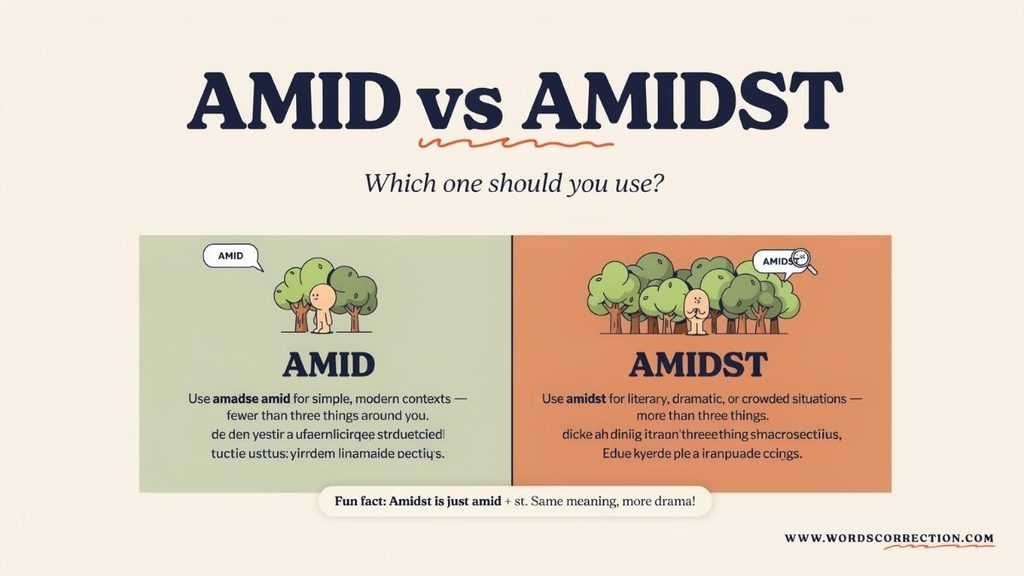
Amid is generally the more common choice in modern American English. It appears frequently in journalism, business writing, academic work, and everyday formal communication.
For example
- The company announced layoffs amid declining sales.
- Officials issued a warning amid severe weather.
- The school introduced new policies amid concerns about student safety.
Amidst is also correct in American English. Writers may use it when they want a more traditional, descriptive, or literary tone.
For example
- The cabin rested amidst the pine trees.
- She found comfort amidst the uncertainty.
These sentences are perfectly acceptable. However, a writer aiming for a direct, contemporary style may prefer amid.
The important point is that American English does not prohibit amidst. The choice is largely stylistic.
Learn the difference between often confused words
Monkeys or Monkies Which Spelling Is Correct?
Is Amid or Amidst More Common in British English?
Both words are accepted in British English. Amidst may feel more natural to some British readers in certain contexts, especially in literary or descriptive writing. However, amid is also widely used.
Examples include
- The government acted amid growing criticism.
- The cottage stood amidst the countryside.
- Negotiations continued amid uncertainty.
- The children played amidst the autumn leaves.
These examples demonstrate that both forms work in British English.
It is better to follow the conventions of your publication, organization, or intended audience than to assume that one word belongs exclusively to British English and the other to American English.
Learn the difference between basic English word mistakes
Signalling vs Signaling Which Spelling Is Correct?
When Should You Use Amid?
Choose amid when you want direct, natural, and widely accepted wording. It is particularly useful when clarity and brevity matter.
News and journalism
News writing often favors concise language. Amid can introduce the circumstances surrounding an event without making the sentence unnecessarily long.
Example:
The minister resigned amid allegations of misconduct.
The sentence quickly explains the circumstances surrounding the resignation.
Business and professional writing
Amid works well in reports, emails, presentations, and workplace updates.
Example
The department maintained service quality amid staff shortages.
The wording is clear and professional.
Academic writing
Academic writers can use amid to describe conditions surrounding a study, event, or development.
Example
The research was conducted amid significant changes in environmental policy.
The word communicates the context without adding unnecessary detail.
Everyday communication
Amid is also suitable for ordinary situations.
Example
She managed to finish her assignment amid several distractions.
The sentence is simple, natural, and easy to understand.
Learn the difference between commonly misused words
Sent or Send Which one Is Correct?
When Should You Use Amidst?
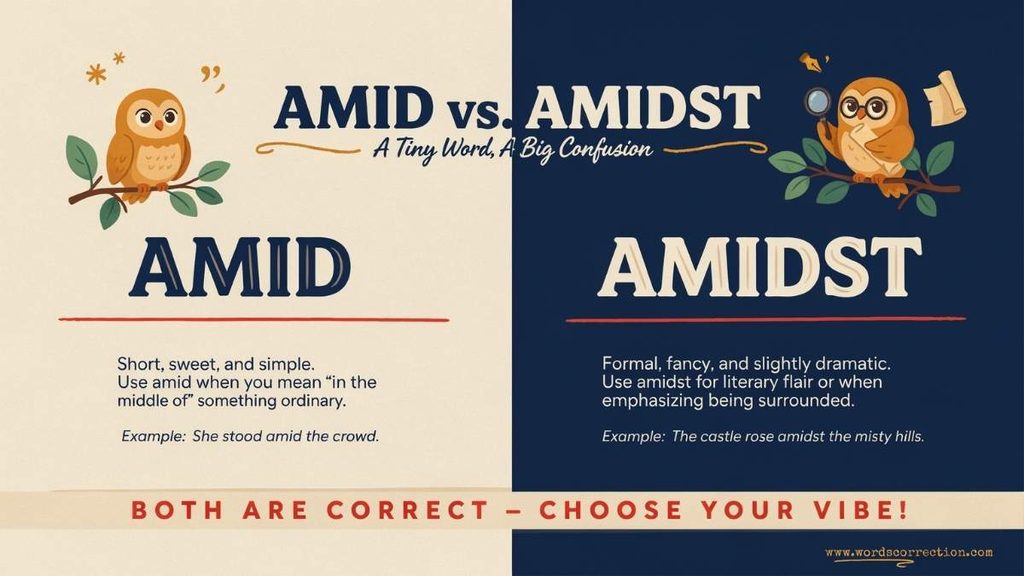
Choose amidst when it fits the tone, rhythm, or atmosphere of your writing. It can work particularly well in descriptive passages and creative storytelling.
Describing a setting
Example
The old church stood amidst a field of wildflowers.
Amidst helps create a descriptive tone, although amid would also be correct.
Creating atmosphere
Example
A quiet voice emerged amidst the noise of the crowd.
The sentence describes a sound surrounded by other sounds.
Writing fiction or poetry
Example
He searched for answers amidst the ruins of his past.
The word can support a reflective or literary tone. Still, the surrounding sentence matters more than the choice of preposition alone.
Maintaining a consistent voice
If your writing already uses a traditional or literary style, amidst may fit naturally. If the rest of your writing is concise and contemporary, amid may be the better match.
Neither choice automatically improves the writing. The goal is to make the sentence sound natural.
Learn the difference between everyday English mistakes
Peak or Peek What’s the Difference?
Common Mistakes to Avoid
Although amid and amidst are easy to use, writers sometimes make mistakes when combining them with other words or choosing between similar expressions.
Using “amid of”
Incorrect: The company grew amid of economic uncertainty.
Correct: The company grew amid economic uncertainty.
Amid is followed directly by a noun or noun phrase. It does not require of.
The same rule applies to amidst.
Incorrect: The village stood amidst of the mountains.
Correct: The village stood amidst the mountains.
Assuming Amidst Is Incorrect
Incorrect assumption Amidst is not a real English word.
Correct understanding Amidst is a standard English preposition. It is correct even if amid is more common in a particular style or region.
Do not mark amidst as an error simply because a publication prefers amid.
Assuming Amidst Is Always More Formal
Amidst can sound literary or traditional, but it is not automatically more formal. Both words can appear in professional, academic, and journalistic writing.
For example
The company continued operations amid financial difficulties.
The company continued operations amidst financial difficulties.
Both sentences are appropriate for formal communication.
Using Amid When Another Word Is More Accurate
Amid and amidst describe something happening in the middle of, during, or surrounded by something. They are not always the best replacements for among or between.
For example, “The letter was among the documents” means that the letter was part of a group. It does not necessarily mean that the letter was physically in the middle of the documents.
Choose the word that expresses your intended meaning.
Switching Between Words Without a Reason
Using both amid and amidst in the same short passage is not grammatically wrong. However, switching between them without a clear reason can make the writing feel inconsistent.
For a polished article, report, or essay, choose the form that best fits your style and use it consistently unless the context calls for a change.
Learn the difference between more words people mix up
Mrs or Miss What’s the Difference?
Amid vs Among vs Between
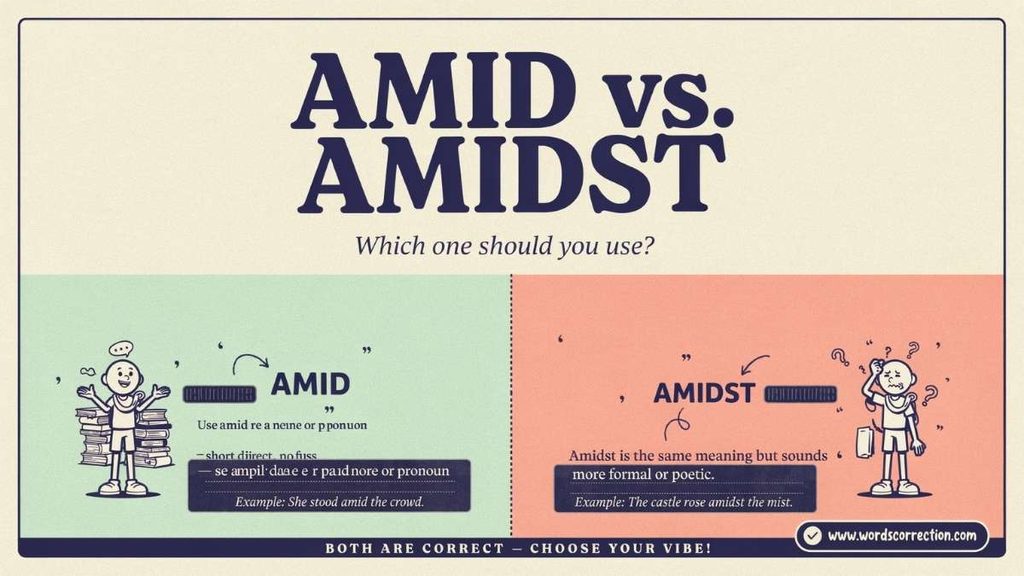
Among and between can appear in similar sentences, but they have different uses.
| Word | Main Meaning | Example |
|---|---|---|
| Amid | In the middle of a situation or surrounded by something | She remained calm amid the confusion. |
| Among | Part of a group or surrounded by members of a group | The letter was hidden among the papers. |
| Between | In the space separating two people or things, or involving distinct parties | The agreement was made between the two companies. |
When to Use Amid
Use amid to describe circumstances, conditions, or surroundings.
Example: The team stayed focused amid mounting pressure.
The word connects the team’s focus with the difficult circumstances.
When to Use Among
Use among when something belongs to, appears within, or is surrounded by a group.
Example: The missing key was found among the books.
The key was part of a collection of books and other objects.
When to Use Between
Use between when referring to a relationship, separation, or distinction involving identifiable people or things.
Example: Negotiations between the two organizations continued.
The word identifies the two parties involved.
Choosing the correct word makes your meaning more precise and prevents awkward sentences.
Learn the difference between tricky English words with easy explanations
Todays or Today’s Which Is Correct?
Synonyms for Amid and Amidst
Several words and phrases can replace amid or amidst, depending on the context. However, they are not interchangeable in every sentence.
| Alternative | Meaning or Use | Example |
|---|---|---|
| During | At some point within a period or event | She remained calm during the crisis. |
| Among | Within or surrounded by a group | He walked among the guests. |
| In the middle of | At the center of something or while something is happening | They arrived in the middle of the discussion. |
| Surrounded by | Having things or people around something | The cottage was surrounded by trees. |
| In the midst of | In the middle of a situation or event | The team worked in the midst of uncertainty. |
| Amidst the chaos | A phrase emphasizing a disorderly situation | She remained hopeful amidst the chaos. |
The best synonym depends on what you want to emphasize. During highlights timing, among emphasizes a group, and surrounded by focuses on the things around a person or object.
For example, “The announcement came during the meeting” emphasizes timing. “The announcement came amid controversy” emphasizes the circumstances surrounding the announcement.
Here are 25 fill in the blank practice questions on Amid or Amidst, followed by a separate answer session. The questions help readers practice correct usage in everyday, academic, professional, and descriptive writing.
Practice Session Fill in the Blanks
- The company continued to grow ______ economic uncertainty.
- A beautiful cottage stood ______ the green hills.
- The announcement came ______ growing public concerns.
- She remained calm ______ the confusion.
- The children played happily ______ the tall trees.
- The government introduced new policies ______ rising inflation.
- He found hope ______ the difficult circumstances.
- The old castle stood ______ the ruins of a forgotten village.
- The school remained open ______ severe weather conditions.
- The speaker continued her presentation ______ interruptions.
- The flowers bloomed ______ the surrounding greenery.
- The team celebrated its victory ______ loud cheers.
- The organization continued its work ______ financial difficulties.
- A small bird rested ______ the branches.
- The manager made an important decision ______ mounting pressure.
- The village looked peaceful ______ the surrounding mountains.
- She discovered new opportunities ______ the uncertainty.
- The negotiations continued ______ political tensions.
- The family gathered ______ the festive celebrations.
- The artist found inspiration ______ everyday challenges.
- The rescue workers continued their efforts ______ the chaos.
- The farmhouse stood ______ open fields and beautiful gardens.
- The company announced its expansion plans ______ market changes.
- He remained optimistic ______ the setbacks.
- A ray of sunlight appeared ______ the darkness.
Answers
- Amid
- Amidst
- Amid
- Amid
- Amidst
- Amid
- Amid
- Amidst
- Amid
- Amid
- Amidst
- Amid
- Amid
- Amidst
- Amid
- Amidst
- Amid
- Amid
- Amidst
- Amid
- Amid
- Amidst
- Amid
- Amid
- Amidst
Here’s a trusted source for clear word meanings:
Cambridge Dictionary
FAQ’s
What is the grammatical role of amid in a sentence?
“Amid” is a preposition that describes the circumstances or surroundings in which something happens. For example, “She remained calm amid the confusion.”
Can amid be followed by a verb?
“Amid” is generally followed by a noun or noun phrase, not a verb in its base form. For example, “amid growing concerns” is correct, while “amid grow concerns” is incorrect.
Is amid appropriate for business writing?
Yes. “Amid” works well in business emails, reports, and presentations because it describes surrounding circumstances concisely. For example, “The company continued to grow amid market uncertainty.”
Is amid commonly used in news headlines?
Yes. News headlines frequently use “amid” to summarize the circumstances surrounding an event. For example, “Markets Fall Amid Economic Uncertainty” connects the market decline with the broader economic situation.
Can amid describe positive situations?
Yes. “Amid” can describe positive, negative, or neutral circumstances. For example, “The community celebrated amid renewed hope.”
Can amid describe a physical location?
Yes. “Amid” can describe something surrounded by physical objects or places. For example, “A small cottage stood amid tall trees.”
Does amid always suggest something negative?
No. “Amid” is a neutral word that does not imply conflict, difficulty, or distress. It can describe celebrations, happiness, natural surroundings, uncertainty, and many other situations.
Can amid begin a sentence?
Yes. You can begin a sentence with “amid” when the opening phrase establishes the surrounding circumstances. For example, “Amid growing excitement, the organizers announced the winners.”
Is amid appropriate for academic essays?
Yes. “Amid” is suitable for academic writing when it accurately describes the circumstances surrounding an event or development. For example, “The study was conducted amid rapid technological change.”
Should I use amid or during to describe an event?
Use “during” when emphasizing when something happens. Use “amid” when highlighting the circumstances surrounding it. For example, “The phone rang during the meeting” emphasizes timing, while “The announcement came amid controversy” emphasizes the surrounding situation.
What is the difference between amid and in the midst of?
Both expressions can mean in the middle of a situation or event. “Amid” is more concise, while “in the midst of” is a longer alternative. For example, “She worked amid uncertainty” and “She worked in the midst of uncertainty” have similar meanings.
Is amidst appropriate for business reports?
Yes. “Amidst” is grammatically correct in business reports. However, “amid” is often preferred for concise, straightforward professional writing. Follow your organization’s style guidelines when applicable.
Can amidst be used in a formal letter?
Yes. “Amidst” can be used in formal correspondence when it fits the context and tone. For example, “We appreciate your continued cooperation amidst these changes.”
Does amidst change a sentence’s meaning compared with amid?
Usually, no. Both words convey the idea of being surrounded by something or experiencing something while it happens. Any difference is generally stylistic rather than semantic.
Can amid describe emotions?
Yes. “Amid” can introduce circumstances associated with an emotional experience. For example, “She found confidence amid her doubts.”
Can amidst be used with abstract nouns?
Yes. “Amidst” can precede abstract nouns such as uncertainty, confusion, change, adversity, and excitement. For example, “They discovered new opportunities amidst uncertainty.”
Is amid suitable for SEO articles and website content?
Yes. “Amid” works well in SEO articles when it expresses the intended meaning naturally. Use it where appropriate rather than repeating it unnecessarily to target a keyword.
Is amidst outdated English?
No. “Amidst” remains a correct and recognized English word. Although it can sound more traditional or literary in some contexts, it is still used in modern writing.
Can amid and amidst take past-tense forms?
No. Neither word has a past-tense form because both are prepositions, not verbs. Their spelling remains unchanged regardless of the time described in a sentence.
Can amid be used with plural nouns?
Yes. “Amid” can precede singular or plural nouns. For example, “She walked amid the trees” and “The announcement came amid several changes” are both correct.
What punctuation follows an introductory phrase beginning with amid?
A comma commonly follows an introductory phrase beginning with “amid.” For example, “Amid growing concerns, the school revised its policy.” The appropriate punctuation depends on the sentence’s structure and clarity.
Is amid appropriate for a professional email?
Yes. “Amid” is suitable for professional emails when describing circumstances, challenges, or changes. For example, “Thank you for your patience amid these changes.”
Can amid describe a period of change?
Yes. “Amid” can describe the circumstances surrounding a period of transition. For example, “Employees adapted to their new responsibilities amid organizational change.”
Is amid suitable for short, direct sentences?
Yes. “Amid” is concise and effective in short sentences. For example, “Hope remained amid uncertainty.” It communicates the surrounding circumstances without unnecessary wording.
How should I choose between amid and amidst when editing?
Consider your audience, tone, and writing style. Choose “amid” for a concise, direct style or “amidst” when it better suits the passage’s voice. Both are correct, so prioritize clarity and consistency over unnecessary grammar rules.
Learn the difference between confusing more English words step by step
Fulfilment or Fulfillment Which Spelling Is Correct?
Conclusion
Choosing between amid or amidst doesn’t have to be confusing. Both words are correct and have almost the same meaning. The main difference lies in their style and usage. Amid is generally more common in modern American English, while amidst can sound more traditional or literary. Remember, a longer word doesn’t always make your writing better. The best choice is the one that fits your sentence and communicates your meaning clearly. By understanding their differences and practicing with simple examples, you can avoid common grammar mistakes and write with greater confidence. Keep your writing clear, choose your words carefully, and leave the grammar confusion behind.

Stella AJS is an experienced blogger and dedicated English language writer at Words Correction. She turns confusing grammar, word meanings, spelling, and usage into clear, practical insights that readers can easily understand and apply. With a passion for precise and engaging writing, Stella helps readers avoid common language mistakes, strengthen their vocabulary, and communicate with greater clarity and confidence.




