
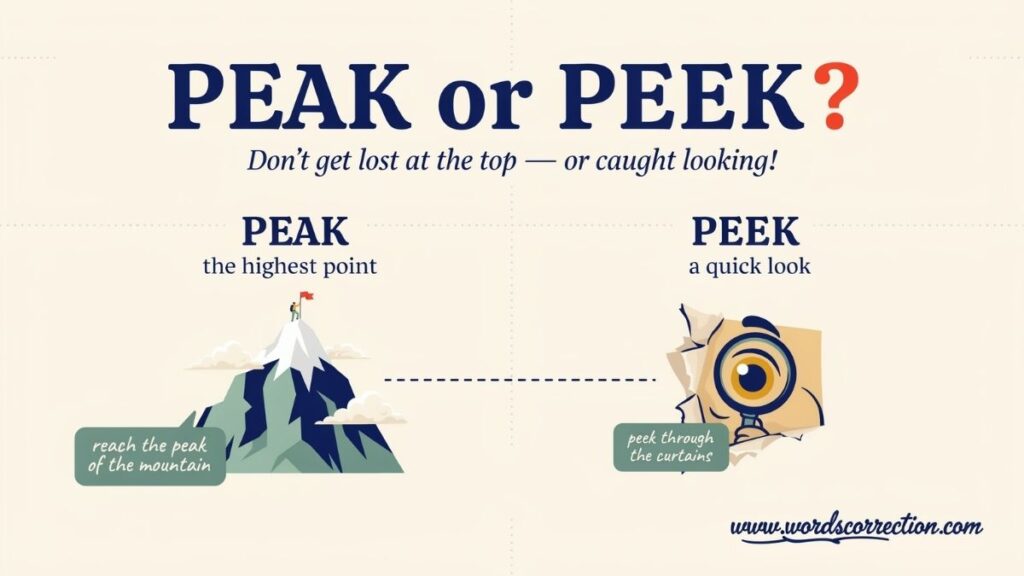
Confusing peak, peek, and pique is a common grammar mistake, even for experienced writers. These words sound alike but have very different meanings. Peak refers to the highest point, peek means to take a quick look, and pique means to spark interest or curiosity. Using the wrong word can change your sentence’s meaning and leave readers confused. The good news is that learning the difference is easier than you might think. This Peak vs Peek practice session includes 25 fill in the blank exercises with an answer key to help you understand these words, avoid common mistakes, and improve your everyday writing skills.
Peak or Peek Quick Answer
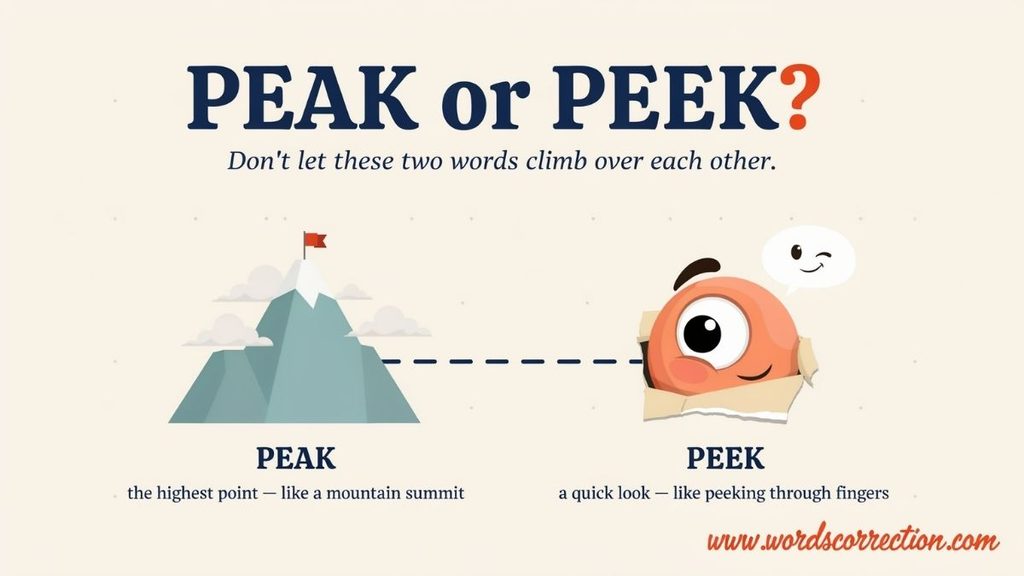
The main difference between peak and peek depends on what you want to describe. Use peak when you mean the highest point or maximum level of something. Use peek when you mean a brief look at something.
Although these words sound alike, their spellings and meanings are not interchangeable.
| Word | Meaning | Part of Speech | Example |
|---|---|---|---|
| Peak | The highest point or maximum level | Noun, verb, adjective | The climbers reached the peak. |
| Peek | A quick or secret look | Noun, verb | She took a peek inside the box. |
| Pique | To stimulate interest or curiosity; to cause irritation or resentment | Verb, noun | The unusual headline piqued my interest. |
Here’s an easy way to remember the difference:
- Peak = top. Think of a mountain summit or the highest point on a graph.
- Peek = look. Think of someone peeking through a window or looking inside a gift bag.
- Pique = interest. Think of something that sparks your curiosity.
Peak or Peek Examples
These examples show how the correct word depends on the sentence’s meaning.
Examples with peak
- The hikers reached the peak of the mountain before sunset.
- Demand for air conditioners peaks during the hottest months.
- She delivered her best performance at the peak of her career.
- Traffic reaches its peak during the evening rush hour.
Examples with peek
- I took a peek at the birthday present.
- He peeked through the curtains to see who was outside.
- Can I peek at your notes before the test?
- The children tried to peek inside the locked room.
Example with pique
- The documentary’s opening scene piqued my curiosity.
Notice the pattern: peak describes a high point or maximum, peek describes looking, and pique describes stimulating interest or curiosity.
Peak vs Peek at a Glance
The quickest way to choose the correct word is to identify the idea you’re trying to express.
| Intended Meaning | Correct Word | Example |
|---|---|---|
| The top of a mountain | Peak | We stood on the mountain peak. |
| The highest level of sales | Peak | Sales peaked in July. |
| The busiest time of day | Peak | Peak hours begin at 5 p.m. |
| A quick look | Peek | Take a peek at this photo. |
| A secret look | Peek | She peeked through the doorway. |
| Something that stimulates curiosity | Pique | The mystery piqued his interest. |
Keep this distinction in mind whenever you face a peak or peek spelling question. The surrounding words usually reveal which meaning makes sense.
Learn the difference between confusing more English words
Cannot or Can Not which one is Correct Spelling?
What Does Peak Mean?
The word peak refers to the highest point, greatest level, or maximum intensity of something. It often describes mountains, performance, demand, activity, and important stages in a person’s life or career.
The meaning can be literal or figurative. A mountain has a physical peak, while a business can experience peak sales. A person’s career can also reach a peak when they achieve their greatest professional success.
In everyday English, peak functions as a noun, verb, and adjective. Understanding these grammatical roles makes it easier to recognize and use the word correctly.
Peak as a Noun
As a noun, peak identifies the highest point of something. The word often refers to a mountain summit, but it can also describe the maximum point of a process, trend, or achievement.
For example
- Physical meaning: The mountain’s peak disappeared behind the clouds.
- Performance: The athlete reached the peak of her career.
- Business: The store recorded peak sales during the holiday season.
- Popularity: The singer’s popularity reached its peak in the early 2000s.
- Intensity: The storm reached its peak during the night.
The phrase “highest point of a mountain” is one of the clearest examples of mountain peak meaning. When climbers reach a mountain’s peak, they reach its summit or top.
However, the noun doesn’t always describe a physical location. In the sentence “The company’s growth reached its peak,” the word refers to the highest level of growth rather than a place.
Common expressions include the peak of success, the peak of a mountain, and the peak of activity.
Peak as a Verb
As a verb, peak means to reach the highest point or maximum level. It often describes something that rises, increases, or develops before reaching its highest level.
Consider these examples
- Tourism peaked during the summer holidays.
- The temperature peaked at 102°F in the afternoon.
- Online sales peaked during the holiday shopping period.
- His athletic performance peaked in his late twenties.
The expression “career peaked” describes the point when someone’s professional success or performance reaches its highest level. For example, “Her career peaked after she won the international award” suggests that this achievement marked the high point of her career.
The verb also changes form according to tense.
| Verb Form | Example |
|---|---|
| Peak | Sales usually peak in December. |
| Peaks | Demand peaks during hot weather. |
| Peaked | Visitor numbers peaked last summer. |
| Peaking | Electricity demand is peaking right now. |
| Has peaked | The market has peaked after several months of growth. |
One important detail: peaked doesn’t necessarily mean that something has declined. It means that something reached its highest point in the context being discussed. A decline may follow, but the word itself identifies the maximum.
Peak as an Adjective
Peak can also describe a period when activity, demand, or usage reaches a particularly high level. In these cases, it functions as an adjective within a noun phrase.
Common examples include
- Peak hours: Times when traffic, electricity use, or customer activity is especially high.
- Peak season: The busiest period for a business, tourist destination, or industry.
- Peak performance: The highest level of ability or effectiveness.
- Peak demand: The greatest level of demand during a particular period.
For example, “The hotel charges higher rates during peak season” means that prices rise during the period when the hotel expects the most demand.
Similarly, “Please avoid traveling during peak hours” refers to the busiest times on the road or public transportation network.
These expressions demonstrate that peak doesn’t always refer to a mountain or an individual achievement. It can also describe periods when activity reaches a high level.
Learn the difference between tricky English words with easy explanations
Monkeys or Monkies Which Spelling Is Correct?
Common Expressions With Peak
Several everyday phrases use peak to describe maximum levels or particularly important stages.
| Expression | Meaning | Example |
|---|---|---|
| Peak performance | The highest level of performance | The runner achieved peak performance after months of training. |
| Peak hours | The busiest hours | The subway is crowded during peak hours. |
| Peak season | The busiest season | Beach resorts charge more during peak season. |
| Peak demand | The highest level of demand | The power grid must handle peak demand in summer. |
| At its peak | At its highest level | The business had 50 employees at its peak. |
| Reach the peak | Arrive at the highest point or level | The climbers reached the peak before noon. |
| Peak of a career | The highest point of professional success | The award came near the peak of his career. |
These expressions all relate to the idea of a top, maximum, or high point. If you’re describing something reaching its greatest level, peak is usually the word you need.
Learn the difference between commonly mixed-up more words
Nevermind or Never Mind Which Spelling Is Correct?
What Does Peek Mean?
The word peek means to take a quick, brief, or sometimes secret look at something. Unlike peak, which describes a high point or maximum, peek focuses on the act of looking.
People peek when they’re curious, want to see something briefly, or prefer not to be noticed. You might peek inside a present before opening it, peek through a doorway, or take a peek at a document before a meeting.
The meaning can be playful, casual, or secretive depending on the situation. However, peek doesn’t automatically imply that someone is doing something wrong. Taking a quick look at a photo, for example, is an ordinary use of the word.
Peek as a Verb
As a verb, peek means to look quickly or cautiously at something. It often appears with prepositions such as at, into, and through, which help explain where or how the person is looking.
Here are some common constructions
- Peek at: She peeked at the clock during the meeting.
- Peek into: He peeked into the room before entering.
- Peek through: The child peeked through the curtains.
- Peek inside: I peeked inside the package to check its contents.
- Peek over: She peeked over the wall to see what was happening.
These examples show how context determines the phrase you need. The basic meaning remains the same, but the preposition adds information about the direction or target of the look.
The verb also changes form depending on tense.
| Verb Form | Example |
|---|---|
| Peek | Don’t peek at the surprise before the party. |
| Peeks | The curious puppy peeks around the corner. |
| Peeked | She peeked through the window. |
| Peeking | The child is peeking inside the box. |
| Has peeked | He has peeked at the results already. |
Remember that the past tense is peeked, not peaked. This distinction matters whenever you’re describing someone looking at something in the past.
Peek as a Noun
Peek can also function as a noun. In this form, it refers to the quick look itself rather than the action of looking.
The most common expressions include take a peek, have a peek, and sneak a peek.
Examples
- Take a peek at the new design before we publish it.
- I had a quick peek at the menu before ordering.
- She sneaked a peek at the birthday decorations.
- The company offered customers a peek at its upcoming collection.
The expression “take a peek” means to take a brief look at something. It’s common in informal conversation, emails, instructions, and marketing messages.
For example, a colleague might write, “Could you take a peek at this report?” The request asks the recipient to look at the report, usually without suggesting an extensive review.
However, context still matters. If someone asks you to take a peek at a contract, they may expect you to inspect it briefly. If they need a detailed legal review, they should state that more clearly.
Common Expressions With Peek
Peek appears in several familiar expressions that describe a quick look.
Take a peek: Look at something briefly.
Example: Take a peek at the photos from our trip.
Sneak a peek: Look at something secretly or without being noticed.
Example: He tried to sneak a peek at the answers before the quiz began.
Peek inside: Look into the interior of something.
Example: She opened the envelope slightly to peek inside.
Peek through: Look through a narrow opening, gap, or barrier.
Example: Sunlight peeked through the clouds.
Peek-a-boo: A playful game in which someone hides their face and then reveals it, often to entertain a baby.
Example: The father played peek-a-boo with his baby.
These phrases share the same central idea: looking briefly or revealing something in a limited way. None refers to a maximum level or the top of a mountain.
Learn the difference between confusing more English words step by step
Signalling vs Signaling Which Spelling Is Correct?
Peak vs Peek Key Differences
Although peak and peek are homophones in standard English, they serve different purposes. Homophones are words that share the same pronunciation but have different meanings and often different spellings.
Other familiar examples include right and write, flour and flower, and sea and see. These words show why pronunciation alone can’t always help you choose the correct spelling.
The difference between peak and peek becomes easier to understand when you focus on the sentence’s meaning rather than how the words sound.
Peak vs Peek Comparison Table
| Feature | Peak | Peek |
|---|---|---|
| Core meaning | Highest point or maximum level | Brief or quick look |
| Noun use | The summit of a mountain | A quick glance |
| Verb use | To reach a maximum level | To look briefly |
| Adjective use | Describes a high-demand period or level | Not commonly used as an adjective |
| Common phrases | Peak season, peak performance, peak demand | Take a peek, sneak a peek, peek inside |
| Past tense | Peaked | Peeked |
| Example | The temperature peaked at noon. | She peeked at the temperature display. |
The table highlights an important grammar rule: peak can be a noun, verb, or adjective, while peek is primarily a noun or verb in everyday English.
Their grammatical forms also help you distinguish them. If you’re describing sales reaching a maximum, peaked fits. If you’re describing someone looking at a sales report, peeked fits.
How to Remember Peak vs Peek
A useful memory trick connects each word with a familiar image.
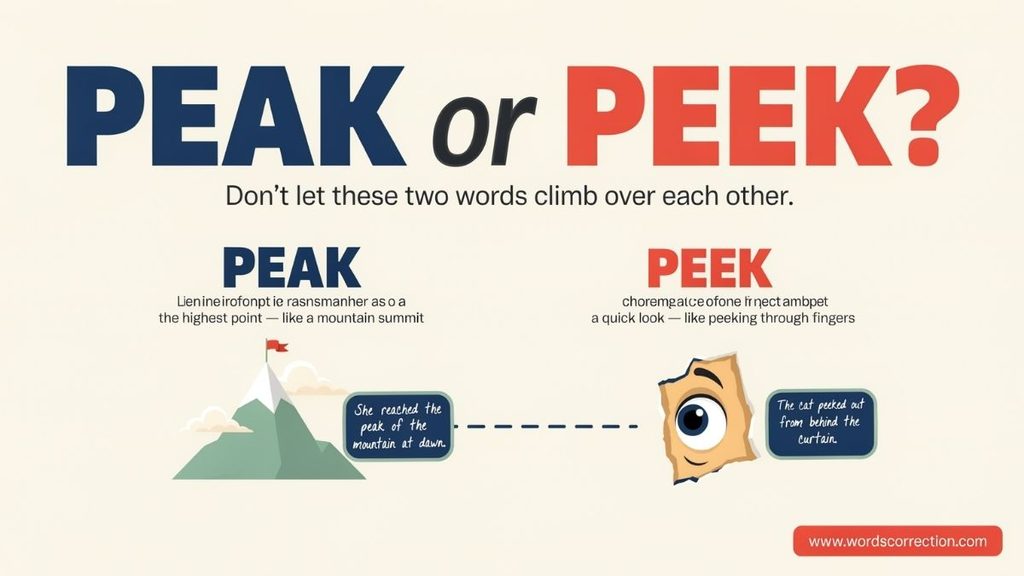
Peak = the top of a mountain. Imagine standing on a mountain summit. You’re at the highest point, so the correct word is peak.
Peek = a quick look. Imagine a child peeking around a door to see who’s outside. The child is looking briefly, so peek is the correct word.
You can also use a simple substitution test:
- If you can replace the word with top, maximum, or highest point, use peak.
- If you can replace it with look, glance, or brief look, use peek.
For example, consider the sentence “The company’s profits reached their ___ last year.”
Replace the blank with maximum. The sentence makes sense, so peak is correct.
Now consider “Can I take a ___ at your phone?” Replace the blank with quick look. That works, so peek is correct.
This approach is one of the most practical English vocabulary tips for remembering commonly confused words. It relies on meaning instead of memorizing isolated spellings.
Learn the difference between tricky grammar more words
Per Se or Per Say Which Spelling Is Correct?
Peak, Peek, or Pique What’s the Difference?
The confusion doesn’t stop with peak and peek. The word pique sounds similar and often appears in the same spelling questions.
However, pique has a separate meaning. As a verb, it commonly means to stimulate someone’s interest or curiosity. As a noun, it can mean irritation or resentment, especially when someone feels offended.
The three words are not interchangeable. Choosing the correct one depends on whether you’re describing a high point, a look, or a reaction.
What Does Pique Mean?
The verb pique often appears in expressions such as pique someone’s interest and pique someone’s curiosity. These phrases describe something that makes a person interested enough to want to learn more.
Examples
- The mysterious photograph piqued her curiosity.
- The opening chapter piqued my interest in the novel.
- His unusual explanation piqued the audience’s interest.
- The research findings piqued the scientists’ curiosity.
The noun pique appears in a different context.
For example, “She left in a fit of pique” means she left because she felt irritated or resentful.
This meaning is less common in everyday conversation than the expression pique someone’s interest, but it’s useful to recognize when reading formal writing or literature.
Peak vs Peek vs Pique Examples
The easiest way to understand the difference between peek, peak, and pique is to compare the words in similar situations.
| Word | Example Sentence | Explanation |
|---|---|---|
| Peak | The mountain’s peak was covered in snow. | Refers to the mountain’s highest point. |
| Peek | The hiker took a peek at the map. | Refers to a brief look. |
| Pique | The map’s unusual markings piqued her curiosity. | Means they stimulated her interest. |
| Peak | Online traffic peaked at 8 p.m. | Means traffic reached its maximum. |
| Peek | He peeked at the screen. | Means he looked briefly at it. |
| Pique | The headline piqued readers’ interest. | Means it attracted their curiosity. |
Notice that peak and peek can both work as verbs, but their meanings remain different. Pique introduces another action: stimulating a feeling or response.
Is It Pique Your Interest or Peak Your Interest?
The correct expression is “pique your interest.”
Use pique when something sparks your curiosity or makes you want to investigate a subject.
Correct: The article’s title piqued my interest.
Incorrect for this meaning: The article’s title peaked my interest.
Why does this mistake happen? People often hear the expression rather than see it written. Because peak, peek, and pique sound alike, it’s easy to substitute the more familiar word peak.
However, peak refers to reaching a high point. If you’re describing an interest level that reaches its maximum, you could use peaked in a suitable context. That differs from the standard expression pique someone’s interest, which means to stimulate curiosity.
Compare these examples:
- Pique: The documentary piqued my interest in marine biology.
- Peak: Interest in the documentary peaked after its release.
- Peek: I took a peek at the documentary’s trailer.
Each sentence uses a different word to express a different idea.
Learn the difference between confusing word pairs
Trys or Tries Which is Correct Spelling?
Common Peak and Peek Mistakes
Most peak or peek errors occur in familiar phrases. Because the words sound alike, writers may choose the spelling that looks familiar rather than the one that matches the meaning.
Learning these common mistakes can help you catch errors in emails, essays, reports, and online content.
“Take a Peak” vs “Take a Peek”
The correct expression is “take a peek” when you mean to take a quick look.
Incorrect: Can I take a peak at your new phone?
Correct: Can I take a peek at your new phone?
The word peak would make sense if you were discussing a summit or maximum level, but it doesn’t fit an expression about looking.
A useful test is to replace peek with look. “Can I take a look at your new phone?” makes sense, confirming the correct choice.
“Sneak Peak” vs “Sneak Peek”
The correct expression is “sneak peek.” It refers to a preview or an advance look at something before its full release or public availability.
Incorrect: The company released a sneak peak of its new product.
Correct: The company released a sneak peek of its new product.
You’ll often see sneak peek in entertainment, marketing, product launches, and event announcements.
For example
- The studio shared a sneak peek of its upcoming film.
- Subscribers received a sneak peek at the new collection.
- The author posted a sneak peek of the next chapter.
- Guests enjoyed a sneak peek of the exhibition before its official opening.
The word sneak reinforces the idea of seeing something early or discreetly. The word peek supplies the meaning of a quick look.
“Peak Your Interest” vs “Pique Your Interest”
When you mean to stimulate curiosity, write “pique your interest.”
Incorrect: The unusual discovery peaked his interest.
Correct: The unusual discovery piqued his interest.
The corrected sentence means the discovery made him curious. If you write that his interest peaked, however, you’re saying that his interest reached its highest level.
That difference may seem small, but it changes the meaning of the sentence.
“Sales Peeked” vs “Sales Peaked”
When sales reach their highest level, use peaked.
Incorrect: Sales peeked during the holiday season.
Correct: Sales peaked during the holiday season.
The correct sentence describes a maximum in sales activity. The incorrect version suggests that sales took a quick look at something, which doesn’t fit the intended meaning.
This distinction also applies to traffic, temperatures, website visits, electricity use, and other measurable trends.
For example, “Website traffic peaked at noon” means the site received its highest level of traffic at that time.
“Peek Performance” vs “Peak Performance”
The correct expression is “peak performance.”
Incorrect: The athlete delivered a peek performance.
Correct: The athlete delivered a peak performance.
Peak performance means operating or performing at the highest level of ability, effectiveness, or achievement.
The expression applies to sports, education, business, and other areas where people or systems aim to perform at their best.
For example, a company might introduce new training to help employees improve their performance. An athlete might adjust sleep and recovery routines to support peak performance.
“Peek of the Mountain” vs “Peak of the Mountain”
When referring to the highest point of a mountain, use peak.
Incorrect: The hikers reached the peek of the mountain.
Correct: The hikers reached the peak of the mountain.
The noun peak refers to the mountain’s summit. The word peek describes looking at something, not the physical top of a mountain.
You could say, “The hikers peeked around a rocky ledge to see the summit.” In that sentence, peeked describes the hikers’ action, while summit names the highest point.
“Peaked at the Screen” vs “Peeked at the Screen”
If someone takes a quick look at a screen, use peeked.
Incorrect: She peaked at the screen to read the message.
Correct: She peeked at the screen to read the message.
The verb peeked describes the act of looking. The verb peaked describes something reaching its maximum level.
For example, “The brightness peaked at its highest setting” uses peaked correctly because the sentence describes a maximum rather than a glance.
Learn the difference between often confused words
Accel or Excel Which Spelling Is Correct?
Quick Peak vs Peek vs Pique Correction Table
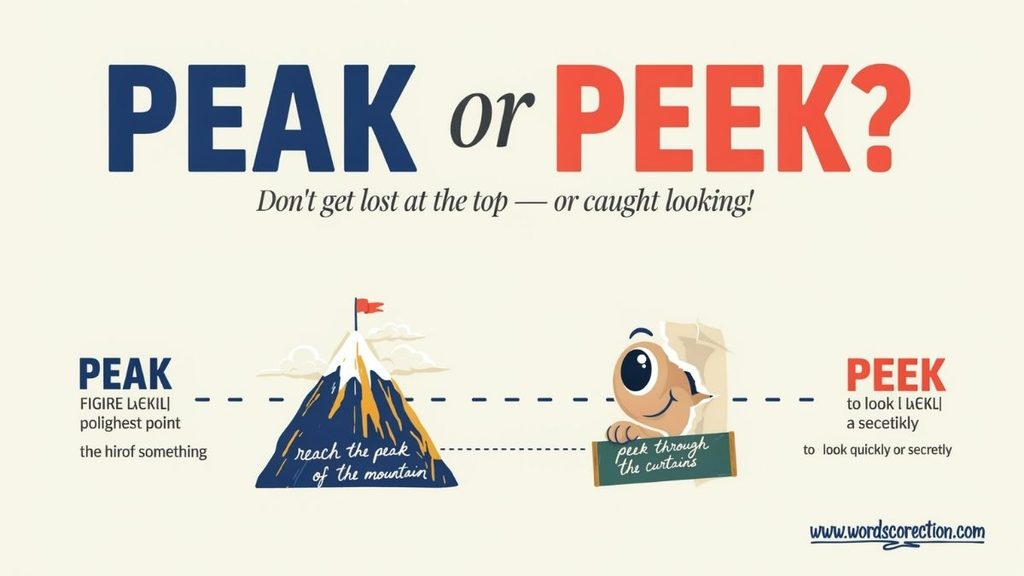
Use this table as a quick reference when editing your writing.
| Incorrect Phrase | Correct Phrase | Explanation |
|---|---|---|
| Take a peak | Take a peek | Refers to a quick look. |
| Sneak peak | Sneak peek | Refers to an advance look or preview. |
| Peak your interest | Pique your interest | Means to stimulate curiosity. |
| Sales peeked | Sales peaked | Means sales reached their maximum. |
| Peek performance | Peak performance | Refers to the highest level of performance. |
| Peek of the mountain | Peak of the mountain | Refers to the summit. |
| Peaked at the screen | Peeked at the screen | Describes looking briefly. |
When proofreading, pay special attention to these familiar expressions. A quick meaning check can prevent most spelling mistakes involving these words.
Learn the difference between basic English word mistakes
Authorised or Authorized Which Spelling Is Correct?
Peak or Peek in Everyday Writing
Choosing between peak and peek becomes easier when you consider the purpose of the sentence. The same words can appear in professional emails, business reports, academic work, and casual conversations, but each situation calls for the meaning that fits.
Peak vs Peek in Emails and Messages
In emails, peek often appears when someone asks another person to look at something briefly. Peak is more common when discussing schedules, workloads, or performance levels.
Examples
- Could you take a peek at the attached document before the meeting?
- I’ll send you a sneak peek of the presentation this afternoon.
- Customer inquiries usually peak on Monday mornings.
- We expect demand to peak before the holiday weekend.
The first two examples involve looking at something. The last two describe activity reaching a high level.
If you ask a colleague to review a report carefully, remember that take a peek can suggest only a quick look. For a detailed review, a more precise request might be, “Could you review the report and check the figures?”
Peak vs Peek in Business and Professional Writing
In business, peak frequently describes measurable trends and operating conditions. Companies use the word when discussing demand, production, traffic, staffing, and seasonal sales.
For example
- The company increased staffing to handle peak demand.
- Website visits peaked after the advertising campaign launched.
- The support team receives the most calls during peak hours.
- Managers took a peek at the preliminary sales report before the meeting.
These examples show the importance of grammatical context. Business reports often describe data reaching a maximum, while workplace messages may ask someone to look at a file or report.
Consider a simple hypothetical case study.
Case Study A Seasonal Online Store
An online store notices that orders increase sharply in November and December. Its managers hire temporary staff to handle peak demand during the holiday season. Before launching a new product, the marketing team also gives selected customers a sneak peek at the product.
The store uses peak to describe its busiest period and highest order volume. It uses peek to describe the preview offered to customers.
Both words fit the same business situation, but they communicate different ideas.
Peak vs Peek in Social Media and Marketing
Marketing content often uses sneak peek to build anticipation for a product, event, video, or announcement.
Examples
- Get a sneak peek at our upcoming collection.
- Here’s a peek inside our new studio.
- Watch the campaign launch when engagement is expected to peak.
- The teaser is designed to pique your interest in the full announcement.
These expressions are common because each word communicates a specific idea. A sneak peek gives people an early look. A trend that peaks reaches its highest level. Content that piques interest makes people curious.
Using the correct word helps keep marketing copy clear and credible. A spelling mistake in a short headline can be especially noticeable because the phrase may appear prominently in a post, advertisement, or email subject line.
Learn the difference between commonly misused words
Authorised or Authorized Which Spelling Is Correct?
Peak vs Peek in Academic and Formal Writing
In academic writing, peak often describes maximum values, physical summits, or high points in a process. Researchers may discuss peak temperatures, peak concentrations, or the peak of a distribution.
Examples
- The recorded temperature peaked at 38°C.
- The researchers identified peak activity during the final observation period.
- The expedition reached the mountain’s highest peak in the afternoon.
Peek can also appear in formal writing when the subject genuinely involves looking briefly.
For example, “The observer peeked through the narrow opening” is grammatically correct, although a more formal context might call for “looked briefly through.”
The important point is not that one word is formal and the other informal. Instead, choose the word that accurately expresses the intended meaning.
British English vs American English Peak or Peek Spelling
A common question is whether peak and peek differ between American and British English. They do not. Both varieties use the same standard spellings and core meanings.
The difference is semantic, not regional. Peak refers to a top or maximum, while peek refers to a brief look.
| Usage | American English | British English |
|---|---|---|
| Highest point of a mountain | Mountain peak | Mountain peak |
| Highest level of demand | Peak demand | Peak demand |
| A brief look | Take a peek | Take a peek |
| An advance preview | Sneak peek | Sneak peek |
| Stimulate curiosity | Pique interest | Pique interest |
There can be differences in vocabulary, pronunciation, and spelling between English varieties. For example, American English commonly uses color while British English uses colour. However, peak and peek are not examples of that kind of regional variation.
For writers addressing a global audience, the same basic rule applies everywhere: use peak for the highest point or maximum and peek for a quick look.
Learn the difference between everyday English mistakes
Manuel or Manual An Easy Guide to the Correct Word
Practice session
- The mountain climbers finally reached the ______ of the mountain.
- Could I take a quick ______ at your presentation before the meeting?
- Online sales usually ______ during the holiday shopping season.
- The company shared a sneak ______ of its upcoming product.
- The unexpected announcement helped ______ everyone’s curiosity.
- She tried to ______ through the slightly open door.
- Traffic reaches its ______ during the morning and evening rush hours.
- The children wanted to ______ inside the gift box before opening it.
- The new advertisement was designed to ______ customers’ interest in the product.
- Hotel prices often rise during the tourist ______ season.
- He ______ through the curtains to see who was standing outside.
- The athlete trained hard to achieve ______ performance during the competition.
- The manager asked to take a ______ at the latest sales report.
- Customer demand ______ in December before declining in January.
- The mysterious headline was enough to ______ the reader’s interest.
- We arrived early to avoid traffic during ______ hours.
- She couldn’t resist taking a quick ______ at the surprise gift.
- The company’s profits reached their ______ last year.
- The filmmaker released a sneak ______ before the movie’s official premiere.
- The unusual design may ______ the interest of potential buyers.
- The little boy ______ around the corner to see what his parents were doing.
- The store experiences its busiest period at the ______ of the shopping season.
- Please don’t ______ at the answers before completing the quiz.
- The journalist’s question was intended to ______ the audience’s curiosity.
- The mountain’s highest ______ was covered with snow.
Answer Key
- Peak
- Peek
- Peak
- Peek
- Pique
- Peek
- Peak
- Peek
- Pique
- Peak
- Peeked
- Peak
- Peek
- Peaked
- Pique
- Peak
- Peek
- Peak
- Peek
- Pique
- Peeked
- Peak
- Peek
- Pique
- Peak
Here’s a trusted source for clear word meanings:
Cambridge Dictionary
FAQ’s
What is the difference between peak and peek?
Peak refers to the highest point, level, or period of greatest activity. Peek means to look at something briefly or secretly. For example, “Sales reached their peak” and “She took a peek inside the box.”
How do you spell peek when referring to looking at something?
The correct spelling is “peek” when referring to looking at something briefly or secretly. For example, “Can I peek at your notes?” The word “peak” refers to a summit or the highest level of something.
Is it take a peek or take a peak?
“Take a peek” is correct when referring to a quick look at something. “Take a peak” is incorrect in this context because peak refers to a highest point or summit.
Is it sneak peek or sneak peak?
The correct expression is “sneak peek.” It refers to an advance look at something before its official release or public announcement. “Sneak peak” is a common spelling error.
Is it sneak peek or sneak pic?
“Sneak peek” is the standard expression for an early preview of something. “Sneak pic” may be used informally to describe a secretly taken photograph, but it is not a substitute for the established phrase “sneak peek.”
How do you pronounce sneak peek?
“Sneak peek” is pronounced with a long “ee” sound in both words. The two words sound similar to “sneak” and “week,” with the initial consonant of the second word changed to a “p” sound. The phrase is pronounced the same way regardless of context.
What does sneak peak mean?
“Sneak peak” is generally a misspelling of “sneak peek.” The correct expression describes an early or exclusive look at something before its official release, launch, or announcement.
What is another word for sneak peek?
Common alternatives to “sneak peek” include “preview,” “first look,” “early glimpse,” and “advance look.” The best choice depends on the context. For example, a movie trailer offers a preview, while a product announcement may provide an early look at a new release.
What does sneak peek mean in slang?
In informal language, “sneak peek” means getting an early or exclusive look at something. It is often used on social media when creators share a small preview of an upcoming video, product, event, or announcement.
What does peek mean in English?
In English, peek means to look at something briefly, often secretly or through a narrow opening. It can be used as both a noun and a verb. For example, “Take a peek inside” uses peek as a noun, while “She peeked through the door” uses it as a verb.
What is the difference between peak, peek, and pique?
Peak means the highest point or level, peek means a quick look, and pique means to stimulate interest or provoke a reaction. For example, “reach a peak,” “take a peek,” and “pique someone’s curiosity” demonstrate the correct use of each word.
Can peak be used as a noun, verb, and adjective?
Yes. Peak can function as a noun, verb, or adjective. A noun, it refers to a summit or highest point. As a verb, it means to reach a maximum level. As an adjective, it describes the busiest or most active period, as in “peak season.”
Can peek be used as both a noun and a verb?
Yes. As a noun, peek means a quick look, as in “She took a peek at the letter.” As a verb, it describes the act of looking briefly or secretly, as in “She peeked through the curtains.”
What is the past tense of peek?
The past tense of peek is “peeked.” It describes an action that happened in the past. For example, “He peeked through the doorway to see who had arrived.”
What is the past tense of peak?
The past tense of peak is “peaked.” It describes reaching the highest point or level. For example, “Online sales peaked during the holiday shopping season.”
What does it mean when sales peak?
When sales peak, they reach their highest level during a particular period. Businesses often experience peak sales during holidays, promotional campaigns, or seasonal shopping periods before demand begins to decline.
What does peak performanc mean?
Peak performance refers to the highest level of effectiveness, ability, or productivity that a person or system achieves under particular conditions. The term is commonly used in sports, business, education, and professional development.
What does peak season mean?
Peak season is the period when demand, activity, or visitor numbers are at their highest. For example, summer may be peak season for beach destinations, while December may be peak season for retailers selling holiday gifts.
What are peak hours?
Peak hours are periods when demand or activity reaches its highest level. The term commonly refers to rush-hour traffic, crowded public transportation, or times when electricity consumption is particularly high.
Is peek through the window grammatically correct?
Yes. “Peek through the window” is grammatically correct because peek describes looking briefly through or around something. For example, “The child peeked through the window to watch the rain.”
Is peek inside correct English?
Yes. “Peek inside” is a standard English expression meaning to look briefly into a room, container, building, or other space. For example, “She peeked inside the box before opening it.”
What does at the peak of mean?
“At the peak of” refers to the highest point, greatest level, or most intense stage of something. For example, “At the peak of the tourist season, hotels are often fully booked.”
Why are peak and peek often confused?
Peak and peek are often confused because they are homophones in standard English. They have the same pronunciation but different spellings and meanings. Peak refers to a highest point, while peek refers to a quick or secret look.
What is the difference between peaked and peeked?
“Peaked” means reached the highest point or level, while “peeked” means looked briefly or secretly at something. For example, “Demand peaked in June” describes a maximum level, whereas “She peeked behind the curtain” describes an action.
How can you remember when to use peak or peek?
Use “peak” when referring to a summit, maximum, or highest level of activity. Use “peek” when referring to looking briefly at something. A helpful memory tip is to associate peek with eyes taking a quick look and peak with the top of a mountain.
Learn the difference between more words people mix up
Gopher or Gofer Which Spelling Is Correct?
Conclusion
Mastering the difference between peak, peek, and pique is easier with a little practice. Remember, peak refers to the highest point, peek means to take a quick look, and pique means to spark interest or curiosity. Although these words sound alike, using the correct one makes your writing clearer and more professional. The 25 fill in the blank exercises in this article can help you recognize common mistakes and build confidence in using these words correctly. Keep practicing, review your answers, and remember taking a peek at the answer key is perfectly fine, but letting grammar mistakes reach their peak is best avoided.

Stella AJS is an experienced blogger and dedicated English language writer at Words Correction. She turns confusing grammar, word meanings, spelling, and usage into clear, practical insights that readers can easily understand and apply. With a passion for precise and engaging writing, Stella helps readers avoid common language mistakes, strengthen their vocabulary, and communicate with greater clarity and confidence.




