
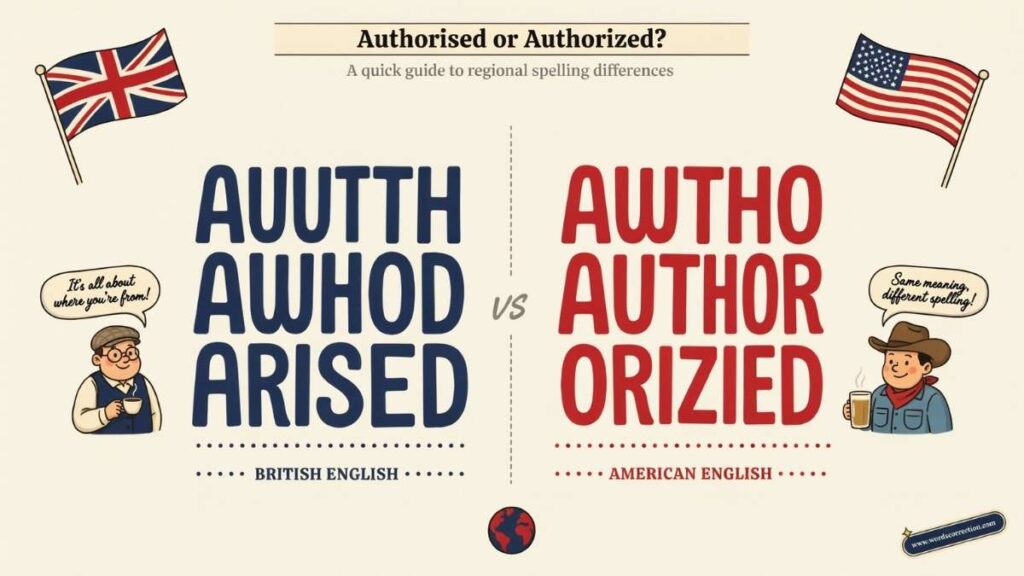
Choosing between “authorised” and “authorized” can confuse even experienced writers. You might wonder which spelling is correct and whether using the wrong one will affect your writing. The good news is that both spellings are correct. The main difference is where they are used. British English generally uses “authorised,” while American English prefers “authorized.” Both words have the same meaning to give someone official permission or approval. In this guide, you’ll learn the difference between authorised or authorized, see simple examples, and discover how to choose the right spelling for clear, accurate, and professional writing.
Authorised or Authorized Quick Answer
The correct spelling depends on the English convention you follow.
- Authorised: Common in British English and publications that use -ise spellings.
- Authorized: Standard in American English and accepted by some British dictionaries and style guides.
- Meaning: Both words mean officially permitted, approved, or given authority to act.
Neither spelling is inherently wrong. Your audience and preferred style guide should determine which version you use.
Authorised vs Authorized Quick Comparison
| Feature | Authorised | Authorized |
|---|---|---|
| Common usage | British English using -ise conventions | American English |
| Part of speech | Past tense and past participle of authorise | Past tense and past participle of authorize |
| Meaning | Officially permitted or approved | Officially permitted or approved |
| Example | Only authorised staff may enter. | Only authorized staff may enter. |
| Correctness | Correct under the appropriate convention | Correct under the appropriate convention |
The difference is purely a matter of spelling. It does not change the word’s meaning or grammatical function.
Examples of Authorised and Authorized in Sentences
Consider these examples
- British-style spelling: The director authorised the payment yesterday.
- American spelling: The director authorized the payment yesterday.
- British-style spelling: Only authorised employees can access the records.
- American spelling: Only authorized employees can access the records.
Each sentence communicates the same information. The spelling changes to match the chosen English convention.
Learn the difference between confusing more English words
It’s vs Its What’s the Difference?
What Does Authorised or Authorized Mean?
The authorised or authorized meaning is straightforward: someone has given permission, official approval, or legal power for an action to take place.
The word often appears when a person, organization, institution, or governing body grants someone the right to do something. For example, a bank may authorize a payment, a manager may authorize an expense, or a company may appoint an authorized representative to sign documents.
In everyday language, the word can describe something as approved, permitted, or officially allowed.
Authorized Meaning and Authorised Meaning Explained
Although the spelling differs, the authorized meaning and authorised meaning are identical.
Imagine that a company allows only certain employees to enter a secure office. A sign on the door might read:
Authorized personnel only.
A British organization that follows -ise spelling conventions might instead write:
Authorised personnel only.
Both signs tell visitors that entry is restricted to people who have permission.
The word can describe several situations:
- Permission: An employee is authorized to access a company database.
- Approval: A manager authorized a purchase.
- Legal authority: A representative is authorized to act on behalf of a client.
- Official designation: An authorized dealer has approval to sell a manufacturer’s products.
- Financial clearance: A bank or payment provider authorizes a transaction.
Authorization does not always mean an action is legally valid in every circumstance. The person’s authority, applicable rules, and type of transaction still matter.
What Does an Authorized Person Mean?
An authorized person is someone who has permission or authority to perform a particular task. That permission may come from an employer, a government body, a property owner, or another person with the right to grant it.
For example, an organization might authorize an employee to approve expenses up to $5,000. The employee can approve qualifying expenses within that limit but may not have permission to approve larger purchases.
Similarly, a bank account holder might authorize another person to handle certain transactions. The scope of that person’s authority depends on the arrangement and the bank’s requirements.
The key point is that authorization has boundaries. Being authorized to perform one task does not automatically grant permission to perform every related task.
Learn the difference between confusing more English words step by step
Accel or Excel Which Spelling Is Correct?
What Does an Authorized Signature Mean?
An authorized signature is a signature made by a person who has permission to sign a particular document or approve a transaction on behalf of themselves or another party.
You may encounter the term in
- Business contracts
- Purchase orders
- Bank forms
- Employment documents
- Company resolutions
- Official applications
For example, a company may allow its finance director to sign supplier agreements up to a specified amount. If the director signs an agreement within that authority, the signature may satisfy the company’s signing requirements.
However, a signature is not valid merely because someone labels it authorized. The signer must have the necessary authority, and the document must meet any applicable legal or procedural requirements.
What Does an Authorized Signatory Do?
An authorized signatory is a person formally permitted to sign documents or approve transactions for an organization or another party.
A business might appoint its chief executive, finance director, or another designated representative as an authorized signatory. Banks and other institutions may require evidence of that appointment before accepting the person’s signature.
The related term authorised signatory has the same meaning but uses the British-style spelling.
Learn the difference between commonly mixed-up more words
Canceled vs Cancelled Which Spelling Is Correct?
Why Do Authorised and Authorized Have Different Spellings?
The difference comes from the spelling conventions that developed across varieties of English. Over time, British and American English adopted different preferences for certain word endings, including -ise and -ize.
Words such as organise/organize, recognise/recognize, and authorise/authorize show the same pattern. The endings may differ, but the words retain their meanings.
British English Spelling Authorised
In British English, authorised is a common spelling, especially among writers and organizations that follow -ise conventions.
You’ll often see this form in
- Workplace policies
- Public notices
- British business correspondence
- Instructions and access restrictions
- Publications that use British-style spelling
For example
“The supervisor authorised the staff member to access the confidential file.”
The sentence uses authorised because the writer follows a British-style spelling convention.
However, British English does not require every word ending in this sound to use an S. Some British dictionaries and publishers accept or prefer -ize spellings. Oxford spelling, for instance, commonly uses forms such as authorize and organize.
Therefore, it is more accurate to say that authorised is common in British English rather than claiming it is the only correct British form.
American English Spelling Authorized
American English generally uses authorized. The Z spelling appears in dictionaries, educational materials, workplace documents, and standard American publications.
For example
“The department authorized the employee to access the confidential file.”
The meaning is identical to the British-style version. Only the spelling convention changes.
Other common American forms include
- Authorize
- Authorizes
- Authorizing
- Authorization
If you’re writing for an American company, a US publication, or an audience accustomed to American English, authorized is usually the safest choice.
Is Authorize or Authorise Also Correct?
Yes. Both authorize and authorise are accepted spellings, although their use depends on the dictionary or style guide you follow.
The difference carries through the related forms:
| Verb or related form | British-style -ise | American-style -ize |
|---|---|---|
| Base verb | Authorise | Authorize |
| Third-person singular | Authorises | Authorizes |
| Present participle | Authorising | Authorizing |
| Past tense | Authorised | Authorized |
| Noun | Authorisation | Authorization |
The final E in authorise disappears before the -ing ending, producing authorising. The same pattern applies to authorize, which becomes authorizing.
These forms should not be mixed randomly within a document. Choose a convention that matches your audience and follow it consistently.
Learn the difference between tricky grammar more words
Happy New Year or Happy New Years Which Is Correct?
The Origin of Authorised and Authorized
The history of authorised and authorized helps explain why both spellings exist.
The verb authorize developed from words associated with authority and authorship. Its history connects to Anglo-French and Old French forms and ultimately to the Latin word auctor, meaning a person who originates, promotes, or brings something about. The same word family contributed to English words such as author and authority.
Over time, the meaning of authorize became closely associated with granting someone the right or power to act.
The spelling variation developed within the broader history of English spelling. British and American writers gradually adopted different preferences for certain word endings, while dictionaries and publishers helped establish conventions.
Where Does the Word Authorize Come From?
The meaning of authorize has evolved around the idea of granting authority.
The word family has historical connections to authorship, influence, and the power to establish or support something. In modern English, authorize most often means to give formal permission or empower someone to act.
For example
- A manager authorizes an employee to approve expenses.
- A government agency authorizes a company to provide a regulated service.
- A customer authorizes a payment.
- A property owner authorizes a contractor to enter a building.
These examples share one central idea: a person or organization with sufficient authority grants permission for an action.
The word’s historical development explains its connection to authority, but its modern meaning depends on context. Authorization may be informal, as when a supervisor approves a task, or formal, as when a legal document grants specific powers.
How Did British and American Spelling Standards Diverge?
British and American spelling conventions developed through a long process rather than a single decision.
In the United States, spelling reformers such as Noah Webster promoted forms intended to simplify or standardize American English. His influence helped establish many spelling differences between American and British usage, although the -ize ending has a longer history and was not simply invented by Webster.
British usage developed its own preferences. Many British publications favor -ise forms, while other British dictionaries and style guides retain -ize forms in words such as authorize.
This history explains an important point: the letter Z does not automatically make a spelling American, and the letter S does not automatically make every alternative British. Individual words and style conventions matter.
Learn the difference between confusing word pairs
Grey or Gray Which Spelling Is Correct?
British English vs American English Spelling
The authorized vs. authorised difference is one example of the wider spelling differences between British and American English.
British English often uses forms such as colour, centre, and organise in publications that follow traditional British conventions. American English generally uses color, center, and organize.
However, spelling differences are not perfectly uniform. Dictionaries, publishers, institutions, and individual organizations may follow different rules.
Authorised in British English Examples
Here are several examples of the British-style spelling in context
- The manager authorised the purchase after reviewing the budget.
- Only authorised staff may enter the laboratory.
- The bank authorised the transaction yesterday.
- The company appointed an authorised signatory to approve the agreement.
- You must obtain authorisation before accessing the records.
Each example uses authorised or a related -ise form. The spelling is appropriate for a document that follows this convention.
Notice that authorisation is the noun form. It describes the permission or approval itself rather than the act of granting permission.
Authorized in American English Examples
The same sentences can use American spelling:
- The manager authorized the purchase after reviewing the budget.
- Only authorized staff may enter the laboratory.
- The bank authorized the transaction yesterday.
- The company appointed an authorized signatory to approve the agreement.
- You must obtain authorization before accessing the records.
The sentences communicate the same information. The spelling changes to match the American convention.
Learn the difference between basic English word mistakes
Whose or Who’s What’s the Difference?
Authorised or Authorized in Other English-Speaking Countries
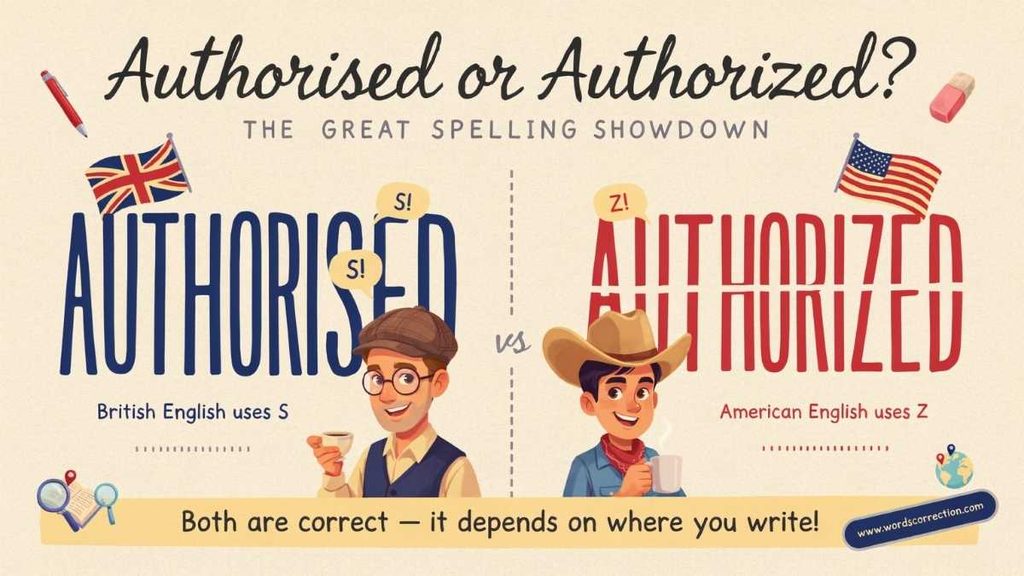
English spelling conventions vary beyond the United Kingdom and United States. Countries such as Australia and New Zealand commonly use British-style spelling, while Canadian English combines conventions from both British and American usage.
| Region | Common tendency | Practical advice |
|---|---|---|
| United Kingdom | Authorised in many -ise style systems; authorized is also accepted by some guides | Follow the publisher’s style |
| United States | Authorized | Use American English |
| Australia | Authorised is common | Follow local organizational standards |
| New Zealand | Authorised is common | Follow the relevant style guide |
| Canada | Usage varies by institution and style | Check the required dictionary or guide |
These are general tendencies, not universal rules for every publication or organization.
For example, an Australian company may follow a house style that prefers -ize endings. A Canadian publisher may choose a particular dictionary and apply its recommendations throughout a publication.
If you’re preparing a report for an international audience, identify the required spelling convention before you begin. When no preference exists, choose a consistent variety of English and use it throughout the document.
Learn the difference between often confused words
To That Effect or To That Affect Which Is Correct?
Which Spelling Should You Use?
The easiest way to choose between authorised and authorized is to consider who will read your writing and which spelling system the document follows.
A spelling is not better simply because it looks more familiar. What matters is whether it fits the context.
When to Use Authorised
Use authorised when your writing follows British-style -ise conventions.
This form is often suitable for
- UK business correspondence that uses -ise spellings
- British-style workplace policies
- Australian and New Zealand documents that follow local -ise conventions
- Publications that explicitly prefer authorised
- Organizations whose internal documents already use this spelling
Example
“Only authorised representatives may sign the agreement.”
If the rest of your document uses words such as organised, recognised, and authorisation, the S spelling helps maintain consistency.
When to Use Authorized
Use authorized when writing in American English or following a style guide that prefers -ize forms.
This spelling is generally appropriate for
- US business reports
- American academic writing
- US workplace policies
- American customer communications
- Publications that follow American spelling conventions
Example
“Only authorized representatives may sign the agreement.”
The wording remains the same. The spelling simply aligns with the intended audience.
Which Spelling Should You Use in Global Writing?
Global writing often involves readers from several countries. In that situation, consistency matters more than trying to accommodate every regional preference in a single document.
Follow these steps
- Check the style guide. A publisher, university, employer, or client may specify a preferred spelling system.
- Identify your audience. Use the convention your readers are most likely to expect.
- Stay consistent. Avoid switching between authorised and authorized without a clear reason.
- Preserve official wording. When quoting a policy, contract, law, or company name, reproduce the original spelling accurately.
- Review related forms. Check authorise/authorize and authorisation/authorization as well as the main word.
For example, a report written in American English should generally use authorized, organization, and authorization. A report following British -ise conventions would normally use authorised, organisation, and authorisation.
Consistency makes your writing easier to read and helps it look professionally edited.
Learn the difference between commonly misused words
Cannot or Can Not which one is Correct Spelling?
Common Mistakes With Authorised or Authorized
Although the spelling difference is simple, writers sometimes make mistakes when choosing between the two forms. Most problems come from confusing regional spelling preferences with grammar rules or using related words as though they mean the same thing.
Thinking One Spelling Is Incorrect
One common mistake is assuming that authorised is a misspelling because it doesn’t use Z, or that authorized is incorrect because a British publication uses S.
Neither assumption is accurate. Both forms are accepted, although a particular style guide may prefer one over the other.
For instance, a British-style document might use:
“The committee authorised the new policy.”
An American document might use:
“The committee authorized the new policy.”
Both sentences are grammatically correct. The spelling reflects the convention chosen by the writer.
Mixing British and American Spelling
Another mistake is switching between spelling conventions without a reason.
Consider this sentence:
“The manager authorized the purchase and then organised the delivery.”
The sentence combines American authorized with British-style organised. This is not necessarily a grammatical error, but it may look inconsistent in a document that follows one spelling system.
A consistent American version would read:
“The manager authorized the purchase and then organized the delivery.”
A consistent British-style version would read:
“The manager authorised the purchase and then organised the delivery.”
Some words have different regional forms, while others share the same spelling. The goal is not to change every word mechanically. It is to follow a recognized convention and check words whose spellings vary.
Confusing Authorised With Authority
The words authorised and authority belong to the same word family, but they have different grammatical roles.
- Authorised/authorized: Describes someone or something that has been given permission or approval.
- Authority: Refers to the power, right, or responsibility to make decisions or give permission.
Compare these examples
“The director authorised the payment.”
“The director has the authority to approve payments.”
In the first sentence, authorised describes an action. In the second, authority describes the director’s power or right to act.
Understanding this difference helps you choose the correct word rather than simply the correct spelling.
Confusing Authorized With Authenticated
Authorized and authenticated may appear in the same business or technology context, but they do not mean the same thing.
Authorization concerns permission. Authentication concerns verification.
For example, a company website may authenticate a user’s identity by checking a password or security code. An authorization system then determines which pages, files, or actions that user may access.
| Term | Meaning | Example |
|---|---|---|
| Authorized | Given permission to act or access something | The employee is authorized to view the file. |
| Authenticated | Verified as genuine or as belonging to a claimed identity | The employee authenticated their identity using a security code. |
A person can successfully authenticate their identity without having permission to access every resource. Similarly, someone may have permission to perform a task but still need to verify their identity before using a system.
This distinction is particularly important in banking, cybersecurity, and other settings where access controls protect sensitive information.
Using the Wrong Related Spelling
Writers sometimes spell the main word correctly but overlook its related forms.
If you’re following American English, use forms such as:
- Authorize
- Authorized
- Authorizing
- Authorization
If you’re following British-style -ise spelling, use forms such as:
- Authorise
- Authorised
- Authorising
- Authorisation
Individual style guides may use -ize spellings in British English. The best approach is to consult the dictionary or style guide your publication follows rather than assume that every related word must use S.
Learn the difference between everyday English mistakes
Nevermind or Never Mind Which Spelling Is Correct?
Authorised or Authorized in Everyday and Professional Writing
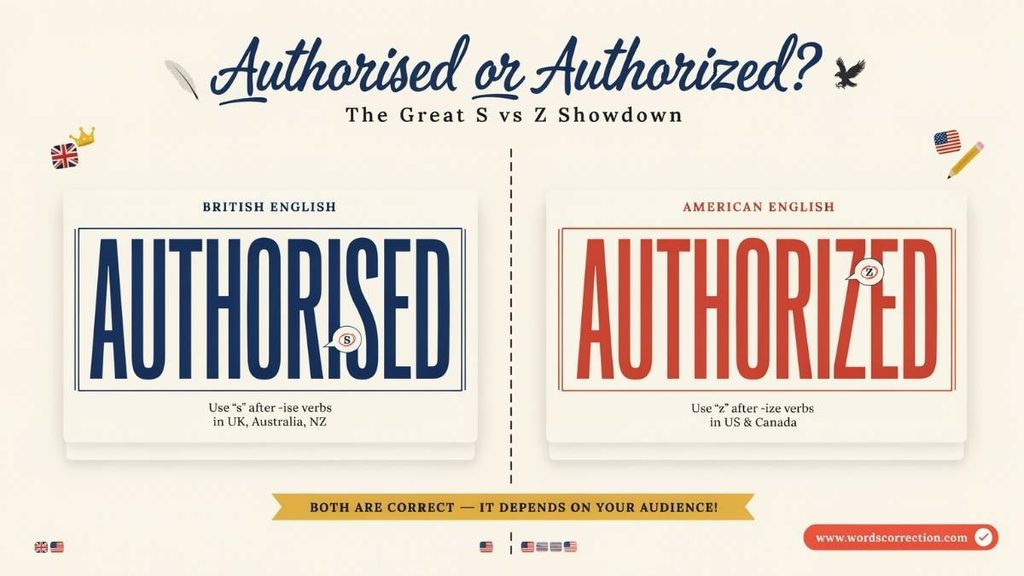
The word appears in many practical settings. Its exact meaning depends on what permission has been granted, who granted it, and what the person is allowed to do.
The examples below show how to use the word naturally and accurately.
In Emails and Workplace Communication
In the workplace, authorization often concerns access, responsibilities, approvals, and decisions.
Examples include
- The supervisor authorized the team to work overtime.
- Please obtain authorization before sharing the report.
- Only authorized employees can access the personnel database.
- The manager authorised the revised schedule.
In professional emails, the word can make responsibilities clear. However, avoid using it when a simpler word such as approved or allowed communicates the same idea more naturally.
For example, “The manager approved your request” may sound clearer than “The manager authorized your request” if you’re simply telling a colleague that a routine request was accepted.
The best choice depends on context. Authorized often emphasizes formal permission or delegated power, while approved emphasizes acceptance or agreement.
In Business and Financial Documents
Business documents frequently use authorized or authorised to describe financial approval and delegated responsibility.
Examples include
- The finance director authorized the transfer.
- The purchase exceeds the employee’s authorized spending limit.
- Only an authorized signatory may execute this agreement.
- The customer authorized the recurring payment.
In financial settings, the distinction between permission and completion matters. An authorized transaction is not necessarily the same as a settled transaction. A payment may receive approval at one stage and complete at a later stage.
Similarly, a person with authority to approve a purchase may not have the power to sign every contract on behalf of the organization. The actual scope of authority depends on the company’s rules and applicable law.
In Legal and Official Documents
Legal and administrative writing uses authorization to describe powers, permissions, and official responsibilities.
Examples include
- The representative is authorized to submit the application.
- The agreement must be signed by an authorized officer.
- The agency authorized the inspection.
- The employee acted without authorization.
In these contexts, the word may carry legal consequences. A person may have permission to perform one action but not another.
For instance, authorization to submit paperwork does not necessarily mean authorization to enter into a binding contract. The document, governing rules, and relevant jurisdiction determine the limits of that authority.
When preparing a legal document, follow the spelling used by the relevant institution or drafting standard. More importantly, make sure the language accurately describes the authority being granted.
In Technology and Online Security
Technology provides a clear example of the difference between permission and verification.
Imagine that an employee signs in to a company’s online system. The system checks the employee’s password and confirms their identity. That is authentication.
Next, the system checks whether the employee can view payroll records or download a confidential report. That is authorization.
The two processes work together, but they serve different purposes.
Common examples include
- Authorized users may download a file.
- The application authenticates users before granting access.
- The administrator authorized the employee to manage the account.
- Unauthorized access may violate company policy or applicable law.
In technical writing, using these terms correctly helps prevent confusion. A system can authenticate a user successfully while still denying access to a particular feature.
In News Articles and Public Notices
News reports and public notices often use the word to identify official permission or designated representatives.
For example
- The authorized spokesperson issued a statement.
- Only authorised vehicles may enter the restricted area.
- The agency authorized an independent review.
- The announcement came from an authorized representative.
The spelling should follow the publication’s house style. A US newspaper would generally use authorized, while a publication following British -ise conventions might use authorised.
When quoting someone directly, preserve the original wording and spelling where required by the publication’s editorial rules.
Learn the difference between more words people mix up
Per Se or Per Say Which Spelling Is Correct?
Authorised vs Authorized Comparison Table
The following table summarizes the key differences between the two spellings and their related forms.
| Word or feature | British-style spelling | American-style spelling |
|---|---|---|
| Main word | Authorised | Authorized |
| Base verb | Authorise | Authorize |
| Present tense | Authorises | Authorizes |
| Present participle | Authorising | Authorizing |
| Past tense | Authorised | Authorized |
| Noun | Authorisation | Authorization |
| General meaning | Officially permitted or approved | Officially permitted or approved |
| Example | The director authorised the payment. | The director authorized the payment. |
These are common patterns, not absolute rules for every dictionary or publisher. Some British authorities prefer -ize forms, so check the relevant style guide when exact conformity matters.
practice session
Instructions: Complete each sentence with the correct word or spelling.
- The manager has __________ the payment.
- In British English, the preferred spelling is __________.
- The company requires __________ before processing the transaction.
- I hereby __________ my representative to collect the documents.
- Only __________ personnel can enter the restricted area.
- The director __________ the request yesterday.
- In American English, the correct noun spelling is __________.
- The bank has not yet __________ the payment.
- The employee is an __________ signatory for the company.
- Please obtain __________ from your supervisor before proceeding.
- The British company has __________ its staff to access the records.
- The security system verifies a user’s identity through __________.
- After authentication, the system checks whether the user is __________ to access the file.
- The supervisor will __________ the request after reviewing the details.
- The contract was signed by an __________ representative.
- The past-tense British English spelling of “authorise” is __________.
- The customer must provide __________ before the company shares personal information.
- The company has __________ the use of its logo in the advertisement.
- In British English, the correct spelling of the verb is __________.
- The security team __________ the visitor’s identity before granting access.
- The employee __________ the purchase last week, so the order could proceed.
- The form states, “I hereby __________ the release of my records.”
- The company follows American English, so its policy uses the spelling __________.
- A person who has official permission to sign documents is called an __________ signatory.
- Authentication confirms identity, whereas __________ determines what a user is allowed to do.
Answers
- authorized
- authorised
- authorization
- authorize
- authorized
- authorized
- authorization
- authorized
- authorized
- authorization
- authorised
- authentication
- authorized
- authorize
- authorized
- authorised
- authorization
- authorized
- authorise
- authenticated
- authorized
- authorize
- authorization
- authorized
- authorization
Here’s a trusted source for clear word meanings:
Cambridge Dictionary
FAQ’s
What does authorized mean?
“Authorized” means officially permitted, approved, or empowered to do something. For example, an authorized employee has permission to perform specific duties on behalf of an organization.
Is it authorize or authorise?
Both spellings are correct. “Authorize” is the standard spelling in American English, while “authorise” is preferred in British English and commonly used in Australia and New Zealand.
Which is correct authorized or authorised?
Both “authorized” and “authorised” are correct spellings of the same word. Use “authorized” for American English and “authorised” for British English. The meaning remains unchanged.
Is I authorize or I authorized correct?
Both expressions are grammatically correct, but they refer to different time frames. “I authorize” expresses present permission or a current decision, while “I authorized” describes permission granted in the past. For example, “I authorize the payment” versus “I authorized the payment yesterday.”
Which is correct I hereby authorize or I hereby authorized?
“I hereby authorize” is the standard form when formally granting permission through a current statement. It is commonly used in legal documents, consent forms, and official letters. For example, “I hereby authorize my representative to collect the documents.”
Which comes first authorization or authentication?
In most digital access-control systems, authentication comes before authorization. Authentication verifies a user’s identity, while authorization determines which resources or actions that user is permitted to access.
What is the difference between authentication and authorization?
Authentication verifies identity, answering the question, “Who are you?” Authorization determines permissions, answering, “What are you allowed to do?” For example, logging in authenticates a user, while granting access to restricted files is an authorization decision.
What does authorization mean?
“Authorization” means the act of granting permission or the official permission itself. It may refer to approval for a financial transaction, access to confidential information, or permission to perform a particular action.
What are the three types of authorization?
There is no universally recognized classification of exactly three authorization types. However, three widely used access-control approaches are Role-Based Access Control (RBAC), Attribute-Based Access Control (ABAC), and Access Control Lists (ACLs). They manage permissions based on roles, attributes, or specified access rules.
Is authorize spelled correctly?
Yes, “authorize” is spelled correctly in American English. In British English, “authorise” is the preferred alternative. Both forms are grammatically acceptable and have the same meaning.
What does I hereby authorize mean?
“I hereby authorize” means “I officially grant permission through this statement.” It is frequently used in formal declarations, consent letters, business agreements, and legal documents to communicate clear permission.
What is another word for authorize?
Common synonyms for “authorize” include “approve,” “permit,” “allow,” “sanction,” and “empower.” The most suitable alternative depends on the context. For example, “approve” suits formal decisions, while “permit” emphasizes granting permission.
Is authorisation or authorization correct?
Both spellings are correct. “Authorization” is standard in American English, whereas “authorisation” is preferred in British English. Both nouns describe the act of granting permission or the permission granted.
What is the past tense of authorize?
The past tense of “authorize” is “authorized” in American English. In British English, the corresponding form is “authorised.” For example, “The manager authorized the request yesterday.”
What is the noun form of authorize?
The noun form is “authorization” in American English and “authorisation” in British English. Both refer to the act of granting permission or the resulting approval.
How do you use authorized in a sentence?
“Authorized” can describe a person, action, or activity that has received official permission. For example, “Only authorized personnel may enter the restricted area.” The word can also function as the past-tense form of the verb “authorize.”
How do you use authorised in a sentence?
“Authorised” is used in British English to describe something officially permitted or approved. For example, “Only authorised employees can access these records.” Its meaning is identical to that of “authorized.”
Is authorized person grammatically correct?
Yes, “authorized person” is grammatically correct. It refers to someone who has been officially granted permission or authority to perform a particular task, access a resource, or act on behalf of another person or organization.
What does authorized signatory mean?
An “authorized signatory” is a person officially permitted to sign documents on behalf of an individual, company, or organization. This authority may cover contracts, financial transactions, legal forms, or other official records.
What does authorized signature mean?
An “authorized signature” is a signature made by someone who has the appropriate authority to approve or execute a document or transaction. It indicates that the signer is permitted to act in the relevant capacity.
Is authorized a verb or an adjective?
“Authorized” can function as both a verb form and an adjective. As a verb, it is the past tense and past participle of “authorize,” as in “The director authorized the payment.” As an adjective, it describes something officially permitted, as in “authorized access.”
What is the difference between authorize and approve?
“Authorize” generally means to grant someone permission or the power to act, while “approve” means to accept or agree to something. For example, a manager may approve a proposal and then authorize the team to implement it. In some contexts, the two words can overlap.
Do Australia and New Zealand use authorized or authorised?
Australian and New Zealand English generally prefer “authorised,” following British spelling conventions. However, spelling practices can vary by organization and style guide, so it is best to follow the convention required by your publication or workplace.
Is authorized the same as authenticated?
No, “authorized” and “authenticated” have different meanings. “Authorized” means permitted to perform an action, whereas “authenticated” means verified as genuine or confirmed to be associated with a claimed identity. A user may be authenticated without being authorized to access every part of a system.
Should I use authorized or authorised in formal writing?
Choose the spelling that matches your intended audience and the style guide you follow. Use “authorized” for American English publications and “authorised” for British English publications. Maintain consistent spelling throughout the document to ensure professional, polished writing.
Learn the difference between tricky English words with easy explanations
Trys or Tries Which is Correct Spelling?
Conclusion
Choosing between “authorised” and “authorized” is easier than it may seem. Both spellings are correct and share the same meaning. The main difference is regional British English generally uses “authorised,” while American English prefers “authorized.” To avoid confusion, consider your audience and use one spelling consistently throughout your writing. After all, a single letter shouldn’t turn a simple spelling choice into a grammar mystery. Whether you’re writing an email, preparing a report, or publishing a blog post, choosing the appropriate spelling helps keep your content clear, accurate, and professional.

Stella AJS is an experienced blogger and dedicated English language writer at Words Correction. She turns confusing grammar, word meanings, spelling, and usage into clear, practical insights that readers can easily understand and apply. With a passion for precise and engaging writing, Stella helps readers avoid common language mistakes, strengthen their vocabulary, and communicate with greater clarity and confidence.




