

The difference between Sent or Send may seem small, but using the wrong form can turn a professional email into a grammar puzzle. This common confusion affects students, professionals, and even experienced writers. For example, writing “I have send the email” instead of “I have sent the email” can undermine an otherwise polished message. Fortunately, mastering “sent or send” doesn’t require a grammar degree. With a clear understanding of their meanings and grammatical rules, you can use both forms correctly and confidently. This guide explains their differences, highlights common mistakes, and provides practical examples to help you communicate clearly and professionally.
Quick Answer Sent or Send?
Both “send” and “sent” are correct. However, each word is used in different grammatical contexts.
- Send: The base form of the verb, used in the present simple with certain subjects, after modal verbs, in commands, and in infinitive constructions.
- Sent: The simple past tense and past participle, used for completed past actions and in perfect tenses and passive constructions.
Consider these examples:
| Sentence | Correct Form | Explanation |
|---|---|---|
| I send emails every morning. | Send | Describes a regular activity. |
| I sent the email yesterday. | Sent | Describes a completed past action. |
| I will send the document tomorrow. | Send | Follows the modal verb “will.” |
| I have sent the document. | Sent | Uses the past participle after “have.” |
| Please send me the details. | Send | Uses the base form in a request. |
| The document was sent yesterday. | Sent | Uses the past participle in passive voice. |
The easiest way to choose the correct form is to identify the sentence structure and determine whether you are describing a regular activity, a past event, or an action expressed through another verb construction.
Learn the difference between more words people mix up
To That Effect or To That Affect Which Is Correct?
What Does Send Mean?
The verb “send” means to cause something to go from one person or place to another. It commonly describes transferring messages, emails, documents, packages, information, or other items.
Send is the base form of the verb. It appears in the present simple, commands, infinitive constructions, and sentences containing modal verbs.
Examples of Send in Sentences
The following examples demonstrate how to use send correctly in different contexts
- I send my manager a weekly report.
- We send birthday cards to our relatives every year.
- Please send me the meeting details.
- I will send you the file tomorrow.
- You should send a confirmation email.
- They want to send their children to a good school.
- Can you send me the address?
- I usually send my assignments before the deadline.
In these examples, send describes a routine, a request, a planned action, or an action associated with another verb.
When Is Send Used in the Present Tense?
Use send in the present simple when the subject is I, you, we, or they. This tense commonly describes habits, routines, general facts, and repeated actions.
Examples
- I send messages to my colleagues every day.
- You send useful information to the team.
- We send invoices at the end of each month.
- They send updates after every meeting.
When the subject is he, she, or it, the correct present simple form is sends.
Examples
- She sends emails to her clients.
- He sends a report every Friday.
- The system sends an automatic notification.
Remember that sends is the third-person singular form of send. It should not be confused with sent, which is the simple past tense and past participle.
Is Send Present or Past Tense?
Send is the base form of the verb. It is used in the present simple with appropriate subjects and also appears in future constructions when followed by a modal verb.
Examples
- Present: I send reports every Monday.
- Future: I will send the report tomorrow.
- Request: Please send the report today.
Although “will send” refers to the future, send remains in its base form. The correct expression is “will send,” not “will sent.”
Learn the difference between everyday English mistakes
Whose or Who’s What’s the Difference?
What Does Sent Mean?
Sent is the simple past tense and past participle of send. It is used to describe completed past actions and to form certain verb tenses and passive constructions.
For example
“I sent the package yesterday.”
This sentence describes an action completed in the past.
Now consider another example
“I have sent the package.”
In this sentence, sent follows have to form the present perfect tense.
Send is an irregular verb, so its past forms do not follow the regular pattern of adding -ed. The correct form is sent, not sended.
Examples of Sent in Sentences
Here are several examples showing how sent is used correctly
- I sent the email this morning.
- She sent me a message last night.
- They sent the package to the wrong address.
- We sent the documents before the deadline.
- He has sent the invitation to everyone.
- I have sent the payment confirmation.
- The manager had sent the instructions before the meeting.
- The letter was sent last week.
These examples illustrate different uses of sent. Some describe completed past actions, while others use the past participle in perfect tenses or passive constructions.
When Is Sent Used in the Past Tense?
Use sent to describe an action that happened and was completed in the past.
Examples
- I sent the report yesterday.
- She sent the invitation two days ago.
- We sent the application last week.
- He sent me the information earlier.
- They sent the order on Monday.
Time expressions such as yesterday, last week, earlier, and two days ago often indicate that an action occurred in the past. When a sentence describes a completed event at a specific past time, sent is generally the appropriate form.
However, the correct verb form depends on the entire sentence, not just a time expression. Understanding the grammatical structure is essential for accurate usage.
Is Sent Always Past Tense?
Sent is the simple past tense of send, but it also functions as the past participle. Although the word stays the same, its grammatical role changes according to the sentence.
Simple past
- I sent the message yesterday.
- She sent the documents last night.
Present perfect
- I have sent the message.
- She has sent the documents.
Past perfect
- I had sent the message before the meeting started.
- They had sent the documents before the deadline.
Passive voice
- The message was sent yesterday.
- The documents were sent to the wrong department.
In each example, sent is grammatically correct. The auxiliary verbs and surrounding sentence structure determine how it functions.
Learn the difference between commonly misused words
Cannot or Can Not which one is Correct Spelling?
Sent or Send Understanding the Difference

The main difference between send and sent lies in their grammatical forms and the contexts in which they are used.
Send is the base form of the verb. Sent is both the simple past tense and the past participle.
| Feature | Send | Sent |
|---|---|---|
| Verb form | Base form | Simple past and past participle |
| Present simple | I send messages. | Not used for ordinary present simple statements |
| Simple past | Not used for ordinary past simple statements | I sent a message. |
| After will | I will send it. | Incorrect in this structure |
| After have or has | Incorrect in this structure | I have sent it. |
| After had | Incorrect in this structure | I had sent it. |
| In commands | Send the file. | Not used for ordinary commands |
| Passive voice | Used with appropriate auxiliary structures | The file was sent. |
The most reliable way to distinguish these forms is to examine the sentence structure rather than relying solely on when the action occurred.
For example, “I sent the email” and “I have sent the email” both describe an action that has already happened. However, the first sentence uses the simple past tense, while the second uses the present perfect tense.
Learn the difference between basic English word mistakes
Nevermind or Never Mind Which Spelling Is Correct?
When to Use Send
Send is appropriate in several common grammatical situations. Understanding these patterns will help you use the verb correctly in everyday and professional writing.
1. To Describe Regular Activities
Use send to describe habits, routines, and repeated actions.
Examples
- I send invoices to customers every month.
- We send a newsletter every Friday.
- They send progress reports at the end of each week.
These sentences describe recurring activities rather than individual completed events.
2. After Modal Verbs
Use the base form send after modal verbs such as will, can, could, should, may, and must.
Examples
- I will send the document tomorrow.
- You can send the details by email.
- She should send the application today.
- We must send the report before the deadline.
- They may send a confirmation later.
Modal verbs are followed by the base form of the main verb. Therefore, sent is incorrect immediately after these modal verbs when used in this structure.
Incorrect: I will sent the document tomorrow.
Correct: I will send the document tomorrow.
3. After “To” in Infinitive Constructions
Use send after to when forming an infinitive.
Examples
- I need to send an email.
- She wants to send a gift.
- They plan to send the documents tomorrow.
- We decided to send a formal invitation.
In these sentences, “to send” is an infinitive construction. Using sent in the same position would be grammatically incorrect.
4. In Commands and Requests
Use send when giving instructions or asking someone to perform an action.
Examples
- Send me the file, please.
- Please send your application by Friday.
- Send the confirmation to the client.
- Could you send me the meeting notes?
Commands generally use the base form of the verb, which makes send the correct choice.
5. In Questions With “Did”
Use send after did when asking questions about past actions.
Examples
- Did you send the email?
- Did she send the documents?
- Did they send the payment?
- When did you send the application?
Did already indicates the past tense, so the main verb remains in its base form.
Incorrect: Did you sent the email?
Correct: Did you send the email?
Learn the difference between often confused words
Per Se or Per Say Which Spelling Is Correct?
When to Use Sent
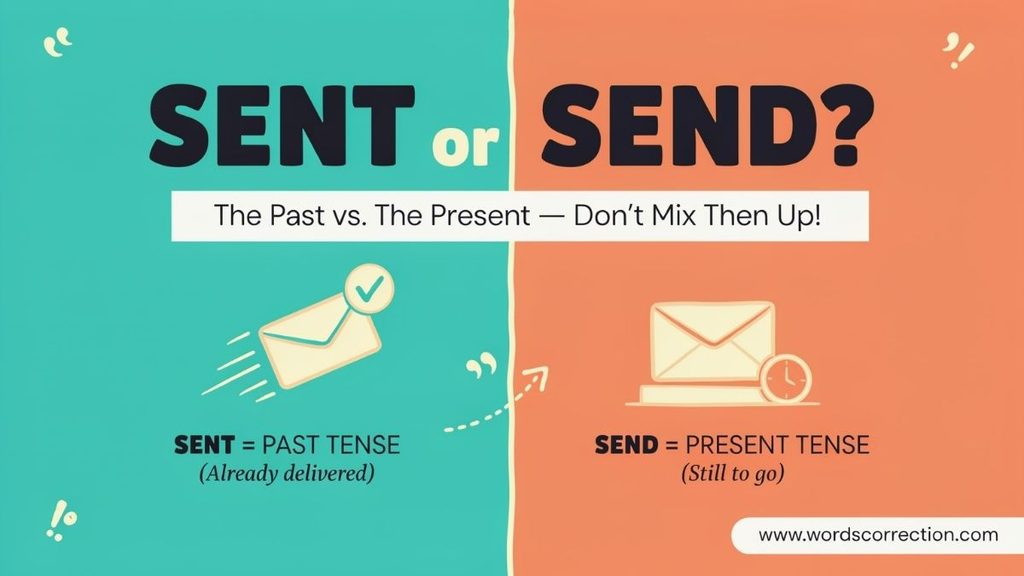
Sent is the correct choice when a sentence requires the simple past tense or past participle.
1. To Describe Completed Past Actions
Use sent when describing an action that happened in the past.
Examples
- I sent the email yesterday.
- She sent the invitation last week.
- We sent the documents on Monday.
- They sent the package earlier today.
These sentences describe completed actions rather than habits or routines.
2. After Have, Has, or Had
Use sent after have, has, or had when forming perfect tenses.
Examples
- I have sent the report.
- She has sent the invitation.
- We had sent the documents before the meeting.
- They have sent their applications already.
In these constructions, the auxiliary verb combines with the past participle to form the appropriate tense.
Incorrect: I have send the report.
Correct: I have sent the report.
Incorrect: She has send the invitation.
Correct: She has sent the invitation.
3. In Passive Voice
Use sent in passive constructions such as was sent, were sent, has been sent, and had been sent.
Examples
- The email was sent yesterday.
- The documents were sent to the head office.
- The confirmation has been sent.
- The package had been sent before the address was corrected.
Passive voice emphasizes the action or the person or thing receiving it rather than the person who performed the action.
4. To Show That One Past Action Happened Before Another
Use had sent when you need to establish that one action occurred before another past event.
Examples
- I had sent the email before the meeting began.
- She had sent the documents before the manager requested them.
- They had sent the package before receiving the cancellation notice.
The past perfect tense helps clarify the sequence of past events.
Learn the difference between confusing word pairs
Trys or Tries Which is Correct Spelling?
Common Mistakes With Send and Sent
Confusing send and sent is a common English grammar mistake. The following examples explain how to recognize and correct the most frequent errors.
Mistake 1 Using Sent After Will
Incorrect: I will sent you the details.
Correct: I will send you the details.
Explanation: Will is a modal verb and must be followed by the base form of the main verb.
Mistake 2 Using Send for a Completed Past Action
Incorrect: I send the email yesterday.
Correct: I sent the email yesterday.
Explanation: The sentence describes a completed action in the past, so sent is the appropriate form.
Mistake 3 Writing “Sended” Instead of “Sent”
Incorrect: She sended the package last week.
Correct: She sent the package last week.
Explanation: Send is an irregular verb. Its simple past tense is sent, not sended.
Mistake 4 Using Sent After Did
Incorrect: Did you sent the invitation?
Correct: Did you send the invitation?
Explanation: Did already marks the past tense, so the main verb must remain in its base form.
Mistake 5 Using Send After Have or Has
Incorrect: I have send the document.
Correct: I have sent the document.
Explanation: The present perfect tense requires the past participle after have or has. In this case, the correct form is sent.
Mistake 6 Confusing Send With Sending
Incorrect: I am send the email right now.
Correct: I am sending the email right now.
Explanation: The present continuous tense uses a form of be followed by the verb ending in -ing.
Mistake 7 Confusing Sent With Scent or Cent
Sent, scent, and cent sound alike in many English accents, but they have different meanings.
- Sent: The past tense and past participle of send.
- Scent: A smell or fragrance.
- Cent: A monetary unit, such as one cent.
Examples
- I sent the letter yesterday.
- The flower has a pleasant scent.
- The item costs fifty cents.
Recognizing these differences can help you avoid spelling mistakes and communicate your intended meaning accurately.
Learn the difference between tricky grammar more words
Accel or Excel Which Spelling Is Correct?
Send Verb Forms Present, Past, and Past Participle
Send is an irregular verb because its past forms do not follow the usual pattern of adding -ed.
Its main forms are shown below.
| Verb Form | Word | Example |
|---|---|---|
| Base form | Send | I send messages daily. |
| Simple past | Sent | I sent a message yesterday. |
| Past participle | Sent | I have sent the message. |
| Present participle | Sending | I am sending a message. |
| Third-person singular | Sends | She sends messages daily. |
The distinction between the simple past and the past participle is particularly important. Both forms use sent, but they appear in different grammatical structures.
For example
- Simple past: I sent the file.
- Present perfect: I have sent the file.
- Past perfect: I had sent the file.
- Present continuous: I am sending the file.
Learning these forms makes it easier to choose the correct verb when writing sentences in different tenses.
Learn the difference between commonly mixed-up more words
Authorised or Authorized Which Spelling Is Correct?
Send or Sent in a Sentence Practical Examples
The following examples show how the correct form changes according to the intended meaning and grammatical structure.
Everyday Communication
- Present simple: I send messages to my friends every day.
- Simple past: I sent my friend a message yesterday.
- Future: I will send my friend a message tomorrow.
- Present perfect: I have sent my friend a message.
- Present continuous: I am sending my friend a message now.
Workplace Communication
- Present simple: We send weekly reports to the management team.
- Simple past: We sent the report on Monday.
- Future: We will send the revised report tomorrow.
- Present perfect: We have sent the revised report.
- Past perfect: We had sent the report before the meeting started.
Online Shopping and Deliveries
- Present simple: The company sends orders every afternoon.
- Simple past: The company sent my order yesterday.
- Future: The company will send my order tomorrow.
- Present perfect: The company has sent my order.
- Passive voice: My order was sent to the wrong address.
These examples demonstrate that the correct form depends on the tense and sentence structure, not simply on the type of action being described.
Learn the difference between confusing more English words
Manuel or Manual An Easy Guide to the Correct Word
Case Study Choosing the Correct Form in Professional Emails

Consider an employee who needs to update a manager about an important report. Choosing the correct verb form helps communicate the status of the task clearly and professionally.
The employee might write:
“I send the report yesterday.”
Although the intended meaning is understandable, the sentence contains a grammatical error. Because the report was sent yesterday, the correct version is:
“I sent the report yesterday.”
Now consider a sentence about a future action:
“I will sent the revised report tomorrow.”
This sentence is also incorrect because will must be followed by the base form of the verb. The correct version is:
“I will send the revised report tomorrow.”
Finally, suppose the employee wants to confirm that the report has already been delivered.
The correct sentence is:
“I have sent the revised report.”
Each example illustrates a different grammatical structure. The simple past describes a completed event, will send refers to a future action, and have sent uses the present perfect tense.
Understanding these patterns helps you write accurate professional emails and provide clear updates to colleagues, managers, and clients.
Learn the difference between tricky words and use them correctly
Gopher or Gofer Which Spelling Is Correct?
practice Session Fill in the Blanks
1. I _____ the email yesterday.
2. Please _____ me the document.
3. She _____ messages to her clients every morning.
4. I have already _____ the report.
5. Did you _____ the invitation?
6. We will _____ the package tomorrow.
7. The email has already _____ to the manager.
8. He _____ the files last night.
9. I am _____ you the details right now.
10. They have _____ the payment confirmation.
11. She did _____ the application before the deadline.
12. I forgot to _____ the attachment.
13. The letter was _____ on Monday.
14. Have you _____ the photos yet?
15. He usually _____ a weekly update.
16. I will have _____ the documents by Friday.
17. Why did you _____ the wrong file?
18. The documents have been _____ to the office.
19. She is _____ an email to her teacher.
20. I _____ you a message two hours ago.
21. Can you _____ me the address?
22. The package has _____ already.
23. He had _____ the email before the meeting started.
24. Every Friday, our team _____ a progress report.
25. I have just _____ the final version.
Answers
- sent
- send
- sends
- sent
- send
- send
- been sent
- sent
- sending
- sent
- send
- send
- sent
- sent
- sends
- sent
- send
- sent
- sending
- sent
- send
- been sent
- sent
- sends
- sent
Here’s a trusted source for clear word meanings:
Cambridge Dictionary
FAQ’s
Which Is Correct, Send or Sent?
Both “send” and “sent” are correct, but they serve different grammatical purposes. “Send” is the base form of the verb, while “sent” is its simple past tense and past participle. For example, “I send emails every day” describes a routine, whereas “I sent an email yesterday” refers to a completed past action.
Do I Send or Do I Sent?
“Do I send” is correct because the auxiliary verb “do” must be followed by the base form of the main verb. For example, “Do I send the documents today?” is grammatically correct. “Do I sent” is incorrect because sent cannot follow do in this question structure.
Is It Correct to Say I Have Sent You?
Yes, “I have sent you” can be correct when the recipient or object is clear from the context. However, “I have sent you the document” is more specific and complete. The verb sent is the past participle required after have in the present perfect tense.
Which Is Correct, I Already Send or I Already Sent?
“I already sent” is generally correct when describing a completed action in American English. For example, “I already sent the email” confirms that the email was sent earlier. “I already send” is appropriate only in a context that supports the present tense, such as describing a regular activity.
Which Is Correct I Have Sent You or I Sent You?
Both expressions are correct, depending on the context. “I sent you the file” uses the simple past to describe a completed action. “I have sent you the file” uses the present perfect to connect the past action with the present situation. Both are natural when the object is stated or understood.
Which Is Correct Has Already Been Sent or Has Been Already Sent?
“Has already been sent” is the more natural and commonly preferred construction. For example, “Your confirmation has already been sent” clearly communicates that the confirmation was dispatched earlier. Although “has been already sent” can occur in English, placing already before been generally produces smoother wording in this sentence.
Which Is Correct Have Been Send or Have Been Sent?
“Have been sent” is correct because this passive construction requires the past participle of send. For example, “The documents have been sent to the manager” is grammatically correct. “Have been send” is incorrect because send is the base form, not the required past participle.
Is We Have Already Sent or We Send Correct?
Both expressions are correct, but they convey different meanings. “We have already sent the documents” confirms that the action is complete. “We send documents every week” describes a regular activity. The correct choice depends on whether you are reporting a completed action or describing a routine.
How Do I Say I Already Sent You an Email?
You can say, “I already sent you an email.” This is natural American English and indicates that the email was sent earlier. You can also say, “I have already sent you an email” to emphasize the action’s relevance to the present situation.
Which Is Correct, You Have Sent or You Had Sent?
Both are grammatically correct, but they express different time relationships. “You have sent” uses the present perfect and connects a past action to the present. “You had sent” uses the past perfect and indicates that the action occurred before another past event.
What Does Sent Already Mean?
“Sent already” means that something has been dispatched before the time being discussed or sooner than expected. For example, “The package was sent already” indicates that the package has been dispatched. In everyday American English, “The package has already been sent” often sounds more natural.
Which Is Correct Sent Email or Email Sent?
Both expressions can be correct, depending on the context. “Sent email” can refer to an email that has been dispatched, as in “Check your sent email folder.” “Email sent” is commonly used as a brief status message confirming that an email has been sent.
Should I Say Send or Sent?
Use “send” for the base form of the verb, regular activities, commands, and constructions such as “will send” or “can send.” Use “sent” for completed past actions and after have, has, or had. For example, say “I will send it tomorrow” but “I sent it yesterday.”
Is I Did Send or I Did Sent Correct?
“I did send” is correct because did must be followed by the base form of the main verb. For example, “I did send the email” emphasizes that the action really happened. “I did sent” is incorrect because did already indicates the past tense.
Is I Forgot to Send or I Sent Correct?
Both expressions are grammatically correct, but they have different meanings. “I forgot to send the email” means you failed to send it because you forgot. “I sent the email” means you completed the action. Choose the expression that accurately describes what happened.
What Is the Past Tense of Send?
The simple past tense of send is “sent.” For example, “I sent the application yesterday” describes an action completed in the past. Send is an irregular verb, so its past tense is not formed by adding -ed.
What Is the Past Participle of Send?
The past participle of send is “sent.” It is used with auxiliary verbs to form perfect tenses and passive constructions. Examples include “I have sent the message,” “She had sent the report,” and “The package was sent yesterday.”
Is I Will Sent It Tomorrow Grammatically Correct?
No, “I will sent it tomorrow” is incorrect. The correct sentence is “I will send it tomorrow” because the modal verb will must be followed by the base form of the main verb. The same rule applies to expressions such as can send, should send, and must send.
Which Is Correct She Send or She Sends?
“She sends” is correct in the present simple tense because the subject she requires the third-person singular form of the verb. For example, “She sends a report every Friday” describes a regular activity. “She send” is incorrect in an ordinary present simple statement.
Which Is Correct I Am Sending or I Am Sent?
“I am sending” is correct when describing an action in progress. For example, “I am sending the documents now” uses the present continuous tense. “I am sent” can be correct in certain passive constructions, but it does not normally describe an action that the speaker is performing.
Is The Email Was Send or The Email Was Sent Correct?
“The email was sent” is correct because passive voice requires the past participle of the verb. For example, “The email was sent this morning” describes a completed action. “The email was send” is grammatically incorrect.
What Is the Difference Between Sent and Sending?
“Sent” is the simple past tense and past participle of send, while “sending” is the present participle and gerund. For example, “I sent the message yesterday” describes a completed action, whereas “I am sending the message now” describes an action in progress.
Is I Have Just Sent or I Just Sent Correct?
Both expressions are correct in American English. “I just sent the email” uses the simple past and is common in everyday conversation. “I have just sent the email” uses the present perfect and emphasizes the action’s connection to the present.
Which Is Correct The Documents Have Sent or The Documents Have Been Sent?
“The documents have been sent” is correct when describing documents that someone has dispatched. This sentence uses the present perfect passive voice. “The documents have sent” is generally incorrect when the documents are the items being dispatched because the sentence requires a passive construction.
Can I Use Sent Without Mentioning What Was Sent?
Yes, you can use “sent” without explicitly naming the object when the context makes the meaning clear. For example, “Have you sent it yet?” and “Yes, I sent it this morning” are both complete and natural exchanges. Naming the object is helpful when the reader or listener might not know what you mean.
Learn the difference between similar English words the easy way
Monkeys or Monkies Which Spelling Is Correct?
Final Thoughts
Understanding the difference between “send” and “sent” is easier than it may seem. Remember, “send” is the base form used for commands, regular actions, and after words like “will,” “can,” and “did.” “Sent” is used for past actions and with helping verbs such as “have,” “has,” and “had.” These simple rules can help you avoid common grammar mistakes in emails, messages, and everyday writing. Before sending your next message, take a moment to check your verb choice. After all, you want your message to reach the right person, not become a grammar lesson! With a little practice, you’ll know when to use “send” and “sent” correctly and write with greater confidence.

Stella AJS is an experienced blogger and dedicated English language writer at Words Correction. She turns confusing grammar, word meanings, spelling, and usage into clear, practical insights that readers can easily understand and apply. With a passion for precise and engaging writing, Stella helps readers avoid common language mistakes, strengthen their vocabulary, and communicate with greater clarity and confidence.




