
English spelling can be confusing, and bare or bear is a good example. These words look and sound similar, but they have different meanings. You can walk on the beach with bare feet, but you wouldn’t want to walk near a bear without being careful! Using the wrong word can make your sentence confusing or even funny. The good news is that learning the difference is easy. In this guide, you’ll learn what bare and bear mean, when to use each word, and how to avoid common spelling mistakes. With simple rules and clear examples, you’ll soon feel more confident using both words correctly.
Bare or Bear Quick Answer
Bare means uncovered, exposed, empty, or lacking something. It can function as an adjective or a verb.
Bear has several meanings. It can refer to a large animal or mean to carry, support, endure, tolerate, or produce something. It can function as a noun or a verb.
Compare these examples
- Bare: She walked across the room with bare feet.
- Bear: I cannot bear the noise any longer.
- Bare: The walls were bare and needed decoration.
- Bear: The hard work will eventually bear fruit.
The easiest way to remember the difference is to associate bare with being uncovered and bear with carrying, enduring, or producing something.
Learn the difference between more words people mix up
Accel or Excel Which Spelling Is Correct?
What Does Bare Mean?
The word bare describes something that is uncovered, exposed, empty, or without its usual covering or contents. It can also mean to reveal or expose something that was previously hidden.
Bare as an Adjective
As an adjective, bare describes a person, object, surface, or place that lacks a covering or something expected.
Examples include
- She walked barefoot across the grass.
- The room contained only a table and four bare walls.
- He grabbed the hot pan with his bare hands.
- The tree branches were bare during winter.
- The shelves were bare after the store sold its remaining stock.
- They entered a bare apartment with no furniture.
In each sentence, bare suggests that something is uncovered, empty, or missing.
Bare as a Verb
As a verb, bare means to uncover, expose, or reveal something.
Examples
- He bared his teeth in anger.
- The investigation bared the truth about the scandal.
- She bared her soul in a heartfelt conversation.
- The storm bared the tree roots by washing away the soil.
- The report laid bare the weaknesses in the company’s strategy.
The expression lay bare means to expose something clearly. It often appears in discussions about facts, emotions, problems, or hidden motives.
For example
“The investigation laid bare the problems within the organization.”
This means the investigation revealed problems that had previously remained hidden.
What Does Bare Minimum Mean?
The phrase bare minimum refers to the smallest amount of effort, money, work, or resources needed to meet a basic requirement.
Examples
- He did the bare minimum to pass the exam.
- The company provided only the bare minimum of training.
- You need the bare minimum of equipment to begin.
- She completed the bare minimum of household chores before leaving.
The phrase can be neutral when describing basic requirements. However, it often carries a negative tone when someone does less than expected.
For example, “He does the bare minimum at work” suggests that he makes little effort beyond what is necessary.
What Does Barely Mean?
Barely is an adverb that means only just, almost not, or by a very small amount. Although it comes from bare, it does not mean exactly the same thing as the adjective.
Examples
- I could barely hear the announcement.
- She barely passed the final exam.
- We had barely enough time to catch the train.
- He was so tired that he could barely keep his eyes open.
In these sentences, barely emphasizes a limited amount or a narrow margin.
What Does Bare Bones Mean?
The expression bare bones describes the most basic parts of something, without extra details, features, or decoration.
Examples
- The proposal contains only the bare bones of the plan.
- We started with a bare-bones budget.
- The software offers a bare-bones version with limited features.
The expression often appears in business, technology, and everyday conversation when someone wants to describe a simple or basic version of something.
Learn the difference between everyday English mistakes
Manuel or Manual An Easy Guide to the Correct Word
What Does Bear Mean?
The word bear has several meanings. As a noun, it refers to a large mammal. As a verb, it can mean to carry, support, tolerate, endure, or produce.
The intended meaning usually becomes clear from the context.
Bear as a Noun
A bear is a large mammal belonging to the bear family. Different species include black bears, brown bears, polar bears, and giant pandas, which belong to the broader bear family.
Examples
- We saw a black bear near the forest.
- The polar bear moved across the ice.
- A mother bear protected her cubs.
- The children watched a bear at the wildlife sanctuary.
In these examples, bear refers to the animal.
Bear as a Verb
As a verb, bear has several common meanings.
To carry or support
- The bridge can bear the weight of heavy vehicles.
- She bears the responsibility for managing the team.
- The shelves cannot bear that much weight.
Tolerate or endure
- I cannot bear the thought of losing my friends.
- He could barely bear the pain.
- Please bear with me while I check the details.
To produce or yield
- The apple trees bear fruit in late summer.
- Her efforts finally bore results.
- The agreement may bear positive outcomes for both companies.
Give birth to or bring forth
- The novel describes a queen who bore three children.
- The tree bears small, sweet fruits.
The exact meaning depends on how the verb is used in the sentence.
What Does Bear With Me Mean?
The expression bear with me means to be patient with someone while they complete a task, explain something, or resolve a problem.
Examples
- Please bear with me while I find your order.
- Bear with me for a moment while I explain the instructions.
- The website is loading slowly, so please bear with me.
- Bear with me while I review the information.
This phrase is common in customer service, professional emails, presentations, and everyday conversation.
Remember that the correct expression is bear with me, not “bare with me.” The phrase asks someone to tolerate a delay or inconvenience. It does not ask them to uncover anything.
What Does Bear Fruit Mean?
The expression bear fruit means to produce positive results or achieve the intended outcome.
Examples
- Years of hard work finally began to bear fruit.
- The new marketing strategy may bear fruit next quarter.
- Their investment in employee training has started to bear fruit.
- The negotiations eventually bore fruit.
The expression is often used in business, education, personal development, and discussions about long-term effort.
For example, if a student studies consistently and earns excellent grades, the student’s hard work has borne fruit.
What Does Bear the Cost Mean?
To bear the cost means to pay for something or accept the financial responsibility for it.
Examples
- The company agreed to bear the cost of repairs.
- The government will bear the cost of the new program.
- We had to bear the cost of replacing the damaged equipment.
The phrase can also refer to accepting a burden or consequence rather than simply paying money.
For example, “The entire team bore the cost of the manager’s poor decision” suggests that the team suffered the consequences.
What Does Bear in Mind Mean?
The phrase bear in mind means to remember or consider something when making a decision.
Examples
- Bear in mind that the deadline is approaching.
- Please bear in mind that prices may change.
- You should bear in mind the needs of your audience.
It is a useful expression in professional writing, instructions, and everyday communication.
Learn the difference between commonly misused words
Gopher or Gofer Which Spelling Is Correct?
Bare vs Bear Key Differences
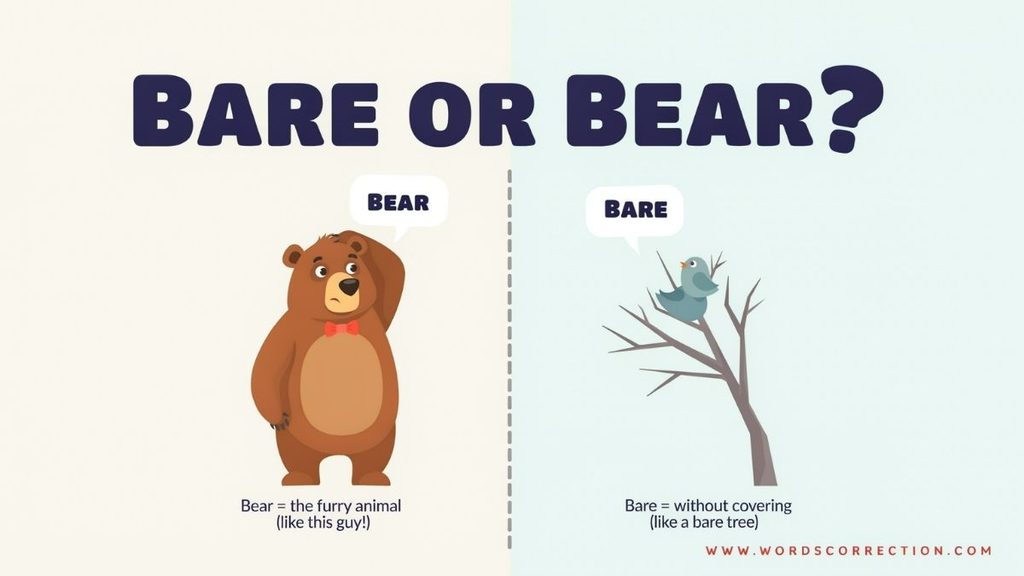
Although bare and bear sound alike, their meanings and grammatical uses differ.
| Feature | Bare | Bear |
|---|---|---|
| Main meaning | Uncovered, exposed, or empty | Carry, endure, tolerate, or produce |
| Part of speech | Adjective or verb | Noun or verb |
| Refers to an animal | No | Yes |
| Common expression | Bare minimum | Bear with me |
| Another common expression | Bare hands | Bear fruit |
| Example | He stood on the bare floor. | She could not bear the pain. |
The most reliable way to choose the correct word is to examine the meaning of the entire sentence rather than relying on pronunciation.
Learn the difference between tricky words and use them correctly
Amid or Amidst What Is the Difference?
Bare vs Bear Example Sentences
The following examples show how each word works in everyday situations.
Examples of Bare
- The hikers walked over the rocks with bare feet.
- The apartment had bare walls and an empty kitchen.
- She decided to bare her feelings during the conversation.
- The tree stood bare after losing its leaves.
- The report laid bare several serious problems.
- They had only the bare essentials for the trip.
- His bare hands were covered in paint.
- The classroom walls were bare and needed posters.
Examples of Bear
- I cannot bear the sound of that alarm.
- Please bear with me while I finish this report.
- The bridge must bear the weight of the trucks.
- Their patience will eventually bear fruit.
- The company agreed to bear the expense.
- The mother bear stayed close to her cub.
- You should bear in mind that the rules may change.
- She bore the responsibility with courage.
Bare or Bear in Everyday Situations
Consider these common situations to see how the words differ.
At home
- Bare: The living room had bare walls.
- Bear: I cannot bear the noise from the television.
For work
- Bare: The presentation revealed the bare facts.
- Bear: The manager must bear responsibility for the decision.
At school
- Bare: The classroom had bare desks.
- Bear: Students must bear the consequences of their choices.
In nature
- Bare: The branches were bare in winter.
- Bear: The apple tree will bear fruit in summer.
These examples show that the correct choice depends on the meaning you want to communicate.
Learn the difference between basic English word mistakes
Monkeys or Monkies Which Spelling Is Correct?
Common Expressions With Bare and Bear
Both words appear in familiar expressions. Learning these phrases can help you recognize the correct spelling more quickly.
| Expression | Meaning | Example |
|---|---|---|
| Bare minimum | The least required amount | He did the bare minimum to finish the task. |
| Bare hands | Hands without gloves or covering | She picked up the object with her bare hands. |
| Bare bones | The most basic parts | We discussed the bare bones of the proposal. |
| Lay bare | Reveal or expose | The report laid bare the problem. |
| Bear with me | Be patient | Please bear with me while I investigate. |
| Bear fruit | Produce results | Their efforts began to bear fruit. |
| Bear the cost | Pay or accept the expense | The company will bear the cost. |
| Bear in mind | Remember or consider | Bear in mind that the schedule may change. |
| Bear the burden | Carry a responsibility or hardship | She had to bear the burden alone. |
| Bear witness | Give evidence or confirm an event | Several people came forward to bear witness. |
Paying attention to these expressions will help you avoid common spelling mistakes.
Learn the difference between often confused words
Signalling vs Signaling Which Spelling Is Correct?
Is It Bare With Me or Bear With Me?
The correct phrase is bear with me.
It means asking someone to be patient while you do something or explain a situation.
Correct: “Please bear with me while I check your account.”
Incorrect: “Please bare with me while I check your account.”
The incorrect version uses bare, which means uncovered or exposed. That changes the intended meaning and makes the sentence inappropriate for the situation.
A simple memory trick is to connect bear with the idea of enduring something. When you ask someone to bear with you, you are asking them to tolerate a short delay.
Is It Bare Minimum or Bear Minimum?
The correct expression is bare minimum.
It refers to the smallest amount of effort, resources, or work needed to meet a requirement.
Correct: “He completed the bare minimum of work.”
Incorrect: “He completed the bear minimum of work.”
Think of the word bare as something stripped down to its essentials. The bare minimum is what remains when everything unnecessary is removed.
Learn the difference between confusing word pairs
Sent or Send Which one Is Correct?
Is It Bear Fruit or Bare Fruit?
The correct expression is bear fruit.
It means to produce results, benefits, or success.
Correct: “Their investment in education will eventually bear fruit.”
Incorrect: “Their investment in education will eventually bare fruit.”
In this expression, bear means to produce or yield. Bare does not fit because the sentence is about achieving results rather than uncovering something.
Is It Bare Facts or Bear Facts?
The correct expression is usually bare facts when you mean the essential facts without extra details.
Example: “The report presented the bare facts of the case.”
Here, bare means basic or stripped of unnecessary information.
However, bear facts is not a standard expression with this meaning. The verb bear can be used in other contexts involving carrying or supporting information, but it does not replace bare in this common phrase.
Is It Bare or Bear in the Past Tense?
The past tense of bear is bore. Its past participle is borne in many uses and born in the context of birth.
Examples:
- Present: She bears the responsibility.
- Past: She bore the responsibility.
- Present perfect: She has borne the responsibility for years.
- Birth: She was born in June.
The word bare follows a different pattern when used as a verb.
Examples
- Present: He bares his feelings.
- Past: He bared his feelings.
- Present perfect: He has bared his feelings.
Do not confuse bore with bare. Bore is a past-tense form of bear, while bare means uncovered or to uncover.
Learn the difference between tricky grammar more words
Peak or Peek What’s the Difference?
Bare or Bear Common Grammar Mistakes
Even experienced writers sometimes confuse bare and bear. The following mistakes are especially common.
Using Bare With Me Instead of Bear With Me
Incorrect: “Bare with me while I finish the presentation.”
Correct: “Bear with me while I finish the presentation.”
The phrase asks someone to be patient. Therefore, bear is the appropriate choice.
Writing Bear Minimum Instead of Bare Minimum
Incorrect: “She put in the bear minimum of effort.”
Correct: “She put in the bare minimum of effort.”
The phrase describes the smallest amount of effort required. Bare is correct because it suggests something reduced to its essentials.
Using Bare Fruit Instead of Bear Fruit
Incorrect: “The new strategy will bare fruit.”
Correct: “The new strategy will bear fruit.”
The expression refers to producing results. Bear is the correct verb.
Confusing Borne and Born
Incorrect: “He has born the responsibility for years.”
Correct: “He has borne the responsibility for years.”
Use borne when referring to carrying a responsibility or enduring a burden. Use born when referring to birth, as in “She was born in July.”
Choosing a Word Based on Sound Alone
Because bare and bear are homophones, pronunciation cannot help you distinguish them. You need to consider their meanings and the context of the sentence.
When you are unsure, ask yourself whether the sentence refers to something uncovered or to carrying, enduring, supporting, or producing something.
Learn the difference between commonly mixed-up more words
Mrs or Miss What’s the Difference?
How to Remember the Difference Between Bare and Bear
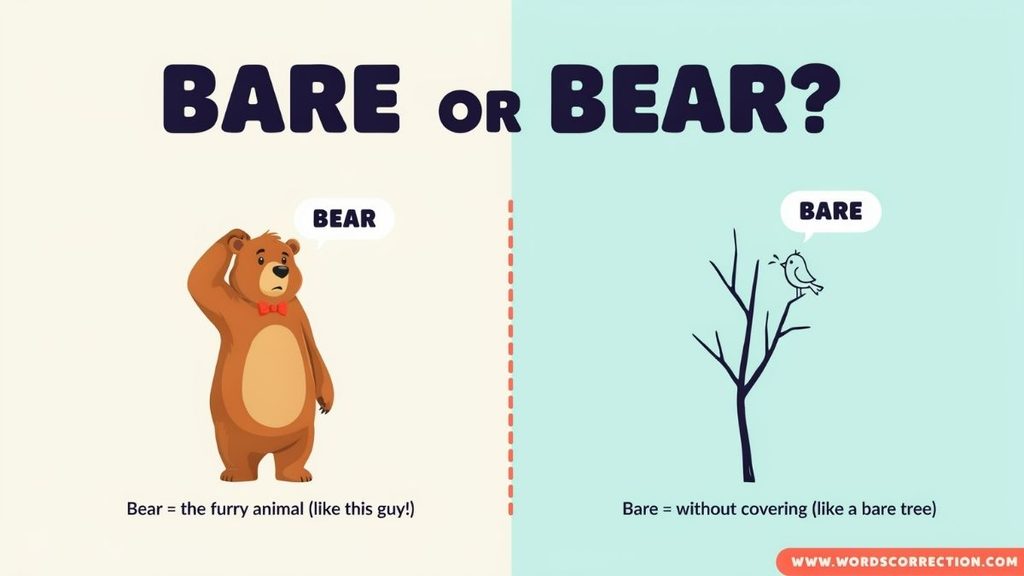
You do not need to memorize every definition at once. A few simple associations can make the difference easier to remember.
Connect bare with uncovered things.
Think of bare feet, bare walls, bare hands, and the bare minimum. Each example describes something uncovered, empty, or reduced to its essentials.
Connect bear with carrying or enduring.
Think of bearing a burden, bearing the cost, or bearing responsibility. In each case, bear suggests carrying something or accepting a difficulty.
Remember familiar expressions.
Learn phrases such as “bear with me,” “bear fruit,” and “bare minimum” as complete expressions. Remembering the phrase helps you choose the right spelling without stopping to analyze every word.
Read the whole sentence.
Context is more reliable than pronunciation. If the sentence means “uncover,” “expose,” or “without a covering,” bare is likely correct. If it means “carry,” “tolerate,” “endure,” or “produce,” bear is usually the right choice.
Learn the difference between confusing more English words
Todays or Today’s Which Is Correct?
Practice Session
Fill in the Blanks
1. Please _____ with me while I check your order.
2. She walked across the warm sand with _____ feet.
3. Years of hard work finally began to _____ fruit.
4. He could not _____ the thought of losing his job.
5. The room had _____ walls and very little furniture.
6. The company agreed to _____ the cost of the repairs.
7. She completed the _____ minimum of the assignment.
8. The investigation helped _____ the truth about the incident.
9. We spotted a brown _____ near the forest.
10. You should _____ in mind that the deadline is approaching.
11. He decided to _____ his feelings during the conversation.
12. The old tree had _____ branches during winter.
13. Every employee must _____ responsibility for their actions.
14. The hikers carried only the _____ essentials for the trip.
15. She has had to _____ a heavy emotional burden.
16. The child _____ a strong resemblance to his father.
17. The witness agreed to _____ witness to what she had seen.
18. The dog _____ its teeth when the stranger came closer.
19. The bridge must _____ the weight of heavy vehicles.
20. The new strategy may _____ positive results.
21. Please _____ your head as a sign of respect.
22. The family had to _____ the consequences of their decision.
23. The report laid _____ the weaknesses in the plan.
24. The deadline is beginning to _____ down on the team.
25. She has _____ the responsibility for managing the project for years.
Answers
- Bear
- Bare
- Bear
- Bear
- Bare
- Bear
- Bare
- Bare
- Bear
- Bear
- Bare
- Bare
- Bear
- Bare
- Bear
- Bears
- Bear
- Bared
- Bear
- Bear
- Bare
- Bear
- Bare
- Bear
- Borne
Here’s a trusted source for clear word meanings:
Cambridge Dictionary
FAQ’s
What is the difference between bare and bear?
Bare means uncovered, exposed, or lacking a covering. Bear means to carry, endure, tolerate, or produce something. Bear can also refer to a large mammal. The correct word depends on the meaning of the sentence.
Is it bare or bear the pain?
The correct phrase is bear the pain because bear means to endure or tolerate something difficult. For example, “She tried to bear the pain without complaining.”
Is it bare with me or bear with me?
The correct expression is bear with me. It means asking someone to be patient while you complete a task, explain something, or resolve a problem.
Should I use bear or bare?
Use bare when describing something uncovered, exposed, or stripped of its usual covering. Use bear when referring to carrying a burden, enduring a situation, or producing results. Consider the sentence’s meaning before choosing the word.
Is it bare or bear a burden?
The correct phrase is bear a burden. It means to carry a responsibility, hardship, or emotional difficulty. For example, “She had to bear the burden of supporting her family.”
Why do people write bare with me?
People sometimes write “bare with me” because bare and bear sound alike. However, the standard expression is bear with me, which means “please be patient with me.” Using bare in this phrase is a common spelling mistake.
Is it bear down or bare down?
The correct expression is bear down. It can mean to apply pressure, make a determined effort, or move toward something forcefully. For example, “The team must bear down and finish the project.” In childbirth, bear down can also refer to pushing during labor.
Which is correct I can’t bear or I can’t bare?
“I can’t bear” is correct when you mean that you cannot tolerate or endure something. For example, “I can’t bear the noise any longer.” Bare does not convey this meaning.
Do you bear or bare your soul?
The correct expression is bare your soul. It means to reveal your deepest feelings, thoughts, or personal experiences. For example, “He bared his soul during the conversation.”
Do you bear left or bare left?
The correct phrase is bear left. It means to continue in a leftward direction, usually at a fork or bend in the road. For example, “Bear left at the next intersection.”
What does it mean to bare your teeth?
To bare your teeth means to expose your teeth, often as a sign of anger, aggression, or a threat. For example, “The dog bared its teeth when the stranger approached.”
Is it bare your head or bear your head?
The usual expression is bare your head, meaning to remove a hat or another head covering. For example, “He bared his head as a sign of respect.”
Is it bear arms or bare arms?
Both expressions are correct, but they have different meanings. Bear arms means to carry or use weapons, while bare arms means to have uncovered arms. For example, “The soldiers trained to bear arms,” but “She wore a dress that left her arms bare.”
What does bear witness mean?
Bear witness means to provide evidence, confirm that something happened, or testify about an event. For example, “Several people came forward to bear witness to what they had seen.”
Is it bear responsibility or bare responsibility?
The correct expression is bear responsibility. It means to accept or carry responsibility for an action or outcome. For example, “Managers must bear responsibility for their decisions.”
What does bear the consequences mean?
Bear the consequences means to accept the results of an action or decision, especially when those results are unpleasant. For example, “He must bear the consequences of breaking the rules.”
Is it bear in mind or bare in mind?
The correct expression is bear in mind. It means to remember or consider something when making a decision. For example, “Bear in mind that the deadline may change.”
What does bear fruit mean in business?
In business, bear fruit means to produce successful or beneficial results. For example, “The company’s investment in employee training began to bear fruit after six months.”
Is it bare essentials or bear essentials?
The correct expression is bare essentials. It refers to the most basic items or resources needed for a particular purpose. For example, “Pack only the bare essentials for the weekend trip.”
What does bare all mean?
Bare all means to reveal everything, including information that may be private or embarrassing. It can also refer literally to removing all clothing. For example, “The documentary encouraged the interviewees to bare all about their experiences.”
Is it bear a resemblance or bare a resemblance?
The correct expression is bear a resemblance. It means to look similar to someone or something. For example, “The child bears a strong resemblance to her mother.”
What does bear out mean?
Bear out means to support or confirm a claim, theory, or statement with evidence. For example, “The latest findings bear out the researchers’ original conclusions.”
Is it bear down on or bare down on?
The correct expression is bear down on. It means to approach something forcefully or apply strong pressure to a person or situation. For example, “The deadline is bearing down on the project team.”
What is the difference between borne and born?
Borne is the past participle of bear when referring to carrying, enduring, or supporting something. Born is used when referring to birth. For example, “She has borne many responsibilities” and “He was born in October.”
Can bear and bare be used interchangeably?
No. Bear and bare have different meanings, even though they sound identical. Bear can mean to carry, endure, tolerate, or produce, while bare means uncovered or to uncover. Using one in place of the other can change a sentence’s meaning or create a grammatical error.
Learn the difference between similar English words the easy way
Fulfilment or Fulfillment Which Spelling Is Correct?
Conclusion
Understanding the difference between bare and bear doesn’t have to be difficult. Remember, bare means uncovered or exposed, while bear can refer to an animal or mean to carry or tolerate something. Confusing these words can make your writing unclear or unintentionally funny. After all, you wouldn’t want to write “bare with me” when you mean “bear with me”. The easiest way to avoid this mistake is to learn their meanings, practice using them in sentences, and double-check your spelling when needed. With a little practice, you’ll use both words correctly and write with greater confidence. Keep the rules in mind, and these tricky words won’t catch you off guard again.

Stella AJS is an experienced blogger and dedicated English language writer at Words Correction. She turns confusing grammar, word meanings, spelling, and usage into clear, practical insights that readers can easily understand and apply. With a passion for precise and engaging writing, Stella helps readers avoid common language mistakes, strengthen their vocabulary, and communicate with greater clarity and confidence.




